
Alexandra Palace and Park, Muswell-hill, Hornsey. A magnificent building overlooking charming scenery. The grounds devoted to various fetes, archery meetings, reviews and races, which are held in a fine racecourse with an excellent stand from which to witness the sport. In the building are concerts, collections of scientific and art objects, flower and fruit shows, theatrical and other entertainments daily. The Alexandra Palace is easily reached by the Metropolitan and Great Northern Railway which takes visitors to the gates. Admission, 6d. and 1s. on ordinary days, 2s. 6d. on special days.
Alexandra Palace and Park, Muswell
Hill six miles north of London---A large building, from which extensive views of
the surrounding country may be obtained. The entertainments provided are of the
same class as those offered at the Crystal Palace. Admission, usually 1s. The
grounds are covered with trees, which add greatly to the rural effect. The park
contains about 300 acres, and comprises a racecourse, cricket and bicycling
grounds, a lake, a trotting track, &c. Reached by rail from Moorgate-street
and King's - cross (G.N.). From Moorgate-street and Broad-street, 1st, 1/-,
1/10; 2nd, -/10 ¼ ; 3rd, -/7, ½ . From King's-cross, 1st, -/11, 1/5 ; 2nd
-/9. ½ ; 3rd, -/6, -/11.
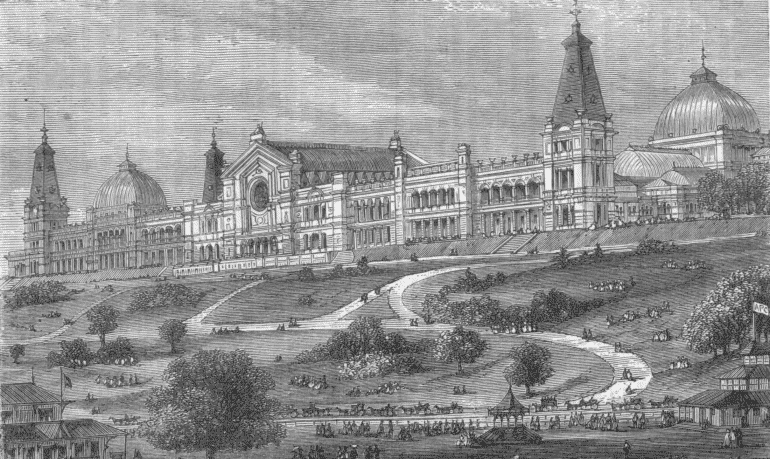
ALEXANDRA PALACE AND PARK.
THE ALEXANDRA PALACE* [* After having been erected from
the materials of the International Exhibition of 1862, and remaining unfinished
for several years, the Palace was formally opened In May 1873, and within a
fortnight was almost completely destroyed by fire. The news of the catastrophe,
which took place on the 9th of June in that year, spread over London in a few
hours, and was regarded as a national calamity. Such active steps, however, were
taken for its resuscitation, that the new palace was rebuilt, after a different
and improved design, in less than two years; and opened on May Day 1875 by the
Lord Mayor and Corporation, assisted by many other notabilities from various
parts of the country, In the preaulce of some sixty thousand people.] stands
on Muswell Hill (one of the eminences to the north of London) in the centre of a
park about 220 acres in extent, and in the midst of some of the most beautiful
scenery in Middlesex. It is distant some six miles from London, and may be
reached by the Great Northern Railway, while access to it is also provided by
junctions with the North London, the North-Western, the London Chatham and
Dover, the Great Western, and Great Eastern lines, as well as by roads from the
western, eastern, and northern suburbs. It is open daily, including Sundays;
when, however, only season ticket-holders have the privilege of entry to the
park and grounds.
The Park is laid out in ornamental walks and garden
beds; cricket, archery, and croquet grounds; a racecourse, with a grand stand ;
trotting rings, gymnasiums, pleasant walks, running grounds, lakes, undulating
drives, and numerous plantations. In various parts of the grounds are several
novel buildings - a Japanese village complete, as in the Vienna Exhibition of
1873 ; a Norwegian house of varnished timber; a circus for horse riding; a large
swimming-bath, a lake for boating, a rustic water-village raised on piles, etc.
In addition, the visitor may find his way to the grove in the rear of the
Japanese village, where a military hand performs during the summer.
The present PALACE is a great improvement upon the previous
building. Instead of a lofty and somewhat narrow perspective, surmounted by a
great dome, the internal space has been divided into a grand central hall
forming the transept, with an Italian garden on one side and exhibition court on
the other; beyond which, on either hand, are a theatre, concert-room,
reading-room, conservatories, and corridors. The form of the Palace is that of a
parallelogram, covering seven acres and a half of ground, and though capable of
being thrown into one grand hail, it is built in compartments, and is therefore
scarcely more hazardous in respect of fire than a terrace of large houses, each
hail, court, room, or corridor being completely isolated from the rest by
fireproof walls.
The Central Hall divides the Palace into two equal
halves; and it has a semicircular roof of uniform elevation throughout its
entire length of 386 feet, supported by rows of ornamental iron pillars. It is
184 feet wide, and is seated for about 12,000 visitors. The orchestra rises on
the north side, like an amphitheatre, and is capable of accommodating a band and
choir of 2000 performers. At the back stands the organ, erected by Mr. Willis,
under the superintendence of Sir Michael Costa, and supplied with all the modern
improvements. This fine instrument is one of five claviers - four manual and one
pedal. The compass of the former is from CC to C in altissimo (five octaves),
and of the latter from CCC to G (two octaves and a fifth). The numerous stops
are operated on by eight patent pneumatic combination pistons. The bellows are
blown by two steam engines, one of eight, the other of twelve horse-power.
Performances are given daily by the organist of the Company under the direction
of the general musical director. The acoustic properties of the hall are in
every way satisfactory.
Around this hall, which is lighted from the roof, and at one
end of which is an elegant stained glass window, are ranged a series of terra
cotta statues of royal and historical personages from William I. to Queen
Victoria, including Oliver Cromwell, all coloured after life. By an ingenious
arrangement of doors and arches, the whole building, from end to end, can be
converted into one long gallery.
The Theatre, which will hold about 4000 persons, is
built after the best modern models, with a stage about the size of that of Drury
Lane, and is arranged for all kinds of dramatic and spectacular performances.
The Concert Room, which, like the theatre, is detached
from the main building, is fitted to accommodate about 3500 visitors. It has a
semicircular orchestra, and, in point of sound, is almost perfect.
The Picture Galleries, on the north side of the
building, are thoroughly well worth visiting. They contain a goodly show of
modern art; the pictures and drawings being labelled with particulars of the
subject, artist's name, and price, thus avoiding the necessity for the purchase
of a catalogue.
The Refreshment Department is situated on the ground
floor in the south-west and south wings, and consists of a series of
dining-rooms and buffets, with billiard and smoking rooms adjoining, looking out
upon the grounds, from which they are approached by broad flights of steps.
The Terraces on the four sides of the palace command
views of delightful rural scenery, well wooded country, and garden ground laid
out in the best modern fashion. The prospect extends into four
counties-Middlesex, Essex, Hertfordshire, and Kent; and so well designed are the
approaches that the whole country within sight seems to belong to the Alexandra
estate.
ALEXANDRA PALACE AND PARK, MUSWELL HILL. The Park is beautifully laid out, and embraces fine views. Open occasionally. Trains from King's Cross, Moorgate and Broad Street Stations; see daily papers.

THE ALEXANDRA PALACE.
What the Crystal Palace has been to the south, it was thought the Alexandra Palace would prove to the north, of London. The former was built of the materials used for the Exhibition of 1851 ; the latter, of those employed for the Exhibition of 1862. A superb site, north of Hornsey and east of Muswell Hill, was chosen for it, and it was opened in May, 1873. Fourteen days later the building was burnt down; and, Phoenix-like, the present structure rose from its ashes, being finished in just under two years. It is very fine in its way, and contains all manner of courts and a fine concert-hall. The grounds, too, with their ornamental water, are delightful. But for some years now, with the exception of an occasional short season, the Palace has unfortunately been closed.
FOR the second time in the strange eventful history of the Alexandra Palace an attempt is being made to secure its municipalisation. On this occasion success seems assured, and there is every prospect that this famous yet unfortunate temple of amusement will enter upon a new sphere of usefulness under public management. Various attempts have been made from time to time to revive the drooping fortunes of the Palace, but owing to lack of capital and want of proper management these efforts have proved unavailing, and the place allowed to fall into disuse. A few days ago it was announced that possession of the Palace could be obtained for the sum of £100,000; and when it is remembered that the building alone cost £300,000, and that on a previous occasion £260,000 was asked for the undertaking, the nature of the offer will be appreciated. A few public-spirited men in the district, headed by Mr. Henry Burt, a member of the Middlesex County Council and the Hornsey District Council, at once embraced the opportunity of securing the Palace and the beautiful grounds for the people of London. A committee was formed £5,000 subscribed as a deposit, and the bargain secured. The committee had sufficient faith in the enterprise of the local authorities of Wood Green and Hornsey (in whose districts the Palace stands) and the central governing bodies of the metropolis to risk their deposit, well knowing that the necessary capital would be speedily forthcoming. Nor have they been mistaken. Hornsey has already voted £30,000, Wood Green another £25,000, while the Middlesex County Council, the Islington Vestry, and other public bodies are favourably considering the proposal. No appeal will be made to the public for subscriptions, as in previous schemes of this character. The scheme is by no means a local one, although the people of Hornsey and Wood Green will largely benefit by the acquisition. The Palace will essentially belong to Londoners, and it is intended that all those public authorities which contribute towards its purchase shall have a share in its management. The Palace will be an open space and a pleasant resort for the whole of the Metropolis, and, as our map indicates, it is easily accessible by rail from all parts.

The suburbs round the Palace are growing at such a rapid rate that, it would
be nothing short of a disaster to let slip this opportunity of securing so
desirable a bargain.
The Palace is situated at the top of the highest of the northern hills of
Middlesex, from which it is seen for many miles around, and commands an extent
of view surpassed only by that obtained from the Palace at Sydenham. The
building is of the most substantial character, land consists of a large central hall, capable of seating about 20,000 people, fitted with a
magnificent organ, a separate concert-room, a completely-fitted theatre,
large-covered winter gardens, picture galleries, courts, dining-rooms, kitchens,
&c. The building covers eighteen acres, whilst the park slopes comprise an
area of over 160 acres, of which 134 is freehold. Since the present scheme was
originated, the committee have arranged for the purchase of an additional ten
acres of splendid woodland, called "the Grove," which can be secured for
another £10,000. The Grove is interesting as a favourite resort of Dr. Johnson. The scheme also provides
for the acquisition of the racecourse at the foot of the Palace. At present the
course is held on a lease, and we understand that it is not proposed to disturb
the present arrangements.
In the course of an interview with one of our representatives,
Mr. Burt
stated that it was proposed to constitute a Board of trustees, nominated by the
contributing authorities, to manage and maintain the property. An income of from
eight to ten thousand pounds a year can be depended upon, to be applied by the
trustees in the general maintenance and repair, the keeping surplus being devoted to improvement, enfranchising of leasehold, and
reduction of principal debt, at the discretion of the trustees.
In addition to the usual features found in such a pleasure resort, it is
proposed, Mr. Burt stated, to put the Palace to some practical use. For
instance, great facilities could be afforded for the development of the
Volunteer movement. The capacity of the under floor, with entrances from the
sloping up of the grounds, and in the providing of music, &c., any terraces, is almost unlimited for storage of guns and material, consisting as
it does of about eighteen acres of dry-covered space. Ample drill space could be
set apart without in the least interfering with the public, and the grounds
could be made avail. able for Yeomanry and Mounted Infantry practice. A separate
building in the grounds could also be entirely appropriated to the use of the
battalions as headquarters.
The trustees would also he able to devote considerable attention
to technical
and manual instruction, unlimited apace being available for engineering schools.
workshops, laboratories, &c.
ALEXANDRA PALACE (THE) at Muswell-hill, N., six miles out of London, is a large building for many years used as a place of entertainment, similar in its original idea to the Crystal Palace. After many vicissitudes it has been acquired by the joint contributions of the Middlesex County Council and other local bodies as a public palace and park, and is a large addition to the open spaces in that part of London. Admission free daily (except on certain maintenance days during the year). It has a large Hall and organ, Theatre, Exhibition Galleries, Skating Rink, etc., the whole construction of the building being based upon the large conception for which it was created. Firework days are a feature of the summer season. High-class concerts are given throughout the year in the great Hall, and the Alexandra Choral Society produce under able leadership the works of Handel, Elgar, Sullivan, and other great composers at frequent intervals. The part, consisting of 165 acres, has a grove of trees, and fine views can be obtained from its summit. It has a lake, switchback railway, etc. The ALEXANDRA PARK Racecourse, adjoining the park, is leased to a private Company, and the races take place on Saturdays in April, July, August, September and October. NEAREST Ry. Stns., Wood Green and Alexandra Palace (G.N.R.); Electric cars run from Finsbury-pk, and Tottenham, right up to the Palace itself.