
[nb. in Hyde Park 1851; in Sydenham 1854-1936, ed.]
 Pictures and Souvenirs from the Exhibition (John Johnston Collection)
(home page:- John Johnston Exhibition, Bodleian http://www.bodley.ox.ac.uk/johnson/exhibition/)
The Lodging-House Keepers of London are beginning to calculate the probable profits of the Great Exhibition season of 1851, or in other words, they are "counting their chickens before they are hatched;" that is to say, before they shell out. Somebody has said that 4,000,000 of strangers will be poured into London, and as there are not more than 1,000,000 beds to let, the rules of arithmetic call upon us to divide one by four, and as four into one won't go, we recommend some of the intended visitors before they leave a comfortable bed at home to "sleep upon it" until they have made sure of a substitute.
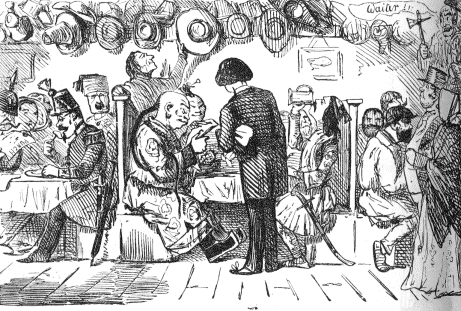
LONDON DINING ROOMS, 1851
Waiter (to Chinaman). "VERY NICE BIRDS'-NEST SOUP, SIR!. - YES, SIR! - RAT PIE, SIR, JUST UP - YES, SIR! - AND A NICE LITTLE DOG TO FOLLER - YES, SIR!"
[influx of foreign visitors to the Crystal Palace, ed.]
NOBODY doubts the courage of the Police; but the gallantry of
the body is being every day severely tested at the Great Exhibition. Though they
would never hesitate to "clear the kitchen" - including sometimes the
safe - they find it almost impossible to clear the Crystal Palace, when resisted
by the powerful band of ladies who oppose the civil power at the point of the
parasol. In vain do the constables attempt to forget the susceptibility of the
man in the firmness of the officer; in vain does the Committee issue orders
which blue cloth and oilskin might possibly execute, but which flesh and blood
cannot carry out. Who could stand against a battery from the fire of the
flashing eyes of angry ladies; and what policeman would be bold enough to
meet the charge of a light female brigade by a counter-charge at the
station-house.
If the regulations are really to be carried out for closing
the Crystal Palace at a given hour, the only course will be to swear in a number
of ladies as special constables, and throw upon them the execution of the duty,
which no man - with such irresistible force opposed to him - can possibly
perform.
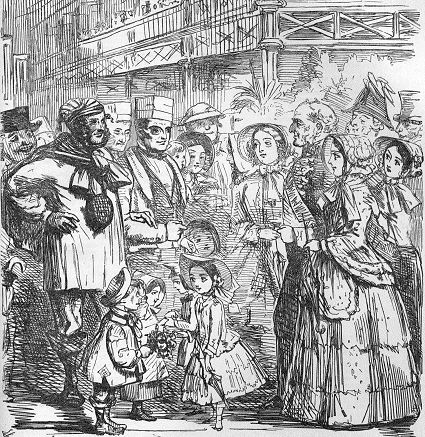
THE POUND AND THE SHILLING
"Whoever Thought of Meeting You Here?"
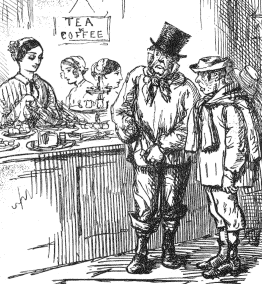 SCENE - EXHIBITION REFRESHMENT ROOM
Visitor. "PINT O'BEER, MISS, PLEASE."
Miss. "DON'T KEEP IT. YOU CAN HAVE A STRAWBERRY ICE AND A
WAFER!"
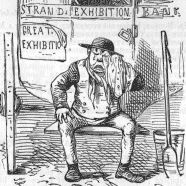
SINCERE GRIEF AT THE DESTRUCTION OF THE CRYSTAL PALACE
Omnibus Man. "OH, WHAT A HORRID SHAME, TO PULL DOWN SUCH A B-B-B-BE-AUTIFUL B-B-B-UILDING"
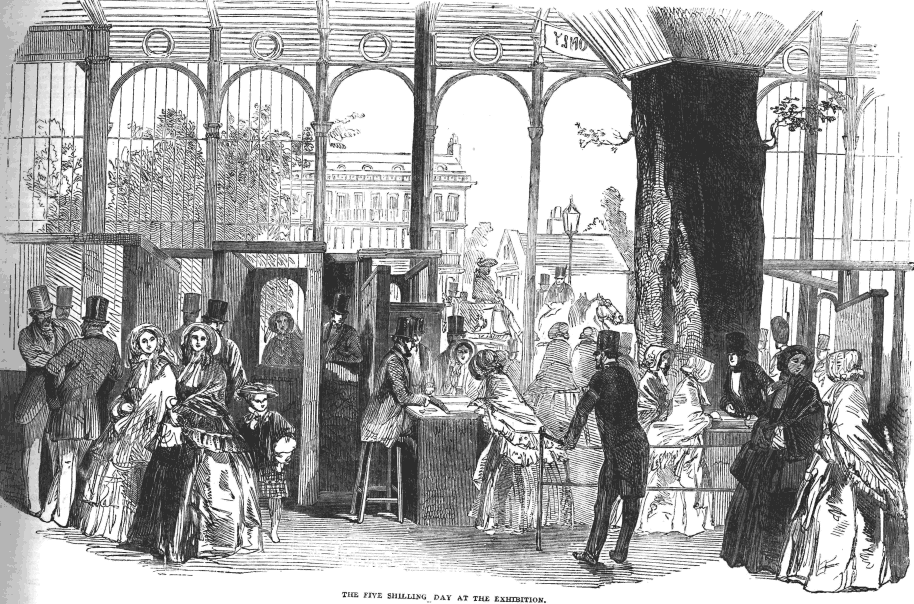
For the first week or two, the road within
a mile of the ‘Glass Hive’ was blocked with carriages. From the Prince of
Wales’ Gate to Apsley House there stretched one long line of cabs, omnibuses,
carriages, ‘broughams’, ‘flies’, now moving for a few minutes, and now
stopping for double the time, while the impatient visitors within let down the
blinds and Thrust their heads out to see how far the line
extended.
Now, there is scarcely a carriage or a Hansom cab to be seen.
The great stream of carriage visitors has ceased (except on the most expensive
days)... The southern entrance is no longer beset with broughams, but gathered
round it are groups of gazers, too poor or too ‘prudent’ to pay for
admission within. The public-houses along the road are now filled to
overflowing, for outside them are ranged long benches, on which sit visitors in
their holiday attire, resting on their way. Almost all the pedestrians, too,
have baskets on their arms, evidently filled with the day’s stock of
provisions.
The ladies are all ‘got up’ in their brightest-coloured
bonnets and polkas [jackets], and as they haste along, they ‘step out’ till
their faces ate seen to glow again with their eagerness to get to the Grand
Show, While the gentlemen in green or brown felt ‘wide-awakes’, or fluffy
beaver hats, and with the cuffs of their best coats, and the bottoms of their
best trousers turned up, are marching heavily on—some with babies in their
arms, others with baskets, and others carrying corpulent cotton umbrellas.
And inside the Great Exhibition the scene is equally
different from that of the first week or two. The nave is no longer filled with
elegant and inert loungers—lolling on seats, and evidently come there to be
seen rather than to see. Those who are now to be found there, have come to look
at the Exhibition, and not to make an exhibition of themselves There is no air
of display about them—no social falsity—all is plain unvarnished truth. The
jewels and the tapestry, and the Lyons silks, are now the sole objects of
attraction. The shilling folk may be an ‘inferior’ class of visitors, but
at least, they know something about the works of industry, and what they do not
know, they have come to learn.
Here you see a railway guard, with the silver letters on his
collar, and his japan pouch by his side, hurrying, with his family, towards the
locomotive department. Next, you come to a carpenter, in his yellow fluffy
flannel jacket, descanting on the beauties of a huge top, formed of one section
of a mahogany tree. Then may be seen a hatless and yellow- legged Blue-coat boy
mounting the steps of one of the huge pneumatic lighthouses, to have a glance at
the arrangements of the interior. Peeping into the model of the Italian Opera
are several short-red-bodied and long-blacked-legged Life Guardsmen; while,
among the agricultural implements, saunter clusters of countrymen in smockfrocks.
On the steps of the crimson-covered pedestals are seated
small groups of tired women and children, some munching thick slices of bread
and meat, the edges of which are yellow with the oozing mustard. Around the
fountain are gathered other families, drinking out of small mugs, inscribed as
‘presents for Charles or Mary’; while all over the floor, walk where you
will—are strewn the greasy papers of devoured sandwiches.
The minute and extensive model of Liverpool, with its long
strip of looking-glass sea and thousands of cardboard vessels, is blocked round
with wondering artisans, some, more familiar with the place, pointing out
particular streets and houses. And as you pass by the elaborate representation,
in plaster, of Underdown Cliff, you may hear a young sailor—the gloss upon
whose jacket indicates that he has but recently returned from sea—tell how he
went round the Needles last voyage in a gale of wind. Most of the young men have
catalogues or small guide-books in their hands, and have evidently, from the
earnest manner in which they now gaze on the object, and now refer to the book,
come there to study the details of the whole building.
But if the other parts of the Great Exhibition are curious
and instructive, the machinery, which has been from first to last the grand
focus of attraction, is, on the ‘shilling days’, the most peculiar sight of
the whole. Here every other man you rub against is habited in a corduroy jacket,
or a blouse, or leathern gaiters; and round every object more wonderful than the
rest, the people press, two or three deep, with their heads stretched out,
watching intently the operations of the moving mechanism.
You see the farmers, their dusty hats telling of the distance
they have come, with their mouths wide agape, leaning over the bars to see the
self-acting mills at work, and smiling as they behold the frame spontaneously
draw itself Out, and then spontaneously run back again. Some, with great
smockfrocks, are gazing at the girls in their long pinafores engaged at the
doubling-machines.
But the chief centres of curiosity are the power-looms, and
in front of these are gathered small groups of artisans, and labourers, and
young men whose coarse red hands tell you they do something for their living,
all eagerly listening to the attendant, as he explains the operations, after
stopping the loom.
Here, too, as you pass along, you meet, now a member of the
National Guard, in his peculiar conical hat, with its little ball on top, and
horizontal peak, and his red worsted epaulettes and full-plaited trowsers;
then you come to a long, thin, and clean-looking Quaker, with his tidy and
clean-looking Quakeress by his side; and the next minute, may be, you encounter
a school of charity girls, in their large white collars and straw bonnets, with
the teacher at their head, instructing the children as she goes.
Round the electro-plating and the model diving-bell are
crowds jostling one another for a foremost place. At the steam brewery, crowds
of men and women are continually ascending and descending the stairs; youths are
watching the model carriages moving along the new pneumatic railway; young girls
are waiting to see the hemispherical lamp-shades made out of a flat sheet of
paper; indeed, whether it be the noisy flax-crushing machine, or the splashing
centrifugal pump, or the clatter of the Jacquard lace machine, or the
bewildering whirling of the cylindrical steam-press—round each and all these
are anxious, intelligent, and simple-minded artisans, and farmers, and servants,
and youths, and children clustered, endeavouring to solve the mystery of the
complex operations.
For many days before the ‘shilling people’ were admitted
to the building, the great topic of conversation was the probable behaviour of
the people. Would they come sober ? Will they destroy things ? Will they want to
cut their initials, or scratch their names on the panes of the glass lighthouses
? But they have surpassed in decorum the hopes of their wellwishers. The fact
is, the Great Exhibition is to them more of a school than a show...
see also David Bartlett in London by Day and Night - click here
A DAY AT THE CRYSTAL PALACE.*
[• The multiplicity of objects in the Crystal Palace is found so perplexing to ordinary visitors, that this paper has been prepared with a view to furnish a clue to seeing, in an orderly manner, in one visit, its principal features. ]
How swiftly we rush along! as though our locomotive had just received a stimulative supply of
alcohol, in lieu of water, to incite it to drag us
bravely up the incline, whence, in an instant, we
shall gain our first near glimpse of the Crystal
Palace. See! like a vision of magic, its striking
foreground and magnificent park come into view;
whilst, beyond them the Palace rises, wondrous in
extent, yet so light and aerial in aspect, as almost
to defy belief that it is a thing of solid substance.
A pleasant journey we have had by railway.
Ere, however, the interior of the Palace is reached,
a long walk awaits us, commencing with the gigantic flight of steps before us, leading from the
trains to the ticket-taking entrance. From this
point you perceive there is a route across the park
to our destination, through the door there to the
right, and another along the pretty flower-adorned
corridor facing us. The latter we will follow. It
will bring us to another flight of stairs and the
third-class refreshment• room, where visitors may
obtain an excellent dinner of cold meat and bread,
with a temperate glass of beer, for ninepence—a great consideration to those who
seek enjoyment without extravagance. Take a peep into the refreshment-room, and observe how conveniently it
is arranged. Now ascend to the gallery above,
conducting to the final ascent.
At length, as the reward of our pilgrimage, the
shrine is attained. Is it not beautiful? Yet re-
strain your admiration, and move round slightly to
the left, along by the small refreshment tables to
the front of yon splendid screen, covered with statues, each representing a
sovereign of England. What an enchanting scene here meets the eye! A seemingly
interminable vista opens, presenting innumerable gaily-dressed groups of
visitors, promenading through lines of luxuriant foliage, intermingled with statuary, from behind which arise
ranges of elaborately ornamented facades, and
lofty, slender, parti-coloured columns, festooned
and enwreathed with graceful climbing plants,
springing from the ground, and shooting out from
suspended baskets, lustrous with blossoms of every
hue ; while, high overarching all, is a crystal canopy, stained, as it were,
with the mellow blue of the heavens, or sparkling with myriads of sunlight
reflections. In the foreground, covered with white and purple and crimson
water-lilies, is a sheet of water, from the midst of which springs the world-
renowned crystal fountain, glittering with prismatic colours. The scene, in fact, look in whichever direction we may, displays features of beauty,
magnificence, and interest, which cannot fail to
inspire enthusiastic appreciation.
The main building, as seen from this point, is
composed of a nave, more than a quarter of a mile
long, 72 feet wide, and 104 feet high ; of two side
aisles, giving, with other arrangements, a general
width to the Palace of about 312 feet ; of three
transepts, termed respectively the South, Central, and North — the South and North being each
336 feet long from east to west, and 72 feet from
north to south ; and the Central one 384 feet from east to west, 128 feet from
north to south, and 168 feet high. Above each aisle are two galleries, which run entirely round the edifice ; whilst
above them, in certain quarters, are other galleries, from which particularly striking views of the
interior and the peculiar construction of the edifice may be obtained. And, marvel of marvels,
" the total length of columns," says the official
guide-book, " employed in the construction of the
main building and wings, would extend, if laid in
a straight line, to a distance of sixteen miles and
a quarter. The total weight of iron used in the
main building and wings amounts to 9641 tons,
17 cwt., 1 qr. The superficial quantity of glass
used is 25 acres ; and if the panes were laid side
by side, they would extend to a distance of 48
miles ; if end to end, to the almost incredible length
of 242 miles." To which may be added the further marvel, that on the edifice and its appurtenances,
the park, etc., not much less than a million and a half sterling has been
expended. This series of facts, combined with what we see around us, evinces a
truly amazing amount of cost and skill in design, and taste in execution—all,
too, bestowed on a shilling exhibition for the people, and renders the
establishment one without a parallel.
Looking down the nave, from where we are standing, we face
the north, and therefore have the east on our right hand, and the west on our
left. Lying immediately on either hand, occupying the eastern and western ends of the South
Transept, is the ethnological and natural history
department of the Palace. Commencing our tour
of inspection here, with the western portion of the
department, or that referring to the New World,
we find ourselves amongst highly interesting and
instructive representations of the human and brute
creations of North and South America, so grouped
as to display their ways and habitudes, and, as far
as possible, the scenery and vegetation of their
locale. The neighbouring glass-cases contain specimens of beautiful American birds, of North American river-animals, and of West Indian corals,
sponges, and molluscules, as found assembled together at the bottom of the sea. Everything
about us is, in fact, wonderfully characteristic.
Look, for instance, at these groups of Indians
some asleep, others at work just as they might
be seen in their native lands. Nov observe this
graphic representation of the polar bear and other
arctic animals "at home," amidst icebergs and the
bleak desolateuess of the North Pole, all so truthfully displayed that we need
but travel five miles from London to be able to obtain a perfect idea of one of
the most striking scenes of nature, existing thousands of miles away, and only
accessible to the human eye under circumstances of the greatest difficulty and danger.
We have now passed out of the South Transept
into what is termed the Pompeian Court, and the
southern end of the western aisle. Imagining that
this Court incloses, as it assumes to do, a real Pompeian house, this airy
uncovered portion is the atrium, or outer court of the edifice, used for the
reception of visitors. Those small rooms surrounding it are bed-chambers—cell-like looking places,
to be sure, but in the days of the Pompeians, and under their sultry clime,
doubtless adapted to their requirements, especially as there is reason to believe that they did not regularly go to bed, as we
do, in a four-post bedstead, but merely threw theme
selves upon a shall couch, and made their toilets
next day in their bath-rooms requiring, therefore, no space in their sleeping apartments for toilet conveniences, or for aught beyond the couch,
and it may be, an occasional yawn and stretch of
the arms on arising, idly inclined. Through the
open side of this atrium we see the state-room of
the house, its columned garden, and dining-room;
the whole attesting, by their decorations, the cultivated taste and art proficiency that once existed
in Pompeii, the overthrown city, whose intellectual
cultivation was sadly in contrast with its moral
depravation.
Succeeding this revival of the works of an obliterated race one this side of the Palace, and inviting our further progress, are compartments, styled
the Sheffield, Birmingham, and Stationery Industrial Courts, the News Room, the
Central Transept, and the Egyptian, Greek, Roman, Alhambra,
and Assyrian Fine Arts Courts, each of which we
shall notice on our passage through it. Within,
between, and behind the Industrial Courts, exhibitors' stands are placed, displaying almost every
description of manufactured articles, and forming part of the universal museum
of natural and useful art productions the Palace may be said to
contain.
Here we stand within the Sheffield Court,
containing a choice and valuable assortment of
Sheffield wares, and considered by many, on account of the exquisitely light and
elegant arcade of arches forming its upper part, to be the most pleasing in appearance of all the Industrial Courts.
They are composite Moresque Gothic in design,
and iron in material ; whilst iron and plate-glass
are exclusively employed in the construction of
the whole.
On leaving this Court, do not fail to notice the
gorgeous-looking stand of gold, silver, and plated
goods you will come upon; then, before entering
the Birmingham Court, turn to the left, to pause
and admire Bell's lovely marble group of the
"Babes in the Wood;" for the sight of that alone is more than worth the
cost of a visit to the Palace. One of the most noteworthy features of this, the
Birmingham Court, is its splendid facade of cast iron, in the English ornamental
style of the seventeenth century an appropriate characteristic, Birmingham being
the chief seat of the application of iron to ornamental as well as useful
purposes, interesting examples of which are to be seen spread
around in profusion. Between the architectural
peculiarities of this and the next, or Stationery
Court, a marked difference exists the latter being
formed entirely of wood, ornamented in the Cinque
cento style. And see how different are the contents of the one and the other,
yet intimately connected by a link obvious on reflection; for here
are exhibited splendid specimens of costly book-binding, maps, prints, and stationery ware in general, which could not be produced without the
aid of such implements and material as Birmingham chiefly manufactures and employs in her work-shops. After what we have been feeding our
minds upon, the Penny News Room (although apparently a very superior place of
the sort) can have no charms for us to-day, consequently we will pass on through
the approaching groups of English and German sculpture into the great or Central Transept. Observe the noble span and vast
height of its roof! No part of the building required so much skill to erect as this ; and, unhappily, the valuable lives of several workmen were
sacrificed during the process of erection. But as
we shall have another opportunity of examining
this portion of the building at our leisure, we will
leave its multifarious attractions for the present,
and press forwards into the Fine Arts Courts,
bearing in mind that each of these Courts, with
those immediately opposite to them, shows the
state of the arts of architecture and sculpture,
with reference to the country after which it is
designated.
The first of the Fine Arts Courts before us is
the Egyptian Court, presenting features awfully
solemn, imposing, and mystical in character, as
the remote ages of the world to which they carry
the imagination back. Here also are models of
both early and late Egyptian architecture, all displaying solidity, grandeur, and simplicity, indicative of the earliest periods of scientific construction, some being models of portions of temples and
palaces, and some of tombs. Of much of the surrounding sculpture, it must be admitted that it is
stiff and unnatural ; perhaps, however, the result
only of conventional requirements having been
followed in its conception ; and the whole of it
denotes the heathen principles which animated the
Egyptians of yore.
A glance suffices to show that we are now in the Greek Court;
amongst the relics of a race differing greatly front the Egyptians, more refined in
their conception of beauty of form and expression,
and more ideal in the embodiment of their imaginings. Greek art is of the highest order—poetic,
chaste, and elevated. No other country carried
sculpture and architecture to so great a degree of
perfection as Greece ; and it would appear to be
vain to hope to surpass the excellence it achieved.
Hence its best works have justly become fixed
standards of perfection, as regards grace, proportion, sentiment, and execution.
But here is an arch, seen nowhere else about
this Court, because it is intended to indicate a
change of architectural style, being that of the
Romans; for though the arch was not first employed by them, as is proved by
modem discoveries in Egypt and Assyria, they were the first people who adopted
the general use of it in buildings, showing therein taste and discernment, as
the greatest beauty and strength are alike its characteristics. This, the Roman Court entrance,
presents, you perceive, a pleasing vista, formed of
arches, and terminating at the Alhambra Court,
towards which we will wend our way, gazing the
while on the numerous objects of historic as well
as art interest which lie along our path.
Now mark the wondrous change of scene that
meets the eye! Ideal, graceful, and beautiful, as are the Greek and Roman
creations of genius we have just been contemplating, still the surrounding Alhambra balls appear to be the offspring of
the more poetic fancy. In gazing on them, a
sense steals upon us of a different, if not superior,
race of producers gene, gnomes, and fairies ---
beings accustomed only in their habitations to
whatever excitingly attracted and gratified the
senses ; such as arches and roof's trimmed with
exquisitely delicate fretwork ; illuminated walls,
covered with fanciful arabesque patterns ; the fragrance of lovely flowers, and soft
murmuring's of
air-cooling fountains. The halls represented are
the Court of Lions, the Hall of Justice, and the
stalactite roofed Hall of the Abencerrages ; each in a manner conveying a
perfect idea of the unsurpassable splendour of its multifarious decorations a splendour, we fear, which will render the
appearance of the North Transept, we are about to
enter, somewhat cold and tame, although it represents tropical regions, and
abounds in striking attractions, as witness this avenue of palms and sphinxes,
forming an appropriate oriental-looking foreground to the gigantic figures towering
above us.
The latter are sixty-five feet high, and are supposed to portray Rameses the Great, seated on a
throne ; the massive temple behind is Nubian,
and for many reasons is fittingly located next to
the Assyrian and Nineveh Court. It is but a few
years since the originals, serving as models for
this Court, were discovered ; consequently these
sculptured tablets, winged bulls, symbol painted
walls, and extraordinary effigies of combined human and brute beige, are facsimiles of newly
resuscitated remains of the past ; displaying likewise remarkable architectural and sculptural features, previously unknown to man for aces anterior
to the Christian era. Examine them well, for
they will impart to you many new and valuable
ideas. The sculptured tablets are curiously-elaborated symbolic and pictorial representations of
events full of the most singular and minute details, introduced therein to render them comprehensible as public records, or adapt them to serve
the purposes of our modern written histories the
art of writing having been unknown to the Assyrians. Every figure about us here is typical of
some incident or peculiarity connected with the
histories of Assyria and Nineveh.
Gleamed upon by the huge watchful eyes of the
noble pair of man-headed, winged bulls behind us,
we have now arrived at the north or tropical end
of the Palace, and stand amidst trees, and plants,
and birds, familiar only to regions far :sway, and
widely diverse from our own. From this end of
the Palace a wing juts out, called the North Wing,
containing a picture gallery. We will visit it,
however, on another occasion, as we have enough
before us to occupy our attention for the remainder
of the day.
Onwards, then, to the architectural Fine Arts
Courts, of which there are seven, not only containing an enormous mass of the finest architectural details, but a profusion of contemporaneous
tombs and sculptures, all masterpieces of art.
These three archings - note how charming the
view through them! - lead into the Byzantine and
Romanesque Court ; the cloister to the right is Romanesque ; the other objects are sufficiently
explained by the inscriptions affixed to them ; and
as almost everything exhibited in the architectural Courts is similarly explained, if you will rest
a while, we will endeavour to compress into a few
words, all that we think necessary to point out
with regard to the series, and the other objects we
shall meet with en route to our original starting-
point.
To begin with our neighbour, the German Medieval Court
: the guide-book speaking of it, says that it is devoted exclusively to examples
of Gothic art and architecture in Germany ; and, taken with the English and
French Medieval Courts, it gives an excellent idea of the style and character of
architecture in those three countries during the middle ages. Succeeding the
German, is the English Mediaeval Court, containing splendid specimens of Norman early English, decorated and
perpendicular styles of architecture, as well as a
cloister, one of the gems of the Palace. Next
occurs the French and Italian Mediaeval Court,
the style of which, for the sake of instruction,
should be compared with that of the preceding
Courts, and of the adjoining Renaissance Court.
The latter-mentioned is a species of revival of
the antique Roman, with florid modern accessories. The chef-d'oeuvre
of the Renaissance Court
is the remarkable fac-simile it contains of the
wonderful Florentine Ghiberti Gates. The Renaissance leads into the Elizabethan Court-- a
highly interesting one, as showing one of the superior deviations from the acknowledged original
standard styles of architecture ; as also, for the
same reason, is the Italian Court, which succeeds
it, and is modelled after the Farnese Palace in
Rome.
On leaving the Italian Court, another maze of
beautiful architectural and sculptural models will
invite and repay inspection, as will also the Great
Transept, the French Court, the newly-opened
Ceramic Court, containing- superb specimens of
porcelain ; the Glass Court, displaying the choicest description of fancy glass
goods ; the Musical Instruments Court ; and, lastly, the Ethnological
and Natural History Department, illustrating
Asiatic, African, and Australian races of human
beings and wild animals.
Long as our stroll has been, the delightful distractions attending it have brought us unfatigued
to this, the Ceramic Court, which is so brilliant, so
unique, and so complete in its appointments, that
it irresistibly claims further comment. It contains the finest examples of
pottery and porcelain, displaying art in form and decoration, and produced
between the present period and remotest antiquity. The works of living
manufacturers and Assyrian ware are brought together in these cases, united by a
series of old Chelsea, Worcester, Wedgwood, Sevres, Dresden, Berlin, Vienna, Limoges, Mayolica, and other descriptions of ceramic
productions, modern as well as ancient. This
chain of art is formed with the greatest taste and
discrimination, and nearly every link of it is worth
its weight in gold. Gems, fruits, flowers, metals,
gorgeous masses of colour, and the finest paintings, are imitated to perfection on plain or ornamental
forms of the utmost purity and grace. The classic groups of Wedgwood ware are
surpassingly fine ; but where all is so perfect, individual taste alone can
accord the palm of superiority to one portion of the display over any other. The
value set upon one of these cases of groups by its proprietor is, we have heard, as much as £15,000 ;
single objects likewise being similarly highly valued, or at from 100 to nearly 2000 guineas.
Once more the small refreshment-tables meet the eye ; but
this time surrounded by hungry groups, satisfying their appetites with the
dainties supplied for visitors who have not imitated our economic example, and
brought their own refreshment with them. Yet the charges here are by no
means extravagant; unlimited veal and ham pie,
roast and boiled beef, salad and bread and cheese,
for eighteenpence ; pigeon-pie, or chicken with
ham or tongue, for two shillings ; jelly or pudding
being sixpence extra. The knives and forks clattering here make, however, a less agreeable music
than that of the band, which has now commenced
playing. We will proceed, therefore, slowly down
the line of the nave's ever-varying attractions, to
the Orchestra, then rest a while and enjoy our
lunch and the music together ; but without having seen more than half of the interesting con-
tents of the Palace a portion, however, that,
with a sight of the fountains, must content us on
this occasion.
Hark ! the gong sounds, announcing that the
fountains are about to be displayed ! We will
view then to-day from the Terrace in front of the
Palace, descending and proceeding thereto by the
way of the Great Machinery department. This is
an excellent place, exactly central, and affording a
splendid prospect of a landscape considered to be
one of the finest in the kingdom. See how its
features are momentarily diversified by lines of
light and shadow playfully darting across its rich
masses of woodland, as though engaged chasing
each other up hill and down dale in a summer's
day pastime. Now the tallest fountain jets, like
silver framework, divide the scene into compartments, vying with each other in
loveliness. Higher and higher some of them rise, the others the while dancing
merrily around them, making their own music. The gay sound of waters is heard,
rushing and tossing gleefully about. There a lovely
iris has formed across the spreading sheet of the
centre tall jet ; and mark how the ladies are
wildly fleeing hither and thither to save their
pretty dresses from being soaked with envious
spray a diversion which amused even our gracious Queen on the day (the 18th of last June) of
the first display of the complete fountain system.
Ah ! that was a beauteous sight. On the high
ridge of ground there, just above the large lakes,
thousands of spectators were ranged, grouped
round a mass of brilliant scarlet uniforms, the
ladies' lively-coloured dresses making the green
sward beneath shine as if flower-enamelled ; along
the pathways winding amongst the trees and
shrubberies, and surrounding the water basins,
were lines of more gay company, whilst numerous
detached groups stood dotted about the lawns in
every direction. But the great feature of the fete
was our Queen, who, accompanied by her guests,
husband, and family, graciously condescended to
be driven slowly through the ground, and bestowed her sweet, never-to-be-forgotten smile on
one and all, creating in every breast the impression that she is the most fascinating
of women, as well as loveable of sovereigns. During her progress, the air continuously rang with grateful huzzas, and when the new great fountains spouted
forth their enormous liquid columns (the cascades
pouring their sparkling crested volumes into the
lakes) ; and when the sun gleamed out, as it did
at the moment, with brighter beams, and the
winds broke the aspiring waters into sheets of
silvery mist, the scene, as you may imagine, be-
came almost overpoweringly exciting.
Well, we have told our tale ; the fountains have ceased
playing, and we think it time to be wending homewards. Our course shall be
across the grounds to yonder doorway at the end of the south wing of the Palace,
and leading to the trains. Take a passing glance at the tastefully laid-out
park, and lovely scenery beyond, now becoming more and more tenderly illuminated
by the declining sun, whose rays are gradually producing an increasingly softening gloom, beautifully expressive of day melting away. On our
route to our dear home we will recall the unlimited
sources of useful and interesting knowledge we
have been exploring, and bestow a grateful thought
upon those whose exertions have enabled us to
enjoy an eve•-memorable day of pleasure at the
Crystal Palace. To-morrow let us work all the
brisker for our holiday.
Our leisure, or, at least, my leisure, was spent at the Crystal Palace, in the winter looking at such shows as we could get into by luck or cunning, and in the good weather, in the grounds, where the shrubberies were full of birds' nests - and sometimes improperly behaving lovers, where occasionally on Sundays we could manage to get hold of a boat and row across to the islands in the lake and penetrate into the very interiors of the prehistoric animals, where there were certain places in which we could help ourselves to coloured-fire laid out ready for the Firework Thursdays, and where there were on race-track races between men on horseback and men on bicycles and cycle-races and so on. I remember now the roar of laughter that went round the grassy slopes when the first safety bicycle made its appearance! And it was in the roller-skating hall of the Crystal Palace that I first fell in love with a girl of much my own age, who was, I was sure, as pretty at Dulcie in Vice Versa, and who skated so very much better than I did. How hard I tried to make her acquaintance!
see also James Payn in Lights and Shadows of London Life (1) (2)
SWIMMING AT SYDENHAM
The Crystal Palace, in addition to the thousand and one other entertainments (for they are really now as numerous as those of the Arabian Nights) will offer shortly, it is stated, a thousand and second, in the shape of baths, where we may entertain ourselves by swimming or by seeing others swim.
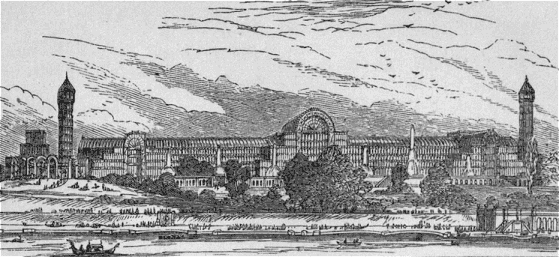
EXCURSION TO THE CRYSTAL PALACE.
Opened at 10 a.m.; closed at dusk.
TRAINS from London Bridge (London, Brighton, and South-Coast Railway) and
Victoria Terminus, Belgravia, every 15 minutes. Average duration of
journey, 20 minutes.
Fares from London Bridge and Pimlico.
First class, with admission to the Palace (every day but
Saturday), return 2s. 6d.
Second class ditto ditto . 2s. 0d.
Third class ditto ditto . . . 1s. 6d.
Children under 12, half-price.
Admission to the Palace, 2s. 6d. on Saturday, and 1s. every other day.
Season tickets, issued in. April, 1l. 1s.
The Crystal Palace demesne, formerly known as Penge Park,
occupies about 200 acres, chiefly of elevated and well- wooded ground,
overlooking a very extensive and most magnificent series of landscapes. The
building itself is a development of the Industrial Palace of 1851, and was
designed by the same ingenious architect, Sir Joseph Paxton. Its total length is
1608 ft.; its greatest width, 384 ft.; height of the nave, 110 ft. 3 in., of the
central transept, 194 ft.; width of the transept, 120 ft.; height of the north
and south transepts, each 150 ft.; width of ditto, 72 ft.; height of towers, 284
ft.; area occupied by the whole building, 603,072 ft.
The gardens are surpassingly beautiful, and of great extent,
and in the shimmer of noble fountains present a coup-d'oeil which will
not readily be forgotten. The Upper Terrace is 1576 ft. long, by 48 ft. wide;
the Lower Terrace, 1664 ft. by 512 ft. wide. Length of the garden front, 1896
ft.
The fountains, which in volume and beauty of arrangement,
excel even the famous water-works of Versailles, are supplied from the
water-towers; the tanks on whose summits contain 357,675 gallons. They consume -
through 11,788 jets - no less than 120,000 gallons per minute, the supply being
kept up by steam power.
Entering the building, let us now proceed to traverse its
whole extent, starting from the Screen, which is ornamented with figures of the
English sovereigns, copied from Thomas's admirable statuary in the New Palace at
Westminster. As we move forward we shall pass in succession, on either hand,
casts of famous sculptures.
The Courts will now demand our attention. From the
north transept we pass into the Assyrian Court, a species of reproduction
of Mr. Austen Layard's "Nineveh," effected by Mr. Ferguson.
The Egyptian Court, with its mysterious Sphynxes, its
hieroglyphic "Rosetta Stone," its Hall of Columns, the rock-tomb from
Beni.Hassan, the sculptured pillars from the temple at Phile, was principally
arranged by Mr. Bonomi.
The Greek Court contains some good copies of beautiful
antiques. The frieze from the Parthenon of Athens is presented in the gallery at
the back. Observe the group of the Laocoon "deifying pain;" Ariadne
sleeping; and the Discobolus, or Quoit-Player.
The Roman Court imitates the architectural wonders of
the magnificent Colosseum, and enshrines casts of the famous Apollo Belvidere,
"The Lord of the unerring Bow,
The God of life, and poesy, and light
(Byron);
of Venus Calypigia, Venus Anadyomene, and busts of Menander, Poseidippus,
Agrippina, and Trajan.
The Pompeian Court is an admirable reproduction of the
domestic architecture in vogue at Pompeii - the lava-buried city, .the city of
the dead-at the epoch of its destruction by a sudden eruption of Vesuvius. The
details were arranged by Signor Abbate.
The Byzantine Court illustrates the architectural
character of the Constantinople of the Greek Emperors, the ancient Byzantium.
The Alhambra, reminding the visitor of the glories
of the Abencerrages and the romantic history of Moorish Spain, evidences the
taste and erudition of Owen Jones.
The Medieval Court is devoted to an illustrated
history of the various periods of English architecture:
Norman, prevailing from A.D. . . 1066
to 1200
Early English, ditto . . . . 1200 to
1300
Decorated, or Later Pointed, ditto
1300 to 1400
Perpendicular, ditto . . . . 1400 to
1500
Tudor, ditto . . . . . . 1500 to 1600
The French, Italian, and German Medieval
Vestibu1es; the Elizabethan Court; the Renaissance (or New
Roman) Court; and the Italian Court, are all replete with interest to
the observant visitor, - to him who is not content with the mere amusement
afforded in the Palace, but seeks to profit by the lessons its abundant
illustrations of art and science are so well adapted to inculcate.
The manufacturer and the mechanical, as well as the student
of the industrial resources and capabilities of various nations, will turn with
avidity to the Industrial Courts: to the Ceramic, and to British
Ceramic (or Pottery) Manufactures, - Fancy and Foreign
Glass Mauufactures, - the Sheffield Court, - the Birmingham,
Stationery, and Canadian Courts. Machinery in motion;
basket-carriages and broughams; locomotives, pumps, and washing-machines; the
cotton-loom and the printing-press; the myriad products of ingenuity and
invention stimulated by the wants or luxuries of mankind - these, too, will in
their turn excite our curiosity and reward our investigation.
Then there is the noble collection of tropical plants and
ferns in the north transept, and tropical birds and reptiles, and things both
strange and rare from Oriental lands, to be wondered at; and the Mammoth Tree
from California, 400 ft. high in its original state, and about 4000 years old;
and the Naval Museum; models of bridges and viaducts, and other engineering
successes; the new Picture Gallery, occasionally containing some good examples
of English art; the Industrial and Technological Museum; the Photographical
Collection; Osler's Crystal Fountain, originally erected in the Industrial
Exhibition of 1851; the Fountains at the end of the nave, designed by Monti; the
Great Orchestra, accommodating 4000 performers; Gray and Davison's Grand Organ,
with its 60 stops, and 4568 sounding pipes; objects of art and vertu - the
utilities and luxuries of modern social life: a curious and brilliant world - a
very microcosm, or miniature of the actual world which Trade and Commerce,
Enterprise and Invention, brighten and enrich - is here laid bare before the
curious investigator. Nor do the directors of the Crystal Palace fail to appeal
to our love of pleasure and excitement. Opera concerts and Blondin performances;
archery and cricket; great Handel festivals and monster musical fetes; and
especially the weekly concerts, conducted with so much taste and skill by Herr
Augustus Manns, contribute to the amusement of the elite, as well as of
the ubiquitous "Million."
The Refreshment Department is vigorously conducted by
the present contractor, and distinct tariffs are intended to accommodate the
pockets of the various classes of visitors. Dinners, from 1s. to 5s. per
head; shilling teas; cold collations, luncheons, &c., are provided in great
variety; and the bon vivant may enjoy his entremets and patés,
while the third-class excursionist is content with "bread and cheese,
and a pint of porter."
Some excellent hotels- especially the Queen's, South
Norwood, and Masters', Crystal Palace- and numerous lodging-houses, at
widely differing rates, may be found in the vicinity of the Palace. The
neighbourhood is remarkable for its healthy air and glowing landscapes.
The Literary Department, which comprises classes for
the study of modern languages, lectures upon art, a reading-room, and library,
is under the direction of A. K. Shenton, Esq.
General Manager: Mr. R. Bowley. Musical
Director: Augustus Manns, Esq.
Chairman of the Crystal Palace Company: A.
Anderson, Esq. Secretary: G. Grove, Esq. Offices: 3 Adelaide Place,
London Bridge, E.C.
Several following years of early childhood were spent at Norwood, with the Crystal Palace as an entrancing playground. In the early ‘seventies the place was rich with the scent of the beds for tropical vegetation, stale buns, and new paint; and in the more rapturous end— where the parrots were kept—came unmistakable gusts and shrieks from the monkey-house, entrancing to the infantile mind, but deemed unhealthy and too exciting by parents and governess alike. The Crystal Palace was at that time a paradise for children, and one of the most comprehensive art museums in the world (this I knew later); it was also the home of music in England of that decade, with daily concerts, a small local opera, crashing brass bands, a mammoth organ, great Saturday classical concerts, and huge Handel Festivals. The place was not only full of appeals to the imagination, from the toy stalls to great intimidating groups of statuary, it was a world full of sound. The loud strains of a symphony might burst from the closed concert-room, interrupting the musical whiz and purring of a top spun by a toy-stall assistant; simultaneously would come the scarlet cries of a cockatoo and the persistent cadences of a popular valse played by a mechanical piano, and, most delightful of all, the tinny sounds of clockwork toys, which moved if a penny were dropped into them by an indulgent elder. Thereupon glass waterfalls would trickle in landscapes of Virginian cork; whilst a train with cotton-wool smoke, darted over a Lilliputian bridge, and small Swiss peasants valsed, all too briefly, to the sound of a tired musical box.
see also Richard Rowe in Life in the London Streets - click here
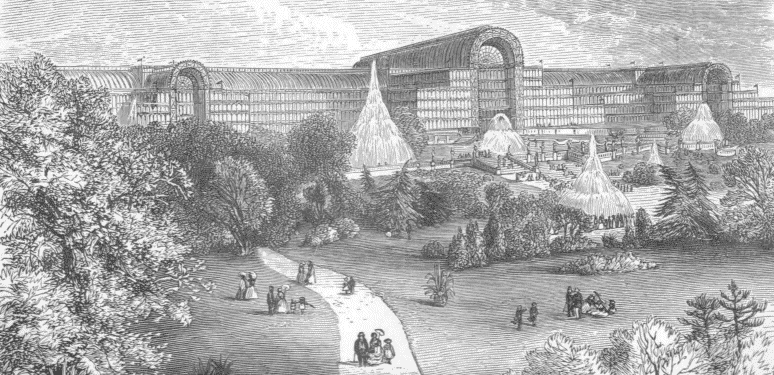
THE CRYSTAL PALACE.
Open from Monday to Friday inclusive, on payment of 6d. on Monday, and of 1s.
on the other days. On Saturday the price of admission is 2s. 6d., except during
the months of August and September, when it is a shilling. Children under twelve
half price. Non-transferable season tickets, admitting for a whole year, are
issued at one guinea each person, with numerous privileges, such as the special
concerts, etc. Tickets may be obtained at the Crystal Palace Office, near the
Central Transept Entrance ; at the offices of the London and Brighton Railway
Company, London Bridge; at the Victoria Station, Pimlico; at the Central Ticket
Office, 2 Exeter Hall, Strand; and at various other places in London. Persons
not holding tickets may either pay at the entrance to the Palace, or at the
railway stations on paying their fare. Much more detailed information than can
be given here will be found in the Shilling Official General Guide, illustrated
with plans and views, sold at the railway stations and in the Palace.
The Crystal Palace may now be reached from all parts of
London by rail; junctions having been made between the Brighton and the North
London, and other railways; and between the London, Chatham, and Dover, and the
North-Western, Great-Eastern, and Great-Western systems. The high- level line
from Ludgate Hill carries the visitor direct to the doors of the Palace. In the
summer the trip by road is also very picturesque.
The Crystal Palace is seen from far, crowning Sydenham Hill
with a structure of glittering glass, held together by iron. It owes its origin
to the Exhibition building of 1851, a structure of the same materials, and both
designed by the late Sir Joseph Paxton, M.P. A joint-stock company, promoted by
a number of gentlemen who believed that a permanent edifice might be of great
service in furthering the education of the people, and affording them a large
amount of innocent recreation at a cheap rate, purchased an estate which now
comprehends about 200 acres, erected the buildings, and laid out the gardens, at
an expense of nearly two millions sterling-a sum very much beyond that
originally contemplated. The main building is 1608 feet long, with a width
throughout the nave of 312 feet, increased to 384 feet at the central transept.
A striking feature of the interior is its great height, the nave rising to the
height of 110 feet above the ground floor; the central trausept to the height of
74 feet. Two spacious galleries extend at each side of the nave throughout its
entire length, and round each end. From a distance the two towers, 284 feet
high, are conspicuous objects. These can be ascended by a spiral staircase, and
their roofs command, as may be imagined, a splendid view of the country,
extending into six counties. They serve the double purpose of carrying off the
smoke of the fires which heat the building, and of maintaining in tanks at their
summits a supply of water for the high jets of the great fountains. Railway
visitors alight at one of two covered stations, either at a wing leading to the
south end of the main building or at the centre of the latter on the high level.
The north wing, destroyed by fire and storm in 1861, has been partly rebuilt.
On entering the palace for the first time, the visitor is is
commended to place himself at one end of the building, for the purpose of
obtaining a view along the entire nave. He will be much struck by the length and
height of the structure, its light and elegant appearance, the floods of
daylight that pour in from all sides, the distant statues, the baskets of
flowers suspended from the galleries, the green healthy plants growing on the
level of the floor, and the large marble tanks, rendered gay by bright blossoms
and beautiful ferns.
Then, with the view of taking things in detail, let him,
after glancing at the screen of the kings and queens, turn to the left, and,
passing the Crystal Fountain, make his way to the Pompeian Court, where
he will see reproduced a house such as a well-to-do inhabitant of Pompeii
resided in at the time Vesuvius potted it for posterity. Enter the court or
atrium, with its tank in the middle, and observe the miserably small dens set
apart for sleeping in. Into the ambulatory beyond, the dining-rooms, chief
bed-chamber, and other apartments opened. In the middle is a small garden, and
between this garden and the atrium is the tablinum, where were deposited the
ornaments of the house.
We may then pass in succession through the Sheffield,
Birmingham, and Stationery Courts, all elegantly and appropriately
decorated and filled with objects displayed in cases or on stalls. works for the
most part appertaining to the useful arts. Issuing from the last named court we
find ourselves in the central transept, at the foot of a flight of stairs
leading to the western gallery. Over against these stairs is the Concert Room,
where there is a daily performance of good music. At the west end of the great
transept are the organ and grand orchestra, in which oratorios are executed.
Behind is the main carriage-entrance from the road.
Now let us enter the Egyptian Court, with lions
couchant keeping guard. The architecture is characterised by massive solidity,
and the examples here given, selected from various temples and tombs, fully
conveys that idea. Two courts are separated by a hail of columns, modelled from
those at Karnak. The colouring is taken from actual remains in Egypt, and all
the hieroglyphics have their meaning.
In the Greek Court the style is marked by far more
elegance and symmetry. Models of temples, and sculptures copied from the finest
remains of Greek art, are placed in the central court. The light colouring of
this court is supposed to be justified by ancient examples. In the gallery
beyond the pillared walk, at the back of this court, a copy of the frieze of the
Parthenon has been placed, and this has been coloured, the tints employed being
however purely conjectural. Here also will be seen a model of the western front
of the Parthenon, about one-fourth of the size of the original ; and more
statues and groups, including the famous Niobe group from Florence. This gallery
is continuous with that behind the Roman Court, and we may compare the
noble intellectual countenances of the Greeks with the more sensual faces of
their Roman conquerors. In the court will be found copies of sculptures, all of
them carved by Greeks under Roman rule, including many well-known masterpieces.
The walls are coloured in imitation of the marbles with which the rich Romans
were in the habit of adorning their houses. In the side court are placed the
busts of generals and empresses.
The Alhambra Court, copied from the ruined Moorish
palace of this name at Granada in Spain, must strike every eye by the
gorgeousness of the colouring, the elaborateness of the ornamentation, and the
quaint grace of the architectural style. The Court of the Lions, 75 feet long,
is two-thirds the size of the original. Crossing what is here called the Hall of
Justice, we enter the Hall of the Abencerrages, the reputed scene of the
massacre of the Spanish family of that name, with its stalactite roof and its
lateral divans.
This is the last of the courts on the western side. Passing
into the nave we may examine the plants, natives of warm regions, which are
hereabouts to be found. The water plants look particularly healthy and happy.
Near this stood, before being consumed by the fire, the bark from the lower part
of the trunk of a Californian coniferous tree, named Wellingtonia gigantea. On
its native mountains it rose to the astonishing height of nearly 400 feet, and
its age has been estimated at 4000 years, that is far older than any of the
ancient buildings whose copies we have been examining. Close by is the Water
Barometer, 40 feet long, which was originally erected by Professor Daniel in
the hail of the Royal Society's rooms, Somerset House, and has only lately been
removed here. The top of the column of water may be seen from the first gallery.
As the extent of its variation is twelve times greater than that of the
barometrical column of mercury, it is very interesting to watch its oscillations
in unsettled weather.
The visitor may now enter the Marine Aquarium, situated
at this end of the building. It is constructed on the best principles, and
contains a large, perhaps the largest, collection of fishes, crustacea, and
other curiosities of the deep ; all to be seen in their habits as they live.
Some most remarkable curiosities will attract attention - the
octopus, the crabs and lobsters, numerous specimens of the marine anemone,
strange-looking but minute sea-horses, various examples of living coral and
sponges, and some very rare specimens of fishes from distant seas, together with
salmon in their several stages of growth. In addition to the above, this
Aquarium contains specimens of what may be called the domestic fishes - those
which are brought to market, and whose appearances are better known to us on the
table than in their living state.
Not far off the Library and Reading Room offer their
resources to the visitor. There is a fair collection of books, a large supply of
newspapers, British and foreign, materials for writing letters, a postage box,
etc. To non-subscribers the charge of one penny is made for admission
Let us now enter the Byzantine Court by the middle of
the three arches which communicate with the north transept, and turning to the
right pass along the copy of a cloister, the original of which is at Cologne.
The roof is decorated with Byzantine ornament in imitation of glass mosaic work.
In the middle of the court is a copy of a fountain from a convent on the Rhine.
Notice the Prior's doorway from Ely, in a late Norman style the curious Norman
doorway with zigzag moulding from Kilpeck Church, Herefordshire; the doorway
from Mayence Cathedral- the bronze doors within being from Augsburg
Cathedral-the effigies, near the fountain, of Henry II. and his queen Eleanor;
Richard I. and his wife Berengaria ; John, and his wife Isabella, all from
ancient originals. There are many other copies of architectural subjects in this
court and the adjoining vestibules which deserve attention.
The next court is a small one, exclusively devoted to
specimens of Gothic art and architecture in Germany, and hence styled the German
Medieval Court, where, dividing court from vestibule, we shall see the copy
of a celebrated church doorway at Nuremberg. St. George on horseback, from the
cathedral square at Prague, and some tombs of bishops and others, are amongst
the remarkable objects here. In the vestibule next the nave are several pieces
of sculpture, some of it quaintly droll.
Passing into the nave, and proceeding to the English
Medieval Court, we enter beneath a pointed arch, and find ourselves in a
cloister of the Decorated period, with a doorway from Worcester Cathedral at the
north end, and a doorway from Ely at the opposite end. The court itself contains
many excellent examples from old churches. The rich doorway from Rochester
Cathedral, leading to the vestibule, will catch the eye, and in the middle is a
decorated font from Walsingham in Norfolk. Turn round and admire the arcades of
the elevation towards the cloisters. Those who revel in the poetry of Gothic
architecture will find much to delight them in the doorways, tombs, niches, and
canopies placed before them here.
We now arrive at the French and Italian Medieval Court, the
details of which have been furnished by various foreign churches, much being
taken from Notre Dame at Paris. The statue on the floor, and the subject towards
the nave, are Italian.
The rich elaborateness of the Renaissance Court will
fascinate the most careless eye. The facade towards the nave, copied from a
mansion at Rouen, built at the beginning of the sixteenth century, is highly
attractive. In the centre of the court is a fountain from a French chateau, and
two bronze wells from the ducal palace at Venice, arranged as fountain basins.
Amongst the numerous charming things, notice the copy of the Baptistery gates
from Florence, so famous in art; the cinque-cento doorways from the Doria
palace, Genoa; one with five bas-reliefs from the Florence museum, above it;
various compositions of cinque-cento work on the back wall; the Louvre
caryatides supporting Benvenuto Cellini's nymph of Fontainebleau; a part of the
interior of the principal entrance to the Certosa at Pavia, very elaborately
carved; and Donatello's two statues, St. John in marble, David in bronze. The
adjoining vestibule contains the bronze monument of Lewis of Bavaria, remarkable
for its finish, Pion's Graces, and many beautiful bits of the period when the
Renaissance style prevailed. In the gallery behind this court is the monument of
Richard Beauchamp, Earl of Warwick, from Warwick, considered one of the finest
Gothic monuments now existing in this country.
The small Elizasbethan Court is indebted for its
architectural details to Holland House, Kensington, mentioned elsewhere in this
volume. Here are some tombs of the period, including those of Mary Queen of
Scots, Queen Elizabeth, and the Countess of Richmond, Henry VII.'s mother, all
from Westminster Abbey. Here also is a copy of Shakspere's bust from Stratford
upon Avon.
The Italian Court succeeds and illustrates the style
which the Roman nobility employed in their palaces, the Farnese palace being the
type selected. Observe the statue of the Virgin and Child after Michael Angelo ;
the monument of Giuliano do Medici from Florence on the south side, with the
reclining figures of Night and Day on the opposite side; M. Angelo's monument of
Lorenzo de Medici, likewise from Florence ; Bernini's group of the Virgin with
the dead Christ; the same subject by M. Angelo; the Fountain in the centre from
Rome; and the copies in the arcades from Raphael's frescoes in the Vatican. In
the gallery behind, notice the painted ceilings partly after Raphael ; and
Michael Angelo's Moses, the admiration of all lovers of art. In the adjoining Vestibule,
next the great central transept, the decorations are copied from a mansion
at Milan. On the extensive wall in the transept we shall find several
interesting monuments.
Now let us turn aside for a few minutes to survey the
beautiful prospect of the gardens and. the country beyond, which is afforded by
the open corridor at the end of the central transept.
Then, recommencing our survey of the courts, we may betake
ourselves to the nearest one, which contains a large collection of Fancy
Manufactures, a sort of bazaar, in short, where a good deal of money is
expended in the course of the year by persons desirous of carrying away with
them some memorial of the Palace. We may now examine the illustrations of Natural
History which are here to be found in the shape of figures representing man
as he has been met with in different parts of the globe; and the stuffed animals
scattered amongst beds of plants that grow in the localities from which these
animals have been brought. Here are cases of birds, sponges, etc.
Young visitors will be delighted with the Wurtemberg
collection of stuffed animals-a collection as curious as they are suggestive. It
is not quite impossible that the monkeys, rats, squirrels, weasels, etc., may
enjoy themselves in their native wilds in something like the fashion here so
artistically suggested.
Scattered up and down the nave and transepts are many pieces
of sculpture to which we have hitherto paid no attention, We shall now recommend
the visitor to bend his steps down one side of the nave, examine the casts as he
goes along, and on arriving at the transepts to survey each completely before
proceeding As all the casts have been marked with their names it will be
unnecessary here to repeat them. On arriving at the central transept look up at
the Orchestra erected for the Handel Festival, and capable of
accommodating 4000 performers. The organ built by Gray and Davidson for its
present position, contains 66 stops, with four rows of keys. In the eastern
portion of this transept is a large collection of casts from several of the most
celebrated ancient and modern statues and groups; and here also is the Choragic
monument of Lysicrates, often called the Lantern of Demosthenes, one of the
marvels of Greek architecture. Then working our way down the nave we reach the
tropical end of the building divided by glass during the cold months of the year
from the rest of the building.
At the extreme north end of the building are some colonial
and other collections worthy of notice. One is of the products of Tasmania,
another comes from Egypt. Into the botany of the Palace we shall not undertake
to enter, partly because all the plants have been labelled with their names, but
chiefly because to give even a short account of the interesting collection would
occupy more space than we can command.
The Galleries, however, must not be passed by. In
the gallery over the Stationery Court, and the other courts on that side, is a
large collection of oil paintings, and the stairs to the south of the grand
orchestra will lead us to them. At the northwestern end of the central transept
is deposited a collection of the staple and manufacturing products of Canada.
Passing through the Picture Gallery we shall arrive at a series of stalls where
a great variety of articles are exposed for sale, and continuing our course we
work round to the garden end of the central transept. Climbing the spiral
staircase we reach a gallery above, where is deposited the Industrial Museum
and Technological Collection, illustrating our manufactures by the
exhibition of the various materials employed therein. There are a vegetable, a
mineral, non-metallic, a metallic, and an animal series, all deserving
examination on the part of those who desire enlightenment as to the numerous
articles with which the productive labourers of this country deal.
Descending into the body of the building, we may cross the
great central transept, and seek the stairs that lead down to the basement
floor, which is on a level with the first terrace. Here we shall find a large
collection of agricultural implements, and a number of manufacturing machines in
motion, including cotton spinning machinery, steam engines, pumps, etc.
Having gratified his artistic sense in Picture Galleries and
the Fine Art Courts; having listened to the music of the Grand Organ, or been
amused at the Theatre, the visitor may perhaps like to vary his enjoyment. Let
him enter the Skating Rink and take a turn upon the rolling wheels; he
will find numerous companions in the full enjoyment of the exhilarating pastime,
and even should he. attempt the roller skate for the first time, he will obtain
ample instruction from careful and skilled attendants. Tired of this gyrating
exercise he may turn his attention to the more active pastime of lawn-tennis. In
truth, it is difficult to enumerate all the sources of pleasure at the command
of the visitor, not to mention those of the refreshment department.
Let us now leave the building for the gardens. The first
terrace is 1576 feet long, by 48 feet wide ; on its parapet are placed 26
allegorical marble statues, intended to represent important countries and
industrial cities. Descending the flight of steps, 96 feet wide, we reach the
lower terrace 1664 feet long, and 512 feet wide, affording a beautiful
promenade, adorned by the six upper fountains, and by beds of flowers. The chief
features of the picturesque grounds are the broad central walk, 96 feet wide,
and 2660 feet long; the arcade of iron trellis work, and the rosery around,
placed on a mound; the two grand fountain basins with the stone arcades; and the
lake at the bottom of the gardens, with restorations of extinct animals upon its
islands. These restorations are intended to give as accurate a notion as can now
be formed of those animals, whose bony remains have been found fossilized in
various ancient strata, the Hylaeosaurus, Megalosaurus, Tclithyosaurus, and
other monsters, with forms as ugly as their names, which lived in lakes and
swamps in the age of reptiles. Near at hand are some illustrations of geology,
ingeniously designed to explain the succession of rocks in the crust of the
earth, and the principal geological phenomena. In other parts of the gardens are
a rifle ground, a cricket field, and an archery ground.
THE FOUNTAINS, which constitute a great attraction in the
grounds, are in two series. The six fountains of the upper series, which are
upon the lower terrace, throw their water to the height of 90 feet, whilst minor
jets play round the bases of the principal one. Then there is a great circular
fountain in the middle of the central walk, which can throw a jet of 150 feet in
height, whilst many other jets are playing around. On each side is a smaller
basin. These nine fountains comprise the upper series. Below are two water
temples 60 feet high, placed at the head of a cascade on each side of the broad
walk. Below these again are the great fountains, which throw a central column to
the height of 280 feet, with a great number of jets around them. The effect of
the display of the whole system of fountains is very striking, but of course
this occurs but seldom, and on special occasions, for a grand display consumes
about six millions of gallons, 120,000 gallons being thrown in a minute, through
11,788 jets. It may be well to state here that the lofty towers, 284 feet
high, one of which stands at each end of the palace, are of cast iron, and each
contains 800 tons of that metal. They need to be strongly built, for they hold
when full, a body of water weighing 1576 tons. The water is obtained by means of
an artesian well 575 feet deep, which penetrates the London clay to the
greensand below. This well, which is at the bottom of the garden, is a brick
shaft 8.5 feet in diameter, for the first 247 feet; the remaining part is an
artesian bore. Steam-engines of 320 horse power are employed to force the water
into the garden basins and the tower-tanks. The pipes which convey the water,
and by which a great part of the garden is tunnelled, weigh about 4000 tons, and
are ten miles in length.
REFRESHMENT DEPARTMENT.-All classes of visitors to the
Crystal Palace may obtain refreshments in it at rates suited to their purses.
There are private dining rooms, where first class dinners can be obtained;
public dining rooms, where meals are furnished at a settled printed tariff;
there are even third class rooms, where plain fare is supplied at a low charge;
and lastly, stalls are scattered about the palace, where light refreshments are
to be had as in a confectioner's shop. Those whose physical strength is not
equal to the task of perambulating the palace, may hire bath-chairs, the stand
for which is near the entrance to the building from the railways. Lifting chairs
for carrying invalids from the railway station into the palace, or to the
galleries, may also be procured. In short, the convenience of visitors is
consulted in every possible way.
The Portuguese have a saying to the effect, that those who
have not seen Lisbon have seen nothing. In the same spirit, we may say that
those who have not seen the Crystal Palace have not seen London. A thousand
interesting objects have necessarily been omitted in our hasty sketch, but even
if the half only of those mentioned have been examined, every visitor must admit
that he has had a marvelously cheap shilling's worth of enjoyment, for he will
have seen something that no other age, and no other country has been able to
produce.
Within, it is a single huge hall, a little world. At the first glance you take in nothing. From one court you pass into a café, from a café into a bazaar, from a bazaar to a garden or museum. Amongst cypresses, laurels, aloes, palms, and all the pompous plants of the Torrid Zone, giraffes stretch out their necks, and Michelangelo's statues raise their heads. From the sphinxes of an Egyptian court-yard you see in the distance a Greek house with the group of the Laocoon and the Venus of Milo. From a Greek house you enter a Roman house; here your' gaze penetrates into the mysterious little chambers of the Alhambra; and from the Alhambra you look into the court of a little Pompeian house. You go out and pass between groups of lions and tigers, fighting and biting, between two rows of eagles and parrots, and next come out in a Byzantine court, from which, through a series of doors, you see the court of a medieval house, the hall of a Renaissance palace, or the chapel of a Gothic church. You go on among sepulchral monuments, fountains, doors embellished with historical designs, and all the masterpieces of modern sculpture; and you come into the midst of a crowd at the door of a theatre, where they are playing Il Trovatore. A little beyond, on one side, you see a musical stage, seating three thousand artists, under a semi- cupola twice as large as the dome of St. Paul's, and on the other side a stage on which a professor is giving lectures on mathematics. You pass before a comic theatre, camerae-obscurae, circuses, and enter a labyrinth of grand bazaars in the forms of temples and kiosks, in which are exhibited the most splendid industrial products of all countries, from Cairo to Birmingham, and from Paris to Pekin. You run through the corridors of libraries, between long rows of piano-fortes, carriages, furniture, and vases of flowers, and you go wandering among the trees and dens of a forest peopled with savages from Africa or Oceanica, scattered on the hunt, or gathered in families about their hearths, or ambushed behind rocks in the act of shooting arrows at each other. You go up a staircase; galleries stretch endlessly away before you, where you can walk miles among oil paintings, water colors, photographs, and busts of celebrated men. And above these, more galleries with a thousand turns, from which on looking out you take in at a glance the beautiful landscape of the county of Kent, and looking below, all that fantastic circuit of halls, gardens, courts, theatres, and restaurants; people going up and down, and thronging about the theatres, and appearing and disappearing among the plants and statues; and on this prodigious variety of forms, colors, and sights, of this compendium of the world, arched over by a crystal firmament, the sunlight darts in and spreads a glow over everything, throwing prismatic colors and rays and showers of silver sparks along the walls and azure arches.

HERE is one notable place which we really must not forget to visit-THE CRYSTAL PALACE. True, we have, most of us, been there more than once; but that is just the reason why we want
to go again. There is so much to see in that immense enclosure
that one cannot take if in all at once; and even when we have
become familiar with the permanent features of the place, there are fresh
additions, again and again, and good music to feast our ears with, and the
beautiful building glistening like a fairy pavilion in the sunshine, and the
spreading grounds to ramble in, and the flowers in bright masses and devices of
many colours, and the chaffinches and redbreasts and sparrows among the trees
and bushes, and - But it is time that sentence came to an end. Given a fine, sunny
day, in spring, or summer, or autumn, and a nice little party of friends - boys
and girls and older folk, if they are not too proud and stately to admire and
enjoy the scene-and there can scarcely be a better place for a tired Londoner
to pass a few happy hours than the Crystal Palace.
I dare say you have seen pictures of the Crystal Palace in Hyde Park-
the building which was erected for the Great Exhibition of 1851. It was
designed by Mr. Paxton, who rose from being a gardener's boy to be ' Sir
Joseph Paxton, M.P.' Built almost entirely of iron and glass, it had a
beautiful fairy-like appearance; and though it was nearly twice the breadth
and fully four times the length of St. Paul's Cathedral, covering twenty acres
of ground, it had a gay, lightsome look, which was a pleasing novelty
amongst our public buildings. It was opened by the Queen on May 1st, 1851,
and continued open till the 11th of October. During those one hundred and
forty-four days of exhibition it was visited by more than six millions of persons.
And no wonder; for not only was the building itself a marvel, though run up
in a few months, but the variety and value of its contents, the perfection of its
arrangement, and the beauty of its vistas - especially that along the nave, or
body of the building - presented a combination of attractions which the world
had never before seen, and which remains as yet unrivalled.
When the Exhibition was over, a general desire was expressed that
the
building should be purchased by Government, and so preserved from destruction;
but this was not agreed to. A few gentlemen, however, in 1852, came to the
rescue, and bought it, and had it removed to Sydenham, where it was erected,
much altered and improved, on the upper part of a lovely estate of three
hundred acres. When opened as our present Crystal Palace by the Queen, on
June 10th, 1854, the building was found to have been greatly changed from its
former self. In place of one transept there were three, and the roof of the
nave had become arched, instead of being flat, and had been raised forty-four
feet higher than the old one. The central transept is the great feature of the
architecture, being three hundred and eighty-four feet long, one hundred and
twenty wide, and one hundred and sixty-eight high; but its total height from the
garden front is two hundred and eight feet-six feet, higher than the
Monument.
It would take up all my pages to give a description of all the things to be
seen in this immense building and its wide-spreading grounds. All I can say
to you is, ' Come and see.' Roam along the beautiful nave, and gaze on the
statues, and plants, and flowers, and fountains, and works of art; turn off into
those wonderful Courts-Assyrian, Egyptian, Greek, Roman, Medieval, &c.,
not forgetting the resplendent portions of the Alhambra; then traverse the
picture galleries; descend to the lower regions, and watch the machinery and
various processes of manufacture. But the sun is shining, and soon you will
want to be out in the grounds. So out let us go, and gaze for a minute from
the upper terrace on the grand prospect - trees, and water, and beds of flowers;
hill and dale and verdant alley - and the rosary and water temples and
panorama house. If we wander down the steps, and along the winding paths,
we shall come to the upper terrace of the grand plateau, and shall have before
us the lake, which has three islands in its bosom, adorned with life-size models
of the fearful and gigantic animals which are supposed to have swarmed on our
planet many ages ago. Then, if we pass on to the rustic bridge, we shall see
an excellent representation of the strata between which that grand English
necessary, coal, is found. It is worth looking at for a few minutes; for it is
not a mere painted model, but is constructed of several thousand tons of coal,
and ironstone, and limestone, and red sandstone, old and new.
CRYSTAL PALACE, SYDENHAM. Modern pictures and sculpture. 1s. Trains from Victoria, Ludgate Hill and London Bridge.
CRYSTAL PALACE PARK, SYDENHAM. Open daily, 1s; on Saturdays 2s. 6d. Trains from Victoria, Ludgate and London Bridge Stations.

THE CRYSTAL PALACE.
Built of the materials that housed the Great Exhibition of 1851 in Hyde Park, the Crystal Palace at Sydenham cost no less than a million and a half sterling. It is composed entirely of glass and iron, and was designed by Sir Joseph Paxton. The Palace from its lofty eminence is visible for miles in every direction. Its principal hall, or nave, is 1,608 feet long, while the central transept is 390 feet long by 120 feet broad, and rises to a height of 175 feet. On either side of the Palace are the water towers, each 282 feet high, and these add greatly to the general effect, best appreciated from the delightful grounds, which cover in all some 200 acres. Our view shows the Upper Terrace, the Central Transept, and the northern Water Tower.
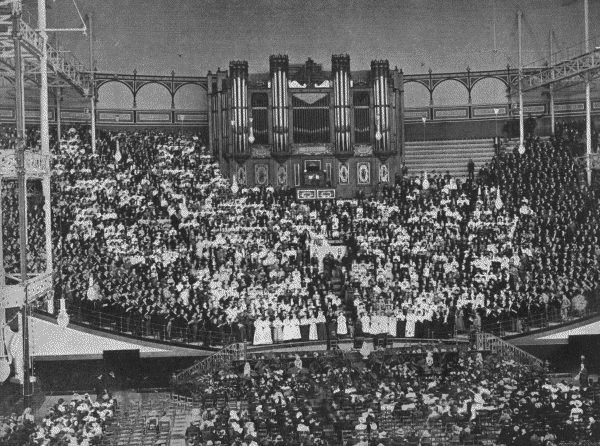
A TEMPERANCE DEMONSTRATION AT THE CRYSTAL PALACE.
Owing to the circumstance that the Handel Festival is always held at the Crystal Palace, the orchestra in the central transept of the Palace of Glass is known as the Handel Orchestra. It can accommodate no fewer than 4,000 persons. The dimensions of the transept, which has a diameter twice as great as that of the dome of St. Paul's Cathedral, can only be realised when it is crowded, as in onr picture, which shows in progress the great temperance fete that is held at the Crystal Palace every year. The organ, which is supplied with air by hydraulic machinery, boasts 4384 pipes, and cost £6,000. The acoustic properties of the building are admirable for large volumes of sound.

DOG SHOW AT THE CRYSTAL PALACE (1895).
Paxton's great building at Sydenham is admirably adapted for big exhibitions such as the annual Dog Show of the Kennel Club. The animals are benched all along the nave, which is 1,608 feet long; and even this space is insufficient for all the competitors, while there is plenty of room in the Central Transept for the judges rings, one of which is shown in our picture. Moreover, the Palace is light and airy, and the barking of the dogs is not so deafening here as in smaller buildings. To these shows the best bred dogs in the country are sent, of almost every known variety, and to win a prize in such company is praise indeed. The Kennel Club, which was founded in 1874, has much the same authority in the "doggy world" that the Jockey Club exercises on the Turf.
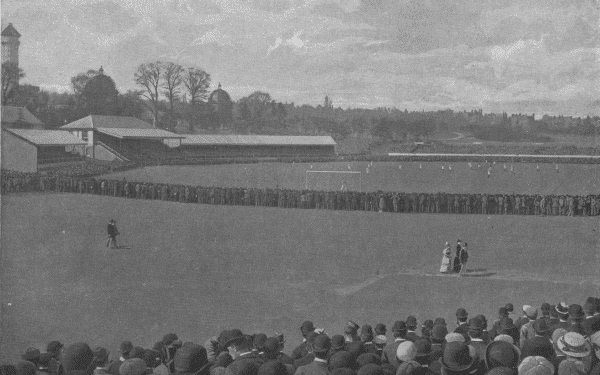
FOOTBALL AT THE CRYSTAL PALACE.
Football has become so popular with all classes of the community that the Crystal Palace authorities were well advised in laying out a part of the fine gardens at Sydenham as a football ground. The lake was filled in for this purpose and, from the spectators' point of view, there is not a finer ground in the country. It is estimated that sixty thousand persons can obtain an uninterrupted view of the game; and the accommodation in the covered stands and on the rising ground is all that could be desired. Our picture shows in progress the final tie for the Football Association Cup in the 1894-5 season. This match, the most exciting of the year under the Association rules, was won by Aston Villa, who defeated the West Bromwich Albion eleven by a goal to nothing
[-148-]
FIVE P.M.: A CHILDREN'S FESTIVAL AT THE CRYSTAL PALACE
I SUPPOSE that the myriads of little folk scattered
throughout the great House of Glass at Sydenham, and in the gardens thereof,
have been here since early in the forenoon; but it was five o'clock ere we could
get away from work, and enjoy one of the most delightful drives of which I am
aware - that from London, through Brixton and Dulwich, to Norwood. Apparently,
some hundreds - it may be thousands - of boys and girls have just finished some
grand musical performance; since we watch them streaming down the degrees of the
great orchestra; and in another part of the palace there is a gymnastic contest
going on, the view of which, however, to a late corner, is barred by serried
ranks of anxious, yet delighted, fathers and mothers, who are watching the
exploits in calisthenics of their small offspring.
Now and again you catch a glimpse of a youth in cricketing
flannels, or of a tiny maiden in a blouse and knickerbockers, performing some
athletic feat, which, so far as I am concerned, I am perfectly certain I was
never able to do. But I am delighted to see that [-149-] gymnastic, and almost
acrobatic, training is making so much headway in the education of girls.
Such training will conduce towards making them healthy and
strong; and as I have always been a fervent advocate of woman's rights, it
strikes me that, during the next generation or so, what remaining rights women
have to secure, will be much more easily obtained, if the women themselves have
not only the mind but also the muscle wherewith to demand justice. It will not
be easy to trample on the sex when they have become physically strong enough to
take you by the scruff of the neck if you argue with them, or give you "one
in the eye" if you refuse them the Parliamentary franchise.
It is a sight, and a most exhilarating one, to see these
troops of children, from little dots of four and five in sun-bonnets, to big
girls of twelve and fourteen with their hair down their backs, or twisted into
those pig-tails which were fashionable when Charles Dickens was writing Pickwick
more than fifty years ago, and which - as is the case with most fashions -
have recently come into vogue again. It was as delightful to contemplate the
merry, round-faced, chubby boys, the smaller ones in those knickerbockers, the
origin of which, as an article of small boys' wear, has yet to be cleared up.
So far as I can make out, knickerbockers have not an American
origin, in the sense of the garment having been devised by an American tailor;
and, if my remembrance serves me correctly, it was an English [-150-] lady,
writing to the Times, some six-and-thirty years ago, who stated, that she
had made for her little boy some very neat and cosy galligaskins out of a pair
of old trousers belonging to her husband. She had given, she added, the name of
"knickerbockers" to these garments, because she had been looking at
George Cruikshank's illustrations to Diedrich Knickerbocker's - that is to say,
Washington Irving's - History of New York, in which George has depicted
divers Dutch worthies arrayed in prodigiously voluminous breeches. Even at
present there is an old Manhattan family in New York who bear the highly
suggestive name of Ten Brock.
To behold the youngsters at tea was likewise a joy. The
quantities of bread and butter they put away; the cups of tea and cocoa and milk
and water they consumed; the numbers of buns and slices of plum-cake they
contrived to dispose of filled me not only with delight, but with bewilderment.
The staying powers of those little boys and girls demolishing their holiday
grub, reminded me of a little white Pomeranian dog of which, for at least a
dozen years, I was the proud possessor. He had during his long career several
names. Sometimes, I believe he was called Tradelli, at others Dr. Biggs;
sometimes he was Bismarck, and occasionally Hobson Jobson. His real appellation,
I believe, was Ivan the Terrible, and when he came to me, a puppy, his then
owner triumphantly declared that he would never be big enough to fill a quart
pot. He grew somewhat larger than that measure of capacity; [-151-] but he was
always a very diminutive bow-wow. He had fought every dog and bitten every child
in Mecklenburg Square; but in the domestic circle he was the kindest little
creature imaginable, and had clearly the heart that could feel for another. His
greatest accomplishment next to begging was barking; and it often used to puzzle
me how so much bark could come out of such a small dog. I brought him with me to
Victoria Street, where he died of old age, and we had him buried in Hyde Park;
and I will never have another dog.
It was the sight of the children merrily "wolfing"
their tea, that brought back the image of Ivan the Terrible, with his many
aliases, to my mind. To be sure, the children at the Crystal Palace did not
bark; but it was enrapturing to listen to their rippling laughter and chatter.
When at length their repast was over, they scattered again, and went trotting
about the palace, pattering with their small feet like so many armies of white
mice, and then pouring out down the great staircase by the fountains into the
gardens, gamboling and racing, and sliding down steep embankments, and enjoying
themselves with a thoroughness of glee, that to my mind only English children
can display.
The Crystal Palace is not only a great school of artistic and
technical education, and a place of varied and innocent amusement, but it is
likewise the finest playground for children in the whole kingdom; and, in the
interests of the public happiness and the [-152-] public morality, it ought to
have a handsome endowment from the State. It is wicked and nonsensical to assert
that private enterprise, and private enterprise alone, should be the purveyor of
amusement to the people. It is idle, wicked, and mendacious into the bargain, to
say that the State cannot afford to endow such a thoroughly national institution
as the Crystal Palace. How many thousand pounds a year do we blow away in
gunpowder on Woolwich Common, or on Southsea Beach? How many thousands more have
we recently spent on torpedoes - beshrew their murderous name! - which are being
tested, and turn out to be utterly worthless?
You are not to think that these legions of little ones were
destitute of adult guides, philosophers, and friends; or that they were allowed
to wander about the palace and grounds at their own sweet wills, or revel
entirely in their own devices in the way of play. When we had had our own
dinner, and I came out into the garden about eight o'clock to smoke a cigar, the
children in regiments, in battalions, in squadrons and platoons, were being
marshalled and formed in line for the purpose of merrily marching them towards
the entrance leading to the railway stations; or, rather might they be likened
to so many flocks of sheep under the guardianship of careful shepherds and
shepherdesses, who, with walking-sticks and umbrellas in lieu of crooks, were
collecting the lambs and gently gathering up those who were straying; and who,
although to the stranger the children might have been at tea-time, or [-153-] at
their games, even as "forty feeding like one," were evidently familiar
with the faces of every one of their young charges. It was growing dusk ere the
last flock had got well on their way out of the palace; but, in the remote
distance, one could hear their shrill cheering as they entered the carriages
which were to take them home, a little tired perhaps, but ah, so happy!
As to ourselves, we lingered in the palace grounds till the
dusk had deepened into night; and driving home through the green lanes, one of
our companions, a lady, undertook to count the couples of sweethearts whom we
encountered placidly strolling along in the moonlight. She left off at a hundred
and eighty-seven, by which time we were in sight of the late Bon Marché,
Brixton. After that there were no more sweethearts; there were only the blazing
gas, and the blinding electric light, and the striving, palpitating crowds,
filling the streets of Nineveh, that Great City.
No sweethearting couples did I count; for all the time
that I had passed at the Crystal Palace, and all the way home, I had been
thinking of the magnificent Pleasure Dome, which the genius of Joseph Paxton
imagined, and which the will of the nation, guided by the counsel of the wise
and good Prince Consort, decreed. I witnessed the opening of the Great
Exhibition in Hyde Park by Her Majesty the Queen; and I can see her in the
mirror of my memory now, with the Prince Consort, in a Field Marshal's uniform,
by her [-154-] side. With her, also, were the little Princess, eleven years old,
who is now the Empress Frederick of Germany, and a little boy a year younger
arrayed in Highland dress, and who is Albert Edward, Prince of Wales. I can see
the Archbishop of Canterbury in lawn sleeves pronouncing the benediction on the
enterprise that day inaugurated; and then the Sovereign, with her Consort and
her children, followed by the Primate, the Lord Chancellor, and the Judges, and
a host of great officers of State, courtiers, diplomatists, Exhibition
commissioners, and committee-men, made the circuit of the entire building; the
route being kept by the Yeomen of the Guard, with their glittering halberts, and
the Royal trumpeters meanwhile blaring out joyous fanfares from their
silver trumpets.
You know that when the Great Exhibition of '51 had run its
marvellous and unprecedented course, notwithstanding the bitter opposition of
good old cranky Colonel Sibthorpe, who was continually thanking Providence that
he had never entered "the bazaar full of rubbish," the Crystal Palace
was somehow or another transported to a site near Upper Norwood, which, although
not actually in Sydenham, the greater part being in Lambeth parish, is always
considered to belong to Sydenham. How they got the thousands of tons of iron,
and the thousands upon thousands of panes of glass, to Sydenham Hill, there is
no room here to describe, if indeed I could tell the tale. I only know that the
thing was done; and that visiting the works in progress at Sydenham sometime in
1853, I wrote in [-155-] Household Words an article entitled, "Fairy
Land in 54," pointing out what would be the chief attractions in the palace
and grounds, then rapidly approaching completion.
Perhaps after all that which was, humanly speaking, a fairy
structure, was brought from Hyde Park to Sydenham on a magician's carpet; but
whether that was the case, or whether the thousands of tons of iron and glass
were conveyed to Sydenham in balloons, or in Pickford's or Carter-Paterson's
vans, there stands the palace, the rebuilding of which I watched just as I had
done its original edification in London. The party which visited the fairyland
that was to be, and which left London on a murky late October day, comprised Sir
Joseph Paxton himself; Mr. William Henry Wills, the assistant editor of Household
Words; the famous dramatist, essayist, and wit, Douglas Jerrold; Mark Lemon,
the editor of Punch; Owen Jones, the decorative architect, and author of The
Grammar of Ornament; Charles Knight, of Penny Cyc1opaedia, History of
England, and Shakespearian Commentary's fame, and your humble servant, with the
exception of whom, not one of that merry band of pilgrims to Sydenham survives.
We tramped manfully for a good two hours through the stiff soil from which was
rising a structure more wonderful even than its forerunner; but I fail to
remember the hotel at which we afterwards dined. Possibly it was a humble
village inn at Beulah Spa- for the transformation of Sydenham,
Anerley, and Upper Norwood into a handsome suburban city, as [-156-] beautiful and
as smiling perhaps as one of those twenty-two cities which once glorified the
now desolate Campagna of Rome, had not then been begun.
Still, the hill to be crowned by the palace and grounds
commanded a prospect which, if it did not equal in sublimity that of the hills
which girdle Rome, yet possessed features of unequalled loveliness in richly
wooded and softly undulating plains, rising at last to the distant acclivities
of Kent and Surrey. I was at the opening of the palace in 1854; but ere that
pageant took place, I dined as a guest of the distinguished comparative
anatomist, Mr. Waterhouse Hawkins, in the interior of the model of some gigantic
Saurian, on a margin of the lake, where also were to be seen other life-sized
models of the former gigantic inhabitants of the earth. I cannot remember
whether it was in the stomach of the Iguanodon, or in that of the Malaeotherium,
the Anoplotherium, the Plesiosaurus, or the Megatherium, that we feasted; but we
did hold a very joyous banquet in an improvised dining-room not much larger than
the cabin of a small yacht.
Another exceptional dinner that I partook of within the walls
of the palace itself was about a year after it had been opened. Shareholders did
not then enjoy the privilege of visiting the palace on Sundays; but I happened
to know one of the early Directors of the Company. I was one of a small party of
his personal friends who went down to the palace one Sunday afternoon and dined
in the Alhambra Court. We squatted on our hams a la Turc round the
Fountain [-157-] of the Lions, and the bill of fare comprised pillafs and kibabs,
which we pretended to like and didn't; and then we proceeded to the terrace to
enjoy narghilés and chibouks, and pretended to like the Latakia tobacco
and the thick grouty Mocha coffee which accompanied the pipes ; but I am afraid
we liked those post-prandial refreshments no more than we had done our pillafs
and kibabs.
You very rarely see a narghilé, which is the Turkish
equivalent for the Indian hookah in Constantinople, in the present day. It has
been dethroned by the cigarette ; and, indeed, the last time that I was in the
Levant it was not until the steamer touched at the Greek island of Syra, where
we spent a few hours, that I could manage to obtain at the café a narghilé
on which to experiment. The pipe had to be "cooked," or
preliminarily smoked, in the kitchen before it was brought up to me, for, to the
Oriental mind, no Frank is capable of drawing the first twenty puffs through the
glass reservoir, filled with rose water, and so, through many convolutions,
through the amber mouthpiece between his lips.
Some weeks afterwards, however, I did manage to purchase a narghilé
in the Bezesteen at Stamboul; and taking it to the house of my dear
friend-now, alas! deceased, - Eugene Schuyler, who was at the time
Consul-General of the United States at the Sublime Porte, we had a narghilé
séance. It was scarcely a success, and I speedily abandoned my own hookah
for a cigar. Schuyler managed his narghilé, with that [-158-] phlegmatic
determination worthy of a member of an ancient Dutch long - piped smoking
family. An American friend of his, who had come to Turkey for the purpose of
studying early Byzantine architecture, and who was so venturous as to struggle
with the old-fashioned Turkish pipe, had an experience of it not altogether
agreeable. He had been drawing away at a narghilé for about a
minute and a half, when we noticed that his countenance grew first very yellow,
then very green, and then very white. "How do you like it?" we asked.
"Oh !" he replied, in a very faint voice, and with many gasps,
"it is delicious; it is ethereal-it's heavenly - it's - I don't
think I shall live five minutes;" and he tumbled off the divan
on to the carpet in a dead faint. To be quite Oriental, our friend had swallowed
the smoke, which we had to press and pummel and knead out of him in spirals
issuing from his nostrils and his mouth, and, as I thought, from his eyes and
his ears. We got him round at last, by the administration of a liquid a little
stronger than sherbet; but he declared that that particular narghilé the
first that he had ever tried to smoke, should likewise be the last. In all
probability he kept his word.
