Victorian London - Publications - Etiquette and Household Advice Manuals
- Cassells Household Guide, New and Revised Edition (4 Vol.) c.1880s [no date] -
Gardening (1) - Conditions of Town Gardening - The Soil and How to Improve it -
Aspect of the Ground - Walls and Fences - Laying out the Garden - Succession of
Plants - (2) The Window Garden - (3) The Small Suburban Garden - Formation of
Garden Paths - The Cultivation of Small Gardens - (4) The Window Garden - (5)
The Window Garden (cont.) - The Cultivation of Small Gardens - (6) The Tool
House - Rotation Cropping of a Small Garden - (7) cont. - (8) cont. - (9)
cont. - (10) The Vegetable Garden - (11) - (12) - (13) Rotation
Cropping - The Culture of Vegetables - (14) - (15) - (16) The Vegetable Garden
[-back to main menu-]
Volume
1
[-20-]
GARDENING.-I.
IT is one of the best of the signs of the times that the love of gardening
and its practice, in and around our towns, have greatly increased within the
last few years. Men of all classes, deeply engaged in business, from the
humblest mechanic upwards, show a growing disposition to cultivate what Bacon
has termed "the purest of human pleasures," and add to their homes
that adornment which may be found in the culture of such a piece of ground as
their means will allow them to secure. Much has been written to assist in the
gratification of this wholesome taste, but there can be no doubt that people
generally have still a great deal to learn as to the principles which should
guide them in their gardening amusements, and the direction. in which their time
and outlay might be expended to the best advantage. In the present paper we
shall offer a few hints as to the general principles which should be kept in
view in suburban gardening, especially in small plots of ground, leaving
gardening upon a larger scale for future consideration; and we shall follow
these hints by details as to the profitable culture of flowers, vegetables, and
fruit, by persons whose means and whose opportunity for gardening are alike
limited.
CONDITIONS OF TOWN GARDENING.
It is often supposed that the conditions of soil
atmosphere, &c., under which gardening is pursued in the vicinity of towns,
render it difficult to meet with a similar measure of success to that found in
country gardens. If any proof were wanted of the general ignorance which exists
on gardening subjects, it would be afforded by the prevalence of this belief.
The fact is that, rightly followed, town gardening may be made as successful and
as profitable as gardening in the country; and the reason why the one so often
presents an unfavourable contrast to the other is chiefly that suitable subjects
are not employed, or, if used, are not tended with proportionate care. What will
grow well in the country will often not thrive well in a town, and the attempt
to rear the same plants and the same varieties under the two widely different
conditions, frequently results in conspicuous failure. But, on the other hand,
town growth is peculiarly suited to some classes of plants, which positively
flourish better in the more heavily-charged air. The greater quantity of ammonia
in a town atmosphere, which is constantly being brought down in large quantities
by the rains and absorbed into the ground, is precisely what many vegetables and
plants require for their full development; and the town gardener has therefore
in this case a constant and natural supply of that which the country farmer is
at considerable expense to procure by artificial means.
Again, the greater warmth which is found in towns as compared
with the open country in winter, is eminently favourable to many of the forms of
vegetable life. The superior growth and condition often observed in many of our
best evergreens in town as compared with the same objects in the country, is an
instance of the peculiar suitability of the neighbourhood of town to a certain
class of plants; and in other classes it is equally favourable to some
varieties, although it may be injurious to others. What these varieties are we
shall have occasion to point out under their several headings, when we come to
touch upon the different kinds of plants cultivated in our gardens.
But, while the gardener in town or suburb should bear these
facts in mind for his encouragement, he must also remember not only that it is
necessary to choose suitable plants for his garden, but to counteract the
impurity of a town atmosphere by greater attention to the cleanliness of his
plants. The leaves of a plant are its air-vessels, through which impurity will
be conveyed to its system if it exists in the surrounding air. A good supply of
water in dry and dusty weather is therefore doubly necessary to plants grown in
town; but the water should be applied, not to the roots only, as is the general
practice, but by gentle sprinkling or washing as in a rainfall, over the entire
surface of the plant. At frequent intervals the soot and dust which are sure to
settle more or less on the leaves should be entirely washed away, and the
plants, if healthy, will immediately repay the attention by their fresh
appearance and vigorous growth.
These two principles of suitable selection of plants and
constant attention to cleanliness, are the chief points necessary to be observed
to enable the town and suburban gardener to compete successfully with the
resident in the country. But now as to other matters which demand his
consideration.
THE SOIL, AND HOW TO IMPROVE IT.
The first is, to study at the outset the character of the
soil with which he has to deal. This must be his guide as to the class of plants
that he should attempt to grow. Some flourish in light while others thrive in
heavy soils, and his choice must be made accordingly; but it is always possible
in a small garden, by a little judicious outlay, to do much to alleviate the
general character of the soil, whether of the one kind or the other. Stiff
clayey soil, for instance, may be lightened by the addition of sand,
road-scrapings, and vegetable manure; while too light a soil requires the
addition of clay or marl and rich vegetable earth.
Many suburban gardens, attached to newly-built houses, are
formed of meadow land recently broken up; and the soil in these is generally
sufficiently rich and fertile to form basis for operations without much trouble
in preparation. But in others the ground which the gardener has to cultivate [-21-]
is thickly strewn or intermixed with brick and rubble, which must be
carefully cleared away before he can do. any good with it. Even this rubbish,
however, will be useful in small quantities, as a little of it interspersed in
the subsoil will assist in the drainage of the ground. It is a common mistake to
remove all stones from the earth or mould. They assist in keeping the ground
open and making it porous, preventing it from caking in the heat of summer, or
being washed out of the beds on to the paths in heavy showers of rain. Moreover,
in hot weather stones are highly useful in preventing the loss of moisture from
the plants by evaporation; for, if you remove a stone; from the surface of the
mould, you will generally find the earth damp underneath.
Then, again, the soil may be shallow in depth, and require
either that fresh soil should be imported or that the subsoil should be brought
up by trenching - an operation which we shall hereafter explain. Lastly, and
more commonly still, the fruitfulness of the ground may have been quite
exhausted by previous operations, in which case plenty of manure must be dug
well into it. Rotted stable manure is the best possible material for this
purpose, but many others are easily procured. Road scrapings, matter gathered
from ditch bottoms, all kinds of vegetable refuse, with lime, soot, &c., are
all useful in their way, according to the character of the soil and its
condition. The right use of manures will form the subject of a future chapter.
ASPECT OF THE GROUND.
Other considerations to which proper regard must be; paid
are the aspect and the surroundings of the garden. If the general aspect be
south or south-west, you may attempt to grow vines, fruit trees, and many
delicate vegetables and flowers with which you would certainly fail if your
garden were exposed chiefly to north and easterly winds. It may be that your
plot of ground is so situated. that you have two entirely different aspects, one
side being fully exposed to the genial influences of the sun and the south-west
breezes, and the other lying nearly always in the shade, and meeting only the
keener winds. You will find both sides useful for different purposes. On the
brighter side, for instance, besides planting your vines and fruit trees, you
may sow your seeds in spring, and the rising plants will get warmth and shelter
until they are ready for planting out. The other side will be equally valuable -
as summer advances; for many of your vegetables and tender plants which would be
burnt up by the heat, will here flourish in the shade. You must carefully
observe, then, the aspect of the ground, and be guided by this in your planting.
WALLS AND FENCES.
The next point for consideration is the manner in which
the garden is enclosed - whether by fence or wall. Brick walls, as a rule, are
much less suited to gardening purposes than open fences. They obstruct the
light, and the free passage of air to the plants. The wind and the rain beat
forcibly against them, and all things immediately within their shelter suffer in
consequence. On the other hand, they have their occasional advantages. A good
wall facing the sun is the most suitable spot in the garden for a vine or a plum
tree, as it retains and reflects the heat to ripen the fruit. If fruit is not
desired, many of the climbing plants, such as the Virginian creeper and the blue
passion-flower, common in the southern counties of England, may be used as a
covering and ornament. For a damp wail, ivy is the best thing, as it will keep
it dry; but in a garden it should be kept cut close, and thinned from time to
time, otherwise it will grow unsightly, and form a breeding place for a colony
of vermin. A continuous wooden fence presents the disadvantages of a wall
without its advantages; therefore choose, if you can, a garden enclosed by an
open palisading, which will admit the light freely to the plants, and at the
same time break the force of strong currents of wind, while it allows a thorough
circulation of air.
LAYING OUT THE GARDEN.
Now as to the planning out and arrangement of your garden.
If you have an open fence, this will require less consideration, and the usual
plan of a narrow bed round the sides, with others in the centre, will do very
well, supposing you wish to grow flowers chiefly. But if you aim at the culture
of vegetables, it is preferable, if the garden is a small one, to have the sides
occupied by wider beds, with one pathway running down the centre Thus you get
more available space, and can cultivate your vegetables in larger and wider
strips, which will be much more convenient for planting, &c., and, at the
same time, more favourable to their growth.
If a small garden is enclosed by a wall, the best arrangement
is to have the paths running round the outer sides, leaving the whole of the
central space for your plants and flowers. Thus you bring them out of the shade
into as much light and air as can find their way into the enclosure, It will be
better still if you can raise the bed or beds into which you may divide this
central space, above the general level of the ground, so as to give them still
more exposure, and at the same time a better drainage. In many cases this may
easily be done when you are making a garden, by importing a quantity of broken
bricks and similar rubbish, and with this forming a foundation ii for the soil.
The expense is trifling, and the trouble will be amply repaid in the saving of
labour and the better condition of your plants at a future time.
In all cases remember to lay out your garden and place your
beds so that the plants may be readily got at in all stages of their growth. And
when you come to plant, do not fall into the common error of planting so thickly
that the subjects choke up each other, and you have a difficulty in attending to
one without injury to the rest. The air should be allowed to circulate freely
around the stem, and the sun's rays and the rain should be able to reach all the
leaves of every single plant, if you wish to have a collection of anything more
than weak and sickly vegetation.
SUCCESSION OF PLANTS.
If you intend to devote your ground to the culture of
vegetables, you will not need to be reminded that it is desirable to have a
constant succession of plants in the ground, and that gardening will therefore
require your attention and afford you amusement throughout the year. But if you
think of growing flowers only, avoid, above all things, the modern practice of
occupying the ground in the summer months alone by tender and showy plants,
geraniums, calceolarias, and the like, and leaving it a barren and desolate
space throughout the rest of the year. The smallest piece of ground is capable
of affording you a new pleasure in every month from January to December
inclusive, as we shall show in detail, in the course of these papers, if you
will plant such flowers as follow each other in reaching perfection at the
successive seasons of the year.
So much for the general principles which should be kept in
view in setting out. We now come to the practical details of the subject, and
shall treat in an early paper on the laying out of the small suburban flower
garden.
[-43-]
GARDENING.-
II.
THE WINDOW GARDEN.
ALTHOUGH it is not in every man's power to have a garden, in the ordinary
sense of the word, it is not difficult to improvise a greenhouse, or to
cultivate flowers in the very heart of a town. Window-gardening is within reach
of all who have a roof to cover them, and the nearer the sky the operations are
carried on the better chance haze the flowers of thriving. A few boxes made of
rough boards nailed together, or, indeed, anything that will hold earth and
permit drainage, will serve as the ground-work of a window garden; and even in a
house where there are only two or three rooms, flowers may be cultivated
successfully.
It is erroneous to imagine that it is unhealthy to have
plants in living-rooms. There are, of course, exceptional cases, where the
perfume of some particular flower produces sickness or headache, but this only
occurs with delicate persons; from sleeping-rooms, however, growing plants ought
to be excluded. As a rule, it is a good plan to keep flowers in a living-room
during the day, as they absorb the noxious gases in the atmosphere. These they
exhale by night; and as they thus poison the air of the room, it is desirable,
as far as possible, then to remove them.
[-44-] We have said that
anything capable of containing soil and affording an outlet to moisture will do
for flowers to grow in. Ordinary flower-pots are most frequently used, but they
are not desirable when economy of space is an object. The great advantage of
pots is the facility which they afford for changing the plants from time to
time. Zinc boxes are often preferable to clay pots, and they can be had at a
very trifling cost, or made at home without much trouble. The bottom must be
perforated, and, the box either raised upon small feet of wood or iron, or set
upon bricks. A wooden outside case is a very great advantage - it ought to be a
trifle larger than the zinc one-the intervening space being filled 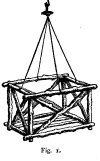 with
moss, or straw, or dried leaves. The object to be gained by this is one every
window-gardener must attend to - namely, to prevent the rays of the sun
over-heating the earth in which the roots of his plants are lying. Very pretty
and ornamental cases are made by planting common ivy between the zinc and wood,
and letting it trail over the sides, or upon a little trellis-work, which is
easily made by bending and interlacing willow wands, such as basket-makers use,
sticking the ends into the earth. I once saw a box of this sort with a very
picturesque device. Four wands were fastened at the corners, from which four
more met in the centre; round these a small-leaved clematis was trained, and
kept so close that it did not interfere with the passage of air or light to the
other flowers.
with
moss, or straw, or dried leaves. The object to be gained by this is one every
window-gardener must attend to - namely, to prevent the rays of the sun
over-heating the earth in which the roots of his plants are lying. Very pretty
and ornamental cases are made by planting common ivy between the zinc and wood,
and letting it trail over the sides, or upon a little trellis-work, which is
easily made by bending and interlacing willow wands, such as basket-makers use,
sticking the ends into the earth. I once saw a box of this sort with a very
picturesque device. Four wands were fastened at the corners, from which four
more met in the centre; round these a small-leaved clematis was trained, and
kept so close that it did not interfere with the passage of air or light to the
other flowers.
The pots or cases having thus been secured, the next - thing
to do before filling-in the earth will be to attend to the drainage. Be very
particular never to let your plants stand in water. Some few plants, it is true
- hydrangeas, for example - like to have their roots kept constantly moist, but,
as a rule, plants, like men, are better with their feet dry.
The best way to set about the drainage is to cover the - hole
at the bottom of the pots with a piece of a broken pot, so placed as to afford a
free passage for the water; over this spread moss or straw, to prevent the earth
running down and choking up the drainage. If a case is used, set to work in the
same way, only lay the broken pieces a little thicker, and let the moss be also
thicker, and well pressed down. A very good drainage may be easily obtained by
filling the bottom of the box or pot with a layer of common coal cinders, about
an inch in thickness.
The next thing is to get soil - not always an easy matter in
a crowded town, and often entailing many a long walk. In London it is very
difficult indeed to get soil, if there is no ground adjoining the dwelling which
can be laid under contribution. It will often prove the best economy to procure
some 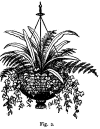 from a gardener,
which will have the advantage of being specially prepared for the growth of
flowers; and the expense of getting such a small quantity as would be required
for a window-garden would be very trifling indeed. At any large market where
flower roots are sold, the gardeners are glad to part with any of the refuse
soil they have brought there round the roots of the plants for a very trifling
cost. For a penny or two the amateur window gardener will get enough soil to
fill at least two good-sized flower boxes. When people can get out into the
country, they will have little difficulty in obtaining leave to gather the earth
that they want from the little hillocks of road-scrapings piled at the side of
the road, which are full of valuable manure, choosing always those parts where
the grass is stiff and sharp. For some plants - namely, those of the fine
hair-rooted sorts, such as heaths, &c. - a more fibrous earth, mixed with
flints and sands, will be required. This can always be obtained where heath
grows. When you have time, and really mean to excel in your flowers, it is an
excellent plan to carry home a few sods of the wiry grass we mentioned, and
having charred the grass at the fire, lay the sods away in any dark dry corner
for a month or two, when it will be ready to powder down with the hand. In some
cases it is a good thing to mix sand with it. All soils, however, do not require
an extra quantity of sand, and you can determine as to this in a very simple
way. Take a little soil in your hand, and work it into a pulp. If it feels
gritty, you will require very little sand, perhaps none at all; if it gets
simply soft and smooth, add sand accordingly. The manure you mix with the soil
must be perfectly rotten, and in a crumbling state. You must use your own
judgment, when it is thoroughly mixed with the soil, as to adding sufficient
moisture. It is a mistake to use too fine soil, as it is apt to run together and
cake; therefore take rough soil in proportion to the size of your pots.
from a gardener,
which will have the advantage of being specially prepared for the growth of
flowers; and the expense of getting such a small quantity as would be required
for a window-garden would be very trifling indeed. At any large market where
flower roots are sold, the gardeners are glad to part with any of the refuse
soil they have brought there round the roots of the plants for a very trifling
cost. For a penny or two the amateur window gardener will get enough soil to
fill at least two good-sized flower boxes. When people can get out into the
country, they will have little difficulty in obtaining leave to gather the earth
that they want from the little hillocks of road-scrapings piled at the side of
the road, which are full of valuable manure, choosing always those parts where
the grass is stiff and sharp. For some plants - namely, those of the fine
hair-rooted sorts, such as heaths, &c. - a more fibrous earth, mixed with
flints and sands, will be required. This can always be obtained where heath
grows. When you have time, and really mean to excel in your flowers, it is an
excellent plan to carry home a few sods of the wiry grass we mentioned, and
having charred the grass at the fire, lay the sods away in any dark dry corner
for a month or two, when it will be ready to powder down with the hand. In some
cases it is a good thing to mix sand with it. All soils, however, do not require
an extra quantity of sand, and you can determine as to this in a very simple
way. Take a little soil in your hand, and work it into a pulp. If it feels
gritty, you will require very little sand, perhaps none at all; if it gets
simply soft and smooth, add sand accordingly. The manure you mix with the soil
must be perfectly rotten, and in a crumbling state. You must use your own
judgment, when it is thoroughly mixed with the soil, as to adding sufficient
moisture. It is a mistake to use too fine soil, as it is apt to run together and
cake; therefore take rough soil in proportion to the size of your pots.
In transplanting or repotting you must be careful to damp the
earth and roots thoroughly, then spread the fingers over the surface, reverse
the plant, and tap the pot smartly, the contents will come out unbroken;
separate the outer roots a little at the outside, place the plant in the pot,
and crumble in the fresh earth round the ball of roots. If the earth is lumpy,
and the roots scanty, wash the roots free from soil, keeping them in your hands
and manipulating very quietly, for fear of breaking the fibres; then, replacing
the plant in the pot, throw in the fresh earth, packing carefully, but lightly,
when rapid growth is the object. This last should always be observed; but if you
want to stimulate flower bulbs, pack the earth firmly. After transplanting,
water equally with a rose, or if you have not such a convenience, take any flat
thing - a lid or a piece of wood - and by holding it over the plant, a gentle
stream of water falls upon the surface, which will thus be diffused over the
foliage as well as the soil.
For raising seedlings, warmth, air, and comparative darkness
are essential. Warmth must range at 45? or 50? to germinate the seed, after
which 60? is quite as much as the young plants will bear. Moisture is
essential, but should be equal, and never excessive.
Comparative darkness is desirable, as the seed will sooner
germinate, and throw forth its shoot, than when kept in a hardened condition by
the influence of a hot sun. Care must, however, be taken to accustom the plants
gradually to the light, and that as soon as they begin to show above the
surface. The great secret in raising seedlings is never to allow them to get a
check.
It is more difficult to raise seeds in pots than in the [-45-]
open air, and we shall therefore give a few practical directions for
planting and raising them.
Our illustrations show designs for hanging-baskets, which may
be suspended in the window by a hook driven into the ceiling of the apartment,
and, when filled with ferns, creepers, &c., will be found to produce a very
elegant effect. Of these Fig. r represents a basket made of rough pieces of
rustic wood joined together, while Fig. 2 is of a little more elaborate kind,
being composed of twisted wire.
[-58-]
GARDENING.-III.
THE SMALL SUBURBAN GARDEN.
AMONG the many thousands of houses which have been built
during the last few years in the neighbourhood of our large towns, few are
without some small patch of ground which may be turned to account for flowers.
There may not be room for an extensive and showy display, but there is usually
enough, either at back or front, to make an ornament to the house, and to afford
some degree of amusement and interest to the owner. What to do with these small
plots, is the difficulty with many who are without gardening experience, and
have little time to acquire it, and consequently we very often find such spaces
either very injudiciously filled, or neglected altogether. We shall try to put
our readers in the way of making a flower garden, even if the space at their
disposal be only a few yards in extent, and this at a very small outlay of
either money or labour.
We must ask our readers to keep in view the hints we gave in
our last paper, as to the planning of the small garden, and the preparation and
improvement of the soil. Taking these as a starting-point, we will suppose the
beginner to have put his piece of ground in order by clearing away rubbish, well
turning and breaking up the soil, and importing mould if necessary. For getting
the ground ready, if it has ever been used as a garden before, he will find a
three-pronged fork far more useful than a spade. It will be more effective in
its work, while at the same time it is more easily handled. But, in selecting
either spade or fork, do not choose a large or heavy implement. Select a tool
that you can wield with ease, for by so doing you will be able to go over far
more ground in a given time, than if you chose one which apparently would turn
up a great deal more at a stroke, but would entail in its use a degree of
fatigue which might soon compel you to desist altogether. People very often
fancy that it is necessary to get tools for their work of the same size and
weight as those which a regular gardener is in the habit of using, but this is a
mistake.
With such operations as trenching, manuring, and making pits,
all of which are most important, and will require a full explanation, it is not
our purpose to deal at present. Our readers who may desire information on those
subjects will find it as we proceed ; it being our intention to describe all the
various gardening operations in their regular order, as they are successively
required.
The ground prepared, it has next to be laid out. There must
be the space in which the flowers are to be grown, and - what it is equally
important to provide for - the means of getting at the flower-bed or beds from
all points, for planting or cultivation. A small garden should have small beds ;
but it is a common mistake to make one large bed in such a place, usually in the
form of a circle or an oblong square. If the garden is surrounded by an open
fencing, the best arrangement is a flower border running round three of its
sides, with a walk up the centre.
[-59-] If there is sufficient
width, a middle space may be allotted to flower-beds in addition. But if as we
have before remarked, a wall or close fence encloses the plot, make your
flower-beds in the centre, and your walks around the sides.
The arrangement of side beds may be made either in the usual
fashion of a straight and uniform line, or with the outer border forming a waved
line. The latter plan is decidedly preferable where the available space is not
so limited as to cause a trivial effect. Besides being a departure from the
tiresome uniformity which ordinarily meets the eye, it affords somewhat better
means of tending the flowers, as the indentation of each curve gives a more
convenient approach to the plants. But in these and other matters, it is hardly
possible to lay down any very definite rules, and the reader must be guided by
the suitability of the plan suggested to the space at his disposal.
As to centre beds, beware, in any case, of
the mistake to which we have before alluded. It may be easy enough to plant a
large bed, beginning from the middle and working outward ; but when the plants
come to grow, it is impossible to tend them properly without risk of injury.
When they require trimming or watering, the plants are difficult of access, and
you must step upon the bed to accomplish the work. For watering, in town
gardens, should be given occasionally to every individual plant; not to its
roots alone, but thoroughly over its leaves, to remove from them the dust and
other pollutions which choke their pores. And when plants are in flower, it is
necessary to remove from them continually all decaying leaves and spent
blossoms, so that they may be kept in health, and their period of blooming may
be prolonged as far as possible.
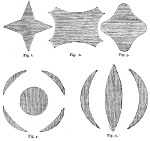
Accordingly, for any central space, let the ground be
divided, so that access to all the plants is freely open. If the space will
allow the formation of one good-sized bed only, reject the form of either circle
or square ; there are others which will be both more pleasing to the sight and
more convenient from the gardening point of view. We give two or three diagrams
of suitable forms of single beds, Figs. 1, 2, and 3, which will suggest others
to our ingenious readers.
When there is a larger space available, and more than one
central bed can be made, the ground may be portioned out in geometrical forms,
comprising a circle or an oval, with segments of a circle. Our illustrations,
Figs. 4 and 5, suggest figures applicable in this case, always remembering to
let the forms chosen satisfy the eye, as well as afford ready access to the
plants.
We have seen, where plans similar to these are adopted, and
especially where the garden is formed on what was previously meadow land, the
grass left on the spaces around or between the beds. But we must confess we
would rather relay turfs at any time than attempt to renovate old and coarse
grass, which can never be made to look so well as new; neither do we approve of
turf for either edging or lawn in very small gardens. It requires, in summer
particularly, incessant clipping and attention to keep it in tolerable order,
and the time which should properly be devoted to the plants is thus occupied by
their surroundings. What is best for the purpose is a walk of neat gravel.
FORMATION OF GARDEN PATHS.
In the case of paths, we have heard it stated that
perfect drainage is only absolutely essential in a very damp locality, or where
there is a rush of water from higher ground near at hand; but we beg to differ
in this respect, because we look upon it that "whatever is worth doing is
worth doing well," and as it is merely the question of a little extra
labour, there is no good reason why so important a matter should be slighted.
Our plan is to shape out the paths exactly, and remove the earth in their entire
course to the depth of eighteen inches, making, as it were, a clean, square
trench; then, having spread stones or rubbish, such as broken crockery, burnt
brick clay, or some similar hard material, so as to fill to the surface, we
permit it to lie for a time, ramming it down every now and again, until it has
become perfectly solid. In a week or more, according to the weather and labour
bestowed, it will be sunk to a distance of six inches from the top of the
trench. Then place upon it a layer of coarse gravel, from three to four inches
thick, and let it be well rammed down, and afterwards rolled as flat as
possible; and as soon as you have made the surface to your liking, put another
two-inch layer of finer gravel over the whole, roll it as before, and you will
have a path that will discharge any amount of wet, and never give way or become
rotten or untidy, let the weather be what it may. The gravel for the purpose may
be obtained in many localities at a very slight expense, and it is not
necessary, although it may be desirable, to have more than the usual bottom of
well-beaten earth; but where it is not so easily procured, stones, shingle,
rubble, or any similar material, may be beaten into the ground to form a solid
path. All garden paths, great or small, should be somewhat higher in the centre
than at the sides, to allow water to run off freely, and so prevent their
getting into a sloppy and unpleasant condition in wet weather.
In the choice of material for the borders of beds, tastes
differ widely, some preferring a permanent edging of tiles, [-60-]
or similar material, while others will have nothing but flowers. But
where flowers are used for the purpose, it is necessary to plant very closely,
or one of the chief objects of the edging - namely, to keep the mould from being
brought down on to the path by rain, &c.- will not be secured. Nothing
answers this end better, or looks neater, than good terra-cotta tiles, which may
be obtained at the rate of about 15s. the hundred, each tile nine inches in
length. Where this edging cannot be procured, rounded stones are sometimes used;
and in small gardens, in the vicinity of towns, we have frequently seen borders
of oyster-shells, or broken bricks driven into the ground with the corners
uppermost.
Box is the best and most lasting material for a permanent
green edging, but it must be planted with great care, to protect it against
frost. The soil round the edge of the bed to be formed must be patted down firm
and even, or level, and having chopped out the trench in a slanting direction
towards the walk, the roots of the box must then be laid against this, and the
soil pressed down tight as the trench is being filled up around them. They
should be planted in March or September, and clipped in July or August. An
edging of grass is objectionable, as we have already remarked, as it requires
constant attention to keep it tidy.
THE CULTIVATION OF SMALL GARDENS.
In the outskirts of London, and, indeed,
of most towns, there are to be found numbers of small houses at a moderate
rental, with a very small patch of ground at the back, from twenty to thirty
yards in length, and six or seven yards wide, so small, in fact, that at first
sight it might appear questionable whether it would be really worth the time,
trouble, and necessary expense to keep it in a state of cultivation. We hope to
be able to show that this would be a mistake. A plot of ground, however small,
is far too valuable to be wasted, especially in the suburbs of towns, where
garden produce of every sort and description is very expensive; and our present
object is to show those of our readers who have small gardens of this kind in
what manner they may cultivate them to the best advantage.
The laying-out of them should be as simple as possible -
either with a path down the centre, and beds on each side to the boundary walls,
or else with a path running round the garden at about two or three feet from the
wall. Of these, the latter is preferable, for several reasons; it is certainly
more sightly, and enables the occupier to reach every part of his little
territory with facility.
Of course, if it be merely intended to use the garden as an
ornament, it will be easy enough to fill the surrounding beds with flowers, the
centre being laid out in grass, with a few small beds of flowers in the centre,
as we have already described, but this is an expensive matter, as all the plants
will have to be procured fresh year after year, there not being sufficient space
to propagate fresh ones, or to keep a stock through the winter for the next
summer's planting.
If it be desired to make the garden remunerative, flowers
must be made a secondary consideration, and the principal part of the space
should be filled with a judicious selection of vegetables. In favourable
situations such a plot would grow the cabbages, lettuces, radishes, endive,
onions, spinach, and the various useful herbs necessary for a small family; and
if all the ground were kept continually under cultivation, or, in other words,
as soon as one crop is done with it were cleared off, and another put in its
place, it might be made remunerative.
In the case of smaller plots of ground, such as belong to or
accompany dwellings of a minor description, which might be better understood by
the name of yards, if they were only paved, it would likewise pay the tenant to
grow useful pot herbs, and such crops as onions, lettuces, radishes, and so
forth; and as such there is no reason why even a single foot of soil should lie
idle. In a future paper we shall again revert to the subject of gardens on a
somewhat larger scale, and endeavour to show how to make them pay.
Cauliflowers, rhubarb, sea-kale, and even asparagus might be
grown.
A few of the most useful fruits, such as raspberries,
currants, gooseberries - of course, small-sized - might be planted here and
there in the garden, currants might be nailed against the wall with advantage -
(these latter would prevent that look of bareness about the walls, so
detrimental to the appearance of any garden) - and space might also be found
here and there for a few strawberries.
In an ensuing paper we shall give a plan for the laying out
of a small villa garden, and shall then proceed with some account of the
tool-house - so necessary an adjunct to every garden, however small - and with a
brief description of the nature and uses of the more ordinary garden tools.
[-81-]
GARDENING.-IV.
THE WINDOW GARDEN (continued from p.45).
THE practical result of good gardening is to keep up a
show of blossom or ornamental foliage all through the year, to effect which it
is necessary to know the seasons when the various plants arrive at perfection.
Supposing, therefore, we begin our year in winter, though few flowers are
blooming out of doors, yet our window garden may be gay enough, as may be seen
from the following list of flowers which bloom at that season, all of which are
available for our purpose -Pompon chrysanthemum, tree carnation, Chinese
primrose, polyanthus, single garden anemone, mignonette, musk, Neapolitan and
Russian violet, wallflower, scarlet geranium, myrtle, camellia, China rose,
heaths, daphne.
Besides these there are many more, but as they require more
attention and greater space for growth than most of our readers will be able to
spare, we shall leave their names until a future number, and say a few words
upon the culture of each of those given in our present list. 
Pompon Crysanthemums are especially suitable for
winter window decoration, both on account of their size and variety of colour.
Though naturally dwarf ?plants, they will admit of still further dwarfing, by
having the points of the shoots "laid" at the end of August. In
potting you will require rich light soil give plenty of water afterwards, and
when they have done flowering remove them into a yard or spare window and
protect them from sharp frosts. You can increase your stock by dividing the
roots or suckers, in April or May
Tree Carnation.-Make cuttings in spring, re-pot in
May, again in September; pinch off the points of the early shoots when you first
re-pot, so as to retard the flower-buds. Train upon a wooden frame or up the
sides of the window.
Chinese Primrose - Sow in April or May under a
square of glass; pot and re-pot twice, as the plants increase in size. Use
sandy, fibrous, rich earth, and see that you have free drainage. When past
flowering treat as chrysanthemums, and re-pot for the second season.
Polyanthus takes a moderately large pot, rich loamy soil,
and should be watered with liquid manure.
Single Garden Anemone. The roots of these and
their bulbous brethren are the better for being taken out of the earth when
flowering is over, and stored for the summer. This, however, must not be done
until the foliage withers, which shows that Nature is resting. Good plants may
be had by putting in the roots early in winter, and keeping the pots in a dark
cool place until their leaves appear.
Mignonette?-To bloom through the winter,
select from the box or bed, and re-pot a strong woody plant, train it up
a frame of sticks, and water sparingly.
Musk - grown either from seed, cuttings, or division
of the roots. Keep very moist while growing, and dry while the plant is sleeping.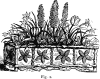
Violets, Neapolitan and Russian.- Re-pot in May,
expose to the air as much as possible, either in a border yard, or window-box.
Use well-manured, rich earth watering freely. When the runners appear, nip them
back so as to concentrate the strength in the main root. In September re-pot
into light loamy good soil, and place in your window. Give all the air you can,
and wash the leaves frequently.
Wallflowers may be made to bloom in winter by
cutting back in spring or summer, and from their perfume are always a favourite
adjunct of the window garden
Scarlet Geraniums.-The sweet-scented and
oak-leafed are the best for winter growing, and will go on flowering up to
February. Of their treatment we shall have occasion to speak under the head of
pelargoniums.
Myrtle.- No foliage is prettier and
fresher. The plant will last for years, is easily propagated by cuttings, and
although apt to grow too large for its share in a window case, can be kept
within bounds by pruning. Sandy loam. mixed with heath and a little silver sand,
is the best soil in which to grow myrtles. Re-pot once a year; wash the
foliage now and then as soot smuts blister the delicate green leaves.
Camellias.-Choose the double, which are the best
flowering sort, and treat in the same way as the myrtle. A very simple way of
striking camellia cuttings is by merely putting a spray (first nipping off the
flower-bud) in a small medicine bottle half full of water; let the stalk just
enter the water. Hang up the bottle in a light warm place, and in a short time
you will have a well-rooted young plant to pot.
China Roses - Plant in midsummer, or even later ,
use rich loamy soil, well chained. Strike at any time from cuttings.
Heaths - being rather capricious in their growth,
must be planted in heathy soil well mixed with silver sand and leaf mould,
thoroughly drained, and kept free from wet. The pot must be rather small in
proportion to the size of the plant. Give plenty of air, and protect carefully
against a hard frosts.
Daphne - although not very ornamental, and apt to
straggle in its growth, will nevertheless always find a place a where sweet
perfume is acceptable. Heath soil and loans is the most suitable earth. Be
careful to keep off frost or even a sudden chill and remove from the window at
night. Indeed, we may here observe that this rule should apply to all winter
flowers. The temperature falling so suddenly inside the room the dying out of
the fire, renders the plants extremely sensitive to the change in the outside
atmosphere. If such a misfortune as a frost-bite occurs, remove the plant to a
dark place, and let it recover itself; light will blister and decay the surface
affected by the frost.
These flowers will have shed their beauty in January. when
you should have your bulbs ready to fill their place. Of these the following
will flower in January and February :-Hyacinths, narcissus, jonquils, tulips,
crocuses, snowdrops, and scillas. The pretty effect a selection of these will
produce when well arranged, is shown in our illustration, Fig. 2.
The treatment of these several sorts is much alike. Plant in
soil mixed with leaf mould and well-rotted manure, early in autumn, say
September. Keep in the dark until well rooted, which process is encouraged by
having a saucer supplied with water below the pot. When the roots are thoroughly
grown, which will generally take place in eight weeks, remove the pots to the
light, and the flower and foliage stems will soon show. Great [-82-]
care should be taken to have the drainage act quickly, as although the
plant should be well supplied with constant moisture, it must not get clogged
with wet earth. If the flowers of the hyacinth begin to show before the
stein has sprung up far enough to let them develop fully, you can force its
growth by twisting a paper funnel and placing it over the plant; flowers always
seek the light, so the hyacinth will strain to reach the greatest light as shown
by the aperture at the top of the funnel.
By the time your bulbs have finished flowering there are many
pretty spring flowers ready to blossom, so we will suppose you have been
preparing a stock of primroses, violets, ranunculus, anemone, Indian pink,
forget-me-not, and lily of the valley.
Of these, Primroses are perhaps the most popular,
reminding as they do of country lanes ; they require no further care than good
drainage, and to be planted in light soil mixed with leaf mould.
Violets we have already described.
Ranunculus, Anemone.-These are treated in the
same manner as the single anemone mentioned before.
Indian Pink, Forget-me-not.-Sow in
November, thin out if too thick, keep cool and dry.
Lily of the Valley.-Take close plump roots and
pack tightly in the pot, shake in a light sandy soil, and place in a saucer
constantly half-full of water.
To follow the early spring show you have a large and very
beautiful family of flowers, known as annuals. We scarcely need say that an
annual is a plant which is sown, blossoms, goes to seed, and dies in a year.
Some annuals, it is true, may be made to live on for several
years, but this is only by coaxing nature into an unusual course, by picking off
the buds, or pruning back. The annuals suitable for our purpose are those not
requiring artificial heat, and therefore designated hardy and half-hardy ; of
these the following list will suffice to keep up the summer supply:- Mignonette,
lobelia, mesembryanthemum, portulaca, balsam, cockscomb, convolvulus, anagallis,
calandrinia, nemophila, and mimulus.
The treatment of these small-seeded annuals is alike. Sow in
March or April under a pane of glass, thin out, and transplant when large
enough. They will then be ready to fill your window in June, or even the end of
May, and continue flowering until the harder wooded perennials are ready. Of
these, the favourite sorts suitable to the window are:- Pelargoniums of various
sorts, fuchsia, salvia, and calceolaria.
For low-growing plants to fill up the case, you should keep
up a supply of lobelia, musk, and moss. Mignonette never comes amiss for an odd
corner, and the common wild mosses, grown in flower-pots, form a lovely relief
to the bright colours of the geranium.
Pelargoniums, usually known as geraniums, are
propagated by cuttings made from March up to the end of August.
The scarlet geraniums are not quite so suitable for - window
gardening as the large florists' geraniums, which grow luxuriantly in the house,
and often, too, under the most adverse circumstances. In taking cuttings you
should select well-ripened stems, removed as far as possible from the flowering
shoot; let them be about three inches in length, and cut across a joint with two
or three joints above; the cutting should not be sunk deeply in the soil, an
inch is quite deep enough.
Pelargoniums require forcing every year ; first you must
prepare them for the operation by hardening the wood in the open air. When they
have been out of doors three or four weeks, cut back the young shoots, giving
the plant the form required; this is the fittest opportunity for cuttings, as
you then make a better selection, and do not damage the plant.
After pruning, the plant should be kept pretty dry until the
young shoots break away, then they must be re-potted into sandy loam, leaf
mould, and fibrous earth. Take care to nip off any decaying roots, water freely,
and shade from the glare of sunlight. Plants re-potted in February will flower
in June, and you can go on, keeping up a continuous show by merely taking care
to re-pot at proper seasons, beginning when the plant is young, or by nipping
off the first young shoots, thus obliging the parent stem to send out fresh
flower stems.
Fancy or dwarf geraniums are much grown now, and if nicely
pruned form lovely little shrubby plants. These require more water while
sprouting, and should have smaller pots in proportion, while the addition of a
little heath soil is a great advantage. The best time to make cuttings of any
geranium is in March and April, and then you should take the little side shoots,
and having struck re-pot them once or even twice during the summer. Before
leaving the subject of propagation by cutting, we must impress upon the window
gardener that to have a good strong plant to stand the winter he must strike his
cuttings not sooner than March or later than June.
Some of the fancy geraniums bloom almost continually. This is
a grand object to achieve in a window garden, so we advise our readers to buy a
plant of Gaines' scarlet, Rollisson's purple, or the Prince of Orange, a strong
young plant, any one of which may be had for three or four pence at a nursery
gardener's ; and here let us observe that the first outlay is the last, as a
good stock can always be kept up by propagation, or exchange. Those geraniums
which are kept in foliage all the winter require considerable care ; the leaves
will grow yellow and drop off if you do not keep them moist, which is best done
by syringing, or washing delicately leaf by leaf with a small sponge or bit of
flannel, an operation which can be easily done after the day's work, if you are
careful to draw the plant-case into the room, and avoid any chance of frost
catching the damp leaves. While plants are blooming, care should be taken to
keep them moderately moist.
Fuchsia.- There is nothing more graceful or
ornamental than this queen of window plants, and on the whole nothing more
simple in its cultivation. Propagated like the pelargoniums from cuttings, the
plants require much the same treatment, that is to say, re-potting, pruning, and
hardening. One thing, however, the fuchsia is more greedy of, and that is water;
you can scarcely water a healthy plant too much, always understanding that the
pot has a quick and thorough drainage. Give all the air possible, and when the
lovely bells fall and the leaves turn yellow put the plant out of doors to drink
in life and vigour from the pure breath of heaven. Take care however, that it
does not get frost-bitten; prune and remove into smaller pots for the winter in
October cm November, and set it somewhere where neither frost nor excessive damp
can reach it.
In March, when the plant is shooting, you must form it
carefully. Slips pulled off close to the old wood in April will strike well, and
make neat plants for flowering in autumn ; the parent plant must be re-potted in
a slightly larger pot, and kept well watered by syringing the stem, rather than
deluging the root.
The best form in which to train a fuchsia is that shown in
Fig.1. The plant throws out more graceful branches, and takes tsp less room in
the winter; the stem will go on growing until it attains a considerable
thickness. Liquid manure is good for fuchsias while they are preparing to bud,
but should not be given after flowering, and the flowers should never be wetted,
or they will drop off before their time.
Salvias.- The scarlet, by proper
management, may be contemporary with the chrysanthemum as well as the
pelargoniums, and all the precaution necessary is to top your cuttings taken in
early summer, and force the plant to go over its preparation for flowering
again.
[-113-]
GARDENING.-V.
THE WINDOW GARDEN (continued from p. 81).
FERNS are among the most beautiful of the plants adapted to window culture.
The graceful forms of the foliage more than compensate for the absence of
flowers when they are used alone ; but when they are employed together with
flowering plants, in some such contrivance as the bulb case engraved in our last
paper the effect extremely pleasing. They may be placed as a centre with dwarf
flowers around, according to their size and habit of growth. But they are
also useful for hanging-baskets, the drooping fronds falling naturally over the
sides, and making a handsome base either for the flowers or taller ferns which
may be grown in the centre.
 With
regard to the baskets used for such purposes as this, we may remind our readers
that it is not at all necessary that they should be of a very ornamental
character; so long as they are neat in outline, and adapted to the purpose by
being sufficiently roomy to admit the soil and the free growth of the plants, it
is immaterial what amount of decoration may be displayed upon the sides. As the
plants grow, these will be covered and hidden from view, and, therefore, the
elaborate and expensive affairs which are sometimes sold for hanging-baskets,
are practically worth no more than the plain and unpretending articles which may
be purchased for a quarter of the sum. A good example of the hanging-basket has
been included in our previous illustrations.
With
regard to the baskets used for such purposes as this, we may remind our readers
that it is not at all necessary that they should be of a very ornamental
character; so long as they are neat in outline, and adapted to the purpose by
being sufficiently roomy to admit the soil and the free growth of the plants, it
is immaterial what amount of decoration may be displayed upon the sides. As the
plants grow, these will be covered and hidden from view, and, therefore, the
elaborate and expensive affairs which are sometimes sold for hanging-baskets,
are practically worth no more than the plain and unpretending articles which may
be purchased for a quarter of the sum. A good example of the hanging-basket has
been included in our previous illustrations.
When ferns are employed alone in the basket, it should be
fitted with a zinc pan, in which to place the soil, as it will be necessary to
keep this constantly moist, and without the pan an unpleasant dripping would be
experienced. Ferns for the purpose of indoor culture may be found in abundance
in any wood, and in most of our country lanes. They may occasionally be seen
growing in chinks of rocks, upon old walls, &c. A good variety might thus be
obtained with very little search including the common maidenhair, the hart's
tongue, spleenwort, lady fern, and many others. The locality will in many cases
decide the examples which may be thus selected for growth as each district has
some kinds more or less peculiar to itself. The plants chosen should be small -
the smaller the better - as the more pleasure will be found in watching
their gradual development; and when they have grown somewhat too large for the
pot or basket, they may be removed to the garden, where they will help to make a
pleasing variety among the shrubs and flowering plants.
If ferns be procured from a nurseryman or seedsman the hardy
native kinds should be chiefly chosen for window gardening, and they may be seen
in numbers and variety to suit any individual taste. Many of the other species
are apt to require too much heat and moisture to render them desirable subjects,
especially for growing in baskets. A few good healthy ferns to start with, will
enable you to keep up a constant supply, as they may be propagated with ease by
division of roots, and by raising from the spores. The spores are the seeds
which are found on the under surface of the frond, and they are most easily
collected by cutting off the frond entirely when the spore-cases become brown,
and laying it by in a warm place, wrapped in a piece of paper. In a few days the
cases will have burst, and the spores may be collected and sown. They may be
sown in a pot, which should be half or three parts full of material for
drainage, and the soil should be light and fine. A little moss placed underneath
the soil will keep it sufficiently moist, and assist the growth. A small piece
of window-glass should be put over the pot, and left there until the shoots
begin to appear above the surface, when it must be raised occasionally for the
admission of air. When the plants have grown large enough to handle, they should
be transplanted immediately.
Drooping plants, which will flower freely in the basket, may
be had in great variety and at very little cost. Among the most popular
favourites of this kind are the nasturtium family, tropeolum, canariensis, and
other varieties, convolvulus major, honeysuckle, and trailing mesembryanthemum;
but there is scarcely any limit to the number of plants that may be grown in
this way. The verbenas, heliotropes, petunias, nemophilas, lobelias, mimuluses,
&c., may be trained to cover the sides of the hanging-basket, and thus each
spring or summer an entire change may be made in the character of the plants so
grown.
We will conclude these papers on the window garden with some
hints on the raising and keeping of plants which require something more than the
slight degree of attention which is sufficient for many of the kinds described
in our last paper. It will be found advantageous to stimulate the growth of
certain seeds by artificial means, some of which may be carried into effect
simply and inexpensively. Bell glasses are useful, and not expensive. A cracked
tumbler will answer the purpose in some cases; and in others, a flower-pot
turned upside down. In a cottager's garden we once saw a very neat contrivance:
a tray was filled with sawdust, and placed in an east window; on this the pots
with their seedlings were placed, and over them was a frame of glass. The
sawdust, by being kept wet, moistened the soil, and at the same time generated a
sort of bottom heat, which materially helped the seeds to germinate on cold
days. The master and inventor of this little forcing establishment sprinkled the
sawdust with warm water.
[-114-] The pots must be filled
one-third with cinders for drainage; we then divide the remaining space into
three parts-laying first a layer of lumpy, rough soil; then a layer of finer
soil, mixed with sand; next, and lastly, finely-powdered soil, containing a
greater quantity of sand.
The surface soil must be sandy and light, If you cannot
obtain heath soil, a little powdered charcoal is a good substitute.
Water the pots so as to thoroughly damp the soil, and let
them stand for a day to drain in a dry shaded place.
Level the surface of the soil and then thinly scatter in the
seeds, top-dressing them with a layer of fine soil of a thickness in proportion
to the size of the seeds used press the soil down, and lay over the top of the
pot a square of window-glass; sometimes, in case the plants are delicate, or the
sun scorching, it will be found advisable to shade with a piece of paper.
For small seeds, such as calceolaria, lobelia, &c., a
slight dressing of dry silver-sand is best. Mignonette requires dusty dry earth,
lightly laid on. Balsams will take the tenth of an inch, and convolvulus
one-fourth, to cover them. It is a very common mistake to plant seeds a great
deal too deep.
For bringing on tender plants, and keeping the less hardy
kinds in winter, the miniature greenhouse is a most useful contrivance. Any
ingenious person possessed of a few tools may make one for himself. The size and
kind of the house must depend upon the number and nature of the plants he wishes
to provide for, and it may be either little more than the ordinary garden-frame
in character and appearance, or so constructed and fitted as to keep
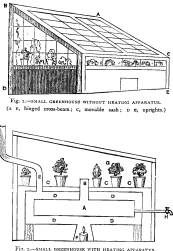
stove-plants in health in a severe season. Our illustrations will afford an idea
both of the more simple and the more elaborate contrivances of this kind, and
they maybe of very moderate dimensions - in fact, in length from four feet
upwards.
Fig. 1 represents a small house, which may be placed in the
corner of a garden or yard, to act as a receptacle for the window-plants when
they have ceased to flower, a training-house for young plants raised from seed
or cuttings, and a shelter for fuchsias, calceolarias, verbenas, &c., in the
winter.
It should be erected with the back on the north side of the
garden, and the roof sloping towards the south, so as to receive as much as
possible of the sun's rays. A good layer of fermenting dung, placed underneath
the soil, and removed from time to time, will generate heat; but in fine and
temperate weather the roof should be lifted for the admission of the air, which
is necessary to keep the plants thoroughly dry and healthy. At night, if the
weather be frosty, the structure should be covered with a cloth or mat to
prevent radiation.
Our next illustration represents an arrangement for the
supply of heat by artificial means without much expense or trouble, and this
also is adapted to a greenhouse on a very small scale. The means used is a
hot-air chamber, kept at a certain temperature by means of a spirit-lamp laced
under a water-reservoir. A is here the reservoir, and B the opening for the
water supply, covered by a lid when the lower portion of the reservoir is full.
C may be either a stand for pots, or the soil in which the plants are embedded.
D D represents the air chamber surrounding the reservoir, and which moderates
the heat before it reaches the plants; while E is the flue through which the
heat is allowed to make its escape when it becomes excessive. F is the
spirit-lamp, G the movable sash by which the outer air is freely admitted in
temperate weather, and H the tap by which the water may be drawn off. Either of
these plans is capable of adaptation to any corner of ground that may
be available for the purpose.
THE
CULTIVATION OF SMALL GARDENS.
(Continued from p. 60.)
 Gardens must
necessarily vary in extent and shape. We will take as an example a plot of
ground ninety feet long by forty wide, and although this will afford very fair
scope for carrying out a nice arrangement with economy, still simplicity of
design will be necessary. We do not advocate intricate plans on a small scale,
as they only entail extra labour without an equivalent return. Suppose, then,
that the frontage is laid out as a lawn and flower garden, we will proceed to give
a few hints to enable our readers to follow out our plan, with such variations
as their own inclination may suggest. As a rule, let all walks in this
department be curved rather than straight, sharp angles being very objectionable
and harsh to the eye. Let the beds and borders be oval, round, or simply curved,
rather than angular. If you have room for a grass plot, all well and good; but
we do not like to see a lawn too small to be effective. It will be seen by the
plan (Fig. 3) that we have provided for one in this instance. On this lawn we
would plant a few miniature ornamental trees such, for instance, as copper beech
silver birch, red or black thorn; or some of the better kinds of conifers, as
cypress, pines, &c. The plots marked 2 may be planted with flowers; 3 is
shrubbery.
Gardens must
necessarily vary in extent and shape. We will take as an example a plot of
ground ninety feet long by forty wide, and although this will afford very fair
scope for carrying out a nice arrangement with economy, still simplicity of
design will be necessary. We do not advocate intricate plans on a small scale,
as they only entail extra labour without an equivalent return. Suppose, then,
that the frontage is laid out as a lawn and flower garden, we will proceed to give
a few hints to enable our readers to follow out our plan, with such variations
as their own inclination may suggest. As a rule, let all walks in this
department be curved rather than straight, sharp angles being very objectionable
and harsh to the eye. Let the beds and borders be oval, round, or simply curved,
rather than angular. If you have room for a grass plot, all well and good; but
we do not like to see a lawn too small to be effective. It will be seen by the
plan (Fig. 3) that we have provided for one in this instance. On this lawn we
would plant a few miniature ornamental trees such, for instance, as copper beech
silver birch, red or black thorn; or some of the better kinds of conifers, as
cypress, pines, &c. The plots marked 2 may be planted with flowers; 3 is
shrubbery.
For kitchen and fruit garden, we have set apart two-thirds of
the entire plot. On the wall a let a peach, nectarine, apricot, or vine be
planted, or one of each, if the aspect and situation allow of it. The centre, or
main portion of the ground, may be cropped with vegetables; and if you follow a
system of rotation in cropping, and have due regard to the application of
manure, you cannot fail to make your garden pay. Let herbs occupy the border, b,
cover the wall c with plum, cherry, and pear trees. The wall d will
do for tomatoes, and the border e for smaller crops, such as lettuces,
radishes, and the like.
[-137-]
GARDENING.-VI.
THE
TOOL-HOUSE.

A TOOL-HOUSE of some kind or other must be provided in every
garden, or you will invariably find your implements out of order, and a great
deal of time will be wasted in looking for them when required for use. Such a
structure need only be of the very simplest kind; all you want is to keep out
the wet, and if you have no little outhouse convertible for the purpose, you
may put up, at a trifling expense, a small lean-to shed against the garden wall.
The shed should be fitted up inside with shelves and drawers for stowing away
mats, netting, and the like when out of use, as well as for keeping together
shreds, nails, flower-sticks, and so forth, all ready for use at a moment's
notice. Then again, the walls or sides should be furnished with nails, hooks,
pegs, brackets and supports, upon which every tool may be hung, or put away,
when not in use. Each tool should be carefully cleaned and returned to this
house as soon as it is done with. It is important to keep the shed as dry as
possible, for the damp soon rots the mats and nets, and covers iron
and..-steel tools with rust, especially knives and scissors. The larger
implements, such as the mowing machine, barrow, &c., might stand in the
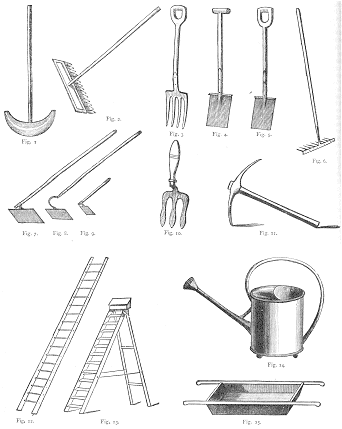
centre of the building. Our illustrations show the best forms of several of the
most ordinary garden tools.
The Spade - This implement is made of three sizes, and it is advisable to have two
for a moderate-sized garden ; the largest, or second size, to be used for
trenching purposes, and the smallest for digging amongst the flowering plants in
crowded borders. There are two kinds of handles, as shown in Figs. 4 and 5, the
second being preferred by many on account of its being more easily wielded.
The Digging Fork, Fig. 3, as its name implies, is used for turning up the soil,
and to be really useful should have four prongs. We generally prefer the fork to
the spade where the ground is hard, as the points enter with greater ease, and
do the work of pulverising or breaking up the clods with better effect.
Small
Weeding Fork.-This is invaluable for weeding, and lifting bulbous and
fibrous roots from one spot to another without injury. A convenient shape is
shown in Fig. 10.
The
Rake, Fig. 6, is used for levelling newly turned-up ground, removing, or rather collecting in a body for
removal, weeds and rubbish, burying seeds and the like by a series of forward
and backward movements. To perform this kind of work, lightness of hand is very
essential, as, if clumsily done, an even surface may very soon be made rough.
This implement is made of several sizes.
The Hoe is of great service for clearing away weeds,
thinning the various crops, loosening the surface of the soil, drawing drills,
earthing up, &c. It should be handled (when weeding or loosening the soil)
something like a chopper, bringing the blade towards you in a slanting position
at each blow; of this tool there are several forms and sizes. That shown in Fig.
7 is useful for rough weeding and drill- drawing; Fig. 8 for lighter kinds of
work, and Fig. 9 for weeding and thinning such small crops as onions, &c.
The Turf cutter, Fig. 1, is a handy tool, and is used
for cutting grass turfs, paring, or rather regulating, the edges of lawns, and
other similar worlc. It should be kept sharp all round.
The Pick-axe, Fig. 11, although not likely to be used
to any great extent in a small garden, is nevertheless useful, and necessary for turning gravel walks, and loosening rubbish
that has become too hard for removal by any other means.
The Ladder and Garden Steps.-The former, Fig. 12, will
be useful for getting up to tall trees, and climbers on walls, for the purpose
of pruning and training; and the latter, Fig. 13, which is a kind of double
ladder, will stand without any other support. This will be of great use for
pruning, or gathering fruit from standard trees, against which it is undesirable
to rear a ladder, for fear of breaking the young shoots, and injuring the bark.
The Daisy Rake, Fig. 2.-This is a very useful
instrument on a small lawn. By drawing it over a lawn studded with daisies the
heads or flowers become fixed between the teeth, and thus the lawn can be
cleared in a very short time. It may be used also for clearing away dead leaves
from the grass.
The Hammer for the garden should be furnished with
claws, such as we have described in our paper on the Domestic Tool Chest (page
24), for the purpose of drawing out old rusty nails, and training trees and
plants on walls.
The Roller is, or should be, called into use for
keeping the surface of gravel walks smooth, as well as for levelling
grass-plots, both of which operations should be performed in damp and cloudy
weather. Iron rollers have quite [-138-] superseded the stone rollers of former days they are more
lasting, easier to draw, and much more effective. The size of your roller must
be regulated by the width of your walks and grass-plots. It is well to have one
as large in circumference as you can conveniently manage. Clean it carefully
after using, and put it in the shed, or somewhere under cover. The axle must
be kept well oiled, or it will soon wear and work loosely.
The Watering Pot, of which there are several sizes, is
for giving moisture to plants in dry, hot weather, without which they would
certainly suffer severely at times, and occasionally perish altogether. The one
which we figure above, Fig. 14, will be found as convenient in shape as any.
The Axe, for felling trees, pointing stakes, and such
work, is a necessary item among garden requirements. In buying an axe take care
to select one that you are able to use with case, not too heavy, and well
balanced. Nothing is so fatiguing as to work with an awkwardly-made axe, which
requires all your strength to wield it. The edge must be well steeled, and the
handle of ash. It should not be ground to too fine an edge, and should be kept
in order with a smooth, hard rubbing-stone.
The Hand-Barrow, Fig. 15.-The chief use of this is to
remove potted plants from place to place. The only drawback is that it requires
two to use it ; but no other implement will do so well for the purpose. In our
next paper we will describe some more of the most ordinary garden tools.
ROTATION CROPPING OF A SMALL GARDEN.
In our last article on Gardening (page 114), we gave a plan
for laying out a small villa garden. In the present and subsequent papers, we
propose to give directions for cropping to the best advantage the eight beds
into which the kitchen garden was divided. The numbers refer to the beds in the
plan.
January.- 1. This bed is planted with strawberries and
raspberries-the former must be protected from frost, and the stakes of the
latter attended to. 2. Manure and dig this compartment as soon as vacant ; half
of it may be cropped with potatoes, the remainder to be left for cauliflowers,
to be planted in March or April. 3. This plot is laid down with permanent crops
of sea-kale, rhubarb, and globe artichokes. All that can be done now us to cover
the roots of the artichokes with stable manure. 4, Let this plot be well
manured and dug as soon as empty, so that it may be ready for the reception of
onions early in March. 5. Early peas may be sown to succeed those sown in
November, and such greens and other crops as are of no further use removed to
make room for a succession of peas. 6. If celery, Brussels sprouts, or other
winter crops, have been grown here, you may clear them off as soon as possible,
and manure and dig the ground for the reception of scarlet runner beans. 7. If
this plot is empty, as it should he, get it ready for carrots and other roots by
trenching the ground to the depth of eighteen inches at least. 8. This is
supposed to serve for odds and ends. All you can do is to manure and trench
such portions as become vacant, leaving the surface to be penetrated by frost.
February. 1. Remove covering from strawberries, and
fasten raspberries to their stakes. 2. If potatoes were planted here last month,
no particular attention will be required, save getting in readiness the space
left for cauliflowers. 3. Sea-kale and rhubarb for succession should be covered
with leaves or dung. 4. Give this a slight forking over on a frosty day.
Radishes may be sown with the onions in March. 5. Another sowing of peas
may be
made for succession. Remove spent broccoli, and dig the ground at once. 6.
Continue to manure and dig the ground as it becomes vacant, for it will be
required for dwarf and runner beans. 7. Expose the surface of the
ground to frost as much as possible by digging and leaving it in rough trenches,
and sow a row or two of broad beans. 8. Take up winter turnips, and have the
ground manured and trenched for the reception of future crops.
March.-. 1. If the covering was not removed from
strawberries last month, remove it at once, and stir the soil between the rows.
Prune raspberries left untouched last month, and stir the soil between them, but
not deep enough to injure the roots. 2. Plant cauliflowers here. Potatoes
planted last month will make their appearance above ground, and will require
protection from frost; any portion of this plot that has become vacant by the
removal of any winter crop, should be removed and dug up at once. 3. Make a
fresh plantation of globe artichokes, and keep up a succession of rhubarb and
sea-kale. 4. Sow onions here, either broadcast or in rows; if the former method
is adopted, radishes may be sown with them. 5. Sow peas, and get any vacant
ground cleared, manured, and trenched for the reception of future crops.
Round-leaved spinach may be sown between the rows of peas. 6. Very little can be
done with this plot as yet, it being too early for dwarf and runner beans, but
it must be well weeded, and the surface of the soil occasionally stirred. 7. If
a few broad beans were sown here last month you may get the remainder of the
plot ready for the reception of a crop of carrots, with parsnips if you wish
them. 8. This plot being intended for growing various things not mentioned
above, it may be got into order for whatever things the cultivator may have
occasion to grow hereafter.
April.- . 1. As this contains the strawberries and
raspberries only, there will be little to do save forking over the ground
between the rows of the former, and pruning and tying up the latter, if not
already done. 2. A portion of this may be planted with cauliflowers, if
not done last month. Potatoes may occupy another portion, and, if desirable, the
remaining ground filled up with later cauliflowers. 3. This being laid down with
permanent crops, will require, during the present month. little or no care, save
putting the ground in order for the season. 4. Presuming that you sowed
radishes and onions here last month, there will be nothing to do but to stir the
soil between the young plants with a hoe. 5. Two lots of peas may be sown at different periods this
month. Clear the ground of green stuff that is done with, and manure and dig the
vacant space. Stick the early sown peas as they advance in growth. 6. This
plot, which has been kept vacant may be sown with dwarf and runner beans, at
the commencement, and against the end of the month. 7. Early horn and long
Surrey carrots may be sown early in the month, and beet at the end of it. Thin out the parsnips as soon as they are large enough to
handle. Stir the surface between advancing beans and sow more for a second crop
towards the end of the month. 8. Turnips may be sown on a portion of this plot,
about the second week in the month, and any other crop that is likely to be
required may be sown or planted in the remaining space.
May.- 1. Attention will be required here, for if the season
proves dry it will be necessary to water the strawberry plants liberally. The
raspberries will require little or no attention for the present. 2. Earth up the
potatoes towards the end of the month, and keep down weeds. Stir the soil
between the first planted cauliflowers, and put out a row or two more in the
space reserved for a second lot. 3. Give the sea-kale beds a good dressing, and
the ground between the plants a slight digging or forking over. 4. Keep onions
clear of weeds, and draw radishes as soon as possible, to give the onions ample
room to grow. 5. Place stakes to the different crops of peas as they seem to
need it, and sow a [-139-] row or two of a later sort for succession, and reserve a
portion of the plot for another and final solving in June. 6. Should the crop of dwarf kidney beans have failed, as is
quite possible, make another sowing directly, and continue to do so as long as
you have room for the same, bearing in mind that they will require protection
when first they make their appearance, as they are very tender. Scarlet runners
may be sown the first week in the month. 7. The carrots sown here will require thinning as soon as
large enough to handle. Another solving of broad beans may be made, and the
early sown ones earthed up. Stir the soil between the growing rows of beet.
8.
The first sowing of turnips may be preserved from frost by covering with a layer
of clean straw or mat. Remove the remnants of greens and broccoli, and manure
and dig the ground afterwards. A few lettuces may be planted or perhaps a row of
celery, and for this purpose a spare corner should be reserved.
June.- 1. Dry litter should be laid down between the
strawberry rows to keep the fruit from the ground, and it will be necessary to
water the plants occasionally in dry weather. 2. By the second week in the
month this plot will be quite full, the second row or two of cauliflowers having
been planted; but as the potatoes will be almost ready for taking up, there will soon be room for something else. As soon as the potatoes are removed from
the ground, add a little dung if necessary, and turn up the ground that it may
be fit to receive the next crop. 3. Very little attention need be paid to
sea-kale, except to prevent the plants from producing too much flower and seed.
4. Thin the onions in this bed by means of a small hoe, if you want fine bulbs;
taking care, however, to leave no footmarks upon the ground. Celery plants ready
for planting, should be got out at once on a vacant portion of this plot: a foot
wide and ten inches deep will be sufficient for the drills, at the bottom of
which a little well-rotted manure should be put previous to planting. 5. Make the final sowing of peas about the middle of the
month, and place sticks to such advancing crops as may require support. 6. Dwarf
kidney beans may be sown once or twice more this month, and any imperfections
in the rows may be made good by transplanting from places where they have come
up too thick and are choking each other. Stick scarlet runners as they advance
in growth, and keep weeds down by frequent hoeing. 7. Thin the carrots in this
compartment, and also the turnips as soon as large enough, and sow more for
succession. Put in another crop of broad beans, and earth imp the previous
sowing. 8. Let your celery trenches be prepared for the reception of the plants,
and on the top of the ridge between the trenches, lettuces may be planted with
advantage, as they will come up in time to allow of the crop being earthed up.
The portion of this plot that has been occupied with winter broccoli should, as
soon as cleared of the stumps, be well manured and trenched.
In our next paper we propose to continue these remarks upon
rotation cropping, and when they are concluded, we shall proceed to give
detailed information on the three great departments of gardening-the cultivation
of vegetables, fruits, and flowers.
[-148-]
GARDENING.-VII.
THE TOOL-HOUSE (continued from p. 138).
BEFORE finishing our description of the contents of the
tool-house, the following list of the prices of tools may be found useful to
some of our readers:
|
? |
s |
d |
|
Spade |
0 |
2 |
0 |
|
Shovel . |
0 |
2 |
0 |
|
Spud |
0 |
0 |
6 |
|
Digging Fork |
0 |
2 |
0 |
|
Three-pronged Fork |
0 |
1 |
3 |
|
Pitchfork |
0 |
1 |
6 |
|
Weeding Fork |
0 |
1 |
3 |
|
Draw Hoe, 6d., 1s., and 1s. 6d. |
0 |
3 |
0 |
|
Drill Hoe |
0 |
1 |
0 |
|
Rake, 1s. 2d. and 2s. |
0 |
3 |
2 |
|
Dibber |
0 |
0 |
8 |
|
Trowel |
0 |
0 |
9 |
|
Potato Dibber |
0 |
2 |
0 |
|
Shears, short handles |
0 |
2 |
6 |
| Do. long handles |
0 |
5 |
0 |
|
Basket |
0 |
2 |
6 |
|
Pruning Knife |
0 |
1 |
6 |
|
Budding Knife |
0 |
2 |
6 |
|
Water Pots, 1s. 3d. and 5s. 0d. |
0 |
7 |
0 |
|
Billhook |
0 |
2 |
6 |
|
Wheelbarrow |
1 |
5 |
0 |
|
Handbarrow |
0 |
10 |
0 |
|
Roller |
4 |
0 |
0 |
|
Ladder |
1 |
0 |
0 |
|
Steps |
0 |
5 |
6 |
|
Garden Line |
0 |
1 |
6 |
|
Pruning Scissors |
0 |
4 |
6 |
|
Daisy Rake |
0 |
4 |
0 |
|
Scythe |
0 |
10 |
6 |
|
Mowing Machine... |
1 |
10 |
0 |
|
Turf Cutter |
0 |
1 |
6 |
|
Dock Spud |
0 |
1 |
6 |
|
Dutch hoe |
0 |
1 |
2 |
|
Pick-axe |
0 |
2 |
6 |
|
Fumigator |
0 |
9 |
6 |
|
Axe |
0 |
2 |
0 |
|
Syringe |
0 |
10 |
6 |
|
Water Barrow |
2 |
0 |
0 |
|
Measuring Tape |
0 |
1 |
6 |
|
?15 |
5 |
9 |
Mowing machines have become much cheaper
of late years, and one which will do all the work of a small garden can
now be bought for the sum above stated. It should be well oiled, and when
necessary can be sharpened by revolving the opposite way with emery and oil.
Pruning Scissors will be found handier than the knife
at times and for this reason we would include them in our catalogue of garden
requisites. They are especially useful for trimming small currant and gooseberry
bushes.
The Hand-saw and Tenon-saw we have already
described (p.43); the former will be found useful in the garden for the removal
of such branches as are too thick for the knife to separate ; the latter is
frequently needed in grafting where the stock is of too tough a nature, or of
too large a size to admit of the use of the pruning-knife.
The Scythe-stone, or Rubber. - This is essential for
keeping up a good edge to the blade of the scythe, which necessarily gets dulled
by use, or injured by coming in contact with stones, &c., and requires
sharpening. Most people know the old kind of stone or rubber used by mowers,
which is of a very rough texture; but there is now a better kind for garden
purposes, that puts on a smoother edge, and consequently enables the mower to do
his work cleaner and quicker. The above is usually carried in a kind of leather
satchel or sling, supported by a strap over the shoulder. The rubber must never
be used when wet, and must be handled gently, as it is very brittle. It is a
good plan to wash it carefully when you have done with it, but you must remember
to dry it before using.
Shears (Fig. 8), which are neither more nor less than
a large pair of scissors with long wooden handles in place of loops for the
fingers, will be found of great service for clipping the borders of grass, box
edgings, quick, and other hedges.
The Dutch Hoe (Fig. I) is very useful for cutting up,
or rather under-cutting weeds, and at the same time loosening the surface of the
soil. This implement should, however, be pushed before you at the depth of from
one to two inches, so that it may cut up any weeds. Fig. 2 shows a drill hoe used
for making shallow trenches for small seeds.
[-149-] The Pruning Knife,
as its name indicates, is used for the purpose of keeping fruit and other trees
and shrubs in order by cutting back the shoots at the proper time. A good form
of pruning-knife is shown in Fig. 10.
The Dibbler or Dibble, of which there are two
kinds (Figs. 5 and 6), is used for various things; the small one for planting
stocks, cabbages, lettuces; and the large one, with a projecting piece of iron
for the foot to rest on, for dibbling in potatoes. Either of these may, if
necessary, be made out of an old spade-handle, with a little contrivance,
although it is better that you have such things properly shod with iron, as they
do the work cleaner and with greater expedition.
The Pitchfork (Fig. 3) is an exceedingly handy
implement in a garden, as it is often required for turning over manure, making
up hot-beds, shaking out dry litter, and distributing such dressing or manure as
is spread over the ground previous to its being dug.
The Budding Knife is of small dimensions, and is used
in preparing the bud and stock for budding. It has a bone or ivory handle
tapering towards the end, which is used for raising the bark so that the bud may
be inserted easily. There are blades of several shapes, but the one represented
in Fig. 9 is the best for ordinary work.
The Trowel (Fig. 4) is a tool no gardener should be
without, as it is most useful for the removal of plants from one spot to
another, where it is necessary to retain a ball of earth to their roots,, and
whenever the spade could not conveniently be used.
Baskets (Fig. 7).-These will be found useful for
collecting weeds, vegetable refuse, roots, &c., in small quantities, for
removal from one place to another in lieu of the barrow. The size and number of
these entirely depend upon circumstance

ROTATION CROPPING OF A SMALL GARDEN.
(Continued from p. 139.)
July - 1. As raspberries and
strawberries are the only occupants of this department, little care will be
needed, with the exception of removing suckers of the former and runners of the
latter, in the event of their not being required - and they will not be unless
the family is particularly partial to them, at the expense of other things. If,
however, a few plants are wanted, some of the strongest runners may be permitted
to ramble at will over the ground, on the outside row, and these should be
either pegged down into pots, or into the ground. 2. As soon as the potatoes in
this quarter have been taken up, the ground should be dug over, and some early
turnips sown for a winter supply. We prefer to sow a small quantity often,
rather than wait till the entire spot becomes vacant. As it is almost too late
to plant cauliflowers, a portion of the ground may be reserved for early or
autumn broccoli. 3. Liquid manure supplied to sea-kale now will prove far
more beneficial than dung heaped upon their crowns in winter time. Rhubarb will
require no further care than cutting away all but one of the flower stems, and
this one may be considerably reduced. If, however, no seed is required, it may
be cut down close towards the end of the month. Use the hoe continually for the
purpose of keeping weeds under, and the soil in a healthy condition. 4.
The hoe may be used between onions, provided you can use it without injuring the
leaves, but not otherwise, as this crop will or should have had a final thinning
last month. If perchance a row or two of celery was planted in this department
last month, it will he necessary to earth up the same; but a dry day must be
chosen for the work. Any vacant ground should have a slight raking over, just to
make it look neat until such time as you can plant it. 5. Place sticks to such
peas as require support, and see to the immediate removal of those past bearing,
taking care not to injure broccoli and other things planted between them. 6.
Very little attention will be required here, with the exception of keeping the
kidney-beans clear of weeds, and seeing that high winds do not injure either the
dwarf or runner varieties, for it is alike detrimental to both. 7. There is just
a chance that carrots may prove a failure, and if so, as it will be too late to
sow again, the best plan will be to fill up the gaps in the beds with lettuces;
or a sowing of turnips may be made to come in in the autumn; but do not fill the
ground with anything that is likely to occupy it in the winter, as such an
arrangement would interfere with your future plans. Such broad beans as are
making rapid progress must have their tops nipped off and the soil should be
afterwards stirred between them, and, indeed, between every other crop. 8. This
compartment being principally intended for the growth of celery, and the time
having arrived for planting the general or main crop, a few words on its
management will doubtless be acceptable. Here we will only say that, to ensure
good and fine sticks, abundance of room will be necessary. Single and shallow
trenches suit best for a small supply. but for a larger quantity broad ones
should be made. Fuller directions on the growth of celery will be given as our
work proceeds. As endive and other odds and ends will partly occupy this plot,
the requisite attention must be paid to each at the right time.
[-166-]
GARDENING.-VIII.
ROTATION CROPPING (continued from p. 149).
August.- 1. Early strawberries will have completed their
work in the producing line, and the late kinds be making progress, and therefore
it will be necessary to give them their summer dressing, by clearing away all
weeds, runners, and whatever material was laid down for the purpose of keeping
the fruit free from grit and dirt. A good watering with liquid manure will prove
very beneficial both to those that have done bearing and those that are coming
into fruit. Raspberries will be in full bearing now, and as much depends on the
gathering, we would advise daily recourse to the trees for that purpose, until
they have ceased to yield. These, like strawberries, should be kept entirely
free from weeds and other litter, and be occasionally supplied with liquid
manure. 2. The whole of this plot, if properly managed, will be under
winter crop, with the exception of that portion occupied by a few potatoes
intended for seed. Under good management, broccoli will have been planted, and
turnips sown by this time, and, if so, little remains to be done, except the
making up of deficiencies, of which our readers will be the best judges. 3. This
department being of a permanent nature, little need be said, save to recommend
salt to be sparingly scattered over sea-kale; but rhubarb will need a more
generous food, and must have its full quantum. Weeds must be in all cases kept
at bay, and neither crop must be permitted to extend beyond its proper boundary.
4. As the onions in this plot will have made considerable progress, a vigilant
watch must be kept upon them, so that as soon as they are ripe they may be
pulled up, dried, and stored away in some dry, airy place. The ground thus
rendered vacant should be at once planted with celery, in single trenches,
forty- two inches asunder from centre to centre, and not deeper than eighteen
inches. A six inch layer of well-rotted stable dung should be mixed up with the
soil at the bottom of each trench, previous to planting. The first row planted
will require earthing-up by this time, and this operation you cannot do better
than see to at once. A good watering will also prove beneficial in dry weather.
5. Such peas as are over should be removed without delay, to make room for
future crops, or for the broccoli planted between them. Any gaps in the rows of
savoys, Brussels sprouts, &c., should be filled up at once, and as soon as
the whole of the peas have done their work for the season, remove the haulms,
stir the surface of the ground, and give it a good soaking with liquid manure,
for the purpose of encouraging the growth of the broccoli and other green crops,
which will require earthing-up shortly. 6. As this plot is at present entirely
occupied by kidney beans, both dwarf and runners, you will merely have to keep
the ground clear of weeds, and see that the latter have proper support. 7.
Provided the requisite quantity of beans were planted here, and the carrots were
properly thinned last month, all you will have to do for the present is to
remove the haulms of the first crop of beans as soon as done with, and keep the
compartment tidy in all other respects. 8. As some of the early
celery is still in this quarter, due attention must be given to it, so far as
earthing-up, watering with liquid manure, and weeding, is concerned. A moderate
quantity of endive may be planted out here, and a few lettuces might very well
be planted upon the celery ridges, provided it can be done early in the month,
because, if left later, the ridges will be required for earthing-up before the
celery can be cleared away.
September. - 1. No time should be lost in
giving this plot the dressing advised last month, provided you have hitherto
omitted to do so, and there wilt be little required afterwards save keeping
weeds under, and getting rid of any litter that may perchance accumulate
thereon. As the raspberries - that is to say, the earlier ones - will have done
bearing by the end of the month, you may cut away the old canes, and thus
strengthen the young ones, and thereby increase their fruitfulness next year.
Place stakes to the autumn-bearing ones, to which secure them from time to time,
as required. A few of these late-bearing kinds should be cultivated in every
garden. 2. This compartment, provided it has been properly treated, will be
tilled entirely with winter crops, and all the attention they will require at
present is earthing up. Such of these vegetables, however, as are at all
backward will be greatly assisted by one or two applications of liquid manure.
Not that we approve of gross growth, as that only tends to make them more
susceptible of injury from frost and so forth but in moderation assistance of
this kind will be found very beneficial 3. The chief attention required here is
to keep the ground entirely clear of weeds, with the exception of gathering seed
of sea-kale that has been permitted to ripen. 4. The growth of celery must be
hastened by every legitimate means, because the onion crop will have prevented
your putting in the plants so early as you would otherwise have done. Earth up
such as are ready for the operation, but not otherwise, as we are no advocates
for performing this kind of work too hastily. Where lettuces or the celery
ridges have been cut for the table you may remove the old stalks, for two
reasons-first, to promote the growth of the celery, and, secondly, for the
purpose of giving the plot a neat and orderly appearance. 5. The peas in this
plot will soon be done with, and the removal of their haulms will give more room
to the savoys, broccoli, and other winter stuff planted between them. In a word,
as soon as you have cleared away the former, give the soil a moderate digging,
and a slight allowance of liquid manure. In a little time the latter may be
earthed up a little, that is to say, as soon as they have taken advantage of the
additional space accorded them, which their roots will have done in a week or
so; and fill up all gaps in the rows, and keep the weeds under by the continual
use of the hoe. 6. As soon as the kidney beans have given over bearing, the
ground they occupied should be cleared, manured, and trenched for a supply of
spring cabbages, which may be planted as soon as the ground is ready for their
reception. Let the rows be two feet apart, and the plants one foot asunder in
each row, so that every other one may be drawn early, and the others left to
heart. 7. The broad beans occupying a portion of this plot should be
removed as soon as they have completed their work of bearing; and, having
manured and dug the ground, it will be ready to receive cauliflowers or some
similar crop. The carrots in this compartment will need little or no attention
till the end of the month, when they will be ready for taking up and storing
away. The parsnips and beetroots, as a rule, should be left in the ground until
March, with the exception of such as you may require for use between now and
that time. 8. It will be necessary to earth up the celery several times during
this month, taking care, however, not to commence the work too early, nor to
allow a particle of earth to enter the hearts of the plants. Coal-ashes will be
found beneficial for blanching the latest crop, provided they are placed against
the plants and an additional outer lining of soil is added. Endive, which should
be advancing rapidly on this ground, must be kept perfectly free from weeds, and
on no account must anything be allowed to enter the hearts of any one of the
plants.
October.- 1. Little or nothing will be required here
for the present, with the exception of putting a stop to the growth of weeds by
rooting them up with the hoe, and the removal of every description of litter.
The late raspberries will most probably still continue to bear, and as they do
not like dry weather you wilt be doing them a good turn by supplying them with a
little moisture. Suckers may, and indeed should, be removed as soon as they
are [-167-] ripe, but the pruning may be
postponed till the spring with advantage. 2. This compartment, if filled with
winter crops, will need very little care save earthing up such of them as have
not yet been attended to. 3. The seakale in this plot will be ready for forcing
towards the end of the month, which can be accomplished in two ways, namely, on
the ground with the aid of inverted flower-pots and long litter, and by taking
the roots or stools up and bringing them forward in a heated structure of some
kind. 4. Every attention should be paid to the earthing up of celery on this
plot, and, provided dry weather continues, a good watering with liquid manure
will be found to improve its growth. 5. In a general way the peas on this
quarter will have been gathered long ere this, and in that case the sooner their
haulms are cleared off the better it will be for the broccoli and other green
stuff that has occupied the intervening spaces. 6. Provided you did not put in
the cabbage plants, as advised, last month, you should do so now, on the spot
from which the kidney beans came. 7. The carrots may be taken up and stored. The
portion of the - plot just cleared should be at once well dug, and, if
moderately sheltered, it will do for the first crop of early cauliflowers. 8. If
necessary, thin out the late-sown turnips, but in moderation the first time.
[-190-]
GARDENING.-IX.
ROTATION CROPPING (continued from p. 166).
November.- 1. The strawberries in this compartment will be
greatly improved by having a moderate layer of well-rotted stable dung carefully
put down between the rows. The raspberries will likewise be benefited by being
treated in a similar manner, and in both cases the manure may be slightly
pointed in - that is to say, turned into the soil with a fork. The former will
require no further care than the removal of any runners that have hitherto
escaped your notice, taking care to avoid cutting away any leaves, while the
latter need merely have the old canes removed for the present. 2. This being all
under winter crops in a state of progression, it is only necessary to say that
where two or more varieties of broccoli are planted, notice should be taken of
the periods at which each one comes into use, as a guide for a future season. In
the event of very severe weather setting in, it would be advisable to have all
the Cape broccoli that are ready for use cut and suspended in a damp cellar or
outhouse, as by this means you may keep them for several days, whereas if they
were left exposed in the open ground a sharp frost would render them useless in
as many hours. 3. Now is the time to force any sea-kale you may have to spare,
but not otherwise, for, remember, the plants or stools you take up for that
purpose will be of no further use for out-door purposes. The way to accomplish
this, is to take up a few, plant them in deep pots, and remove them to a warm
place, where light can be entirely excluded. This can be easily managed by
putting an inverted flower-pot over that in which the plants are inserted. This
method, of course, will produce a much earlier supply, but we prefer the old
mode of covering each plant with an inverted pot, and these receptacles, ground
and all, with some kind of fermenting material-such, for instance, as a mixture
of dung and leaves, or old dung from a half-spent melon or cucumber frame. 4.
But very little attention need be paid to celery in this compartment during the
present month, with the exception of earthing up the later kinds as they may
seem to require it. It will be found a good plan to level down and afterwards
fork over the ridges on which the early celery has been grown as soon as it is
at liberty, to give frosts an opportunity of pulverising it, and thereby prepare
it for a future crop. 5. As the removal of the peas will afford the broccoli
planted between them more room to grow, we may naturally expect that they will
begin to look considerably better, both as regards uniformity and compactness.
The only attention requisite just at present, therefore, is to clear the plants
of dead and dying leaves, and of vermin where prevalent. 6. As cabbage plants
will occupy the greater portion of this plot, the work required will necessarily
be chiefly that of searching for and destroying slugs, either by picking them
off by hand or dusting the plants with lime, earthing them up from time to time
as required, and manuring and digging the remaining portion as soon [-191-]
as it can be conveniently cleared. 7. By this time you will have taken up
and stored away the carrots, and thus rendered the space previously occupied by
them ready for he reception of some other crop. Should this position. be
suitable for peas, a row or two might be put in with advantage, about the
sixteenth of the month. In any case, let the ground be ridged up as soon as
possible, so that it may be well pulverised by the time you mean to make use of
it. Any beets, celery, or parsnips may be taken up before severe weather sets
in, and stored away in a cool place ; but they must be covered over with earth
or silver sand-the latter is preferable. 8. Endive, lettuce, and turnips
occupying the main portion of this department, there will be a good deal of care
required, inasmuch as the endive will need blanching by covering over with an
inverted flower-saucer or a board, for. want of a better contrivance. The
lettuce will require tying-up slightly, while the turnips will merely want
thinning out and keeping free from weeds.
HYACINTHS
cultivated in the open air, require soil of a light and rich nature - such,
for instance, as a mixture of one-third sandy loam and two-thirds
well-decomposed manure; and therefore, where the bed or border is of a damp and
heavy description, it will be necessary to add at least a third of silver sand,
or light mould, to overcome the injurious effects of cold, clayey soil, or
otherwise the bulbs would be sure to get mouldy, if not rotten. As it is most
important chat the soil be fresh and sweet, the moment bedding plants are done
with see that the ground be properly ridged up, so as to permit the air to
pulverise it thoroughly prior to the bulbs being planted. The said bulbs should
be planted four inches deep, and from seven to eight inches asunder in every
direction; and as soon as they give indication of having made good root, let
them have a liberal supply of moisture, but not before.
From the middle of October to the end of November is the best
time to plant in the open air, as, if put in earlier in the season, they are
very apt to receive injury from frost and wet.
Those who contemplate rearing this much-admired flower in
pots should plant them singly, in pots four inches in diameter, and six inches
deep. Our reason for advising this method is because, where several are planted
together in a large pot, one or two may fail, and thereby spoil the effect;
whereas, if they are grown singly, it is easy enough to mass perfect and healthy
ones together without any risk of a failure, for the turning out or
transplanting will in no way injure them.
As soon as you have potted as many as you are likely to
require, place them in a dry and level place, and cover them with a six or eight
inch layer of cocoa-nut fibre, tanners' bark, sand, or decayed leaves, and over
this lay a bast mat, or something of the kind to keep the rain off. They will
require no water for eight or ten weeks, as the soil on which they stand
contains sufficient moisture to serve them until uncovered at the expiration of
that time, when they will have thrown out an ample supply of roots, and may then
be gradually supplied with water. Such of the bulbs as show their flower truss
through this temporary covering should beat once selected, and placed in a shady
spot for a day or two ; but if required for forcing into bloom by Christmas, it
will be necessary to remove them to a forcing pit, where they should be plunged
up to the rims in a bottom heat of from seventy to seventy-five degrees. Many
persons who attempt to force these bulbs fail, simply because they do not place
them on a hard substance, and thereby prevent the roots shooting through the
pots into the forcing material, and also because they do not shade them until
the leaves have assumed a bright green hue. Where the stems have been too much
forced it will be necessary to remove them to a cooler temperature ; while, on
the other hand, should the flower truss grow squatty, or close to the foliage,
it will be necessary to increase the top heat, and place an inverted flowerpot
over the plant ; but as soon as the truss shows signs of flowering properly, the
said pot may be raised out of the bottom heat, and have an ample supply of fresh
air and moisture. These plants, after remaining on the surface of the bed for
two or three days, should be removed to the greenhouse, or, for want of that,
the sitting-room. If you do not want to force the plants into bloom before
March, you need merely keep them in a dark place until such time as they have
made good roots, without which fine blooms cannot be expected.
To rear these bulbs successfully in glasses it will be
necessary to fill the receptacles with rain water, just high enough to touch the
base or bottom of the bulbs, and no more ; and, having done so, remove them to a
dark cupboard, or cellar, where light can be entirely excluded, and there let
them remain for four or five weeks. At the expiration of that time they may be
removed to the greenhouse or sitting-room, where an ample supply of light can be
ensured, and a sudden change of temperature guarded against. So long as the
roots are kept in the dark, there will be no necessity to change the water; but
as soon as they are exposed to the light it will be advisable to remove one half
the water once a week, and fill up the glasses with fresh. without disturbing
the roots. A little guano added to the water will tend to strengthen the plants,
and thus improve their blooms. As a preventive against their growing spindly,
and producing meagre trusses of flower. the room in which they are kept must not
be too warm.
[-223-]
GARDENING.-X.
THE VEGETABLE GARDEN.
THE chapters hitherto given on the subject of gardening must be regarded as
merely preliminary. We shall now take up in order, and describe in detail, the
three great divisions of the garden, as comprising vegetables, fruits and
flowers. Of these the vegetables claim our first attention, because of their
constant use as articles of diet, in which respect they occupy a more prominent
position [-224-] than
fruits, and are even more necessary than animal food.
We shall commence with the formation of the kitchen garden, a topic which
involves a variety of considerations, among others the situation, exposure,
aspect, extent, shelter, shade, soil, water, form, &c. The situation of
a kitchen garden is very important. It should be near the dwelling-house as is
consistent with convenience. If possible, it should be either to the back or at
the side of the house, but never in front, as, independent of its appearance,
the necessary garden operations would be at times unpleasant. It frequently
happens that gardeners are guided by circumstances ; but, if possible, low situations and the bottom of valleys should be avoided as in the first instance,
there is a natural sourness in the soil that cannot be removed ; and, in the
second, there is liability to damps and fogs, which are very prejudicial to
plants, in spring evenings, by moistening the young tops, and exposing them to
injuries from frosty nights which often succeed them. Neither should the
situation be so high as to be exposed to boisterous winds, which are equally
hurtful; but a situation between these extremes is the most desirable.
The next consideration is exposure. The garden should not be
surrounded by close woods or plantations because a foul stagnant air is
frequent in such confined situations, which is very prejudicial to growing
plants, but should he open and free, to admit the sun and air, with an
inclination of the ground of about one foot in thirty.
The aspect is another consideration of great importance in the
laying out of a garden; it should lie to the south-east if possible, but there
is no objection to its being a point or two more to the east, as the sun will
still be upon it soon after rising, and its influence will increase regularly as
the day advances, which will be found to have a very beneficial effect in
dissolving hoar-frost.
When the sun is excluded from a garden till ten or eleven o'clock in the
morning, and then darts upon it with all its full heat derived from considerable
elevation, the aspect is bad; the powerful rays of heat melt the icy particles
at once, and, acting upon the moisture thus created, scald the tender tops of
the most delicate plants and greatly injure them. The covering of the hoar-frost
is otherwise particularly preservative to vegetables from frosty winds.
In respect to the extent of a garden, but little can be said,
depending as it does either upon the demands of the family, or the amount of
land actually at disposal for the purpose. Few gentlemen's gardens in the
country contain less than three roods, and sometimes they extend to ten or
twelve acres. The farmer and cottager have generally small portions allotted in
the most convenient part or corner of the homestead, in which they grow the most
common kitchen garden crops, as potatoes, turnips, carrots, &c. For a family
of four persons (exclusive of servants) a rood is about enough, and so on in
proportion, allowing it to be larger rather than too small. In order to bring
the produce of the soil to perfection, the garden should be sheltered from the
east, north, and west winds by hills and rising ground ; but these should be at
such a distance on all sides as not to prevent the suns rays in the spring, when
warmth is of immense value.
In the next place the soil of a garden is obviously of the greatest
moment. This should be a moderately light mellow loam, and if mixed with
silvery grit so much the better. It should not be of a binding nature in
summer, nor retentive of an undue quantity of wet in winter but of such a
texture as may be worked at any season of the year. The soil of a garden should
be at least eighteen inches deep; but if it be two feet so much the better for
when the plants are in a state of maturity, if the roots of most kinds are minutely
traced, they will be found to penetrate into the earth in search of food to
that depth or more, providing the soil he of such a nature as to admit them. The very worst soil is a heavy clay, and the next a light loose sand; a
moderate clay, however, is preferable to a very light soil, though not so
pleasant to work, yet the former may be made good garden soil with a little
trouble and expense, but the latter will require a good deal of both. It will
very rarely happen that the soil is exactly suitable, inasmuch as it will either
prove too poor, too strong, or too light, and in either case it must be
carefully improved without delay; in the performing of which our readers must be
guided by its nature, so as, if possible, to render it subservient to most
general purposes. Hence our duty is to endeavour to hit on that medium which
Suits the generality of vegetables grown in kitchen gardens. If the bottom or
subsoil be of a wet, cankering nature, judicious draining (which we shall
describe in a future paper) is the most eligible means; but where the soil is
stubborn, small gravel, sand, coal ashes, lime, and the like, are very
appropriate substances to be applied, and will, if carefully and well worked
into the ground by digging in the winter months, or indeed at all times when the
ground is not in crop, soon bring it to a proper texture for most purposes. The
ground should be laid in ridges, in order to give the greatest possible extent
of surface for the weather to act upon. Where the soil is poor sand or gravel,
clay or clayey loam, the scourings of ditches, which run on a clayey subsoil,
pond-mud from a similar situation, or scrapings of roads which lie in a clayey
district will be found great improvers; but all, or any of these, are of little
use unless the ground be well worked and pulverised, which is of itself a very
obvious improvement, and which, indeed, is applicable to most soils in
proportion to their adhesive texture. Even free siliceous soils will, if not
moved, soon become too compact for the admission of heat, air, and rain, and the
free growth of the tender fibres of plants.
Our next consideration is water, a copious supply of which is
essential to a good kitchen garden, it being necessary both to the commencement
and progress of vegetation, as it is, so to speak, the vehicle which conveys to
vegetables all the substances useful to their support, and without it no one
will continue to vegetate; and if kept long without, the leaves will droop and
assume a withered appearance; and for want of it many kitchen garden crops are
lost, or the produce is of very inferior quality. From whatever source water is
obtained, it should be conducted to, and reserved in, an open pond or basin, as
near the centre of the garden as possible. The best plan, however, is to have a
square tank built in the ground with bricks, which if compoed over, will last
for years, and may be kept constantly filled from a pump, by means of a
sufficient length of hose (fitted to the spout) to reach from the former to the
latter. Well water, recently drawn, is very improper for watering any kind of
vegetable; yet if it has stood in a pond or basin until warmed by the sun's rays
it may be used; but soft or rain water is much more conducive to vegetation.
The garden should be situated near a river, pond, or brook, if possible, from
which the water may be conducted to it by drains or pipes, being careful to lay
.them low enough to receive the water in the driest season, when it is generally
most wanted.
Our next consideration is as to form, and none to our notion is more
proper than a square or a parallelogram; but we decidedly give the preference to
the former. Kitchen gardens are mostly, or should be, bounded by lines of
walling, the chief reason for which is for the production of fruit, as a kitchen
garden destined solely for the production of vegetables may be as well fenced by
hedges as walls, and indeed, where hedges are good, they are more secure from
trespassers. In laying out a kitchen garden with walls the principal
considerations are as to height, aspect, construction, and materials, all of
which we shall take into consideration in a future paper.
[-239-]
GARDENING.?XI. THE VEGETABLE GARDEN (continued
from p. 224).
Garden Walls.?The height of walls is more
commonly determined by the size of the, garden and the slope of its surface,
than with a view to the training of fruit trees. A small spot enclosed with high
walls has a gloomy appearance, but if the walls are built of different heights,
this will be considerably relieved. In a garden of an acre, or thereabouts,
square in shape, and slightly elevated, the north wall may be raised to fourteen
feet ; the east and west walls to twelve feet ; and the south wall to ten feet
above the surface of the ground. If the garden is larger, the walls may be a
trifle higher. The extreme height of the north wall of any garden should not
exceed eighteen feet, the east and west walls fifteen, and the south wall
twelve. The terms north and south wall denote the north and south sides of the
garden ; but in speaking of wall-fruit, if it be said a tree requires a south
wall, it must be understood to mean a wall with a south aspect. The north wall,
by being raised higher, shelters the garden from the northern blast, and it
affords ample space for training the finer sorts of fruit trees on the south
side of the wall. South aspects are generally deemed the best for fruit trees,
but we prefer an aspect a few points to the. east. It may possibly be argued by
some that the hottest part of the day is the afternoon, and that the sun shines
stronger at that time than in the morning, and so it does, but it is not so
healthy, as the great heat of the sun causes the trees to exhale their juices
faster than their roots can absorb them, which will cause the fruit to be
smaller, the pulp harder and worse flavoured. On the other hand, an aspect
towards the south-east will catch the sun's rays [-240-] earlier,
by which the cold night dews will be sooner and more gently dissipated, and the
scorching effects of the afternoon's sun earlier off the trees.
The next consideration is the construction of these walls ;
so far as we have been able to judge, the upright form is preferable to any
other. The foundation for them should be dug out no deeper than the thickness of
the soil upon the surface, in order that no more of the wall may be lost than
necessary, or, in other words, that economy may be studied in rearing or
building of them. It is necessary that they should be built solid, that is to
say, on a good foundation, and not upon arches, as advised by some, for when so
built, it gives the roots of the trees liberty to grow out at the back of the
wall.
When walls are of any length, and the foundation not of
first-rate quality, they may be strengthened by projecting buttresses, set at
stated intervals, but unless such support be absolutely necessary, the face of
the wall presents a very much better appearance without them, and is much more
convenient for wall fruit if it be perfectly smooth and even.
As regards copings, there are many opinions. There can,
however, in our opinion, be no objection to a temporary coping of boards,
projecting a foot or eighteen inches.

We come to another point, and that is, the materials
necessary for the construction of them. Bricks should be chosen for the
superstructure, and stone for the foundation and basement. If the wall is not
entirely built of brick, it should at least be faced with it on the south-east
and west aspects. If durable stone can be obtained, the basement of the wall
should be built of it, in preference to bricks. The basement of all walls should
be some inches thicker than the superstructure.
Wooden walls are sometimes adopted in small gardens, but,
although good fruit may be produced from them, they are not durable, and on that
account we do not undertake to recommend them.

Trenching, Ridging, Manuring.?The kitchen
garden should include herbs and vegetables enough to furnish an ample supply at
every season ; and it must also be kept in good order. The soil of a garden
should be frequently pulverised, to render it sweet, free, and rich; or it will
not produce early, well-flavoured, and handsome plants. The soil must be sweet,
that the nutriment which the roots receive may be wholesome ; free, that they
may be at full liberty to range in quest of it ; and rich, that there may be no
defect in the food produced. Vegetables cannot wander in search of food, which
must, therefore, be provided for them, in accordance with their habits and
constitutions. The fibres of roots take up the nutriment which they find in the
soil, and the freer the soil is, the more the absorbing fibres will increase, to
the consequently greater vigour of the plants. Hence the soil is to be
pulverised, not only before planting or sowing, but during the growth of
vegetables, if spice permits. The depth of pulverisation will depend on the
nature of the soil ; in clayey land it can hardly be too deep.
Soils are greatly improved by exposure to air, hence the
importance of ridging and trenching. Ridges form a series of nearly equilateral
triangles connected at their bases, thus doubling the surface exposed to the
atmosphere. (Fig. 2.) Trenching is appropriate on all soils, and helps to mix
and pulverise the ground, as well as to change the surface. (Fig. i.) Gardeners
complain that their ground is worn out, or will not produce certain kinds of
vegetables, when it is neither poor nor unmanured. The real cause is neglecting
to change the surface. The best method with which we are acquainted for the
preservation of the fertility of the soil, is this : to take three crops off the
first surface, and then trench the ground three spits (or spades) deep, which
operation is performed by first opening a trench two or three feet wide,
carrying the soil so taken out to the other end of the plot, where the work will
necessarily finish; then another strip the same width is to be begun, and one
spit of the top surface (a, Fig. i) is to be thrown, to the bottom of the first
trench (a). The next' spit under (b), must be cast upon the first in the same
way, and the third (c) upon the second, by which means the top and bottom spits
are re- versed, and the middle remains in the centre as previously, only
somewhat displaced. Three crops should be taken off this surface also, and then
trenched two spits deep, as before, turning the surface spit to the bottom, and
the second to the top, by which the middle becomes the top, and the top the .
middle. Take also three crops oil this surface, and then trench three spits, by
doing which, that which has been the middle and the top, becomes the bottom, and
the original surface now becomes surface again, after having had six years'
rest. Proceed in this manner alternately, trenching one time two spits deep, and
the next three, by which means the surface will always be changed, and will rest
six years and produce three. The next thing to claim our attention is manure,
the use of which is of so much importance that almost everything in culture may
be said to depend upon it. When manure is applied, the ground should never be
overdone' with it ; a little at a time, and 'often, is much better than an
abundance at once. and only now and then applied; for when used in great
quantities, and lying in lumps, it encourages worms, grubs, and other insects,
and forces the plants to grow too rampant and rank. Vegetables are always
sweetest where least dung is used at once. There arc various ways of applying
manure, depending chiefly upon the season of the year, the sort to be used, and
the condition it is in. When the superficial soil is much exhausted, it is a
good way to dig it over late in the autumn, and spread some good rotten manure
on the surface, and to let it lie till towards spring, or till the ground is
wanted, before it is dug in. This method is particularly suitable for land on
which superficial growing crops, such as leeks, onions, radishes, and the like
are. When the ground is to be manured at the time of planting, the best way is
to spread the manure on the surface, previous to digging, and to dig it in
immediately, and particularly so in spring and summer, for if left exposed to
the action of the sun and air, the greater portion of its nutritive matter will
be lost by evaporation, or otherwise Manure may be applied either as a simple or
as a compound, but the latter is the most eligible where a well-flavoured crop
is the leading consideration, for if it has not undergone a proper fermentation,
its effects will necessarily give the vegetables a rank and disagreeable flavour.
[-246-]
GARDENING.?XII.
THE VEGETABLE GARDEN (continued from p. 240).
ROTATION, or change of crops, is a matter of much importance, as
it is well known that each sort of plant requires a somewhat different
nourishment, so that one crop may immediately succeed another, but it should be
contrived that a wide crop should follow a close one, or a close crop a wide
one. The seasons for planting or sowing the different vegetables should be
particularly attended to, in order that each may be obtained as early as its
nature will permit. Another very important subject is the selection of seeds of
the best kind. The quantity of ground to be sown or planted with each kind of
vegetable must be determined not only by the size of the garden, but by the
demands of the family. At the same time, it is advisable to sow or plant rather
more of each sort than you are likely to want. No exact rule can be laid down in
order to proportion the Crops properly, or as we could really wish, and
therefore the cultivator must, to a certain extent, use his own judgment.
The duration of crops varies to a very great extent. The
principal or best time for propagating the different kinds of vegetables is in
the spring months?namely, February, March, and April. for crops to come on in
summer; while smaller portions for succession during summer and autumn may be
sown or planted between the months of April and October. The season for pricking
out and planting each crop must be well attended to, doing it as soon as the
seedlings or plants are sufficiently large for the purpose, and allowing ample
room between each, without which they will neither grow large nor be well
flavoured. The thinning out of the various seedling crops should likewise be
attended to before the young plants have drawn each other up too high. All kinds
of vegetables grow stronger, and arrive at greater perfection when there is a
free circulation of air between them, and the sun is not impeded; and for this
reason we advise a bountiful supply of both, as soon after the plants make their
appearance above ground as possible. As a rule, people are afraid of taking out
a sufficient number of seedling plants, excusing themselves by exclaiming,
"What a pity to pull them up; what a waste!" and so forth ; but they
little think that by overlooking or neglecting such a precaution they frequently
lose half or two-thirds of their crops. But we consider it a much greater pity
to permit any crop to grow at will, so that plants choke or destroy one another.
Of course such a state of things does not exist with those who have had any
experience, and for this reason we wish to impress upon other minds the
importance of timely thinning in all cases. The eradication of weeds is of equal
importance; at all events, where beauty and order is the first consideration ;
and it should be, both as regards appearance and the health of the plants. Very
many gardens promise to supply abundant crops, and would do so if the
cultivator, either from negligence or fear of expense, did not expose them to
destruction by obnoxious weeds; and his ground to be robbed by them of its
richness. The best way to get rid of weeds is either by hoeing or pulling them
up by hand, and either to expose them to the sun and air to wither, or, what we
consider much better, to burn them on the spot, or throw them on the refuse heap
and kill them by fermentation - so long as they are deprived of vitality it does
not shatter by what means. Watering is a matter of much importance, as it not
only affords a proper degree of moisture but is of service in bringing the soil
into a right condition for performing its various functions or offices?in a
word, dry earth of itself has little effect, but when moistened it has the
property of decomposing atmospheric air, and of conveying its oxygen (the air we
breathe and Which is alike essential to the support of both animal and vegetable
life) to the roots of those plants which vegetate within it. It also performs an
important part in most of the changes which take place, both in the animal and
vegetable kingdoms. Watering, however, in some cases, we look upon as
productive, of more harm than good ; as in using hard or calcareous water, which
if abundantly applied will taint the vegetables, and, to a certain extent,
injure the surface of the ground. Rain water should always be used, if possible,
but when it cannot be obtained, resort must be had to pump or spring water that
has been exposed long enough to become impregnated with the sun's rays. The
time, of watering must be regulated according as the weather is cold or
warm?that is to say, water in the evening from the commencement of June to the
end of September; but at any other time of year we prefer the morning for the
operation, although it is safe to moisten anything after sunset. Vegetable crops
generally are gathered by degrees, or we may say the gathering should be
commenced as early as possible, and be continued as long as there is any produce
left. At the same time no portion of a crop should be touched until it has
attained a. certain or proper degree of maturity, nor after it has begun to
decay. In respect to the degree of maturity, a line must be drawn, as it very
much depends upon the particular taste of the growers ; as in the case of
cabbages, some esteeming them most while open and green, and others not until
they, are fully headed and blanched. The operation of gathering vegetables is
performed either by cutting, as in the case of cabbages; by pulling or breaking,
as in the case of peas, beans, and similar productions ; or by drawing or
digging up, as in the case of turnips, onions, carrots, parsnips, potatoes,
celery, and the like. In the performance of these operations due regard should
be had to those roots that will ultimately have to be stored away for future
use?such as carrots, parsnips, potatoes &c., so as not to bruise them, as
in such case they will either rot or lose their flavour. As soon as each crop is
over, the roots and other remains, which domestic animals will not eat, should
be removed to the compost heap or dung yard, as such refuse is unsightly on the
ground, but invaluable as manure.
Manure.?This is one of the most important requisites
for the garden ; the productive power of the soil is continually weakened, and
its nutriment extracted by the crops grown upon it, and it is necessary to
replace this by artificial means. Any substance which, by being mixed with soil,
promotes vegetable growth, is called a manure. Various substances are so
employed ; some in their natural state, others in a manufactured condition, and
act upon the productive power of the soil with different degrees of intensity.
For the ordinary vegetable garden the simplest manures are most generally used,
as being most easily obtainable, and satisfying every requirement. Horse manure
is the most generally used of these fertilising substances, and it is generally
found most advantageous to use in a half-rotted condition. As a rule, the better
the horses are fed the more valuable is the manure. It, is certainly most
economical to use it as fresh as possible ; but it is very difficult to work it,
into the ground satisfactorily, as it is apt to clog the spade, and render the
digging a difficult process. Where possible, the best mode of applying horse
manure is to dig it in an inch or two below the surface, of the soil along each
side of the plants it is intended to benefit. Cow, manure is frequently
employed' in the garden; but its fertilising powers are by no means so great as [-247-]
that of horse manure. It is most frequently used as an ingredient in composts
for potted plants. Cow manure should be gathered fresh, kept in a dry place,
often turned over, and broken into small pieces before using. The other
unmanufactured manures generally available, are those from the piggery and
hen-roost, which are very valuable, and often the only manures obtainable by the
cottager. Liquid manure, either specially manufactured from fertilising
substances in a dry state, or merely as the drainings from the manure heap, is
most generally used for stimulating the growth of fruit and flowers. Of the
special application of other manures and fertilisers, such as lime, salt, guano,
sand, peat, and the like, we shall speak when we have to discuss the treatment
of the various plants, for which they are specially valuable. It is only of late
years that attention has been turned to the employment of sewage as a
manure?in this country, at least, for in many others its value has long been
recognised. Its disagreeable odour long prevented its being generally employed;
but great ingenuity was brought to bear. upon the subject of deodorising it. Mr.
Moule, by his simple invention of the earth closet, has succeeded in reducing
many of the drawbacks of sewage manure almost to a minimum, utilising valuable
substances hitherto wasted, and removing from our houses noxious smells which
poisoned fresh air, and produced diseases innumerable. Mr. Moule thus states his
case :-
"The earth of the garden, if dried ? or dried and
powdered clay ? will suck up the liquid part of the privy-soil ; and, if
applied at once and carefully mixed, will destroy all bad smell
and all nasty appearance in the solid part, and will keep all the value of the
manure. Three half-pints of earth, or even one pint, will be enough for each
time. And earth thus mixed even once is very good manure. But if, after mixing,
you throw it into a shed and dry it, you may use it again and again; and the
oftener you use. it, the stronger the manure will be. I have used some seven,
and even eight times; and yet, even after being so often mixed, there is no bad
smell with the substance; and no one, if not told, would know what it is.
"The proper way to apply it to your garden is either to powder
or sift it, and scatter it in small quantities over your seed beds of cabbage,
turnips, onions, or lettuces. Or, if you are putting in peas or beans, then mix
with water about half a pound, according to its strength and the length of your
drill, and put it in with five or six gallons of water. If you are putting in
plants, use water in the same way. Make a good hole with your setter, and fill
it with the thin mud. One pound weight of that which has been mixed five times
is quite enough, if used in this way, for six dozen broccoli or cabbage plants.
"But now, how is this plan to be worked out? At once
fill up your privy vault. Let the seat be made in the common way, only without
any vault beneath. Under the seat place a large bucket or box, or, if you have
nothing else, an old washing-pan. A bucket is the best, because it is more
easily handled, only let it have a good sized bail or handle. By the side of the
seat have a box that will hold (say) a bushel of dried earth, and a scoop or old
basin that will take up a pint or a pint and a half, and let that quantity of
earth be thrown into the bucket or pan every time it is used. The bucket may be
put in or taken out from above by having; the whole cover moved with hinges. or
else through a door in front or at the back.
"If you can make a place into which you could go from
your upstairs room, there would be no need of a bucket or pan; earth and all
might fall into the place below (which would of course be enclosed), and there
it might at once be mixed and dried."
In our articles on the Construction of the House we shall
have occasion to allude again to the employment of this valuable invention.
[-271-]
GARDENING.?XIII.
ROTATION CROPPING (continued from p.191).
December.? 1. As raspberries and strawberries are
the chief occupants of this quarter, there will be little to do, with the
exception of removing weeds and such rubbish as will accumulate from time to
time amongst them. The gooseberry and currant bushes surrounding this or any
other department, should be pruned at once, and the cuttings removed directly
afterwards, so as to keep up a neat and orderly appearance. 2. Examine the
broccoli here repeatedly, for the purpose of having such as are fit for use cut
and stored away in a cool place where it will keep good for many days. Should
this situation be a very cold one, we should advise you by all means to have a
portion of the winter variety laid down on their sides, in the following
manner:? Commence at the west side of the plot, taking a spit or spadeful of
soil from that side of the plant, bend the same down in that direction, then
take a spit of earth from the next plant and lay it, as it were, on the back of
the first to keep it down, and continue to do the same until the entire piece is
completed. The reason for treating them in this manner is, because it enables
them to endure a much harder frost with greater ease, and at the same time does
not cause the heads to deteriorate in the least, so far as shape and flavour is
concerned. 3. Previous to very severe weather setting in, it will be advisable
to cover up the Globe artichokes so as to keep them from all possibility of
danger. The forcing of seakale is the most important operation just now in this
department, and there is no better way of accomplishing the work than covering
the plants with inverted flower-pots or proper pans, having first scraped away a
little of the soil from the collar of each plant and filled the vacancy thus
made with coal-ashes which will keep away slugs and other vermin. As a
fermenting material tree leaves will be found as serviceable as anything, the
heat being so gentle and yet so regular, that sea-kale seems to thrive with it
better than anything else we know of. Rhubarb may be forced in the same manner,
but it takes a much longer time to start, although when it has once made a cove
it continues to grow with great rapidity. [-272-] 4.
The celery in this plot must be well covered up with dry litter in the event of
severe weather setting in. Ridge up the ground as fast as it becomes vacant,
that it may have the full benefit of frost ; but in doing so avoid as much as
possible treading on the surrounding ground in wet weather. 5. As late broccoli
and other winter greens are the sole occupants of this division, no particular
directions are necessary just now, save that of laying a few of them down as
already described in compartment No. 2. 6. Such cabbage plants as become
loosened by wind, or raised up out of the ground by frost, must be replaced by
pressing the soil round about their stems on a dry day. Likewise point over with
a fork the ground between the early-planted ones, for the purpose of destroying
all weeds as soon as they make their appearance, for, upon the principle that
" a stitch in time saves nine," these wild plants if destroyed early
will save no end of labour at a future time, to say nothing of the benefit that
will accrue from the soil being loosened. 7. The peas sown here last month
should be vigilantly watched, for the purpose of preventing the depredations of
mice and birds, both of which do no end of mischief when left to feast
unmolested. The beet here may be left in the ground until wanted. And lastly,
ground that has become vacant by the removal of carrots and other roots, should
be dug up at once, unless the soil be of a heavy nature, when ridging would be
preferable. 8. A few lettuces should be taken up with balls of earth, and housed
previous to severe weather setting in, when it might be difficult, if not
impossible, to get at them.
THE CULTURE OF VEGETABLES.
Having now concluded our preliminary remarks on the formation, cultivation,
and management of the kitchen garden, we shall proceed in this and following
papers, to treat separately of the different vegetables usually cultivated.
The Globe Artichoke. ?Of this plant there are
two varieties in cultivation, the conical or French, and the Globe ; the former
having an oval head with scales, open and not turned in at the top as in the
latter, which are turned in at the top and have the receptacle more succulent
than the former. This plant is propagated by offsets from the root, in March or
April, when they will be from five to ten inches high. In performing this work,
open the ground round and about the old stool, and slip them off clean to the
root, leaving three or more of the strongest to the parent plant to bear the
next summer crop. Prepare the offsets for planting by clearing away all the
under decayed or broken leaves, as well as any hard or ragged part at the bottom
of the root. Those about to plant, should bear it in mind that this vegetable
delights in a rich light soil of a good depth, as well as in an open and exposed
aspect. The ground should likewise be well manured, and dug or trenched. Plant
them with a dibble in rows, three feet and a half asunder, and three feet apart
in each row. Water them immediately after planting, and should the weather prove
dry, and continue so, repeat the operation until such time as they have made
good root, when they will be able to do without help. Hoe the ground over
frequently during the summer months, in order to check weeds and keep the
surface soil loose about the plants ; this is really all the management
necessary until the season of production is over, with the exception of giving
them moisture in dry weather. These roots will, as a rule, under favourable
circumstances, produce middling-sized heads the same year, from August to
November, and the following year be in full perfection. It not unfrequently
happens, that several young shoots or heads spring from the sides of the chief
or main stem, but in order to encourage the principal head to attain a full
size, detach them from the parent plant as soon as they can be applied to use,
which they may be as soon as they are the size of a hen's egg. The main or chief
heads are not in perfection until the scales diverge considerably, but should be
gathered before the flower appears, cutting two or three inches of the stalk to
each head. As soon as the entire crop is gathered from the stem, cut it down
close to the ground, in order to give the plant more strength to enable it to
throw up superior new shoots next summer. They will now require their winter
dressing, and for this purpose it will be necessary to first of all cut away all
the large leaves, being careful not to injure the small central ones or new
shoots. Then dig The ground between each row, raising the soil gradually,
ridgewise, over the root and close about the plant. In frosty weather cover the
ground with from four to six inches of good rotten manure, taking care to lay it
close about each plant. The spring dressing should be given between the months
of March and April, according as the weather proves favourable, but previous to
doing so, it will be necessary, not only to clear away all litter, but to
examine the stocks, and select two or three of the best shoots for growing and
producing the next summer crop, removing the rest by pressing them off either
with the finger and thumb, which we prefer, or with a knife; then dig the ground
level, loosening it well about the crowns of the roots of each plant. In the
course of seven or eight years, even with the very best management, the heads
will degenerate or, in other words, become smaller and less succulent,
consequently it is essential that a new plantation be made about once in six
years. Those desirous of saving seed must attend strictly to the following
advice. Early in the summer select some of the first and largest heads, and when
the flowerets are about. to show symptoms of decay, turn the head down in a
pendulous or drooping manner, in order that the calyx may throw off the wet.
Jerusalem Artichokes.?The tubers of the root, which
are generally abundant, are the only portion used. Before potatoes were known as
well as they are now, they were highly esteemed, and are yet considered a
nutritious food, and when boiled and mashed with butter they are excellent
eating. The best way to propagate this root is by using middling-sized tubers
and planting them entire. We select for this purpose moderate-sized roots, those
about as big as a shilling, plant them, and when the shoots show above ground
remove all but one, or two at the most, of the strongest. The best time for
planting is from the beginning of March to the end of April. Having prepared the
ground by digging, plant them with a dibble in rows three feet asunder, eighteen
inches apart. They should not be planted more than four or five inches deep, and
when you have finished this portion of the work, rake the ground over, filling
in the ground regularly as you proceed. The only care or culture needed, is when
the plants are up?and they will be in about six weeks after planting?to hoe
the surface of the ground over for the double purpose of destroying weeds and
loosening the surface of the soil. As soon as the weeds have been cleared off
the ground, you may draw a little soil up to the bottoms of the stems. This, as
we have already said, is all the attention required until the time of taking up
the crop arrives. The tubers will be ripe between the months of October and
November, at which time the stems should be cut down, and the produce dug up as
wanted, or the whole may be removed from the soil (and this is the best plan),
and laid in sand under cover, in order that they may be ready in frosty weather,
when, if left in the ground, they could not be got at very easily. The roots of
this plant, if not carefully taken up, so as not to leave the smallest tuber, or
portion thereof, will prove very troublesome, as the least particle, so to
speak, will come up the following season, and for years to come, pestering and
disfiguring the ground without yielding sufficient produce for a crop. Finally,
make it a rule to plant, or form a new plantation every year, making up a bed in
a different spot, if possible, each time.
[-287-]
GARDENING.?XIV.
THE CULTURE OF VEGETABLES (continued from p. 272).
Asparagus.--The young shoots, when grown about two inches above ground, are the parts to be used; but of this we shall speak more explicitly, as we proceed.
There are only two varieties cultivated?the red topped and the green topped; the fanner rising with a very large, full, close head, of a reddish-green colour, and the latter not so plump and close, but generally considered better in flavour. Of these the former are the most esteemed by market gardeners ; the latter by private cultivators. One mode of culture is applicable to both. There are several sub-varieties, as, for instance, the Battersea, Deptford, Gravesend, early Mortlake, Dutch, and large Reading.
This plant may be propagated by dividing the root, but the most general and best way is by seed, which should be sown in March, broadcast, not very thickly, on beds four feet wide, or thereabouts, and in length according to the quantity required. Many gardeners make it a practice to tread the ground after sowing the seed, but we object to this method, and, instead of it, make it a rule,
after sowing the seed, to rake the ground smooth and even, being careful that the seed is all well covered ; and, when the plants have made their appearance, to keep them perfectly clear of weeds, and stir the ground about them twice or three times during the summer. Should the weather prove dry at the time, a little water should be given once a week. In October protect the roots by covering the ground with well-rotted stable manure or litter, which must remain on until all danger from frost is over.
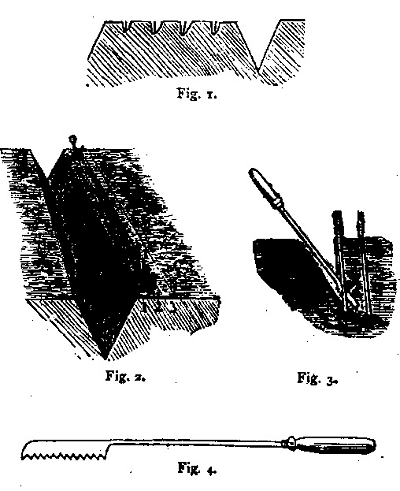
In the formation of new plantations the first thing necessary for our consideration is the situation, which should be open and unsheltered by trees or bushes ; as, unless the spot is fully exposed to the sun, success is next to an impossibility. Damp or wet ground, or where the subsoil is retentive of an undue quantity of wet, should, under any circumstances, be rejected, as being very prejudicial to this plant.
The soil should be from two to two and a half feet deep, and of a light sandy loam. Some months previous to commencing planting see to the preparation of the ground, by trenching it, if possible, at least two and a half feet deep, at the same time mixing a good quantity of well-rotted manure with the soil. When it has lain in this state a month or more, if the weather permit, work the ground over again to the same depth. and repeat this two or three times, in order that the manure and son may become well incorporated with each other. At the last turning over, before planting, lay a solid foundation of rich well-rotted manure in every trench, as no more can be applied for several years, or, indeed, so long as the beds stand. Make it a practice to perform this work in the best weather that can be commanded during the winter months, as such an operation should never be attempted during rainy or showery weather, inasmuch as it would only
tend to make the soil heavy and cold. This portion of the work should be particularly attended to, as the preparation of the coil is of more moment than anything else during the whole course of its culture.
In the removal of the plants from the seed-bed, and final planting, take especial care to perform the work of taking them up by means of a fork, being very careful not to break or cut the roots, or to leave them a longer time exposed to the sun and air than you can help, as very few plants feel a hurt more severely than this ; the roots, being brittle, are easily broken, and do not readily shoot out again.
Although you may plant from the beginning of March to the end of May, the operation will not always be followed with the same success.
The best time, so far as our own experience goes, is just when the plants are beginning to grow ; for when they are removed earlier the plants lie for some time in the ground in a dormant state, and consequently the roots, being of a succulent nature, absorb a considerable quantity of moisture, which, in nine cases out of every ten, causes them to rot, and then the destruction of the plant becomes inevitable. On the other hand, if removed too late, the power of the sun and air will greatly injure them unless very great care be taken, and the roots put into
a basket, or some other receptacle, with sand, as they are taken up.
When your plants are ready, and the ground having been previously prepared as above, stretch a line lengthwise nine inches from the edge, as at Fig. 2, and with a spade cut down a trench six inches deep, perpendicular next to the line, turning the soil to the outer or other side of the trench ; then, having the plants in readiness, set a row along the trench, nine inches apart, with the crowns of the roots two inches below the surface ; then move the line a foot further on, as shown at 2, Fig. 2, and open a second trench, turning the soil taken out of this into the first, over the roots just planted ;. and so proceed, making an allowance of three feet between every four rows for alleys. Should the weather prove dry at the time, give a little water to
[-288-] settle the soil to the roots, and repeat the application until such time, the plants become well established. Fig. t shows a section of the bed. As a rule an asparagus bed should not contain less than a rod, as it very frequently takes more than this to make up a dish at one time; but for a large family twenty poles would not be too much.
Never gather any buds for the first three years after planting; but, on the contrary, permit them to run up to seed, and keep the beds clear of weeds, stirring the soil at each weeding, in order to keep it in a loose state.
It is the practice of some gardeners to throw out the alleys at every autumn dressing, and cover the beds with the soil so taken out. Now this may be
done the first year after planting, but never afterwards ; instead of which give
a good coat of rotten dung, and fork it evenly, both into the beds and alleys, every
season. It is, or should be, well known that this plant forms a new crown every year, and it frequently happens that in a few years the crown extends itself into the alleys, so that by digging them out the plant is certain to be destroyed. We therefore advise that nothing at all be done to them rather than they should be treated according to this too general practice. The first two years a little celery and lettuce seed may be sown on the beds,
and a few cauliflower plants may be planted at the distance of two feet asunder, in the
alleys, but never after, as it would to a certainty rob the asparagus of a great portion of
nourishment.
At the end of October, or beginning of November, the stalks will have done growing and
begun to decay, when they must be cut down close to the ground and cleared away, taking off
all weeds and other litter at the same time; then give the ground a good
three-inch coat of well-rotted manure, and fork it m quite down to the crowns, as above advised, by which means the winter rains, &c., will wash the manure down amongst the roots, which will be greatly benefited thereby. Many people have a notion that by merely covering the beds with litter or recent dung from the stable, they have done. all that is
necessary, but we maintain that such treatment does far more harm than good, as it only
prevents the winter frost from having any influence over the soil without doing the least in the shape of enriching it.
At the end of March, or beginning of April, just before the buds begin to rise, loosen the surface of the beds with a three-tined or pronged fork, being careful not to wound the crowns with the points of the tines ; then rake the surface neatly level, drawing off all large stones and hard clods, leaving the beds as loose as possible, which will not only enable the buds to rise freely, but admit sun, air, and rain into-the soil, and thus encourage the roots to throw up buds, of a superior size and flavour.
By the way, we may mention that the shoots, or buds, come up but weak and slender the first year, stronger the second, and still stronger the third, when some old buds may be gathered, and in the fourth year the buds will be in full perfection.
So far as cutting and gathering is concerned, we say never begin to cut till the plants come to mature growth?that is, three or four years after planting, at which time, and not till then, they are of proper strength to produce full-sized buds. The buds are us the greatest perfection when they have risen above ground from two to three inches, as they are then close and plump. In gathering the buds, scrape an inch or two of the earth from the shoot,
1, Fig. 3, and then slip the knife down, as at 2, drawing it up in a slanting direction towards you, which will separate the head or shoot from the stool easily. Fig. 4 shows the best shape of knife for this purpose. This implement should be thrust into the soil, after having nearly bared the shoot down to the root, and with a saw-like motion sever the same in a slanting direction towards you. The same plan must be resorted to in each instance, until you have entirely cleared the bed. Never
cut much after the middle of June, but
permit it to run up ; in fact, the weak shoots should not be cut at all. If on any
particular occasion cutting should be required later than the above time, be careful
to leave one or two shoots on each stool, in
order to draw the nourishment to it ; for if left destitute of growing shoots they would perish, and thus fill the bed with vacant spots. A plantation of asparagus, under judicious management, will generally continue to afford plentiful crops for twelve or fourteen years, after which time the shoots begin to decay, or, at all events, begin to decline in fertility, and the shoots are
much inferior in quality, even if they do vegetate as long ; so
that to ensure a permanent supply every year a bed or two should be planted every now and
then, so as to get them in readiness for cutting in three or four years' time, in order that they
may come to a productive state
before the old ones are thoroughly worn out. Some people continue their beds for
twenty years or more, but, in our opinion, by so doing they lose much to gain little.
Those desirous of saving seed ?which we scarcely think necessary, considering how cheaply it can be purchased?should select some of the largest and earliest buds as soon as they rise in the spring, to which place sticks or stakes, by which to tie them to during the summer, taking care not to injure the crown of the plant when driving the said supports into
the ground. As soon as the berries are ripe, gather and spread them
in a dry, airy situation, keeping them in the berry until the time of sowing.
To force Asparagus.?Plants about five or six years old should be chosen, if they appear strong enough to pro duce vigorous shoots for insertion into the hotbed. The first plantation for forcing should be made about the latter end of September, and if the bed goes on favourably a crop may be expected in four or five weeks' time. The bed will afford a gathering every two or three days, and will continue in bearing about three weeks. The hotbed for the reception of the plants is constructed of stable-dung or other material in the ordinary. fashion. This should be covered with about five or six inches of tan, or other light material sufficiently porous to admit the heat from the bed to the roots, which are planted in mould laid upon the tan. The bed must then be covered with six or eight inches of rich light soil. The plants may be inserted as close together as possible, several hundred under an ordinary-sized frame. In planting draw a furrow the length of the frame, and place the first row of plant* against it, covering their roots with soil, and proceed in the same way throughout. More soil is gradually to be added as the bed acquires a steady and regular heat.
[-330-]
GARDENING.?XV.
THE CULTURE OF VEGETABLES (continued from p. 288).
The Broad Bean.?The use of this much-esteemed vegetable is well known
to every one who has a spot of ground for a garden, and particularly so to
cottagers and farmers in most parts of the country, who consider a good dish of
beans and bacon a very substantial meal at harvest time. The seeds are the only
part used, and very delicious they are when gathered young and from good sorts.
There are several varieties of the bean, but the principal now planted in
British gardens are the early Mazagan, one of the hardiest and best-flavoured of
any of the early kind; Beck's new dwarf green gem, early longpod, early hangdown
longpod, early green longpod, Marshall's prolific, broad Spanish, and broad
Windsor. This latter variety is
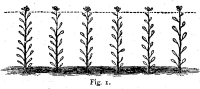 greatly esteemed at
table, and, as such, no one should fail to put in a row or two of seed. The time
of sowing or planting will very much
depend upon the time at which
the produce is required ; for in-
stance, the earliest crop, whether
early Mazagan or anything else
should be be planted from the beginning of October to the end of
December; provided the weather continues open and mild, on a warm border with a
southern exposure. These plant in rows, from two to two and a half feet asunder,
making each drill two inches deep, and placing the seed not nearer than three
inches to each other in the rows. It is a very good plan to sow a single drill
very thickly under a south Wall, in order that it may be protected during the
winter months, and when spring arrives plant them out in rows. The most
successful method is to sow them in a bed of light earth, under a garden frame
laid sloping a little to the sun. Plant the beans all over the bed, an inch
apart in every direction, and cover them about two inches deep with light earth
; and when the plants are well up, and frost shows signs of approaching, cover
the frame down with the lights, giving plenty of fresh air whenever the weather
will permit with safety. Transplant them in February or March, provided the
weather proves fine and mild; but not otherwise, as you had far better defer the
work than run the risk of losing them. In taking up the beans, ease the earth
about the roots, and take them up with as much soil as will adhere to the roots,
taking off the old beans at the bottom, and also the end of the tap root.
greatly esteemed at
table, and, as such, no one should fail to put in a row or two of seed. The time
of sowing or planting will very much
depend upon the time at which
the produce is required ; for in-
stance, the earliest crop, whether
early Mazagan or anything else
should be be planted from the beginning of October to the end of
December; provided the weather continues open and mild, on a warm border with a
southern exposure. These plant in rows, from two to two and a half feet asunder,
making each drill two inches deep, and placing the seed not nearer than three
inches to each other in the rows. It is a very good plan to sow a single drill
very thickly under a south Wall, in order that it may be protected during the
winter months, and when spring arrives plant them out in rows. The most
successful method is to sow them in a bed of light earth, under a garden frame
laid sloping a little to the sun. Plant the beans all over the bed, an inch
apart in every direction, and cover them about two inches deep with light earth
; and when the plants are well up, and frost shows signs of approaching, cover
the frame down with the lights, giving plenty of fresh air whenever the weather
will permit with safety. Transplant them in February or March, provided the
weather proves fine and mild; but not otherwise, as you had far better defer the
work than run the risk of losing them. In taking up the beans, ease the earth
about the roots, and take them up with as much soil as will adhere to the roots,
taking off the old beans at the bottom, and also the end of the tap root.
 By
this previous
protection; the crop will be
accelerated about a week or
ten days. Although the
greatest care may have been taken in the protection, the crop will sometimes be
destroyed by very severe frosts. This being the
case, we recommend our readers to guard against such a calamity by sowing them
thickly in a moderate hot-bed in January or February, or in pots, and placing
them in a cucumber-frame, and afterwards hardening them off until they are fit
to transplant in the open ground. For full and general crops, begin to sow about
the latter end of January, provided the weather is open and mild, such varieties
as the longpod and broad Spanish, in some warm quarter of the garden, where the
soil is light and mellow, and the exposure open, and continue planting the
various sorts until May or even June. The space of time between sowings for
successional crops should be carefully considered ; that is to say, sow the
following or successive crop as soon as the preceding one makes its appearance
above ground, but not before. For the main summer crops, the broad Spanish,
longpod, and Windsor are considered the most proper. The Windsor is considered
the
best flavoured, buy, not so good a bearer as the others. For late crops, to come
in about September, the early kinds are most proper, such, for instance, as the
early Mazagan, Beck's new dwarf green gem, early longpod, early hangdown longpod,
and early green longpod, as they are constituted to stand late as well as early.
For early crops, one pint of seed will be required for every forty feet of row
or drill ; and for main crops, a quart at least will be needed for every sixty
feet ; while for late crops, the same quantity as recommended for early ones
will be found ample. Plant all the early kinds, both for early and late crops,
in rows two feet and a half apart, three or four inches distant from each other
in the rows, and two inches deep ; and the larger kinds for main crops, three
feet from row to row, five or six inches apart in the row, and not less than
four inches deep. Perform the work
with a dibble, having a thick blunt end, to make a wide aperture for each
bean (Fig. 2 shows the dibble), so as to admit each seed down to the bottom,
without having any hollow below. As soon as one row is thus planted, move the
line for the
next, and with a rake fill in the
holes, leaving the ground smooth and even ; and thus proceed until the whole of
the space is completed. Dig the ground, and plant it bit by bit, in order to
avoid treading upon it, which should always be avoided as much as possible. Some
people make it a practice to tread the seed in (as they call it), in order to
secure it in the soil ; but this, we are convinced, they would never do were
they at all acquainted with the use of atmospheric air in promoting germination
and vegetation. The beans that are sown in the summer months, and when the
ground is dry, may with advantage be soaked in soft water for a few hours
previously, as it materially assists their germination; or if sown in drills, as
they mostly are, the ground should be well watered, and the beans put in
directly, drawing the earth over them while the ground is moist. As soon as the
beans are up about three, four, or five inches, they should. be earthed up on
each side of the row, clearing away all weeds at the same time. The hoeing must
be repeated as often as necessary, both to keep down the weeds and loosen the
soil about their roots to encourage the growth. In performing this operation,
great care must be taken not to cover the plants with earth, as such a course
would occasion them to rot or fail. If the ground between the rows were stirred
with a three-pronged fork, after the hoeing is finished, it would be of
considerable advantage to their growth. As soon as the different crops come into
full blossom they should be topped, as it is termed; that is to say, the tops of
each should be pinched off at the dotted lines (as shown in the cut, Fig. 1), in
order not only to accelerate their fruiting and encourage the pods to become
well filled, but to stop the ravages of the black fly, to which they are very
subject. The beans should be gathered when about half their full size, as at
that time they are much better flavoured than when they are older and become
black-eyed. Beans for seed should be gathered when the pods are beginning to
turn black ; the stalks should be pulled up with the beans upon them, and placed
in the sun till quite dry, after which the pods should be taken off the stems,
and stored in a dry place for use. Some people take the seed from the pods as
soon as dry, a practice we do not approve of, well knowing them to keep much
better in the pods than when taken out; the precaution holds good with most
other seeds.
By
this previous
protection; the crop will be
accelerated about a week or
ten days. Although the
greatest care may have been taken in the protection, the crop will sometimes be
destroyed by very severe frosts. This being the
case, we recommend our readers to guard against such a calamity by sowing them
thickly in a moderate hot-bed in January or February, or in pots, and placing
them in a cucumber-frame, and afterwards hardening them off until they are fit
to transplant in the open ground. For full and general crops, begin to sow about
the latter end of January, provided the weather is open and mild, such varieties
as the longpod and broad Spanish, in some warm quarter of the garden, where the
soil is light and mellow, and the exposure open, and continue planting the
various sorts until May or even June. The space of time between sowings for
successional crops should be carefully considered ; that is to say, sow the
following or successive crop as soon as the preceding one makes its appearance
above ground, but not before. For the main summer crops, the broad Spanish,
longpod, and Windsor are considered the most proper. The Windsor is considered
the
best flavoured, buy, not so good a bearer as the others. For late crops, to come
in about September, the early kinds are most proper, such, for instance, as the
early Mazagan, Beck's new dwarf green gem, early longpod, early hangdown longpod,
and early green longpod, as they are constituted to stand late as well as early.
For early crops, one pint of seed will be required for every forty feet of row
or drill ; and for main crops, a quart at least will be needed for every sixty
feet ; while for late crops, the same quantity as recommended for early ones
will be found ample. Plant all the early kinds, both for early and late crops,
in rows two feet and a half apart, three or four inches distant from each other
in the rows, and two inches deep ; and the larger kinds for main crops, three
feet from row to row, five or six inches apart in the row, and not less than
four inches deep. Perform the work
with a dibble, having a thick blunt end, to make a wide aperture for each
bean (Fig. 2 shows the dibble), so as to admit each seed down to the bottom,
without having any hollow below. As soon as one row is thus planted, move the
line for the
next, and with a rake fill in the
holes, leaving the ground smooth and even ; and thus proceed until the whole of
the space is completed. Dig the ground, and plant it bit by bit, in order to
avoid treading upon it, which should always be avoided as much as possible. Some
people make it a practice to tread the seed in (as they call it), in order to
secure it in the soil ; but this, we are convinced, they would never do were
they at all acquainted with the use of atmospheric air in promoting germination
and vegetation. The beans that are sown in the summer months, and when the
ground is dry, may with advantage be soaked in soft water for a few hours
previously, as it materially assists their germination; or if sown in drills, as
they mostly are, the ground should be well watered, and the beans put in
directly, drawing the earth over them while the ground is moist. As soon as the
beans are up about three, four, or five inches, they should. be earthed up on
each side of the row, clearing away all weeds at the same time. The hoeing must
be repeated as often as necessary, both to keep down the weeds and loosen the
soil about their roots to encourage the growth. In performing this operation,
great care must be taken not to cover the plants with earth, as such a course
would occasion them to rot or fail. If the ground between the rows were stirred
with a three-pronged fork, after the hoeing is finished, it would be of
considerable advantage to their growth. As soon as the different crops come into
full blossom they should be topped, as it is termed; that is to say, the tops of
each should be pinched off at the dotted lines (as shown in the cut, Fig. 1), in
order not only to accelerate their fruiting and encourage the pods to become
well filled, but to stop the ravages of the black fly, to which they are very
subject. The beans should be gathered when about half their full size, as at
that time they are much better flavoured than when they are older and become
black-eyed. Beans for seed should be gathered when the pods are beginning to
turn black ; the stalks should be pulled up with the beans upon them, and placed
in the sun till quite dry, after which the pods should be taken off the stems,
and stored in a dry place for use. Some people take the seed from the pods as
soon as dry, a practice we do not approve of, well knowing them to keep much
better in the pods than when taken out; the precaution holds good with most
other seeds.
[-331-] Runner Beans.?This plant has a twining stem, and would rise or grow to
twelve, fourteen, and even twenty feet high, provided it had sufficient support.
This useful vegetable is trained in various ways ; for instance, the general
method of training resorted to by cottagers is strings; another, and in our
opinion a better method, is to have upright supports, one foot apart, with a
cross-rail fixed at the top ; and the third, which is the easiest plan of any,
is to get some tall brushwood and fix it in the ground in the same manner as you
would stick peas, and it will in time cover them, and look exceedingly
picturesque.
Another very excellent method is that of employing small poles about six or
seven feet long (like hop-poles on a small scale), which are stuck into the
ground on either side of the row of beans, so as to cross each other diagonally.
The pods are oblong, seeds kidney-shaped, smooth and shining, and when ripe
varying in colour according to the sort?that is to say, either white, black, or
mottled. The fruit may be had in the open ground from June till destroyed by
frost in the autumn. The unripe pods are the parts in request, and when boiled
are very delicious. There are several varieties, as the scarlet runner, the most
beautiful and lasting bearer, and consequently the best for a main crop ; the
white runner, a variety of the scarlet, the seed and blossom white, but the
pods very similar to the scarlet kind ; and the painted lady, the blossom of
which is red and white. Although there are many sub-varieties, these are the
only three worth growing. The scarlet runners, like the white and variegated,
are tender in their nature, unable to bear the air of our climate before the
latter end of April or beginning of May, the seed being liable to rot in the
ground if planted sooner, even in a dry soil.
It must be known that sharp cold checks the plants, so that they make but
little progress before the weather is settled and warm. The scarlet runner is
most esteemed, on account of its greater prolificacy and longer continuance in
fruit ; the pods are thick and fleshy, and if gathered while young are very
good. The white runner is also good for a principal crop. The painted lady is
more of an ornament, but the pods are very good eating nevertheless.
The whole family of beans flourishes in a light and very rich soil, and if
the land is a little moist, so much the better.
Do not, as a rule, commence planting the beans till the beginning of May, and
then only a moderate crop, deferring the principal crop till the first week in
June. The scarlet runner is the best for principal crops. Sow in rows about five
feet apart, and in drills not more than two inches deep, placing the beans about
five inches asunder in the rows ; after which cover them up evenly, making the
ground quite level.
[-354-]
GARDENING.?XVI.
THE VEGETABLE GARDEN (continued from p. 335)
The Dwarf French Bean.?This is an annual, and its
constitution and habits are very similar to those of the runner, only it has not
a running stem, neither is it so prolific or long-bearing as the former. The
young unripe pods are used as in the former case ; in addition to which, while
these are quite young, and not more than an inch long nor thicker than a straw,
they are greatly esteemed for pickling. The varieties generally cultivated are
the early yellow dwarf, early red speckled, early black or negro, early white,
Battersea white, Canterbury white, black speckled, dun-coloured, and large white
dwarf. The dwarfs will bear sowing a little sooner than the larger, growing
kinds, and will come in somewhat earlier. They are more convenient to cultivate
on a large scale, and are also considered by many to be more delicate in
flavour. For the first early crop sow the early yellow, early black or negro, or
the, early red speckled; and for a rather later crop the early white is the
best, and is generally considered superior to the others in flavour. The
Canterbury and-Battersea are decidedly the best for main crops. The dwarf kidney
bean does not continue in bearing more than three weeks or a month, so that it
is necessary to sow a successional crop or two in order to have a
continuance until the runners come in, or for a regular succession throughout
the summer. Half a pint will sow a row eighty feet long, the beans being placed
from two and a half to three inches apart in the drill. This bean, like the
runner, delights in a rich and light soil, and for early crops it should be
rather sandy and dry; but for later ones a moist loam. is more congenial. You
should commence sowing the various kinds of dwarf beans about the first week in
April, provided the weather be fine and open. The best situation is a dry south
border, although it is not absolutely necessary to their well-doing at all
times. Draw drills two feet apart and an inch and a half or two inches deep, for
the smaller sized beans, dropping them into the drills rather close together, in
order to allow for a failure, which is almost certain to happen at this early
season. For main crops, other portions must be sown towards the end of April,
and in May and June, in order to have a continual supply. For later crops the
drills may be drawn two feet and a half asunder, two inches deep, and the beans
be placed from two to two and a hall inches apart in the rows. If a late crop is
desired, a moderate sowing should be made about the beginning of August. Crops
sown late should, as a rule, be favoured with the best situation the garden can
afford, otherwise they will not turn out to your satisfaction. It is not worth
the trouble to grow very late crops of dwarf beans, as the runners, under proper
management, will continue bearing until frost cuts them off; and that will, as a
matter of course, be very late in the season. The beans for summer sowing would
be greatly accelerated in their germination provided they were soaked in soft
water for six or eight hours previous to sowing. As the plants of different
crops advance in growth, hoe and stir the surface between the rows, and cut down
all weeds as they appear, and draw a little earth to the stems; which will tend
very much to encourage the growth of the plants as well as to increase
[-356-] the crop. The pods should be gathered while young, tender,
fleshy, and brittle, as they are then in the greatest perfection. By clean
gathering the crop will continue longer in perfection than if a superabundant
one were left to grow old ; and, independently of this, you will prevent the
successive pods from being robbed of a considerable portion of their nourishment
or support. A row or two, or more if necessary, should be set apart for seed,
taking care not to gather until they are fully ripened ; then pull up the haulm,
and lay it in the sun until it is thoroughly dry ; after which the beans may be
cleared out of the pods, and put away till wanted. It frequently happens that a
sufficient quantity will be found upon the stalks after a crop is over, and when
such is the case dry them and put them away for future use.
Red Beet.?This is a biennial plant, with large,
oblong, succulent leaves of a reddish colour_; the roots, when at their full
size, are from three to four inches in diameter, and from a foot to eighteen
inches in length, and of a deep red colour. The flowers are of a greenish
colour, and make their appearance in August. The roots are the only eatable
portion when boiled and -sliced, either by themselves or in salads. They are
also used for pickling, and occasionally for garnishing. There are several
varieties of beet?namely Henderson's pine-apple, Nutting's, selected, Cattell's
dwarf blood-red, and Beck's improved?all of which are good ; so that you cannot
possibly make a mistake in selecting any one of the four. This plant delights
most in a dry, light, and a rather sandy loam, having a good depth, so that
there may be ample room for the root to penetrate at will. It is always raised
from seed, which should be sown annually, either the latter end of March or the
beginning of April. We never sow earlier ourselves, for this reason, that we
have invariably found the'early plants run up to stalk, instead of making good
root. The ground on which the seed is to be sown should be well manured and,
trenched the preceding year, in preference to leaving it till the time for
sowing arrives, as ground so recently manured invariably causes the roots to
canker. The ground should be trenched eighteen inches deep, before sowing for
the long-rooted kinds. The seed may either be sown in broad-cast or in drills a
foot apart, but we prefer the latter method for two reasons ; first, because
they can be more easily kept clear of weeds-, and, secondly, they can be thinned
with greater facility. Draw drills as you would for peas or beans, and drop the
seeds, two together, into the same, at about a foot apart, and as soon as the
plants are of an age to distinguish the strongest, pull up the weaker, so as to
leave one only standing. Presuming that they have been sown broadcast, as soon
as the plants are about two inches high, they must be thinned out to about
twelve inches ,apart in every direction, which will allow them full room, to
grow and swell to a good size by the autumn, at which time they will be fit for
use as wanted, and will continue in perfection during the winter and spring
following. However, we make it a practice to "provide for a rainy day," if we
may use the expression, by pitting them up as we would potatoes. But where,
however, you have not a. sufficient quantity for such a purpose, the roots maybe
then taken up, trimmed of their leaves, and be deposited in sand, in a shed or
outhouse; or, if you prefer it, you may take up a portion only and keep them
under cover for use, when hard frosts would fasten them in the ground; but the
remainder may be still left in the soil, to be taken up as wanted, weather
permitting. In February or March the pitted roots may require to be looked at,
in order to check the growth, or prevent their running, or they will not keep
good till May or June, as they would do if examined periodically, as already
observed. Great care must be taken not to break or injure their roots, as they
would then bleed much and become pale-coloured. For this reason, on taking off
the leaves, an inch of the tops should be left on with the solid root. In order
to save seed, a few strong roots should be selected and transplanted to some
spot where they will not be in danger, when in flower, of impregnation with any
inferior or different variety. A few strong roots may be left standing in the
row, which will shoot up the second year, when their flower-stalks should be
tied to stakes to prevent their being blown down.
White Beet.-This is a hardy biennial plant, the leaves
of which are larger than the red beet, and very thick and succulent. It produces
its flowers, which are of a greenish colour, in August and September. The leaves
of this plant are the only usable parts, which are boiled like spinach or
put into soups. The principal varieties in cultivation are the common
small-rooted green-leaved, the common white, small-rooted, and the large white,
or the Swiss. All the sorts are propagated by seed, and the soil for these
varieties may be considerably stronger and richer than that for the red sorts,
but need not be quite so deep. For a bed containing fifty-four square feet, one
ounce of seed will be sufficient. The seed should be sown in March, either in
drills, six or eight inches apart for the small sorts. and ten. or twelve for
the larger, or broadcast, and the seeds raked in well. When the plants are up
two inches high, they must be thinned out to from eight inches to a foot apart,
and afterwards kept clear of weeds. The seed of this sort may be saved in
precisely the same manner as that recommended for the red.
[--grey numbers in brackets indicate page number,
(ie. where new page
begins), ed.--]
|
source: Cassells Household Guide, c.1880s