Victorian London - Publications - Etiquette and Household Advice Manuals
- Cassells Household Guide, New and Revised Edition (4 Vol.) c.1880s [no date] -
Servants of the House - (1) Domestic Servants and their Duties - (2) The General
Servant - (3) The Cook - (4) The Housemaid - (5) The Parlourmaid - (6) The Page,
or Occasional Boy - (7) The Lady's-Maid - (8) cont. - (9) Laundry Maid - Washing
at Home - (10) cont. - (11) cont. - Nurse and Nursery-Maid
[-back to main menu-]
Volume
1
[-102-]
SERVANTS
OF THE HOUSE.-I.
DOMESTIC SERVANTS AND THEIR DUTIES.
THE servant grievance is being constantly discussed to very little
purpose, simply because more people are capable of deploring an evil than
suggesting a remedy. Admitting that the class of domestic servants has generally
become more deficient in ability than any other body of labourers in the social
scale, some allowances should be made for their shortcomings owing to the
exceptional circumstances to which of late years they have been exposed. To cite
only one cause, the increased facilities of locomotion. Formerly country girls
were content to live from one year's end to another in the same situations from
sheer inability to defray the expenses of travelling any distance. Now-a-days,
railway trains have thrown the servant-market open. and, consequently, even
remote provinces are drained of household help. The rush is to large towns, and
especially to London, where wages are high, and dress and pleasures plentiful
and cheap. Arrived at their destination servant girls very likely find their
mistresses unable or unwilling to help them.
It used not to be so. Middle-class employers did not always consider it
beneath them to engage practically in the work of housekeeping. But since the
frenzy for display and excitement has seized upon all classes alike, mistresses
are apt to impose upon their servants responsibilities which the latter are
unfitted by previous training to discharge. Nothing is more natural than that
vexations and disappointments should be the result.
It is not be expected that any sensible change for the better will take place
yet awhile. Not until education proper has corrected the existing false notions
of employer and employed, may we hope for a happier state. In the meanwhile,
every mistress has it in her power to help the good time in coming, by
fulfilling her own part of the contract with her servants scrupulously and
diligently.
The first step in this direction is, as far as possible, to make no
engagements which do not promise to be of a lasting nature. By this is meant,
not to engage a servant with a known unfitness for the place. Many ladies are
prone to take young women into their service, just to stop a gap, or to tide
over a difficulty. All that they want is, to find some one to fill the place for
a time, whilst they are suiting themselves at leisure.
Of course it will be remarked, that it is impossible to do the work oneself,
and that the risk must be run. To this it may be replied, that it should be
every mistress's endeavour to acquaint herself with "servants' work"
generally, in order to meet such emergencies. If ladies were supposed to possess
this knowledge more generally than is commonly believed, servants would be less
independent. And for this reason like other workers, they have to live by the
demand for their services. As it is at present, cooks that know nothing of
cookery, and nurses that are ignorant of the nurture of childhood, get as good
places, and oftentimes higher wages, than women who really know their business,
and are high principled enough to do what they undertake.
Apropos of wages. It is a very prevalent notion that high wages secure
efficient service. The assumption, however, is far from being well-founded. As a
general rule, the best servants are satisfied with the average rate of wages,
and care more for a comfortable situation, where the payments are fair and
certain, than for higher remuneration than is customary. Exceptionally high
wages are apt to he regarded as a bribe rather than as a well-earned reward. It
is better to pay for length of service than for the qualities naturally supposed
to be possessed by servants in their respective places. Thus, if a servant
enters a situation, say at twelve pounds a year, it is a better plan to increase
her wages yearly one pound, than to pay a higher rate at the outset with no
prospect of a rise. Many servants leave good places for the sole reason that they have no such
encouragement to remain. The policy of refusing a similar increase is
short-sighted, for "changing" is generally a costly experiment. It is not
to be supposed that wages are to go on continually increasing; a limit has to be
arrived at at last; but the limit should be the full extent of the employer's
means, and somewhat over and above the possible worth of the servant's labours
to a stranger. By this means, there is some very great possibility of securing
personal interest, if not attachment, to those who serve.
Intimately connected with wages is the finding of extras. For some reason or
other, which it is difficult to account for, many housekeepers do not undertake
to find grocery and beer, but allow money for those articles of consumption.
Either such things are necessary to the diet of servants, or they are not. If
they are necessary, it is better by far to provide tea, sugar, and beer, than to
give money which may not be applied to its proper use. In point of economy, the
money payment is a losing one, because a housekeeper having to feed a certain
number of persons daily, the better all the meals are supplied, the more regular
is the consumption likely to be. A girl that goes without a good tea is more
likely to prove an inordinate supper-eater than one who has previously enjoyed a
good meal.
With regard to beer money. If beer be a necessary, the money ought to be
spent in buying the required nourishment ; if not, there is no sense in giving
wages in lieu of it.
Perquisites are happily going out of fashion; but a certain class of servants
still stipulate for them. The principle is bad, and tends more to promote
dishonesty than any other flaw in our social habits. When a mistress once allows
her servants of their own accord to dispose of any articles, it is almost
impossible to draw a line between what is a rightful perquisite or what is a
misappropriation, not to say a theft. The articles may be of small worth, and,
perhaps, useless to the owner; but the power of disposing of such things is a
temptation to swell the profits by unfair means.
In a well-managed household every remnant of food and clothing should be
disposed of by the mistress' hand. If she pleases to give away things that are
useless to herself, the gift is acknowledged as such. On the other hand, if a
servant has the power of taking certain articles as a right, no thanks are due.
Dripping, bones, rags, and worn-out apparel all have their uses, as we shall
endeavour to prove in the course of subsequent articles on this subject.
With regard to a plan of household work. Whether an establishment be large or
small, positive rules should be laid down for observance in all that relates to
the comfort of the family and the despatch of work. The best plan is to have the
order of work and rules for the in- coming and out-going of the servants legibly
and tersely written, and pasted on the walls of the kitchen. A little ornamental
bordering and varnish makes the placard appear both pleasing and permanent. Any
express duty required of the servant should be particularised thereon.
In order to carry out the above plan successfully, the mistress should have a
corresponding table at hand for her own reference, so as not to give contrary
orders inadvertently, and thereby nullify the rules.
Whether "followers" are allowed is a question often put by a servant on
applying for a situation. Except under very rare circumstances, it is better to
disallow the privilege. While speaking on this subject, we may add that the word
"followers" has a very elastic meaning, and as it is difficult to draw a
line between those that are unobjectionable and otherwise, no hardship can be
felt in refusing to admit visitors to the kitchen save upon express [-103-]
permission. The arrangement to the effect that periodically a servant shall
be permitted to go out and see her friends, does away with the necessity for
having them to call on her. At the same time, a mistress should be careful not
to bind herself to spare her servant on a certain day in every month, as is
sometimes demanded. "Once in a month when convenient" is a better
understanding.
Most servants, in addition to the monthly holiday, ask to be allowed to go to
church of a Sunday once in the day. This request is reasonable ; and if a
servant really goes to a place of worship, some inconvenience should be borne by
her employers to secure her this liberty, but if she goes instead to see her
friends, it should be a matter for consideration whether she shall go out or
not. At any rate, the absence ought not to extend very much beyond the time
occupied in the church service.
Dress in these days is a very disputed point between mistress and maid. Any
attempt to restrict young women in the choice of their garments will be found
fruitless. Certain fashions, however, which are likely to be destructive to the
employer's property, or unfitted for the performance of a servant's duties, a
lady has a right to prohibit.
Caps and white aprons, for answering the door and waiting at table, are
befitting to young women in service. Little crochet caps, at once so cheap and
so becoming, are the best head-gear to stipulate for. Large holland aprons, to
be worn whilst bed-making and dusting furniture, are necessary garments; also,
cotton gowns for morning wear.
If ladies would be at a little pains to mention their wishes on this subject,
young women in service would supply themselves with suitable wardrobes. Whatever
clothing a servant chooses to wear when out for a holiday is beyond a mistress's
rule.
[-147-]
SERVANTS
OF THE HOUSE.-II
THE GENERAL SERVANT.
THE servant of all work, as the old-fashioned term used to be, is fast
becoming extinct. The designation. is now generally applied to female servants
possessing no particular aptitude for any special branch.
"General servants" have mostly had experience of
more branches of service than one. They know something of a cooking-many are
very fair cooks - they understand housemaids' work, and have almost always begun
by being nursemaids. Their wages vary, according to attainments and locality,
number of family, size of house, &c., from seven or eight, to sixteen pounds
a year. Sometimes the wages are modified by arrangements which require them to
find their own tea and sugar, beer, &c., as well as a by a variety of
special circumstances which cannot well be enumerated. The higher wages are
usually asked by good plain cooks, and managers willing to assist in housework
if help be given in rough cleaning such as boots, knives, washing, &c.
For all purposes of comfort, a good servant, even though her
wages should be high, is the cheapest and most likely to settle in her place. It
should be borne in mind that a good servant consumes no more than a bad one. She
destroys less, and is less liable to throw herself out of place, arguing rightly
that twenty situations can be had at twelve pounds a year, against one of
fifteen and upwards. Besides, a shrewd servant is sensible enough to know, that
in a single-handed place a number of comforts are enjoyed which would be denied
where there? are several servants. Many families are prevented from engaging
one good a general servant, because they consider their position requires that
two domestics should be kept. We think, however, that in this, as in everything
else concerning life, the rule holds good, that true happiness does not consist
in our regulating our household according to the supposed fancies of our
neighbours ; but according to what we know to be our own tastes and
requirements.
The duties of a general servant being numerous, it is
desirable that a well-considered plan embodying the principal work of the house,
should be provided. The rules of the house and order of work should be legibly
and tersely written on cardboard, suspended on the kitchen wall.
Early rising is an essential quality in a servant who has to
do any amount of housework before breakfast. Six o'clock is the latest hour at
which she should rise.
By getting her work ready in the evening before going to bed,
she is enabled to set about it at once on coming down in the morning. In order
to do so, she should put everything in its place overnight, wash up plates and
dishes, hang up jugs, and tidy her kitchen. If, after having raked out the fire,
she lays it with fresh coals and dry firewood, a great point will be gained. All
except the front bars of the range can be polished whilst the fire is drawing
up. Twice a week a thorough cleaning of the range, boiler, and oven will do more
to keep it bright than the hasty brushing generally given when time is short. If
a stove is in use, the flues require brushing out with the proper utensils. If
not, the soot from the mouth of the chimney should be cleared away with the
sweep's brush, as far as an arm can reach. Many a good roast joint is sent to
table covered with smuts, from neglect of this precaution.
Whilst the fire is drawing up, the servant should remain near
to give it a timely stir before setting the kettle on, employing her time in the
meanwhile in cleaning boots, knives, or any other occupation of the kind.
Her next proceeding should be to wash her hands and open the
window curtains of the breakfast-room, if she has not already opened all the
shutters and drawn up the blinds of the house, on her way down-stairs. She
should then take a large sweeping cloth, and cover up any ornaments or furniture
likely to be spoilt by dust. The hearth- rug should be folded up and laid aside
to be shaken. A coarse cloth should then be laid in its place, on which the
black-lead box, the cinder sifter, and fire-irons should rest whilst in use. To
clean a parlour grate, fire-irons, and bright fender thoroughly, will take about
twenty minutes.
Sweeping the carpet, or brushing up the scraps of litter in a
dustpan, is the next proceeding. A good manager will never commence this work
without having a plentiful supply of tea-leaves at hand to strew on the floor.
These collect the dust which would otherwise settle on the hangings. To sweep
without tea leaves, is simply time wasted and destruction.
Having proceeded so far in the breakfast-room, the hall and
entrance claim attention. Even if there be not time to whiten the doorsteps
before breakfast, sweeping should be done, and the mats and rugs thoroughly
shaken outside.
The above portion of the work being accomplished, all the
cinders left from the day before should be collected and sifted. These are
useful for burning in copper flues, or they may be used to bank up a kitchen
fire when a steady heat is wanted.
The dirty work of the morning now being at an end, the
servant should change her gown for a cleaner cotton one, put on a tidy apron and
clean cap, and dust the breakfast. room. She is now ready to lay the cloth,
bring in breakfast, and do her up-stairs work generally. if there be sufficient
time, this is the best opportunity she will base for her own breakfast. If not,
she should manage to have her meal as soon as possible afterwards. Nothing tends
to good humour so much as sound digestion, and servants cannot be healthy if
they snatch their food whilst running about.
Directly breakfast is finished and cleared away, the first
thing to do is, to open the windows of the bedrooms, if they have been left
closed, and to strip the clothes oft the beds, piece by piece. The feather beds
should be well shaken and turned, and the mattresses raised for a current of air
to pass through. The chamber crockery must be emptied, and such articles as
require particular cleansing rinsed out with hot water and soda. Two old cloths
should be kept for this purpose - old chamber towels are the best - one for the
actual cleansing, and the other for wiping dry. The water bottles and tumblers
should be emptied, and wiped with a clean glass cloth. At evening, [-148-]
when the beds are turned down, the bottles should be refilled with fresh
water.
In most families where there are daughters, the general
servant gets help in making the beds. Sometimes the mistress of the house
assists. The rooms that are to be specially cleaned should afterwards be made
ready for the work, and the toilet appendages laid on the bed, together with any
books or movables that may require protecting from the dust. A sweeping-sheet
should then be thrown over the whole. The valances of the bed should be tucked
up, and the bed curtains folded neatly across the bolster.
If no special cleaning is to be done, the bedroom should be
quickly dusted and put in order, the servant collecting lamps, candlesticks, and
other articles that have to be cleaned in the kitchen. When the up-stairs work
is so far done, a general washing up in the kitchen should begin. The mistress
or daughters will probably in the meanwhile dust the ornaments in the
drawing-room, and aid in giving an air of order and refinement to the room.
Throughout the morning the tradesmen's bell causes serious
interruption to a servant. It is a good plan to let certain tradesmen call on
specified days only. The orders should be given early by the mistress on those
days, and so diminish the number of times the servant has to answer the bell. A
ticket may be placed in the front window to indicate the days on which different
tradesmen should call.
The hour at which the family dines determines whether the
servant shall do the principal house-cleaning in the morning or afternoon. If
the hour is late, the morning is best; if early, the contrary. In any case a
servant should not be allowed to leave the kitchen while a joint is roasting, as
many are apt to do, thinking that the meat need only swing round and round till
dinner-time to be properly cooked. Afternoon dinners will generally be found
more suitable to the thorough dispatch of house-work, than a mid-day meal,
though of course, when there are children in the family, this is impossible.
Some forethought is required to set a servant free to do special cleaning
without neglecting the dinner.
If a general servant is required to wait at table, it is
unreasonable to expect that she can be very tidy at midday. But if the dinner
hour is late, she may be able to dress herself before dishing up, having
previously cleared her kitchen. No washing up beyond china and glass should be
expected afterwards. The plates and dishes should be cleared of scraps, and
stacked away in an orderly manner in the washhouse till the following morning,
when time for washing them, together with the saucepans, &c., should be
allowed. Under these circumstances the servant can wait upon the family in the
evening, and employ the rest of her time in repairing or making her clothes.
Before laying the dinner cloth, the servant should tidy the
room. The hearth may require sweeping up, and, with the mistress's permission,
the cinders may be carried out and burnt in the kitchen in the evening.
At dusk, it is the servant's business to draw down the blinds
of the house, close the shutters, and prepare the bedrooms for the night.
If any washing is done at home, the work of the house should
be so arranged that Saturday afternoon may be reserved for looking up the
articles to be washed, and putting them into soak. We shall have occasion to
speak more particularly about washing hereafter; meanwhile, observe that there
is great saving of time in washing on Mondays. In order to begin early on that
day, the clothes should be all sorted and in soak (flannels and coloured things
excepted) on Saturday evening.
The closing of the basement and turning off the gas is
generally left to the general servant, but the master or mistress of the house
goes round to see that all is safe.
[-170-]
SERVANTS
OF THE HOUSE.-III.
THE COOK.
IN small households, where only one kitchen servant is kept, the duties of
the cook comprise those which devolve on the kitchen and scullery-maids of
larger establishments. Whether the domestics be few or many, however, the cook's
position is second in importance to none save that of the housekeeper.
The only portion of housework which a cook in a
moderate-sized family is generally expected to undertake is the cleaning of the
hall, the entrance, and the dining room-work which can be done before breakfast
and consequently without hindrance to her special vocation of cooking. In very
few instances will a good plain cook consent to clean boots and knives. If she
does a knife machine is generally stipulated for, and is not an unreasonable
request when the interruption knife cleaning occasions is taken into
consideration. Cinder-sifting, likewise, belongs to cook's work in small
families and is much faclitated by the use of a patent sifter, of which more
anon.
The principal qualities to seek in a cook are early rising,
cleanliness, punctuality, and sobriety. Honesty is, of course, essential in
every department of domestic service, but the want of this virtue is apt to
display itself in cooks less in acts of commission than of omission. By failing
to make the most of the stores entrusted to her care, or by disposing of
articles of food for her own profit, what is indulgently termed "want of
economy" becomes actual dishonesty, and tends considerably to impoverish
the means of employers. Therefore, in taking the character of a cook, it is
important to ascertain whether she has the practice of turning every article of
consumption - remnants, &c.- to the best account for her employer's sake. A
servant that possesses such knowledge, and is willing to apply it to its right
use, deserves better wages than one who recklessly squanders her master's
substance. If the pounds annually saved by an intelligent and faithful servant
were remunerated by a reward of so many shillings, there is no doubt that a
spirit of economy would be more often displayed than is the case where no note
is taken of similar virtues.
A great point would be gained towards securing more efficient
cooks than now usually fill situations of the kind, if every mistress of an
establishment would prosecute her inquiries as to the applicant's fitness for
the place beyond the regular stereotyped questions relative to the reasons for
leaving the last situation, wages, &c. Suppose, for instance - a
satisfactory account of moral character having been given - the employer were to
test the servant's knowledge of cooking by a few practical questions, such as:
How long do you make up your fire before roasting? What time do you allow for
boiling a leg of mutton of a certain weight? What use do you put cold vegetables
to? What do you do with bones and dripping? How much fresh meat do you require
per week to supply soup in a given number of days? How much meat do you consider
should be consumed weekly in the kitchen? How many loaves do you think are
sufficient for a family of so many persons? &c.
By similar inquiries, the good opinion of a well-informed
servant, far from being diminished, would increase in favour of the employer;
and the bane of ignorance would cease to characterise the present body of cooks
as a class. As much for the benefit of the inexperienced employer as the
employed, the following directions are given.
First, with regard to the kitchen fire. A good manager will
keep the winder of the range close handy, in order to enlarge or narrow the
opening according to the culinary operations required. This cannot be easily
done if the grooves are suffered to become choked with cinders and dust. The
only way to obviate this difficulty is never to light the kitchen fire before
first sweeping out every portion of fuel.
A fire for roasting requires a somewhat wider opening than
the length of the joint about to be suspended in front. Meat should always be
put down before a "mending fire" - that is, one which has been made up
of coals still unconsumed. It is bad economy to throw up the cinders for a
roasting fire until the joint is done. A well-made fire should burn steadily
with very little stirring until the joint is half cooked, when the meat-screen
or dripping-pan should be moved from the front of the fire; the lower bars of
the range should be thoroughly raked out from dust, the burning coals should be
brought gently to the front, and the back filled in with fresh, surmounting the
top with a few pieces of coke and small lumps of coal mixed. By this means the
progress of the joint in getting too rapidly cooked on the outside is arrested.
and gives the heat a chance of penetrating to the centre. A fire thus made will
burn briskly by the time when the appetising browning of the joint is needed.
Half the failures in roasting are attributable to putting a joint down before a
fierce fire, and finishing with a slack one.
Slow roasting at the commencement is indispensable to the
preservation of the flavour of the meat. This may be effected by regulating the
distance from the fire. About [-171-] fourteen
inches will be found a good distance, admitting of the joint being
"neared," towards the end of the cooking process.
Fresh killed meat requires longer to roast than when
"hung." Meat a little frozen should be put into cold water till
thawed, and will be improved by being hung in the kitchen over-night. This rule
applies especially to Christmas joints, such as sirloin of beef, and turkeys of
all sizes. Fat meat takes rather longer to roast than lean; about twenty minutes
to half an hour extra on a large joint will be sufficient. The usual time
allowed for roasting is from fifteen to twenty minutes to every pound according
to the strength of the fire and size of joint.
Some cooks are partial to frothing their roasts, by using
flour. A well-cooked joint needs no such addition to its natural appearance, the
streaks of gravy which flow from the centre, when the joint is well done, being
ornament sufficient. If any flour be used, it should be very lightly dusted on
from the dredger, about half an hour before the joint is taken up.
Made gravies are generally considered objectionable with
roast meat. Every joint should be made to supply its gravy in its own trimmings.
Pieces of flap, shanks of mutton, &c., which are not usually sent to table,
should be put into a small saucepan, with some water or plain stock, when the
joint is set down. These should be after wards strained, and either poured over
the burnt ends or added to the gravy which has flowed from the joint into the
dripping-pan. A pinch of burnt sugar will supply the browning. The best gravy of
all for roasts is that which is cleared from the dripping saved from a former
roast joint, to which may be added some boiling water and a little salt. Gravy
should never be poured over a roast joint. It is a good plan to send the
gravy to table in a sauce-boat, or tureen.
Poultry requires to be put down before a brisk fire and
should be previously lightly dredged with flour and covered with clarified beef
dripping. Hares will eat more tender if, for the first half hour of roasting,
they are basted with salt and water in the proportion of a dessert-spoonful of
salt to half a pint of water. When basted the above time, the salt and water
should be removed, and fresh dripping laid in the pan. Some people recommend
water and salt as a first basting for all joints. The mixture certainly improves
the colour of the roast, but we fancy at the cost of its flavour, the salt
exciting a too hasty flow of the gravy.
Now that the use of close stoves and kitcheners has become so
general, the art of roasting in front of a fire is in danger of being lost.
"Roasting in the oven," as the new method is termed, to be successful,
requires a jar of boiling water to be put into the oven with the joint The steam
keeps the meat from becoming dry on the outside and prevents the objectionable
flavour of burnt fat. The water should not be removed till the joint is ready to
brown. This practice holds good for all baking in the side ovens of the
ordinary kitchen-range.
Boiling is a more simple process of cooking than
roasting, and fails generally from being too hastily performed. A steady
simmering is all that is necessary to maintain during this mode of cooking, for
which purpose cinders mixed with a little coal, and the refuse from the
trimmings of vegetables will be found to answer best. Boiling is not an
economical method of dressing meat, if the liquor in which the joint is boiled
is afterwards thrown away; therefore, not more water should be used for the
purpose than will just cover the meat. When the water is near boiling, scum will
rise to the surface, and should be carefully removed as fast as it is formed.
When the scum no longer rises, the pot may be set aside to simmer until the end.
Wrapping meat in a cloth and boiling in milk or lemon-juice is often recommended
to secure a whiteness of appearance. but no mode is so effectual as the patient
removal of the scum itself which causes the unsightly aspect. From twenty
minutes to half an hour per pound of meat, wil1 not be found too long to boil a
joint slowly and well.
Cold water should be used for boiling, whenever the liquor is
to be afterwards converted into soup.
All kinds of fish with the skin on should be put into cold
water, with about a dessert-spoonful of salt to a quart of water. Crimped cod,
slices of salmon, and other cut fish, must be put into boiling water containing
the above proportion of salt. The water should barely cover cut fish. A whole
fish, weighing about four pounds, will take about half an hour to cook, after
the water has come to a boil. Skimming is as necessary for fish when
boiling, as for meat. As soon as the water has boiled, the cover of the
fish-kettle should be tilted on one side, to prevent the skin of the fish from
cracking. Some kinds of fresh-water fish are considered to be improved by
boiling a few herbs in the water, such as sprigs of thyme, bay-leaf, &c.,
according to taste.
Frying, being an expeditious mode of cooking, is in general
favour with inferior cooks, but, if carefully performed, is both economical and
wholesome. Of all modes of cooking, however, none are so liable to prove
unsatisfactory as that of frying, unless the nicest discernment is exercised as
to what articles will fry well, or not. The chief drawback to success in this
branch of cookery, in England, is the shape of the ordinary frying-pan. Although
one is constantly told in cookery books that "frying is simply boiling in
fat," the vessel in which the process is usually performed precludes the
possibility of complete immersion. In France, where frying is most successfully
practised, the frying-pan is generally from seven to eight inches deep,
rendering the first principle of the art easy to be carried out. Too little fat,
insufficient heat, and want of careful preparation, are apt to make fried dishes
in English households wasteful and indigestible.
Before putting whatever is to be fried into the pan,
sufficient fat should, if possible, be put into the vessel to cover the article.
The pan should be scrupulously clean. If there is any doubt upon this score, it
is best to melt a little fat in it over the fire, and wipe the pan out with the
fat, which should afterwards be put aside. The great art of good frying is to
know when the fat is hot enough. This may be ascertained by sprinkling a few
drops of cold water into the fat when supposed to be nearly boiling. If the
water hisses, the fat is hot enough. A piece of bread dipped in hot fat will be
the best test as to whether it is over-heated or not. If the bread just browns,
the fat will do ; if it blackens, the fat should be thrown away, as it will
destroy whatever is put in it.
It is essential to a good colour of fried food that the
articles should be perfectly dry. The only exception to having things perfectly
dry before frying is parsley, which, to look green and crisp, should be shaken
through cold water immediately before it is plunged into the pan.
Lard is excellent for frying fish, and, if not burnt, may
serve for several times. Beef and mutton dripping are better for meat. Oil is
much used by foreigners, but if not of the finest quality gives a disagreeable
flavour to viands. Butter is the least desirable of all fats for the purpose, on
account of the salt and water in it; and it has besides a disposition to
blacken, unless great skill be used.
Broiling is a favourite mode of English cookery, and is
especially adapted to our taste for plain meat. In order to broil successfully
the gridiron must be perfectly clean. It should previously to being used be
heated over the fire, and wiped between the bars with mutton or beef suet, or
fat. A clear fire is needful, but not necessarily a large one. The gridiron
should be raised slightly at the back. A good cook will never leave the fire
when broiling is in progress, the chief art being to keep the meat constantly
turned in order to prevent the pieces from settling. Forks [-172-]
should never be used for turning meat. A small pair of steak tongs soon defray
their cost in the amount of nourishment they save. If a fork must be
used, the cook should avoid sticking it in the prime part of the meat.
Broiled meats should not be sent to table in gravy, still
less should the meat be slashed to supply a gravy. A little pepper and salt,
just before removing the meat from the fire, is all the relish usually
necessary. The plates and dishes cannot well be too hot on which a broil is
served.
The above are the simple rudiments of plain cooking, and
should be familiar to every servant who undertakes a cook's situation in an
English household. It is not possible here to give full details of the duties of
a cook, who should, however, understand the making of pies, puddings, pastry,
and bread in general; she must also know how to prepare sauces, gravies, and
soups; she must be competent to dress vegetables, and prepare all ordinary
herbs; she is to know the value and importance of her stock-pot, and to see that
it is never forgotten; she is expected to be acquainted with the most effectual
methods of keeping provisions, uncooked or cooked; she must look well to all the
arrangements of her larder, kitchen, and kitchen utensils, and must know how to
serve up all ordinary dishes. In many families some of the duties of the
housekeeper fall to the cook's share of work, and will form the subject of
another chapter.
[-181-]
SERVANTS
OF THE HOUSE.-IV.
THE HOUSEMAID.
IN many English households two servants only are kept - cook and housemaid -
a small domestic staff, but one capable, under able supervision, of getting
through a considerable amount of work. In order to effect this, it is necessary
that each servant should be efficient in her duties, and that a regular plan of
household labour be laid down, by which, instead of impeding each other's
progress, mutual help may be rendered to facilitate a thorough dispatch of work.
As a general rule, however, the less a cook has to do out of her kitchen the
better will she be enabled to cook, and the more time a housemaid bestows on
house cleaning, the greater will be the comfort of the family. Dusty furniture
and a close atmosphere are evils which are apt to generate ailments in
establishments where sufficient domestic labour cannot be afforded. Ailments of
the kind should have no existence where sufficient servants are employed to keep
every part of a house clean and wholesome.
One of the chief obstacles to the better discharge of
housemaids' work than generally obtains is, not only the notion on the part of
the servant herself, that her duties are of a semi-laborious nature, but the too
ready acquiescence in this view by employers. Many ladies, when engaging a
housemaid, hold out the "lightness of the work" as an inducement to
get the place filled. Consequently, no sphere of domestic service is so crowded
with young women in delicate health as that of the housemaid. Good health is,
nevertheless, indispensable to the fit discharge of all kinds of labour.
A housemaid's place is no sinecure if properly filled. Early
rising is indispensable; much physical strength is required for scrubbing,
carrying trays, and answering bells, and if, as it often happens, there are
children and invalids in the family, her powers of patience are considerably
tried.
A good constitution and a willing disposition are amongst the
principal qualities to seek in a housemaid, to which may be added a quiet,
pleasing manner and cleanly appearance.
A housemaid's dress is of some importance. When engaged in
her morning work, washable materials are the best; a wide holland apron should
always be worn over one of white material whenever house-cleaning is going on.
If the servant be required to appear at the front door, or wait upon the family
whilst at dirty work, by casting aside the outer apron she is able to appear at
a moment's notice in a presentable manner. For afternoon wear in the winter,
very dark or black French twill dresses are suitable, inexpensive, and easily
washed. In the summer light cotton materials look best. At all seasons a neat
white crochet cap is the best head-gear. Thick boots, especially with nails, are
destructive to stair carpets, and should on no account be worn in the house.
Housemaid's gloves should be found by the mistress of the house.
As the duties of a housemaid are very numerous, and liable to
vary in different households, it is advisable in this place to explain only
those which are of general application.
A good housemaid will rise at six, and have her grates
cleaned and rooms swept by seven. She will then go upstairs, wash her hands, and
make herself tidy for taking to the bedroom hot water if required to do so. In
the meanwhile the dust will have settled, and the rooms will be ready on her
return to be finished by eight. By nine o'clock breakfast ought to be cleared
away and the housemaid ready to strip the beds, empty slops, and set the
bedrooms in order. By eleven o'clock the up-stairs work ought to be done, unless
extra cleaning is in question. Washing up china and glass, dusting the
drawing-room, [-182-] and other light labour of the
kind may take till twelve or one o'clock, by which time a housemaid ought to be
dressed for the day, fit to answer the door, wait on the family, and do
needlework. Any work required of the servant after mid-day should be of a nature
not to soil her garments. At dusk, it is a housemaid's place to close all the
windows at the upper part of the house. Before going to bed she has to turn down
all the beds of the family, replenish ewers and water bottles, empty slops, and
put everything in its place. If she has the charge of the plate-basket she
carries it to the master's room, together with hot water. Considerate employers
will dispense with a housemaid's attendance by ten o'clock, bearing in mind her
morning duties.
The usual plan of housemaid's, work, when no washing is done
at home, is to clean the drawing-room thoroughly on Mondays, and one or two
other rooms, according to their size, on each successive day during the week.
Saturday should be a tolerably clear day from housecleaning, beyond general
dusting and setting in order for Sunday, cleaning plate, airing clean linen from
the wash, &c. Any spare time left beyond these duties is generally allowed
the housemaid for repairing or making her own clothes. If washing is done at
home, the household work must necessarily be delayed in its course.
The following directions are written for the guidance of
housemaids.
Sweeping and Dusting.- Before sweeping a
room remove all light articles of furniture out of the way, and cover up those
which would be spoiled by dust. Draw back the window-curtains and pin them up as
high as you can reach. Open the windows a few inches top and bottom, and shut
the door. Turn the front of picture-frames to the wall, hang a sweeping-sheet
over looking-glass frames, mirrors, &c. Then sprinkle tea-leaves, drained,
but not dry, all over the carpet, especially in the corners. Sweep all carpets
the way of the pile, whether it be in one direction or in another. If the
fireplace is in use, all the ashes should be removed from the grate before
sweeping the carpet. Whilst the dust settles, clean the grate. Having done so,
tie a soft clean cloth over a hair broom and sweep the cornice and ceiling, also
the walls. A turk's-head broom answers better for this purpose, if you have one.
In like manner sweep the curtain-poles, hangings, &c. In the absence of
tea-leaves, some pieces of coarse brown paper, moistened with clean water, will
answer the purpose. Without something of the kind you simply drive the dust from
one part of the room to another.
Dusting.- Remove all articles from the place to be
dusted, and do not wipe round them. Put everything back in its place. Use a
painter's brush for dusting skirtings, and wipe glass and china ornaments with a
fine soft cloth. White dusters are best for chintz furniture. A small feather
broom should be used for raised china and gilt work. Never wipe picture frames
with a duster. Carved woodwork should be dusted with a short-haired furniture
brush, which likewise polishes. Pianoforte keys should be dusted with an old
silk pocket-handkerchief; kept for the purpose.
Scrubbing. - Neglected boards will not come clean
without extra pains. If of a very bad colour a mixture of three parts of
powdered pipeclay with one of chloride of lime, about the thickness of cream,
will be useful. This should be laid on to dry in some time before
scrubbing. Or some white sand laid on the brush when scrubbing will remove the
dirt. Grease will only yield to fuller's earth spread on the spots for several
hours. Well kept boards, especially in country houses, require nothing but cold
water. Soap and soda in hot water make boards black. In scrubbing, only
arm's length should be wetted at the time, taking care that the flannel is
wrung each time dry of the soiled water. Good bass scrubbing-brushes are more
cleansing than those of hair. Vulcanised india-rubber scrubbing-brushes are the
best of all, but are rather expensive at the first outlay.
To clean Grates.- It is a good plan to cover new
grates with a coating of copal varnish lightly; polishing afterwards with a
black-lead brush will keep them in good condition with very little trouble. Once
a year the varnish may be renewed, and the saving will be found considerable,
both in black-lead and labour. Neglected grates are troublesome to restore. The
only effectual way is to scrub off all the accumulation of dust and grease with
a hard brush and soft soap. Afterwards go over them with some Brunswick black,
to be had at most oil-shops. They will only require dusting afterwards for some
time. Bright polished steel, if neglected, may be improved by mixing sweet oil
to the thickness of cream with fine emery knife-powder. Cover the steel with
this mixture, and, when dry, rub it off with a leather dipped in the same
powder. For coarse bright metal a mixture of a little fine brick-dust with the
knife powder and oil will answer. Burnished fire-irons and mouldings
should never be touched with emery or sand-paper. If spotted with rust, the best
plan is to get a "buff" - i.e., a thick piece of soft leather
fastened on a stick-as sold at tool warehouses. Dip the buff into a little oil,
and afterwards into fine crocus powder, and rub the rusty places till they
become bright.
To clean Brass and Copper.- A mixture of oil and
rotten-stone, applied with a piece of leather and afterwards rubbed bright, will
give a good polish.
Ormolu articles should be washed with plain soap
and water, and polished with a wash leather.
Lacquered Work the same. All acids and soda are
liable to destroy lacquer.
To clean Marble.-Ordinary cleansing of marble may be
done by simply washing the surface with warm soap and water, polishing
afterwards with a fine dry cloth or leather. Stained and much soiled marble may
be much improved by boiling equal parts of soft soap and powdered whitening, say
four ounces of each with one ounce of soda. When thoroughly blended, lay the
mixture on whilst hot, and let it remain for a day or so. Afterwards wash off
with clean water, and dry with a leather. Grease stains may sometimes be removed
by applying fuller's earth in the usual manner.
To wash Glass.-Cold water, in which a small
quantity of soda has been dissolved, is the best mode of washing tumblers, wine
glasses, &c. They should afterwards be turned down to drain, and then be
polished with a soft dry cloth. The same plan applies to chandelier glasses. If
the dust is much worked into ground glass, a soft nail brush should be used,
polishing afterwards with a wash leather. Decanters are best cleaned with
tea-leaves or pieces of brown paper saturated with water. Potato parings,
sometimes recommended, may scratch the glass. A wash-leather is the best thing
for washing and drying looking-glasses. Powdered blue and whitening if used are
apt to get into the mouldings, and prove troublesome to remove.
To clean Oil-cloth.- Sitting-rooms are now
frequently bordered with oil-cloth, and consequently the cleaning falls to the
housemaid. Scrubbing oil-cloth with soda and soap is a destructive process, and
there is no necessity for doing so, if ordinary care be used to keep the
oil-cloth clean by daily sweeping and dusting. If any spots appear they are
easily removed by rubbing with a little oil laid on with flannel. When it is
necessary to wash oil-cloth it should be gone over with a flannel moistened with
milk. If the latter is not easily to be had, a small quantity of olive oil added
to weak table-beer will answer. This should be rubbed in with a flannel, a small
space at a time, and dried with a wash leather.
To clean Paint.-There is one description of paint
which a housemaid should be careful not to clean. This [-183-]
is what is termed flaked paint. None but glaziers should be
expected to do this work, as it requires special treatment. Soda ought never to
be used for paint cleaning, and very little soap. Paint is best dried with a
leather, as the latter polishes as well as dries. Grease spots on paint may be
easily removed by dipping the flannel into a little finely powdered gilders'
whitening worked into a paste with water. The parts only which are soiled should
be touched with the whitening, but if the white surface of the paint is very
dirty the mixture may be applied all over, wetting only as much as can
be dried off at a time.
By this means the finest paint may be preserved in beauty for
a very long time. Varnished paint should only be washed occasionally with plain
cold water, applied and dried with a wash leather.
To Clean Paper-hangings.- A split stale
loaf rubbed over the walls with a circular movement is the cheapest and best
plan.
The above are some of the chief daily duties of a housemaid.
Directions for other portions of her work, sometimes performed by the
parlour-maid, page, and laundry-maid, will be considered in subsequent chapters.
[-268-]
SERVANTS
OF THE HOUSE-V.
THE PARLOUR-MAID.
IN most establishments where a parlour-maid is kept, many of
the lighter duties of the housemaid and footman fall to her share of work; to
which is not unfrequently added some of the attendance on the mistress of the
house, usually performed by the lady's maid. These combined duties include
dusting and polishing furniture, answering bells, cleaning plate, waiting at
table, and filling up spare time with needlework.
None of the above are, strictly speaking, laborious duties;
but in order to discharge them effectually, methodical working is indispensable.
Early rising is a cardinal virtue in every branch of domestic work, and is
especially desirable where a cleanly personal appearance is a first requisite.
Any employment likely to soil the hands and dress of a parlour-maid should be
done before breakfast, the attendance of the servant at that meal being
generally required.
The carpets having been swept and the grates cleaned by the
housemaid, the dusting of the furniture and arranging of the rooms should be
done by the parlour-maid. A good memory is needful on her part, to remember
where every article is kept, and she should be careful to consult her employers'
convenience in regard to the placing of books, writing-materials, needlework,
&c. As a general rule, each piece of furniture has its appointed place, but
whenever the arrangement is disturbed, it is the parlourmaid's duty to reinstate
order, unless desired not to do so. A vigilant servant will take the opportunity
of the family's absence from an apartment to make up the fire, sweep the hearth,
and clear away any litter. All sitting-rooms occupied throughout the day require
dusting twice, i.e., before breakfast, and also before the family return
to the apartment from the dining-room. If the weather is favourable, opening the
windows a few inches from the top and bottom sashes, freshens the room, and
proves a grateful change to its occupants.
The hour at which a parlour-maid should be what is termed
"dressed for the day," must depend upon the ever-varying nature of the
work required in different families. Perhaps the best way to decide the question
is, to be guided by the hour at which visitors are likely to call. In most
professional men's houses for instance, the business of the day begins at ten
o'clock, by which time if the parlour-maid answers the door, she should be
neatly attired, and ready at a moment's notice to present herself creditably
before strangers. A servant of good address at a professional man's door, is as
much a matter of personal recommendation of the employer as the situation of his
residence. Some amount of forethought on the part of the mistress is necessary
to ensure cleanly appearance in a door-servant; but the attempt is worth making,
if only for the sake of favourable first impressions on the part of strangers.
The description of dress already given for housemaid's wear, applies to the
parlour-maid. The following are some of the parlour-maid's chief duties.
Answering the Door.-When answering a door, the
servant should open it wide enough to afford free entrance, herself standing
back. Having replied to the question whether the person inquired for is at home
or not, the door should be gently closed, and the question, "Your name, if
you please?" or, "What name shall I say?" should be asked. To prevent
mistakes, the caller if a stranger, usually presents his or her card. Upon
giving the card, the visitor should be shown into the drawing-room, or some
unoccupied apartment. The servant should then place a chair for the visitor,
raise the blinds, stir the fire or make any alteration needed to secure the
comfort of the caller, in the interval of waiting. All cards and letters should
be handed to the person for whom they are intended, on a salver or small tray
kept in the hall for the purpose. If the interview is likely to be short, a
parlour-maid should be prepared to go to the door to let out the visitor, on the
signal of the drawing-room bell ringing. She should stand with her hand upon the
lock until the caller comes in sight, when the door should be opened wide, and
gently closed when the visitor has left the doorstep. If a carriage is in
question, the door should not be closed until the vehicle has driven off.
Waiting at
Table is a very important branch of domestic knowledge, and although the
principles are much the same in all good society, most servants require a little
initiation into the particular ways of each family. We subjoin the most general
rules.
Breakfast.- At the end of the table, where
the lady presides, the cups and saucers should be arranged on either side,
having her plate in the centre. The teapot should stand just behind, and the
milk-ewer, slop-basin, and sugar-basin at the back of the teapot. If an urn or
bright kettle is used, it should be placed within easy reach of the mistress's
hand. In most families the loaf and butter are placed on the breakfast table,
also a rack of toast, a stand of eggs, and some plates of cut bread and butter.
Hot meat is likewise set on the table opposite the master of the house, and cold
meat on the sideboard. Some people like to have the loaf and butter also on the
sideboard. The parlour-maid generally waits in the breakfast-room until all the
family is served with tea and eatables. Having done so, her attendance is
usually dispensed with, the members of the family waiting on themselves during
the rest of the repast.
At Luncheon, much the same order of things is to be
observed, with the exception that both hot and cold meats are then placed on the
table, the servant retiring when the family has been served, as at breakfast.
This rule is generally observed, as it is customary for the servants to dine
whilst the family take lunch. Any unavoidable disturbance at that time should be
guarded against. It is e usual to put a supply of clean plates, glasses,
&c., on the sideboard, in order that persons may change their own plates
after the servant has left the room. Dirty plates are then carried by the users
to the side-board.
Dinner.- Some time before dinner, the parlour-maid
should get everything in readiness preparatory to laying the cloth. Knives
should be dusted and laid in their appointed box, silver and plated articles
should be rubbed lightly with the plate-leather, and laid in the plate-basket,
and wine-glasses, tumblers, water-bottles, and salt-cellars should be arranged
upon a separate tray. The table-napkins and cloth, if untidily put aside, may
require [-269-] passing through the linen-press,
Fig. 1, or mangle. 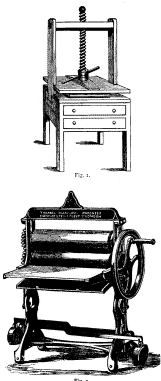 Bradford's
Mangle, No. 1, shown in the illustration, Fig. 2, is suitable for this
purpose, and takes up little room. Before laying the cloth, the parlour-maid
should sweep up the hearth, if fires are used, and put on fresh coals, so that
there may be a cheerful blaze by the time dinner is served. Any papers, books,
or other articles that may be dispersed about the room, should be tidily put
away, leaving the sideboard clear for table requisites. The sideboard cloth
should be laid flush with the edge of the sideboard, not hanging over the front
as is sometimes seen. The same rule should be observed in covering all tables
used as sideboards. At the back of the sideboards should be placed salvers,
bronzes, lamps, or any ornaments belonging to the sideboard. On the right side
should be put clean glasses, arranged according to size and kind; and on the
left, spoons and forks tastefully set out. The middle of the sideboard should be
left unencumbered for sauces, vegetables, or anything not wanted on the table.
The dinner-cloth should be laid with the middle fold down the centre of the
table. Whether the damask has been mangled on the right side or not, the
parlour-maid must observe that the raised creases should be on the top. Some
prominent design in the fabric generally indicates the centre of the cloth,
which should of course be laid in the middle of the table. A lamp, cruet-stand,
or vase of flowers, is generally put to mark the centre, and the distances of
the respective dishes are regulated from that object.
Bradford's
Mangle, No. 1, shown in the illustration, Fig. 2, is suitable for this
purpose, and takes up little room. Before laying the cloth, the parlour-maid
should sweep up the hearth, if fires are used, and put on fresh coals, so that
there may be a cheerful blaze by the time dinner is served. Any papers, books,
or other articles that may be dispersed about the room, should be tidily put
away, leaving the sideboard clear for table requisites. The sideboard cloth
should be laid flush with the edge of the sideboard, not hanging over the front
as is sometimes seen. The same rule should be observed in covering all tables
used as sideboards. At the back of the sideboards should be placed salvers,
bronzes, lamps, or any ornaments belonging to the sideboard. On the right side
should be put clean glasses, arranged according to size and kind; and on the
left, spoons and forks tastefully set out. The middle of the sideboard should be
left unencumbered for sauces, vegetables, or anything not wanted on the table.
The dinner-cloth should be laid with the middle fold down the centre of the
table. Whether the damask has been mangled on the right side or not, the
parlour-maid must observe that the raised creases should be on the top. Some
prominent design in the fabric generally indicates the centre of the cloth,
which should of course be laid in the middle of the table. A lamp, cruet-stand,
or vase of flowers, is generally put to mark the centre, and the distances of
the respective dishes are regulated from that object.
The fashion of dining ? la Russe, very common
at large dinners, requires a separate notice. For the present we will confine
our observations to the usual arrangement of a table in well-conducted
households. By the latter system, the master sits at one end of the table, and
the mistress of the house at the other. Carving knives and forks, together with
dinner knives placed nearest the plate, mark their places. According to the
number of persons to dine, knives and forks are placed for each. A tumbler and
one or more wine-glasses should be put at the right of each guest, just above
the dinner knife. When clean dinner-napkins are laid, it is customary to place a
piece of bread in the folds of the napkin.
Whether cut bread or rolls should be placed at the right hand
or left, is sometimes a disputed point. We decide in favour of the right, for
this reason When a guest wishes to have his plate removed, he is supposed to
rest his fork on the plate. A well-trained servant observes no other rule in
making the change, sadly to the grievance occasionally of an inexperienced
diner, who inadvertently drops his fork. As in breaking bread it is not
considered well-mannered to use both hands, there is no occasion to relinquish
the fork until a change of plate is desired. Between the courses, the crust of
bread may be divided with both hands, if desired. Now that knives are beginning
to be used for eating fish, the last claim of the bread to be laid on the left
of the diner, appears to have been disposed of.
Directly a person lays down his fork, or puts both knife and
fork together on the right-hand side of the plate, the servant in attendance
should bring another plate on which are laid knife, fork, or spoon, appropriate
to the dish which is to follow. All meats, vegetables, and sauces should be
handed on the left side of the diner.
Serving wine, & c., should always be done at
the right-hand side of the guest without removing the glasses from the table,
except in the case of beer, which is served at the left hand. The reason is
obvious. Beer requires to be frothed into the glass ; consequently, it prevents
accidents if the servant presents a tray to the guest on his left to receive the
glass, into which the beer should be poured, at the distance of a step behind
the guest. The full tumbler should then be handed on the left, as it would be
inconvenient for the guest to receive it over the right shoulder. Servants
should avoid handling wine glasses. If they must do so, they should only touch
the stem. Water-bottles are placed on the table within reach of the guests.
Before setting dessert on the table, the parlour-maid should
brush off the crumbs into a small tray with a curved cloth-brush or similar
contrivance made for the purpose.
Carving knives and forks after being used should be removed
before taking the dish containing meat from the table. A long narrow knife-tray
with a clean coarse cloth laid at the bottom, is the proper receptacle for these
articles.
During the intervals which occur in waiting on the guests,
the parlour-maid should remove all things which have been used outside the
dining-room, where one of the under servants usually conveys them to the
kitchen. The servant waiting should contrive to have all soiled vessels out of
the room by the time dessert is put on the table, her attendance not being
wanted after that time.
Tea.- After a late dinner, tea is generally a very
simple repast, requiring only a tray on which teacups and saucers, with other
tea appendages, are set. If tea is made in the drawing-room, the parlour-maid
waits on her mistress until the tea is handed round. A set tea, i.e., a
meal, with tea as a beverage, is served in the same manner as breakfast. It is
now the fashion to cover the tea table with a white cloth, as for breakfast.
Supper is usually served in the same manner as
luncheon.
Washing up china and glass, cleaning plate, and trimming
lamps, being equally the work of the parlour-maid or page, will be described in
another place.
[-305-]
SERVANTS
OF THE HOUSE.-VI.
THE PAGE, OR OCCASIONAL BOY.
THE duties of the page vary in their nature according to the class of
establishment in which such servants are kept. In households consisting of many
domestics the page, as a juvenile servant, executes most of the light
miscellaneous tasks which the upper men-servants are unable to discharge without
hindrance to more important work. Going on errands constitutes a very important
portion of a young page's work in large families; and in order to fulfil this
requirement efficiently, promptness and an intelligent mind are first
essentials. Aptness in reading and writing is a great recommendation, added to
which, if a lad has a good address, a well-formed figure, and a correct manner
of speaking, he cannot fail to rise in his calling, and may ultimately hold the
highest position of confidence a servant can attain in domestic service.
Many of the duties of a page have already been treated of in
preceding articles. We shall therefore only speak in this place of those
branches of work which constitute the basis of general knowledge indispensable
to indoor men-servants generally.
Beginning with early morning work, whatever labour is dirt in
its nature should be done early, i.e, before breakfast. A suit of old
clothes should then be worn, and changed for better by the time the family comes
down. Cinder-sifting may be cited as an instance of the work which should be
done early and in old clothes. Therefore, the master of the house should impress
on the various servants the necessity of their letting the page have all the
cinders from the respective rooms throughout the house as soon as possible.
Whatever cinders may be left unsifted by a given time on one day should be
collected for the following morning's sifting. Knife and boot-cleaning, being
also dirty work, should, as far as possible, be prepared for quick despatch by
the articles being looked up over-night, and brought to one place in readiness
for the morning. Wherever these orderly arrangements are despised, the page's
life is one of incessant worry, and his untidy appearance is an indication of
the disorder which prevails in the household.
The inevitable dust and dirt attending cinder-sifting is much
obviated by the use of improved sifters. These are of various kinds and
excellence.
A larger patent cinder-sifter, or revolving machine, is well
adapted to the wants of large establishments, especially if a garden be attached
to the house ; used also in connection with Moule's earth closets, the
well-sifted cinders become an article of high economy and value.
Even in town residences preference should be given to some
improved sifter over the untidy and wasteful habit of riddling the cinders over
a dust-hole. The only means by which the latter mode can be made effectual is by
placing bars across the top of the dust-bin, on which the sifter may be rested,
and shaken to and fro.
Most "housemaids' boxes" are filled with a small
grating for parlour cinders. A cinder-pail, also fitted with a movable wire
sieve over the top, is a very useful contrivance for sifting small quantities of
cinders, especially if the cinders be thrown on a newly-laid fire for immediate
use.
Boot-cleaning almost invariably falls to a page's share of
work. At present the numberless inventions which have successfully assisted the
despatch of household work seem to have fallen short of perfection in this
branch of labour. The latest and best improvement is a patent boot-holder, the
advantages of which consist in preserving the inside of the boots from being
soiled by dirty hands, which are almost inseparable from the employment, and in
setting both hands free for polishing.
In the absence of a patent boot-holder, the first care of the
page should be to pass a soft clean duster over the left hand before he puts the
boot on it. If the boots are not very dirty, rubbing them over with a hard brush
will be sufficient, but if they are very muddy, a piece of ordinary fire-wood,
shaped at the end in the form of a [-306-] chisel,
should be passed round the welt and between the upper leather. Knives are often
employed for this process, but the practice cannot be too strictly forbidden,
the liability of cutting the leather being very great. if boots be exceedingly
wet and soiled, a coarse piece of wetted sponge (stable sponge) should be passed
over them to remove the first dirt. Boots should never be put near a fire to
dry. A moderately warm room, at a distance from the fire, generally suffices, if
the soles be turned upwards for a night.
In laying on the blacking, very little should be used, and
whilst damp the first polishing-brush should be briskly passed over, finishing
with the finest brush. The stroke to secure a polish should be light and
springy, not hard and with force. Three brushes are required for successful
boot-cleaning.
Patent leather boots simply require washing in the soiled
places, and afterwards polishing with a piece of old cloth.
The black kid tops may be preserved for a long time in a good
state by occasionally using a mixture composed of the sediment of ink and a few
drops of olive oil. This should be laid on sparingly, and whilst still damp
the kid should be lightly rubbed with an old silk handkerchief or a piece
of worn-out table-linen.
Blacking sold in cakes is now generally used for ordinary
heather boots. Instead of mixing the cake with water, a little sour beer, or a
few drops of vinegar, will be found a great improvement.
Knife-cleaning is a simple process, but apt to be destructive if care be not
taken to prevent undue wear. In the first place, knives should not be laid in
hot water when washing them. They should be whisked round in a jug of soda and
lukewarm water, barely deep enough to cover the blade. If the handles are
suffered to touch the hot water, they are liable to become loose. Having washed
and wiped the knives, the usual process is to polish them on a board over which
a Bath brick has been passed a few times, and afterwards to rub the knife to and
fro till a polish is obtained. The knife-handle is then dusted. Unless very
carefully done, this plan is seldom so successful as using a "buff-board"
is. The latter, if somewhat less lasting than the plain deal board, preserves
the knives for a very much longer time in good condition. The emery-powder,
also, used on the buff-board, is not equally destructive with brickdust, and the
former gives a higher polish.
Some people are under the impression that knife-machines are destructive;
but the experience of many years convinces us that such is not the case. Knives
cleaned with really good machines wear evenly and keep a fine edge-qualities
which the old-fashioned knife-boards, unless in very experienced hands, seldom
secure. The saving of time by the use of these machines is very considerable
indeed, and becomes an important argument in their favour.
Plate-cleaning requires time and patience to perform nicely. The plate should
be first washed in warm soap and water. If very greasy, or used in eating fish,
a little soda will be necessary. When wiped dry, a mixture composed of fine
whitening-water (gilders' whitening, sold in balls, is best) and a few drops of
spirits of wine or gin should be laid on the plate with a piece of flannel or
rag. The mixture should be of the consistency of good batter, and when dry on the plate should be rubbed off with a
plate-brush. Instead of the ordinary plate-brush sold at oil-shops, use those
which are termed jewellers' brushes for the finer kinds of plate; they do not
cost any more. A brush should only be used for the embossed work of plate.
Simply rubbing with wash-leather is sufficient to ensure the brightness of
plain plate.
Plated articles are liable to injury if left for any length of time damp. After forks, spoons, &c., have been used for eating vinegar
salads and the like, they should be immediately cleansed.
Although cleaning with whitening, or plate-powder composed of rouge, is, as a
general rule, only necessary once a week, plate looks better for being daily
rubbed over after washing with a leather that may be kept in the plate-basket
for the purpose. Towels boiled in a mixture of a hartshorn powder and water are
an excellent rubber for plate in daily use. Rags-old chamber-towels of hucka-;~
back are best-boiled in a solution of a quart of water to six ounces of
hartshorn powder, are excellent for the purpose.
Window-cleaning is essentially the work of a page or footboy. Having
taken due precaution against the chance of accident by falling, the first
part of the process consists in dusting the window-sashes with a round brush,
called a painter's brush. One pane at a time should then be wetted with a
wash-leather dipped in soda and cold water. When the leather has been
wrung out and passed over again, the polishing should be done with a piece of
dry wash-leather. Many other plans are recommended for window-cleaning, but the
above answers every purpose, and is infinitely preferable to the use of any
description of "window-rags," all linen and cotton fabrics being more or
less fleecy in their nature.
Powdering a window with whitening tied in a piece of cotton cloth is
sometimes necessary, if the windows are unusually greasy or soiled; but for
ordinary occasions cold water and soda will be found sufficient, if a
wash-leather
be used for drying.
Trimming lamps is part of the morning work of a page. Once a week
every lamp in use should be taken to pieces and thoroughly cleansed. The works
of oil lamps of every description should be soaked in hot water and soda, and
rubbed perfectly dry whilst hot with a soft rag, and afterwards polished with a
plate-leather. In trimming the cotton wicks of moderator lamps the greatest
evenness is requisite. The wicks of paraffin lamps should only be dusted until
the charred portions are removed. By this means a wick one-third of a yard in
length lasts several months. All rags in use for lamp-cleaning should be washed
at least once a week in strong soda and soapsuds.
Washing glass, and sending it to table in the highest state of brilliancy, is
an act worth striving to accomplish from the great pleasure the sight of bright
glass affords. Two wooden bowls are required to secure this end - one containing
warm water and a little soda, and the other plain cold water for rinsing. Bowls
used for washing glass should be used for no other purpose. After the glass has
been washed, it should be laid on a coarse cloth to drain, and afterwards
polished with a glass-cloth, i e, a soft linen cloth.
Soiled decanters may be easily cleaned either by rinsing them out with
tea-leaves, or, if very dirty, finely-shred brown paper, soaked in soap and
water. They will require good rinsing afterwards.
Stoppers may be removed in various ways, if unfortunately they have become
fixed. The most successful plan is generally to steam them over boiling water. A
better endeavour is to prevent their becoming fixed. This may be done by
twisting the stopper slightly between the forefinger and thumb as it is put into
the decanter.
Brushing the master's clothes is the page's business where no other
man-servant is kept. In doing so, the greatest care should be taken not to soil
the garments by brushing on a place of doubtful cleanliness. All cloth should be
brushed the way of the pile, i.e., from the neck to the skirts downwards.
Having brushed the clothes, they should be neatly folded according to the size
of the drawer or wardrobe in which they are to be laid. The fewer folds the
better. A small bottle of water, containing a few drops of ammonia spirit, is
useful to remove any grease spots that may be seen in brushing.
[-363-]
SERVANTS
OF THE HOUSE.-VII.
THE LADY'S-MAID.
THE duties of a lady's-maid towards her mistress being of a purely personal
nature, propriety of demeanour and a well-informed mind are requisite qualities.
The strictly technical knowledge required in the situation maybe learnt in
various ways; but no teaching will convey the delicate tact which proceeds from
a pure mind, and the high sense of integrity which should characterise the
slightest action where the interests and feelings of an employer are concerned.
Gentlewomen of refined education appreciate the latter
qualities in a personal attendant far beyond consummate knowledge of certain
arts and adornments. They are sensible that a first-rate milliner or hairdresser
can supply some deficiencies on the part of their maids, but they feel that no
amount of lessons can teach a confidential servant when to speak and when to be
silent, when to expose the faults of fellow-servants or to make excuses.
Unfortunately, some ladies'-maids consider that they display zeal for their
mistresses' welfare by detecting and commenting on the shortcomings of other
domestics. By so doing they create a great deal of preventable unhappiness. If
faults exist - and provided it is not the lady's-maid's duty to report them to
her mistress - the discreet plan is to wait till an opinion is asked for. If a
lady has confidence in the sense and honesty of her maid, she will not fail to
appeal to her judgment whenever household difficulties occur. On such occasions
plain speaking is an imperative duty, at whatever cost of the opinion of
fellow-servants.
Another temptation to steer clear of is the offer of
gratuities and presents on the part of tradesmen who deal in articles of
doubtful excellence.
It is very important that a lady's-maid should know something
of the nature of the cosmetiques and contrivances which fashion is
ceaselessly thrusting upon public notice. Many articles in vogue may be
perfectly harmless, whilst others, although effective in their operation for
awhile, may ultimately destroy the organ they may have been applied to. Here our
Toilette articles will prove serviceable.
In large establishments the position of a lady's-maid is
considered to be sometimes exposed to annoyances from the unwelcome attentions
of men-servants. In well- regulated households these intrusions do not take
place, unless with the lady's-maid's consent. Except at meals, she seldom has
occasion to leave the apartments assigned to her own and her mistress's use. In
modesty of behaviour, and in cordiality of manner towards every one in the
servants' hall, she will find her chief safeguards against any approach to undue
familiarity.
Visiting with her mistress at other people's houses is liable
to cause inconvenience, unless a lady's-maid makes up her mind to regard herself
somewhat in the light of a guest. Most persons find something they do not like [-364-]
when staying in even the most hospitable mansions. But well-bred people
cheerfully conform to the rules of the household where they are visiting, and it
is very annoying to employers when their servants cannot do the same. Whenever
real grounds for complaint exist, it is better for the lady's-maid to speak to
her mistress on the subject, who, on her part, will refer the matter to the lady
of the house.
Honesty is of course an indispensable quality in one who has
the charge of articles of value. A lady's-maid's fidelity in this respect should
be beyond suspicion. She had better be scrupulously saving of things not likely
to be asked for, than to make away with them because they are worthless. When
old dresses and odds and ends of all kinds have inconveniently accumulated - as
they sometimes do from oversight-the lady's-maid should ask her mistress what
her wishes are with regard to the disposal of them. Even when ladies agree to
give their maids cast-off dresses as perquisites, this understanding is expected
to be in force.
With regard to the disposal of such articles, the best plan
is for the lady's-maid to sell them to friends of her own acquaintance, or to
part with them by some other private means. By this mode she is likely to get a
better price, and to be less exposed to temptation from offers for things of,
perchance, a more costly nature than would fairly come into her possession. As a
general rule, ladies do not like to see their maids dressed in the clothes they
themselves have worn - except in wearing a black or a dark-coloured silk - the
difference in the social scale of mistress and maid renders this unpleasing.
The dress of a lady's-maid should be studiously neat,
although tasteful. She should wear nothing likely to spoil or impede her in her
various duties-above all things she should cultivate personal cleanliness as her
chief charm and adornment.
The duties of a lady's-maid are so numerous that it is
difficult, in a limited space, to particularise them. Some knowledge of
dress-making is generally considered indispensable, also of millinery and
hair-dressing. Novelties in these arts may be learnt by taking lessons from time
to time of persons who make the giving instruction of the kind their means of
livelihood. When taking such lessons the lady's-maid should learn from her
teacher the best style to suit her mistress, in the view of being successful in
her work-the same head-dress, for instance, will not become all persons equally
well ; and it makes a great difference if a lady be short and stout, or tall and
thin, whether one style of costume or another is suitable. As far as her means
extend, a lady's-maid should discover what style of dress ladies of high birth,
reputed to have good taste in dress, are wearing at a season when her mistress
is choosing her attire. The several ladies of the royal family of England are an
instance of the excellent tact sensible people display in avoiding all
unbecoming exaggerations of fashion, whilst they adhere sufficiently to the
prevailing mode to avoid the opposite error of being eccentric.
The arrangement of her mistress's room devolves on the
lady's-maid, but in very few cases is she required to do more than dust the
room. She is, however, responsible for the manner in which the housemaid does
the work of cleaning, &c.
Order in putting things aside is indispensable. Whatever
articles are likely to be wanted for dressing, or any other purpose, should be
at hand at a moment's notice.
Although the lady's-maid's duties do not usually require her
to be a very early riser, it is desirable that she should be up some time before
her mistress is likely to want her, in order to get any work done likely to soil
her hands or dress. The washing of fine things, laces, &c. generally falls
to the lady's-maid share of work, and the earlier this is done in the day the
better. The numberless works of cleaning, scouring, and dyeing, that an
experienced maid has to perform, should all be undertaken before her mistress
has risen. By this means interruptions are obviated, and good temper preserved.
Any time that is thus spared could be devoted, in leisure hours, to reading and
improvement of the mind.
The economy of her mistress's wardrobe is a great test of a
lady's-maid's skill. Whether she has the perquisite of cast-off dresses or not,
it is her duty to suggest any saving that may be made by "turning" or
"altering" gowns, &c. A servant that is apt at these suggestions
deserves better wages than one who is not so skilled, and may reasonably expect
the fullest remuneration for her services.
The preservation of clothes is a matter that a lady's-maid
should understand, as well as their restoration - for instance, the elaborate
dresses of the present day cannot be folded up and laid in drawers without
detriment to their beauty. Dresses in wear should be hung up separately in a
clothes-closet, or wardrobe, each dress in a separate bag made of brown holland.
The bag should be, at the very least, half a yard longer than the dress, to
prevent dust from penetrating through the opening. Any loose trimmings that may
be laid aside flat should be removed.
White satin shoes and boots should be put aside in separate
bags, having been previously folded in blue paper.
Furs should be well dried before a fire, and thoroughly
shaken before they are put away. The box containing them should also be
previously dried and brushed out. A celebrated furrier says that,
"Furs, when put away after winter use, should be closely packed in linen or
brown paper to preserve them from moth, having been previously well beaten with
a small cane and carefully combed through ; this process should be repeated at
least once a month, and may be relied on as effectual." Strong aromatic
odours are useful for preventing the attack of moths ; but without the above
precautions their use may prove ineffectual.
Laces not in wear should be thoroughly cleansed in several
waters from all traces of starch. They should then be dried in the sun if
possible, and afterwards put away in bags made of blue paper.
Unpicked dresses should not be folded, but each width of the
material should be separately wound on a roller. Skirts that are not likely to
be worn for a time should be taken Out of the band and laid flat. In folding all
plain skirts begin at the bottom, and divide the skirt into four equal folds
commencing at the middle of the back width; then divide the skirt in cross
folds, according to the size desired, taking care to pass the hand between each
division to avoid "corner creases." Some hours before dresses that
have been laid aside are worn, they should be shaken well out, and hung before a
fire.
Woollen materials require much the same treatment as furs to
prevent the ravages of moth and mould.
Linen and calico garments should be rough dried before they
are laid aside. It is also essential that they be thoroughly free from damp.
All materials of clothing not in constant use require to be
periodically aired. A dry sunshiny day is best for this purpose.
Volume 2
[-13-]
SERVANTS
OF THE HOUSE.-.VIII.
THE LADY S MAID (concluded from Vol. I., p. 364).
To Clean Trinkets .-All jewels not "set clear," i.e. with
a backing of gold or other metal, may be washed in the following way:- Brush
them with soap and water, and a very soft tooth-brush. If mounted in silver, a
little gilders' whitening will be necessary, as for plate. Rinse them in clean
water, and then shake them about in box-wood sawdust till they are quite dry,
which may be seen by the sawdust no longer adhering to them. Do not handle them
with the bare fingers, but use some silver paper. Box-wood sawdust is used by
jewellers for the above purpose, and may be had at any rule-maker's ; it is
cheap, and sold by the pint. Filigree ornaments may be cleaned in the same way
as described; likewise gold chains and bracelets. Ornaments not set clear should
only be cleaned on the surface with but little moisture.
To Wash Hair.- The head should be held over
a large basin of lukewarm water, in which a third of a packet of Manby's washing
powder has been dissolved. Then rub the hair with a piece of pale yellow soap,
moistening it with the water in the basin till a good lather is produced. Have
at hand a can of lukewarm water. Pour the latter over the hair, collected in a
bunch at the top of the head. When all traces of the lather are removed, envelop
the head, for a few minutes, in a coarse, dry towel. Having squeezed out as much
moisture as possible, rub the hair plentifully with pomatum, or plain hair-oil.
Wring the hair in a dry cloth, comb it out, and leave it to hang over the
shoulders to dry.
To Wash Hair-Brushes.- Use no soap, but a
little washing-powder in lukewarm water. Very little moisture is necessary, if
brushes be rubbed one against another; only the bristles should be wetted. If
possible, set them in the sun, bristles downward, to dry.
Combs should never be washed in water. Small brushes are sold
for the purpose.
Hair washes, as a general rule, are not necessary if the hair
be periodically washed and daily dressed with care. A mixture of one pennyworth
of borax, half a pint of olive oil, and a pint of boiling water, is a popular
wash with many who do not approve of washing the head.
Pomatum for the Hair composed of animal fat is to
be preferred to that made of vegetable oil. Beef marrow or lard, reduced to the
desired consistency with olive oil, and scented with any perfume, is the basis
for all good home-made pomatums. As a general rule, the pomatum sold at
hair-dressers is strongly scented enough to bear the addition of as much again
of the above compounds without additional scent. We give a Swiss receipt, which
has the credit of really stimulating the growth of the hair when advanced age
does not offer a serious impediment. It is cheap, simple, and above all innoxious,
which cannot be said of many similar preparations:- Into an earthen vessel put
sixpennyworth of sweet unsalted pork lard, recently melted, or as the cooks say,
"tried" down. Set this over the fire in a shallow saucepan of boiling
water. As soon as the lard is liquid, shake into it a pennyworth of powdered
camphor; mix well with a spatula or small wooden spoon; then add four
dessert-spoonfuls of good old Jamaica rum; stir again. After the water in the
saucepan has boiled a minute or two, take out the vessel containing the pomade,
and keep stirring till nearly set. The quantities we have stated could be
increased, but it is better to use it fresh and fresh.
This pomade should be well rubbed into the skin at the roots
of the hair, every day for the first fortnight, and every other day the second.
It is better to use it in the morning than in the evening, because perspiration
at night and the contact of the pillow might tend to weaken its efficacy. There
is no need to be afraid of the smell of the camphor, as it very speedily
evaporates.
A very much more cleanly class of pomades have however been
lately introduced, prepared from petroleum, and sold under the name of
"Vaseline," and sometimes "Cosmoline." Some time ago
accounts were published of the effects of crude petroleum upon the growth of
hair, said to have been discovered by vendors who had dried their smeared hands
upon their own locks. Petroleum has also been extensively applied to the coats
of various [-14-] animals with satisfactory
results. The smell was, however, an insuperable objection to ordinary toilet
use; but the vaselines and cosmolines as now prepared are perfectly inodorous,
resembling in appearance a nearly transparent, semi-fluid jelly. They have an
undoubted influence upon the growth of hair, and it is another recommendation
that most of them are of proved efficacy in the case both of wounds, sores, and
many skin diseases. They have, moreover, the valuable property of never becoming
rancid, however long they are kept, and are hence a decided acquisition to the
nursery and toilet alike.
To remove Grease Spots from Silk.- Take a few
folds of blotting-paper, and pass a moderately heated iron over the spot,
removing the blotting-paper, and replacing it with fresh as soon as soiled. If
any colouring has been in the grease with which the silk is stained, a little
benzole, as used by artists, may be applied to the spot after the grease is
removed. Before making any experiments on valuable silks it is well to try the
means proposed on a piece of the same material, having just caused a stain of
the kind requiring to be removed.
To Revive Black Silk.- This may be done by many
means; but the following is the most simple plan, and answers well:- First
remove all the grease spots in the way described above. Then spread the silk on
a clean ironing-board, and sponge it with nearly a dry sponge dipped in a
mixture of beer and water and ammonia, in the proportion of a pint of cold water
to a teacupfull of stout or porter, in which has been dissolved a lump of salts
of ammonia as big as a hazel nut. Avoid streaking the silk when applying the
mixture, and each fold, as finished, should be rolled on a roller. When nearly
dry, take the silk off the roller, shake it out, and roll it again, repeating
the rolling and shaking, till the silk is quite dry. Do not on any account,
use an iron, and the silk will thus look nearly as good as new.
To Keep Silk. - In using white paper for wrapping
silks, remember that if the paper has been bleached with chloride of lime, it
will have a tendency to impair the colour. Silk should not be kept folded up
long before it is "made up," as this would tend to decrease its
durability, by causing it to cut or split, especially if the silk has been
stiffened with gum.
To Clean Kid Gloves.- Put the gloves
on a wooden hand, sold for the purpose, of the size required, and rub the spots
with a little stale bread, If the gloves are greasy they will require benzole
applied with flannel. A very useful substitute is Price's Sherwoodole, sold at
most dyers and scourers. White satin shoes may be cleaned in the same way.
To Clean Tweed Cloth Cloaks and other Woollens.- Spread
the garment on a clean dresser, and rub the soiled places with a square of
prepared pipe-clay, used dry. Then pass the clay all over the garment,
till quite covered with a white dust. Fold the garment into a compact form, and
beat it with some plaited canes till the dust makes its way through from the
centre folds. Afterwards shake the material, and brush off the remaining dust
with a soft clothes-brush. The above plan is specia1ly excellent for all
grey-coloured cloths, children's knickerbockers, and the like.
To Clean White Satin Shoes- Rub them
lengthways of the satin with a piece of new white flannel dipped in spirits of
wine. If but slightly soiled, they are readily and easily cleaned by simply
rubbing them with stale bread. To keep thin light slippers in shape, fold them
over lengthways or sideways, tie together, and put them away in a covered box or
bag, as already recommended.
The Teeth require to be kept particularly clean rather
than the application of mouth-washes and elaborate dentifrices. The more simple
the ingredients used the better. Unless recommended by a good dentist, all tooth
powders reputed to have beautifying effects should be used with caution. Washing
the teeth night and morning is the best preservative of their beauty and
soundness.
Artificial Teeth have already received attention
in another section of this work. Speaking of these, we ventured, on page 173, to
warn our readers against unqualified dentists. In this warning, we had in view a
large section of that class depending more upon their advertisements than upon
the quality of the articles they supply; but, in common justice, we ought to
have added that advertising has now become so common with most trades and
professions that many of the most respectable practitioners do not hesitate to
adopt it.
Nails.- The finger-nails should be trimmed
to the shape of the finger. ends, leaving them moderately long, but not
projecting beyond the tips of the fingers. Nails should not be cleaned with
sharp-pointed scissors and pins - a soft nail-brush is the right means. If the
hands and nails have become unusually soiled, they should be rubbed with a
little sweet oil or pomatum before washing with soap, and afterwards cleaned in
tepid water. In wiping the hands, the "crescent" of the nails should
be preserved by gently pressing it back with the towel.
We may here state that the washing of fine laces, blonds,
&c., belongs to a lady's-maid's place.
[-50-]
SERVANTS
OF THE HOUSE - IX.
LAUNDRY-MAID - WASHING AT HOME.
THE practice of washing at home, although greatly fallen into disuse amongst
the middle class of housekeepers generally, is much to be commended, not only on
the score of pocket economy, but also on sanitary grounds. The obstacles which
are supposed to exist at the present time against the practice have but to be
fairly confronted to be found of a very unreal character. The chief point to
ascertain is whether the money spent in putting washing out cannot be better
spent in other ways. Of course, if expense be no object, people have a right to
indulge their inclination; but if the laundress's weekly bill can only be met by
stinting food, and limiting the changes of linen to the most absolute
requirements of cleanliness, then it becomes a serious question whether some
personal sacrifice of comfort ought not to be endured for the sake of a
substantial gain.
The invention of washing-machines has done much to obviate
the main objection raised against washing at home, inasmuch as the time and
labour saved by their use is reduced very considerably; hut there still remains
the prejudice to overcome in favour of its being more "genteel" to put
all washing out. This false notion, in fact, is at the root of the general
disinclination to resume a custom which certain obstacles may have caused to be
relinquished, but which have no longer justly tenable grounds.
Like many other persons, the writer was induced, in a moment
of weakness, to discontinue the labour of washing in her household, at a time
when there was some difficulty in replacing a servant who had been accustomed to
the work. From that hour, to resume the task appeared impossible, until the
well-established reputation of certain washing-machines induced her to remodel
her household, in the express view of having all the family linen washed at
home; and after nearly six years' experience of the working of the
washing-machine the writer has no reason to revoke the good opinion originally
entertained of this substitute for manual labour. This is not the place to
describe the process of washing by machinery particularly, and the instance is
merely cited to point the direction in which an important matter of household
reform may be accomplished.
Whether household washing be performed by machinery or not, a
thorough knowledge of the process is necessary on the part of the mistress of a
household, in order that the work may be dispatched without waste of time and
material.
The day before a wash is intended, all the dirty linen should
be looked up, sorted, and entered in a book with the same precision as is
observed when things are sent out. Any articles that are in excess - owing to
the state of the weather or what not - should be thoroughly dried, folded, and
put away, under lock and key, till a convenient season. Saturday afternoon is
the best time for the above preparation; the clothes can then remain in soak
till Monday, which greatly facilitates the removal of stains, &c.
All the best white linen should be put in a separate pan, or
tub, and coarse things in another. Sufficient lukewarm, or cold soda and water
should then be poured over the clothes.
Coloured things, flannels, and woollen materials should not
be laid in soak. These require washing separately, piece by piece, when the
work is in progress. Pocket-handkerchiefs should be first rinsed out, and the
water thrown away before they are put in with the rest of the things.
The next arrangement to make should consist in shredding fine
yellow soap into a jar capable of containing sufficient liquid, according to the
amount of washing to be done. About a pound of soap to a gallon of water is a
good proportion; no soda should be added. Having poured boiling water on the
soap, cover the jar and set it aside on the kitchen stove, or range, till Monday
morning, when the soap will be found to be melted to a jelly. When lukewarm,
take some of this soap-jelly, and mix it in the water in which the clothes are
to be washed. By this means a fine lather is easily produced without waste.
About a pint of soap jelly to an ordinary tub of water will be sufficient. The
clothes will require but trifling rubbing with hard soap in the very soiled
places.
It is a good plan to begin a wash with the flannels. No soap
is required for them beyond the jelly described, except for the cotton bands and
tapes. Each article should be washed separately in moderately warm (not hot)
water. Having washed them in one water, rinse them in clean warm suds, shake
them Out, and hang them on the lines at once. Never rinse flannels or woollens
in plain water. By doing so they become harsh and shrink.
The water in which the flannels have been rinsed is excellent
for the first washing of the white things. If too dirty for that purpose, it
should be poured on the coarse things, having first taken them out of the cold
soak.
The white things will require two washings, rubbing soap on
the stained places, if required. The second water should be used for the first
process of rubbing less im-[51-]portant articles.
By the time the white things are washed, the copper should be ready for the
boiling process. The water should only be lukewarm when the clothes are put in,
as boiling water fixes the stains instead of loosening them. The water in the
copper should contain a fair proportion of soap jelly and about two ounces of
soda. From ten minutes to a quarter of an hour after the clothes have been at
boiling heat, they should be taken out and plunged into plenty of cold water for
rinsing. Having been wrung out of the rinsing water, they should next be put
into clean blue water, one by one, passing each piece swiftly through the
water to prevent the blue from settling into those unsightly streaks which are
afterwards so difficult to remove.
There is no waste of time in this precaution, because each
article has to be wrung out separately, even if a basketful of linen be tossed
into the blue water at the outset. Directly ?the clothes are blued and wrung,
they should be shaken out and put upon the lines.
A propos of "hanging-out." Before
putting up the lines, they should be passed through a coarse cloth, to remove
any dust or soils from the gravel-paths, &c. All articles set in a band
should be slightly festooned from the bottom hem-never from the band. Sheets and
table-cloths should be hung with the short side towards the wind, to enable the
air to blow the folds apart. Shirts should be suspended from the bottom hem. A
good many pegs are necessary to hang things out well, and the laundry-maid
should be careful not to place the pegs at the corners, without first doubling
the corners. Stockings should each have a peg, and should be turned inside out
before being put on the lines. Wooden pegs are best.
Flannels and woollen materials, set in bands or pleats,
require a different mode of hanging from linen things. The latter should be hung
with the fulness downwards, as described, but flannels should always be
suspended with the fulness at the top.
Gentlemen's waistcoats and trousers require care in being
washed at home. Each article, if woollen, should be washed singly, as described
for flannels. After having been rinsed in suds, the garment should be simply squeezed
tolerably dry, not wrung. The legs of trousers should be pulled straight
before hanging on the lines, and waistcoats thoroughly shaken. Trousers and
waistcoats should be hung out in a breezy shady place, the former being
suspended by the pegs at the band at the back, and the latter by a couple of
pegs at the back lining. Piqu? waistcoats, &c., require the same
management as other materials of the same kind.
[-143-]
SERVANTS
OF THE HOUSE.-X.
THE LAUNDRY-MAID (continued from p. 51).
WHITE cotton stockings should be washed on the right side, and turned inside
out before putting into the copper If very much soiled, they may be safely
cleansed by using a stocking-brush, made of fine fibre for the purpose. Woollen
stockings should not be boiled, but must be turned before putting out to dry,
otherwise the colours will run. Neither stockings nor socks should be wrung
lengthwise, but across, by the laundress placing her thumbs at the tops and
gathering up the whole length in creases, when one twist of the hands will be
sufficient to wring out the water.
[-144-] All the white things
being washed, the coloured articles should undergo the process of two rubbings
and one rinsing in clean cold water; but not boiling, unless the clothes be
servants', and very greasy. Coloured muslins should be left in the rinsing water
till the moment of hanging them out, to prevent running. A handful of salt in
the rinsing water will often prevent running. When half dry, it is a good plan
to take both coloured woollens and cotton things off the lines and shake them
well out, before re-hanging them to finish.
Babies' diapers should never be washed in water containing
any soda. The effect of doing so is to produce irritation of the skin, which is
rarely attributed to the right cause, and often occasions unnecessary physicking.
On this account, infants' under-linen should be washed in the rinsing-suds of
flannels, and should be boiled before soda is added to the copper water.
Kitchen cloths and coarse things require much the same
treatment as other articles. If very greasy, a little lime may be added to the
copper when they are put in to boil. Some people consider powdered pipe-clay an
excellent mode of cleansing coarse cloths. Several new washing preparations have
been lately recommended for the purpose, but with careful use, ordinary soap and
soda ought to be found sufficient to preserve the whiteness of kitchen cloths.
No kitchen cloths should be put aside dirty after use.
When a wash is finished, all the utensils should be scrubbed
and put aside in their appointed places. The lines should be wiped dry, and
twisted across the hand and elbow of the laundry-maid into a neat coil before
being placed in a bag. The pegs also should be collected into a separate bag,
and all things left in readiness for the "getting-up," which must form
the subject of a subsequent chapter.
When the things are brought in from the wash, the
laundry-maid should sort each kind into separate heaps - flannels, muslins,
table and body linen, and coloured things requiring a different treatment to get
up. Folding and starching follows. Begin with starching.
To make Starch.- About two ounces of
maize starch should be allowed to every quart of water. The starch should be
mixed in a clean earthenware bowl, by gradually pouring on a sufficient quantity
of cold water to reduce it to a thick paste. Then add the hot water from a
kettle, whilst boiling on the fire, stirring all the time, to mix the
starch evenly. Generally, no boiling afterwards is necessary. If, however, the
starch should appear at all "lumpy," it will have to be boiled and
strained through a fine sieve.
It is a good plan to melt about two inches of composite, wax,
or tallow candle, to a bowl of starch, in order to prevent sticking to the
irons. Also, if the starch be intended for coloured things likely to "run,"
a little salt should be added. This applies particularly to black and white
mixtures and braid.
"Glenfield Patent Starch" is best for fine muslins
and lace, to which may be added, if preferred, a small quantity of white wax.
"Australian Satin Glaze Starch" is well adapted for articles that
require extra stiffness, such as gentlemen's collars and cuffs. Ordinary rice
starch is good for wearing apparel generally, and plain flour starch will be
found efficient for servants' kitchen gowns.
Begin with starching the muslin and net materials. These
should be dipped into hot starch of moderate thickness, and should be afterwards
slightly squeezed in cold water. They should then be tightly rolled in a clean
coarse wrapper, for several hours before ironing. Hanging lace and muslin in the
open air after starching is liable to make them limp, unless the weather be very
sunny. If dried in the open air, they require damping afterwards, like all other
dried starched things.
The usual plan is to sprinkle all starched materials after
they have been dried, and to leave them for some time in the wrappers, as
described; but in families where washing at home is practised, and saving of
time and trouble is a consideration, the following plan will be found more
expeditious and quite as effectual:- Having starched all the articles in the
usual manner, take a clean coarse wrapper, made of old sheetings, towels, or the
like, and lay the starched things as smoothly as possible on the surface,
covering them with a cloth of corresponding size. Then fold the wrappers over to
the size of the rollers of the mangle or wringing-machine, and pass the rollers
over them once. This will have the effect of squeezing out all superfluous
water, and reducing any lumps of starch to evenness. In fact, the articles are
half-ironed by the process, and are ready for immediate finishing. Shirt collars
and linen cuffs are better done by the above plan.
The starching process being completed, folding for the mangle
is the next work. In doing this, the object should be - to fold the things in as
few folds as possible, and to a keep the materials as straight as the shape
admits of. Garments, such as night-dresses and under-linen, should be commenced
folding at the bottom, shaking them well, to prevent unnecessary creases.
Gentlemen's shirts should not be mangled. After the wristbands and collar
have been starched, the shirt should be laid flat on the dresser, and the
fulness of the back smoothed open ; then lay in the starched places on the
bosom, fold the sides of the shirt over and over, and roll the shirt up as
tightly as possible into a small bundle for several hours.
Some care is required, in folding sheets and table-cloths for
the mangle, to keep the folds even. The best plan is to begin by folding the
article in half (two persons are required for large things), then take up the
corners at each end, and bring them to the middle fold, pull the article
straight, and flap it up and down a few times, fold across, a and lay it on the
dresser, where any rucks should be smoothed out by hand. By the above plan, it
is easy to pass an iron along the seams, without unfolding the whole article.
Table linen and sheets require to be passed through the mangle twice or three
times, body linen (afterwards to be ironed) only once. Cotton stockings should
be mangled on the right side, and ironed on the wrong.
Ironing - Cover the table or dresser with a
coarse~ ironing flannel, doubled, or a piece of old blanket. Stretch over it
some clean old sheeting, fastened to the table at,. the corners with flat-headed
brass nails. Have at hand a basin of clean cold water, to damp out any folds
that may have been badly ironed. Rubbers and iron-holders should be scrupulously
clean. A knife-board, sprinkled with Bath brick, is the cleanliest mode of
polishing flat-irons.
The heat and size of the irons should be regulated according
to the articles to be ironed. Flannels require a heavy, cool iron, and calico
scorches with less heat than linen.
The plain linen articles should be ironed first, and hung to
air, whilst the lighter materials are in hand. Muslins and net require ironing
twice, being gently pulled every way of the thread between each ironing.
Embroidered muslins should be ironed over several thicknesses of flannel. As a
general rule, all fine muslin work is better first ironed through a piece of old
thin cambric this prevents scorching, and also clears the muslin from the
starch. Gentlemen's linen fronts and cuffs should always have the iron first
passed over them in this manner.
In ironing pocket-handkerchiefs, the iron should be passed
along each side before the middle is touched the ironer slightly pulling the
corner in the left hand whilst she irons with the right. To form pleats neatly,
the frill should be laid straight in front of the ironer whilst she makes the
creases of the desired width with the nail of the right hand, the left holding
the point of the hem in place till the iron is passed over it. All pleats must
be laid even to the thread.
[-181-]
SERVANTS
OF THE HOUSE.- XI.
THE LAUNDRY-MAID (concluded from p.144).
Goffering is very much in use at present, and
machines are made expressly for the purpose. For laces and other light frills
the ordinary goffering-irons answer very well. These are used by the ironer
putting her thumb and second finger through the handle, as in using scissors,
then she turns the thumb under, taking up the frill between the irons from
underneath. In the action of bringing the thumb uppermost again, the goffer is
formed. All goffered frills require ?to be ironed first. Goffering is done from
the left hand to the right. Care is necessary not to scorch with goffering-irons.
Very little heat is necessary to form the goffers.
All piqu? materials should be ironed on the wrong
side, over several thicknesses of flannel, if ironed at all. Piqu? looks
better if well shaken only whilst drying, only ironing the hems and bands. Piqu?
waistcoats should be ironed through muslin or soft cambric, as described.
Bed furniture, made of dimity, should not be ironed. After it
has been starched, and pressed through the rollers of the wringing-machine, it
should be shaken out and laid upon clean grass to dry. When nearly dry, the
laundry-maid should pull the dimity the way of the ribs in the material. Two
persons will be wanted to pull the curtains, back, and tester pieces.
Lace and muslin window-curtains should not be ironed. After
washing, they require to be put into rather thick starch, and afterwards cleared
in a small quantity of cold water. To prevent the necessity of wringing, they
should previously be lightly tacked together in folds of a convenient length,
and the laundry-maid should only squeeze the muslin, and turn it over and over
in the tub till all the dirt is removed. Having rinsed and starched them in the
usual manner, they should be carried to some spare room, where they may be
pinned out on the floor to dry. A clean sheet should be laid over the carpet or
boards, and the curtains pinned to it at full width, and very straight.
White cashmere and merino articles are better mangled and not
ironed, as the heat of the iron is apt to make woollen materials fade in colour.
White alpaca should be ironed between muslin, and finished on the wrong side.
Black silk stockings look better if washed without soap. They
require washing in two waters (hot), using some of the best washing powder
instead of soap. In rinsing them, a good deal of blue should be put into the
water. White silk stockings are washed, in the usual way, in soap lather, and
the rinsing-water should contain a little cud-bear or pink saucer, to give the
flesh-coloured tint. If ironed, they should be turned inside out for the
process, but it is better to dry them between two mattresses.
Getting up lace requires a separate notice. Few ladies trust
their fine laces to a laundress. They either do it themselves or send it to a
lace-cleaner. The latter is an expensive plan, and by taking a little trouble
the work can be done very well at home. Large pieces of lace, such as shawls,
scarfs, &c., should be folded into a convenient length, and washed in lather
made of the soap-jelly described in a previous article. The lace should not be
twisted or wrung, but simply patted and squeezed with the flat palm of the
hands, till no more soiled water oozes out. Before blueing, the lace should be
put into a pan, and set under a tap of flowing water (when the water is coming
in from the main is a good opportunity), and after several gallons have run
through the lace, it may be passed through blue water, if desired. For our own
part, we consider the blue contained in the starch sufficient, without any
further addition. The lace should then be unsewn, and stretched out to dry over
a clean mattress. The edges should be previously worked out between the finger
and ball of the thumb. The nails should never be used to open the edges
of lace. Each scallop round the lace should, if possible, have a pin placed
through it to the mattress, beginning at the corners.
Border lace is best washed on a wine bottle, previously
covered with fine flannel, stitched flat and smooth on the bottle. A bottle thus
covered should always be kept for the purpose in a clean linen-closet. Take one
end of the lace, and begin by lightly tacking each scallop to the flannel all
round the bottle, then tack the other edge, drawing the lace to its full width,
and so on, until all the lace is sewn in layers on the bottle. Then plunge the
bottle in some warm suds made of soap jelly, and squeeze the lace with the hands
till the suds have well penetrated. Repeat the process in second suds, and
afterwards rinse, as described, under flowing water. Set the bottle in the sun,
for the lace to dry, turning it round as often as necessary. When tolerably dry,
put the bottle into some Glenfield starch, working the starch through with the
fingers. Afterwards, wash off the superfluous starch on the outside, by plunging
the bottle for an instant in cold water. Set the bottle in the sun to dry again.
Unless the weather be very favourable, this may require two days to accomplish.
In the meantime, cover the lace with some thin material, to keep off the dust.
When dry, the lace will only require unsewing from [-182-]
the bottle. If it has been well tacked on, it will come off looking even
and raised in the meshes, like new lace. The above is the best way of cleaning
old point lace, Honiton, and every kind of guipure. The pearl edges may
require a little working out with the ball of the thumbs.
If lace be very much soiled, a little sweet oil may be laid
on each fold as it is being put on the bottle. New lace also is rendered less
liable to crack in the meshes, if moistened with oil before washing.
Clear-starching is an art, of which the process is kept a
secret in the trade, but ladies may get up their fine muslin embroidery, almost
as well by the following means:- Wash and rinse, as described for fine
materials, then pin out the article over several folds of flannel, and iron as
usual. This is necessary to emboss the raised work. If the design be in lace,
"raise" the pattern, by passing an ivory stipple into the scrolls,
rubbing gently until each thread looks clear and glazed. The end of an ivory
handle of a crochet needle answers very well for this purpose. When finished,
the article should be left till perfectly dry. Only the plain parts of the
muslin or net should be touched with the iron. Isinglass is sometimes used for
stiffening fine lace.
Blonde is seldom successfully washed at home. If attempted,
the above plan will be found to answer as well as any.
NURSE AND NURSERY-MAID.
Where the care of young children is concerned, the duties
of the above domestics are precisely the same, the chief distinction being, that
in families where more than one domestic is kept in the nursery, the upper
servant is usually styled "nurse," and the under servant "nurserymaid."
Also, in households where much responsibility is vested in one nursery domestic,
she is often called "nurse". If the female head of the household
superintends the management of the children, a "nursery-maid" only is
generally kept to do the rougher portions of the work, such as scrubbing floors,
emptying slops, &c. It is advisable that employers should understand the
nature of these distinctions, because, in making engagements, disappointment is
unavoidable if the precise position of the servant is not clearly defined.
Next to the engagement of a governess, that of a nurse
requires the greatest consideration. If the mother of the children spends a
great deal of time in the nursery, she is naturally the individual to whom the
little ones look for advice and assistance. But if from pressure of business,
ill health, or any other cause, she is compelled to confide the care of her
offspring to a stranger, too much care cannot be taken to secure the services of
a well- informed, kind-hearted deputy. The most essential qualities to seek in a
nursery attendant are truthfulness, intelligence, cheerfulness, and cleanliness.
As a general rule, these qualities are not very commonly to be found in the
class of domestic servants from whence inferior situations in a household are
filled. Nurses, as representatives of mothers, should be drawn from the more
highly educated circles of society than usually constitute the domestic servant
class. Daughters of small tradesmen, ill-paid civil service employ?s, and
clerks, that have enjoyed the training which a well-regulated home above the
reach of actual want affords, are excellent, generally speaking, as upper
nurses; and the assistance of such, when once secured, should be rewarded in a
generous spirit. Having enjoyed the blessings of a settled home, they usually
impart an air of comfort to the nursery apartment, and take pains to instil into
the minds of their infant charges high principles and a love of home. These qualities
are seldom acquired by the domestic who has filled every kind of situation in
ever-varying households. Experienced the latter may be, but the experience is
apt to be of a kind which is mingled with bitterness and dissatisfaction at the
numberless changes to which their path in life has been subjected.
In choosing a nursery-maid, early rising, good temper, and
strength of constitution are necessary qualifications. Truthfulness is obviously
of so much importance, that any shortcoming in this particular should not be
overlooked. If a nursery-maid has time to spare from more active duties, it is
advisable that she should be a fair needle-woman; not only that she may assist
in mending the children's clothes, but because a young person who has a taste
for sewing is generally more companionable to the little folks in the nursery
than one who has no inducement to sit down when her more active duties are
finished.
In addition to the ordinary duties of the nursery, an
under-nurse is generally required to assist in washing infants' linen, flannels,
socks, frills, tuckers, &c. Time should be allowed for this work on a
certain day of the week, the children, in the meanwhile, being placed entirely
under the care of the nurse or mother.
In preceding articles on the rearing of young children, in
the HOUSEHOLD GUIDE, the question of food and clothing has been minutely entered
into. It therefore only remains to indicate some points of nursery management
not included under those heads.
Whenever the plan of the day's work rests with the nurse, the
primary consideration should be to secure plenty of time for out-door exercise
and recreation. With this view, nursery cleansing, and other arrangements should
be made subservient to the state of the weather, in order that exercise in the
open air may be taken in the finest part of the day. As young children generally
wake early, the morning walk should, in summer time, take place before the sun's
heat is oppressive. The most healthy time for walking out in the summer months
is between eight and ten o'clock in the morning, and from half-past five till
seven o'clock in the evening. In the spring and fall of the year, from ten to
twelve o'clock in the morning, and from three till five o'clock in the
afternoon, will be found equally suitable. Young children should never be
exposed to the burning heat of the sun, neither should they be allowed to sit
down in the parks and squares of towns. As far as it is possible, little
children residing in the country should spend the greater part of their time out
of doors ; the nurse, if necessary, doing any light needlework in the meantime.
Any kind of game which exercises the limbs of children whilst in the open air,
is conducive to health; only when passing through the streets should they be
required to walk hand in hand.
In the absence of the children from the nursery, the windows
should be open from the top and bottom sashes, and the bedding exposed to air.
If the nursery boards are scrubbed, a fire should be lighted in the room, to
quicken the drying and take off the damp chill.
All children under four years of age (and as much later as
the habit can be enforced) should be persuaded to rest on returning home from a
walk-the little ones to sleep, and the older ones to read books or look at
pictures, whilst in a recumbent position.
In the meanwhile, the nurse should wash and dress herself
thoroughly in another room, if she has been prevented from doing so in the
earlier part of the morning. Whilst the children are taking their morning nap is
the best time for the nurse to do any little work not suitable to the nursery.
Before leaving the room, however, she should take every precaution to prevent
accidents, by the children falling out of bed, playing with fire, or what not.
In order to leave no inducement to the children to lie awake
in their beds, the nursery blinds should be drawn down during the morning hour
of slumber. All toys should be put out of sight, and the apartment made to
appear as little suggestive of play as possible. In the [-185-]
waking hours of children the reverse should be the case. The more the
floor is bestrewn with toys, and the more nursery litter is about, the more
happy the place is to its infant denizens. A skilful nurse will know when to
enforce habits of order, and when to give way to a natural inclination on the
part of children to create confusion.
The seeming love of disturbance and destruction shown by all
healthy children should not be too seriously regarded. The impulse springs from
a desire to test bodily strength and to acquire knowledge. It needs guiding, not
checking. If improper things for these purposes are placed within the reach of
children, the fault is not theirs. The sole good of an article to a child's
comprehension is the use it can be put to. They know nothing of the value of the
presents well-intentioned friends make. All that children think of is the amount
of pleasure a toy can be made to yield; and, for all practical purposes, a fine
horse, stripped of saddle, mane, and tail, reduced, in fact, to a mere block of
wood-or a beautiful doll, denuded of fashionable attire, and converted into a
bundle of rags, answers the purpose, in their degraded state, more effectually
than in the original condition. At the same time, little children should not be
permitted to commit ruthless destruction on works of art, for of such a nature
toys, now-a-days, are. On the contrary, gifts of the kind should be treated with
respect by those in charge of the children, and should not be sent into the
nursery to share the fate of common toys. There should be toys too good for
every-day use, just as there are Sunday clothes. Some restraint should be
imposed in the use of such pleasures; and when the gratification of handling
them is at an end, the precious treasures should be put carefully aside.
Expensive toys may thus be made to serve a double purpose-pleasure in their use,
and admiration of their structure.
[-246-]
SERVANTS
OF THE HOUSE.-XII.
NURSE AND NURSERY-MAID (continued from p. 183).
INDISPENSABLE as watchfulness is at all times in the management of children,
the need of vigilance is most a urgent, to detect the first signs of disease.
Any change in the natural habits of children should be reported by the nurse to
the parent. Any accident, however slight, that a child may have sustained,
should be spoken of to those most interested in its welfare. Matters that may
appear of no moment at the time, frequently prove the fore runners of serious
ailments. No one can prevent mishaps but concealment is a grave error. The cause
of many a spinal complaint has been traced to an unlucky fall and numberless
hidden diseases have arisen from children swallowing improper substances.
Nothing is more fatal in these cases than the delusion that no harm can come of
such accidents. Sooner or later the truth is liable to become known, and the
nurse to suffer blame for an evil which candour would have dispelled.
Some nurses are tempted from over-anxiety to suggest, that
upon any little derangement of health "a powder" should be given. They
look upon certain medicines as the cure-all of every complaint, instead of a
last resource, to be administered only under medical advice. Dieting is,
however, generally, the only dose a young child, living in pure air, needs when
a little out of health. By dieting is meant substituting one kind of food for
another - as beef-tea instead of meat; bread and milk instead of bread and
butter or cheese; light egg-puddings in place of those composed of fruit,
jam, and suet; avoidance of tea, coffee, wine, and beer, if such articles of
food, unsuitable to most a young children, have been partaken of. If having
tried change of food, combined with plentiful use of water for bathing, and
ample exercise in the open air, a child still shows symptoms of failing health,
medical aid should be sought.
The occasions which require instant remedy are those a which,
from their sudden appearance, the nurse is most likely to be the first to
perceive. Amongst these are croup, one of the most alarming diseases of
childhood. This terrible complaint is often unpreceded by any symptoms of a
common cold. The first intimation of its approach is usually given in a loud,
brazen-sounding couch unlike any ordinary cough. Only one sound may be uttered at
considerable intervals at the outset, but the first cough should call forth
active measures. In the absence of immediate medical aid, an emetic may be
safely given. When vomiting has set in, a warm bath, at a temperature of 98?
Fahrenheit, should be prepared, and the child should remain in it from a
quarter-of-an-hour to twenty minutes. An eminent physician, in an excellent work
on maternal management of infants recommends as an emetic for croup, one grain of
tartarised antimony dissolved in an ounce of boiling water, to be taken in doses
of from five to, but never exceeding, twenty drops, according to age. The remedy
being a powerful one, larger doses should only be taken under medical advice.
Attacks of croup are prevalent even with robust children between two and twelve
years of age, and are most general in the spring and fall of the year, during
the prevalence of north-east wind after rain.
The manner in which a child sleeps is a great indication of
its healthful state. Perfect composure in sleep denotes perfect health. The
flitting smile that plays across an infant's features when asleep - poetically
called an "angel's whisper "- arises from flatulency, and is of
frequent occurrence. The child's position should be slightly changed to dispel
the wind. Rolling of the head upon the pillow is a more serious sign, especially
if the eyes be fixed, and the child starts fitfully in its sleep. If the child
be unusually costive, an aperient dose may remove the symptoms ; if otherwise, a
medical man should be consulted.
Another sign which should excite attention is the appearance
of a child's limb drawn in an unusual manner. The thumb drawn tightly into the
palm of the hand, for instance, may precede an attack of convulsions. The
passing of a child's hands over the top of its head and forehead also, may
denote some disturbance of the brain.
The cry, which to many nurses always means hunger, varies
very much in infancy, according to the nature of its wants. The shedding of
tears, which is the most pathetic appeal to our feelings, is in reality the
least alarming of all kinds of crying. It is supposed that the flow of tears
arises only from mental emotions, whilst the tearless cry denotes bodily pain.
The cry of hunger is generally heard when an infant wakes from slumber, and may
be known by alternate fretfulness and a catching sound of the breath,
accompanied by an eager movement of the tongue and lips, and carrying of the
hands to the mouth.
A continuous moaning cry proceeds from wearying pain, of which
the seat may be generally ascertained by observing the movement of the hands and
legs. If the legs be updrawn the pain will probably be in the stomach; if the
hands be frequently put to the mouth, cutting a tooth may be suspected.
Any of the above indications of pain should be reported to
the mother, and if medical aid be sought, the nurse has no responsibility in the
treatment of the case. All her thoughts should be centred in carrying out the
doctor's instructions, whether they coincide with her notions of propriety or
not. In describing a child's symptoms she should avoid speaking from her own
impressions or past experiences, confining herself strictly to present facts.
The medicine should be administered with faithful exactness, the nurse carefully
noting its effect. If anything strikingly unusual should follow on giving a
dose, she should confer with the child's parents on the subject, and be advised
by them whether to follow the doctor's directions or not.
The dress of a nurse needs some words of comment. Long skirts
should not be worn, tripping little children up, as they are liable to do. Gowns
made of washable materials are most suitable. These are easily cleansed if
soiled by nursery duties, and cost but little to renew. A waterproof apron worn
under the ordinary white apron will be found a great comfort to a nurse, and
might be supplied with advantage at the cost of the employer. Every nurse should
also be furnished with a long, loose, warm wrapper, made like a dressing-gown,
for night wear, when her duties require her to rise from her bed to take a baby
to and from the mother's room. This garment should be purchased by the mistress,
and kept for the use of any nurse who may succeed to the situation.
Volume 3
[-26-]
SERVANTS
OF THE HOUSE.-XIII.
OCCASIONAL HELP:- CHARWOMEN, NEEDLE WOMEN, SWEEPS, DUSTMEN,
ETC.
THE greater the amount of work that can be done at home without occasional
assistance from "extra hands" the better for household peace and
economy. Upon this subject people are generally agreed, and nine out of ten
persons deplore the unpleasant fact of being obliged to have occasional help,
without, at the same time, making any particular effort to dispense with the
necessity.
The general impression of housekeepers who have not gone into
figures on the matter, is, that it is cheaper to engage people to do extra work
than to keep sufficient domestics to meet any pressure that may arise. If, at
the year's end, however, they cast up the indirect expenses entailed by this
system of management, they will find that the cost has been greater than they
imagined. As a general rule, the mere wages paid for occasional help is the
smallest part of the outlay. Few charwomen and other
domestic day-labourers are satisfied with sheer money payment. They look to be
better fed, in quantity if not in quality, than resident servants,
and, moreover, they expect to have the privilege of taking home with them odds
and ends and remnants which, with good management, should be consumed in the
household where they attend.
Exceptions are to be met with, of course, but the above is
the general opinion entertained by people of the class that go out for a day's
charing, &c.
Connected with the actual cost of the day's hire, should be
taken into consideration the discomforts and disorder which the presence of
strangers in a household entails. For the time being they are the guests of the
servants. rather than the servant of the employer. It is a rare pleasure if the
extra hand, thus called in, goes to her work in a thoroughly earnest and
indefatigable spirit. To begin with, charwomen do not usually bring with them
adequate knowledge, except of work of the roughest kind, and the additional food
and beer generally allowed only serve to dull whatever energy and intelligence
they may happen to possess.
Households that are subject to be frequently supplemented by
charwomen and other like assistants, are also liable to be exposed to still
greater disturbances than those described. The love of gossip is inherent in the
class, and the affairs of every one of the families the charwoman serves become
in most cases a common fund of conversation. Domestic matters of the most
delicate nature are discussed, and in an unsparing manner. Whatever facts are
not accurately known are unhesitatingly surmised, until all privacy of living is
out of the question with whatever neighbours may happen to be at the mercy of
the same ignorant tongue.
There are families that are never free from the presence of
the charwoman. She is no sooner out of the house than some unexpected domestic
crisis requires her services afresh. These households, with very few exceptions,
are never settled with servants; good, bad, and indifferent characters from the
last place, appear to be attended with the same consequences. The servants do
not stay; neither can they always be induced to state the reason of their
objection. If the reasons could be obtained, they would be discovered, in a
large number of cases, to be founded on the fact that the Servants have
"heard something about the place they did not like." The simple
circumstance of many predecessors having filled the situation within a short
space of time, is often sufficient to give a good servant a dislike to a place.
Even when every attempt has been made to conciliate supposed objections, and a
total change made in all persons hitherto employed, in the house, the same
mischance is apt to occur. One person is generally left behind, and that person
is usually the charwoman, who comes to clear up and put things in order for new
comers. Thankful as one may be at times for any domestic help, on any terms, it
should be borne in mind that the accommodation may be had at too high a price ;
and that there are occasions when it is better to help oneself, or do without
help at all, rather than re tam the services of a suspected medium.
Uncharitable as the foregoing observations may appear to
people who have not had very long experience of housekeeping, the main facts
will be found verified by the circumstance, that those who have had servants in
their employ a good number of years, seldom seek outside aid. The members of the
household seem to be actuated by a common interest, and are willing to bear
temporary inconvenience arising from unusual causes.
A just employer, sensible of the comfort a good servant
effects by doing extra work, will not suffer her labour to go unrewarded - a
little present. or a pleasure trio when the labour is done, is a fair and
suitable acknowledgment of the service rendered.
[-27-] The only instance when
hiring a charwoman is generally a judicious measure is when a single-handed servant
is kept. The extra hand, then, should have special work to do, and nothing
beyond. She should be required to come and leave at a certain time, and her food
and wages should be a matter of distinct understanding. A washerwoman, or a
charwoman who goes out for a day's washing, for instance, should be kept to her
washing just as a gardener, working by the day, is expected to keep to his
gardening. Everything should be ready to her hand on her arrival. The clothes
sorted, the copper-fire lighted, and the other necessaries of the work supplied.
When her task is done, she should be required to leave the kitchen or scullery
in good order, and the copper clean and dry. The average pay of a washerwoman in
and near London is two Shillings per day, provided food and beer be found; and
half-a-crown if required to "find herself." A certain quantity of beer
or gin is generally stipulated for in the latter case. Some charwomen are
willing to go out for less pay, on condition that their food and beer are found;
but in the end it will be discovered that the cheaper and more satisfactory plan
is to pay an equivalent for all extras in money.
Superior to the charwoman in social position, but liable
to the same objections in some respects, is that large class of women who go out
for a day's work at the needle. The blessed invention of the sewing-machine has
reduced this class of workers considerably, and it is now by no means easy to
get a really good seamstress to take a day's work at the employer's house. The
best have sewing-machines of their own, and have plenty of employment at full
pay at home. The least skilled are still to be had, but they are inefficient
hands generally, and require constant supervision.
It is a great question whether, as matters stand, it is not
far cheaper to give out extra needlework that cannot be done at home, by the
family and servants, in preference to engaging needlewomen of the kind
now-a-days to be had. In the first place, a great deal of time is usually wasted
in giving the necessary and minute instructions required, and a considerable
portion of the day is spent in the number of meals consumed.
The real economy of having needlewomen in the house consists
in several members of the family lending assistance in doing the unskilled
portions of the work-running seams, making piping, &c. The seamstress is
then able to devote her time to the more important branches of the work-fitting
and finishing. At the same time, if a needle-woman is kept exclusively to this
employment, she naturally expects a higher rate of remuneration than one who is
only capable of doing inferior work. Needle-women of the latter class are
generally content to receive about two shillings a day; whilst one working in a
family whose daughters, for instance, do the easy parts of the labour, looks
with reason to receive higher wages. From three shillings and upwards is often
asked for assistance in the latter case.
The chief economy in having dresses made up at home lies in
making use of old materials. If everything has to be bought new, there is little
advantage in making up materials at home, that is to say, unless the seamstress
gets very considerable aid.
Everything should be ready when the seamstress arrives;
patterns should be decided on beforehand, and the materials for the work
selected.
Amongst the rougher kinds of
household labour, which are a hindrance to personal comfort, may be classed
having the chimneys swept. Unless the structure of a chimney, however, be very
defective, there is no occasion to have the sweeps oftener. than once in about
six weeks for kitchen flues, and less often for sitting-room chimneys. Any
apparent necessity for their attendance at shorter intervals, is generally owing
to the cook or housemaid neglecting to keep the mouth of the chimney clear by
sweeping round the opening daily as far as her arm will reach. If this
precaution is neglected, the best constructed chimneys will be liable to smoke,
and sending for the sweeps will be the consequence.
The Ramoneur Company is an excellent institution for
subscribers who are troubled with smoky chimneys and careless servants. For
half-a-guinea a year, one can have all the chimneys of a house swept as often as
liked - a privilege, we presume, that is rarely abused.
Whenever it is considered necessary that a chimney should be
swept, some one should be appointed to go outside the house to see that the
sweep's broom appears above the top of the chimney. This, in fact, is the only
proof of the work having been effectually done ; otherwise the ordinary
hearth-broom would answer the purpose as well. Scraping the top of a chimney-pot
is sometimes a successful mode of curing a chimney of smoking.
Preparatory to the sweep's visit, all movable articles should
be either removed from the apartment or covered up. The looking-glasses should
be lightly covered with a sheet or sweeping cloth, and all mats taken away,
leaving a piece of drugget for the sweeps to walk upon. After a chimney has been
swept, the carpet of the room should be thoroughly brushed, and the walls
lightly swept with a hair broom covered with a clean glass-cloth.
Dustmen are periodically necessary visitants, although not so
frequently necessary as some people imagine. In the suburbs of London, where the
collection of dust is not enforced, there is no occasion for a dust-bin at all,
except to receive sifted cinders, until it is convenient to dig them into the
earth or otherwise dispose of them. Dust-bins as ordinarily used are nothing
better than foul receptacles for litter and rubbish that ought to be consumed by
the kitchen fire. It is an untidy and unhealthy practice to throw vegetable
trimmings, pieces of paper, bones, and dirty rags into the dust-hole. The
practice is also reprehensible on account of the wasteful facilities the dust
bin affords of getting rid of remnants of food. If decently set aside, such
remnants would afford a meal to some of the starving poor, to be found
everywhere. A strict watch on the emptying of dust-bins in various
neighbourhoods will best illustrate the necessity of looking after such things
at home.
The practice of giving "pig wash" to people who
apply at some houses for the gift is also liable to be abused. People really do
not care to take the trouble of collecting the wash if it contains not remains
of loaves, joints, vegetables, &c. Extravagant servants find the latter
means a most convenient mode of effecting a clearance of food that has been
repeatedly at table. The benefit such a gift confers on the collector is very
questionable.
[--grey numbers in brackets indicate page number,
(ie. where new page
begins), ed.--]
|
source: Cassells Household Guide, c.1880s