Volume 1
[-109-]
COURT MANUAL.-I.
INTRODUCTION.
IN every nation under heaven distinctions of rank are recognised. The most
rude and barbarous, equally with the most refined and civilised, have adopted a
social gradations under every variety of government. Such an arrangement appears
to have been found necessary not only to the well-being, but to the very
existence of society. Whatever the explanation, some have been clothed with
authority over others, have had the pre-eminence, and been regarded with
deference. Such authority and pre-eminence may be regarded as a the necessary
consequence of the relations in which people stand to each other. That the
husband should be the head of a family, his wife his nearest equal and the
children subordinate, seems to be natural, and not an arbitrary decision. The
same is true of the relation of master and servant. The principle is adopted in
larger communities, and it is found necessary to place one member at the head,
whether he be called a chief or a president, a king or an emperor. But inasmuch
as one man is not equal to the task of personally regulating state affairs,
others are appointed in various degrees of subordination to him, and all having
therefore a certain precedence or rank above the mass. The rank thus acquired is
in some cases temporary and official but it is often made hereditary, and
sometimes rank and title are conferred for important services to the State. In
this country, and in many others, probably the majority of those who claim
superior rank do so on account of their connections with families which have
been ennobled. Some time or other it has come to pass that every member of the
community is regarded as belonging to a particular class, and therefore as
occupying a definite position in the social scale. This position is not,
however, always fixed and irrevocable in the case of individuals, of whom some
may ascend and others may descend, where descent is possible.
It is not the object of these chapters to discuss the topics
which have been indicated, nor even to blame or praise all the arrangements
which they involve. The object is rather, in a brief and intelligible manner, to
enumerate and describe the various ranks and offices which come within our
scheme, and to exhibit the order of precedence which is recognised by society
and authority. It need scarcely be added that our attention will be limited to
our own nation, as most in accordance with the practical character of this work.
Moreover, as royalty, in the person of the Sovereign is, in fact, the head and
source of all other ranks and high offices, we shall commence with that, and
proceed afterwards to other branches of the subject.
THE SOVEREIGN.
In this country the sovereign head of the State may be either a king or a
queen, and becomes such by inheritance. The Sovereign, on his or her accession
to the throne, is proclaimed, and enters forthwith upon the honours, duties, and
emoluments of the Crown. The coronation follows with many solemnities and
formalities, amid all the splendour which such an occasion justifies. The new
monarch takes the following, or coronation, oath :-" To govern the people
of this United Kingdom of Great Britain and Ireland, and the dominions thereto
belonging, according to the statutes in Parliament agreed on, and the respective
laws and customs of the same; to his power to cause law and justice in mercy to
be executed in all his judgments; to the utmost of his power to maintain the
laws of God, the true profession of the Gospel, and the Protestant reformed
religion established by law; to maintain and preserve inviolably the settlement
of the United Church of England and Ireland, and the doctrine, worship,
discipline, and government thereof, as by law established within England and
Ireland, and the territories thereto belonging ; and to preserve unto the
bishops and clergy of England and Ireland, and to the united Church committed to
their charge, all such rights and privileges as by law do or shall appertain to
them or any of them."
This oath was taken by her present Majesty, but the last two
clauses will have to be modified on any similar occasion hereafter, in
consequence of the disestablishment of the Irish Church.
As the duties of the Sovereign are so great and constant, the
throne is never supposed to be vacant, and "the law ascribes to that person
a never-ceasing existence," so that when a king dies the office passes at
once to the successor.
Mr. Thoms, in his "Book of the Court," to which we
once for all acknowledge our obligations, says: "As the representative of
the State, the Sovereign has the supreme exclusive management of transactions
between the United Kingdom and all foreign powers." This includes the
appointment and reception of ambassadors, making treaties, declaring war and
peace, and whatever pertains to military matters. As the "fountain of
justice," the Sovereign is sworn to administer according to law, though he
does this by means of judges and the Lord Chancellor. The Sovereign is supreme
in regard to trade and commerce, and the current coin of the realm,
[-110-] and is entitled to all wealth which has no known owners or heirs.
As the "fountain of honour and privilege," the Sovereign alone confers
titles, dignities, and various high distinctions, including ministerial offices.
He pays no toll nor tax, and cannot hold lands of a subject, because such things
would imply a certain inferiority. As head of the Church, while he may not alter
the established religion, nor forsake the profession of it, the Sovereign may
reform abuses and appoint fasts and thanksgivings, appoints bishops and
archbishops, and has many other powers and rights as to the disposal of
benefices, the calling of synods, the publication of Prayer-books, and the
copyright of the authorised version of the Bible.
As head of the Parliament, the Sovereign alone makes laws of
the Bills which are passed by the Lords and Commons. No other can summon a
Parliament, or prorogue, or dissolve one. By person or by deputy he must be
present at the opening of every session. He appoints the Speaker of the House of
Lords by commission, and must approve the Speaker of the Commons. Additions to
the peers are made by him at his will. in public documents the Sovereign uses
the plural number of the first person "we," "us,"
"our," and he is said to be King - Dei gratia - By the
grace of God. The principal titles of her present Majesty are "Her Most
Excellent Majesty, Victoria, by the Grace of God Queen of the United Kingdom of
Great Britain and Ireland; Defender of the Faith ; Sovereign of the Most Noble
Order of the Garter ; of the Most Ancient Order of the Thistle; of the Most
Illustrious Order of St. Patrick," &c. The Ionian Islands were formerly
mentioned in the Queen's titles, but of course the reference is now dropped. Her
Majesty is not styled Sovereign of France, as several of her predecessors were,
but she has assumed the title of Empress of India, though it is not to be used
in Great Britain and Ireland.
The Queen does not wear official robes except on her visit to
Parliament, when she wears red; and on her coronation, when she proceeded to the
Abbey in crimson, and was there invested with the purple. As Sovereign of the
Order of the Garter, her Majesty wears the riband over the left shoulder, the
badge and stars of the order - the two latter set in diamonds, and an armlet
with the motto of the order on her left arm. At such times her Majesty generally
wears a circlet of diamonds on her head.
When the reigning Sovereign is a king, and is married, the
queen consort enjoys various privileges and prerogatives, and the same is true
of a queen dowager, but we may dispense with an account of them. In the case of
a queen regnant. her husband is invested with very high dignities, but does not
share in the Sovereign power. For example, the late Prince Consort enjoyed no
regal prerogatives.
[-223-]
THE ROYAL FAMILY.
THE details respecting the reigning Sovereign of this country are naturally
followed by some account of the Royal Family, and here the children of the
monarch occupy the first place. Foremost among these is
The Prince of Wales.- The eldest son and heir of the
Sovereign is at his birth Duke of Cornwall, and is forthwith entitled to all the
revenues and rights of his Duchy. He is also born Duke of Rothsay, and Seneschal
of Scotland, but other titles, such as Earl of Chester, Prince of Wales,
&c., are afterwards conferred upon him by royal patent. That the title may
be granted to one who is not the son of a king, but who is, nevertheless, heir
to the crown, is shown by the example of George III., whose father, Frederick,
Prince of Wales, died in 1751, whereupon George was created Prince of Wales and
Earl of Chester. Since the time of. James I. the proper title of the eldest son
and heir-apparent has been Prince of Great Britain, though he is usually styled
Prince of Wales, a title derived by transfer from the Princes of Wales.
The Prince of Wales is, next to the Sovereign, chief in this
realm, although still a subject. His safety, and that of his wife, are guarded
by special enactments, and he enjoys peculiar privileges; for instance, he sits
at the right hand of the Sovereign in all solemn assemblies of state and honour,
and he may retain and qualify as many chaplains as he will. At a coronation he
wears a mantle doubled below the elbow with ermine, spotted diamond- wise; and
in Parliament his robe is adorned with five bars of ermine, a gold lace above
each bar. He has a coronet of gold, consisting of crosses-pat?e and fleur-de-lys,
one arch, and a ball and cross. He also has a plume of three
ostrich-feathers with a coronet, beneath which is a scroll with the words "ICH
DIEN" (I serve). This mark of honour is traced back to the time of Edward
the Black Prince, who killed the King of Bohemia at the Battle of Crecy, and
took from him a similar plume and motto. The Prince of Wales has a place in the
House of Peers, and, on his first introduction, is received with much ceremony;
he also takes the oaths and subscribes the declaration. His wife is styled
Princess of Wales their children are princes and princesses.
The Princess Royal.- This title is borne by
the eldest daughter of the Sovereign. She is the only one of the princesses who
is heir to the crown in default of male issue, and she is, therefore, more
regarded by our laws than her younger sisters.0
The Royal Family in General - The younger sons and
daughters of the Sovereign, and other branches of the royal family, have
precedence of peers and public officers, ecclesiastical and civil. Their order
among themselves is determined by their relationships to one another. The
members of the royal family are princes or princesses, and are all called Royal
Highness. The sons, brothers, and uncles of the Sovereign are Princes of the
Blood Royal; and the daughters, sisters, and aunts are Princesses of the Blood
Royal ; all these have their distinctive coronets. The nephews, nieces, and
cousins of the Sovereign are called Princes and Princesses of the Blood (not
Blood Royal). A letter to a prince or princess of the Blood Royal is addressed
"To His (or Her) Royal Highness -. " but a letter to a Prince or
Princess of the Blood is superscribed "To His (Or Her) Highness -.' In the
first case the letter commences "Sir" (or "Madam") and
concludes,
"I
remain,
With the greatest respect,
Sir,
Your Royal Highness' most
dutiful and most obedient, humble servant."
In the other case the conclusion is,
"I have
the honour to be,
With great respect,
Sir,
Your Highness' most obedient and very
humble servant."
The forms for the wives of princes are similar.
The marriages of the Royal Family arc regulated by Act of
Parliament, 12 Geo. II. c. ii. ; but no act interferes with the free choice of
the Sovereign. The chief provisions of the law are, that none of the Royal
Family under the age of twenty-five may marry without the consent of the
Sovereign, but that after that age they may, under certain conditions, do so.
It may be observed that no one who is not a Protestant can
succeed to the throne of these realms. By the Articles of Union the Protestant
succession of the House of Hanover is a fundamental part of our constitution.
THE PEERAGE.
Under this name are included several degrees of rank, some of them very ancient, and all of them very honourable. The word is used as a general designation for the titled nobility of Great Britain and Ireland, and properly denotes their equality. There are, however, several degrees of rank, viz., duke, marquis, earl, viscount, and baron; and, not unfrequently, one man possesses several of these titles. The House of Lords Consists of peers, and includes the peers of England, of Great Britain, and of the United Kingdom, the representative peers of Ireland~ and Scotland, and certain bishops and archbishops - the latter being the lords spiritual, and the former the lords temporal. The titles of the lords temporal are usually hereditary, but not always ; and some of the titles which belong to peers are titles of courtesy only, and give no right to a seat with the peers in the House of Lords. Ladies may be peeresses in their own right, and the wives of peers bear titles corresponding with those of their husbands, and as such are called peeresses.
[-263-]
WE now proceed to give an account of each of the five orders of the hereditary peerage of this kingdom, commencing with the highest.
Duke.?A dukedom is created by royal patent, and all dukes can sit in the House of Lords. The privileges of this dignity are numerous, and its holders, with their families, take very high rank in the scale of precedence. At a coronation a duke and his duchess are entitled to wear special robes and coronets. The coronet is in each case of gold, set round with eight strawberry-leaves of gold ; its cap is of crimson velvet lined and turned up with ermine, and surmounted with a gold tassel. There are also special robes and a cap to be worn when the sovereign in person opens or closes Parliament. A duke is styled His Grace; and he may qualify eight chaplains, and his duchess two.
Marquis.?The eldest son of a duke is by courtesy a marquis, but he does not on that account occupy a seat in the House of Peers. The rank of marquis is conferred by the sovereign, and is next in degree to that of duke. The title of marchioness is borne by the wife of a marquis, but it has been occasionally bestowed upon ladies as an independent dignity.* In such cases the dignity is not hereditary, as it usually is in the case of gentlemen. The marquis has a special robe and coronet, and so has a marchioness. The coronet of a marquis is a gold circle set round with four strawberry-leaves, and alternating with them ate four pearls set on pyramidal points. The coronet of a marchioness has eight pearls on points with as many small strawberry-leaves alternating, and a gold tassel on the top. The robes differ somewhat from those of a duke, and are worn on similar occasions. The eldest son is, by courtesy, an earl, and his younger sons are viscounts. A marquis can retain and qualify five chaplains. and when he is such by creation or inheritance, he is a peer of the realm.
Earl.?The eldest son of an earl is by courtesy a viscount. The creation of an earl is by letters patent, which give the possessor of the title, in England at least, a place. in the House of Peers. The wife of an earl is a countess, and both have special robes and coronets, the latter having each eight pearls on points, and as many small strawberry-leaves of gold alternating with them. The younger sons of earls are styled barons, and the daughters viscountesses.
Viscount.?This title is conferred by letters patent ; it descends according to the limitations expressed in them, and it is the most modern title of peerage in this country. The eldest son of a viscount holds the rank of a baron, his daughters that of baronesses, and his younger sons that of bannerets. A viscount and a viscountess have their proper state robes and coronets, the latter adorned or set with sixteen pearls each, and having a tassel of gold. A viscount may retain four chaplains, and a viscountess two.
Baron.?There were formerly barons by tenure, but these no longer exist. Some barons have been such by writ, as it is termed ; but it is by letters patent under the great seal that the heritable dignity is conferred at this time in cases of new creation. A baron and baroness have their appropriate robes and coronets, the latter being set with six pearls each, and surmounted by a gold tassel. A baron is an hereditary peer, his eldest son has the place of a banneret ; he may retain three chaplains, and his baroness two.
* In the same manner ladies have been invested with the titles of duchess, countess, baroness, &c.
COURT MANUAL.?IV.
LESSER TITLES OF HONOUR.
HAVING enumerated those dignities the holders of which properly constitute
the peerage, we proceed to mention such other honourable titles as are prevalent
among us, the first being that of baronet, which many regard as one of true
nobility.
Baronet.?This is the lowest degree of hereditary
honour in this country, and does not confer a right to a seat in the House of
Lords. The title was introduced by James I. Baronets and their eldest sons when
of age have the privilege of being knighted by the sovereign if they desire it.
Formerly, so many availed themselves of this privilege that baronets were often
styled knight and baronet whether they had really been knighted or not, but this
was of course a mistake where knighthood had not been conferred. A baronet has
neither special robes nor coronet. His wife, sometimes called a baronetess,
claims the title of lady, and has precedence of all knights.
Knight Banneret.?This is a title of honour which has
been occasionally conferred by the sovereign as a reward for naval or military
service.
Knight Bachelor.?This is the proper designation of
those who are commonly called knights?as Sir A. B., Knight. The party to be
created knight kneels before the sovereign, who, laying a sword upon his
shoulder, bids him rise, calling him by his Christian name. The dignity is
personal and not hereditary. The wife of a knight is by courtesy styled lady.
Esquire.?This term, although in practice of very
extensive application, really indicates a degree in the social scale next to
that of knight. At one time it was a title which could be granted by the
sovereign, and even now, in spite of modern custom, it appears that only certain
persons are actual esquires. In the form of squire the term still retains a
trace of its ancient distinctiveness. The following are said to be truly called
esquires:? the eldest sons of knights, and their eldest sons in succession ;
eldest sons of younger sons of peers, and their eldest sons in succession ;
esquires by creation, and their eldest sons ; justices of the peace, while they
remain in commission ; sheriffs of counties, for life ; officers of the royal
household, while in office ; mayors of towns ; members of Parliament ;
counsellors-at-law ; bachelors of divinity, law, or physic ; esquires by office,
as esquires of Knights of the Bath, &c. In law, foreign and Irish peers, and
eldest sons of British peers, are only esquires.
Gentlemen.?This word actually denotes the lowest order
of the minor aristocracy, but, like esquire, its true use has been almost lost
sight of. Our forefathers, when social status was more clearly defined than how,
as readily distinguished between a gentleman and a yeoman, as we do between a
landed proprietor and his tenantry. At present the question is rather curious
than important.
ORDERS OF KNIGHTHOOD.
Of these we have but few, and our rules are so strict that no British subject
can rightly accept foreign orders without special permission from the Crown. In
this country the sovereign admits to one of the national orders such persons as
their constitution allows, in testimony of royal regard.
The Most Noble Order of the Garter.?The institution of
this is referred to the reign of Edward III. and the year 1349, and the order
itself is considered the highest in the world. The sovereign is its head, and
its numbers are limited, but always include several foreign potentates and
princes. The habits and ensigns of the order consist of garter, mantle, surcoat,
hood, collar, and George. The garter is worn below the left knee, and is Of dark
blue velvet edged with gold. It bears a motto in gold letters, Honi soft qui
mal y pense, and has a gold buckle and pendant. The mantle is of garter-blue
velvet, lined with taffeta ; the surcoat is of crimson velvet lined with white
taffeta, and, like the mantle, bears on the left side an eight-pointed star
embroidered in silver. In the centre of the star is the red cross of St. George,
the patron of the order, the whole being surrounded with a small garter in blue
velvet, and bearing the motto of the order embroidered in gold. The hood is of
crimson velvet lined with taffeta. The hat is of black velvet with a plume of
white ostrich feathers, and a tuft 'of black heron, feathers fastened to the hat
by a band of diamonds. The collar is of gold, and weighs thirty-two ounces. It
is formed of twenty-six garters with roses in each, alternately white and red.
The George is a figure of St. George on horseback, and is attached to the collar
; the lesser George is hung to a broad blue ribbon worn over the left shoulder.
The [-332-] officers of the order are, (1) the
prelate, who is the Bishop of Winchester; (2) chancellor, the Bishop of Oxford ;
(3) registrar, the Dean of Windsor; (4) garter principal king of arms; (5) usher
of the black rod. A Knight of the Garter takes the initials K.G. after his name
or title.
COURT MANUAL.?V.
ORDERS OF KNIGHTHOOD (continued from p. 332).
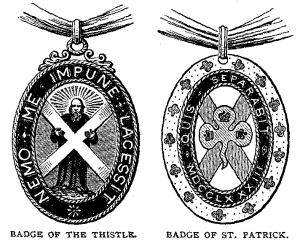
The Most Ancient Order of the Thistle.? It is
uncertain when this order was first instituted, but it was revived in 1687, by
James II., and re-established in 1703 by Queen Anne. A statute passed in 1827
directs that the order shall consist of the sovereign and sixteen knights. The
members are chiefly of the Scottish nobility, but the Queen has conferred the
order upon each of her four sons, who, with herself and sixteen knights,
constitute the order at present. The motto of the order is, Nemo me impune
lacessit. The star, which is worn on the left side of the cloak or coat, is
a St. Andrew's cross embroidered in silver, with rays between the points of the
cross ; a thistle in green and gold on a gold ground in the centre, surrounded
with a green circle on which is the motto in gold letters. The badge or jewel,
worn pendant to the collar, or to a dark green ribbon over the left shoulder and
tied under the arm, is a figure of St. Andrew in gold enamelled with colours,
bearing before him the cross in white, the whole surrounded with rays. The
colour is of thistles alternating with sprigs of rue. The officers of the order
are, the dean, secretary, lyon king of arms, and gentleman usher of the green
rod. The knights have the initials K.T. after their name or title.
The Most Illustrious Order of St. Patrick.?This
was instituted in 1783, and is especially for the nobility of Ireland. It
consists of the sovereign, a grand master (the Lord Lieutenant of Ireland), and
twenty-two knights; the Prince of Wales and the Duke of Connaught also belong
to the order. The motto is, Quis separabit? The star consists of the red
cross of St. Patrick on a white ground, bearing a trefoil with a crown on each leaf surrounded by a sky-blue circle
inscribed with motto and date (1783), and encircled by eight rays of silver. The
badge is of gold surrounded with a trefoil wreath, enclosing a blue circle
bearing the motto and date, and having a centre like that of the star. The
collar is of gold, and consists of roses, harps, and knots alternating, and
having in the centre a crown surmounting a harp from which the badge is
suspended. The officers consist of prelate, chancellor, registrar, secretary,
genealogist, usher of the black rod, and Ulster king of arms. The ribbon of the
order is sky-blue ; and the letters K.P. are added to the names or titles of
members.
The Most Honourable Order of the Bath.?This was
instituted in 1399, revived in 1725, and enlarged in 1815 and 1847. Its members
are of three kinds: (1) knights grand cross ; (2) knights commanders ; (3)
knights companions. To the first and second classes of this order foreigners may
be attached as honorary members. The sovereign is the head of this as of the
other orders, and the knights, &c., can be both military and civil. The motto
is, Tria juncta in uno. The badge for military classes is a gold Maltese
cross of eight points, in white enamel, a gold lion in each corner; in the
centre the rose, thistle, and shamrock issuing from a sceptre between three
crowns ; round these is a red circle with the motto of the order, and about this
are two laurel branches issuing from a blue scroll inscribed Ich dien in
gold letters. The first class wear this from a red ribbon over the right
shoulder, the second class from the neck, and the third class from the
button-hole. The collar, of gold, and weighing thirty ounces, consists of nine
crowns, eight roses, thistle, and shamrock issuing from a sceptre, and in their
proper colours, linked by seventeen gold knots enamelled white, and with the
badge pendant. The star of the first class is formed of silver rays, and a gold
Maltese cross ; in the centre within the motto, branches of laurel, &c., as in
the badge.
The civil knights of the first class retain the old
badge and star of the order. The star is eight-pointed, of silver, and in the
centre three crowns upon silver, inclosed by a red circle and the motto. The
badge is of gold ; rose, thistle, and shamrock issue from a sceptre between
three crowns, round which is the motto. Civil knights commanders wear a similar
badge, but smaller, hung round the neck from a red ribbon. The civil companions
wear the same, but still smaller, from a red ribbon at the button-hole. The star
of knights commanders is a silver cross-pat?e with a centre like that of the
grand cross, but with no Maltese cross upon it. Civil knights commanders have a
like cross for star, but without laurel wreath and scroll, and the words Ich
dien. The officers of the order are dean, Bath king of arms, registrar and
secretary, and gentleman usher of the scarlet rod. The members are styled
respectively G.C.B., K.C.B., and C.B.
The Most Exalted Order of the Star of India.?This
was instituted in 1861, and has been since enlarged. It consists of the
sovereign, 205 ordinary members or companions, and honorary members. There are
three classes : (1) grand commanders, (2) commanders, and (3) companions. The
Viceroy of India is grand master. The star of gold is radiated. In the centre is
a five-pointed star of diamonds, round which is a light-blue ribbon, tied, and
bearing the motto, Heaven's Light our Guide, in diamonds. The collar is
composed of the lotus, palm branches, and red and white roses, and an imperial
crown in the centre. The badge is an onyx cameo of Her Majesty in an ornamented
oval, with the motto, and surmounted by a diamond star. The ribbon, of blue with
a white stripe near the edges, is worn from the right shoulder to the left side.
There is also a mantle of blue satin, lined with white,
fastened with white silk cord, with blue and silver tassels, and having on the
left side the star of the order. The knights grand commanders are designated by
the letters G.C.S.I. ; knights commanders by K.C.S.I., and companions by C.S.I.
The officers are secretary and registrar.
The Most Distinguished Order of St. Michael and St
George.?This was instituted in 1818, enlarged in 1868 and 1877, in favour of
the colonies and natural-born subjects of the Crown who have held high office
there. It consists of a grand master, knights grand cross, knights commanders,
and companions. The star of a knight grand cross is of silver, seven rayed, and
with small rays of gold alternating. Over all is the red cross of St. George. In the centre is St. Michael encountering
Satan, within a blue circle inscribed with the motto, Auspicium melioris ?vi.
The collar is of alternate lions and Maltese crosses, and the letters S.M. and
S.G. ; an imperial crown in the centre over two winged lions, each holding a
book and seven arrows. Two similar lions are at the opposite end of the collar.
The whole is of gold, except the crosses, which are of white enamel. The badge
is a gold cross of fourteen points, enamelled white, with gold edges ; on one
side in the centre is St. Michael and Satan, and on the other side St. George
and the Dragon, within blue circles inscribed with the motto. The cross,
surmounted by a crown, is worn by grand crosses to the collar, or to a blue
ribbon with a scarlet [-345-] stripe from the right shoulder to the left side. Knights
commanders wear the badge upon a narrower ribbon from the neck, and have on
their left side a star of four rays, upon which is a small cross of eight points
in silver, surmounted by the red cross of St. George, and having the same centre
as that of knights grand crosses. Other members wear the small cross from a
still narrower ribbon at their button-hole. The blue satin mantle is lined with
scarlet, is tied with cordons of blue and scarlet silk and gold, and has the
star of the grand cross on the left side. The chapeau, of blue satin, lined with
scarlet, is surmounted with black and white ostrich feathers. The officers of
the order comprise the prelate, chancellor, secretary and registrar, king of
arms, and officer of arms (Malta). Knights grand cross are designated by the
letters G.C.M.G. ; knights commanders, K.C.M.G. ; and companions, C.M.G.
[--grey numbers in brackets indicate page number, |