Volume 1
[-188-]
THE VARIETIES OF CATTLE.
IN these papers it is our intention to give such information as may be of
practical utility to those who keep two or three cows only; the limits of our
space and the scope of the magazine alike forbid a wider consideration of
the subject.
Before entering upon the general management of cattle, it
will be well to describe shortly the principal breeds, pointing out their
special merits and principal defects.
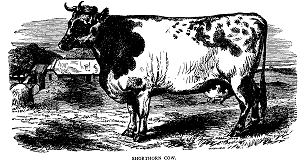
The Shorthorn is an animal of magnificent shape, being
very large and full in the body, and low on the leg, with fine bones. The back
and belly should form nearly straight lines ; indeed, in the best animals the
body, when viewed sideways, forms nearly a parallelogram, whose length is twice
its breadth. The fore-quarters are very deep, and the head fine and small, while
the disposition is particularly mild and gentle.
The Shorthorn is confessedly the most valuable breed of
cattle we have, and combines all the useful qualities in a greater
proportion than any other animal.
Of late some breeders have paid more attention to the
fattening than the milking qualities of the Shorthorn, and hence the coarser
variety, known as the Yorkshire, is generally preferred by London dairymen.
These latter cows have been known to give sixteen quarts of milk per day; but
even the improved Shorthorn cow will generally yield sixteen quarts daily, many
of them much more. Lately the Yorkshire cows have been crossed with improved
Shorthorn bulls, and the result is a cow which can hardly be equalled where a
large quantity of milk is desired while it fattens well when dried.
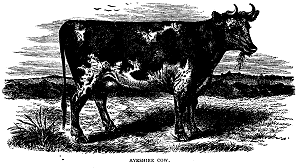
The Ayrshire is another splendid dairy breed. While
the Shorthorn is peculiar for the quantity of the milk, and is hence
adapted to town supply, the Ayrshire seems pre-eminently suited for the
production of butter and cheese, the milk being not only plentiful, but of a
richer quality. It does not, however, fatten so well as the Shorthorn when
dried.
The Ayrshire cow is under the middle size, but of singularly
handsome proportions. The head is small and fine, rather long and narrow at the
muzzle, which is black; the horns are small and short, the eye very clear and
lively. The neck is somewhat long and slender, the fore-quarters light, and the
limbs fine and delicate looking; the back, however, is very broad over the hips
and the carcase rather deep. The udder is large and well-shaped, as might be
expected. The usual colour is sandy-red, distributed in patches, mingled with
white.
The principal drawback to this breed is the rather small
size, which involves more labour for the same produce. Hence this is essentially
a country dairy cow. Singularly enough, however, it does not always
thrive in the rich pastures of England, but in some cases the yield of milk
diminishes, and the animal lays in fat instead.
The Alderney, a Channel Island cow, does not, as is
popular supposed, yield any extraordinary quantity of milk, but is
remarkable for its very rich quality. Hence an Alderney cow is often kept in
dairies to enrich the produce of the stock. It is a small animal, of very
angular form, as generally met with, looking, in fact, as if starved, from the
great projection of the bones. When dried, however, it often fattens well. On
the whole, this cannot be considered a very profitable cow, the return of
milk not being commensurate in quantity with its great appetite; hence very many
purchasers of this breed have been greatly disappointed. Its place is rather to
supply the gentleman's table with the richest quality of dairy produce, where
pecuniary profit is not so much desired.
The Alderney cow is generally very hollow behind, with high
shoulders, and a very thin neck, and is also remarkable for very long and thick
hair. The colour is generally white and fawn. The Guernsey animals are often
thought to be rather superior; but this is a doubtful point. Alderney cattle are
very easily obtainable at Southampton.
A more profitable animal in most circumstances is the Breton,
or Brittany cow, which has rapidly grown in popularity since its
introduction a few years ago. This breed is very small - even diminutive -
rarely standing more than forty-two inches high at the shoulder, and often eight
or ten inches lets ; but it is remarkable for its symmetry, hardihood, very
great milk-producing qualities relative to its size, and peculiar aptitude for
laying on flesh with very moderate, or even coarse, feeding. The head is short,
sharp, and fine; the muzzle small, with beautifully cut nostrils ; eye quick and
lively ; ears small and neat; and horns slender, curving at first upwards and
downwards, the points afterwards turning into each [-189-]
other. The slenderness of the horns is a great point, and is always
looked for as an indication of good blood. The neck is slender, the back
straight, loins long and of good width, with hip bones rather prominent. The
limbs should be short, straight, and slender. The udder of this species is large
in proportion, with the "milk-vein" well developed.
The colour of the Brittany cow is usually white and black, or
all black, but sometimes yellow and red. In France, a mixture of red and white
is most valued; but if other points are good, the colour is purely a matter of
fancy. Take it altogether, this cow is just the one for a lady's dairy, and
almost fit to be a lady's pet, being small, gentle, pretty, hardy, and
productive. For the cottager it is equally adapted, having somewhat of the
ability of the ass to forage for itself. The milk is not only plentiful, but of
great richness. The small size is the principal drawback to its perfection, as
it makes it unsuitable for large dairies ; but in cases where this objection
does not apply, it may fairly be said that the breed can hardly be surpassed for
milking purposes.
The Suffolk is a polled or hornless breed, long
celebrated for its milking qualities. The hips are very high and prominent, and
the loins usually inclined to be narrow; but this fault might be easily remedied
by a little careful selection in breeding. The best milkers are very spare
animals, with light and narrow heads. One animal has been known to yield
thirty-two quarts per day, and twenty-four quarts is not an unusual quantity.
The quality of the milk is not, of course, equal to that of some breeds which
yield less, but it is very good, and makes excellent butter, though it is said
to be inferior for cheese.
There is a Welsh breed of black cattle, which often
produces very good milkers.
The Kerry cow is also well known for its milking
qualities. It is rather small, but hardy, and has very much of the foraging
ability of the Breton. The cow varies greatly, and so do its distinguishing
points of excellence. The Kerry cow adds to its other merits that of being cheap.
It can be easily obtained at almost any town where Irish cattle are
imported.
The cows we have described in this paper are especially good
for dairy purposes, and as such are especially valuable to the amateur or
cottage farmer who has not sufficient fodder available for fattening cattle.
[-228-]
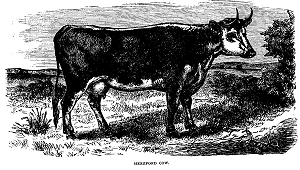
PASSING from the dairy to what must be called rather the flesh-producing breeds, the first place, after the Shorthorn, must be given to the Hereford. This breed is characterised by an almost invariably red colour, with a white face. It has lately been much improved, and now almost equals the Shorthorn in size and early maturity ; while many think the quality of the meat is a shade superior. As milkers, however, the cows are decidedly inferior.
The Devon is a smaller breed, and was a great
favourite with the Late Prince Consort. The horns are rather long, and turned
upwards. Like the Hereford, the pure breed is inferior for the dairy, but
fattens well, and produces meat of very juicy quality, It has, however, another
recommendation to very many parties: being remarkably light and active, it is
more than any other breed suitable for farm work on light hand, and in
many places the oxen are accordingly worked in harness till five or six years
old, after which they are fattened, which process is very readily accomplished,
the bones being small and fine. On light soil, two Devon oxen will do as much
work at the plough as one horse, but their light make renders them unsuitable
for working on heavy land.
The colour of the Devon is red or bay. Although, as we have
hinted, inferior in point of quantity of milk, what there is of it is of unusual
richness, so that the cow will yield much more butter than might be supposed. A
Devon cow, crossed with a. Shorthorn bull, generally produces a cow excellent
for milking, with a good tendency to fatten when dried.
The Sussex breed much resembles the Devon, but it is
larger and coarser; hence the oxen are better adapted for labour on heavy land.
Many prizes have lately been awarded to this breed, which is gaining ground as a
meat-producing one.
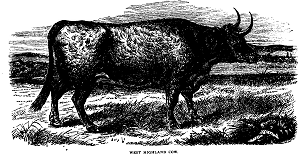
The West Highland or Kyloe breed is largely
reared in Scotland, to be driven south, and fattened for the English butcher.
They are symmetrical animals, especially the bulls, very hardy, and their meat
is of fine quality. The- colour is generally black, but sometimes reddish or
dun, and the hair is long and shaggy. The cows do not yield much milk, but it is
of very great richness.
The Galloway is a somewhat similar breed, but of the
polled or hornless tribe, and the hair is smoother, and not so long as in the
West Highland; the animal also attains a larger size. This must be described as
one of the very i best built and most symmetrical of all our breeds of cattle.
All is beautifully compact, with a broad and straight back which cannot be
surpassed.
The Angus is also a polled breed, and the largest of
all the Scotch varieties. It is of a black or sometimes red colour, and of very
great fattening capacities.
There are numerous other breeds, sub-varieties and crosses,
but which scarcely demand special attention and we conclude this article with a
few practical remarks of a general character.
We have endeavoured to give, shortly, the usual qualities
of the principal breeds ; but it will be easily under stood that different
individuals of the same race may vary greatly in their milking qualities. Yet,
while this point may make all the difference, how very seldom it is
investigated. One cow will give twelve quarts at a milking, while another of the
same breed may only give six. Very likely the price of each animal will be the
same, while the return is widely different.
When the parentage can be traced, it is generally safe to buy
a cow which comes of a good milking family - that is, if the dam is a
good milker, and the sire also bred from a good milker, it is many chances to
one the animal her self will be valuable in the same way, and it is surely worth
some trouble to ascertain. Great consideration must, however, be given to what
the cow is wanted for. If the sale of milk be intended, animals must be kept
which will give the largest quantity; but if butter be the object this rule may
lead to disastrous mistakes, for eight quarts of milk from one cow will yield
more butter than twelve quarts from another. Again, the milk of some cows will
make good butter, but very bad cheese, and all these circumstances should be
taken into account.
Generally speaking, the hind-quarters of a good milking cow
are much heavier than the fore, and according to many careful and scientific
observers, the spinous processes of the lumbar vertebrae generally bend well
forward, so as to leave a good space between the last spine and the sacrum. The
udder also should be long and wide but not too deep (which shows debility), and
it is very important [-229-] for all the
teats to be able to pass milk without difficulty. Dealers sometimes affirm this
is no matter, but the fact is, that each teat is the outlet of an entirely
distinct and separate secretory organ, so that a faulty one is equivalent to the
absolute loss of its due proportion of milk.
But probably the best criterion of a good milker is that
pointed out by M. Guenon, which consists mainly in the appearance of the hair on
the animal's buttocks. The coat in this locality grows partly upwards and partly
downwards, producing at the juncture a ridge or fringe of hair which is called
technically the escutcheon. Now supposing that in different cows Other
characteristics appear equal, observation proves that in nearly every ease an
animal with a large escutcheon is a better milker than a cow with a small one.
The veins called "milk-veins," which run along the
belly, are not really connected with the supply of milk at all, but it
nevertheless appears in practice to be of importance that they should be large
and well developed.
After all, it is sometimes found that a cow, bad by nearly
every rule, turns out a capital milker, so that we again insist on careful
inquiry or observation of the parentage. A cow is in her prime after her second
calf, and remains profitable to the age of six or seven years. The chief means
of judging the age is by the horns, which form a fresh ring at the root every
year; but only the third year's circle is obvious to ordinary inspection. After
six or seven years the produce rapidly diminishes, so that it is very important
to get rid of the animals when they reach that age.
Farmers generally prefer to buy young cows when in calf; but
in commencing a small family dairy it is less trouble, when possible, to obtain
the animal after her calf has been separated. When old, the most profitable plan
is to dry her, fatten her in her own stall, and sell her for immediate slaughter
; she will then often realise nearly her original value ; but if this cannot be
done, some pounds loss on this head is of course inevitable. It is in connection
with this point that the importance will be seen of selecting a breed which has
a good tendency to fatten, such as the Shorthorn; for while a bony, angular,
lean-looking cow will often give a good quantity of milk, if she will not fatten
when finally dried, there must be a considerable loss on her sale, which might
have been avoided by a better choice.
[-309-]
THE HOUSING. FEEDING, AND MANAGEMENT OF DAIRY COWS.
NOTHING differs more than the average produce of each cow in the various dairy districts of the United Kingdom and between different individual dairies the variation is still more striking. Much of this may be accounted for on the ground of good or bad judgment in the selection of the stock, as pointed out in our last paper ; but still more depends upon the system of management, which it all old districts is still opposed to every conclusion of reason and science, and diminishes the profit accordingly. In fact, there is, in most quarters, an actual jealousy against any improved system which is very difficult to overcome, and which at first is puzzling to account for. But we think the reason is not far to seek. More improved systems have usually been seen or worked out or what are known as "model" farms, in many cases by costly, and sometimes disastrous, experiments, and nearly always under expensive buildings, and with appliances beyond the means of the plain man who has to "make his living" out of his dairy or farm; and hence the whole becomes jumbled up in his mind as a "new-fangled theory," to which he prefers his own plain though faulty practice. Still, by degrees, certain undesirable principles and facts get indisputably established and adopted one after another by the most successful agriculturists; and at length the plainest and most plodding practical man finds that he must adopt them also, or be left behind. This has, of late years, been eminently the case in regard to the economy and management of all kinds of live stock; and we are endeavouring to give, in these papers, such practical rules as have been, after trial, conclusively established as the soundest and best, at the same time bearing in mind the ease and economy of their practical application.
With regard to the management of all cattle, three grand principles have now been thoroughly established by the conclusive test of facts. I. That any given area of green crops, be it grass, clover, or roots, will support nearly double the number of animals if cut and carried to them elsewhere than if grazed. 2. That within reasonable limits warmth is equivalent to so much food, which would otherwise be required to keep up the natural heat of the animal. 3. That manure made under cover is better than manure made in the open yard, whilst if dropped upon the land itself it is most wasteful of all. It is obvious that each of these principles condemns at once the old system of managing dairy farms, which consisted in keeping the cows in the open fields, killing a number at the approach of winter, and getting along in any possible way with the rest. By this system the animals injured the crops as much by the poaching of their feet as by what they actually ate; they never yielded much in severe weather, and by spring were nearly starving; while the manure was nearly wasted, and three or four acres were required for every cow. On the modem system, at least double the animals can be kept on the same quantity of land, while the milk per head is much increased in quantity, and the return is increased proportionately.
Still there are circumstances which may make a system
composed chiefly of grazing the cheapest and most advisable. If the pasture land
be very rich, producing, say, 12 tons to the acre yearly, with no further
expense or labour than weeding, keeping up fences, and supplying manure ; if
these advantages be combined with a moderate rental, and if, finally, the dairy
is the main object of all the operations of the year, it may answer better to
depend almost altogether on the natural produce of the land, which will thus
probably produce as much, for the money spent on it, as it can do in any
other way. Even in such a case, however, the cows should be housed in all severe
weather, and some addition to the food will be required at night if the supply
of milk is to be kept up during the winter. But if the dairy be part of the
regular economy of the farm, the advantages are all in favour of of
stall-feeding, more or less thoroughly carried out, as the greater number of
animals kept under cover, with the consequent increase in quantity and
improvement in the quality of their manure, will have a great influence upon the
other crops. For it is obvious that, supposing by spending on this system twenty
shillings per season extra in wages and food the produce be only increased by
the same amount, the additional manure will be a very great gain to the farmer.
In fact, in many districts, bullocks are fattened for this purpose alone, the
profit on the sale only paying for the bought food consumed, and all the farm
produce given them being considered to be repaid by the manure thus
manufactured.
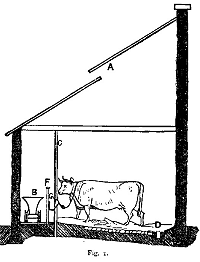
The first great point to attend to is to provide sheds or
cow-houses which are at once sufficiently light and well ventilated, but free
from any direct draught, which is apt to cause many diseases. Very few,
comparatively, of the covered yards or sheds hitherto erected are quite
satisfactory in this respect, the most usual fault being draught, arising from
the admission of air in the lower part of the building. Indeed, no entirely
satisfactory place, that we are aware of, was ever proposed to avoid this
defect, and at the same time give thorough ventilation, until that invented by
Mr. H. S. Thompson, of Kirkley Hall, Yorkshire, for his own farm buildings, and
recently described by Mr. Morcross in the Journal of the Royal Agricultural
Society. By this plan, the whole of the ventilation is carried on through
the roof; the provision for that purpose is ample, and the animals are kept
in a temperature equable and healthy ; at the same time, the plan of
construction is simple, and adapted to any scale. In a future paper in the
HOUSEHOLD GUIDE, we shall give an illustration of Mr. Thompson's principle as
adapted to the general covering-in of the homestead in order to shelter the
cattle, but we have here only to consider it as applied to a single building or
range as a cow-shed or stall, which may be built on Mr. Thompson's plan without
one farthing's additional expense. Instead of the rafters reaching, as usual,
from the eaves to the ridge, they are divided in two. The lower length is
spiked, as usual, on to the caves and middle rafter or parlin, but the upper
ones, instead of being with them, as usual, are spiked at the lower end over the
lower rafters. The laths and tiles are then laid as usual, and the effect, as
seen in the section, is an opening for ventilation half-way up the roof, along
its whole length, equal to the depth of the rafters. The upper set of tiles
should overlap about twelve inches, which will quite prevent the driving in of
rain, and any necessity for louvre boards, &c., is avoided. To prevent the air
from stagnating in a crowded shed, openings may be made in the walls nearer the
ground, as far as possible from the animals, and covered with perforated zinc.
Plenty of light is easily given by the use of a glass tile at intervals, and the
whole of the work is therefore of the cheapest description possible.
The most convenient arrangement for the interior of the sheds
is also shown in the section. It is best divided by wooden partitions into
stalls about eight feet wide, which will contain two cows; but they may be kept
without any partitions at all with no difficulty. Along the lightest side of the
shed should run a clear passage four or five feet wide, for the passage of the
attendant with the food and water; and if the number of cows be more than half a
dozen, it will be a great saving of labour to lay down a line of rails, as
shown, when the food can be all carried at once in a large truck (B) ; and by
having a tank mounted with a small pump, water can be supplied in the same way,
but a long pipe running along all the troughs with a tap over each, is
preferable. If only a few cows are kept the railway is not needed. At the end of
the passage should be the room or house where the food is prepared.
The animals are most conveniently fastened to posts (c), over
which is slipped a ring sliding up and down, having attached to it a chain long
enough to allow the cow sufficient liberty. If other modes of fastening are
adopted, the cow cannot turn round to lick herself when irritated. The floor
should be very slightly inclined towards the back, that the liquid
portion of the manure may run into the drain (D), and may be pitched, all but
the upper portion, which should be of hard trodden earth or concrete (H), les
the cows should injure their knees. If the posts are placed about a foot from
the rail (F) which parts off the passages, the space between is convenient for
fixing the food and water troughs (G), as shown in the section. These should be
raised about 18 inches from the ground.
In large dairies the cows are often placed in double rows
with a passage between. This has been thought injurious, from the animals
breathing on each other; but we think if the passage be wide enough the evil
must be small, unless in the case of pleuro-pneumonia, or other infectious
disease.
Small sheds are easily arranged on a similar system and where
a ready-made building has to be made available, it is only needful to see that
the ventilation be perfectly provided somewhere above the level of the
animals, which should be screened from draughts, and the floor he arranged in
some such way as can be easily cleansed.
In such sheds?be they large or small?the cows may be housed
at night all through the year with great advantage. The free use of the curry
comb is needful, of course, and when followed by a good brushing, especially
down the legs, will keep the skin in beautiful condition, and the animal will be
contented and happy.
Cows require, in an ordinary way, decidedly gentle treatment
; and the importance of keeping them clean and their house well ventilated,
cannot very easily be over-estimated. A good cow well -treated is often a
fortune to a poor man, and to the rich man its possession is as often it source
of special satisfaction, from the various ways in which it may be made to
minister to the family wants. Some of these we shall point out in a future
number, and in another section of our work
[--grey numbers in brackets indicate page number, |