Volume 1
[-203-]
ODDS AND ENDS.
To loosen Glass Stoppers.- A very common source of
trouble and vexation is the fixed stopper of a smelling-bottle, or of a
decanter; and as in the case of all frequent evils many methods have been
devised for its remedy. Some of these methods we shall enumerate. 1. Hold the
bottle or decanter firmly in the hand, or between the knees, and gently tap the
stopper on alternate sides, using for the purpose a small piece of wood, and
directing the strokes upward. 2. Plunge the neck of the vessel into hot water,
taking care that the water is not hot enough to split the glass. If after some
immersion the stopper is still fixed, recur to the first process. 3. Pass a
piece of list round the neck of the vessel, which must be held fast while two
persons draw the list backwards and forwards. This will warm the glass, and
often enable the hand to turn the stopper. 4. Warm the neck of the vessel before
the fire, and when it is nearly hot, the stopper can be generally moved. 5. Put
a few drops of oil round the stopper where it enters the glass vessel, which may
then be warmed before the fire. Next take the decanter or bottle, and employ the
process No. 1, described above. If it continues fixed, add another drop of oil
to the stopper, and place the vessel again before the fire. Then repeat the
tapping with the wood. If the stopper continues still immovable, give it more
oil, warm it afresh, and rub it anew, until it gives way, which it is almost
sure to do in the end. 6. Take a steel pen or a needle, and run it round the top
of the stopper in the angle formed by it and the bottle. Then hold the vessel in
your left hand, and give it a steady twist towards you with the right, and it
will very often be effectual, as the adhesion is frequently caused by the
solidification of matter only at the point nearest the air. If this does not
succeed, try process No. 5, which will be facilitated by it. By combining the
two methods numbered 5 and 6, we have extracted stoppers which had been long
fixed, and given up in despair after trying the usual plans. Broken stoppers are
best left to professional hands.
Liquid Glue and Cement - Take of crushed orange-
shellac four ounces, of rectified spirit of wine (strong), or rectified wood
naphtha, three ounces. The rectified spirit of wine makes a far superior
composition, but the other is good enough for all ordinary work. Dissolve the
shellac in the spirit, in a corked bottle in a warm place; frequent shaking will
assist it in dissolving, and it should also be shaken before use. This
composition may be used as a varnish for unpainted wood.
Perpetual Paste. - Take one ounce of gum tragacanth or
gum dragon; pick it clean, and put it into a widemouthed vessel of glass or
white ware capable of con-[-204-]taining a quart.
Add as much corrosive sublimate as will lie on a fourpenny-piece. Then pour on a
pint and a half of clean soft water, cold. Cover the vessel and leave it till
next day, when the gum will be dissolved, and will nearly fill the vessel. Stir
the mass well with a piece of stick-not with metal, because the corrosive
sublimate will blacken it. Repeat the stirring several times during the day,
when it must be left, and it will form a thick white jelly. It must be kept
closely covered, and under lock and key, as the corrosive sublimate is
poisonous. It will keep for any length of time if the air is excluded, and if it
is not put into a vessel of metal. For paper and many other things it forms a
strong and colourless cement; and since it may be always at hand, it may tend to
induce persons to do a number of small useful jobs, which would be neglected if
paste had to be made. If the above rules are followed, especially about not
allowing continued exposure to the air, and not keeping it in metal, it will be
very slow to spoil.
Blue Wash for Walls.- Take two quarts of lime, a pound
of blue vitriol, and half a pound of glue. Thoroughly melt the glue in a quart
of soft water. Reduce the vitriol to powder in a mortar, and put it into a
wooden pail. When the glue-water is about cold, pour it on the vitriol, and mix
the two well with a stick. Then stir in the lime by degrees. Try the colour by
dipping into it a piece of white paper, which, when dry, will show the tint. If
too dark, add more lime; and if too light, add more powdered vitriol. The proper
consistency can be secured by means of soft water. It is used like whitewash.
ODDS AND ENDS.
Keeping Liquids Warm.£
To keep liquids warm for any
length of time, it is usually said that vessels of polished metal should be
used, and that such vessels should always be kept perfectly bright, in which
condition they are estimated to radiate (or part with) heat as one, although if
tarnished they will radiate it as nearly two and a half. But polished metals are
good conductors of heat, and by contact part readily with it. the best vessels
for such a purpose are, therefore, vessels made with earthenware and coated with
metal, earthenware being a bad conductor of heat, and polished metal a bad
radiator.
Back Windows.£
To shut out a disagreeable view from a
back window, the glass may be rendered ornamental, and the obnoxious objects
shut out, by a very simple plan, which makes a Fair imitation of ground glass.
This is effected by cutting out stars or diamonds upon a piece of white muslin,
tarlatan, or common tissue-paper, which is then gummed or pasted on to each pane
of glass, the great point being to get the gum or paste as colourless as
possible. By washing the glass over with a hot saturated solution of Epsom
salts, or sal amtnoniae, or Glauber's salts, or blue stone, very beautiful
effects of crystallisation can be obtained, by which also the above purpose is
served in shutting out an obnoxious view, and the window has also a very
ornamental appearance. By a saturated solution is meant one containing as much
of the salt as the water will dissolve. The solution must be applied while hot,
and with a brush.
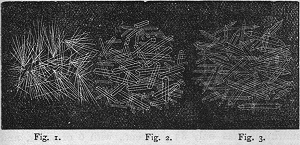
Be careful not to use salts of a deliquescent nature. To aid our readers in
making their choice of crystals, we give a diagram, in which Fig. 1 represents
the crystals formed by the sal ammoniac, Fig. 2 those formed by Epsom salts
(four-sided prisms) ; Fig. 3, the crystals of Glauber's salts (six-sided
prisms).
Stools for Children.£
Children should have stools low
enough to let them rest their feet upon the ground ; and these stools, if made
after the manner of the north country "cracket,£
" are easily knocked together at
home. The seat is round, made of a thick piece of deal ; three holes are drilled
or burnt within this with a red-hot poker, and into these the legs are fixed.
Hyposulphite of Soda (a Hint for the Laundry).£
We are
informed that the above is an excellent substitute for common washing soda, by
the adoption of which the laundry would be really benefited. It does not appear
to injure the texture of linen and cotton articles as the coarse soda commonly
employed does: clothes come from the wash-tub in which it is used softer and
cleaner, and they dry whiter.
Washing Blankets.£
We append a few hints on the best
way of washing blankets. In the first place use tepid water with a little soda
in it. The blankets, first rubbed well over with soap, then put into the water
and kneaded with the fists, as in kneading dough. If a little ox-gall £
very
little £
be put in the first water, the impurities soon mingle with it. Scotch
lasses jump on blankets when in the tub, and so tread out the dirt. The water
must be changed often, or until it looks clean ; but the blanket must be soaped
each time, or put in a lather of soap and a little soda, prepared in a copper.
The rinsing water must also be soapy, or the wool will dry harsh, and the
blankets shrink. They must be wrung as dry as possible, and after hanging on the
drying-line for an hour, be taken down and be pulled on all sides by two
persons, to prevent them "felting." Blankets will " felt," or " mat," if the
water they are washed in be very hot £
tepid water only should be used £
or if
much water be left in them when hung up to dry.
Pearl White.£
This is an oxide of bismuth, and, though
very clear, is very evanescent. If it comes into contact with sulphuretted
hydrogen gas it at once turns black. Ladies inclined to use it as a cosmetic,
ought to be made aware of its liability to change colour under circumstances
which might lead to unpleasant consequences.
ODDS AND ENDS.
Hot Buttered Toast.£ The art of making really good toast is little understood, and this is largely the reason why it is so often denounced as unwholesome. A slice of bread burnt on the two outer surfaces, with its interior in a moist, waxy condition, has no right to be called toast, but is rather a compound of charcoal and tough, heavy, sodden dough, in which condition it is certainly and seriously unwholesome. But a slice of bread, not too thick, just browned on the outside, but thoroughly baked through, is wholesome and pleasant food, which may be fearlessly eaten. The way to toast bread thus is to keep it at the right distance from the fire, so that it may be toasted throughout before the outer surface is overdone £ [-302-] in other words, not to toast it too fast. Concerning the buttering of hot toast we may add another hint or two. An ill-toasted slice of bread does not absorb the butter, but allows it to remain in a mass on the surface. A slice of properly-toasted bread, on the contrary, allows the butter to permeate every part of it, and to all parts equally. Butter in the one case is too heavy for the stomach ; but when thus intimately associated with the whole mass of the food, in finely divided and proper proportions, its character is entirely changed, and it becomes wholesomely nutritious.
[--grey numbers in brackets indicate page number, |