Victorian London - Publications - Etiquette and Household Advice Manuals
- Cassells Household Guide, New and Revised Edition (4 Vol.) c.1880s [no date] -
Point Lace Work (1)
[-back to main menu-]
Volume
1
[-225-]
POINT
LACE
WORK.-I.
 THE
longer we live in this world the more we find that there is indeed nothing new
under the sun, and each successive day only brings us back to the works and
devices of our ancestors.
THE
longer we live in this world the more we find that there is indeed nothing new
under the sun, and each successive day only brings us back to the works and
devices of our ancestors.
It is even so with the employments, or rather amusements, in
which ladies spend their hours of leisure from more important occupations; and
the point lace, on which so much time was spent in days when it was used for
ecclesiastical purposes, as well as for every ornamental part of woman's dress,
has again become a fashionable pursuit, many a female finger being now busy in
imitating, although it cannot excel, the handiwork of those long since gathered
to their fathers.
Innumerable are the uses to which this imitation of the old
point lace may be made serviceable in a lady's dress, to say nothing of the
ornamental articles of juvenile apparel, and the adornment of furniture, to
which it may be applied. We therefore propose to dedicate a few chapters to this
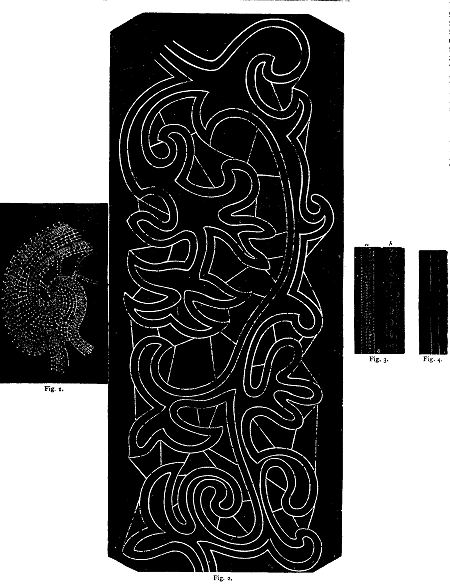
favourite occupation, and, to commence with, we present an effective but simply
worked pattern, Fig. 2.
The materials required will be some tracing linen, which can
be purchased at a good stationer's, some toile cir£
e, green on one side,
severa1 yards (say a dozen) of point lace braid, some fine linen thread, and a
large needle (No. 6). All these can be procured at a Berlin wool shop. The
tracing linen must be cut about half an inch larger than the design, and kept
quite flat and very steady while the pattern is traced off with pen and ink upon
it; next, a piece of the toile cir£
e should be cut to the same size
exactly, and the linen with the design closely tacked to it all round the edge,
so as to ensure the flatness and firmness of both.
The braid employed may be of two kinds, the plain, with an
open edge, a, or one with a round opening at intervals in the centre, b,
Fig. 3, giving a more decidedly lace-like appearance to the work. To avoid
joining, which is very important, the braid should be wound double on a
card, leaving the two ends to commence the work with ; by this means cutting is
avoided. The braid must be carefully sewn on with middle-sized reel cotton,
taking the stitches (of which there should not be too many) quite through both
linen and toile cir£
e, and following the design in all its meanderings
as exactly as possible. In those parts where the leaves are pointed, great care
should be taken to keep them as flat as possible at the point, and the braid
should be folded and kept to time shape, in turning it, with much nicety.
When the whole design has been braided, the outside edge of
the braid has an open stitch worked into it, which we will call the "open
over-cast" and it is thus accomplished:- With the fine linen thread the
needle must he passed through one of the openings in the edging of the braid, as
if for over-casting, but the stitch most not be drawn tighter than is required
to make it about the same size as the edging of the braid, then the needle being
passed through the single part of the stitch, still in the manner of
over-casting, the thread is drawn tightly and fastens the stitch ; this must be
repeated in every second or third mop of the braid-edge, and forms another
edging upon it, which greatly improves the work. This double over-cast is
repeated on the inside of the braid, and each leaf and open part of the design
is filled up with a succession of rows of this stitch, which need not, however,
be done with great preciseness in the filling up, as a slight irregularity in
the size and tightness rather adds to the genuine appearance of the
point. Care must, nevertheless, be taken that the work be close enough to secure
the braid in the pattern traced, as this will be found of great importance when
the threads at the brick of the design are cut away at the last. The details of
the work are shown in Fig. I.
With this open over-cast a great deal may be done towards
making the braid lie well to the pattern ; in the curves, for instance - where
the inner edge will naturally be slightly fuller than the outer, or vice
versa - by omitting one or two stitches of the open-work, in one
case, Or putting two stitches into one, in the other, it will be made right. The
bars, Fig. 4, joining the various parts of the design are done when all the
filling tip is completed. To make them, the needle with the fine thread, after
being darned in and out of the centre of the braid, to make the end secure, is
brought out at the edge and passed across and across three or four times to the
opposite opening, and upon these threads, thus made up, a close plain overcast
is worked. On reaching the end of the bar, the thread worked with may be
fastened off in the braid, or carefully darned along it until the next bar is
reached. In those parts of the design where the braid on the one side comes very
near to that on the other, it will not be requisite to work the double over-cast
on the inside edge, but the two inner open edges of the braid on each side may
be drawn together by passing the needle from one to the other.
It is almost needless to add that in the braiding only must
the needle be taken through the linen, &c., all the rest of the work must be
done on the surface, and care must be taken not to catch up the linen with it.
To prevent all chance of this, and also to avoid splitting the thread, it will
be found advisable to work as much as possible with the head of the needle and
not with the point. The threads of the braiding must be cut when all is
finished, and the work taken off with the greatest care. The braid not having
been cut off the design may be continued to any length required, as it will be
found that the end of the work, when detached, will correspond with the
beginning of the design, and can then be preceeded with as at first.
Some persons trace out the design for point work on pink
glazed calico, and, before braiding, sew it down on a piece of strong paper. The
pink colour enables the worker in some instances to see the pattern more easily
by gas-light.
In our next paper on this subject we hope to give directions
for some open stitches, so as to vary the filling-in of the leaves, and also a
slightly different mode of working the bars.
[-281-]
POINT LACE WORK. - II.
IN our first chapter on modern point lace, when alluding to the several uses to which this work may be applied, we mentioned, amongst others, the ornamentation of various articles of furniture, and we now give a design for this purpose. It is called "the Spanish Point
Trefoil," and will be found extremely effective when worked, and is applicable to many purposes. The design, as before, should be drawn on tracing-linen, and tacked in the same manner as then described on
toile cir£
e, or glazed calico. The braid, to give it proper effect, should be a plain, fine, close point-lace one, of the width in the cut. This braid must be carefully sewn on throughout the pattern, over
all the double lines, winding it double, and beginning with each end as in our last pattern. The outside edge must exactly follow the line, the stitches being taken through the pattern, keeping the braid well strained, and sewing it over to prevent its widening where sharp turns are required. When the outer edge is done, the inner one must next be attended to, and this must be gathered in to fit each turn, as, owing to its width, it will necessarily be much fuller on the inside of a curve than on the outside A needle with fine thread must therefore be passed along this side of the braid, taking a small stitch over it, as in
whipping a frill ; and by means of this thread the braid may be drawn to fit the various curves of the design. Great care must be taken that this gathering thread be not in any place sewn through the material on which the pattern is traced; it must be on the surface only, and should be neatly done, as it cannot be touched again, and remains in when the work is completed. The next step is to do the "open overcast" stitch, described in our last, on the outside edge of the braid, throughout the pattern. The vandyke forming the outside of the entire design must be braided separately, and also edged with "open overcast;" but in the second part of the stitch,
instead of taking the needle once through for the fastening, three or four stitches must be worked into the same "open" stitch, as at Fig. 2. For this edge a coarser thread should be used, and the sets of stitches not done too near each other. When all the open edge is worked, a thick smooth linen cord, called "Spanish point-lace cord," must be sewn at the outer side of the braid throughout the design, taking care to leave the "open overcast" always visible. The thread used must be of middle size, and small stitches taken, so as to keep the cord securely in its place. This cord maybe purchased of different sizes, according to the style of the work, but for our design a thick one will be most effective, although in this matter the worker's own taste may be consulted. The outside vandyke does not require this cord. The bars should next be worked, and it will be observed that they differ from those described in our last chapter, inasmuch as each has in it a small knot, or excrescence, as it were, and is worked thus
:£
The thread, not very fine, is darned along the braid, and brought out of one of the edge-stitches ; it is then carried across to another "open overcast," and taken back again, which makes a foundation of two threads ; upon this, four or five close overcast stitches are done, and the next begun in the same way, and as close as possible to the last one; but instead of being drawn up tightly, it is kept down by the left thumb-nail, to about an inch long, and the needle with the thread passed very loosely seven times over the right-hand thread of the stitch, and then, taking care it should not be twisted, it is drawn up tightly, and the dot being thus formed, the needle and thread are passed up at the back of the stitch, and the close overcast is again proceeded with to the end of the bar.
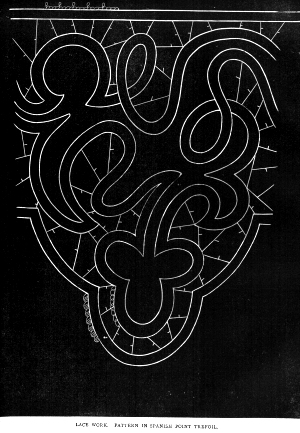
A plain piece of braid forms the heading to this design; the inner edge of this is worked in "open overcast," and the outer one has three stitches of the same, and at the
[-282-] fourth the stitch is kept under the thumb-nail, but quite short,
and one tight overcast is made across it, close to the braid, thus
fastening it and making a sort of pearl-stitch, like that in a pearl-edging;
this is repeated to the end of the straight braid.
Next, all the open portions of the design must be filled up
with fancy stitches, and of these there is such a variety as almost to baffle
description. However, we will attempt to particularise some, and hope, with the
aid of the designs, to make them tolerably intelligible.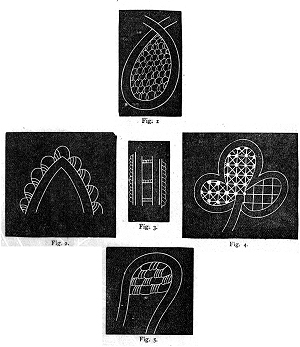
Fig. 4. This may be used for the trefoil, and is done by
stretching threads across from one inner edge of the braid to the other, in
lines at right angles to each other, the one set being done all one way first,
at about the distance given in the pattern; the other, all the other way
afterwards : then are commenced diagonal lines and at the meeting of the lines,
or where they intersect each other, after doing one overcast to keep the threads
together, the needle and thread are passed under and over the threads, until a
tiny wheel is formed, after which the thread is proceeded with diagonally to the
next intersecting or meeting point, where a wheel is again worked and the thread
continued as before, until the opposite braid is reached, beginning again at the
next point with the diagonal lines and wheels as before. A second set of
diagonal lines may be made in the opposite direction, so as to cross those
already done, and in this case, when the wheel is reached, the needle must be
passed under it, just catching it lightly at the back. In those parts where the
two braids lie near to each other, it will be best to work plain bars of fine
thread at intervals of about a quarter of an inch, as at Fig. 3. A very pretty
and simple open stitch in is Fig. I. This is merely the single overcast, done
quite loosely and without the fastening stitch, in rows, one underneath the
other. This may be varied by Fig. 5., in which three "open overcasts"
are worked together on the plain thread, which is rather longer than the usual
stitch, so as to make a larger space for the reception of the three stitches
alternating with it. This may be worked backwards and forwards, or the
thread may be sewn over, to take it back to the left side each time a row is
commenced, and in that case a sewing-over or seam stitch, should come between
each of the three overcasts, and three seam stitches on the plain thread. A
variety in Fig. 2 may be made by using only the intersections of the threads
stretched at right angle for the wheels, and entirely leaving out the diagonal
lines, and then the intersections must be reached by seam stitches on the single
parts of the thread. In the larger spaces for open work in this design, two or
three different stitches may be introduced, but care must be taken that the
joining be neat, and the stitches fitted into each other as well as may be. We
should recommend that three vandykes be traced out for each pattern required,
which may, of course, be continued to any desired length, as the design will be
found to fit, so as to be easily proceeded with. This style of pattern is very
suitable for a chimney-piece trimming, the flat slab being concealed by a board
to fit it, covered with crimson cloth or furniture-velvet, and the work forming
the border with hangs down round t he edge of the board on a plain piece of
crimson velvet; the latter should be cut up between each vandyke, and tacked
underneath to form the same shape as the lace. If about three or four vandykes
be worked, a handsome bracket may be made by nailing the lace round the edge of
it, over crimson velvet arranged in the same manner as for the bordure de
chemin£
e, and a banner-screen of the same material looks remarkably
handsome with this lace laid upon it at the lower edge, also cut up to fit it.
As a border for a table-cover, it is very effective when placed over crimson
velvet. It may again be used as a trimming for curtains, or portieres of
velvet or wool reps. In working a length of it, the fancy stitches
should, in each repetition of the design, be varied, to prevent entire sameness.
We may in a future article give another vandyke of the same dimensions as the
present one, and which may be used alternately with the latter for any of the
purposes we have mentioned; our space prevents its appearing in this paper.
Considerable variety may be allowed in the working of this pattern, and very
much must be left to the taste and fancy of the worker. Instead of working the
"open overcast," an open edged braid may be used for this design; but
it is rather difficult to procure one sufficiently wide and close in texture
to look well. In fact, in this, as in many kinds of fancy work, the
learner will find that, after a little practice, she will be able herself to
vary successfully many patterns from which she has copied, and, indeed, to
invent patterns for herself, suitable in size and character to the place they
are intended to decorate. The opportunity which lace-work thus affords for the
exercise of individual ingenuity and taste is certainly not the least of its
recommendations. We propose to give further hints upon this subject in a future
paper, introducing several other patterns and different kinds of stitches, and
showing more in detail than we have done already the different ends to which
this accomplishment may be turned, whether on the decoration of the home or the
adorning of the person.
[-356-]
POINT LACE WORK.£
III.
WE now give, as promised in our last article, the " Spanish
Point Loop," forming a companion to the "Trefoil;" and we would advise its being
used, alternately, with the trefoil, either for a banner-screen, a bracket, the
border of a table-cover, or a "bordure de chemin£
e". If three of these
vandykes, viz., one "loop," one "trefoil," and one "loop," or vice verse, be
traced out on one length of the transparent linen, and tacked down firmly on
thick twilled coloured calico, the piece of work, when completed, will be of the
right length for trimming a velvet banner-screen, being laid on the velvet,
along the lower edge. The two designs will be found to join perfectly, and may
be continued alternately to any required length, should a table-cover, a
portiere, or any other long piece of work be [-357-]
required the open stitches, given in our last, may be used for the
present design, and arranged after the worker's own taste.
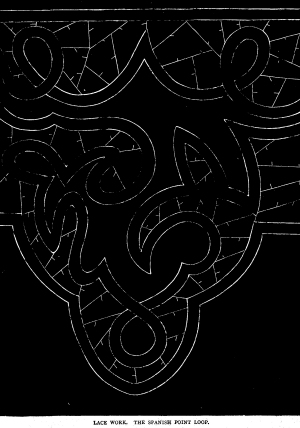
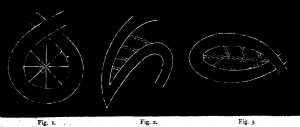
For the "loop," in the point of the vandyke, in our present
number, we should advise that "a wheel" be worked in its open space. For this
purpose, threads should be stretched across, as in Fig. 1, by taking the needle
from one side of the opening to the other, and then sewing back over the thread,
until the starting-point is reached; the needle is now taken on a little way,
and another thread is stretched; this is continued until four threads are taken
across, each being sewn over before the next one is commenced. After the fourth
time, the sewing again goes back as far as the centre, or the point where the
lines intersect, and, after taking a stitch of overcast to keep the threads
together, the spot is then formed by taking the needle under and over the
threads alternately until it be of the required size, when the remaining half of
that thread should be sewn over, which will bring the needle to the opposite
braid again for fastening. For the wheel, fine thread should be used. In some of
the spaces which are not very wide, the bars shown in Fig. 2 may be employed
with much effect, and differ from those given at Fig. 4, p. 282. The thread is
taken across and fastened with an overcast to the braid, then sewn back again
over the thread, which gives the appearance of a twisted rope. This may be
varied by the same style of bar being worked lengthwise, as in Fig. 3, imparting
a sort of leaf-like look, and contrasting well with some of the closer patterns
of the open-work. With regard to the size of cotton used, it is almost
impossible to particularise; indeed, the worker must decide this for herself,
and try the effect of different open stitches, until she can suit her own taste
as to the cotton. A great variety of braids, for point-lace work, are now made ;
and we have seen beautiful patterns sent from Nottingham, and, also, simples of
cotton. We need hardly say that the "Spanish Point-Lace Cord" is to be continued
along the edge of the braid in this "Loop" pattern, as in the "Trefoil." We hope
shortly, to give a design for a border to be laid on the edge of a square-cut
open bodice.
[--grey numbers in brackets indicate page number,
(ie. where new page
begins), ed.--]
|
source: Cassells Household Guide, c.1880s