Volume 1
[-261-]
MARKETING.£ I.
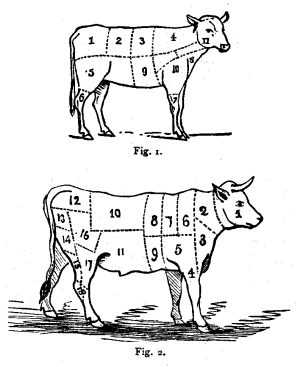
BEFORE going to market it is a very good rule to determine what shall be purchased and in what quantity. This is especially needful when the butcher is to be visited. Another rule is to deal at shops where good articles only are sold, and if possible to take your money with you, because a ready-money customer will, as a rule, be the best served. It is not always safe to let the butcher, poulterer, fishmonger, or other provision dealer choose for you; because he may be over anxious to sell what is not in the best condition, or what is for some other cause hardly saleable. Experienced persons will not fail to observe carefully the quality of what they buy, and they will reflect upon the quantity of bone, gristle, or other waste in it. They will also consider the requirements of the family, and the uses to which they can put what is not consumed as soon as cooked, At the butcher's see the meat cut and weighed, and placed ready to be sent home: you will then know what you have bought. Always buy good meat rather than inferior, and if possible, from the best parts of the animal. To aid the inexperienced, we will now enter somewhat into detail. We commence with Beef, Fig. 2; which are as follow:-
Fore Quarter.
I. Cheek. so.
2. Neck, or sticking-piece. .
3. Clod.
4. Shin.
5. Shoulder, or leg of mutton piece.
6. Chuck ribs.
7. Middle ribs.
8. Fore ribs
9. Brisket.Hind Quarter
10. Sirloin.
11. Thin flank.
12. Rump.
13. Aitchbone.
14. Round, or buttock.
15. Mouse-buttock.
16. Veiny piece
17. Thick flank.
18. Leg
Besides the above, there are the kidneys, heart, tripe, heels, sweetbreads, tongue, and palate.
Quality of Beef£
Young and well-fed ox beef is the best. It may be known by the lean being of a fine, smoothy or open grain, and the fat of a yellowish white. When the fat is either a mottled yellow or white, the meat is doubtful. The suet, however, must be very white. Cow beef is inferior, its fat is whiter, the lean closer in the grain and not of so bright a red. Bull beef has white and skinny fat, closer-grained lean of a dark red, and a stronger smell than other beef. Good beef is more elastic to the touch than that which is old or in bad condition, so
that when pressed with the finger the impression will not be permanent. In poor
meat, the lean is usually dark, the fat skinny, and the sinewy portions
distinctly shown, especially a horny texture in the ribs. Beef should be
perfectly sound, sweet, and fresh, as taint rapidly spreads, and if frosted it
will not cook properly. It is, perhaps, scarcely needful to say, that several of
the joints which are enumerated above, are readily and commonly divided by the
butcher, and sold in portions for the convenience of small families and slender
purses. If at any time more is bought than is wanted for present use, care
should be taken to let it be from such parts as may be cut into two, the one for
roasting and the other for salting and boiling; or let it be such as may be
easily warmed afresh, or otherwise presented hot again at table, which will be
the case with such parts as are stewed, and such cheap portions as the heart. A
cold roasted ox-heart cut into slices and warmed in gravy, is as good as when
first cooked.
Qualities of Veal.£
If the head is fresh. the eyes
will be plump and full; but if stale, they will be sunk and wrinkled. In fresh
meat, the vein of the shoulder is of a bright and clear red. Green or. yellow
spots prove the meat to be bad A good neck and breast will be white and dry, and
not at all clammy or soft. In a loin, the kidney is the part which taints the
soonest. Generally, good veal is of a bright colour, and firm, and neither
flabby nor of a sickly smell. The meat of a cow calf is not considered the best. All veal should be cooked when quite fresh, as it rapidly deteriorates; nor will it keep long even after it is cooked. It must, therefore, be not only purchased fresh, but in such quantities as will be soon consumed. Until. recently the whiteness of veal was enhanced by the mode of killing, which drew all the blood from the animal. This mode has, however, been prohibited by law, and consequently veal is not so white 2. as it was formerly expected to
be; but has a very slight rosy tinge in the lean, even when of the finest quality. The following are the joints into which
Veal, Fig. 1, is usually divided: £
I. Loin, chump end.
2. " , best end.
3. Neck, best end.
4. " , scrag end
5. Fillet.
6. Hind knuckle.
7. Fore knuckle
8. Breast, brisket-end.
9. " , best end.
10. Blade-bone
11. Head.
Besides the above there are the kidneys, liver, heart, feet, and sweetbread.
MARKETING.£ II.
Mutton (Fig 1).£
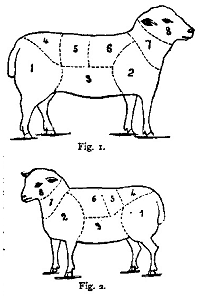
1. Leg. 2. Shoulder. 3. Breast. 4.
Chump end of loin. 5. Best end of loin. 6. Best end of neck. 7. Scrag end of
neck. 8. Head. A leg of mutton with a portion of the loin attached forms a
haunch of mutton. The loin, not divided along the back, is called a saddle of
mutton. In choosing mutton it must be remembered that it is of various kinds as
well as qualities. Some sorts run much larger than others, with a corresponding
addition of fat and bone, and often a coarser texture. The meat of the
black-faced sheep is excellent, when well fed. Welsh mutton is small and highly
esteemed. Forest sheep make good meat, and often appear in the London markets.
The Dorset mutton is of medium quality. The Ryeland sheep is small, and produces
very fine meat. Leicester mutton is large-boned, but when crossed with the
Cotswold variety is much improved. South Down mutton is remarkably good ; and so
is the small Scotch mutton, although it is apt to be lean. As, however,
purchasers cannot always ascertain what particular sort is offered, they must
usually be guided by size and appearance. Generally speaking, wether mutton is
to be preferred : if in good condition, lean will be of a deep red, with a close
grain, the fat white and not very hard. Ewe mutton is paler in the lean and
closer in the grain. Young mutton is tender and elastic to the touch, but old
mutton feels hard, remains wrinkled when pinched, and has fat rather clammy and
sticky. The fat of young mutton can easily be separated, while that of old meat
is stringy and skinny. The leg of South Down mutton is an economical joint
whether for boiling or roasting ; but in selecting it or any other leg of
mutton, preference should be given to such as is thick in the thigh and short in
the shank. The haunch of Welsh mutton is much better than the fore-quarter. Loin
of mutton is not usually economical, owing to the quantity of fat, but it is
very nice, either roasted or in chops. When the fat of mutton is yellow and
watery avoid the meat. A leg of wether mutton is known by a lump of fat on the
inside of the thigh.
 Shoulder
of mutton is most economical when roasted and eaten cold. A haunch or leg of
mutton for present use is best if it has hung a few days.
Shoulder
of mutton is most economical when roasted and eaten cold. A haunch or leg of
mutton for present use is best if it has hung a few days.
Lamb (Fig. 2).-1. Leg. 2. Shoulder. 3. Breast. 4. Chump end of loin.
5. Loin. 6. Neck£
best end. 7. Neck£
scrag end. 8. Head. Lamb is often merely
divided into fore-quarters and hind-quarters. A fore-quarter consists of a
shoulder with part of neck and breast. A hind-quarter consists of a leg and
loin. What is called the target of lamb is the ribs from which the shoulder has
been removed. The joints of lamb vary in size like those of mutton, according to
the breed and age of the animal. This meat, like veal, is best cooked fresh. Its
freshness may be easily ascertained by the colour, feeling, and smell. For a
fore-quarter the old test is, that if the vein in the neck is of a fine blue
colour, the meat is good, but if greenish or yellow the meat is stale. For a
hindquarter, respect must be had to the kidney and the knuckle : if the kidney
emits a faint . and unpleasant smell, or if the knuckle joint is flexible, the
meat is not good. Lamb is more expensive than mutton, and although highly
esteemed is less nutritious. It may be added that the eyes of a recently killed
lamb are plump and bright.
Pork.-Of pork there are many varieties. In choosing, as a rule, we
should select the meat which is young, not too large, and not overburdened with
fat. Dairy-fed pork has fine white fat, pale and smooth lean, and thin, smooth,
and clean rind. It is usually rather small, and a leg ought not to weigh above
six or seven pounds. Whenever the joints run large, with coarse-grained lean and
fat to match, the meat will be most likely hard and insipid. In all cases the
rind must be thin, the lean tender, and the fat of a fine white colour. Old meat
is harsh and even hard to the touch, and generally has a thick firm rind, and
lean somewhat dark in colour. Fresh pork is cool and smooth to the touch ; but
stale meat is clammy and apt to look of a greenish tint in places. The first
part to turn is the knuckle. What is called measly pork is diseased meat, and on
all accounts to be avoided as very unwholesome. It is commonly sold to the poor,
at a low price, by unprincipled dealers. Tainted pork is objectionable and
injurious. Pork is often sold salted ; and the purchaser must be careful to see
that it is in a sound condition. Unsaleable meat is sometimes salted to save it,
but it is always an abomination ; and so is meat which has been spoiled in the
salting, as often occurs in warm weather. The extent to which pork is consumed
by the industrial classes at all seasons, renders it important that the rules
for ascertaining its quality should be well known.
In selecting bacon the purchaser will observe several things. He will
not find it economical to buy bacon from huge animals with a great depth of fat
and little lean in proportion ; nor from large underfed animals with too little
fat and too much skin and bone. Smaller sized and well-fed young meat is best.
The fat of this will be firm, and have a slight pink tinge, but feel greasy to
the touch ; the lean will be bright and stick well to the bone, and the rind
will be thin. Rusty or reasty bacon will show yellow in the lean, if not in the
fat; and will, of course, be ill-flavoured.
Hams are of several kinds. Those from Westphalia are dry, and hard, and
covered with spice, not nice to look at, and requiring to be soaked many hours
in cold water before cooking. When properly cooked, however, they are very good.
Other foreign hams are apt to be coarse and large-boned ; but when smaller and
well cured they are often excellent. English hams vary very much. Some are small
and dried rapidly after very slight salting. Others are large, thoroughly
salted, and slowly dried. The first will not keep so well as the latter, but for
present use in small families they are preferable. A ham which is smooth in the
rind and short in the hock is most economical and the best eating. Long-legged
animals are not to be relied upon either for hams or anything else. After
selecting a ham of proper size and shape, its sweetness must be tested. The
usual method of doing this is by thrusting a knife under the bone which
appears on the fleshy side of the ham. If the knife comes out clean and has a
sweet smell, the ham is sound, but if smeared and with an unpleasant flavour it
is bad. This operation requires to be performed with some care, otherwise it may
be found that the meat is slightly tainted after all.
Venison.£
This is chiefly tested by the fat. If the meat is young the fat
will be thick, clear or bright, and close ; but if old the fat will be tough and
coarse. Venison first begins to change at the shoulders and haunches, into which
a knife must be thrust. If the meat is good the knife will come out clean and
smell sweet; but if bad the knife will be discoloured, and smell rank.
[--grey numbers in brackets indicate page number, |