Volume 2
[-271-]
CHRISTMAS DECORATIONS OF THE HOME
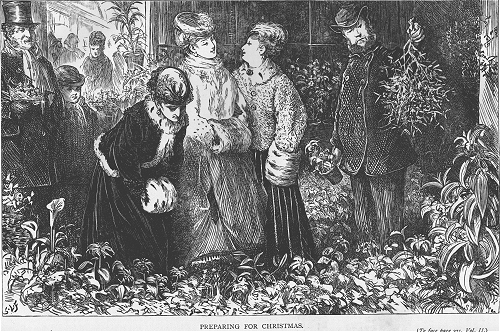
THE materials to be used include all kinds of evergreens,
everlasting flowers, and coloured and gilt papers. It is a strange thing that
though mistletoe is used in the decoration of houses, not a sprig of it is put
into a church. But in house decoration no Christmas would be thought complete if
there did not hang in hall or dining-room a bunch of its curiously-forked
branches, with their terminal pairs of nerveless pale-green leaves, and white
crystalline berries.
Holly is of course the special tree of the season. Its leaves bent into various
curves, its thorny points, and its bunches of coral-red berries make it the
prince of evergreens. Let it be conspicuous throughout the decorations. It is a
good plan to strip off the berries, and use them strung in bunches, as the
berries get hidden when the sprigs are worked into wreaths and devices ; and the
berries, bent into little bunches, dotted about the festoons here and there,
look very effective.
Ivy must be introduced with care. Small single leaves come in with good effect
in small devices, or to relieve a background of sombre yew or arbour vitae. The
young shoots of the common ivy are best, or of the kind which grows up trees and
old walls, which are very dark and glossy, with a network of light-coloured
veins.
Laurel is a very useful green in sprays, and the single leaves may be applied
with excellent effect in wreaths, or overlapping one another in borders. The
variegated ancuba makes a pleasing variety in the colour.
Yews and Arbor Vitae are useful, especially the small sprays of them, for
covering the framework of devices.
Myrtle and Box also are pretty in narrow borderings, into which coloured everlasting flowers may be introduced. The black
bunches of ivy berries may sometimes be used with advantage, to give points of
contrast in the decorations. Of course if chrysanthemums, Christmas roses,
primulas, and camellias can be obtained, the general effect is heightened, and
the decoration becomes more elaborate and more elegant. The best wreaths for
decorating the banisters of a house, or any pedestals, pillars, or columns, are
those made in a rope of evergreen sprigs. There are several ways in which such
wreaths are made. One way is as follows :£
Get a rope or stout cord, of proper
length, and a quantity of twine and a handful of evergreen twigs. Begin at one
end of the rope, which should be attached firmly to something. Dispose a bunch of
the twigs round the rope, and tie them on with the twine; then dispose another
bunch so that the leaves may conceal the stalks of those already on, and give the
twine a turn round them, fastening it with a running knot, and so on until the
rope is rushed. This must be done at the fastening of each bunch of twigs.
Another way very frequently adopted is, in place of a rope, to use only a piece
of stout twine to run rough the wreath, so as to prevent its falling to pieces,
and instead of twine to tie the twigs on, to use fine wire, which must be firmly
twisted round the twigs.
In all kinds of wreaths the thickness of the wreath must be carefully regulated
at the outset, and evenly maintained throughout, and care should be taken that all
the foliage turned in one direction, especially where two persons are working at the same rope. The wreaths may be made
of one kind of evergreen only, or of any number of kinds mixed : the latter has
the better effect. There should be an equal mixture of the fine kinds, as yew,
box, &c., to keep the wreath light and sprayey. Whether the berries are left on
the holly twigs, or threaded and attached at intervals, is, of course, according
to the taste of the decorator. If threaded, they are best fastened among the oily
leaves in bunches about as large as the natural clusters, so as to imitate their
natural effect.
In fastening the wreath to the pillars, take care not to put it on upside down,
as foliage must never be placed in a direction contrary to that of its growth.
When small chaplets or wreaths are constructed, each should be made by one
person, as the effect is frequently spoilt by the two ends not matching, or it
is otherwise wanting in uniformity. When the wreaths are finished, and before
they are hung up, they should be kept in some cool place, or else they shrivel
up; if necessary, a little water may be sprinkled over them.
If holly berries are scarce, a good substitute may be found in rose hips, which
may have a small piece of wire passed through them as a stalk, and several
twisted together. The fallen holly berries, strung on wire, made into rings, and
slipped over the leaves, are very effective; also split peas, glued on here and
there in the shape of small rosettes, look like golden flowers, and they may be
made to resemble holly berries by pouring over them red sealing-wax melted in
spirits of wine.
Where definite shapes are required, there are several methods of accomplishing
the desired effect. Some use a groundwork of tin or perforated zinc.
If outline forms are employed, to be covered with leaves or flowers, these will
be best coloured black. The method of arranging the leaves and flowers will
depend in a great measure upon individual taste. If it is required to use masses
of berries in such a manner that it would be inconvenient or difficult to fasten
them together by any other means, paint the places required to be filled in with
a stiff coat of glue, very hot, and drop the berries upon it. When the glue is
dry they will be found to adhere.
Holly strung has a very good effect. It is very quickly done, and looks like a
rich cord when finished, and all the banisters in a house may be draped in
holly. It is made by threading a packing-needle with the required length of
twine, and stringing upon it the largest and most curly-looking holly leaves,
taking care to pass the needle through the exact centre of each leaf. Flat
borderings, to lie flat along panels of cabinets, doorways, mirrors, and the
backs of sideboards, should be made of leaves sewn in strips on brown paper, or
yards of buckram, cut in strips and sewn together to the required lengths.
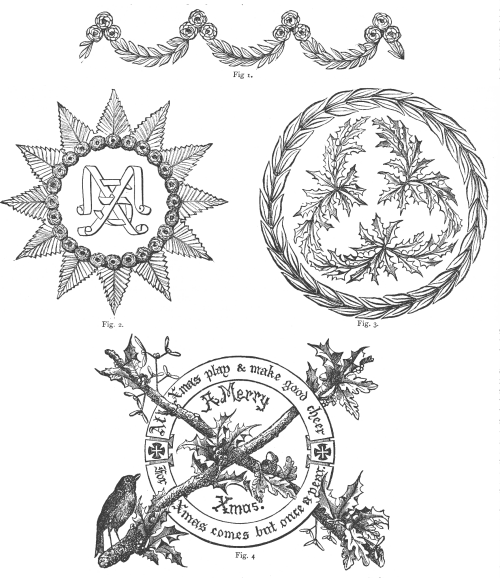
Garlands or half-wreaths (Fig. 1) are best made on barrel hoops for their
foundation. For making letters there is nothing that bends to the shape of the
letters so well as crinoline wires. Single letters are best cut out in brown
paper, and the leaves sewn on with a needle and thread.
Rice decoration is very effective, and looks like carved ivory. The required
shape should be cut out in cartridge-paper, and firmly glued down to its
intended foundation, and then covered with a coating of thick warm paste, or
very strong white gum, into which the rice grains must be dropped, and arranged
so as to lie closely and regularly together, and the whole left until it is
perfectly stiff and dry. Immortelles, and other coloured dried flowers, may be
used in the same manner. The best plan of applying the rice is first to take a
small quantity in a paper funnel and scatter it over the design till dry. Pour
on more gum, then scatter the rice on again, and repeat the process till the
proper thickness and evenness are obtained. When finished, a sharp penknife will
remove all superfluous grains. Monograms made in this way, if the shadows are
picked out with Indian ink, roughly put on, give a very good effect. Alternate
letters of rice and sealing-wax berries look very fanciful and gay.
Mottoes and monograms in white cotton wool have the effect of snow. They are
produced by cutting out the letters in thick white paper, and pasting over them
an even piece of clean white cotton wool, which is, when dry, pulled out so as
to give it a fluffy or snowy appearance. The letters should afterwards be
carefully trimmed with a sharp pair of scissors, and mounted on a ground of
coloured paper.
If there is a lamp in the dining-room supported by chains, holly wreaths twisted
round the chains look well; while a chaplet round the base, and a small basket
filled with mistletoe, suspended from the centre of the base, look very
effective. Borders of evergreens may be placed along the back of the sideboard,
and if there be a mirror in it a small chaplet in the centre, and seeming to
join the borders, looks very
pretty. Pictures and mirrors can be framed with made-up borders of evergreens.
Where these are square, borders arranged in
the shape of Oxford frames will look very pretty. If the entrance-hall be in
panels, narrow borderings of box and ivy look well, laid on all round, and in
the centre half-hoops or chaplets, or a monogram. Scrolls, with mottoes, bidding
people to be welcome and happy, either laid on bright-coloured calicoes, with
holly borderings, or else merely the word "Christmas," done in laurel leaves,
and variegated with immortelle flowers. Even in the bedrooms the frames of
pictures and mirrors can be edged with wreaths.
In Fig. 4 will be found a bold and effective device for a large space, as, for
example, the end wall of an entrance-hall or landing. The cross-pieces are stout
sticks, the size of which must be regulated by the space intended to be filled ;
and it will be found advisable to join them in the centre by a cross joint,
otherwise they will be very awkward to manage. They can then be wreathed with
holly and misletoe, as shown in the figure. The legend surrounding them is made
of letters in gilt paper, pasted
on to coloured cardboard, and the figure of the robin is cut out in cardboard
and painted.
The monogram in Fig. 2 signifies Christmas, and is
very pretty made either of leaves and berries, or moss
glued on cardboard, and edged with three different shades
of immortelles. The border is made of bosses of different
coloured immortelles, and the outside row of star-points
with fern fronds.
Fig. 1 is a bordering
for the cornice of a hall or large room
and is made of
laurel leaves and
rosettes of coloured
paper or immortelles. In Fig. 3 the trefoil is made of holly leaves, and the border of laurel.
In our decorations we must not forget the dining-room table when our guests
gather round it. A very pretty centre-piece is made by covering an inverted
basin with moss, into which insert sprigs of holly quite thick until it forms a
pyramid of holly. On the top place a figure of Old Father Christmas (which may
be bought at any bazaar or sugar-plum shop) and instead of the holly sprig he
generally holds in his hand,
place a small spray of misletoe. A great many lights are required, where fir and holly are much used,
in table decoration, otherwise the effect is heavy and gloomy.
These hints will make it an easy task to adorn the house for Christmas; but
half the pleasure consists is inventing new devices, and giving scope to one's
taste and ingenuity, new ideas springing up and developing themselves as the
occasion arises, till the worker finds delight in the work, and is thus best
rewarded for the toil.
[--grey numbers in brackets indicate page number, |