Volume 1
[-11-]
THE DOG.-I.
ORIGIN AND PRINCIPAL VARIETIES.
IT is impossible now to determine with certainty the origin of the dog. It
seems generally agreed (there are a few exceptions) that all the varieties now
known have had some common ancestor; but about the character of that ancestry
very different opinions prevail. Perhaps the most popular view amongst
naturalists is that which considers the wolf as the original type; and
there certainly are strong reasons to be urged for the belief, absurd as at
first sight it may seem. That the wolf and the dog will breed together, and that
the progeny is fertile, has often been proved; and Arctic travellers have again
and again remarked that the Esquimaux dog and the wolf can hardly be
distinguished. In his account of the well-known expedition led by him in search
of Sir John Franklin, Dr. Kane relates that on one occasion a wolf was reported
at the meat-house, that he went out to shoot it, and shot -"one of our dogs.
I could have sworn he was a wolf." Many of them have all a wolf's
ferocity; and Hayes, in his "Arctic Boat Journey," gives a thrilling
narrative of his narrow escape from being devoured alive by them. Having on one
occasion, when they were hungry, incautiously come near them with nothing in his
hand, they lost their instinctive feeling of dread, and he only saved his life
by providentially perceiving one of the dreaded Esquimaux whips a few feet
distant, before which the gaunt animals retreated. He also relates how, at
Proven, where many of these dogs were kept, the grandson of the governor was
actually devoured by them before his mother's eyes, while walking from one house
to another only twenty yards distant.
Most of these Arctic dogs have lost the wag of the tail when
pleased, which is so distinct a peculiarity of the dog family; but some of the
finest individuals retain it, and, in fact, in some part of the world or other
it is indisputable that almost every conceivable gradation between the dog and
the wolf may be found, both in zoological character and mental disposition. We
cannot therefore deny, as some have done, that the wolf may have been
developed into the dog; and yet we think there are still stronger reasons for
holding the contrary opinion - reasons which cold science little considers, but
which really ought to have as much weight as those which she herself relies
upon.
The wolf has been bred in captivity for four generations, with
scarcely any abatement in its ferocity and wildness of character. Now men do not
take a great amount of trouble for no return; and is it likely that the earlier
races of men would or could have had such faith in the ultimate reward as
to persevere age after age in the attempt to reclaim the untamable beast? Such
questions may be unscientific, but they are reasonable; and there is another
case which bears so strong an analogy, that we cannot forbear quoting it in
point. There is not, and, [-12-] back to the
farthest period which we can trace, there has not been, a wild camel on
the face of the earth it is only known in its subjection to man's use. Further
it is wonderfully adapted to his use, and it has on its knees callosities which
fit it for the constant kneeling down which is required to receive the
burden or the rider but which, in a state of nature, it would never require.
Well the reader may think, there seems nothing strange in this; we all know how
constant use will harden our own bodies, as is proved by the horny hand of the
mechanic Yes, this is true; but while the hand of the mechanic s infant is
soft and delicate as that of the imperial prince's, it is not so with the
callosities on the knees of the camel: the young camel is born with them and
to those who are not too proud to receive it, the conclusion seems irresistible,
that the animal was created by a gracious Providence expressly for the use of
man And when we consider the matchless sagacity of the dog his bodily strength
and power of attack, which make him so formidable, but combined with that
marvellous affection and disposition to obedience, which put all at the service
of the human race, we find it far easier to believe that he also was received at
the hand of a
Creator,
than that man, in the course of a century or two, made him out of a wolf!
and that if the two be identical, it is more likely that the wolf is a feral
dog, than that our faithful guardians are wolves reclaimed. The plan which we
propose to pursue in these papers is, first to describe the different varieties
of dogs, noticing their special peculiarities and the use for which each is best
fitted, and pointing out clearly what are the "points" to be specially
attended to in the choice of an animal of each individual species. We shall then
proceed to give instructions as to their rearing and feeding, both as regards
the sort of food to be given, and the system of giving it, as there can be no
doubt that information on these subjects is very much needed; and we shall also
describe fully what have been found to be the best methods of
"breaking" dogs and training them for the special purposes for which
they may be intended.
And first must be named the terriers as being a class
of universally popular dogs, while the hereditary enmity of the whole race to
vermin makes them very useful. They all share this feeling, but while the smooth
English terrier will always pursue a flying rat, he often declines a real fight.
This is not, however, the case with well-bred dogs, which, as an old rat-catcher
said, "never die in debt."
The smooth English terrier is most prized when pure white, or
black and tan. The muzzle is fine and sharp, with a " foxy" look about
it, the eye bright and sparkling with intelligence, the ears nicely rounded, and
well falling over - we hate to see them cropped or the tail cut The tail is
fine, the limbs graceful but muscular, and the whole animal "tight"
and well made
The black and tan smooth terrier is often bred very small
under the name of the "toy terrier, and some animals have fetched
extraordinary prices. We cannot say we admire these little beasts. They are
excessively delicate, and difficult to rear, often having not even strength to
"grow their own hair" till nearly at maturity, and consequently
growing up in a state of miserable nudity it is painful to witness.
The Scotch or rough terrier is a hardier animal, and
the hair makes the body and muzzle appear of very different shape, but if this
be put back, the muzzle, as in all the varieties, will be found fine, though the
dog is rather more robustly made altogether. This breed is not quite so lively
as the preceding, but it is of great and dauntless courage.
The broken-haired terrier is mid-way between the two, the
coat being moderately long, and of hard, wiry texture, yet close to the body.
This is a splendid vermin dog.
The Skye is well known as the longest in proportion
and hairiest of all dogs. He is always kept as a pet, though possessing a good
share, when well bred, of the courage of his race. The delicate, white,
woolly-coated dogs, often called Skyes, are nothing but mongrels, the coat of
the true Skye being always of a hairy character. This species is more or less
good at vermin, though his long hair hindering his sight, gives him less chance
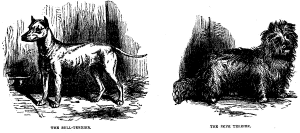
than other dogs. Our illustration shows a specimen of this variety of dog.
There is a Scotch breed known as the "Dandie Dinmont,"
celebrated by Sir Walter Scott, which somewhat resembles the Skye in length of
body, but has a shorter coat, and the legs are without "feather,"
while the Skye is covered to the toes. It has the squarest muzzle of all the
terriers, and is also characterised by a downward curve in the middle of the
back. This terrier, as described by Sir Walter, is perhaps the
"gamest" of the lot, and certain death to anything "that ever cam
wi' a hairy skin on't."
All the terriers are good-tempered, faithful, companionable
dogs, and from their "wide-awake" qualities, very serviceable to awake
a larger, but more sleepy animal.
The bull-terrier is a larger and more powerful dog,
obtained by crossing the bull-dog with the old English
[-13-] terrier. When there s too much bull blood, or the animal is
carelessly bred, the temper is apt to be ferocious and quarrelsome. Such a dog
is absolutely worthless and highly dangerous from his great power. But well bred
animals are generally good-tempered, civil, and obedient, and as vermin dogs,
have no equal. The jaws should show great power from the bull-dog blood, but the
loins and back are also strong, and the general shape very nearly approaching
that of the smooth terrier, but rather more massive.
Where a large dog cannot be kept or is not desirable, the
bull-terrier is a splendid watch dog, or protector for a lady, provided his
disposition be trustworthy, a point which is easily ascertained. His fidelity
and courage cannot be surpassed. The illustration given of the bull- terrier is
taken from a very finely-formed and well-bred specimen of this variety.
The poodle is par excellence the "clever
dog." Nearly all the learned dogs which know the alphabet, or play
dominoes, &c., are French poodles. Everywhere this breed shows an
extraordinary aptitude for learning tricks, and hence is a great favourite with
children. Their affection and fidelity are also exemplary.
[-60-]
THE DOG.-II.
PRINCIPAL VARIETIES (continued from p. 13).
NEXT in point of general interest to those varieties of dogs which we
described in the previous paper, come those larger animals which, on account of
their strength and courage, man allies to himself as the protectors of his
property or his person. Of these the most important is undoubtedly the English
mastiff one of the finest and most powerful of all the many varieties of
dogs. This breed is probably that which was so eagerly sought by the ancient
Romans for combat in the circus, and was then known as the most powerful
fighting dog in the world. William Edwardes relates that in 1615 an English
mastiff killed a tiger in India in single combat; but it is not certain whether
the modern mastiff is of quite such colossal strength as these ancient animals.
Still, he is a grand dog. The height to the shoulder should be from twenty-six
to thirty inches (some reach thirty-four inches) ; all the limbs sturdy and
strong. The head is massive, with a noble forehead; eyes rather small and mild;
ears small and pendant; muzzle broad and square; chest broad and capacious; and
body very large, with powerful loins; tail fine, and reaching rather below the
hocks. The handsomest colour is fawn, or dark buff, with a rich black muzzle;
but very handsome dogs all black are sometimes met with; brindled and red dogs
also occur; but white does not as a rule look well, and is little valued.
The character of the mastiff generally is truly noble.
Indeed, he is said to be the only dog from which even his master dare
take away a bone. Calm and quiet to all, he takes pleasure in the rough gambols
of children, and an infant of a few months old may be fearlessly cradled in his
colossal limbs. But let him be set at any living thing, or let danger assail
those he loves, or even let him see violence attempted to be done, and all his
fearful strength is exerted with a courage that even the bull-dog cannot exceed.
What the lion is among wild beasts, the mastiff is among dogs-the strongest,
noblest, most dignified: and what the lion is not, the gentlest of them all.

The Bull-dog was probably bred from the mastiff
originally, and the old and powerful breed is extinct. The modern bull-dog is a
highly artificial animal, the very shape of the skull being obviously the result
of art; the jaw is under-hung (the lower jaw projecting), the forehead [-61-]
flat and high, and deeply sunk between the eyes, and the muzzle turning upwards,
yet broad and deep, so as to cover the teeth. The chest is deep and full, and
forelegs powerful, this part of the dog showing the mastiff character ; but the
loins are often weak, the dog's strength being chiefly in the neck, fore-legs,
and jaws. The colour varies greatly, white being most fashionable, and so does
the weight, which maybe anything from fourteen to sixty pounds. The character of
the bulldog is uncertain ; some are very intelligent and peaceable, others are
uniformly surly. Many are apt to be friendly with all unless something sudden
occurs, when they will attack without the slightest warning. Hence, although
they are generally inoffensive, unless the temper be known as
trustworthy, they are dangerous dogs. But whatever the disposition be, the
purebred bull-dog always shows the following characters: he always flies
straight at the head of man or beast, and at no other part; he attacks
without a sound or warning, and will remain mute if beaten to death; and he never
lets go till killed or made insensible. It is singular that the slightest
cross of alien blood makes the point of attack uncertain Though the
bull-terrier, for instance, may be of equal courage, he will fly at the legs as
well as the head - the true bull-dog never.

The Bloodhound is now somewhat rare. A good dog
stands about twenty-eight inches at the shoulder, and is a muscular animal, but
not nearly so massive as the mastiff. The ears are large and pendulous. It is
unnecessary to remark on the exquisite power of scent possessed by this breed.
The aspect of the animal is generally quiet and very sagacious, and the
disposition gentle if not roused.
The St. Bernard dog is apparently derived from
the bloodhound. The breed has several times been on the point of extinction,
being kept up in very few hands, and it is much to be regretted it is not more
extensively propagated. The St. Bernard is a really magnificent animal. The
colour is generally orange or tawny, getting lighter or even white on the belly,
and what are considered by the monks the best specimens have a white collar
round the neck, and a white streak down the poll; but many of the finest dogs
have little or no white about them.
The head of the St. Bernard is not unlike in expression to
the Newfoundland, but there is rather a deep furrow between the eyes. The limbs
are of immense size, and the whole animal colossal in his proportions, being
especially powerful about the loins. This gives to the breed what is, perhaps,
its strongest characteristic - a slinging gait, or walk, like that of the
lion. Indeed, this peculiarity, combined with the size and colour, make the
resemblance between a lioness and this dog very strong. Some uncertainty exists
amongst naturalists as to the ideal type of this particular species. The
original St. Bernard breed is stated to have died out some forty years ago. That
which we have described is the kind now kept by the monks of St. Bernard.
The Newfoundland is, perhaps, the most popular breed
of any. He is simply unequalled in the water, and has been picked up in the
middle of the Bay of Biscay, out of sight of land, or of any other ship from
which he had probably jumped overboard. His character, as a rule, is of the
noblest kind ; generous, brave, gentle, and of great intelligence, he becomes
almost part of the family to whom he belongs. Equally good-natured with the
mastiff, he is far less dignified, and enters into all their pastimes with a
zest of which the larger breeds elsewhere mentioned would be ashamed; he is, in
short, not only a good, but eminently a companionable dog. The large breed has
been known to reach thirty-four inches at the shoulder, and though rather
smaller now than formerly, thirty inches is often met with. The head is
splendid, with an expression at once intellectual and benevolent; but the eyes
are to our fancy rather too small in proportion. The chest is well developed,
and all the fore part of the body muscular and powerful; but there is generally
a weakness about the loins which gives rather a slovenly gait to the animal
compared with other large breeds. We are convinced that this defect could be
bred out with a little care. The feet are large, and flatter than usual, which
greatly aids the animal in swimming, an exercise it is really fond of. The best
colour is pure black; next to this, we prefer a dun colour inclining to red; [-62-]
but black and white are often met with. Besides the well-known long-haired
breed, there is a variety of the large Newfoundland, with a short coat
resembling that of a mastiff but thicker and more dense ; this, however, is not
common. There is also a curly-haired variety; but this kind of coat is rather
troublesome to keep in good order, unless the animal can have constant access to
the water. We give an Illustration of this very favourite variety of dog.
Besides the large Newfoundland, there is a smaller variety,
known as the Labrador dog, which -is only about twenty inches high at the
shoulder. Peeler, the celebrated "dog of the police," one of the most
remarkable examples on record of canine sagacity, was a Labrador Newfoundland.
It should be observed, that although the Newfoundland dog is generally of an
excellent temper, there are many individuals of a very surly character; and the
variety, though bearing the antics of children with great complacency, cannot
bear to be long deliberately teased so well as some others. The animal's
great intelligence seems to resent such unworthy treatment.
Next to the Newfoundland naturally come the spaniels and
retrievers, which show a strong resemblance to it in conformation-indeed, the
Labrador is often called a spaniel. Of these we propose to treat in our next
article on this subject, as well as of the other principal varieties of dogs
most commonly used in sport. This branch of our subject being exhausted, we
shall pass on to the feeding and rearing of the animal, together with an account
of the principal diseases to which he is liable, and the most approved methods
of treating them.
[-76-]
THE DOG.-III.
PRINCIPAL VARIETIES (continued from p. 62)
THE Water Spaniel is a moderate
sized animal, rather stoutly built, with a close curly coat, which is generally
of a brown colour. As might be supposed, he is very fond of water, and appears
to be specially adapted to that element, by an unusual secretion of oil in the
coat. This, however, often causes rather a strong odour when indoors, and makes
him less suitable for a domestic dog.
The Setter is too well known to need description, and
is so named from the habit, either natural or acquired, of crouching when
he comes on the scent of game. Both this habit, and that of the pointer, have
been thought to be originally the natural start of surprise at coming on a fresh
scent,cultivated and improved by successive training. The best setters are more
or less liver-coloured, or mixed with white. The setter makes a capital pet dog,
being very handsome in shape, docile, and intelligent. Like the little cocker,
and in fact all the spaniels, it is also remarkably affectionate and mild in its
disposition. For sportsmen who are noted pedestrians, or for shooting over wild
moorland, setters are often better companions than pointers ; their
superior speed and dash, and harder feet, enabling them to keep on with vigour
after the pointer would be exhausted. They should, however, be allowed to wet
the body thoroughly every now and then, and to take a good drink at intervals,
or they cannot stand the work.
The little King Charles and Blenheim Spaniels are
known to every one. They certainly are little beauties as far as looks go - and
often are affectionate, good tempered, and amazingly clever at learning tricks
but too often also are such spiteful little wretches, as to be a nuisance to all
save their fond owners. A great deal of this, however, we suspect to be owing to
bad feeding and consequent indigestion.
The Retriever is scarcely a distinct variety, being
bred from any dogs likely to produce a suitable animal. It is often bred
from the water-spaniel and terrier crossed, or a spaniel and poodle ; but the
dog so well known under that name, is generally bred from the spaniel crossed
with the Newfoundland. Hence it much resembles rather a small Newfoundland, but
with a sharper muzzle, and a sharper look, having also longer legs and a more
lively carriage. The handsomest colour is black. By care some few strains have
been perpetuated without a recent cross, and reared to nearly the size of a
Newfoundland; but there is always more silkiness in the hair than is
usual in that breed. A good retriever is a wonderfully handsome and intelligent
dog, very playful, and with a good temper nothing can exceed.
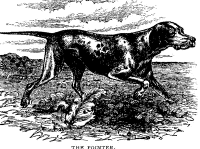
The Pointer is a very characteristic
dog, trained to such perfection through successive generations, that a
well-broken dog will, on the scent of game, stand with every member rigid, in
the exact position in which it happened to be at the moment. This habit has now
become almost instinctive, so that a well-bred dog takes to it with little
training ; and it is recorded that a brace of pointers have stood at "point"
for nearly an hour and a half, without moving a muscle, whilst a sketch was made
from which their portraits were painted. The pointer should have a rather large
head in proportion, with a broad muzzle, the lips or flews slightly projecting.
The neck is very long, and set on at the shoulders in a very peculiar manner not
found in any other breed, the shoulders being prominent, and higher than the
head when the animal is in motion. The chest is well developed, something in the
style of the hound ; but the tail, like the shoulder, is altogether peculiar. At
the base it is rather thick, but lessens somewhat suddenly, and then continues
with a scarcely perceptible taper to within two or three inches of the end, when
it lessens to a very fine point. Some of the best judges affirm that this
formation of the tail is the proper criterion of good blood, and that its
absence shows a cross ; but we are not sure this can be maintained. The pointer
is intelligent, and of an extremely mild and affectionate disposition. When
properly trained, and in good condition, it is always willing to work ; and no
words of scorn are too deep and bitter for the conduct of those who can
deliberately shoot the poor beast with small shot, not to kill, but to punish
him for disregard to their very likely contradictory commands. No variety is
so foully abused as the poor pointer, and no dog merits or needs it less, and
the owner himself is mostly in fault.
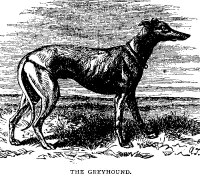
The Greyhound is in shape the very ideal of
light and winged speed, and when well bred, is of singularly graceful outline.
All the bulk of the animal's body seems collected in the capacious chest, whilst
the slender limbs are models of symmetry and grace. Our engraving will save the
necessity for detailed description, but it is necessary to remark that inferior
breeds of this dog are very apt to show an awkward and ugly droop at the loins,
which not only spoils their speed, but also their beauty of form.
The old English greyhound must have been a
larger animal than the present breed, as it was used to hunt the stag, and even
the wolf. Indeed, we are inclined to think that the original breed was the hairy
or rough variety still known as the Scotch greyhound, but which is nearly
extinct. This animal is both larger and more powerfully built than the English
greyhound, and with very long hair. We saw recently a noble animal of this
breed, which was considered the finest specimen in England, and had taken many
first prizes. It was as tall at the shoulder as the largest mastiff was
"feathered" down to the toes, [-77-] and
of an iron-grey colour. Like the modern greyhound, the dog was good-tempered
enough, but had an unmistakably ferocious look about the head. The few who
possess these dogs now are anxiously endeavouring to perpetuate them, and we
trust their efforts may be successful.
The greyhound is moderately affectionate and intelligent, but
sometimes snappish to strangers. As is well known, it is now only employed in
coursing.
The other hounds, such as the foxhound, the harrier, and the
beagle, do not belong in any sense to the household, being, as a rule, only
adapted for the pack. They vary in size, but resemble each other remarkably in
shape and qualities. We believe them all to have been originally derived from
the bloodhound, crossed with the greyhound, but we question very much if there
be not a dash of the bulldog in some celebrated strains, though this has been
denied by good authorities.
Hounds are kept under the severest discipline, but when not
under the control of the huntsman, whipper-in, or other attendants, are highly
dangerous to strangers. There are, however, individual dogs which have shown
remarkable attachment and docility.
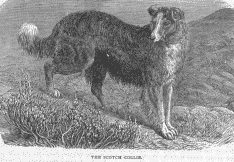
Of Sheep Dogs there are two kinds, the English rough
sheep dog, which very much resembles a very large rough terrier without a tail,
and the Scotch collie. The English dog is a very useful animal, having a
splendid constitution and great intelligence; but the Scotch collie is a far
superior breed, and is every year becoming more highly prized in England. This
beautiful breed has a very fox-like muzzle, expressive but shy-looking eyes,
sharp and graceful ears turning well over forwards, and generally a white line
down the forehead between the eyes. There are both smooth and rough varieties -
the latter is most admired - but his coat is different from that of the
Newfoundland, the hair being closer and straighter, and not so long. The tail is
very large and bushy, and when running is always carried high, though in repose
it droops. The loins are beautifully arched, and the whole outline remarkably
sprightly and graceful. Down the legs the coat is short. The colour varies
greatly.
The true-bred collie is one of the most intelligent dogs in
the world, and perhaps surpasses all others in quick resource and readiness of
invention in cases of emergency. It is in minding sheep, however, that its
capacities are best tested ; for having been trained to this work for
generations, a well-bred collie takes to it "naturally," and needs
comparatively little training. A Scotch shepherd said his dog "could do
anything except carry the hurdles," and the praise was not exaggerated.
The Dalmatian or Carriage Dog is doubtless a
hound, the well-known spotted skin having probably appeared accidentally from
some cross. As a rule, they seem to care most for the stable, and hence are not
adapted for domestic pets, though inoffensive and good-tempered; but we have
known individuals which have displayed considerable intelligence and affection.
Many less marked varieties have been omitted from our list,
and we will only add in conclusion that in choosing a dog, care should always be
taken to ascertain his disposition. Individuals of every race may be troublesome
or even actually ferocious, and every person owes it to society not to keep a
dangerous dog. In our next paper we shall enter upon the subject of training dogs.
[-106-]
THE DOG.-IV.
TRAINING.
IF a dog be kept for actual service, such as minding sheep, or assisting the
sportsman, he will generally be more efficient and valuable if trained up from
birth by his owner, than if purchased when professedly "broken" by
another. The animal will not only be much more under control, but will
understand his master's peculiar signs and gestures in a degree he will not do
if broken by a stranger. In fact, even when you have trained your own dog, if
you lend him a few days to another person, the chances are that, on his return,
it will be some little time before he is quite as useful as before - so
rapidly and strongly do even individual idiosyncrasies become reflected in the
intelligent animal.
Training dogs is much facilitated by the fact that habits
handed down through successive generations are transmitted almost as strongly to
the offspring as natural instincts. Thus, a Newfoundland maybe as intelligent in
general as a Scotch collie ; but the most careful training would fail in making
him so good a sheep-dog as the other becomes with very little trouble, for the
simple reason that his ancestors for generations have been trained to
that duty, and he takes to it almost as a second nature. It is the same with
sporting dogs; and hence the great importance of obtaining, if possible, puppies
from a well-bred strain - they do not give one quarter the trouble in training.
They are, in fact, naturally disposed to do what is required of them, and their
inclinations often need little beyond controlling and directing. It has been
said, indeed, that a cross-bred, or otherwise slow and dull dog, when trained,
will be more reliable and useful than a better-bred and more docile animal; but
we do not think such an opinion was ever held by any one who had really tried
both.
For the training of the Sheep-dog very little definite
instruction can be laid down, success depending almost entirely on the
intelligence, patience, and, we may add, kindness of the shepherd. An impatient,
ill-tempered man will never train a good dog ; while with a good master a
well-bred collie may be taught to do almost anything. The education of
the pup should commence as soon as he can run faster than the sheep, so as to
"head" them: till then it is useless to begin, though he should be
taken out with them in order to become friendly with them, and to understand the
most common words of command, which he will soon do if in company with a steady
old dog. Indeed, an old, well-trained animal is almost essential to the training
of a first-rate sheep-dog with any ordinary trouble, though they may be
trained without, if the shepherd have time and patience to persevere. If,
however, there be a sagacious old dog to assist, the task is very easy. As soon
as the pup can go fast enough, he should be sent in company with the old dog to
fetch in stragglers. After two or three times he will do this by himself, when
he should be most sedulously taught to leave them alone when he has
performed the duty. The next lesson is to "go round them" and keep the
flock together; and the old dog again will do half the teaching; without him,
patience and good temper is the only method. The young dog must next be trained
to obey not only the voice, but the waving of the hand in any direction. When,
in addition to this, the pup can keep up the flock behind while his master walks
before, he is as well trained as ordinary shepherds have any idea of; but is
very far short of what he ought to be, to the incalculable saving of time and
labour. He can be taught by dividing the flock and putting him in the middle, to
drive different flocks without mixing one animal ; to jump over a hedge in order
to head the flock in a lane, and in fact can be made, and in Scotland often is,
so perfect in his business as to be trusted with the sole oversight of thousands
of sheep during the whoIe day, keeping all in their proper [-107-]
feeding-grounds, and showing a sagacity and fertility of invention in
cases of emergency which is sometimes enough to stagger belief. In mountainous
countries, such as Scotland and Wales, it is surprising to see the skill which
the sheep-dogs will evince in collecting the flock together. They appear to the
full as eager in their task as the shepherd, and rarely, if ever, fail to
collect all the stragglers, in spite of the formidable difficulties which very
frequently lie in their way.
The English rough sheep-dog is rarely capable of such perfect
education as the collie, but will perform all the ordinary work required of him
wth steadiness and skill if carefully trained.
In the training of Pointers the greatest patience and
constant watchfulness are necessary, and the first lessons cannot begin too
soon. We have already remarked on the strong instincts of this breed, and it is
often so developed that puppies still suckling will point on seeing chickens or
finding bits of meat, or coining on the track of a mouse. Where the dog is too
highly bred, in fact, the propensity sometimes is so exaggerated as to make him
useless, causing the animal to point at valueless birds, or stale scent which
the game has left for hours before. In order to prevent this, an occasional
cross of the fox-hound is often used, and some of the very best dogs, such as
have been sold for 200 guineas, are thus bred. This cross also much improves the
endurance of the animal without injury to his powers of scent, but it must
always be employed with judgment, and only the best of the offspring should be
preserved.
At a few weeks old, as soon, in fact, as they feed apart a
from the mother, the pups-not only of pointers, but all a sporting dogs intended
for breaking-should be called to their meals by the firing of a gun, commencing
for a few days whilst actually engaged in devouring their food. At first,they
will be more or less terrified, but will soon associate the sound with
pleasurable enjoyment. It is best to leave off when this object is attained.
They must also be taught;. from the first to come to heel at a call or whistle,
being invariably, as soon as they evidently understand the command, made
to obey it by a sufficient but temperate chastisement for every
neglect.
When old enough to walk out into the fields, the pups must be
well practised in coming to heel, and when tolerably perfect in it, taught to
obey the word "down." At first the command should be uttered
with the whelp at the feet, forcing it down at the same time by the pressure of
the hand; repetition of this will soon teach the pup what is meant, and cause
obedience, which may be occasionally rewarded by a bit of bread. When obedient
at the feet, the pup should be ordered "down" when at some
distance, and if a steady old pointer can assist, will soon obey; but, if it
does not, the trainer must walk quickly up to it and repeat the command in a
stern voice. On the second disobedience a good scolding is added, and if a third
time the order be neglected, a smart cut with the whip accompanies the "down,"
and probably impresses it on the youngster's memory. This lesson is of very
great consequence, and must be well attended to, teaching the dog by degrees to
drop at the mere wave of the hand, as speaking much in the field would spoil the
sport. The animal must never be allowed to rise till ordered to "hold
up", or simply "up", or directed by some expression of
the kind.
The next step is to teach the pups to drop at the report of
the piece by ordering them "down" immediately after discharging
it, by degrees omitting the command, and meeting any consequent neglect, at
first by a rebuke, and the second time by slight chastisement. On no account
must they be allowed to rise until the piece is reloaded, checking any attempt
to do so by an imperious "down." This lesson also is of the
utmost importance, thoroughly teaching a dog to "down charge" being of
more influence than almost anything else in securing good sport ; but if the
various stages have been attended to as described, there will be little of
either difficulty or punishment about the process, and the whelps may be trained
to perfect obedience in regard to all the foregoing sports by the time they have
reached the age of four or five months.
The young dogs may now be taken to the game, if possible, in
company with an old one. Their incessant chasing of the small birds should not
be checked, as it will make them eager, and the calm disdain of the old dog for
such small deer will, as soon as they meet with real game, soon make them
ashamed. The example of the old dog will also speedily teach them to point and
hunt with the greatest eagerness ; and as soon as this is accomplished, he
should be kept at home and the pups taken out by themselves for the final stage
of training, which consists in bringing their eager delight in hunting under
perfect control. And here will be found the benefit of teaching them to "down
charge," or to drop at a wave of the haul, before they have been
allowed to scent game. If this lesson be deferred till after, when all the dogs'
hunting instincts are in full exercise, the task of subduing them will be long
and difficult; but, with the habits of obedience to signals and watching the
loading of the gun thoroughly taught first, it will not take long after to turn
out a thoroughly good pointer.
The first lesson is to prevent the other dogs, when a comrade
has found game, from rushing in upon the scent - to teach them, in fact, to back
his point. The trainer must wait till the first dog has made a decided and
tolerably steady point, and then, if another dog runs in, his name, and the word
"soho!" or other word of caution, must be shouted in a. stern
voice, at the same time waving the hand. Of course, if the preceding lessons
have been attended to he will know that he ought to drop at the well-known
signal; and if he does not, he must have both a good scolding and enough
of the whip to impress the fault upon his memory pretty sharply. We repeat here,
once for all, that the great majority of dogs may be trained with very little
correction, which should never be administered wantonly or unmercifully; but
still, when needed, to give less than shall be well remembered will be
useless, and therefore is nothing but mere cruelty. Generally from two to
half-a-dozen smart cuts with the whip will be found quite sufficient for the
purpose.
Again, if the game should run, and the dog follows, the
others will naturally approach, and they may be allowed at first to follow on
the scent in order to increase their ardour. But if any pup attempts to go
before the one that found, he must be at once checked, and punished if he
disobeys ; for the first dog would feel it keenly if his scent were taken from
him, and probably prove quite unruly for the rest of the day.
Young dogs should be allowed to play with the first game they
see killed. They enjoy this greatly, and with every successive bird they mouth,
their ardour in the sport seems to increase, while they rarely injure it much if
left to drop it themselves. On no account should it be torn or snatched from
them, as it might teach them to tear it, and such a habit makes a dog
almost useless.
Having thus got the pups to back each other's point, there
remains only to perfect them in observing the "down charge" when
in actual sight of the game. The best way is to fire when the birds rise, but at
first not hitting them. Still the dogs will endeavour, in all probability, to
give chase, but probably an angry "down charge" will induce
them to obedience; if not, the whip must again be used. If any dog is peculiarly
obstinate, it is best to fasten a light but strong line to his collar, and. just
when he has gathered full speed, to fetch him up sharply, which will send him
tumbling over in a way he will much dislike, and with a few sharp cuts of the
whip [-108-] will soon bring him to order. The same
experiment may be employed to teach an obstinate dog that he must not chase
rabbits, hares, or birds. We may here remark that unless towards the latter part
of their training the dogs are allowed to find plenty of their proper game, it
will be very difficult to prevent them hunting and pointing small a birds, for a
good dog must hunt something; but if taken among game they soon learn the
difference.
A pointer thoroughly obedient in all the foregoing may a be
considered a well-trained dog, and any other special points of training for
sport it will be found comparatively a easy to teach him. He must, however, be
taught, as fast as possible, to receive his orders by motions of the hand, in
order that he may avoid any noise which might scare the game; and he must be
made to keep sufficiently near the sportsman for the birds he springs to rise
within shot.
If it is desired to use the pointer as a retriever also, the
pup should be taught to "seek" while in the house by throwing bits of
bread or meat. After a while a small carcase may be constructed out of a rabbit
or hare-skin, stuffing it with cotton-wool and briars mixed. This will soon
teach him to seize tenderly, without breaking the plumage. Then, when they are
being trained in actual pursuit of game, the only thing to observe will be that
the dogs do not run in and seize the game until ordered to "seek
dead." Pointers which retrieve seldom do so well when in company, as
they tend to spoil the other dogs which have not been so trained ; but when
alone will often perform in both capacities to perfection.
The Setter is trained in very much the same manner as
the pointer, the principal difference being that he "sets," or
crouches, instead of "pointing," on finding his game. In endurance the
setter will surpass the pointer, having a harder feet and more power of limb. A
setter has also more fire and dash, which often enables a quick shot to bag more
birds within a given time, and to get over more ground; but these very qualities
tend to make him a less perfectly obedient animal, his impulsive disposition
seeking to break out, as it were, on every occasion. Some sportsmen, indeed,
affirm that a setter can never be a thoroughly broken; but this is contradicted
by many dogs of this breed, whose behaviour in the field is quite
unexceptionable. It is, however, essential, even more than in the case of
pointers, that their training should commence when yet little pups, and that
they be kept from the first thoroughly under control, so far as they have been
taught; but if this be attended to they will usually turn out most useful
assistants, whilst to our fancy they are about the handsomest of all the dog
family.
The Retriever almost invariably contains a cross of
the Newfoundland, whatever the other parentage may be, and his training is
comparativelv a very simple matter, though it should be commenced, like that of
all other dogs, when very young. As with other sporting dogs, he must first be
taught to pay implicit obedience in the way of coming to heel, and dropping
every time the piece is fired - in fact, never to leave his master when
on business, unless ordered to do so. He should also be taught, from the very
milk, to "seek" articles thrown about, and to carry tenderly, by
carcases stuffed with briars, as already described. Such a dog is more than half
trained. Very often, retrievers are not sufficiently taught to "down
charge," and the consequence is, that they break away after the shot,
whether it be a hit or miss, frighten the game, and spoil the chance of a great
many other shots by their impetuosity. Having therefore, trained the retriever
to "down charge," and in fact, to remain perfectly quiet in the field,
except ordered to "seek," little remains, except the teaching him to
bring the game to your very hand, and to deliver it in no other way. Nothing can
be more annoying than to see your dog find the game and bring it,
perhaps, within a dozen yards, and then drop it in some heavy crop, such as a
thick field of turnips, which very effectually secures you from ever finding it
also. The retriever must likewise be taught to do his work without loss of time,
by occasionially giving him food as a reward, but never until he has carried the
game by your side a little while, and you have taken it from his mouth with your
own hand. This is highly necessary, or he will get the habit of
dropping the game to eat the food of which we have already spoken. In
training a retriever for water-fowl shooting, it is best to begin in summer, in
order that the dog may not have to face the cold water all at once ; and it is
necessary to check him if he ever attempts to catch rats or other vermin, as he
will often waste his time in hunting on his own account.
Spaniels are much used for shooting in cover, and
are seldom so obedient as field dogs, being necessarily often out of sight. To
be of much use, they must be early accustomed to the game they are intended for,
otherwise they will gad about after anything alive, or open on a stale scent,
either of which makes a dog of little value. They may be easily taught to
hunt in any direction, according to a wave of the hand, and to drop on the
report of the piece; but it is difficult to get them to thoroughly "down
charge"; they will generally rush to seize the game, if
it falls, If the dog can be taught to "down charge," like a setter, it
is better; but, if he is too impetuous for this, the sportsman may be well
content with making him retrieve properly, by bringing it tenderly to the hand.
Few spaniels will do more. Most spaniels open on the scent, and pretty loudly
too ; but some breeds are mute on certain scents, and the well-known Clumber
spaniel is perfectly so.
In training all sporting dogs, a command of temper is [-109-]
indispensable, for an unnecessary lash, or even rebuke, ought never to be
given. One object only should be sought at a time, or the dog will get confused
; neither should he be trained too long at one period, lest he become tired and
disgusted. When he behaves properly, he should he patted and encouraged - in
fact, made a friend of throughout, and only corrected when really
necessary.
Having trained your dog to your own satisfaction, and got him
to understand and obey your signals, you will do well never to lend him
on any consideration, except to a person both trustworthy and not very unlike
yourself in conduct and habits when in the field. To lend a good dog to a bad
sportsman, is infallibly to spoil him for at least several days. If you have
shot in company, and your friend and the dog mutually understand and respect
each other, no harm can ensue; the great point undoubtedly is that the dog must
be thoroughly familiar with the sportsman who uses him, and in the hands of a
bad sportsman a good dog is very soon spoilt.
In training Greyhounds for coursing, the great point
is to exercise their power by slow degrees, so as to develop without overtasking
them. The exercise should, therefore, commence with a little, gradually
increasing as the young dog's strength grows. The forenoon is always best, if
the weather is fine. Daily rubbing or scrubbing, with a tolerably hard brush, is
very beneficial, giving firmness to the muscles, and keeping the skin in good
order. Sometimes the limbs are fired to increase their power, but we question if
any advantage is gained by this cruel operation. The feeding is very important;
it usually consists of oatmeal and flesh; but the training of all hounds is now
so reduced to method, and comprehends so many details, that it is utterly
impossible to enter upon it here.
In training dogs for performance, no method can be laid down;
but kindness, firmness, and indomitable patience will always succeed. No other
rules can be needed, for no boy ever yet failed in training his dog to do
anything he desired. We do not think severity is ever needed in this branch of
training, but we never look at the poor wretch who performs in some penny show
at a fair, without commiserating him for the brutality he has probably had to
suffer.
[-204-]
FEEDING AND GENERAL MANAGEMENT.
WHEN it has been determined to keep a dog, it is very much
better to procure a fine pup than to purchase a full-grown animal. It will
involve some trouble, certainly; for bad habits will have to be checked and
corrected, more attention will be needed, and there will be the possibility of
having to nurse it through the distemper; but in no other way can the full
pleasure of the connection be obtained, and the full affection of the noble
creature be secured. Moreover, the pleasure of training a young dog is very
great to both parties, and it is much more satisfactory to possess an animal
whose habits you have formed, whose disposition you know, and whose fidelity to
you may be implicitly trusted. Such a dog is also much less liable to be lost or
stolen.
The animal's lodging is a matter of no small
importance, but is very seldom ordered as it should be; too often any old box is
made to do duty, and the consequence is a weakly constitution, if not actual
disease. The best material is deal or pine, which has a very strong resinous
smell, and contains well-marked veins of turpentine, over all its surface. The
wood ought to be a full inch thick, and be well and tightly joined in the
well-known shape, but with what is very seldom seen, the gable roof projecting,
at the very least, six inches, both at the sides and back, while the front
should project a foot or more, in order to throw off the rain. Of course, if the
kennel is to stand under a shed, this will not be necessary but it is highly
needful in the open air. The whole should be well painted, and, in very wet
weather, it is well to throw a large tarpaulin over all. Many people seem to
think the dog can withstand any weather with impunity, and if left at full
liberty, it might perhaps be so ; but when chained up, it is positive cruelty
not to afford the faithful guardian comfortable shelter. For the same reason,
the kennel should stand on four small blocks or bricks, to raise it from the
ground and keep it dry.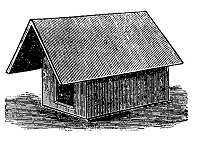
Should the dog become infested with fleas or other vermin,
several bucketfuls of boiling water should be dashed into the kennel, to
sluice it thoroughly, and, when dry, it should be painted over with turpentine
or paraffin. The animal itself should have powdered sulphur well dredged and
rubbed into its coat, which will usually eradicate insects powdered camphor will
do the same. Another method much approved of, is a good washing with soap and
warm water, followed by careful combing; or a little benzine introduced to the
skin of the animal wherever the fleas congregate, will drive them out, and if it
touches them, will kill them. Tobacco water has been often recommended, but
should never be used, as it always makes the dog sick, and spoils the appearance
of the coat. There will, however, he little trouble from vermin, if the kennel
is made of resinous wood, and deal shavings are given for the bed. It is also
worth remarking that the discovery of any such annoyance need not occasion the
commotion in a household which it often does. It is to be removed, certainly ;
but the species, both of fleas and lice, which infest the dog, will not live
more than a few hours upon a human being, and, consequently, need not be
dreaded.
Feeding.-If few dogs are properly housed, still fewer
are properly fed. Some people seem to think they can live with hardly any food
at all; others, on the contrary, think that nothing can be too good for them.
Ladies' pets are, as a rule, worst treated of all, if the health of the animal,
and not the fancy of the mistress, is the point to be considered. They get their
share of every meal, and no exercise after it. When their over-loaded stomachs
at last reject further additions, their appetites are coaxed with every
delicacy, until at last the poor beasts either go to the dog doctor, or perish
in their misery.
Dogs are carnivorous animals, and in a state of nature they
would have to hunt down their prey with severe exertion. It should also be
remembered that their digestive system is very easily deranged. We play all
sorts of tricks with our stomachs; our poor dog cannot. Bad feeding is the sole
cause of the strong and offensive odour so often complained of in the parlour; a
properly fed dog is never a nuisance in this way. When, therefore, a few simple
rules will preserve his health and make him a credit to all concerned, it is
surely worth while to observe them.
And first, a dog should only have one daily allowance. It may
be added, that no dog can possibly remain in health if present at every meal
with an ordinary family. The head of the house may forbid anything to be given
him, but it is of no avail, bits will find their way to his jaws. Indeed,
what else is he there for? if he is to have nothing, he might as well be
outside the door. The fact is, if he is in the room, he will have something ;
who can resist the poor beggar's pleading eyes? who can withstand that touching
wag of his tail, as he goes round the table? and the result is, that while each
thinks he has given him nothing at all, the dog has really eaten as much
in proportion as any one at the table. Probably, too, it has been chiefly meat,
which a house dog should very rarely have. No if our dog is to be kept in
health, with a glossy coat and entirely inoffensive presence, we must
make one condition, that, whatever else be his privileges, he be rigorously
excluded at meal-times.
What, then, should be his food? That will depend upon what he
is. For house dogs, the food should be almost entirely vegetable. Oatmeal is
good; so is coarse biscuit, so is boiled rice soaked in gravy. A good plan is to
let the staple food consist of oatmeal, or biscuit, and once a week, or even
once a fortnight, to boil a piece of liver of the size the dog will eat, and let
that be his food for one day only, giving him rice boiled in the liquor
for the next. It is best given in the evening, when he can have a good sleep
after to digest his repast ; but whatever time is fixed should be kept with the
utmost punctuality. At first, it is best for a few days to put more than enough
before the [-205-] animal, and watch him carefully.
For a while you will see that he evidently "means business;" steadily
and briskly he keeps to work, giving no attention to anything out his food. At
last he raises himself, and either walks away, or, if he again stoops, is
evidently picking over or playing with his food. That is the signal to stop,
and after a few days, if he is full grown, you will know what he requires, and
need take no further notice. He should, in fact, have quite enough to satisfy
his hunger, but not more.
Pointers or other sporting dogs need very different diet when
in work. They should have meat every day and if worked hard it ought to be raw,
while the animal should have as much as it will eat at a single meal. Pointers
are often under-fed. They ought to be put on full working diet at least a
fortnight before commencement, in order to get up their strength, for it is a
great mistake to suppose that one feed of meat will at once create strength for
the work of the day. When the season is over, their meat should either he
boiled, or, if kept about the house, a partially vegetable diet should gradually
be substituted.
Horseflesh, unless known to be of good quality and fresh,
should never be given, as it is apt to cause diseases of the skin. Pot liquor
also should never be given to dogs; it often purges them, and, if salt,
sometimes makes the hair come off. Paunch is the best animal food for a house
dog, and may be given boiled like tripe. Liver must be used with discretion, as
it is a laxative, hence we recommend it to be followed by rice with the liquor,
rice having a contrary effect. Sporting dogs do best with the coarse parts of
beef; or liver; but for all dogs, warm, choice meat is most injurious;
it causes rank odours, foul teeth, and various digestive diseases. It
should always be given perfectly cold. The food is best thrown on the bare
earth, as for feeding poultry. Dogs thus fed always preserve their teeth whiter
and cleaner than those to whom it is given on plates or dishes. Throw the dog's
allowance, therefore, on the ground ; it will be better for him, and he will
enjoy it more. Every possible consideration confirms our demand, that dogs of
all kinds, from the lady's pet to the mastiff, should be fed out of doors. Keep
them from the kitchen for the same reason as you do from the dining-room.
A word is necessary with regard to bones. A dog should not
have more than at most one a day, and care should be taken that there be
scarcely any meat upon it. Dogs naturally prefer some bones and parts of bones
to others. Rib and marrow bones are dangerous, although the latter may be safely
given if split open before thrown down, as dogs will seldom gnaw them when their
marrow is gone. Fish and fowl bones are often dangerous and it is not worth
while to chance losing a valuable dog by bone-splinters causing inflammation of
the bowels or sticking in the throat.
So much for your dog's diet; if you would have him thrive,
you must also see that he has exercise. He was made to be a most active
animal, and it is cruel to keep him always chained to his kennel. Let him have a
good walk out whenever possible, and as often as you can, let it be with you;
you will then be identified with his greatest pleasure, and his queer antics
will sometimes almost make the tears come into your eyes. If you cannot take him
yourself, let a servant take him on an errand, or send him out with a child.
Dogs take to children as naturally as ducks to the water, and we have known a
great bull-terrier which it would have been dangerous for any stranger to
approach, suffer the little children of the family-under three years old-to
sprawl over and about him with evident pride and enjoyment. To keep a dog always
chained, of itself sours his temper. Let him see the world use him to a
collar and chain, and keep them bright with constant wear.
Ladies' pet dogs, more than almost any others, suffer from
want of exercise - the more so from the delicate and constant feeding they have
to undergo - so opposed to all dog nature. All the walking the wretched creature
knows is between his plate of meat and the ottoman which forms his bed. What
wonder if he snaps and snarls at every visitor? His fond mistress thinks and
says, " Poor Fido is so sensitive;" the real fact is, the unhappy
wretch is always suffering from indigestion. Cut him down (by degrees of course)
to one meal a day, of oatmeal, or rice and gravy; send the servant out with him
for two hours every morning, and deny any scraps; and if not too far gone, he
will in a month be a different creature.
Washing - If the animal is healthy and kept as we have
recommended, washing will be seldom necessary. A mere cold bath is well
enough every morning, provided he is kept active afterwards till thoroughly dry,
although in very warm weather this precaution is not so necessary, at other
seasons he should on no account be allowed to lie down or go to the fire till
all the moisture is gone. Thus treated, a mere cold bath whenever convenient
will do him good, except in severe weather. Let the hair be combed and brushed
every day - always waiting to remove mud splashes till the coat is dry - and the
animal, if in health, will always look respectable.
General Treatment. - Be kind to your dog, but make him
feel that you are his master; be gentle and considerate, but always firm. Dogs
will presume, if allowed: their intellect is undoubtedly higher than that of
most other animals, and they know how to take advantage of weakness or
indecision. We hate to see a dog kicked and abused; but we also dislike to see
him pampered and spoilt. Such dogs are never so fond of their masters as those
which are kept in proper subjection.
Also study your dog's character. Be sure he has one. He knows
when he is praised ; he knows when he is blamed ; he is quite aware when he is
even ridiculed! This we are certain of ; indeed ridicule - in plain words laughing
at him - is a potent agency in the training of a dog; no dog can bear to be
laughed at. He even has a sort of conscience. Apart from mere fear of
punishment, he knows there is a right and a wrong. We have often marked a
half-bred retriever, after doing what he had never done before, and therefore
never been punished for, but which he knew to be wrong, slink in with his tail
between his legs, the very picture of guilt.
In approaching strange dogs, it is best to notice the eyes.
The highest authority we are acquainted with states, that when a dog is angry or
excited the pupil is always dilated, and that with ordinary animals this sign
may be implicitly depended on, and that by waiting till the pupil is again
contracted they may be approached with safety. Some breeds, however, such as the
bull-terrier and St. Bernard, are of very uncertain temper, and will sometimes
snap without any warning. With all such it is well to be cautious; but when
approaches become necessary, coolness without presumption is the best policy If
you are afraid, do not appear to be so if you can help it, and the probability
is that the brute will submit. But it is best never to approach a large strange
dog till you know his disposition; we have known sad results from want of
caution in this respect. Savage dogs are best killed out of the way. But they
are the exception; the rule is affection the most unbounded, devotion the most
absolute, fidelity the most inviolable, obedience the most perfect and all this,
if you will, you may have in your dog.
[-266-]
DISEASES OF DOGS.
IN giving a few general outlines of the symptoms and treatment of the
ordinary complaints to which dogs are liable, we may make one introductory
remark. If you keep a dg which is either of unusual value intrinsically, or is
much prized as a pet, ascertain, whilst the animal is yet in health, the
whereabouts of the very best canine physician in the neighbourhood. In most
large towns there is some dog practitioner of high repute, and, in the absence
of such, it may be needful to consult a veterinary surgeon, huntsman, or
gamekeeper ; but these latter are only to be trusted in the case of large, hardy
dogs, such as they are chiefly accustomed to, and the former are very often
totally ignorant of the dog's nature. In fact, very many drugs have upon the dog
an entirely different action from that they exert upon man or other
animals. To give one or two familiar instances : aloes is a violent purge to the
human subject, while castor-oil is a gentle laxative justly valued ; to the dog,
on the contrary, castor-oil is a most violent purgative, while aloes produce
little or no effect whatever. Again, salt is almost necessary to preserve health
in man ; but with the dog small quantities cause nausea and vomiting, while in
larger doses the condiment deserves to be called a poison. It may be generally
stated that dog-practice, during the last twenty years, has undergone a radical
change, much akin to that in the higher walks of medicine. Tonic treatment has
taken the place of depletic medicine, and much greater faith is placed in the
powers of nature, with great gain to all concerned. Foremost in this beneficent
and mild school of treatment is Mr. Edward Mayhew ; and wherever we have given
actual prescriptions in this and the following paper, we have followed the
proportions laid down by him.
Diminutive bitches can seldom rear more
than two pups, and few pet dogs more than three ; robust animals may be able to
suckle all their litter. If more valuable pups must be reared than the mother
can nourish, either a cat or a foster-bitch of some common breed should be
provided, or fits will be the consequence. Should such occur, the best treatment
will be an enema of ether and laudanum in gruel, followed by a spoonful of wine,
and tonic treatment, as we shall describe in speaking of distemper, when
consciousness is restored ; the mother must be kept away at night, but may be
allowed to suckle her pups in the day, after they have been well fed with
cow's milk from a bottle such as is used for children, only the nipple should be
male with the old-fashioned wash-leather, pricked with holes, and filled with a
bit of sponge or cotton to give it substance. To rear pups by hand is not
difficult, but very troublesome, as they want feeding at night. They should be
suckled about a quarter of an hour, and it will only be needful to keep the teat
from becoming sour. In less than a month, however, they may be taught to lap,
when they should get a little meat scraped to pulp, and a week after tasting
this they will feed themselves.
It often happens that the smallest pup is, for that very
reason, the most valuable. In that case the owner will have to see it has its
share, or in the general scramble at every meal it will get crowded out and
starved. If no other means avail, the bitch should be held while the pup sucks
its fair allowance.
As they grow up they will probably have to pass through the
dreaded distemper, which, as a rule, affects young dogs, though it is a
mistake to say it is universal, as there are many dogs which escape it
altogether, while others only suffer late in life. Still, the usual period is
towards the end of dentition, and the most frequent seasons of the year are
spring and autumn. At these times young dogs should be carefully examined
occasionally for symptoms. And as it is always found that dogs fed upon flesh,
highly fed in any way, or kept in confinement, suffer far more than those fed on
plain and rather spare diet, with plenty of exercise, common sense will dictate
the treatment best suited for all such animals.
The earliest symptoms are indefinite, dulness and loss of
appetite being sometimes all that can be remarked, while, on other occasions,
the appetite may be voracious. In most cases, however, the inner edges of the
eyelids will soon be observed to be redder than usual, while the pulse is
increased. Still, distemper may not be present, but if the animal speedily
begins to seek the fire, and is felt to shiver with cold, the case is nearly
certain. When confirmed, however, the white round the eye is covered with small
bright red veins, tending towards the centre, while a purulent discharge begins
to appear, and also a little yellowish discharge from the nostrils, while the
nose remains dry and hard. A bad cough often sets in, and the dog frequently
vomits, and some digestive disorder is always apparent. In a week the symptoms
often subside, and sometimes disappear altogether ; perhaps, indeed, this is
generally the case, and the owner is apt to believe the disease has run its
course. It may, indeed, be so, for many dogs only suffer very slightly. If such
be the case, the dog will rapidly make flesh, or fatten, and recover condition,
while the eyes look healthy, and the morbid symptoms disappear ; but if the emaciation
continues, or the animal makes no progress, and especially if the white of
the eye presents the appearance of minute blood-vessels in a radial
direction, the disease is only slumbering, and will break out again with tenfold
force.
In aggravated cases, the discharge from the eyes and nose
becomes excessive, completely stopping up the nostrils, and sometimes ulcerating
the eye itself. One of the worst signs is a great and rapid loss of flesh,
especially if the appetite be good. A filthy, foetid coat, suddenly swarming
with vermin, is also a very unfavourable sign, and so is a very foul and coated
tongue, dry at the tip, with a marked foulness of the breath. On the contrary,
an evident amendment in the eyes, a marked improvement in the condition, and the
return of the tongue to a healthy state, hold out every reasonable hope of
recovery.
The first thing in the treatment is to regulate the diet.
Meat must be taken away, and the generality of dogs put upon bread and milk?a
ship-biscuit and milk. Weakly dogs may have boiled rice, with a little broth
free from fat ; and as they will frequently refuse this at first, a little good
underdone meat may be minced fine and mixed with it, gradually lessening the
quantity till none be given, for all meat, sweets, and delicacies must be
denied. The water must be often changed. The dog should be put in a good
sheltered kennel, but in the open air; all blankets and such pampering
beds taken away, but plenty of good hay and straw allowed instead. This is
needed, because the dog will burrow in it when the shivering fit is on him ; and
the bed, moreover, must be shaken and cleansed every day, and entirely changed
every two days.
[-267-] In mild cases, when the first symptoms have
been marked, and consist perhaps of only a redness about the eyes, and great
inclination for the fire, give for two or three days, in the morning, a mild
emetic, such as half a tea-spoonful to a dessert-spoonful of antimonial wine.
About the fourth or fifth day, give a gentle purgative. From one to four
tea-spoonfuls of the following mixture is much recommended, and if mixed with a
little sugar or simple syrup, will be readily taken :-
Castor oil ... ... ... ... 4 drachms.
Olive oil ... ... ... ... 2 drachms.
Oil of anise ... ... ... ? drachm.
Mix.
Or a pill may be compounded of:-
Extract of colocynth ... ... 10
grains.
Colchicum, in powder .. .. 6 grains.
Blue pill ... ... ... ... 5 grains.
This last is best, and is for a small dog. Three such pills,
or one three times the quantity, would be needed for a mastiff or Newfoundland.
At the same time, make up the following pills, choosing from the quantities
named, according to the size of the dog:-
Extract of belladonna ... 6 to 24
grains.
Nitre ... ... ... 20 to 80 grains.
Extract of gentian ... ... I to 4
drachms.
Powdered quassia ... ... quantum
sufficit.
Make the above into twenty-four pills, and administer three daily. Often this
treatment seems to cure. If so, the belladonna has done its work, and the
following tonic is substituted:-
Di-sulphate of quinine ... 1 to 4
scruples.
Sulphate of iron ... ... 1 to '4
scruples.
Extract of gentian... ... 2 to 8
drachms.
Powdered quassia ... ... quantum
sufficit.
This is for twenty pills, three to be given daily, with
liquor arsenicalis, prepared by adding ten to twenty drops of the
pharmaceutical preparation to an ounce of water, with a little simple syrup, and
giving a teaspoonful thrice daily.
If the case be more severe, and the bowels very costive, no
laxatives must be used, but an enema made up of four drachms sulphuric ether,
and a scruple of laudanum, added to a quart of cold gruel, (one-eighth for a
small dog), will greatly relieve the animal in its distress. The tonics and diet
are to be as before. Should the lungs b2 affected, the diet must be kept spare,
giving food often, but very little, and discontinue the tonics for-
Extract of belladonna ... ? to 1
grain.
Nitre ... ... ... 1 to 4 grains.
James's powder ... ... ? to 1 grain.
Conserve of roses ... quantum
sufficit
In making, add one drop of tincture of aconite to every four pills, and give one
pill every hour. When better, resume the tonics, even though the lungs be not
well.
[-308-]
DISEASES OF DOGS (continued from p. 267).
Distemper (continued).?Affections of the eyes are
best let alone, even if deep-seated ulcers. They should, however, be cleansed
with a sponge and warm water.
If severe diarrhoea sets in, add two ounces of ether and
eighty grains of tincture of opium to a pint of gruel, and administer very
gently an enema, according to the size of the dog, giving every hour from one to
four tablespoonfuls of the same as a dose. Should it still continue, add five to
twenty drops of liquor potassae to each dose, with a little powdered chalk.
During the whole, however, continue the tonics. If the severity of this symptom,
however, continues unabated, and especially if fits supervene, there is very
little hope of recovery, and none whatever except in the care of a really
skilled practitioner. Mere fainting fits at the close, however, are of
little consequence, if treated with the ethereal injection and tonic mixture
already given.
During convalescence let the diet be rather spare and almost
entirely vegetable, in two or three meals a day, or even more, till the recovery
be advanced. Let exercise be regular and moderate. The skin often peels off; and
sometimes mange will break out, but is easily mastered by the treatment which
will be described in our next paper.
Fits in the dog often cause much alarm, as they are
not unfrequently mistaken for rabies or madness, respecting the real symptoms of
which latter most people are profoundly ignorant. The most marked difference
between the two is, that whilst hydrophobia is always preceded by
symptoms of disorder, fits commonly occur with little or no previous warning.
The animal suddenly stands still and seems stupid, then, with a guttural cry in
the throat, falls over and probably emits involuntarily its feces or urine, or
both, while the limbs become rigid, the eyes seem starting from the head, and
the dog foams at the mouth, while it will probably bite any one who attempts to
touch it. Nothing could be nearer the popular idea of "a mad dog," and nothing
further from the reality. When the fit is over, the dog, if left alone, will run
off with all its might, and may then be hounded to certain death by a
terror-stricken rabble.
The treatment of fits is simple. While the dog is insensible
he must he secured by the neck or collar, and when recovered caressed till quiet
again, then got home as quickly as possible in the first vehicle that can be
procured, as walking could probably bring on another attack. Put the animal into
a quiet, darkish, and if possible, empty room, and make an enema as follows
Sulph. ether ... ... ... 3 drachms.
Laudanum, . ... ... ... ... 2 drachms.
Cold water ... ... ... ... 5 ounces.
For a small dog inject two ounces or less of this mixture,
but a large one may have the whole. Then leave the animal entirely alone,
whatever be the symptoms, for an hour, when the injection is to be repeated. and
so on, till the dog gives evidence of final recovery by coiling itself up for
sleep. It will do no harm to administer one more injection, even then, when the
animal should be left. 'this treatment is simple, safe, and rarely fails.
Fits are caused, as a rule, by too high a flesh feeding; and
after recovery the diet and stomach generally should be attended to. The dog for
some time should only be allowed out for short distances, and be always held in
hand by a chain till there seems no chance of a relapse ; but exercise, though
moderate, must be regular, in order to insure a good recovery.
Rabies or Hydrophobia commences very differently. For
some days the dog appears moody and irritable, or even snappish, and seeks
solitude and darkness, often drinking eagerly, but not seeming to care much for
food. Indeed, his appetite is usually altogether depraved, and straws, stones,
and filth of all kinds are devoured. The light seems to give him actual pain. By
degrees his restlessness increases, and he starts off, neither walking nor
galloping, but in a drooping, miserable trot, his tongue hanging out, but dry.
The mad dog does not foam. If no one conies in his way, he will pass on ;
if any one does, he will give an impatient snap?the deadly bite of a mad dog?and
then pass on. But it is blind agony, not malice ; he does not mangle, he never
tears ; but snap snap?snap?he does his fearful work, impelled by an inward
agony, which is evidently insupportable, if, indeed, he knows what he does, for
many people think he is utterly insensible to all but his misery : he will bite
the live coals from a grate without appearing to feel the heat.
Again, he seeks darkness. The thirst increases upon him, but
at length comes that dreadful swelling of the throat which prevents his
swallowing ; though still, so far from dreading water, he will bury his
miserable head in it, as if to cooi his raging fever. And then, at last, the end
comes ; he gets furious, flies in blind fury at everything in reach, utters the
most hideous and appalling cries, till strength fails, and death ends the misery
and danger.
No treatment is of the slightest use?let the poor creature be
mercifully destroyed when the case is beyond reasonable doubt. So far from the
popular idea being correct, let it be always remembered that the leading and
characteristic symptoms of rabies are not foaming at the mouth or dread of
water, but, on the contrary, snappishness for some longer or shorter time
previous, dislike to light and company, depraved appetite, and
intolerable thirst. Very often the animal is perfectly under control all
through ; but of course this ought never to be risked, and a doubtful case
should always be confined in an empty room till its real character be known,
when execution should be immediate.
Fortunately, rabies is very rare ; there are seldom more than
three or four cases in a year, and these are not caused by heat, for they occur
oftener in winter than in summer. Hence there is very little to be dreaded from
hydrophobia ; but, when bitten by a supposed mad dog, the only certain remedy is
cauterisation, which never fails. It may be applied hours, or even
days, after the wound ; indeed, many think that any time previous to the
development of the secondary symptoms is efficacious ; for as these always begin
again at the wound, whether healed or not, before the general system seems
affected, it is thought that till then the virus remains local and can be
destroyed. The cautery may be either actual, as applied by hot iron (the hotter
it is, the less pain, though of course the best is bad) or the galvanic
battery, or when the patient's courage is not equal to either, by cutting a
stick of lunar caustic to a pencil point, and thoroughly working it about in the
wound till every point has been well treated. Excision is effectual if
done immediately, but requires more nerve than most people possess, as it must
usually be done by the sufferer himself.
[-358-]
DISEASES OF DOGS (continued from p. 308}.
Mange: This word is used to denote almost every
kind of skin disease in the dog. True mange is caused by an insect; but Mr.
Mayhew describes four other kinds, and says he believes there are many more.
In real mange (which generally arises from contagion)
the skin is more or less extensively denuded of hair, dry and scaly, and
corrugated (in ridges), _ The spirits are mostly dejected, with only occasional
symptoms of . liveliness, and the animal is constantly scratching himself, while
the heat of the body is greater than usual, and, as a rule, the animal drinks
more than when in health.
Mercurial ointment is commonly prescribed by farriers or
illiterate dog-doctors. It doubtless cures the mange, but at the same time it
greatly injures the animal. A dog never completely recovers from salivation,
therefore the best ointment is one composed of
Ointment of resin } at discretion.
Sublimed sulphur } at discretion.
Oil of juniper ... ... } at discretion.
Add as much of the second ingredient to the first as can possibly be mixed,
till the mass is too stiff to add any more, and then thin drown with the third
till of a convenient consistency for use. Rub well into the skin
(smearing the coat merely is ridiculous), and wash off next day. Do this three
times, which will last a week. Then rest a week and repeat the process, which
will usually be sufficient; but if the dog begins again to scratch itself
suspiciously, the process must be gone through again.
In another kind of skin disease the hair falls off in
patches, which, as before, appear hard, scaly, and corrugated, and the itching
is intense, but in this kind seems worse in the parts still covered with hair.
The treatment begins with tonic medicines for a week or two, such as are given
for distemper?omitting quinine when liquor arsenicalis is given, and diluted
with water?this being a sure specific. Give a small dog half a drop thrice a day
at first, a large one two drops, and so in proportion to, the size, each day
increasing the doses by half a drop, or a drop, respectively, for the whole
day* (not for each dose) [* As half a drop a day divided in
three may puzzle the reader, we may observe that the liquor (ordinary strength)
may be diluted with six times its bulk of water. Then an increase of one drop of
the mixture to each dose will be equivalent to only half a drop of the
liquor during the whole day and so on.] . At length the dog will have a
discharge from the eyes, or they will look bloodshot, or he will loathe his
food, or in some other way show the medicine is acting, when it must be stopped
for three days, and then commenced again at half a drop less than the last dose,
for fear of overdoing it, again increasing till the dog is affected a second
time. Some animals require very little before their system is influenced; others
will stand an enormous quantity, comparatively, of the poison before they show
any sign that the medicine is acting?in fact, require what would kill another
dog of equal strength and size. But, whatever be the dose required, the medicine
is infallible, and when given cautiously, as described, perfectly innocuous. In
one to two months the disease will be cured.
Over-fed or fat dogs are apt to contract another kind of
mange, which manifests itself by a most offensive odour and an enormous
thickening of the skin. Of course sensation is deadened, and the very hardest
pinching-only gives the animal pleasure. The back often shows more or less bare
places, but not always, and the spirits are dull. The cure consists in
withholding all flesh meat, and confining the animal to vegetable diet, giving
on emetic of antimonial wine, and then a daily dose for three or four days of a,
castor-oil mixture. (such as is given hereafter), followed by tonics, with a
cold bath every morning. Then apply daily some stimulating liniment, such as?
Oil of turpentine ... 2parts } mix
Nut oil ... 1 part} mix
Oil of pitch ... 2 parts} mix
After a week Make it as follows :?
Oil of turpentine ... 1 part} mix
Nut oil ... 1 part} mix
Oil of pitch .... 1 part} mix
Turpentine ... 1 part} mix
As the turpentine acts in reducing the thickness of the
skin it will give acute pain, and the dog will utter piteous cries. The
quantities used may then be somewhat lessened : but, in spite of the animal's
agony, the process must be continued if a cure be desired, though it is a
question whether real humanity would not rather order a merciful execution.
In another kind of mange the hair suddenly falls off
in. patches. "For this," Mr. Mayhew says, "no application is necessary, if the
diet be attended to ;" but we think the application of sulphur ointment much
facilitates re-growth.
In the last kind of so-called mange?which frequently attacks
young pups?the hair nearly all falls off, till the pup is almost naked, the skin
being covered with nearly black patches, caused by effusion of blood, and large
pustules filled with matter. In grown dogs, as a rule, only the back, neck, and
head are affected, and a cure is certain with patience, but is very tedious and
expensive. In the case of pups all depends on the strength of the
[-359-] animal. The treatment consists in opening
the pustules freely, and also puncturing the skin to let out the dark blood,
then washing the skin with a soft sponge and warm water, and applying the
following soothing ointment
Camphor, powdered ... ... ... 1 part.
Mercurial ointment ... ... ... 1 part.
Elder ointment ... ... ... ... 1 part.
The sponging and ointment are to be repeated daily, and liquor arsenicalis
given, as already described, and with the same precautions, till a cure be
effected.
Canker of the Ear is one of the commonest complaints
of dogs, and we believe in every case it is caused by foul, improper, or too
high feeding. There are two kinds of canker recognised, and known as internal
and external; but internal canker appears to be the only one which can be called
a disease, the external canker?a canker of the flap of the ear?being never found
unless in conjunction with the internal complaint, and being evidently caused by
the creature continually shaking the head, or scratching the ear from the
internal irritation, till the continual violence causes a sore, which
degenerates into an ulcer of more or less extent. The treatment formerly
recommended was almost inoperative, and cruel in the extreme. The diseased parts
are still often cut away, without the least effect, as the internal irritation
again causes the continual shaking of the ear, which leads to the disorder. For
internal canker many practitioners?and even Mr. Youatt?prescribe dressings which
make the poor dog howl with agony, and, as this writer confesses, do not seem to
have much success.
The first symptom of internal canker is the animal constantly
shaking the head or scratching the ear. In worse, or more developed cases, there
is a blackish discharge visible within the ear, with a smell which Mr. Mayhew
compares to decayed cheese. The remedy is vegetable diet (in nearly every case
of canker there has been too much of flesh meat), and a dressing composed of
equal parts of extract of lead. and water. This is to be carefully applied by
two persons, one holding the dog's head in one hand, and having the root of the
ear in the hollow between the first finger and thumb of the other. The assistant
then pours the dressing (half a teaspoonful to a teaspoonful) into the ear, when
the 'person who holds the dog closes the ear and works it with his fingers, that
the liquid may penetrate thoroughly. This dressing is soothing in its character,
and gives no pain. As the lead solution makes a mark wherever it touches the
clothes, a coarse apron should be worn, and when both ears are done the creature
should be suddenly thrown to a distance, that he may not splash any on the
operator's garments. The dressing is to be used three times a day.
External canker being different in its nature, and due to
mechanical causes, needs different treatment. The first thing is to get a cap of
linen or calico, and tie over the creature's head and ears, to prevent further
irritation by shaking or scratching ; and the only application needed will be
the soothing mercurial camphor ointment prescribed above for one of the
varieties of mange.
If the shaking of the ear has produced actual abscesses ?as
it sometimes will?within the flap, the treatment is the same in principle. The
sac must be slit thoroughly open, a small pledget of lint, soaked in the extract
of lead solution, kept in it for a day or two, when the wearing of the cap?to
prevent further irritation until the internal canker be removed and the animal
no longer shakes its head?will complete the cure.
`The dog is also sometimes subject to malignant cancer in various parts,
analogous to the same dreaded human disease. No cure of such cases seems
possible, though they may sometimes be so alleviated by a skilled practitioner
that the animal's life may be spared. Sometimes excision- may be effectual at an
early stage.
[--grey numbers in brackets indicate page number, |