Volume 1
[-14-]
THE HOUSEHOLD MECHANIC.-I.
INTRODUCTORY.
IN commencing a series of papers upon the subject we have
before us, it is satisfactory to know, that while comparatively few people
possess more than a very slight knowledge of the mode of construction of the
commonest articles of domestic use, yet there are a vast number of persons who,
either from motives of economy, or for the sake of having an unfailing means of
recreation, desire and seek after assistance and instruction on this subject. -
In writing these articles our ajm will be, first to incite a taste for the
constructive and mechanical arts, and then, by a series of familiar examples,
beginning with the most simple forms, and gradually getting up to the more
complex and difficult, to put the would-be learner in the way of educating
himself, sufficiently at least for him to be able to accomplish any ordinary
task likely to be required in a moderate household. We. shall also take it for
granted that our readers are entirely ignorant of the smallest knowledge in
handling a tool, and we must, therefore, ask those who have attained some slight
proficiency to bear with us if, in the first chapter or two, we enter rather
more minutely into details than they might consider necessary.
We shall first introduce to our readers the principal tools
with which they will have to become acquainted, explaining briefly their
separate uses and the principles which should govern their application, in order
to produce the greatest effect with the least amount of labour, and also the
means to be taken to preserve their effectiveness. Next we intend describing the
nature and mode of treatment of the different woods and other materials likely
to be required by the beginner, giving some idea of their different qualities;
and having thus brought together the objects to be worked upon and the means of
working them, we shall proceed to give practical directions for the construction
of some common objects found in every house, such as a door or window frame, [-15-]
&c.; judging that having once learned to handle tools well our
readers will find no difficulty in adapting their knowledge to each particular
piece of work. We intend to give, in detail, instructions whereby the
householder who is fortunate enough to possess out-door space, may be enabled to
erect sheds or fowl-houses and cucumber frames, and, if necessary, small
greenhouses, not forgetting that if he gets these, he will most likely want some
such thing as a wheelbarrow, and other conveniences, which he may be enabled, by
our directions, to construct for himself.
In-doors, the details of window-blinds, curtain-poles,
shutters, door locks, and springs, will be explained; and as now-a-days almost
every house contains some specimen of patent machine, we stall devote a chapter
to the explanation of the working of a few of these labour-saving contrivances.
Then again, it is necessary, and in many cases indispensable, that every
occupant of a house should be familiar with the arrangement of his gas and water
apparatus; or ever one knows how many serious gas explosions and expensive
overflows of water might have been prevented by a very slight knowledge of these
matters.
In all our instructions we shall aim at being rather practical than theoretical, though not forgetting that a thorough knowledge of the theory if not indispensable is certainly a great assistance to the attainment of perfection in practice. We give the following list of tools for the benefit of those who do not intend getting a complete set, so that each may pick out what he most requires, either as his convenience may dictate or his pocket admit. The prices are of course only approximate, and, will vary with the degree of excellence sought.
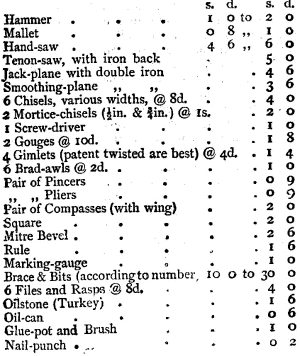
The above are almost indispensable, and the following will be found useful.
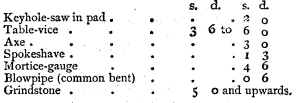
As the above prices are taken from the catalogue of a noted London tool-maker, we do not fear that any of our readers will have to pay more. It will be seen that for an outlay of between two and three pounds a very complete and serviceable set of tools may be obtained; but do not let any with short purses get the idea that they cannot do with a much smaller quantity than named here while at the same time we certainly advise those who can afford it to start with some such assortment. From time to time, as we enter into the different branches mentioned in our introduction, we shall need to make additions to our stock.
THE TOOL-CHEST.
In
cases where the expenditure of two or three pounds is possible we should advise
the purchase, from some respectable tool-maker, of a complete set in a chest,
which will form a nucleus, to which additions can be made as they are required.
If, however, any of our readers are fortunate enough to be able to set aside a
room as a workshop, the chest will hardly be needed, as it will be found much more convenient to hang the tools in racks
or perforated shelves fixed by brackets to the walls over the bench. This saves
the trouble of having to replace the tools in their box each time after using,
and also facilitates the finding of them when wanted.
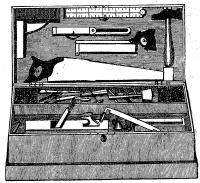
The engraving (purposely drawn out of perspective so as to
show the interior of the box and lid) exhibits a convenient arrangement for a
chest, supposing our amateur cannot manage to devote a room exclusively to the
purpose. It will be seen that the lid is fitted with narrow contrivances and
fastenings, by which the tools are fixed, so that the lid may be closed without
their falling from their places. The tray rests on slides in the sides of the
box, so as to admit of its being pushed backwards and forwards for greater
convenience in getting at the articles underneath. Sometimes two trays are used
instead of one. These trays generally contain partitions or divisions at either
end, to keep the nails, screws, &c., distinct, the centre space holding the
lighter tools, such as brad-awls and gimlets. For the chisels and screw-drivers,
a rack made of two slips of wood the whole length of the box, screwed at about
three-eighths of an inch apart, fastened inside the front at just such a
distance from the bottom as to prevent the hanging tools from touching it, will
be found handy. The planes, oilstone, and heavier tools will go best underneath.
Any strongly-made box may be easily fitted up for a tool-[-16-]chest in this manner, and the work will be found capital
practice for a beginner.
We now proceed to explain fully the different varieties of
the tools, and the uses for which the various forms are specially contrived.
In so doing we shall doubtless have to place before our
readers many that they will not be likely to require but in order that those who
are intending to purchase tools should not be put to unnecessary expense, it is
important they should rightly understand what they need and what they need not
have. We shall, therefore, at once proceed to the description of the different
contents of our tool chest, explaining as simply as possible the way of using
each tool, and the work for which it is adapted, and adding instructions as to
the proper way for keeping it in order
Brad-awls-.These are merely pieces of steel wire
ground with two faces at the point, which faces meet and form a cutting edge. In
use, however, this tool does not cut, but wedges the fibres of wood on either
side The upper end is sharpened and driven into a wooden handle, which has a
brass ring or ferule to prevent it splitting. Some awls are square wires
sharpened to a point. Coopers' awls have curved blades. Sets of brad-awls which
all fit into one socket, and store away in the handle, which is hollow, and
unscrews, may be met with but being mostly got up cheaply they are seldom satisfactory.
Brace and Bits.-Fig.1 is a diagram of an ordinary
carpenter's brace made of wood with brass mountings.
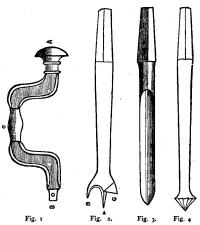
It
is in principle a simple crank handle. The piece, A, which revolves loose, is
rested against the chest; and in the bottom, B, is a square hole, into which
the bit is inserted, and held either by a spring catch, or a screw. There are
various forms and varieties of this instrument, but the principle and action are
the same. The brace is turned by the right hand, which grasps the part C; the
handle, A, being kept in position on the chest by the left hand.
Fig. 2 is a centre-bit. It consists of a central triangular
point, A, which enters the wood first and guides the tool ; an arm or knife, B,
which regulates the diameter of the hole, cutting the edge cleanly, and a cutter
or chisel, C, set obliquely, which follows and pares up the wood into shavings.
Centre-bits are of various fixed sizes, but may also be obtained with movable
blades, so that by shifting this blade. h&les of different diameters may
be made with the same cutter. For small holes a gimlet-bit, which is only an
ordinary gimlet with a square end made to fit the hole in the brace, and pin and
nose-bits, are used. The pin-bit, Fig. 3, is a fluted rod, sharpened at the end
like a small gouge; the nose-bit is like a pin-bit with a small blade turned
under, which cuts out the wood; Fig. 4 is a countersink.bit, used for enlarging
holes, or to sink a depression to allow the heads of screws to he buried level
with the surface. Augers and screw-drivers are also fitted as bits, and rymers
or broaches, for enlarging or making holes taper, are used in the same way. Of
drills and the more powerful forms of ratchet braces, we shall have to treat
when we arrive at metal work.
Chisels.-A common chisel, Fig. 5, is a flat blade of
steel sharpened from one side at an angle of about thirty degrees. It is driven
into a wooden handle up to the shoulder. In principle all chisels are wedges,
and it should be borne in mind that as such they tend to split and tear up the
fibre of wood when the shaving cut is too. thick to bend to the pressure of the
edge of the tool. Paring chisels are much thinner and wider than ordinary ones,
and are used for clearing out deep holes, such as mortices
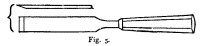
Mortice Chisels, Fig. 6, are much stronger and thicker, and are sharpened in the same way, but with an angle rather less acute. Gouges are only curved chisels, and. are used in the same manner. Chisels are used either by the pressure of the hand, or by blows of a mallet, the flat side being always kept in the intended path of the blade, which path it regulates and guides.
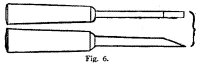
The above diagrams show the chisel-blades seen on the edge
and from the back.
In sharpening chisels they should be ground on the stone
slightly more acute than their finished edge is intended to be; this is in order
to reduce the surface, which will have to be perfected or polished upon the oil-
stone. In all cases after sharpening it will be found that there is a slight
burred or wire edge upon the extreme end of the flat side of the blade which
must be removed by rubbing on the stone, taking care to keep the blade down
perfectly flat on the stone, or a second bevel will be produced, thereby
increasing the angle of the edge, and destroying the keenness of the tool. In
sharpening on the oilstone the tool must be firmly held by both hands, and
rubbed backwards and forwards, always being traversed in a parallel path, as any
approach to a rocking motion would produce a thick rounded edge. Gouges are
sharpened in the same way, of course receiving a rolling motion to bring all
parts of its edge into contact with the stone. This motion requires some little
practice to perform satisfactorily. The wire edge on the inside of the gouge is
removed by rubbing a small round slip of oil- stone against it, but in this case
the chisel is fixed and the stone moved.
In large workshops stones are kept having hollow grooves in
their surfaces, in which the round gouge blades are rubbed. Both chisels and
gouges are made of various widths and strength; but three or four of each will
be found sufficient.
[-23-]
THE HOUSEHOLD MECHANIC.- II.
THE TOOL-CHEST (continued from p. 16).
Files and Rasps.-Files are flat blades of steel fixed by a tang
into a wooden handle, and cut all over with a series of teeth more or less
minute, the various sizes of which are known as rough cut, bastard cut, second
cut, smooth, and superfine, and they are of various shapes and sections, such as
round, half-round, square, oblong, triangular, oval, &c., according to the
purpose for which they are required. The square and oblong shapes often have one
edge not cut. This is called a "safe edge," and is used as a guide in
filing up shoulders, &c. Usually files are of fully hardened steel, and are
therefore capable of attacking any metal which is not equal to themselves in
hardness. A? large proportion are made rather thicker in the middle than at
either end, in order to in some degree counteract the rolling motion of the
hands, which it is very difficult altogether to prevent in the filing of flat
surfaces. They are, however, sometimes made with parallel surfaces and edges.
For the purposes of cutting thin slits, such as the nicks on the heads of
screws, thin blades, cut only on the edge, are used. These are called slitting
files.
In all cases where from use on material of adhesive nature
files have become clogged up, the teeth should be brushed out with a file-card,
for which purpose a piece of worn out cotton combing-card, a kind of thick
fustian woven with steel wires, answers admirably. As files are a somewhat large
item of expenditure in a workshop, from the speedy wear to which they are
subject, many methods have been tried for recutting the teeth, when worn away,
by means of acid. The following method we have found very effective for fine
files, but of little use with coarse ones. After being brushed clean, an old
file is dipped into a mixture of three parts sulphuric acid, one part nitric
acid, and seven parts water for a time varying from five to twenty minutes,
according to the freshness of the mixture, and the depth of cut required ; it is
then washed in water, and dipped in lime-water to prevent any further action of
the acid, again washed, and dried by heat, and brushed over with a mixture
of oil and turpentine to prevent it from rusting. Whether this process acts only
by clearing out dirt and dust, or really cuts into the surface, we cannot say,
but we know from experience that it is certainly effective, although not quite
so good as recutting, a process we do not advise our readers to attempt. The
acid process should be performed out of doors, as the fumes given off are
rather unpleasant.
Considerable practice is necessary to attain much proficiencv
in hand filing, especially of flat surfaces, as from the motions of the elbow
and shoulder joints, the hands naturally tend to move the tool in curved lines,
thereby making the work convex or rounded. The same fault is further induced by
the fact that in sweeping a file of moderate length across a narrow surface, one
hand being at each end, the blade becomes a lever, the fulcrum of which is
continually shifting in position; and if the pressure at each hand is kept
constant, the ends will alternately be raised or depressed, and will, of course,
produce a convex surface, instead of a square and true one. As before explained,
it is in some degree to counteract this tendency that files are made thicker in
the middle than at the ends, or "bellied," as it is termed. In
finishing and smoothing filed works the files are slid along sideways or
laterally. This motion is called draw filing, the teeth only scratch, and do not
cut. Rasps are the same in action as files, but, being used for wood, the teeth
are larger, being produced one at a time by blows of a small chisel or punch.
The teeth are always in lines, ranged diagonally, or in curved rows across the
blade.
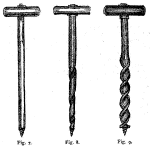
Gimlets and Augers.-Fig. 7 shows the ordinary form of gimlet, which is simply a piece of steel wire fastened into a handle at right angles to it, the lower or cutting part of which is grooved and fluted out so as to leave sharp edges. At the extreme end is a small taper screw, by which the tool is kept continually forcing its way into the wood, the edges of the flute cutting out the shavings which escape out up the groove. Twisted gimlets, Fig. 8, are by far the best, the effect being exactly the same, for as the flute is twisted round the barrel the wire is not so
much weakened, and the groove being in the form of a screw, the shavings are
lifted out, instead of having to force their way up the groove. Augers, Fig. 9,
are like twisted gimlets, but in place of one groove they have two wound round
the rod; the bottom edges of the metal left by the two grooves are sharpened
into a cutting edge, and consequently their action is very easy, smooth, and
rapid. The largest augers ate not fixed into handles, but have their tops
expanded into rings. into which a movable handle is thrust.
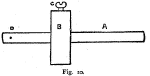
[-24-] Gauges.- Fig.
10, page 23, shows a common marking-gauge, in which the rod A slides
backwards and forwards in the block B, but capable of being fixed at any
required place by the screw E; near one end is a hole through which the steel
point D is driven. In using this tool the right end is grasped by the right
hand, the thumb and forefinger of which take hold round the block. In gauging a
piece of wood, one edge, previously planed, is used as a guide, the left of the
block being kept close up to it, the point of course marking a line parallel to
the edge of the wood at any required distance from it. In cutting thin parallel
laths, a knife is used instead of the point D;
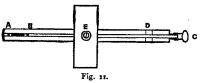
this is called a cutting-gauge. Fig. 11 shows a mortice-gauge, which is used
for marking two parallel lines at once, as in marking mortices and tenons. The
point A is driven through in the same manner as in the common gauge, but a
second point, B, is fixed on the piece of brass sliding in a groove in the rod,
which slide is moved by the screw C. The screw C works in a box or nut shown by
the dotted lines at D. The method of using is the same as with common gauges.
The rod is fixed by the screw E.
Hammers and Mallets.- It would seem almost
absurd
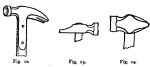
to trouble our readers with a description of tools so universally known, but as no tool-chest would be complete in their absence, we should not feel altogether justified in passing them over. Fig. 12 shows the head of an ordinary c1aw-hammer, the claw of which is useful in taking out nails wrongly driven, &c. Fig. 13 shows the head of a tang hammer, the tang being convenient for slight blows
on nails, just for fixing them in a position to be driven in. Fig. 14 is a
smith's chipping-hammer, the weight of which is nearly all in the lower end, the
tang being usually rounded. Of mallets we need say nothing, except to recommend
the square-headed ones for morticing and carpenters' work, and the cylindrical
ones for more domestic purposes, such as tapping beer-barrels, &c.
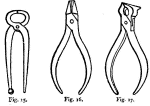
Pincers and Pliers.- Fig. 15 is a diagram
of a pair of ordinary pincers, which are contrivances for obtaining a firm grasp
on small objects, such as nails or pieces of wire, &c. Common pliers, Fig.
16, are used for the same purposes as pincers, but being smaller, do not grasp
quite so firmly ; and Fig. 17, a pair of cutting-pliers, used for severing small
wires. The cutting edges are sometimes on the side, and sometimes on the top
edges of the tool. In the former case the ends are prolonged into regular
pinching surfaces, thereby serving the twofold purpose of cutting and holding.
Planes.- Fig. 18 is a section showing the
construction and arrangement of an ordinary plane. The body, A, is
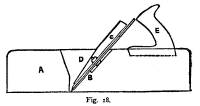
wood, usually beech, the bottom of which is called the sole. The line B, on which the iron rests, is the bed, and for carpenters' planes is mostly inclined at an angle of forty-five degrees. The iron is kept firmly fastened down to the bed by the wedge C, which fits into grooves on each side of the mouth Di The angle of the wedge is about ten degrees, and it is cut away in the middle so as to leave room for the screw which holds the two irons together. The plane is pushed forward by the handle E, which is let into the top. Fig. 19 shows the arrangement of the double iron found in most planes. A is the bottom iron, which is the cutting part, and B is the top iron or break, as it is termed, which is intended to throw off the shavings from the cutting edge. It is set with its edge about one-
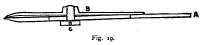
twentieth of an inch from the edge of the cutting-iron, to which it is held
by the screw C. The adjustment is allowed by the long slot in the bottom iron in
which the screw slides. The top iron is curved in the direction of its length,
in order to keep its edge in more complete contact with the lower iron, and so
to allow no shavings to pass between.
In setting a plane the two irons are screwed together and
placed on the bed with the wedge lightly pressed in its place; the edge will
then be felt underneath by the hand, and can be adjusted. Should it be too far
out, a tap with a hammer on the fore-part of the plane will bring it up, or
should it not project enough a slight blow on the top of the iron will be
necessary; when in its place a sharp blow on the top of the wedge will fix it
there. The diagram, Fig. 18, shows about the proportion of a jack- plane, the
length of which is from fourteen to sixteen inches. The smoothing-plane is
smaller, about seven or eight inches. The trying-plane is much longer, about
twenty inches, the greater length giving greater accuracy in the surface to be
operated on. The order of using is generally jack, trying, and smoothing.
Plane-irons are sharpened in the same way as directed for chisels, but from the
greater width of the blade, three inches, the operation is more difficult.
[-42-]
THE HOUSEHOLD MECHANIC.- III.
THE TOOL CHEST (continued from p.24).
FOR mahogany a tool like a smoothing-plane is used, but the angle of the bed is much greater, eighty or ninety degrees, and the edge of the iron is cut into little teeth. The action of this tool is more scraping than cutting, and is of most use in roughing veneers. It is called a toothing- plane. Beading-planes, for cutting beads of various sizes and curves, are constructed with irons of the required shape. Hollows, rounds, and various mouldings are cut by the same means. Fillisters, or rebating-planes, are provided with knives which cut on the sides as well as at the sole, and are chiefly used for cutting out the channel in window-frames in which the glass lies. They are often provided with movable stops and guides, without which their action is very uncertain. Match-planes are provided with two sides, one of which has an iron constructed to hollow out a groove on the edge of a plank, the other side having a double iron, which cuts a tongue exactly to match the groove, the object being to fit two planks together, edge to edge. It is common to work a small bead on one edge, which is a great improvement to the appearance. These planks are termed "match-boarding."
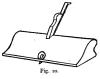
Fig. 20 is what is known as an "old woman's tooth,"
and is used for cutting out grooves across the grain, such as slides, into which
shelves are fitted. The edges of these grooves should be sawn out with a tenon-saw.
Compass-planes have round soles according to the curve they
are required to cut, and of course are of great variety.
The principle in a plane is the same as with a chisel, with
the advantage of much greater steadiness on account of the increased power of
guiding given by the sole, which prevents too great a degree of penetration.
The spokeshave is the lowest form of plane, and is only used
for small widths. It is pulled towards the operator by both hands. The angle of
the edge being only twenty- five degrees, the tool cuts quickly and easily.
Saws.- It is by means of saws that the more easily worked
materials are converted from the tree form to the crude shape they are required
to assume before the finishing processes are begun; and as the ends to be
accomplished are so varied in magnitude and difficulty, so are the forms these
tools are given numerous and diversified. All saws, however, consist of thin
blades of steel, fixed in convenient handles, and having one edge serrated, or
cut into teeth; and it is in the size and shape of these teeth, and the angles
at which they are inclined, that the most important variations are to be
noticed. In all saws intended for wood, the teeth are slightly bent alternately
outwards, in order that the cutting edge should present a larger surface to the
material than the blade [-43-] will require to
follow in. If this were not done, the tool would become clogged and choked with
the sawdust. In metal saws, the teeth being too fine and thick to admit of being
bent, or "set," as it is termed, the back of the blade is made much
thinner than the cutting edge.

Fig. 21 shows a "saw-set," the nicks of which are of different
sizes, to suit the various thicknesses of the blades.
As none of our readers are likely to have occasion to use the
pit-saw, it is of no use to bring it before them. The next largest variety is
the cross-cut saw, Fig. 22,
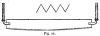
which is used for felling and cutting trees or timber in a direction across
its grain. It is worked by two men, one at each end, and pushed backwards and
forwards with equal force, cutting both ways; and for this reason the front and
back angles of the teeth are equal, or about sixty degrees. The teeth are kept
so upright to prevent too great a degree of penetration.
The rip-saw, Fig. 23, is the largest single-handled saw -
about 2 ft. 6 in. or 3 ft. long-and is used for sawing or
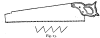
ripping along planks in the direction of the grain. The teeth are, therefore,
inclined forward, and work very fast, and number about three and a half teeth to
the inch. The half-rip saw is of the same shape and form of teeth as the rip,
but altogether smaller. The panel-saw is much narrower at the bottom end than
the half-rip. Its width there is about two inches, and it is much finer in the
teeth, which generally number about six or seven to the inch.
The last three may be considered to represent the most usual
form of plain hand-saws. In use they are grasped by the right hand on the
handle-the work to be sawn being laid on the sawing-stool, and held by the left
hand or either knee. After just notching the end of the line to be cut, the
strokes are lengthened gradually, and. swept downwards with considerable vigour
and force, and brought up with the teeth kept well down in the cut, the blade
being used from top to bottom. A little grease smeared on the blade occasionally
makes the saw go easier.
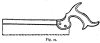
The tenon-saw, Fig. 24, consists of a thin blade, fastened at
the top edge in a metal rim or back, which keeps it firmly stretched out. It is,
nevertheless, rather - a delicate instrument, and requires careful usage, or the
blade will be crumpled or buckled - a fault very difficult to remedy. If the
buckle is only slight, a smart blow with a hammer on the middle of the top of
the back will often set it right; but failing this, the blade must he taken out
and re-fitted by a smith, as it is entirely unfit for its work while in that
condition. The teeth are fine - ten to the inch - and the pitch is not very
forward, the back angle being about thirty degrees with the cut, and the forward
angle ninety degrees. Dovetail-saws exactly resemble tenon-saws, but are smaller
and much thinner in the blade and finer in the teeth. The hint
about careful usage should be doubly observed with them.
After making the line intended to be sawn, these two saws are used horizontally,
and across the grain of the wood, and are grasped by the right hand, being moved
with short, quick, parallel strokes. The work should be fixed higher than in rip
sawing; the bench is a convenient height.
We now come to saws intended to cut in curves or
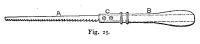
circles-the most ordinary form being the keyhole-saw, Fig. 25. This is a long, thin, tapering blade, A, much thicker on the teeth edge than at the back, to allow of the curve to be made. In order that the extreme end of the thin part may be used for small circles without danger of crippling or breaking, the blade is made to slide into a long hole right through the handle, and is fixed at any required place by the screws, C. In using, a hole is first bored with a gimlet, touching the required path of the saw, the thin end of which is then introduced and pushed ,backwards and forwards rapidly, but not too forcibly, the straight or curved path being regulated by the twist of the hand.
[-49-]
THE HOUSEHOLD MECHANIC.- IV.
THE TOOL-CHEST (continued from p. 43).
Saws.- For larger curves and coarser work, a strong, narrow, tapering blade, fixed into a handle, is used. This is called a compass-saw. For more elaborate curves, a narrow parallel blade, thinner on the back than in front, is stretched in a wooden frame. This is called a turning- saw, and a common arrangement is shown in Fig. 26.
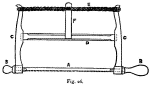
The blade, A, is fixed by a rivet at each end to the handles, B B, which are thrust through holes in the sides of the frame, C C. A centre bar, D, keeps this frame distended, and acts as a fulcrum, whereby the force generated by the twisting of the cord, E, is transmitted to the blade. The cord is twisted by the lever, F, and should consist of five or six turns of strong whipcord. The parts of the handles which go through the frame
being cylindrical, they can be turned so as to put the blade in any required position to keep the frame out of the way of the work. The handle behind the pitch .of the teeth-which is the one taken hold of - is usually larger than the one at the other end. A stronger and larger form of this kind of saw is much used on the Continent for all sorts of carpentry work, in place of our rip and half-rip saws. The turning-saw may be used to cut out spaces, by first boring a hole, into which the
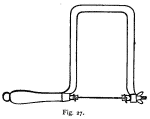
blade, released from one of the handles by taking out the rivet, is inserted. Of course, the limit of distance from the edge of the work at which these saws can act, is equal to the space between the blade and the centre bar, D. Fig. 27 is a diagram of the buhl-saw; these saws are used for cutting delicate and elaborate patterns through thin materials, such as veneer for inlaying, and they are fitted in frames with very long backs of light metal, so that they may take in work of some size. The blade is of extremely thin metal, with very fine teeth, so that if a pattern is sawn through two layers of veneer at once, one of light colour and the other dark, temporarily stuck together, with a piece of paper glued between them for the convenience of separation, the pieces of each set would correspond and fit into the holes of the other, and vice versa; and so, with the one operation, two patterns are produced, one dark on light ground, and the other light on dark ground. The joints of the pattern are barely perceptible, owing to the extreme thinness of the saw. In use, this saw is held with the blade vertical, and the
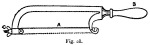
handle below the work, and both frame and work are twisted about as the curves of the pattern require. The professed buhl cutter often uses a kind of wooden vice, one jaw of which acts with a treadle, in which case the work is in a vertical position, and the saw is held horizontally. Fig. 28 shows a common metal saw, which is a stout blade, A, of hard-tempered steel, thicker at the teeth edge than the back in order to allow clearage way, the teeth not being "set," fixed in a metal frame, B, in which it is strained by the nut, C. This saw is held by the handle in the right hand, and pushed forward with considerable force, the left hand being lightly pressed on the curve of
the frame in order to steady the blade. These saws should be used as little as possible for cutting steel, which wears them out very quickly, and they are too hard to be filed up again economically. The ordinary forms of wood saws are sharpened with three-cornered files, known as saw files, which are moved rapidly to and fro over the front and back edges of the tooth. The blade of the saw
is held in a wooden vice, but an ordinary bench or tail-vice
may be made to answer the purpose, if a couple of wooden clamps be placed in the
jaws one on each side of the blade, otherwise the grating noise is almost
unbearable. Of circular or vertical machine saws, it will not be necessary to
say anything here, as they will not be likely [-50-]
to be required for the small jobs we shall probably meet in our household.
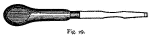
Screw-driver.-Fig. 29 is the diagram of a
screw-driver, a tool in which the only variation noticeable is in size. The
longer the handle, of course the greater the power obtained. The point should
not be ground up sharp, but bevelled nearly to an edge, so as exactly to fit the
nick in the head of a screw. Screw-drivers are also fitted as bits, and used in
the brace, a most convenient form where much screwing is to be done.
Squares, Levels, &c.-Fig. 30 shows the
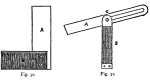
ordinary form of carpenter's square, which consists of a thin, flat, steel
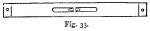
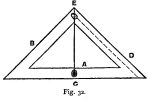
blade, A, which is riveted into a thicker piece of wood, B, at right angles to it, the inner edge of the wood being generally faced with brass. In using, the blade is laid flat on the wood to be squared, with the brass part of the handle held close up to the edge, and being brought to the required place, a line drawn along the metal edge will be exactly at right angles to the guide edge of the wood. Squares are also used in testing the accuracy of planed work, in which case the work should be held between the eye and the light, so that, on applying the too], it will at once appear if it is at all untrue. Similar in principle and application is the mitre bevel, Fig. 31, which is a handle, B, with a shifting blade, A, which can be set at any required angle by the screw, C. The blade can be drawn out to the full extent of the slot in it, by which means a much longer line can be drawn. When not in use, the blade is turned round and brought in a line with the handle, in which position it occupies very little space. Fig. 32 shows the form of larger squares used by masons and others, which also serve as levels and tests of upright lines, by means of the plummet and line, C. For the horizontal test, it may be used on the same position as in the diagram, or turned over with the side, B, downwards, in which case the plumb-bob falls into the hole at E. The opposite side, D, held to vertical work, will test its uprightness. The plummet will fall in this case into the hole E, as with the last. Fig. 33 shows a common form of spirit- level, which consists of a hollow tube of glass, closed at each end, and full of spirits of wine, all but a small bubble of air. This tube is mounted in a block of wood, faced with brass, in the centre of which is an opening, through which the tube is seen; across the slit is a thin line, which marks the exact middle of the level, and when placed on the surface to be tested,
the bubble should stand exactly under this index if the work
is correct. Levels are of many different shapes, and are sometimes found set in
rules or squares ; but in all forms their application is the same., Analogous in
use to squares and levels are carpenters straight-edges, often called
winding-sticks, which are simply parallel slats of wood about two feet long,
with their edges planed perfectly true. Suppose a long block of wood has been
planed up to an apparently true surface, place one straightedge on each end, and
parallel to one another; bring the eye down so as to get the two sticks in a
line, and if any twist should exist in the log of wood, the greater length of
the straight-edge will magnify the fault. If, however, the two sticks appear,
when foreshortened, exactly parallel, the work is correct. One edge of a
straight-edge is usually bevelled to a point, which is used for testing long
surfaces, by bringing this sharp edge in contact with the work when between the
eye and the light. If the light is seen plainly through at any part, it is
obvious that that part is too low, and therefore the surrounding portions must
be reduced to the same level. For gauging across narrow logs, the metal edge of
the square is mostly used in the same manner. For marking across the grain, a
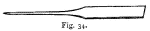
tool is used called a striking knife, shown in our illustration, Fig. 34, which
is a blade sharpened with a slanting edge, which is bevelled from both sides.
The other end of the blade terminates in a point, which is used for such
purposes as pricking holes as guides for the position of nails, &c.
Vices.-These useful contrivances are almost
indispensable if any work in metal is attempted; but should our amateur only
desire to work in softer materials, he will find the screw bench, to be
described hereafter, answer his purpose, or at all events will only need a small
table- vice. Fig. 33 shows the usual arrangement for the larger
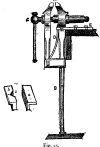
kinds of vices, called tail-vices, from the fact that one of
its arms is prolonged downwards into a tail, B, which rests on the floor, and
contributes much to the steadiness of the hold. The work is held between the
jaws, A, which are closed by turning the handle working the screw, C, the jaws
opening, when released, by the action of the spring, D. These vices should be
screwed firmly to the bench or table. Table-vices are much the same as the
above, but smaller, and have no tail, but are screwed to the edge of the bench.
They are only fit for light work, however. In both the above, the insides of the
jaws are faced with steel, and cut into teeth, in order to increase the holding
power; these teeth, however, are liable to injure the surface of finished work,
if such is required to be held. To prevent this, clamps are used, made of soft
metal, and may be had ready to fit the jaws; although, for nearly all purposes,
nothing answers better than two strips of thick sheet lead, the length of the
jaws, and about three or four inches wide, nipped half-way in, and the remaining
half bent over on each side with a hammer, so as to fit round the jaws and keep
on them when opened. For holding round bars or pipes, a pair of clamps, like a
and b, Fig. 35, will be found useful, a is a piece of angle
iron, and b is similar, but thicker on one side, which side is filed out
into a gap, c; the three faces formed by the sides of the neck and the
clamp a giving a vastly increased grip on rods, &c., besides
altogether preventing them from slipping out of the upright position.
[-51-] Fig. 36 shows a hand or
pin-vice, much used by watchmakers, &c., for holding small wire. The jaws
are closed by a fly nut, and the handle is hollow, to admit of a long. rod being
slipped through. The round handle is very
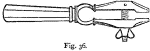
convenient for keeping work cylindrical if required, as the file may be moved in a straight path while the vice is rolled backwards and forwards by the left hand, the work being lodged in the partially-opened jaws of another vice. To obviate the difficulty in holding large works, owing to the disadvantage produced by the radial motion of the jaws in these arrangements, vices have been contrived in which the jaws move horizontally. Fig. 37 shows one
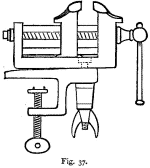
of these, which, being usually fine specimens of workmanship,
are of course rather expensive (about 30s.). Tail-vices may be had from 10s.
upwards, according to weight, about 6d. or 7d. per lb. being the average price.
Table-vices are about is., and pin about 2s. 6d. upwards.
Wrenches.- These are used chiefly for
turning nuts or bolts by means of their heads, which are shaped so as to admit
of being gripped, mostly having four or six sides. The ordinary form is known as
a spanner, but, being of certain fixed size, is, of course, limited in
effectiveness to only just those nuts or bolts it happens to fit. In order to do
away with the necessity of having a large
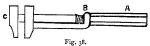
number to fit every size, wrenches are made with sliding
jaws, which open or close by various means. Fig. 38 is a diagram of what is
popularly known as a screw hammer. The handle, A, turns in the collar, B, and
has a screw cut in a hole bored inside it, into which screw the movable jaw, C,
is drawn by the turning of the handle. There are many other forms of screw
wrenches, but in all the application is similar, and it is needless to describe
each form.
Before concluding this chapter on tools, it will be as well
to bring before the reader the common forms of nails, &c., he will be sure
to want, and just to let him know the names by which to call them. In Fig. 39, A
shows that most common form, the "cut" nail. It will be seen that,
looked at from the side, this is wedge formed, but from the edge parallel. It
follows, therefore, that the nail, when driven into wood, should be placed with
its wedge side in a line with the grain of the 1 wood. If this is not attended
to, the wood, if at all thin, is sure to be split, besides which the hold is not
so firm, as the fibres, being bulged away, do not maintain so complete a contact
with the nail as if driven in right. A practical trial or two will soon show the
truth of this argument. These nails are very cheap, about 2?d. per lb., and are
known as inch, two-inch, &c., cut nails. At one time the standard for their
length was the height of piles of pennies; but since the alteration in the
coinage this standard has given way to the more rational one of inch measure.
Brads, B, are cut by machinery from sheet
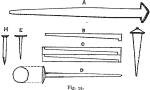
iron, which is used without waste in their manufacture, as the diagram C, showing the manner in which they fit one another, will show. These are also wedge-formed in one direction, and should be driven as directed for cut nails. The price of brads varies according to size, being from about 3d. to 1s. per 1,000 is a round, flat-headed nail, called a "clout," much used for such purposes as nailing on sacking of beds, &c., or in any case where a broad holding surface is required. These nails, being almost exclusively wrought by hand, are expensive, about 6d. per 100 and upwards, according to size. The tack, E, is a reduced form of the above, and will perhaps be the most used of all nails in household requirements for nailing down carpets, blinds, &c. They may be had as japanned or tinned tacks, at 4d. to 6d. per packet, containing 1,000. Wall-nails, F, are used only for nailing up trees to walls, and such purposes. They are made of cast iron, and consequently very brittle. Price, 2d. per lb. The sort of long iron tacks known as French pins, deserve to be much more generally used, as their grasp is very firm, although, owing to their cylindrical shape, there is but little danger of splitting the wood in using them. They are made of iron wire, flattened at one end into a head, sharpened at the other into a point. The price ranges from 6d. to 1s. and over per lb. Gimp-pins, H, will be found useful for tacking on bordering, fringe, &c., to curtains, ottomans &c. They are only short, very stout forms of pins made of brass wire, and lacquered of different colours to suit the different furniture; price about 2d. per oz. Nails with iron or steel points and brass heads or hooks of various shapes, will most likely be in much request; they may be had with screws instead of points, if required.
[-77-]
THE HOUSEHOLD MECHANIC.- V.
WOOD.
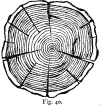
IN the process of drying, wood contracts considerably, but the inner fibres, being protected from the influence of the atmosphere by the outer rows, do not shrink in the same proportion. The consequence will be readily seen by reference to the diagram, Fig. 40, which shows the result which is almost sure to ensue if a log of green wood is merely left to take care of itself. The only safe means to guard against the disastrous effects of too sudden drying is to expose the wood very gradually to the influence of the atmosphere. It will be found much more economical to purchase just the required article from some respectable timber or hard-wood merchant, who will only supply it in a condition fit for immediate use. Shrinking does not take place to any sensible degree in the direction of the length of the fibre.
Ash is one of the toughest,
most flexible, and elastic of home-grown timbers, but as it is of very slight
durability, it is not suitable for construction of outdoor work, or building
purposes. Some specimens maybe found dark and beautifully marked in grain, and
are then much prized for cabinet work.
Beech is a tree which attains considerable size in
this country, the wood of which is of a reddish brown colour, and of very even
texture and fine grain. It is much used in small turned work, handles for tools,
common furniture, &c.
Mahogany is the most universally known and prized
of the furniture woods, as its immense size and great soundness, its almost
perfect immunity from dry rot, its freedom from shrinkage, and its beautiful
appearance, render it the most valuable of all woods for domestic purposes. The
finest in grain, or Spanish, is imported from Cuba, and is mostly cut into
veneers, which are overlaid on common and cheaper wood. The Honduras is lighter
in colour and weight than Spanish, but is better for solid work. Mahogany is
also good for turning, and admits of a fine polish.
Oak is of immense strength and large size, and
peculiarly unsusceptible to the attacks of the weather. There are many different
varieties, nearly all being found in the temperate zone. The growth of the oak
is slow, and the wood is consequently hard and firm, and of great tenacity, the
best being of a light brown colour.
The darker kinds are softer and less durable, but being in
most cases beautifully marked with crossings of lighter colour, called the
flower, are much prized for ornamental purposes, especially in church
architecture and carving. Oak is rather difficult to work, owing to its great
hardness, but is susceptible of a splendid polish. Wheelwrights use oak almost
exclusively for the spokes of wheels, the rims or felloes being generally ash,
and the naves elm.
Pine.- Under this head properly come all the
varieties of the order Coniferae, such as fir, white and yellow deal,
larch, &c. The different species of pine supply the largest part of the
timber employed for building purposes, on account of the immense size and
straightness of the wood, the abundance of the supply, and the ease and facility
with which it can be worked, combined with its durability and comparative
strength. The durability of the pine tribe is in proportion to the quantity of
resin [-78-] and turpentine contained. Yellow deal
as it is called is the best for carpenters, being even and straight in grain
and tolerably free from knots. Some varieties are entirely without these knots,
such as St. John's pine imported from Newfoundland, which may often be had two
or three feet wide and forty feet long. This kind is very soft, however. The
white kinds are harder and freer from resin, but less durable if exposed to
variations of moisture. Larch is softest of all, but the grain is large and
coarse, and, owing to the immense quantity of turpentine contained in it, is
well suited for out-door work, such as fence-posts, buried work, &c.
It is perhaps worthwhile here just to touch upon the various
technical terms applied to the sizes into which pine and other woods are cut.
In its largest state (generally about one foot square and of
indefinite length) it is known as timber, and when cut into three slices, these
are known as deals - deal being only the name for a certain size of pine, and
not, as is erroneously supposed by many, a species of wood by itself. A smaller
size than deals, about seven inches by two or three, are termed battens; and
deals ripped into three or four nearly square logs, of two inches by three, or
three inches by four, are known as quartering. If sawn into slices of about one
inch by nine to twelve wide, these slices go under the name of planks, which
being again sliced form boards. If sliced diagonally, from corner to corner,
feather-edged or weather-boards will be produced. These are used for roofs and
outsides of sheds to throw off the wet.
Walnut is highly esteemed as a furniture wood, and
is procurable of large size. The colour of the wood is grey, with brown or black
blotches and streaks, which deepen in colour towards the centre of the tree. The
grain is rather large and coarse, as the growth of the tree is comparatively
rapid. Walnut is easily worked, and susceptible of a fine polish. Its principal
consumption is for gun-stocks, for which it is admirably suited, owing to its
light weight and durability.
JOINTS.
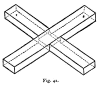
Having now the materials and tools before us, let us go through a short preliminary course of what may fairly be called carpenters' joints, as the very essence of carpentry is a thorough knowledge of how to build up of many pieces a fabric of the greatest possible strength, with the smallest outlay of material, bearing in mind the influence which humidity or over-dryness exerts over all kinds of wood. If our reader is new to the work, let him commence by a taking a log of quartering, say three feet long, and planing it up square, testing its accuracy as directed in our remarks on the square. When he has accomplished this feat satisfactorily, he may saw the log in half with the tenon-saw, and will then have two logs eighteen inches long, with which to make the first and simplest joint in carpentry-the cross joint. The object will be merely to let the two pieces one into the other at right angles, until their corresponding surfaces are flush or level, that is to say, the part where the joint is made shall be no thicker than the log itself. The quartering, we will say, is three inches by two, and we will make the joint flat-wise. Lay down log No.1i, and mark a line across it with the square and pencil or striking-knife; from this line measure the width of the log to be let in, and also draw this line across with the square, and produce each of these lines round the narrow sides of the log. Set the marking-gauge to half the thickness of the narrow side, and mark on both sides with it between the two lines. The part thus marked off must be removed by sawing the lines across the grain, and then chiselling the piece out, thus leaving a gap in log No. t three inches wide and one inch deep. Take exactly the same course with log No. 2 and if properly done, the two will fit exactly together, in the form of a cross. This joint may be varied, for practice, by placing the logs obliquely to each other, instead of at right angles, in which case the required angle must be got by the mitre bevel, instead of the square. Fig. 41 shows the finished joint. This joint is much used in wooden erections, especially in its oblique form, as will be seen hereafter.
[-84-]
THE HOUSEHOLD MECHANIC.-VI.
JOINTS (continued from p. 78).
THE next kind of jointing we will try to describe is morticing. For
simplicity, we will use logs of the same size as before, and will suppose that
it is required to join the end of No. 2 log into the middle of the narrow side
of No. 1 (Fig. 42), a T-shaped piece, of course, being the result. Plane up
true, as before, and square a line, A B, on No. 2, 2t three and a quarter inches
from the end, and continue the line all around the log. Now take the mortice-gauge
(Fig. 11, page 24) and set the two points to the width of the mortice-chisel,
which should, in this case, be about three-quarters of an inch, and then adjust
the pair of points to mark on the narrow edges of the log two parallel lines,
each at an equal distance from its respective side. The gauge is easily set by
tapping with a hammer to about the right place, and then tested by pricking
holes from one edge, and then reversing the action to the other edge, until the
marks made from either side coincide, and when once set correctly, the
screw should be tightened, to prevent the points shifting. Mark the narrow edges
of the log with these points from the 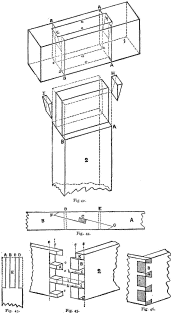 square
marks A and B to the end, and then across the end to join them, and remove the
wood on either side as far as these marks, as shown by the dotted lines, the cut
in the direction of the grain to be taken with a rip-saw, and the transverse cut
with the tenon-saw. It only remains to smooth off the roughness left by the saw,
and this part of the joint, which is called the tenon, is finished. In the
middle of log No. 1 mark round the log, with the square, two lines, A B, A B, at
a distance from each other equal to the width of No. 2, viz., three inches, and
mark the narrow edges, A A, between these lines with the gauge in the same
position as before, and as the logs are of equal thickness, the marks will fall
in the middle in this case, as on No. 2. If we now look at our marks, we shall
find we have two parallel lines, a a, three-quarters of an inch apart,
and three inches long. Turn the log completely over, and make the same gauge
marks on the bottom, and a corresponding oblong slit mark, bcde, placed
exactly opposite A, will be the result. Next lay the log on the stool or bench,
and fix it in the most convenient manner (it is usual with carpenters to sit on
the work to keep it steady), and take the chisel, and holding it with the edge
at right angles to the length of the hole to be cut somewhere between the two
gauge lines, and the blade quite upright, hit it a smart blow with the mallet.
Now, with the chisel, take a cut a little further either way, but always keeping
the flat side of the blade towards the end you are approaching, and gradually
advance about one- eighth of an inch at a cut, to the end of the required sit,
or mortice, as it is termed. When the line A is reached, the tool is reversed
from the place where the cut commenced till it comes to the B. Once below the
surface, the blows of the mallet must be smart and swift, and the [-85-]
chisel will be required to be used obliquely sometimes, in order to prize
out the slips, which would otherwise clog the hole. About the depth of two cuts
should reach the centre of the block, when the log must be turned over, and
worked from the other side, until the two holes meet in one and so form the
mortice. Even though the wood to be morticed were very thin, it would be
necessary to commence from both sides, or the edges of the work, supposing the
chisel to come right through from either side to the other, would be splintered
and uneven from being forcibly bulged out. The oblique ends, E F, of the hole
are afterwards cut from the top of the log, to make room for the wedges, H I, in
No. 2. Clean out the ragged parts inside the mortice, with a wide, thin-bladed
chisel, and drive in the tenon; from the under side, it should project about a
quarter of an inch through the top. Now drive in the wedges, H I, lightly, saw
off all that projects above the surface, and plane smooth. If the directions
have been attended to, and the work accurately done, the joints should fit
exactly, without play or looseness, and the shoulders should come well up to the
under side of the block. Should it be required to remove the tenon from the
mortice, before finally wedging tip, the morticed block, No. 1, must be tapped
on the side from which the tenon enters it. The weight of the block and the
force of inertia will cause it to jerk out a little at each tap. Any attempt to
force it out from the top would spread the fibres in the tenon, and rivet it
more firmly in its place. This joint will tax the powers of the novice, but will
be found capital practice, and in after work we shall have constant need of it,
as it is about the most important joint in carpentry. The correct proportion for
the thickness of the tenons is rather more than one-third the total thickness of
the morticed log, but the drawing is purposely made with the tenon larger for
distinctness. For the best work, two tenons are used, as Fig. 43, ranged side by
side on the end of the log, and fitting into two corresponding mortices, in
which case the lines ABCD are sawn down with the half-rip saw, the space B being
removed with the mortice-chisel.
square
marks A and B to the end, and then across the end to join them, and remove the
wood on either side as far as these marks, as shown by the dotted lines, the cut
in the direction of the grain to be taken with a rip-saw, and the transverse cut
with the tenon-saw. It only remains to smooth off the roughness left by the saw,
and this part of the joint, which is called the tenon, is finished. In the
middle of log No. 1 mark round the log, with the square, two lines, A B, A B, at
a distance from each other equal to the width of No. 2, viz., three inches, and
mark the narrow edges, A A, between these lines with the gauge in the same
position as before, and as the logs are of equal thickness, the marks will fall
in the middle in this case, as on No. 2. If we now look at our marks, we shall
find we have two parallel lines, a a, three-quarters of an inch apart,
and three inches long. Turn the log completely over, and make the same gauge
marks on the bottom, and a corresponding oblong slit mark, bcde, placed
exactly opposite A, will be the result. Next lay the log on the stool or bench,
and fix it in the most convenient manner (it is usual with carpenters to sit on
the work to keep it steady), and take the chisel, and holding it with the edge
at right angles to the length of the hole to be cut somewhere between the two
gauge lines, and the blade quite upright, hit it a smart blow with the mallet.
Now, with the chisel, take a cut a little further either way, but always keeping
the flat side of the blade towards the end you are approaching, and gradually
advance about one- eighth of an inch at a cut, to the end of the required sit,
or mortice, as it is termed. When the line A is reached, the tool is reversed
from the place where the cut commenced till it comes to the B. Once below the
surface, the blows of the mallet must be smart and swift, and the [-85-]
chisel will be required to be used obliquely sometimes, in order to prize
out the slips, which would otherwise clog the hole. About the depth of two cuts
should reach the centre of the block, when the log must be turned over, and
worked from the other side, until the two holes meet in one and so form the
mortice. Even though the wood to be morticed were very thin, it would be
necessary to commence from both sides, or the edges of the work, supposing the
chisel to come right through from either side to the other, would be splintered
and uneven from being forcibly bulged out. The oblique ends, E F, of the hole
are afterwards cut from the top of the log, to make room for the wedges, H I, in
No. 2. Clean out the ragged parts inside the mortice, with a wide, thin-bladed
chisel, and drive in the tenon; from the under side, it should project about a
quarter of an inch through the top. Now drive in the wedges, H I, lightly, saw
off all that projects above the surface, and plane smooth. If the directions
have been attended to, and the work accurately done, the joints should fit
exactly, without play or looseness, and the shoulders should come well up to the
under side of the block. Should it be required to remove the tenon from the
mortice, before finally wedging tip, the morticed block, No. 1, must be tapped
on the side from which the tenon enters it. The weight of the block and the
force of inertia will cause it to jerk out a little at each tap. Any attempt to
force it out from the top would spread the fibres in the tenon, and rivet it
more firmly in its place. This joint will tax the powers of the novice, but will
be found capital practice, and in after work we shall have constant need of it,
as it is about the most important joint in carpentry. The correct proportion for
the thickness of the tenons is rather more than one-third the total thickness of
the morticed log, but the drawing is purposely made with the tenon larger for
distinctness. For the best work, two tenons are used, as Fig. 43, ranged side by
side on the end of the log, and fitting into two corresponding mortices, in
which case the lines ABCD are sawn down with the half-rip saw, the space B being
removed with the mortice-chisel.
It is often necessary to join beams together end-wise, and in
Fig. 44we show one of many methods of doing this. The ends of the logs A and B
are shaped as there shown, leaving a space at C where the diagram is shaded, and
into this space the rectangular piece C is driven tightly, thereby closing the
joint well up at the angles F G, which are the holding part of the joint. At D
and E, as shown by the dotted lines, holes are bored with an auger, and wooden
pins driven in, making all secure and immovable. It must be remembered that no
joint, however well constructed and executed, is so sound and strong as the same
size of solid wood, and, therefore, piecing should be avoided, if consistent
with efficiency.
We next come to dove-tailing, which, though not by any means
difficult, will, nevertheless, require considerable care and dexterity to
produce accurate work. We will suppose we require to make a box two feet long,
one foot thick, and one foot deep, of inch material. For this, we shall want ten
feet six inches of inch board, twelve inches wide, but, as deal is only usually
nine inches wide, we shall have to glue up three inches more, to make the right
width. Cut up the planks into lengths of two feet one inch each, and strip down
ten feet three inches wide, and cut also into the same lengths. Plane, or shoot,
as it is called, one edge of each width, perfectly true, and square carefully,
testing the accuracy with the square and straight-edge, and then with a brush
smother the planed edges with hot glue rather thin. Now place the pieces edge to
edge, and press evenly and smoothly, so as to force out all the superfluous
glue, sliding the edges a little across each other. Be very careful to bring the
pieces back flush and level. It will be necessary to leave these boards for some
hours under pressure, and when perfectly dry, if properly done, the glue joint
will be stronger than the wood is itself. The essence of success is the complete
exclusion of the excess of glue. These pieces must be carefully planed up
smooth, and the edges shot and squared. Next square up the ends, and reduce the
length of two pieces to two feet and a quarter of an inch for the front and
back, and of two for the ends for one foot and a quarter of an inch. The
quarter-inch is for a slight overplus it is usual to leave until the joint is
finished, when it is planed off true. Now rule off on the end of each of the
four pieces, and on both sides, a space equal to the thickness the wood is
reduced to and the above overplus. These marks, e e e e, will show the
exact size of the interior of the box, when complete. The dove-tail joint, Fig.
45, consists of the pin A and the dove-tail B - the pins being usually made
first - and should be on the end or short side of the [-86-]
box. Take the mitre-bevel and set it to about 60? or 70?, the exact angle is
not important, and set off on the edge of each end of A, the two outside pins,
and any convenient number of pins between them, the bevel being reversed to mark
the two sides of each pin. Produce the bevel round both faces of the board, with
the square, as far as the gauge lines e e. Now fix the board firmly in
the bench, end up, and with the dove-tail saw (Fig. 24, page 43) cut the gashes c
c c. Lay the board flat on the bench, face downwards, and take a sharp
chisel and a mallet, and give a cut exactly on the square line, e, between
each pin. Turn the piece over and cut from the other side gauge-line until the
pieces between the pins are removed, taking care that the pins should not be
injured in the process. Carefully square the spaces with the chisel, without
using the mallet, and trim off the roughness left by the saw on the pins.
Next take the front or back (2) of the box and lay on the
bench inside uppermost, and place on it the end A on edge, with its inside edge
touching the square mark e, and with its top and bottom edges flush with
those of 2. Now, with the point of the striking-knife, mark off the bevels on
the edges of each pin, and produce the lines with the square across the end of B
and to the square mark on the other side, with the mitre-bevel. Saw the lines h
h with the dove-tail saw, and remove the spaces i i by chiselling out
across the square line, and K K by sawing. The pins on the ends of A will then
exactly fit the dove-tails in B. The four corners of the box require to be
treated in the same way, the pins being worked on each end of the shortest side
or end and the dove-tails on each end of the longest or side of
the box. Glue in firmly, and, after the work is dry, carefully plane off the
projecting ends. The appearance of the joint will then be as shown in Fig. 46,
in which the end grain of the wood is shaded.
The bottom, which should be of thinner wood, may be nailed or
screwed on, and the top should have a ledge round the front and end edges which
will shut over the body. A narrow slip of wood (about three inches) nailed round
the bottom and nicely bevelled or mitred at the corners, will much improve the
appearance of the work and add to its strength.
For small common work, it is a very frequent practice to
mitre up the edges to an angle of 45? and glue them together, and then, when
dry, to make little saw cuts obliquely, alternately inclined upwards and
downwards, and glue thin slips of veneer into these niches. This method is much
easier than dove-tailing, and is tolerably strong. It is known as the mitre and
key-joint. There are several modifications of the dove-tail joint, such as Fig.
47, which shows only from the side, and not in front.

This arrangement is used for drawers in cabinet work. The mitre or secret
dove-tail has the pins and dove-tails worked on a bevelled edge, and when joined
up, neither can be seen at all. These, however, are required chiefly for the
higher class of cabinet work.
In our next paper we shall give instructions for making and
fixing a carpenter's bench.
[-101-]
THE HOUSEHOLD MECHANIC.-VII.
THE CARPENTER'S BENCH.
FIG. 48 shows the simplest possible kind of carpenter's bench, but it is
almost needless to state that it is not an absolute necessity. Any solid old
table, or wide shelf, about two feet nine inches or three feet from the ground,
can be used to plane up a piece of wood upon if a screw or nail be driven in as
a stop for the wood; but there would then be no means of holding a board on edge
for the purpose of planing it, and we shall therefore describe the figure for
the benefit of those who wish may make a bench for themselves.
A bench may be made either as a fixture or movable; the
former, of course, will be preferable. It consists of a strong frame, firmly
morticed and screwed together, and strengthened by a thick plank along the
front, and in width two to three feet across the top, which should be of planks
not less than two inches thick. In front, and at the head of the bench Fig. 48,
is the bench vice, consisting of the 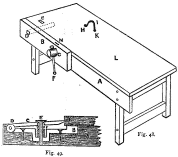 board
B, which screws in and out by means of the screw C, which works in a wooden nut
fastened behind A, the further end being supported by the rod D, which projects
from the sliding board through A, in which it slides loose. The Screw C is
turned by the handle F, and the vice is opened or shut according to the
direction. The wooden spike at M falls into a small groove in the screw C, and
keeps the shifting board close up to the head of the screw when turned outwards.
The slide D is often replaced by a screw like C, and this, perhaps, is a better
arrangement. The stop E may be simply a square log, fitting tightly into a hole
in the bench top, and having a few sharp teeth at its edge, which bury
themselves into the wood required to be held and keep it in its place. The stop
is knocked up or down with a mallet, but soon works loose. A better form of stop
is that of which we give an illustration in Fig. 49. It consists of a plate, B,
to which is hinged at D the knife C, which is screwed down by the screw E, and
the edge K being cut into teeth, which stick into the wood, as in diagram. The
spring F, coiled in the box underneath, keeps the plate well up to the head of
the screw, but the top plate C can be screwed down quite level with the bench
top, which is a great advantage, as it then cannot be at all in the way. The
lower plate is let into a hole morticed in the wood of the bench, to which the
whole is fastened by the screws H I. The screw principle introduced here
gives great advantages over the hammering up or down of a plain block, from the
fineness of the adjustment obtainable, enabling the workman to plane the
thinnest boards without danger of taking a piece out of his plane-iron. The
price of this dog is about three shillings. There are several other patent
stops, but this seems the simplest. The bench hook H is useful for holding down
blocks to be morticed and other purposes. It is nothing but a piece of strong
iron bent something like a crook, and fitting loosely into the hole in the bench
at K. The block to be held is placed under the part H, and a sharp blow with a
mallet on the top of the crook fixes it. A blow on the back at I releases the
work.
board
B, which screws in and out by means of the screw C, which works in a wooden nut
fastened behind A, the further end being supported by the rod D, which projects
from the sliding board through A, in which it slides loose. The Screw C is
turned by the handle F, and the vice is opened or shut according to the
direction. The wooden spike at M falls into a small groove in the screw C, and
keeps the shifting board close up to the head of the screw when turned outwards.
The slide D is often replaced by a screw like C, and this, perhaps, is a better
arrangement. The stop E may be simply a square log, fitting tightly into a hole
in the bench top, and having a few sharp teeth at its edge, which bury
themselves into the wood required to be held and keep it in its place. The stop
is knocked up or down with a mallet, but soon works loose. A better form of stop
is that of which we give an illustration in Fig. 49. It consists of a plate, B,
to which is hinged at D the knife C, which is screwed down by the screw E, and
the edge K being cut into teeth, which stick into the wood, as in diagram. The
spring F, coiled in the box underneath, keeps the plate well up to the head of
the screw, but the top plate C can be screwed down quite level with the bench
top, which is a great advantage, as it then cannot be at all in the way. The
lower plate is let into a hole morticed in the wood of the bench, to which the
whole is fastened by the screws H I. The screw principle introduced here
gives great advantages over the hammering up or down of a plain block, from the
fineness of the adjustment obtainable, enabling the workman to plane the
thinnest boards without danger of taking a piece out of his plane-iron. The
price of this dog is about three shillings. There are several other patent
stops, but this seems the simplest. The bench hook H is useful for holding down
blocks to be morticed and other purposes. It is nothing but a piece of strong
iron bent something like a crook, and fitting loosely into the hole in the bench
at K. The block to be held is placed under the part H, and a sharp blow with a
mallet on the top of the crook fixes it. A blow on the back at I releases the
work.
[-128-]
THE HOUSEHOLD MECHANIC.-VIII
DOORS.
AN ordinary frame door will supply good practice chiefly in the mortice and
tenon joint, and will be a capital example of the principle of joinery-to build
up of separate pieces a fabric of lighter weight and greater strength than if
solid, and also so pieced together as not to be affected to any extent by
changes in the atmosphere.
It will be seen by reference to the article on Wood that the
tendency of boards to shrink or expand is in the direction of the width and not
of length. If a door is made up of boards simply fastened edge to edge, the
expansion of its width will be very considerable, while its length remains the
same. Therefore, if a "ledge door, as it is termed, fits in damp weather,
in dry it will be smaller and too loose. Ledge doors are made by placing boards
together edge to edge, and strengthened with two or three ledges or battens
nailed across the back, but these are only suited for common work.
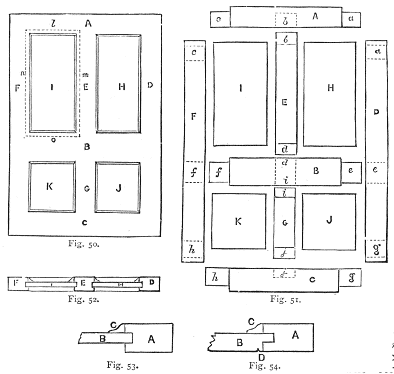
Fig. 50 shows that the essential principle in the proper
construction of an ordinary frame and panel door is such a combination of length
and width of grain as reduces the possibility of expansion or contraction to a
minimum. The frame consists of the styles or vertical pieces, DEGF, and the
rails or horizontal bars, A B C. The method by which they are firmly united is
seen in Fig. 51 in which each piece is detached and lettered to show where each
joint is made. The styles, D E G F should be about four inches wide, and from
one and a quarter to two inches in thickness, and the rails of the same
thickness, but only the top rail, A, of the same width; the middle and lower
rails, B C, being about double the width of the styles. The middle styles are
tenoned into the middle rail at d and 1, and into the upper and lower at b
and j. The side styles are then morticed at a e g, c f h, to
fit the tenons corresponding on the rails.
H I J K show the panels, which are of much thinner material,
usually about one-third, and which are, as will be seen, larger than the spaces
in the frame which they occupy visibly. On the inner edges of both styles and
frames, a groove is planed out with a plough of the exact width of the thickness
of the panel, and about half an inch in depth. Into these grooves the panels are
loosely fitted, and the outer styles are driven into their respective mortices,
and wedged up as usual. The panels not quite filling up the groove in their
width, have a slight amount of room for expansion. The dotted line l m n o , Fig.
50, shows the room occupied by the panel. The corners formed between the frame
edge and panel are to be filled in with a bead or moulding, which must be cut to
the exact size, and accurately bevelled at each corner. These mouldings are
fitted by means of brads to one or both sides of the door, according to
circumstances, and are merely ornamental. Fig. 52 is a section across the door
in the middle of the panels, and shows the whole arrangement very clearly, D E F
being the styles, and H I the panels. Fig. 53 shows enlarged section of the
joint of the style A and panel B, and shows the moulding C fitted in the corner.
This panel is used for light doors for inside work, a stronger variety being
needed for the outside doors, which require much greater strength. This panel is
of double thickness, and is tongued to fit the groove in the styles and rails,
as in Fig. 54, and is indented only on the front or outside, the back being
flush with the surface of the frame ; the edges of the panel at the back are
usually beaded, as at D. The corners in the front are filled in with the
moulding, C. We have taken as an example a four-panelled door, for the sake of
simplicity, the construction being similar for six, the usual number. In a
six-panel door the top rail is known by that name, the next is the frieze rail,
the next the middle or lock rail, and the last the bottom rail. The panels are
also distinguished by the same names. The lock is let into the door at either e
or f and does not show, except from the edge. The hinges are fixed
near the top and bottom of the styles, on the side opposite to the lock, but, of
course, must not be placed at a part where the style is weakened by the mortice.
[-140-]
THE HOUSEHOLD MECHANIC.- IX.
WINDOWS.
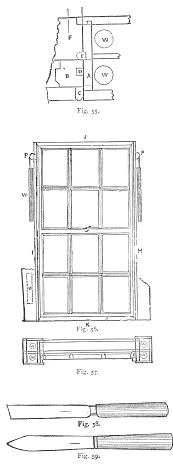 THE
glazed contrivances in houses which we call windows - having for their duty not
only the admission of light to the inmates, but also protection against weather,
and the optional admission of air - are too well known to need any description
except just to distinguish between the varieties. For instance, the one we
illustrate in Fig. 56 is known as a suspended sash window. The sashes which open
outwards or inwards, after the same manner as doors, are called casements, and
are variously contrived to suit various requirements. It is not, therefore, our
intention to even enumerate these differences, but to [-141-]
simply look into the hidden part of the most common of all, in order that
such a calamity as a broken sash-line need not in future make a visit of the
carpenter necessary.
THE
glazed contrivances in houses which we call windows - having for their duty not
only the admission of light to the inmates, but also protection against weather,
and the optional admission of air - are too well known to need any description
except just to distinguish between the varieties. For instance, the one we
illustrate in Fig. 56 is known as a suspended sash window. The sashes which open
outwards or inwards, after the same manner as doors, are called casements, and
are variously contrived to suit various requirements. It is not, therefore, our
intention to even enumerate these differences, but to [-141-]
simply look into the hidden part of the most common of all, in order that
such a calamity as a broken sash-line need not in future make a visit of the
carpenter necessary.
The frame into which the glazed sashes fit is composed of the
perpendiculars, or styles, H I, the lintel J, and sill K, and this frame may
almost be considered a part of the framework of the house, as it is fixed firmly
in the brickwork, and in many cases has to carry weight. Fig. 55 is an enlarged
section of one side of the frame and sash, and clearly shows the exact
arrangement of the .guides which keep the sashes in place. B is the sash which
carries the glass. In the plan a groove, D, is shown in the edge of this sash,
the object of which is the receipt of the line which runs up to the top of the
style and then disappears over a pulley, P, into the weight-box, W. Now let us
suppose the cord supporting B, Fig. 55, is broken, and we will proceed to mend
it. On the inside of the frame is a beading, C, which runs all the way round the
window. This must be removed on the side where the break is by levering it from
its fastening with a screw-driver or chisel, great care being observed to
prevent damage to the paint. This done, the sash must be first pushed upwards
far enough to bring it over the bottom bead, and it will then come bodily out of
its place. The broken rope must then be removed from the groove D. The ?sash
out of the way, the style A will be exposed, and in the lower part a portion of
this board, as shown by the dotted lines, is found to be movable. Take out the
piece, A, and the weight, W, can be got at, and the broken line taken from it.
Get a small piece of lead, or anything heavy but small, and tie to the end of a
thin piece of twine, and insert this "mouse, as it is called, over the
pulley at the top, and let it drop down to the hole, A, and fasten to it the new
sash line end, which can then be pulled back over the pulley. The weight, W, is
threaded by this rope from the top, and a knot tied and pulled well into the
place sunk in the weight to receive it, so that there shall be no danger of its
getting wedged up in the box. Replace the loose piece, A, and fasten it, and cut
off the sash-line to the proper length. The proper length will be arrived at by
pulling the weight up to the pulley, P, and bringing down the end of the cord to
the top of the sash, allowing three or four inches for the nailing into the
groove, D. Of course the weight must not come quite up to the pulley, but just
within an inch or so. Secure the cord into the groove firmly, with two or three
clouts or round-headed nails. Replace the sash, and nail on the beading, C, and
the job is done. Supposing the top sash, which slides down F, to be the one
requiring repair, it will be necessary to remove the front, or lower sash, and
then, by taking out the beading, E, the back sash can be got out also. Otherwise
the process is the same as above described. The weights, W W, Fig. 55, should
exactly counterpoise the sashes; and two are required for each. They are usually
made of cast iron, as cheaper; but for situations where space is short, lead
weights are used, the specific gravity of lead being so much greater than iron.
Fig. 57 shows the plan of a complete window. In old-
fashioned window-frames the entrance to the weight-box is often from the front,
as shown by the dotted lines, N, (Fig. 56), but this plan is most objectionable,
because the paint-work is so much more pulled about whenever a breakage occurs
in the line.
Ordinary rope is not suitable for windows, because, being
twisted, it is liable to stretch, and to spin the weight round every time the
window is opened or shut, in a noisy way; and it is not strong or durable
enough. The cord to be used is known as sash line, and should be plaited of good
hemp instead of being twisted. Of course the cost of it is greater, but not more
than its advantages would warrant.
Shutters are often suspended exactly like sashes ; but the
modern windows, which go down to the ground, do not admit of these, there being
no space into which they can slide away. Various arrangements of folding and
hinged shutters supply their place, but these will not need detailed
description, as a careful examination of a few varieties existing in nearly
every house will, if conducted with a little common sense, familiarise the
inquirer much more than a most elaborate description, which could not possibly
meet every case.
The fastenings of windows are important if the outsides are
accessible to the incursions of burglars, the ordinary form, as shown in Fig.
56, being liable to the objection that a thin knife inserted tip the crack
between the sashes will force it open. The best remedy is a screw sent through
the two frames ; but there are many other patent arrangements by which security
is to be attained.
This being the first time we have done such a thing as to
mend a sash line, it is lucky if we have not broken one of the panes of glass.
For practice we will suppose we have done so, and now we must go and mend it.
The channel which receives the glass is invariably on the
outside of the sash, i.e., the side exposed to wind and weather. The
reason for this is that the pressure of the wind may tend to keep the glass the
more firmly in its place, there never being pressure from the inside.
With a strong-backed knife, something like Fig. 58, if we
have not a regular glazier's hacking-knife, hack out the old, dry putty which
holds the remains of the glass, and clean out right down to the wood, using the
point of the knife, and knocking it on its thick back with a hammer. If we have
not a diamond, we shall have to take an exact measure of the size, and get the
pane cut at a glass shop. The price varies with the size, quality, and thickness
of the glass, and would be from 2d. to 6d. per foot. Sixteen ounces to the foot
would be the right thickness. Twenty ounces is the thickness for large panes, or
for skylights. Of course the above prices are for crown or sheet glass; plate
being very much thicker, and ground and polished perfectly true, is very much
more expensive. The [-142-] next requirement is the
putty, which we make as follows:- take a lump of whitening, and cut or
bruise it up quite fine, and then gradually add, a little at a time, linseed
oil, which must be thoroughly incorporated and mixed by beating it until a stiff
dough-like material is obtained. Remember, the more putty is mauled about the
better it becomes ; and before using it should be kneaded with the hand, the
warmth of which will render it still more pliable. If sticky, add more
whitening; if too stiff, more oil.
Take a lump of putty in the left hand, and with the
putty-knife, Fig. 59 - an ordinary oyster-knife answers the purpose - press in a
thin layer of putty into the corner of the channel which is to receive the
glass, and all round, drop in the pane and press evenly all round, and gradually
force it well down until it will not go farther. Now press more putty into the
angle round the edge of the glass, and with the knife press and smooth it into a
neat bevel, which must thoroughly adhere to both wood and glass. If either of
these are wet it will not do so, on account of the fact that water repels oil. A
previous coat of paint is necessary if the sash is of new wood, to make the
putty adhere properly. Trim off the superfluous putty from both sides of the
glass, and when thoroughly hard - which it will be in a few days - paint it of a
dark colour outside, and grain to match inside. Some use white lead in their
putty, but this is liable to the objection that it is very difficult to remove,
in the event of future breakage, as it adheres to the wood, and becomes so very
hard that in hacking out, the frame is often injured. For use in mahogany frames
it is common to colour putty by adding red lead to tint as required. This does
not set so hard as white lead. Putty is only about a penny a pound; but we have
given the directions for making it for cases where it is not readily procurable.
[-175-]
BLINDS.
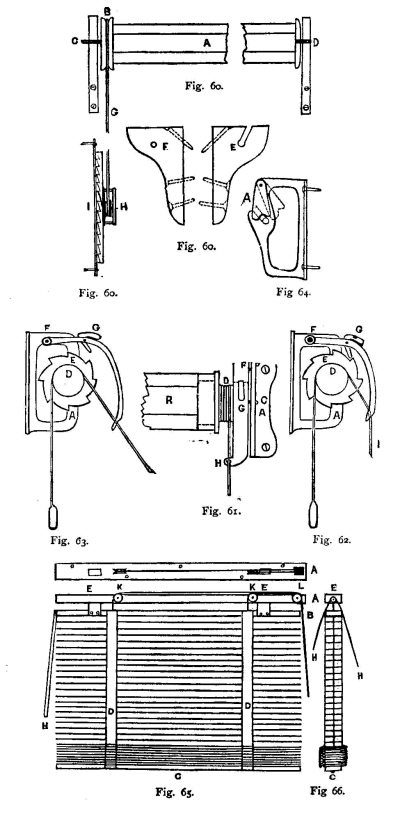 FIG.
60 shows the commonest form of blind - the common roller blind. It is almost too
well known to need description. The roller, A, is made from a square
strip of one and a quarter or one and a half inch wood, with the corners planed
off until the piece is octagonal. On one end, usually the right hand, is
fastened a little grooved wheel, B, and through the centre of both, the
pivot, C, a piece of stout iron or steel wire, is driven. At the other
end of the roller a similar pivot is driven through a sort of flange, D, which
is just to keep the blind from running over the end. The pivots at each end are
supported in two brackets, of hard wood or metal, something like E F, one
having only a hole, as F, through it, the other a hole and an oblique cut
from the top, into which to drop the pulley-end pivot, after the other pivot has
been thrust into the hole F. Over the pulley B an endless cord, G,
runs, which cord also runs round the pulley H, which may be fastened
in any convenient position on the side of the window-frame. This pulley is in a
small brass frame which works in the slide, I, the back of which is
formed into steps like a ratchet. Into this a spring on the frame of H catches,
and in such a manner as to allow the frame to slide downwards only. The object
of this movement is the tightening of the cord, G, in order to keep the
blind wherever it is wanted. The material of which the blind is composed is
tacked to the wooden roller, and in a wide hem at the bottom a lath is slipped,
and a tassel and cord are fastened to the middle with a screw-ring, for the
convenience of pulling the blind down. This form of blind, however, has many
disadvantages ; for instance, as its firmness is dependent on friction entirely,
it is subjected to an unusual amount of strain at its working parts, which
working parts are often of too soft a material and of too hasty a manufacture.
The process of pulling up is also tedious and inconvenient, the edges of the
slide, s, often scratching the fingers. It is not wonderful, therefore, that
many devices have been thought of and patented to remedy these evils. We
illustrate one of these plans, not as being superior to many we have seen, but
simply to show the principle on which they are most of them based, it being
quite impossible to mention all. Fig. 61 shows a front view of this arrangement.
The frame, A, is screwed on to the window-frame, in the same position as
the wood brackets before mentioned, and has in its edge a hole at c, to carry
the blind pivot. So far, there is no material difference. The roller is also
just the same, but at each end it is let into a hollow iron end, which
terminates in a pivot fitting into the hole C. On the end of this box is
a sort of drum, D, and further out still a rachet-wheel, E (Figs.
62 and 63). Round the edge of this rachet-wheel is found a sort of band of
brass, which is hinged to the bracket, A, at F, and in this band [-176-]
is a small drop tooth, G, which takes into the rachet. The lower
end of the band terminates in a projection, H, in which is a small hole.
The bracket supporting the other end of the roller (Fig. 64) is quite simple,
the catch A falling over the oblique slit by its own weight, thereby
preventing the pivot from jumping out of its place.
FIG.
60 shows the commonest form of blind - the common roller blind. It is almost too
well known to need description. The roller, A, is made from a square
strip of one and a quarter or one and a half inch wood, with the corners planed
off until the piece is octagonal. On one end, usually the right hand, is
fastened a little grooved wheel, B, and through the centre of both, the
pivot, C, a piece of stout iron or steel wire, is driven. At the other
end of the roller a similar pivot is driven through a sort of flange, D, which
is just to keep the blind from running over the end. The pivots at each end are
supported in two brackets, of hard wood or metal, something like E F, one
having only a hole, as F, through it, the other a hole and an oblique cut
from the top, into which to drop the pulley-end pivot, after the other pivot has
been thrust into the hole F. Over the pulley B an endless cord, G,
runs, which cord also runs round the pulley H, which may be fastened
in any convenient position on the side of the window-frame. This pulley is in a
small brass frame which works in the slide, I, the back of which is
formed into steps like a ratchet. Into this a spring on the frame of H catches,
and in such a manner as to allow the frame to slide downwards only. The object
of this movement is the tightening of the cord, G, in order to keep the
blind wherever it is wanted. The material of which the blind is composed is
tacked to the wooden roller, and in a wide hem at the bottom a lath is slipped,
and a tassel and cord are fastened to the middle with a screw-ring, for the
convenience of pulling the blind down. This form of blind, however, has many
disadvantages ; for instance, as its firmness is dependent on friction entirely,
it is subjected to an unusual amount of strain at its working parts, which
working parts are often of too soft a material and of too hasty a manufacture.
The process of pulling up is also tedious and inconvenient, the edges of the
slide, s, often scratching the fingers. It is not wonderful, therefore, that
many devices have been thought of and patented to remedy these evils. We
illustrate one of these plans, not as being superior to many we have seen, but
simply to show the principle on which they are most of them based, it being
quite impossible to mention all. Fig. 61 shows a front view of this arrangement.
The frame, A, is screwed on to the window-frame, in the same position as
the wood brackets before mentioned, and has in its edge a hole at c, to carry
the blind pivot. So far, there is no material difference. The roller is also
just the same, but at each end it is let into a hollow iron end, which
terminates in a pivot fitting into the hole C. On the end of this box is
a sort of drum, D, and further out still a rachet-wheel, E (Figs.
62 and 63). Round the edge of this rachet-wheel is found a sort of band of
brass, which is hinged to the bracket, A, at F, and in this band [-176-]
is a small drop tooth, G, which takes into the rachet. The lower
end of the band terminates in a projection, H, in which is a small hole.
The bracket supporting the other end of the roller (Fig. 64) is quite simple,
the catch A falling over the oblique slit by its own weight, thereby
preventing the pivot from jumping out of its place.
Now suppose we have the blind coiled round the roller, as in
the last case, and slipped into its place in the brackets, the band G falls
over the rachet, which cannot move because of the tooth in G. Fasten a
thin cord to the hole in the side of the drum, and pass it through the eye, H,
and let a sufficient length hang down. The stick in the bottom of the blind
requires to be heavier than usual, because its weight has to bring the blind
down.
To let the blind down, take hold of the string, I, and
raise it backward, as shown in Fig. 63. This will bring up the band G, and
with it release the tooth from the ratchet; and the cord, being allowed to slip
through the fingers will be coiled on the drum by the descent of the blind. To
draw it up it is only necessary to pull the string, I, thereby drawing
from the drum the cord coiled on it, the back of the teeth in the ratchet
raising up the little catch in G; which falls into its place by its own
weight. When all the cord is drawn off the drum, the blind should exactly reach
the top, so that the possibility of over-winding the blind is prevented. No
tassel is necessary to this arrangement.
The spring blind consists of a hollow cylinder of metal
(tin-plate), in which a spiral spring is coiled. The act of pulling down the
blind by the tassel winds up the spring; but a spring lever catch falls into a
ratchet at one end, and prevents it from flying up again. The lever is pulled up
by a string fastened to it, and the blind goes up. It is necessary to steady it
up with the tassel, to prevent too sudden jerks.
We now come to the most elaborate, though decidedly the most
complete of all - the Venetian blind. This consists of a series of thin flat
laths, the full length of the width of the window sashes, and about three inches
wide, suspended by means of tapes at about two inches apart. The laths are
capable of being turned obliquely, either outwards or inwards, or of being
altogether raised out of the way, The advantage of thus being able to modify the
light afforded, while, at the same time, free ventilation between the laths is
in no degree impeded, is such as to need no comment or recommendation.
The method by which these varied required adjustments are
attained will be seen by reference to Fig. 65, which shows a two-tape light
Venetian blind. A series of thin laths are strung by means of tapes, D, at
intervals of about two inches as before stated. The bottom lath, C, being
much thicker and stronger than the others, and the top lath, B, the same.
The wide tapes run from the the top lath, B, to the bottom, C, on
both sides, and hold the thin laths in their places by means of thin tapes sewn
to the wide ones alternately on the right and left edges. From one edge of the
lath B, on the outside of the tapes D D, are two wide tapes
running up to the top board, A, and round two wide pulleys, E E, in
it to the other edge, so making a triangular sling, which suspends the top lath
from which the whole set hangs. The board A is screwed to the lintel or
top of the window. frame. By referring to the end view, Fig. 66, the whole plan
by which the laths are turned obliquely to diminish or increase the admission of
light, will be evident, by pulling the cord H on either side. So far for
the adjustment ; now we have to show the drawing up. The limit of length to
which the blind descends is, of course, the length of the tapes, D D, but
by raising the bottom lath, C, by means of cords passing through holes in
each lath, or behind the tapes, D, each successive lath takes up the one
above it, until the whole are accumulated in a bundle at the top of the window,
all being supported on the thick bottom one, C. The cords which
accomplish this end pass from the board, C, to which they are knotted, up
through a hole in each lath to the fixed board, A, over small pulleys, K
K, in this board, and thence to each end of this board, and down over a pair
of pulleys, L, to the hand at I. The two, or, in other cases,
three or more, cords are here knotted together to prevent the laths going up one
side at a time, instead of quite horizontally, as they should do. The blind is
fastened up by winding the cords round two hooks in the window-frame.
Lately iron Venetian blinds have been introduced and
patented. One of their merits is stated to be greater lightness, being made of
metal not thicker than ordinary note-paper. The laths, too, never break or
splinter. Being japanned in place of being painted, they are brighter, more
easily cleaned, and the expense of repainting is avoided. They go into less than
half the space when drawn up than wooden lath blinds, thus allowing more light
to penetrate into the room from the top of the window, and do not look as clumsy
as the wooden blinds. They will not take fire, and impart a cheerful appearance
to the room.
[-180-]
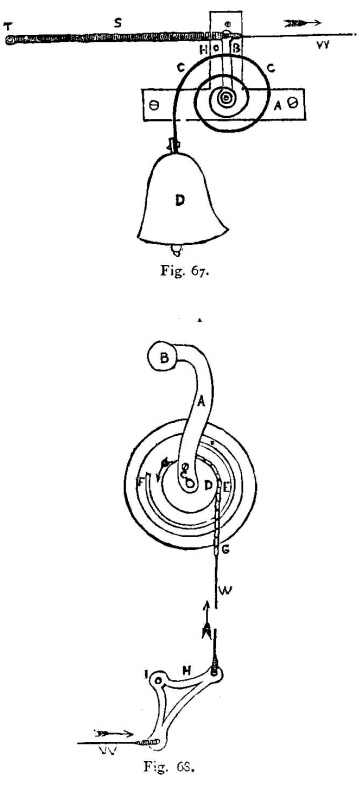 THE
HOUSEHOLD MECHANIC.- XI.
THE
HOUSEHOLD MECHANIC.- XI.BELL-HANGING.
THE simplest way to look into the mystery of bells and bell-hanging,
as known in ordinary houses, will be perhaps to trace a wire from the pull at
one end to the bell at the other. Fig. 68 is a diagram of a bell-pull such as is
usually found at the side of the fireplace, and in this, as in nearly all, the
principle of action is leverage. The lever A is pivoted on the screw C,
and has on its upper end a knob, B, to take hold of. The nose of the
screw is prolonged and screwed to take on the ornamental plate which hides the
working part, both plate and knob being of various patterns and qualities,
according to the situation. Fastened to A, and also hanging on C, is
the drum D, round a part of which runs a flat chain, of which there is
just enough to encircle about one-half of the drum, to which it is fastened on
the top. The lever is only free to move between the gap in the ring, or about a
quarter of a circle. This movement, however, is quite sufficient. A small hole
at G in the ring, allows the chain to move out or in with each movement
of the handle. The wire, W, is fastened to the lowest link, and proceeds
to the crank, H, the form of which is that of a simple triangle hinging
on a pivot at the apex, I, the opposite corners having holes to receive
the wires. In the course of the wire, if the bell is a long way off, and not in
a direct line, perhaps several of these cranks will be found, and they also vary
in form according to the direction of the motion required. Should the wire have
to traverse long distances horizontally, it is passed through small staples of
galvanised wire to prevent its weight from dragging it down. The wire used is
copper, and the price per ounce about 2d.; but in large quantities it is much
cheaper. The hanging of the bell itself is shown at Fig. 67. A is a flat
brass frame, which fastens to the wall, and having a lever arm, B, pivoted
on it, to the [-181-] end of which lever, opposite
the pivot, the wire, W, and the spiral spring, S, are fastened. On
a little boss, or drum, round the pivot, but hanging with B, is a long,
flat spring, C, to the end of which is fastened the bell, D. The
spiral spring, S, is nailed to the wall at T, and is fastened at
sufficient tension to pull back the lever, B, to its stop, H,
after it has been moved by the wire, W. The spring, S, has,
however, to hold the whole length of the wire through all its various bends and
turnings, strained tight right up to the handle, A, Fig. 68, and upon it
the balance necessary depends. The flat spring, C, to which the bell, D,
appends, has for its purpose only the prolonging of the swing motion of the
bell, for it is well known that a single movement of A will produce a
ring continued in proportion to the delicacy of the balance. Should, however,
any bell fail to act, the cause will most probably be that a length of wire
between two of the cranks has got stretched or broken, in which case the handle,
A, Fig. 68, will hang down loose.
Where a number of bells from different parts of an
establishment are all brought together, they should be arranged on the
bell-board in a regular and systematic order - that is the smallest, or highest
toned, should be at one end, and gradually range up to the largest, or deepest
toned, each succeeding bell a trifle higher than the former. The reason for this
arrangement is obvious - the smaller bells allowing the wires to the others to
pass over them without touching them. With large numbers of bells together, it
would be often difficult to tell which had been rung, from the slight variation
in tone, so the following arrangement is adopted:- Each wire passes in as usual
to its respective bell, affixed to which is a small catch, having at the, bottom
a pendulum, which continues to swing a considerable time after the bell has
ceased to ring ; or, better still, after setting in motion their respective
pendulums, all the wires proceed to a single gong, which only utters one note,
and leaves the pendulum to show which room requires attention. The great
advantage of the latter plan is too evident to require even mentioning.
The numerous forms of bell-pull contrived to suit the varied
requirements of households, are all more or less on the same principle as we
have illustrated. The wires themselves are often passed through tubes of thin
zinc let into the plaster of the wall, several wires sometimes passing through
one tube; but the cranks and connections should, if possible, be where
they are accessible when repairs are necessary. In hotels and large buildings,
electricity is rapidly superseding the old system of bell-hanging, and it is now
being gradually introduced into ordinary houses. In another paper, we hope to
treat fully of electric bells. Speaking-tubes,
again, are very useful, and easily contrived ordinary iron gas-pipe answering
the purpose nearly as well as gutta-percha, and at a much less price, and the
flexible ends and whistles can be purchased sufficiently handsome for the most
elegant apartment, and sufficiently cheap to be within the reach of the most
ordinary purse.
When several pipes terminate in the same place, the whistles
are fitted with indicators - little ivory rods which are blown out when the
whistle is used, thereby showing where the attention is required.
[-208-]
CURTAINS.
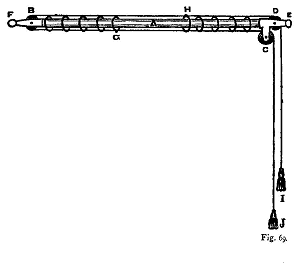 AKIN,
and properly belonging to, the chapter on blinds, would be the very little
machinery which can appear in connection with curtains. The ordinary window
curtain is suspended by hooks to rings, which slide backwards and forwards on a
pole or rod fixed at the top of the window. This pole is of either wood or
metal, generally brass; and if of the former material, its diameter should be
slightly smaller in proportion to the internal diameter of the rings, than if of
metal, because the friction is greater, and a more oblique position is necessary
to get the rings to slide easily. In this arrangement, or rather want of
arrangement, the curtain has to be dragged across the window from the ground,
and the rings on the pole follow in a jerky and unsatisfactory manner, often
failing to meet exactly at the top; indeed, the action beginning at the wrong
end must necessarily be inconvenient. We will only, however, just explain the
proper stringing of what are known as French rods, and leave the mere
description to speak for itself. These rods are much thinner than an ordinary
curtain pole, about three-quarters or one inch being the outside size, and they
are concealed from view by a cornice and fringe which hangs down over the
curtain. They are usually of metal, but may be of wood with brass ends for short
lengths and light curtains. Fig. 69 shows the arrangement for a pair of curtains
to one window. A is a rod terminating at one end with a single sheave or
pulley B, and the other by the pulleys C and D, the ends of
the pulley-boxes being prolonged into eyes, E and F, by which the
rod is supported to the cornice-board. The rings must be of brass, and just
large enough to slip over B, and are strung on and fastened to the
curtains in the ordinary way. We show five rings to each curtain, and in the
position in the figure, each curtain would be about three-quarters drawn. A
length of blind-cord is passed over D and over B, returning
through all the rings to C and down the tassel I. The first or
inner ring H, if the right curtain, is fastened to the upper cord at H,
and the first of the left curtain to the lower cord at G. Now it is
obvious that as G and H are the opposite sides of a practically
endless cord, any motion of either will pull the other the reverse way, so that
by pulling the tassel I, we shall open both curtains simultaneously; or,
vice versa, should J be pulled. In the cut, we leave out the curtain altogether,
to prevent confusion. In some cases it is preferred to use two rods side by
side, in order that the curtains may overlap slightly, and so shut closer ; but
the principle of stringing is precisely the same as in the case we describe. If
preferred, the line may be carried round a pulley, instead of terminating in the
tassels I J ; but this difference is quite immaterial. It must be borne
in mind in all cases, that the simpler our arrangement of cords can possibly be
made, the less the liability to get out of order.
AKIN,
and properly belonging to, the chapter on blinds, would be the very little
machinery which can appear in connection with curtains. The ordinary window
curtain is suspended by hooks to rings, which slide backwards and forwards on a
pole or rod fixed at the top of the window. This pole is of either wood or
metal, generally brass; and if of the former material, its diameter should be
slightly smaller in proportion to the internal diameter of the rings, than if of
metal, because the friction is greater, and a more oblique position is necessary
to get the rings to slide easily. In this arrangement, or rather want of
arrangement, the curtain has to be dragged across the window from the ground,
and the rings on the pole follow in a jerky and unsatisfactory manner, often
failing to meet exactly at the top; indeed, the action beginning at the wrong
end must necessarily be inconvenient. We will only, however, just explain the
proper stringing of what are known as French rods, and leave the mere
description to speak for itself. These rods are much thinner than an ordinary
curtain pole, about three-quarters or one inch being the outside size, and they
are concealed from view by a cornice and fringe which hangs down over the
curtain. They are usually of metal, but may be of wood with brass ends for short
lengths and light curtains. Fig. 69 shows the arrangement for a pair of curtains
to one window. A is a rod terminating at one end with a single sheave or
pulley B, and the other by the pulleys C and D, the ends of
the pulley-boxes being prolonged into eyes, E and F, by which the
rod is supported to the cornice-board. The rings must be of brass, and just
large enough to slip over B, and are strung on and fastened to the
curtains in the ordinary way. We show five rings to each curtain, and in the
position in the figure, each curtain would be about three-quarters drawn. A
length of blind-cord is passed over D and over B, returning
through all the rings to C and down the tassel I. The first or
inner ring H, if the right curtain, is fastened to the upper cord at H,
and the first of the left curtain to the lower cord at G. Now it is
obvious that as G and H are the opposite sides of a practically
endless cord, any motion of either will pull the other the reverse way, so that
by pulling the tassel I, we shall open both curtains simultaneously; or,
vice versa, should J be pulled. In the cut, we leave out the curtain altogether,
to prevent confusion. In some cases it is preferred to use two rods side by
side, in order that the curtains may overlap slightly, and so shut closer ; but
the principle of stringing is precisely the same as in the case we describe. If
preferred, the line may be carried round a pulley, instead of terminating in the
tassels I J ; but this difference is quite immaterial. It must be borne
in mind in all cases, that the simpler our arrangement of cords can possibly be
made, the less the liability to get out of order.
[-213-]
LOCKS AND DOOR FITTINGS.
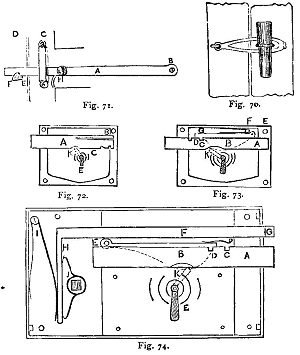 BEFORE
going into the description of the more complete modern locks it will, perhaps,
be advisable to touch upon the simpler methods of fastening and securing doors.
Perhaps the most primitive, but at the same time most useful for outdoor work,
is the staple and hasp fastening, which, being of very rough and ready
application, and not requiring much fit, is a sort of thing anybody can put up.
Suppose a fastening of this kind is required on a garden gate, it is only
necessary to screw in the hasp to the gate, and then, holding it up over its
place on the gate-post, drive a large staple into the post; a peg, secured by a
string or a chain, is slipped into the staple over the hasp, and so secures the
gate. Fig. 70 shows the arrangement complete; it is too simple to require
detailed description.
BEFORE
going into the description of the more complete modern locks it will, perhaps,
be advisable to touch upon the simpler methods of fastening and securing doors.
Perhaps the most primitive, but at the same time most useful for outdoor work,
is the staple and hasp fastening, which, being of very rough and ready
application, and not requiring much fit, is a sort of thing anybody can put up.
Suppose a fastening of this kind is required on a garden gate, it is only
necessary to screw in the hasp to the gate, and then, holding it up over its
place on the gate-post, drive a large staple into the post; a peg, secured by a
string or a chain, is slipped into the staple over the hasp, and so secures the
gate. Fig. 70 shows the arrangement complete; it is too simple to require
detailed description.
We come next to the common, or latch fastening, shown at Fig.
71. A bar A, about eight inches or less in length, pivots on the screw B,
being kept in its place and limited to a small upward or downward movement by
the guard C, constitute the fittings on the inside of the door. Into the
post D the latch E is driven; this latch consists of a small piece
of iron pointed at the end which drives into the wood, the other end being
expanded as is shown in the drawing, the upper edge is formed into a bevel
upwards for a short distance, when the piece is suddenly contracted, thus
forming a notch. The action is evident. The door being shut, brings the end of
the bar A in contact with the bevel F of E, and thereby
raises it until it falls into the notch, when the door is quite shut. To open
the door from the inside, it is necessary to raise the bar A by the knob
or the lever at H ; this lever is carried through the door and terminates
on the outside in a broad, flat sort of plate, on which the pressure of the
thumb is exerted to raise the bar inside. In cases where this projection of the
thumb-plate would be objectionable, a sunk iron plate is substituted, in the
centre of which is a knob, which being pressed by the finger or thumb, attains
the same end.
Let us now look into a common cupboard lock, one of the
simplest forms of lock used in this country. It consists of only a bar A (Fig.
72) sliding across the framework of the lock, and part of one side being split
up into a rude substitute for a spring, B, which has just flexibility
enough to allow the notches in the bar at C to rise out of the frame on
pressure upwards being used with the key. The key to this lock is a barrel key,
that is. it is tubular, and pivots on a wire in the lock; and on being thrust on
this wire, and turned round into the notch in the bar A, the pressure of
the key compresses the spring B, and allows the bar to slip over into the
other notch. The key will then complete the circle, and come out of the hole.
[-214-] To prevent the opening
of the lock by any key but its own, a number of iron or brass rings, or
"wards," as shown at E, arc fitted inside the lock, to prevent
the key from being turned round, unless the slits in the key exactly correspond
with the wards.
The action of the tumbler lock is, however, quite different.
The bolt A (Fig. 73) is made to slide easily in the slots in the frame of
the lock, but this bolt is not solid, except at the end which shoots out, its
thickness being reduced in the middle to make room for the tumbler B to
go behind it. This tumbler is hinged at E, and is pressed downwards by
the spring F. On the end of the tumbler furthest from E, is a
little projection, G, which exactly fits a notch in the bar A, as
shown. The tumbler goes behind the bolt, as shown by the dotted lines. Now take
the key, insert it into its place, and turn it round one edge coming in
contact with the lower edge of the tumbler, will raise it from the notch C,
and free the bolt ; a further movement driving the bolt out, or shooting it, as
it is termed ; the, tumbler then drops into the notch D, and holds it
secure. The reverse action of the key produces exactly the reverse result. The
bolt A shoots into channels in the door-frame, the forms of which are
quite immaterial.
We now come to the latch and lock combined (Fig 74), which,
as far as the lock is concerned, is just what we have now described in the
tumbler lock, but looks more complicated on account of its combination. In the
lock part of [he arrangement, the same letters are used as with Fig. 73, and the
same description exactly applies. The latch is a long bar, F, sliding
easily for about half an inch, and projecting that distance from the end,
terminating in the bevel G at that end. The other end is turned at right
angles to the bar, and prolonged into a smaller bar H. A spring, I,
keeps the whole bolt out, and a lever, J, acts on H, on its
being turned either way, and forces the bolt back. Into the square hole in J
a square rod fits, and on to each end of this rod the handles are fastened. One
handle is usually permanently fixed, the other is fastened by a screw in the
handle, which catches into holes in the rod, so arranged on each side as to
allow any adjustment required by the thickness of the door through which the
handle goes. Such locks as are here illustrated will be found on most doors.
They are arranged as "mortice" or as "rim" locks. The former
are made to slide in a hole or mortice in the edge of the door, and are,
therefore, out of sight. Rim locks are screwed on to the inner side of the door,
and, of course, are not so neat as mortice locks. On the outside of the door in
the case of rim locks, and on both sides with the other kind, the handle works
in a plate, known as the "rose," which is bradded on to the door; the
plate ornamenting the key-hole is known as the escutcheon. The handles,
escutcheons, and finger-plates of doors are known as the furniture, and can be
had of various patterns and qualities, according to desire or taste, and are
therefore sold quite independently of the locks.
The complicated and beautiful latch locks, patented by
various makers, are mostly on the tumbler principle, and in some cases the
sliding bolt has six or eight of these tumblers to be raised before it can be
moved from its position; the number and diversity of form in the tumblers
rendering it nearly impossible that any but the right key will shoot the bolt.
In these door latches, the lock tumbler is combined with the lifting latch, the
principle of action being the same.
Locks should occasionally be taken to pieces, cleaned, and
oiled, when the stiff wav in which they work shows they require it. Where much
exposed to damp and change of weather, locks should be made entirely of brass,
as iron locks will rust and become useless ; nor is any amount of oiling
sufficient to prevent it.
In our next paper we propose to give such information on the
subject of gas-fittings as will fall within the scope of the Household Mechanic.
[-250-]
GAS.
A PROPER and correct understanding of the composition of gas, and the best
appliances for the obtaining of artificial light and heat from it, is one of the
most important branches of domestic economy ; and when we consider the frightful
waste resulting from a want of appreciation of its principles, and of the danger
of fire or explosion which may arise to a community from ignorance or
carelessness on the part of any single individual, we feel sure that it is
impossible to make the subject too plain, or to bestow too much attention upon
it. How many lamentable accidents would have been avoided, even by a most
superficial knowledge, it is needless to mention; but we feel that few people
appreciate the necessity of economy of gas as its real importance and magnitude
would warrant. Coal gas is obtained from various kinds of coal by distillation
at a great heat, different varieties of that mineral producing more or less
economical results. We do not, however, intend even to touch on the manufacture
of gas in the present paper, although we may in some future paper give
sufficiently clear instructions to enable those of our correspondents who live
in neighbourhoods where gas is not procurable, to make it for themselves. We
have here to deal with the consumption of the manufactured article in the best
possible way. Nor is it for us hereto deal with the chemical composition of gas,
except just so far as is absolutely necessary in order to understand the
principles of its combustion, though we shall have, in the course of our
article, to consider the use of gas in the house, whether for warming or
lighting, and its bearing on the health of the occupants.
Coal gas, or carburetted hydrogen, is a certain known
combination of the gaseous element hydrogen and par-. titles of carbon in a
volatile form. Other elements mixed with the gas in its first stage of
manufacture are, to a certain extent, although not altogether, cleared away in
the after process of purification. Pure hydrogen, by itself, is incombustible,
and will only burn when in combination with oxygen gas or atmospheric air
containing oxygen. Again, pure hydrogen, when burnt in combination with air,
gives, only a very small amount of light,. yet it evolves great heat; but
,when a proper amount of carboniferous particles are mixed up and burnt with a
sufficient quantity of hydrogen to make them perfectly incandescent?that is,
white hot?the greatest possible light is obtained. We therefore see that we
can burn gas in two totally opposite ways, one object being to produce perfect
combustion, and the utter consumption of the carbon therein contained, thereby
obtaining the greatest possible amount of heat ; the other being the burning of
hydrogen and oxygen in just such proportions as will produce the greatest
incandescence in the particles of carbon, and consequently the greatest light.
Let us illustrate this by a simple experiment. Light an ordinary burner, turn it
up to the best light it will give, and examine it closely. At the lower portion
of the flame an intense blue colour appears for some distance up, where the heat
of the combustion has been sufficient to liberate the innumerable solid
particles of carbon, and to make them white hot. Now turn tip the burner to its
highest extent, and, if the pressure is sufficient, the gas will rush out with
violence, combining with the air imperfectly, the carbon not being exposed to
the heating action sufficiently long to become incandescent. It will thus be
seen that the quantity of gas consumed is no criterion to the amount of light
produced. If this fact is borne in mind, it will explain the reason for the
precise forms of gas-burners we shall have to refer to hereafter.
It will be necessary, for distinction's sake, to divide the
whole subject into two heads--viz., lighting by gas and heating by gas. Let us,
however, first look into the more practical question of getting a supply of gas
to burn, and examine the network of pipes which bring it to us, before we go too
deeply into theory. We will suppose that our reader has taken a house into which
gas is not laid, and we will trace through each detail he will have to look to
in order to get it. First find out the gas company who have mains on the road,
to whom write and state the number of burners required. The company will then
take the expense and responsibility of bringing in a service from their main
into the house. It is necessary for them to communicate with the parish
authorities before disturbing the roadway ; but the householder has no trouble
whatever in the matter. The company will also supply a meter (properly tested
and attested by a Government inspector) at a certain fixed charge, or, if the
consumer desires it, at a regular yearly rental ; or the consumer may supply his
own meter if he likes, but in any case the inspector's seal is necessary before
fixing. The service-pipe once inside the house, and the meter brought, the
responsibility falls on the householder, whose gas-fitter now takes up the
matter. A tap should be fixed on the service-pipe as soon after its entry into
the house, as possible, as, in case of fire or escape of gas, it should be
altogether turned off at the tap. From the tap proceeds a pipe, usually of lead,
to the inlet hole of the meter, and from the outlet another pipe of lead
communicates with the in-door service of pipes. The reason for these pipes being
of lead seems to be for the convenience of bending them into the curves almost
always required ; but where the substitution of iron pipes is possible, such a
course would be desirable. Concerning meters we will say nothing at all now, as
we intend to devote: a chapter entirely to the subject. The service consists of
a series of pipes of various dimensions, and should be contrived after the
manner of the arteries and veins in the human body?viz, that each set of pipes
should be diminished in size as successive branches off on either side reduce
the work it has to do. In an ordinary-sized house of twenty-five or thirty
burners, a one-inch main would be ample, and a twenty-light meter ; but it would
only be necessary to continue such a size and bore a small portion of the whole
length, the pipe gradually tapering down to the smallest size of composition
pipe, which is about one-eighth of an inch internal, and the bore must be
in proportion as the successive points of consumption are supplied.
[-273-]
THE HOUSEHOLD MECHANIC.?XV. GAS
(continued from p. 250).
THE iron service-pipes are made in lengths of from two to ten or twelve feet, and are of wrought-iron welded over on a mandrel; one end bears a socket and the other a screw, the interior of the socket being the converse of the screw. The sizes and pitches of these screws are now universally the same for each given diameter of pipe, so that any screw is sure to fit into any socket. The sockets are either straight, plain, or diminishing, for the purpose of uniting two pipes of different diameters. Whore it is necessary to turn corners, either bends or elbow sockets are used, which may be also plain or diminishing, and when one pipe branches out from another, cross or tee-sockets are required. In connections of iron tubing all that is necessary to be done is to smear the screwed end of the pipe with some thin white-lead, and then screw it forcibly into the socket with the gas-tongs, two pairs of which are used at one time ? one to hold, the other to screw up. These tongs are constructed with long handles, and are so contrived that almost any amount of grip can be obtained with them. Each different size of pipe requires two pairs of tongs, there being only a slight adjustment possible. The junction of iron and composition-pipe is effected by means of unions of brass, which screw into the iron pipes and to which the composition pipes are soldered by means of a blow- pipe. The junc tions between these latter pipes and the bracket or pendant burners are made by means of small brass pipes called nose- pieces, which are bent into various forms, as required.
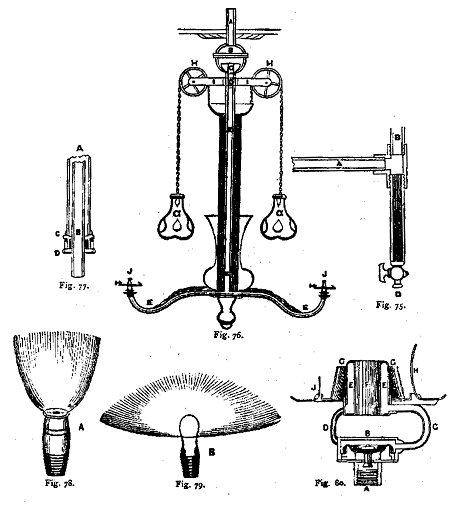
The horizontal pipes should be laid between the floor and the
ceiling, and the boards laid over them should be screwed down again to make the
access to them, when required, as easy as possible. A slight inclination towards
the main-pipes is advisable to prevent the accumulation of water formed, from
the gas by condensation; and this inclination allows any water so formed to run
down to the lowest part of the service, where a syphon should be fixed b receive
it.
The best position for this syphon is at the bottom of the
rising main, or upright pipe, communicating from the lower floors to the ones
above. The rising main is often wed outside the house ? a plan which is
advisable, except when the gas-pipes are fixed as a part of the building of a
house, as such a plan prevents a great deal of mess and expense, with knocking
ceilings about.
Fig. 75 shows the arrangement A is the pipe from the meter, B
is the rising main, C the syphon, which is a short piece of the same pipe, in
which the water can accumulate, at the bottom of which is a small tap to let it
out when the bobbing or jumping of the gas shows the water to have risen to such
a height as to obstruct the passage of the gas. This will not occur more than
once or twice a year in ordinary cases. Where a wet meter is used it will happen
perhaps a little oftener, the gas absorbing moisture during its passage through
the water.
The methods of fastening up the pendants, or brackets,
carrying the burners, must of course be suggested by the necessities of each
individual case. We can only say that brackets may be securely screwed to the
walls by means of wooden plugs driven into the brickwork ; but a very good plan
is to take out a complete brick and insert a piece of wood of the same size into
the hole, and plaster up again. Pendants must not be fixed to the joists if it
can be avoided, but to a small cross-beam.
We will now describe the construction of a balanced pendant
two-light chandelier, and show how, by keeping the water-chamber full, the
escape of gas is prevented, while the chandelier may be pulled down or up with
perfect ease. In Fig. 76, A shows the pipe from the floor above, which usually
comes through a central flower or ornament This pipe expands into the chamber B,
which has a hole in the bottom, Accurately fitted to this hole is the ball C
which is the top of, and pierced by, a down pipe D. The lower part of the ball
is ground to fit the hole in the cup B, perfectly air- tight ; but leak age
sometimes occurs at the joint, when the heat has dried up the grease. A little
tallow snared round and worked in will stop it A frame, I I, carrying two
pulleys, H H, and a length of pipe down to K, complete the top and fixed part of
the chandelier. The cup and ball, B C, enable the arms of the chandelier to be
twisted round and give considerable play and freedom of motion. The lower part,
or chandelier proper, consists of a small inner tube E, small enough to slide up
through D which communicates with the burners, J J, and a larger tube F, into
which D will slide. F is closed at the lower pare and filled with water, which
effectually prevents the gas from escaping.
The lower part is exactly counterpoised by the weights G G,
which hang over the pulleys H H by chains. These weights are often made hollow,
with lead or shot run in to make the balancing more exact. The water in F will,
in time, become evaporated, and will need renewing. Evaporation is prevented by
a teaspoonful of oil being [-274-] poured on the
surface of the water. The proper way to do this is to push the lower part up as
high as it will go, and then till it up to the top, for if filled when the
chandelier is down (a practice, we know, often adopted) the pushing tip will
cause an overflow, because of the displacement of the water by the middle tube.
We have purposely exaggerated the dimensions of the tubes for greater
distinctness. Fig. 77 shows the joint of the telescope pendant ; A is the
down-pipe, B the telescope-tube, which slides through a brass gland C, packed
either with greased tow, or with cork or leather. If the joint is too loose,
screw up D, and so tighten the packing of the gland. This joint is on exactly
the same principle as the stuffing-box of the piston-rod of a steam-engine.
Telescope pendants often swing by a joint at the ceiling, so that they can be
hooked up to the roof, out of the way.
A word here on the subject of ventilation will not be out of
place. To burn gas constantly in any living-room without providing for the
escape of the effluvia, is to ensure the breathing of a most hurtful and
pernicious atmosphere, and such a practice cannot be too strongly condemned. A
grating should be concealed in the central flower, and a pipe, not less than two
inches in bore, carried from it to an air-brick in the wall, or into a chimney.
This pipe will convey away not only the air destroyed by the gas, but a current
will be created which will carry off all the foul air produced by the breathing
of the inmates of the room. The sun-lights fixed in the roofs of public
buildings are always provided with large tubes leading through the roof, and
they form an extremely important and efficient means of ventilation.
We come now to the burners. Fig. 78 is the commonest form,
the fish-tail burner. It consists of a hollow cylinder or barrel screwed to fit
the nozzle of the pipe. The top of this barrel is closed over, but has two small
holes pointing diagonally across each other in such - a manner that the two
streams of gas impinge upon each other, and spread out in the form of a fish's
tail, whence the name. Where the pressure of the gas is high it is a good thing
to unscrew the burner and put a little loose cotton wool inside to reduce it, as
gas at a low pressure bums much more economically. Fish-tail burners become
corroded in time, and require pricking out with a stout pin. Fig. 79 is the
flame of a batswing burner, which is similar to the last, but instead of a flat
top pierced by two holes, it is shaped into a dome, which has a thin slit cut
through the middle of it, The gas issues through this slit and forms a
wide-spreading flame as shown. It takes its name from its resemblance to the
outstretched wing of a bat. The packing recommended for the fish-tail will
sometimes be found good for this form, but as it requires the passage of a
larger quantity of gas, the wool must be put in more loosely. Fig. 80 is a
section of a patent argand burner, fitted with self-acting governor. A is the
usual nose-piece by which the burner is screwed on. B is the governor, by which
the amount of gas is self-regulated, and all direct pressure taken off, before
it reaches the annulus or ring. From the governor-chamber the gas is conducted
by the tubes C D to the annulus or ring E, where it is burnt, the air being
supplied through the centre opening F and the air-cone G. H is simply one of the
chimney-springs, and J one of the studs to support the globe or shade.
It has been found very beneficial to pass the stream of gas
about to be consumed through liquids containing carbon in large quantities, such
as naphtha or petroleum, some of the particles thereby being absorbed by the
gas, and retained a short time, and there can be no doubt that the brilliancy
and purity of the light is consequently con siderably increased, but, the
economy depending in a great measure upon a chemical understanding of the
process, and some trouble being necessary in its manipulation, it is doubtful
whether small consumers would find it worth while to adopt it. We should most
decidedly advocate, however, the more general adoption of regulators, or, as
they are more often called, " governors," by which an even and
unalterable pressure, which can be adjusted, is steadily maintained, no matter
how few or how many burners are in use at the moment. By this means all roaring
and waste, when only a few burners are lighted, are entirely prevented ; and we
have been assured by those who have given them an impartial trial that the
saving in gas has been enough to pay for their cost in a few months. Some
governors are mercurial; these answer well, but the mercury is rather liable to
form an amalgam with the lead pipes, and thus cause dangerous leaks.
THE HOUSEHOLD MECHANIC.?XVI.
GAS (continued from p. 274).
WE now come to the second division of the subject, viz., the burning of gas
for heating purposes. The principle to be observed with regard to the use of gas
as a heating medium, is that any emission of light from the flame will result in
a corresponding loss of heat, a blue non-luminous flame giving the best result.
Such a flame will be produced by allowing the stream of gas from an ordinary jet
to pass through a sheet of fine gauze. The gas being lighted above it, it will
be thoroughly mixed up with a larger amount of air than it could come in contact
with as a simple flame. Again, an ordinary gas flame being interrupted by
striking upon a surface of any object, the heating and incandescence of the
carbon particles will be disturbed, and in consequence of the imperfect
combustion these particles, instead of being wholly consumed, will become
condensed and deposited in the form of soot. In this case, as before, every
particle of soot or smoke produced is the positive waste and loss of heat. It is
to prevent this loss of heat and production of soot and smoke that the gas and
air burner now so generally known and used is contrived. Fig. 82 is a rude
embodiment of the principle on which its action is dependent, shown in section
(p. 300). A jet of gas from the main service through the pipe A shoots into the
larger pipe B, at a part of which tube B, lower than the nozzle of A, are holes,
C C, open to the air. The force of the gas through A is sufficient to draw in
through the holes C C a considerable amount of air, which mixes with the gas,
and is consumed at the flame D, which becomes exposed to the outer air at that
end in addition. The principle is embodied into all sorts of shapes and sizes of
pipes, and for all sorts of purposes and requirements, but it remains the same,
being a jet of gas forced into a pipe open at the end behind which the gas
enters, the force of which drags after it a large quantity of air, which mixing
with it escapes at the holes, where it is burnt. These holes are very much
larger than the ring burner as usually made ? a great advantage, as the very
small holes soon become corroded and stopped up by the gas, and the vapour which
is always the product of combustion of mixtures of hydrogen and oxygen gases.
[-300-] This very excellent system of air and gas
burners has been patented, and various improvements from time to time added,
which have carried it to the utmost perfection, adapting it to all the
requirements for warming and cooking purposes, from a small burner to keep a
kettle boiling, neat enough to stand upon a drawing-room table, up to a complete
range suitable for the most extensive kitchen. The objections urged against an
ordinary gas cooking-stove ? viz., the tendency to make meat cooked with it
acquire a decided flavour of gas, and also their manifest extravagance ? are no
mere myths ; but these defects have been to a great extent overcome during late
years. The before-mentioned burners are also fitted to patent asbestos fires,
which, for the purposes they are intended to serve, are most decidedly a
success.
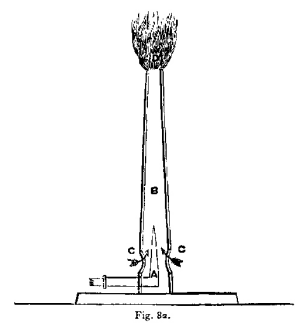 An
ordinary grate is fitted with lumps of clay and asbestos (a practically
incombustible material), and a series of burners ranged under the bottom
grating, so that four or five streams of gas and air are allowed to flow up
among the asbestos, which becomes red-hot in a few minutes after the fire is
lighted, and the carbon of the gas being wholly oxidised by the admixture of the
air, no soot is formed, as would be the case were an unmixed jet of gas poured
through. The comfort of a bright and clear fire which requires no attention
whatever, but which is capable of the most delicate regulation, is too obvious
to require anything but the mere mention. These stoves will be found especially
useful for bedrooms, for invalids and others, where the constant attention
required by coal fires seriously prejudices the benefit to he derived from their
warmth.
An
ordinary grate is fitted with lumps of clay and asbestos (a practically
incombustible material), and a series of burners ranged under the bottom
grating, so that four or five streams of gas and air are allowed to flow up
among the asbestos, which becomes red-hot in a few minutes after the fire is
lighted, and the carbon of the gas being wholly oxidised by the admixture of the
air, no soot is formed, as would be the case were an unmixed jet of gas poured
through. The comfort of a bright and clear fire which requires no attention
whatever, but which is capable of the most delicate regulation, is too obvious
to require anything but the mere mention. These stoves will be found especially
useful for bedrooms, for invalids and others, where the constant attention
required by coal fires seriously prejudices the benefit to he derived from their
warmth.
By having a pipe to supply the gas jet so contrived as to be
controllable by a tap within reach, a patient, without the necessity of getting
out of bed, can regulate the fire to the greatest nicety, or, if left alone, it
remains in exactly the same state for any length of time. We can testify from
positive personal experience, that these fires are as cheerful and comfortable
as coal fires, and the heat evolved is certainly not less than would come from a
bright clear coke fire, which, in fact, they so closely resemble as to be
undistinguishable by a casual observer. Of course we do not say that the use of
gas for this purpose is more economical than the use of coal, but the advantages
gained are, in our opinion, fully equal to any possible apparent difference in
cost ; we say apparent, because the facility of almost instantly producing or
putting-out a gas-jet must be set against the fact that a coal fire takes a
considerable time to become of any use, and must be allowed to die out of its
own accord, at a large waste of material. We should strongly advise any person
requiring such a fire to visit some establishment where one may be seen in
action, when ocular demonstration will supersede the necessity of further
description on our part. A small air and gas-stove for cooking chops, steaks,
&c., by means of heat thrown downwards by radiation front asbestos bricks
deserves especial notice, because of the impossibility of smoking or burning the
meat by the fat falling into the fire.
In another paper we shall pass on to the treatment of
gas-meters, and conclude with the consideration of a question of importance to
all who use gas for household purposes ? namely, the effects its burning
produces upon the atmosphere of our apartments. However convenient or pleasant
gas-light may be, its use should always be adopted with a full knowledge of the
serious evils which accompany it, evils which can only be guarded against by
proper ventilation. In ill-ventilated rooms pains in the head, nausea, languor,
and bronchial irritation are frequently experienced by those who occupy them for
any length of time. The serious consequences of inhaling unburnt gas are but too
often forgotten, and there are thousands now burning it who never heard or read
a word upon the subject. We should ill deserve the title HOUSEHOLD GUIDE if we
did not set up our warning here, and point out not only what to do, but also
what to avoid.
[--grey numbers in brackets indicate page number, |