Volume 1
[-17-]
THE AQUARIUM.-I.
As the study of all animal and vegetable life presents to the mind a special
and elevating influence in addition to the interest it excites, it is a subject
for personal gratitude, that the principles upon which the structure of the
aquarium is founded have been so carried out and simplified, that this little
world in miniature may be adapted to any scale, and that in place of the bowl in
which gold-fish were formerly imprisoned and doomed to a slow consumptive death,
we can adorn the parlour window with a self-renovating, self-supporting lake, in
which the denizens of the water imbibe their natural food, and breathe the gases
necessary to their healthy existence.
To the hard-working town dweller, who seldom sees the
country, or has an opportunity of witnessing the interesting operations of
nature, an aqua-vivarium must be especially entertaining, and, as in the course
of our papers we hope to prove, easily attainable, being neither expensive to
form nor difficult to manage.
The first matter essential to be understood is the
principle upon which the aquarium should be managed. To support animal life
certain natural operations must be carried on, and upon the proper provision for
these, success will depend. If a goldfish be placed in a "globe" of
water, it will at first glide comfortably round, about half-way between the
surface and the bottom, but after a few hours it will become languid, get nearer
to the surface, and ultimately raise its mouth out of the water, as if gasping
for breath - a sure sign that the water does not furnish it with what is
required for its comfort. No animal can exist without air, and fish, like
creatures that live on land, need a supply of oxygen, which is the gaseous
element in air that supports life. Besides this, animals give off by respiration
a poisonous gas, called carbonic acid, which must by some means be disposed of,
or it will impregnate the surrounding air or water, and ultimately destroy the
creatures within reach of its influence. Now the reason that the gold-fish
becomes uncomfortable is that it has by breathing exhausted the air in the
water, and polluted it with its exhalations; the oxygen has been consumed, and
the carbonic acid has been imported into the water, although to all appearances
it remains clean and pure. It will thus be seen that what is required to render
the aquarium self-supporting, and obviate an otherwise necessary change of
water, is that something should be introduced that will supply air and at the
same time absorb carbonic acid. To ascertain what wilt perform this office, we
have only to look into a pond or river, or peep into the pools among the rocks
at the seaside, when we shall discover that Nature's own method of purifying and
aerating the water is by vegetable growth. In fact, it may be laid down as a
principle, that in an aquarium the natural condition of its inmates should as
nearly as possible be imitated in every particular. There should be the same
animals, the same kind of vegetation, the same amount of light, and the same
temperature as if the aquarium were a nook in the corner of a natural piece of
water.
The dimensions of the aquarium must of course depend upon the
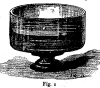
space that can be afforded. The simplest and least expensive is the bell glass,
Fig. 1, such as confectioners use to cover cakes. This being inverted and
placed upon a stand, forms a pretty ornament, and has the advantage of being
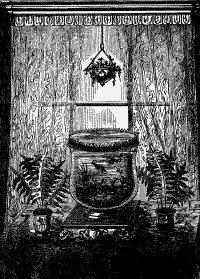
adaptable to any situation. By the arrangement of a few ferns in pots, and a
basket of creeping plants suspended from above, a window may be made exceedingly
ornamental. Where space is not so much an object, an oblong tank may be
selected. This may be made of any size. For fresh water the framework may be of
wood, zinc, iron, or glass pillars, with glass sides but the best are those£
made of slate with a glass front, or with slate ends and glass at the front and
back. If not made of slate, the bottom should be lined either with glass or
slate, which can be embedded in a thin layer of Portland cement. Wood frames are
undoubtedly the least durable for the purpose, for they soon leak, and cannot be
satisfactorily repaired.
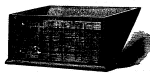
Tanks for fitting on the outside of window-sills, where much
weight would be an objection, may be made with a sloping back, as in Fig. 2.
This shape has also the advantage of presenting a large surface of water to the
action of the air, but it is most suited for marine aquaria, [-18-]
in which the objects do not require so much space to move in. When it is
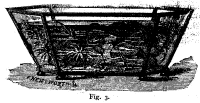
intended to place the aquarium some distance from the window, the hexagonal
shape, Fig. 3, is often chosen as the most ornamental; but this is also better
adapted for marine than fresh-water specimens.
Having selected the shape of the aquarium, the next
consideration is the place it should occupy, which in most cases will be in front of a window. The best situation is a window looking towards the east, where it will get the morning sun for about two hours. The mid-day sun is too hot, If you have not a window looking to the east, give it a southern aspect, but be careful to shade off the noonday sun; a northern aspect is never good for an aquarium; a western is seriously bad. The great point
is to keep up an equal temperature as much as possible, the range being from
45£
to 65£
Fahr. This may be done by opening the window in summer, and
by drawing back the tank from the window on winter evenings. On no account
should the water be allowed to freeze. Not only do you risk the bursting of your
tank, but the fish and plants will droop and die.
It is a matter of importance that the admission of light and
heat should be properly regulated, and that they
should be admitted only through the surface of the water. To accomplish this,
in the case of bell-glasses or tanks with glass ends and back, thin green paper
should be pasted over all the glass except the front, up to the water-line ; by
this means the light is subdued, besides which the objects in the aquarium will
always present a better and more natural appearance if the light is admitted at
the top. The temporary aquaria in the gardens of the Paris Exhibition of 1867 -
a most successful experiment of its kind - were all constructed on this
principle, and presented an exceedingly beautiful appearance. The admission of
light through the opposite side or end of a tank will produce an excessive
growth of vegetation, and cause the accumulation of a green film on the front,
that will, in a short-time, obscure the contents of the aquarium from view.
Having made or planned your aquarium, you must prepare the
bed of your pond. The first thing is to get some river sand, or fine gravel,
cleanse it thoroughly till the water runs from it quite clear, and then lay it
in the bottom of the tank to the thickness of an inch at least; over this, in
places, lay small pebbles; if you want a rock-work or miniature caverns, pile up
small I blocks of granite, fastening them together with the best Portland
cement; other cements are liable to taint the water and injure the fish, and
even this should be allowed to remain in water for a week, in order that it may
part with any soluble matter it may contain. Having laid your sand and gravel,
and built your rookery, let the cement get firm, then add the water, and empty
and refill it till the water is perfectly clear, when it will be in a proper
condition to receive the plants intended to be introduced.
[-63-]
THE AQUARIUM.-II.
FRESH WATER VEGETATION.
ALTHOUGH the aquarium, as herein treated, may be viewed chiefly as an object
for the decoration of a room, its utility as a means of amusement and
instruction should not be lost sight of. The development of vegetation, the
peculiarities of the class to which the plants belong, the habits of the
creatures that may be introduced into the tank, and the microscopic wonders that
are invariably generated, are not only a source of endless recreation, but may
be turned to excellent account in the education of a family. The receptacle
having been provided, and the bed of the aquarium, prepared according to the
instructions previously given, the next operation is to choose the plants and
place them in their proper position.
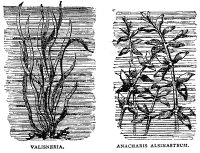
The best and most lasting of all aquarium plants is the
spiral valisneria. This, however, being a native of southern Europe, is not
easily procurable but once established in your tank, it will grow luxuriantly.
The most prolific of the river weeds is the American water- thyme (Anacharis
alsinastrum), but this is a plant we do not recommend encouraging. Of its
introduction into this country there are several accounts, the most probable
being that given by a Cambridge gentleman, who, having received a plant from a
friend in Canada, kept it for a time in a glass jar, but not seeing it develop
itself into anything interesting or beautiful, ordered it to be thrown away;
this was done, and the drain from the house emptying itself into the Cam,
carried down the germs of the weed, which soon spread and became a great
nuisance, as it nearly filled the river. Those of our readers, therefore, who
introduce this plant into their aquarium should take special care to prevent any
opportunities of its being similarly propagated.
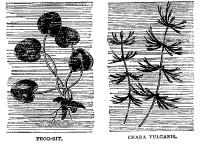
Another suitable plant is the common frog-bit (Hydrocharis
morsus-ranae). Its habit of growth differs considerably from either
of the above, which is an advantage where variety is desirable. Of the other
plants suited for our purpose, may be named the arum (Calla palustris),
the common stone-wort (Chara vulgaris), the water-soldier (Stratiotes
alvides), and the spiked watermilfoil (Myriophyllum spicatum).
In the largest-sized tanks small water-lilies may be [-64-]
introduced. Of these there are two kinds, white (Nymphea alba) and
yellow (Nuphar buteum), both of which are to be found in ponds. A
disadvantage attendant on the use of these is, that lilies die down in winter,
and their leaves, if not removed, encumber the tank without enhancing its
beauty. The common water-shield has pretty oval- shaped leaves, which float upon
the surface, and from the peculiar way in which they unfold themselves are an
object of interest. Reeds and rushes are sometimes used, but require a deeper
foundation for their roots than can be usually given.
The best method of planting the weeds is to tie each of them
to a pebble and sink them below the surface of the shingle. Care should be taken
to arrange them with some regard to effect, the shortest being placed in front
and the longest behind. A glass of aquatic plants neatly arranged is as
ornamental an object as a fern case, and certainly less common.
After all the plants are arranged, a little duck- weed (Lemna
minor) may be thrown in. These float upon the surface and harbour minute
insects, which serve as occasional dainty morsels for the fish.
Before the intended inhabitants of the aquarium are
introduced, the plants should be given time to establish themselves - say about
a fortnight. If it be found that a green film overspreads the surface of the
glass, this must be taken as a sign, either that too much light has been given,
or too many plants have been introduced in proportion to the quantity of water.
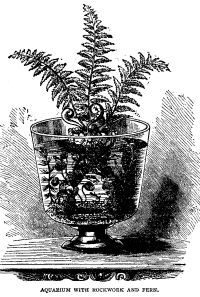
If the aquarium be sufficiently large, a pretty effect may be
obtained by building up the rock-work till it reaches some distance above the
water, and leaving a space into which a fern may be planted, as shown in our
illustration.
If it be intended to introduce small frogs or newts, which
are quite admissible, the aquarium should be covered with glass, to prevent
their crawling over the sides. They may appear perfectly contented and happy all
day, but newts have nocturnal migratory habits, and are most likely to find
their way down-stairs before morning, unless prevented. The cover of a
bell-glass should be a circular piece of glass, large enough to project a
quarter of an inch over the rim, with a round hole cut in the centre to admit
the air. This also answers the purpose of keeping out the dust when the room is
swept.
Amphibious creatures should never be kept entirely in the
water. To give them a resting-place, a little island should be prepared for
them, in this manner :-Take a piece of cork of an irregular shape, smear it over
with marine glue, and then sprinkle it with sand ; let it stand to dry, and then
place it in water for some time. When "seasoned," it may be floated on
the surface of the aquarium. The newts will soon give evidence of their
appreciating this provision for their convenience, by climbing upon it and
diving from it.
THE SELECTION OF FRESH-WATER ANIMALS.
The first specimens of animal life which should be placed
in an aquarium are the molluscs. Of these, the horny coil shell (Planorbis
corneus) and the pond mud shell (Limnea stagnalis) are the most
plentiful and best suited. Both these aquatic snails may be found in stagnant
pools or sluggish rivers. They feed upon the weeds, and may be captured by
drawing a net along the submerged stems of rank grass or rushes that grow close
to the shore. They have been termed the scavengers of the aquarium, because they
assist in keeping down the superabundant vegetation, and consume the minute
green growth that accumulates upon the sides of the glass. They are very active,
and the motion of the planorbis is particularly graceful.
There are also two kinds of mussel that may be introduced,
the swan mussel (Anodon cygneus) and the duck mussel (Unio pictorum), but
they possess no especial recommendation, and require careful watching lest they
die and pollute the water.
Among the lively creatures that deserve a place in the
aquarium, there are few more interesting than the common water-spiders (Argyroneta
aquatica). These form especially attractive objects on account of their
activity, and their habit of rising to the surface, drawing a globule of air
underneath the water, and carrying it down, as if it were a jewel attached to
the hind part of the body. If the aquarium be in good condition, the
water-spider will sometimes weave a web and construct its nest, and live in
confinement for a considerable period.
There are several varieties of the beetle to be found in
rivers and ponds, but only two that can be safely introduced into the aquarium -
the large harmless beetle (Hydrous piceus), and the little
whirligig (Gyrinus natator). The former, though large in size, is
distinguished for its amicable disposition; the latter, though small, makes up
for its insignificant proportions by whirling about and persistently forcing
itself into notice.
The caddis-worm, or cad-bait, is a favourite object for the
aquarium. It is the larvae of the May-fly, and may be found in the shallows of
rivers and streams. With minute pieces of twigs, grains of sand, and other
obtainable materials, these worms construct grotto-like nests, the particles of
which they fasten together by means of silken threads, secreted in the same
manner as in the silk-worm. The methodical, careful, and business-like way in
which the caddis builds its dwelling affords an admirable illustration of the
instinct possessed by the insect tribe; and the operation may be easily observed
in the aquarium, by the use of an ordinary magnifying glass placed on the
outside near the spot where the creature is at work.
[-69-]
THE AQUARIUM-III
FRESH WATER ANIMALS (continued from p. 64).
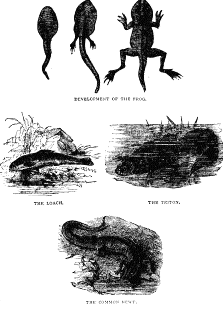
As temporary residents tadpoles certainly claim a
few words of notice. They are easily obtainable in the spring, and their gradual
development into frogs affords a lesson in natural history especially
interesting to the young. They should be introduced in the proper tadpole stage,
when they consist but of an oval body terminating in a pointed tail, which is
actively used as a propeller. Then maybe observed the gradual budding of the
hind-legs the appearance of the head, and the ultimate change into the frog. On
arriving at the final stage of its development it becomes amphibious, and will
climb on the cork island that should float on the surface of the aquarium; then,
of course, it requires its liberty, and should be placed in the way of finding a
more congenial place of retirement. When the plants have become fairly
established, and the beetles and snails have settled down in their new home, it
will be time to consider what fish shall be chosen to complete the furnishing of
the aquarium. For the sake of appearance precedence must be given to the golden
carp; two of these, not exceeding four inches long, will be sufficient for a
circular glass. The most interesting of the fish which may be kept in
confinement is, however, the minnow; these little creatures will live for
a considerable time - sometimes for years - in a healthy condition, and become
so tame that they will take food from the fingers at the surface of the water,
and follow the hand that feeds them round the glass. From six to a dozen of
these will not be too many for even a small aquarium. Sometimes a disease will
attack the minnow, and therefore, before being placed in the aquarium, it should
be carefully examined. If a whitish fluffy spot be noticed near the tail, the
fish should be kept in quarantine, or it will contaminate the rest, and a
general mortality will ensue. This disease usually spreads gradually from the
tail towards the head, till nearly half the body becomes coated with a woolly
fungus, the fish moves with an awkward jerk, and then occasionally floats
helplessly on its back, till in a few days it dies.
The loach is also to be recommended as an inhabitant of the
aquarium. It agrees well with the other fish, soon becomes tame, and invariably
thrives ; its movements are somewhat curious, for instead of gliding about like
the rest, it lies at the bottom, turns over the pebbles in search of food, and
jerks itself round the glass with a spasmodic motion, resting occasionally on
the rockwork that lies in its way. It is also useful in a sanitary point of
view, for it picks up the stray morsels that may have fallen to the bottom, and
thus prevents the water becoming fouled by decaying fragments of food that have
been unobserved by its more lively neighbours. To the above may be added the
common carp, Prussian carp, the roach, the tench, and the gudgeon; the two first
named being the most preferable.
 As it
is important to know what to avoid, it should be mentioned that the stickleback,
though an amusing little creature when kept with companions of its own kind, is
too pugnacious to be admitted into a general collection; and the same objection
holds good with the perch.
As it
is important to know what to avoid, it should be mentioned that the stickleback,
though an amusing little creature when kept with companions of its own kind, is
too pugnacious to be admitted into a general collection; and the same objection
holds good with the perch.
There is another animal that may be safely placed in a small
vessel in company with those we have named, and that is the newt, of which there
are two kinds - the small newt and the triton. They are both perfectly harmless,
and the latter is especially attractive on account of its bright yellow body,
which is striped with black.
An aquarium furnished with the creatures we have named will
contain sufficient variety in form, colour, and habit to render it very
attractive and interesting, and will need but little attention to keep it in
order. Care should of course be taken that the water does not get too warm or
too cold, and that no more food be given than can be consumed. The best food is
a little biscuit powder, kneaded up into pills about the size of pin-heads, and
shreds of raw beef cut with a pair of scissors; these should be dropped in
alternately, when the fish will catch the bits before they sink to the bottom.
This operation should not be performed more frequently than once a day.
As it is not desirable to disturb the contents of an aquarium
oftener than is absolutely necessary, some inexpensive instruments are required.
To remove the stones at the bottom a pair of forceps should be obtained - a
wooden glove-stretcher, to be purchased at any hosier's for a shilling, answers
the purpose better than anything else; to remove lighter matters, such as
decayed leaves, morsels of food, &c., a glass tube open at both ends is the
most effective. By putting one end of the open tube against the debris to be
removed, and then placing the finger over the other end, any light substance can
be lifted out of the water; to take it out by any other method is no easy task,
and often results in breaking it up and fouling the water. When the bottom of
the aquarium becomes dirty from an accumulation of sediment, a syphon of india-rubber
tubing may be used; by letting the tube draw the water from the lower part of
the vessel the refuse will pass out without disturbing the weeds, and clean
water can be introduced gently to make up for what has been taken out. It should
always be borne in mind that an aquarium, properly managed, needs no change of
water; in warm weather, however, it is necessary to add a little water to make
up for evaporation. The writer has kept both large tanks and small vessels for
more than a twelvemonth without changing the water.
An aquarium is more interesting and less troublesome than
most other decorative objects that involve the support of either vegetable or
animal life.
[-105-]
THE AQUARIUM.-IV.
MARINE AQUARIUM.
 IN a
former number instructions were given for the management of the fresh-water
aquarium. These, as far as regards the admission of light and regulation of
temperature, apply equally to salt-water aquaria; but in other respects, the
marine collection requires greater attention to detail, and therefore must be
treated independently. In localities near the coast there is, of course, little
difficulty in obtaining the objects necessary to furnish an aquarium ; but at a
distance from the sea it is not always easy to get even a supply of water, and
therefore it becomes a matter of considerable importance, at starting, to know
how to proceed in the manner least likely to result in disappointment.
IN a
former number instructions were given for the management of the fresh-water
aquarium. These, as far as regards the admission of light and regulation of
temperature, apply equally to salt-water aquaria; but in other respects, the
marine collection requires greater attention to detail, and therefore must be
treated independently. In localities near the coast there is, of course, little
difficulty in obtaining the objects necessary to furnish an aquarium ; but at a
distance from the sea it is not always easy to get even a supply of water, and
therefore it becomes a matter of considerable importance, at starting, to know
how to proceed in the manner least likely to result in disappointment.
The first step to be taken is to choose the vessel. The best
form is the oblong square tank, with the back sloping inwards towards the
bottom, all except the glass front being made of slate. But as this is not
easily procurable, the confectioner's cover inverted, and fixed on a stand, will
answer the purpose. As it is advisable to present as large a surface of water as
possible to the action of the air, the vessel chosen should not be deep, but the
greater the circumference the better. It shou1d be provided with a glass cover
having a circular hole cut in the centre. This will check evaporation, keep out
the dust, prevent anything getting out, and yet admit sufficient air.
The water is the next matter to be considered. Some writers
have recommended the use of artificial sea-water, prepared by dissolving a
mixture of salts in rain water; but the risk of failure is too great to make the
experiment worthy of trial. There are certain ingredients and living organisms
in natural sea-water that would be absent from the imitation, and upon the
presence of these success may possibly depend.*
* An analysis of too parts of the water of the Channel gives the following result:-
Water 96.470
Chloride of sodium (salt) 2.700
Magnesium 0.360
Sulphate of magnesium 0.230
Sulphate of calcium 0.140
Potassium 0.070
Carbonate of lime 0.003
Bromide of magnesium 0.002
Residuum 0.025
Besides very small quantities of iodine, sulphur, silica, and ammonia
The easiest method of procuring real sea-water, is to take
advantage of a visit to a watering-place, and make an agreement with a fisherman
to fill a small cask or large jar, and transmit it to you by rail. In giving him
instructions, tell him to procure the water not less than a mile front the
shore, in order to avoid the importation of impurities. By this means the writer
has succeeded in obtaining water from Weymouth, Broadstairs, and Harwich, the
vessel used being a nine-gallon cask, and the total expense not exceeding
sixpence per gallon. It is scarcely necessary to remark that the vessel should
be new, or, if a stone jar, carefully cleaned.
There are a very large quantity of beautiful objects that may
be kept in a marine aquarium; but as the most attractive are not easily
procured, and require some care in their management, the beginner should first
try his "prentice hand" upon such as can be most readily obtained ;
these fortunately are the least likely to perish from neglect.
Presuming that a vessel has been provided before leaving
home, and that a few gallons of water (twice the quantity actually required for
the aquarium) can be forwarded or taken back as luggage, the visitor to the
seaside may easily obtain all that he requires by taking a ramble over the rocks
at low tide.
The most speedy method of gathering the objects is as follows
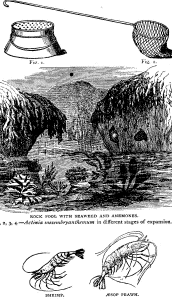
Take a tin can, as shown in Fig. 1, a net with a long handle, Fig. 2, and a
hammer, and go to the beach about half an hour before low water. Choose the spot
where the rocks stretch out farthest from the shore, and make your way over them
to the water's edge. To do this some care is required, for the wrack that covers
the rocks is exceedingly slippery, and a false step may launch you into a pool.
As salt water is not beneficial to shoe-leather, those who are not provided with
sand-slippers should rub a little tallow over their boots, especially in the
crevice above the sole, before starting out. First dip your can half full of
water, and then wriggle the net quickly round the edges of the rock pools within
reach. There are several kinds of small fish that may thus be caught, but as
they do not live long in confinement, you need not feel greatly disappointed if
you fail. You will have no difficulty, however, in capturing a few shrimps or
prawns, although it requires a practised eye to see them. When in the water,
they are almost transparent, and thus easily elude detection, and when caught in
a net they are scarcely observable, unless they force themselves into notice by
jumping about.
You will have discovered that the rocks on which you stand
are intersected by fissures, which are concealed by the sea-weed. Take the
handle of your net and throw [-106-] the weed back,
so as to expose the crevices to view.
Here, clinging against the sides of the rocks, you will see
convex-shaped spots of a jelly-like substance, the colours being either brown,
olive green, or red. These are the commonest kind of sea-anemones - the most
curious, and at the same time the most hardy, of the objects you will find. But
there they are likely to remain, unless you know how to dislodge them. Place
your finger upon one, and it will throw up a jet of water, and at the same time
tighten its hold, so that it cannot be removed without being mutilated; but
approach it cautiously, and quickly force the thumb-nail under the edge of its
base, and it may be peeled off unhurt without difficulty. If you do not succeed
in the first attempt, leave the creature alone, and try another. This smooth
anemone (Actinia mesembryanthemum) will well repay you for the trouble of
taking, for it will need less care and yet outlive everything else that you may
happen to get.
[-132-]
THE AQUARIUM-V.
MARINE AQUARIUM (continued from p. 106).
As you proceed with your search among the rocks and turn over the sea-weed,
some yellow shells will very probably be found adhering to the under surface,
and occasionally a small whelk or periwinkle. A few of these should be gathered
for the sake of variety. Upon the rocks will be noticed round patches of sea
grass, varying in size from a shilling to that of a crown piece. Underneath
these will be found the limpet (Patella vulgaris), to the shell of which
the grass grows. There is the same difficulty with the dislodgment of the limpet
as with the anemone. It no sooner feels the touch than it clings tightly to the
rock, and as the edge of the shell is embedded in the chalk it is not an easy
task to remove it. By selecting one the shell of which is slightly raised, and
putting the blade of a pocket-knife beneath the edge, it may be jerked off
without injury.
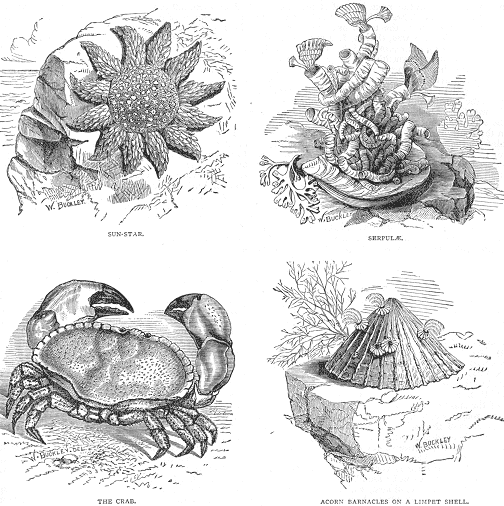
Some limpets are covered with a shelly parasite, called the
acorn barnacle (Balanus) ; one of these should be secured, care being
taken that none of the shells are broken. When these are placed in a glass of
clear sea-water, and looked at through a magnifying-glass, they will be seen to
open a door in the roof of the shell, and protrude a feathery fan, by means of
which food is caught and conveyed through the aperture. Unfortunately, they have
a tendency to die after a brief confinement; they should therefore be carefully
examined in a separate vessel, before being introduced.
Some of the rock-pools, on close examination, present an
exceedingly pretty sight. Sea-weeds of various colours cover the bottoms, and
give them the appearance of miniature forests. As a rule, imported sea-weed does
not grow well in an aquarium, but as it looks pretty for a time and may easily
be removed when it begins to show signs of decay, a few pieces should be
secured. The way to obtain these is to chip off pieces of the rock upon which it
grows, for which purpose a hammer is required. Sea-weed is of no use for
aquarium purposes unless attached to a stone or piece of rock. Vegetable growth
is necessary to the healthy maintenance of the aquarium, but this will soon
develop itself from the germs contained in the water, and gradually cover the
stones and rockwork.
The next curiosity to be sought after is the hermit crab,
which you will certainly not find unless you know how to go about it. This
creature may be described [-133-] as half a
Liliputian lobster and half a periwinkle. The fore part of the body is
crustacean, but at the waist it changes into a molluscous animal, having a soft
tail, which it inserts into an empty whelk-shell. When all is quiet, the shell
containing the hermit may be seen moving slowly along the sand between the
rocks, but the moment the sound of a foot is heard the cautious inhabitant darts
back into the shell and remains motionless, so that it is not easy to discover
it.
On one occasion the writer failed in his endeavour to find a
hermit, but knowing them to be plentiful at Broadstairs, he continued his search
till he met a native boatman, with whom he got into conversation. After
listening to a yarn about wrecks and life-boats, and inspecting three medals
which had been worthily bestowed upon him for saving life, an attempt was made
to enlist his services in the search after the coveted Pagurus Bernhardus. "I
dare say, now, you can tell me where I shall be likely to find a hermit
crab." "Oh," said he, "you'll find plenty of little crabs
about, but I never heard them called by that name before." "I mean
those crabs that carry whelk-shells on their backs. "Oh, I know now, you
mean farmers - that's what we call them." The tide by this time had come up
beyond the line where the hermits were to be found, so the boatman undertook to
find some, to put them into a jar, and send them to London.
There will be no difficulty in finding two or three common
edible crabs (Cancer pagurus) such as that shown in our illustration.
Those chosen should be small, say from an inch to an inch-and-a-half across. If
larger, they prove troublesome to the anemones; if smaller, the anemones will
devour them. The crab is au especially valuable creature in an aquarium, for he
acts as a scavenger and appropriates odd morsels of food that may have been
rejected by his more dainty neighbours.
Another recommendation is, that he will become exceedingly
tame, and even allow himself to be petted. An edible crab from Broadstairs, not
much larger than a man's thumb-nail, became so tame that he would take food from
the fingers, and though at first viewed as the least valuable in the collection,
soon grew to be an especial favourite, and was rewarded by having a glass house
furnished exclusively for his accommodation. After a while, however, he became
shy, and fears were entertained [-134-] that he was
pining for companionship. He forced himself beneath a stone apparently heavy
enough to crush him, and shrank back whenever any attempt was made to get at
him. In a day or two his anxious friends were pleased to see him come from his
hiding-place, but Jack was no longer the same hard-skinned crustacean that he
was before his retirement. In the first place, he had grown considerably; in the
next, instead of presenting a shelly coat to be stroked, his back was as soft as
that of a frog, and he shrank from the touch as if he were afraid of being hurt.
The fact was, that he had undergone the natural process of exuviation, and had
shuffled off his shelly coil, which he had left beneath the stone that had lain
upon him during his temporary withdrawal from society. In about a week his skin
began to harden, and he became more familiar than before. Each morning, at
breakfast time, he came to the front of the glass and tapped against it till he
was fed. On his seeing any one approaching the glass he scrambled out of the
water on to the stones that rose in the centre, and held out his claws for food,
which he took from the fingers, and then scampered away like a monkey to eat it
in a corner. On another occasion the crab's decease was reported. An inquest was
immediately held, and the body inspected in due form. Apparently there could be
no reasonable doubt that he was dead. The post-mortem examination was
made by means of a common magnifying-glass, through which could be seen
his eyes, feelers, &c., and the unanimous verdict was, - "Found
dead." His habitation was of itself a pretty window ornament, for the
miniature rocks were nearly covered with bright green confervae, and around the
sides were several tufts of sea-weed in a healthy condition ; it was, therefore,
left undisturbed. After the lapse of several days, the familiar tapping sound in
the glass was again heard; several pairs of eyes, staring with wonder, were
directed towards the residence of the late lamented crab and behold, there he
stood, in his accustomed attitude of supplication, awaiting his breakfast. He
had grown considerably, and was once more in a soft condition. This led to the
examination of the supposed dead body, which had been placed in a box as a
relic. On further examination, it proved to be nothing but an empty shell, a
fact which was not at first discovered, owing to its containing sand. No one who
has not had an opportunity of witnessing the exuviated shell in a perfect
condition can believe the possibility of the creature getting out of its old
coat and appendages, including head, eyes, antennae, and claws, and leaving it
in one complete piece.
Very small shell-fish, such as young mussels and cockles, may
sometimes be found on the shore near low- water mark. The mussels grow in
clusters, and are attached to the rocks by threads called the byssus. Do not
pull them away, but take your hammer and chip off a piece of the substance to
which they cling.
After a rough sea, the tide leaves numerous star-fishes in
the crevices of the rocks. These are of various kinds, the prettiest being the
sun-star, such as is shown in our illustration, which has twelve rays, and is
best adapted for the aquarium. The commoner kind has but five fingers ; as
this creature is voracious, it is advisable to select the smallest that can be
found.
The objects above mentioned, which afford sufficient variety,
and are not difficult to keep with an ordinary amount of care, may all be
obtained on the shore at Broadstairs, or at any place on the same coast where
the rocks stretch out into the sea. There are, however, other
localities where much more beautiful objects may be found. The coast of Dorset,
Devonshire, and Cornwall is especially rich in zoophytes, some of which are as
beautiful in form and colour as the choicest flowers in the conservatory. There
are certain methods of gathering that yield less common specimens of marine
animals than those already described. For obtaining such as are not amphibious,
the best plan is to engage a fishing boat and use the dredge. By this means you
may obtain a greater variety of crabs (including the curious and interesting
spider) and shells covered with tube-worms (serpulae). These latter are
well worth keeping in an aquarium. The tubes of the serpulae are generally
attached to oyster-shells, and overlay each other in a serpentine form. On
taking them out of the water, a blood-red spot will be seen at the mouth of each
tube; but after exposure it sinks down out of sight. On replacing it in water,
the worm will protrude a feathery coronet, with a kind of stopper in the centre
; but will instantly withdraw it if the hand be passed across so as to suddenly
intercept the light. The illustration shows a group of these singularly-shaped
creatures.
[-161-]
MARINE AQUARIUM (continued from p. 134).
THE selection of objects suitable for the aquarium having been made,
upon reaching home they should at once be placed in as many vessels as you may
happen to have at hand, and left to recover from the effects of their journey
before being placed in the aquarium. The crabs will require to be secured by a
perforated cover, otherwise they will be sure to find their way out.
As the introduction of a dead animal is especially to be
avoided, every object should be carefully examined with a magnifying glass, and
well rinsed in sea water before being put into the aquarium. If there be any
suspicious indications, keep the creature in water by itself until you are
satisfied that it is, or is not, in a healthy condition.
In arranging the rockwork of a marine aquarium, care should
be taken to avoid the formation of hiding-places. The stones or pieces of
granite should be piled up to form a shelving background, which will shade the
light, and at the same time prevent the creatures from getting out of sight.
Immovable objects, such as serpulae, should be placed so as to be easily seen.
Mussels, if deposited against the glass, will cling to it and creep up the side,
thus revealing the suckers of the byssus, and affording an opportunity for
observation by the magnifying glass.
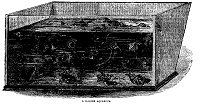
If the aquarium has been in preparation for
sometime, and green growth has commenced to germinate upon the stones, the live
stock may be introduced at once. If not, the water will require to be aerated.
This may be done by taking some out with a cup and pouring it back from a
distance, or by emptying about one-third of the water into a watering pot and
returning it in a shower through the rose. All the creatures you have collected
are accustomed to shallow water, which is well aerated by the splashing of the
waves; it is therefore advisable to imitate this natural operation every day for
a time, by moving a stick quickly backwards and forwards in the water, say for
five minutes continuously. When indigenous vegetation has fairly set in, small
air globules will be generated upon its surface, and these will rise so
plentifully through the water as to give it a frothy appearance. This may be
taken as a sign that other means of aeration may be discontinued.
Begin the furnishing of your aquarium by arranging the
sea-weed at the sides, leaving the space in front quite clear. The limpet-shells
may either be embedded in the shingle at the bottom, or placed on the rocks,
according as they may appear to the best advantage.
The crabs should next be dropped in, and supplied with food.
The best food for crabs and anemones is the flesh of the mussel or oyster, cut
into very small shreds with a pair of scissors. If this is not to be had, raw
beef is a good substitute, but shell-fish should always be procured if possible.
The edible crab before referred to is a very peaceable fellow; but the shore
crab, though very like it in outward appearance, betrays a pugnacious
disposition. The hermit is also fond of a little warlike exercise, from which
circumstance he has acquired the common name of the soldier crab; but as the
other kinds are fleeter of foot he will have no opportunity for the display of
his pugnacity, unless placed in company with one of his own species. When the
hermit grows too large for the shell he occupies, he goes in search of another
that will afford him more room, and if he fails to discover an empty one to his
taste, he will attempt to dislodge any other hermit that he may chance to meet.
Then comes the tug of war, the end of which is that the vanquished generally
loses a claw, and not unfrequently his life. By placing in the aquarium an empty
shell, a little larger than the one inhabited, the hermit may be tempted to
change his cell, which he does in this wise. He first inspects the shell, walks
round it, and turns it about; having made up his mind that it will answer his
purpose, he withdraws his tail, which has no coating to protect it, but
terminates in a pincer-like formation, pushes it into its new abode, and walks
off with an evident feeling of pride at his achievement. The pincers enable him
to keep tight hold of the shell, without which no hermit crab can be considered
complete. On close examination it will be noticed that one claw is larger than
the other ; the smaller one is always drawn in first, and the larger one is laid
across the mouth of the shell. Sometimes, however, the hermit does not alone
occupy the shell, but will submit to accommodate a colony of serpulae or a
parasitic anemone on the outside, and a worm (the Laminated Nereus) within.
Should the hermit forsake his abode and limp about in an uncomfortable manner,
he will require looking after, for [-162-] that is
a sure indication of ill-health, and if he does not speedily die a natural
death, the more lively crabs will make a meal of his unprotected extremity.
If you have a group of serpulae, the shell to which they are
attached should be placed near the front of the glass, where they can be readily
examined. If at any time one of the worms should be seen hanging helplessly out
of its tube, take a needle and remove it. If a milky film be seen at the mouth
of any of the tubes, its inhabitant is in a state of decomposition. To remove
it, under these circumstances, the use of a crochet-needle, which has a hook at
the end of it, will be found necessary.
The anemones may be dropped in one by one without regard to
arrangement, for they will invariably choose some other resting-place than the
spot they are wanted to occupy. There is no occasion for any anxiety as to their
health, for they seem competent to resist the most adverse influences and to
exist under almost any conditions. The writer has never experienced any
difficulty in keeping smooth anemones ; some have lived for years without change
of water, and many a brood of juveniles has dotted the rockwork of his aquaria.
Sir John Dalyell kept one of these for twenty years, and in that time it
produced upwards of three hundred young. The anemones require feeding about once
a week. Before supplying anemones with food, take a pointed splint, stick a
shred of oyster or mussel on the end, and place the food so as just to touch one
of the tentacles of the animal; it will at once seize the proffered morsel and
convey it into its mouth, at the same time drawing in its tentacles. These
tentacles possess adhesive properties which enable the creature to catch
animalcules that come in its way; and though the hairs that give it this power
are too fine to be seen without the aid of a microscope, their effect may be
felt by placing the finger against them when the tentacles are expanded.
Anemones will remain alive without being fed, but they then generally decrease
in size, and display their feelers less frequently. If you do not at the same
time feed the crabs, they will walk round the aquarium, put their claws into the
mouths of the anemones, and steal their food before it has had time to get
beyond their reach. After a meal, the anemones eject the indigestible matter,
which should be removed with a camel-hair pencil. They also occasionally exude a
film, which covers the whole body, and gives it a dull appearance; this also
should be removed by the same means.
The remaining specimens may now be introduced in any order;
the fish, however, last.
When once furnished, the marine aquarium should not require
any change of water, although it is as well to have a supply in reserve. A mark
should be made on the glass where the water reaches, and when evaporation causes
the water-level to descend below the mark, fresh rain-water should be poured in
to make up the deficiency.
In course of time, the length of which will depend upon the
amount of light admitted, a green film of minute vegetation will cover the sides
of the glass. This should be wiped gently off the front by means of a small
sponge tied to a stick, care being taken not to disseminate it through the
water. That at the back and sides may be allowed to remain, as it is of value
both in purifying the water and moderating the light.
The foregoing instructions will enable any person to furnish
a marine aquarium at a small cost, and to maintain it with little trouble. Care
must, however, be taken that the necessary operations are not performed
hurriedly, and that everything is cleansed before being placed in the vessel.
After the furnishing is complete, it will scarcely require more attention than a
fern-case, while it will afford a source of constant amusement to those who are
interested in watching the movements and studying the habits of the animal
kingdom, to say nothing of the wide field it displays for the use of the
microscope.
[--grey numbers in brackets indicate page number, |