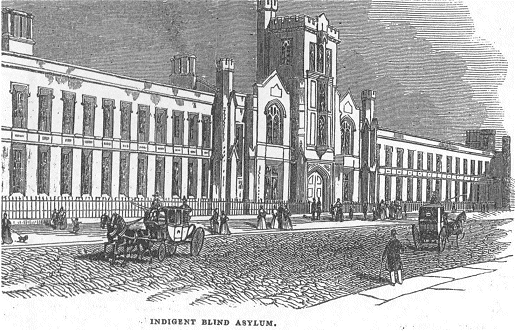
from The Illustrated London News, 1843
The School for the Indigent Blind, near the Obelisk. The object of this school is to instruct the indigent blind in trades, by which they may be able, wholly, or in part, to provide for their own subsistence. It commenced in 1779, and has been most successful, for in little more than eight years it returned thirty persons to their families, able to earn from seven shillings to eighteen shillings per week. There are upwards of sixty persons, males and females, received into the establishment ; and from their exertions, between 600l. and 1000l. a-year are received in aid of the general expenses. This benevolent institution is now removed into a new and very beautiful building that has recently been erected for its reception.
Mogg's New Picture of London and Visitor's Guide to it Sights, 1844
BLIND SCHOOL, (School for the Education of the Indigent Blind), ST. GEORGE'S FIELDS. Instituted 1799. The inmates may be seen at work between 10 and 12 in the forenoon, and 2 and 5 in the afternoon - on every day except Saturdays and Sundays. Annual Subscribers have the privilege of one vote applicable to each vacancy for every guinea they subscribe; and each member for life, one vote for every 10 guineas.
Peter Cunningham, Hand-Book of London, 1850
SCHOOL FOR THE BLIND, St. George's Fields, Southwark:
established in 1799. A visit to this admirable institution is one of deep, if of
painful, interest; and the visitor will examine with surprise the ingenious
appliances and able methods which have been gradually brought to bear upon the
education of the blind. Their books are printed with raised letters. Reading,
writing, and various trades and mechanical employments are here successfully
taught; and many pupils acquire a remarkable degree of musical proficiency.
There are about 160 blind pupils, and their time is occupied in the manufacture
of plain and fancy rugs, basket-work of all kinds, mats, shoes, &c., which
are sold for the benefit of the institution.
Admission on Thursday from 3 to 5 p.m.; on other days by
order.
Cruchley's London in 1865 : A Handbook for Strangers, 1865
BLIND-SCHOOL (THE),
OR the School for the Indigent Blind, was established in 1799, at the
Dog and Duck premises, St. George's Fields; and for some time received only
fifteen blind persons. The site being required by the City of London for the
building of Bethlem Hospital, about two acres of ground were allotted opposite
the Obelisk, and there a plain school-house for the blind was built. In 1826,
the School was incorporated; and in the two following years three legacies of
500l. each, and one of 10,000l., were bequeathed to the
establishment. In 1834, additional ground was purchased, and the school-house
remodelled, so as to form a portion of a more extensive edifice in the Tudor or
domestic Gothic style, designed by John Newman, F.S.A. The tower and gateway in
the north front are very picturesque; the School will now accommodate 220
inmates. The pupils are clothed, lodged, and boarded, and receive a religious
and industrial education; so that many of them have been returned to their
families able to earn from 6s. to 8s. per week. Applicants are not received
under twelve, nor above thirty, years of age; nor if they have a greater degree
of sight than will enable them to distinguish light from darkness. The admission
is by votes of the subscribers; and persons between the ages of twelve and
eighteen have been found to receive the greatest benefit from the instruction.
The pupils may be seen at work between ten and twelve A.M.,
and two and five P.M., daily, except Saturdays and Sundays. The women and girls
are employed in knitting stockings and needlework; in spinning, and making
household and body linen, netting silk, and in fine basket-making; besides
working baby-hoods, bags, purses, watch-pockets, &c., of tasteful design,
both in colour and form. The women are remarkably quick in superintending the
pupils. The men and boys make wicker baskets, cradles, and hampers; rope
door-mats and worsted rugs ; and they make all the shoes for the inmates of the
School. Reading is mostly taught by Alston's raised or embossed letters, in
which have been printed the Old and New Testament, and the Liturgy. Both males
and females are remarkably cheerful in their employment: they have great taste
and aptness for music, and they are instructed in it, not as a mere amusement,
but with a view to engagements as organists and teachers of psalmody; and once a
year they perform a concert of sacred music in the chapel or music-room: the
public are admitted by tickets, the proceeds from the sale being added to the
funds of the institution. An organ and pianoforte are provided for teaching;
and above each of the inmates of the males' working-room usually hangs a fiddle.
They receive, as pocket- money, part of their earnings, and on leaving the
school, a sum of money and a set of tools, for their respective trades, are
given to them.
Among the other Charities for the Blind is the munificent
bequest of Mr. Charles Day (of the firm of Day and Martin, High Holborn), who
died in 1836, leaving 100,000l. for the benefit of persons afflicted,
like himself, with loss of sigkt the dividends and interest to be
disbursed in sums, of not less than 10l., or more than 20l., per
year, to each blind person, the selection being left to Trustees: the Charity is
named "The Blind Man's Fund."
John Timbs, Curiosities of London, 1867