
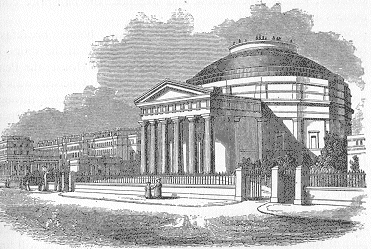
The building bearing this name, in the Regent's Park, is a
polygon of sixteen faces, each twenty-five feet in length, making the outer
circuit of the building four hundred feet: the front is adorned with a noble
Doric portico of six columns, supporting an entablature and pediment; the
entablature is continued round the building, supported at each angle by
pilasters. Above the entablature is an attic, from which rises the dome,
surmounted by a parapet, which forms the front of a gallery, where the
spectators ascend to view the surrounding country. This vast structure was
erected in three years, from designs by Decimus Burton, Esq.
The origin of this edifice is singularly curious. Mr. Horner,
a meritorious and indefatigable artist and as it should seem a man of great
force of character, undertook, at the time of the repair of the ball and cross
of St. Paul's, to make a series of panoramic sketches of London, from that giddy
elevation. That he might overcome the difficulties which the smoke of the vast
city ordinarily presented, he invariably commenced his labours immediately after
sun-rise, before the lighting of the innumerable fires which pour out their dark
and sullen clouds during the day, and spread a mantle over this wide
congregation of the dwellings of men, which only midnight can remove. On a fine
summer morning, about four o'clock, London presents an extraordinary spectacle.
The brilliancy of the atmosphere - the almost perfect stillness of the streets,
except in the neighbourhood of the great markets - the few living beings that
pass along those lines which in the day are crowded like some vast mart, such as
the traveller hurrying to his distant starting-place, or the labourer creeping
to his early work - all these circumstances make up a picture which forcibly
impresses the imagination.
What the artist who sketched this panorama saw only in the
earliest hours of a brilliant morning, the visitor of the Colosseum may behold
in all seasons, and all hours of the day.
N.Whittock, Picture of London, 1836
see also Punch, 1843 - click here
Colosseum, The ... This exhibition, one of the most beautiful in London, is open every day, Sundays excepted, from 10 till dusk. Admission to each part 1s.
The Colosseum is, as its name implies, a building of immense proportions. This vast structure was commenced in 1824 and completed in 1827, under the direct superintendence of Mr. Decimus Burton; its substance is brick, faced with cement, tinted to imitate stone. The interior is judiciously disposed into a saloon, where works of art are exhibited, and galleries for viewing the splendid panorama of London. This latter exhibition is a very extraordinary performance, alike remarkable for its extent and fidelity of representation: it occupies nearly an acre of canvass, painted under the superintendence of Mr. Parris, from sketches made by Mr. Horner in 1821, from St. Paul's, at the time when repairs were going on above the dome of that cathedral. By the aid of machinery that carries a moveable room through the centre of the building, the visiter is raised to a level with the summit of the panorama, and thus spared the trouble of mounting a staircase A model of the cross of St. Paul's, and the original ball, are retained at the Colosseum. The gardens surrounding the Colosseum are laid out so as to appear much more extensive than they really are, and comprise conservatories, waterfalls, fountains, a Swiss cottage, a marine cave and grotto, all of beautiful construction.
Mogg's New Picture of London and Visitor's Guide to it Sights, 1844
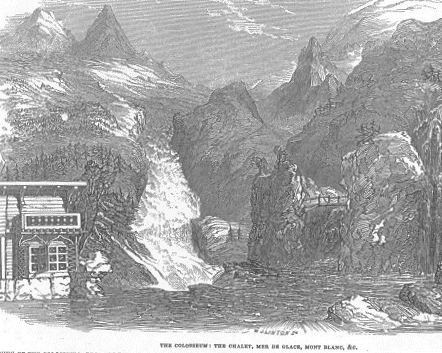
THE CHALET, MER DE GLACE, MONT BLANC &c
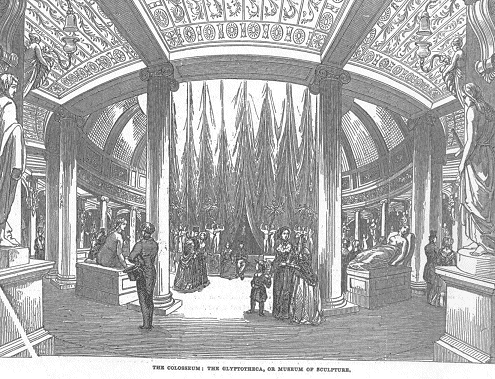
THE GYPOTHECA, OR MUSEUM OF SCULPTURE
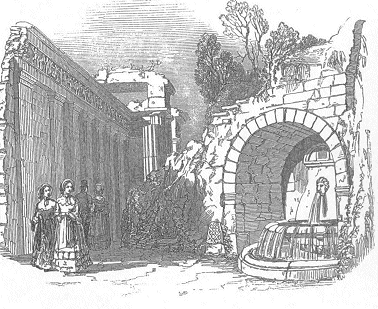
DECAYING GREEK TEMPLE WITH ITALIAN FOUNTAIN
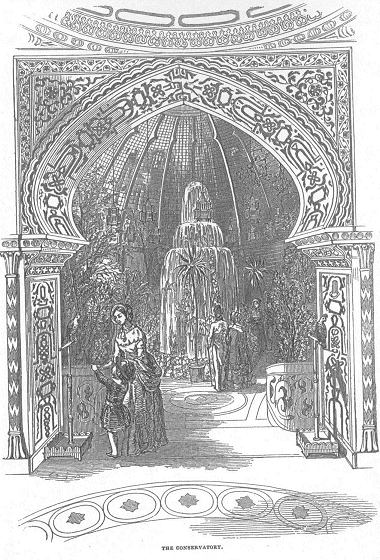
THE CONSERVATORY
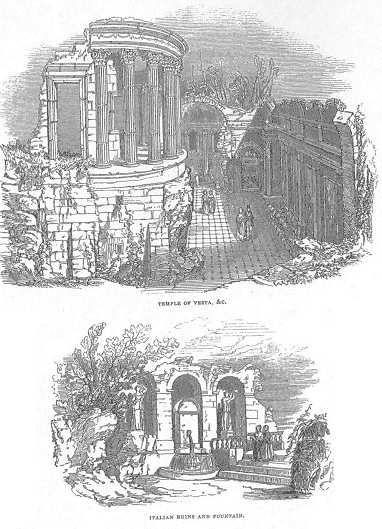
TEMPLE OF VESTA, ITALIAN RUINS AND FOUNTAIN
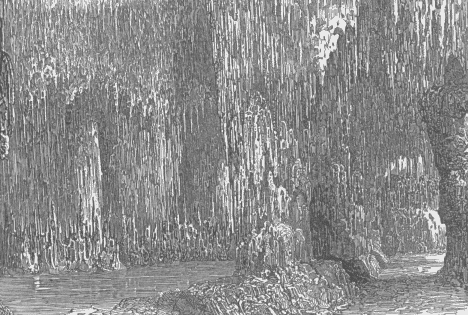
GROTTO
RE-OPENING OF THE COLOSSEUM, REGENT'S PARK
It is now nearly sixteen years since this
vast establishment was first opened for exhibition; and during that period it
has been visited by more than a million persons. Circumstances, much to be
regretted, prevented it being opened originally in a complete state; and when
the property changed hands in 1835, some alterations were made which did not
elevate its character as a place of public amusement. Its attraction,
consequently declined, until it appeared probable that this magnificent edifice
would be taken down, and private dwelling-houses erected on its site. At thus
juncture, the property was purchased by its present owner, who considered it
possible that, with judicious alterations, improvements and additions, the
Colosseum might altogether by restored to public favour. In this hope, he
consulted Mr. Bradwell, whose taste and skill in decorative art and scenic
effects are well known; and this gentleman having designed plans for remodelling
and renovating the entire establishment, they have been executed solely under
his direction, by the most eminent artists. It is, at present, arranged that the
whole will be opened for exhibition early in the ensuing week. In the meantime,
we shall introduce to our readers two of the principal novelties: The Mountain
Scenery, or Model, in the rear of the main polygonal building; and the new
Sculpture Hall in its basement.
The First Illustration shows a portion of the Exterior of the
Chalet, or Swiss Cottage, with the Mer de Glace, and the snow-clad peak of Mont
Blanc; whilst the Mountain Torrent on the left, leaping over the nearest rocks,
comes roaring down the precipes; and after forming a small lake in front of the
cottage windows, overflows its stony basin, and, with a second fall, disappears
in the gulf below. This is, unquestionably, the finest specimen of Model Scenery
executed in this country . . . by the artist, Mr. Danson.
Our second scene shows the Glypotheca, or the Museum of
Sculpture, an entirely new building, designed and erected by Mr. Bradwell. Those
who remember what this apartment was as the Saloon of Arts, cannot fail to be
struck with its complete transformation. In lieu of the calico draperies, which
had the appearance of a large tent, temporarily fitted up, the visitor now
beholds a lofty dome of several thousand feet of richly-cut glass, springing
from an entablature and cornice supported by numerous columns. The frieze is
enriched with the whole of the Panathenaic procession from the Elgin marbles,
and is continued without interruption throughout the entire circumference of the
hall, above which are 20 fresco painting of allegorical subjects on panels; the
mouldings, cornices, capitals of columns, and enrichments being all in gold,
modelled by Mr. Henning, jun.; painted by Mr. Absalom. Beyond the circle of
columns is another of as many pilasters, dividing and supporting arched
recesses. in each of which, as well as between the columns, are placed works of
art from the chisels of some of the most eminent foreign and British sculptors.
In the centre of the building is the circular framework inclosing the staircase
leading to the Panorama; this hung with a classically-disposed drapery, from the
summit of the arched dome to the floor concealing the stairs, and harmonising
with the prevailing tints of the architectural decorations. Around this are
seats covered with rich Utrecht velvet, raised on a dais, and divided by groups
of Cupid and Psyche supporting candelebras in the form of palm-trees; the
figures white, and the draperies, leaves, plumes &c., heightened with gold.
Various other figures support branches for lights around the outer circle and
the whole, whether viewed by daylight, or illuminated in the evening, is a
fascinating coup d'oeuil. The figures, we should add, are tastefully
modelled by Mr. Henning, jun. From this hall the public will have, as formerly,
the choice of two modes of ascent to the first gallery, to view the Panorama;
either by the spiral staircase, just mentioned, or by the Ascending Room ...
RE-OPENING OF THE COLOSSEUM, REGENT'S PARK
We
resume our anticipatory survey of the artistic novelties just completed at this
very popular exhibition; and request the reader to accompany us to the eastern
entrance in Albany-street, which is entirely new. The main addition seen from
she street is a vast apartment, lighted with several lofty windows; the
appropriation of the saloon is not precisely known; but the walls, we are
informed, will bear some extraordinary triumph of scenic skill.
from The Illustrated London News, April 26 & May 3, 1845
PUNCH'S VISIT TO THE COLOSSEUM.
THIS splendid pile of architectural stucco, which rears it, proud dome of zinc
towards a Regent's Parkian sky, was on the eve of being crumbled to atoms
beneath the hammer of the auctioneer, when it was suddenly snatched from its
impending fate by the hand of a capitalist and the eye of an artist. The classic
ground on which the Colosseum stands was about to be actually covered with
ordinary houses, and a row of common-place structures would have filled the spot
hallowed by the truly Roman recollection, which extend from the Camera Obscura,
on the south, to the Lodge, on the north, of the Colosseum. Fortunately,
however, the classic eye of BRADWELL saw the site, and wept its expected
desecration. He could not bear the horrible idea of kitchen sinks and wash-house
pumps standing on the ground where the Swiss Cottage and the indomitable Eagle
had been so often seen. BRADWELL recollected the prediction-
"While stands the Colosseum,
Rome shall stand"
and it occurred to him that the stability of London might depend on the same
contingency. There can be no doubt that unless the Colosseum in the Regent's
Park continues to stand, London, which is exhibited inside, must inevitably
perish; Thanks to a spirited capitalist, who summoned the genius of BRADWELL to
his aid, the Colosseum has, not only been restored to all its original
stability, but made to surpass in splendour and taste anything that Eastern or
Western magnificence can display. We may in vain turn our eye with the
weathercock to every point of the compass, for "we shall never look upon
its like," or anything like its like, "again."
Punch, Jul.-Dec. 1845
I have mentioned the Adelaide Gallery and the Polytechnic
Institution, and there were many other exhibition-places
eminently respectable and popular in my youthful days, which
have since been done away with, and the very names of which
are now scarcely heard. Foremost of these was the Coliseum,
on the east side of the Regent's Park, covering the space now
occupied, I should say, by Cambridge Gate to the front and
Coliseum Terrace to the rear-an enormous polygon, a hundred
and twenty-six feet in diameter, and over a hundred feet high,
built from the designs of Decimus Burton, whose best-known
work nowadays is the Marble Arch. The industrious John Timbs, in his Curiosities of London, tells us that the Coliseum
-or Colosseum, as he spells it - was so called from its colossal
size, and not from any supposed resemblance to its namesake
in Rome. But this spoils the story of the not too cultured
cornet in the Blues, who from Rome wrote to his friend, "I
see they've got a Coliseum here, too; but it is not in such good
repair as that one near our Albany Street Barracks." I remember it well -
my father, in partnership with John Braham,
once owned it, to his sorrow - with its wonderful panoramas of
London by day and London by night, best things of the kind
until eclipsed by the "Siege of Paris" in the Champs Elysées;
its glyptotheca, full of plaster casts; its Swiss chalet, with a real
waterfall, and a melancholy old eagle flopping about its "property" rocks; its stalactite cavern, prepared by Bradwell and
Telbin; and its sham ruins near the desolate portico.* (* The gallery from which the vast panoramas of London were
inspected
was reached by a spiral staircase, and also by the "ascending room," the
precursor of the "lifts," "elevators," and "ascenseurs," now to be found
in every European and American hotel.) In a
small dark tank in the interior of the building I once skated on
some artificial ice; and there was a lecture-theatre, in which I found myself, just before the final doom of the establishment (I
had come in for shelter from a rain-storm), one of an audience
of three listening to an entertainment given by a little gentleman, who was nothing daunted by the paucity of his appreciators, and who sang and danced away as if we had been three
thousand. This plucky neophyte, then very young, has since
developed into that excellent actor, Mr. Edward Righton.
To the Coliseum, some years before its
final fall, was added
the Cyclorama - an extraordinarily realistic representation of
the earthquake of Lisbon. The manner in which the earth
heaved and was rent, the buildings toppled over, and the sea
rose, was most cleverly contrived, and had a most terrifying
effect upon the spectators; frightful rumblings, proceeding
apparently from under your feet, increased the horror, which
was anything but diminished by accompanying musical performances on that awful instrument, the
apollonicon. Never
was better value in fright given for money.
Edmund Yates, His Recollections and Experiences, 1885
[chapter on 1847-1852]
COLOSSEUM (THE), in the REGENT'S PARK. Built (1824) by Decimus Burton, for Mr. Hornor, a land-surveyor, who made the sketches of the panorama of London from the top of St. Paul's, afterwards finished by Mr. E.T. Paris and his assistants, on 46,000 square feet of canvas. The name was suggested, I suppose, by the colossal size of the building, for its form resembles the Pantheon at Rome and not the Colosseum. It is used as an exhibition, and was sold, May 11th, 1843, for 23,000 guineas. It will well repay a visit.
Peter Cunningham, Hand-Book of London, 1850
COLOSSEUM in the Regent's Park, called also the Cyclorama, a large circular
edifice, with a massive portico in the Doric style of architecture. is a public
exhibition, and contains a view of London upon a large scale, as it would appear
from an elevated position, such as from St. Paul's, In addition there are
conservatories of the choicest plants and flowers; fountains, with every
fashionable amusement and recreation, natural and artificial, together with a
saloon, containing works of the Fine Arts &c.. and is splendid concert room, the
entrance to which is in Albany Street. The prices of admission vary. . . . The
most considerable building erected in London for public shows, and therefore not
inaptly named, though unfortunately; as the comparison with its huge and
substantial namesake was uncalled for by the most distant resemblance of form,
and must raise expectations in strangers, only to disappoint them. The chief
portion and that first built in 1824 is a domed rotunda, 120ft in diameter, and
the same in height, to which is attached on the west an entrance portico, so
that the whole resembles a miniature of the Pantheon, except that the
portico is Doric, with only six columns, which are said to be exact full-sized
models of those of the Parthenon; but the reduction of the eight-columned
to a six-columned facade, without making any other change in the proportions,
has destroyed the symmetry; and, as usual, the stripping this sublime style to a
bare skeleton, the representation of this denuded remnant in plaster sham
grandeur, and then its prostitution to the purpose of a show, has exceeded the
true bounds of the burlesque, and altogether failed to please.
The rotunda was intended for exhibiting a truly admirable
panoramic view of London, taken from the top of St. Paul's, the sketches by a
Mr. Horner, who projected the speculation, but was ruined by it, and the
painting by Mr. E.T.Parris. The most elaborate work (presenting the rare
combination of minute detail with a truth of effect amounting to deception) is
now hidden by other panoramas changed about once in two years, the present one
representing the Lake of Thun. There are a variety of other scenic arrangements
well worthy a visit, and the apparent extent given by them to a very small piece
of ground is remarkable. Round the ground floor of the rotunda is a gallery of
casts of sculpture, and in the new building next Albany Street, an extremely
elegant and classic room for exhibiting cycloramas, or moving landscapes, of
which the present represents the Tagus from its mouth to Lisbon.
London Exhibited in 1852
COLOSSEUM (THE).
THE Colosseum, upon the east side of the
Regent's-park, was originally planned by land-surveyor and the building was
commenced for him 1824, by Peto and Grissell, from the designs of Decimus
Burton. The chief portion is a polygon of sixteen faces, 126 feet in diameter
externally, the walls being 3 feet thick at the ground; and the height to the
glazed dome is 112 feet. Fronting the west is an entrance portico, with six
Grecian-Doric fluted columns, said to be full-sized models of those of the
Parthenon. The external dome is supported by a hemispherical dome, constructed
of ribs formed of thin deals in thicknesses, breaking joint and bolted together,
on the principle educed by M. Philibert de l'Orme in the 14th century, and
stated to be introduced here for the first time in England. The second dome also
supports a third, which forms a ceiling of the picture, to be presently
described. The building resembles a miniature of the Pantheon, and has been
named from its colossal size, and not from any resemblance to the Colosseum at
Rome; but it more closely resembles the Roman Catholic Church at Berlin.* (* In
1769, there was constructed in the Champs Elys?es, at Paris, a vast building
called Le Colise?, for fetes in honour of the marriage of the
Dauphin, afterwards Louis XVI. Here were dances, hydraulics, pyrotechnics,
&c.; the building did not resemble the Pantheon, as ours in the
Regent's-park, but the Colosseum at Rome. It contained a rotunda, saloons, and
circular galleries, skirted with shops, besides trellis-work apartments and four
caf?s. In the centre of Le Cirque was a vast basin of water, with
fountains; beyond which fireworks were displayed. The whole edifice was
completely covered with green trellis-work; the entire space occupied by the
buildings, courts, and gardens, was sixteen acres; and the cost was two and a
half millions of money. There were prize exhibitions of pictures; and Mr. Homer
projected similar displays at the Colosseum, but the idea was not taken up by
the British artists. In 1778, the Parisian building was closed, and two years
afterwards was taken down. It is mentioned by Dr. Johnson, in his Tour, in
1775.)
The building is lighted entirely by the glazed dome, there being
no side windows. Upon the canvassed walls was painted the Panoramic View of
London, completed in 1829; for which Mr. Homer, in 1821-2, made the sketches at
several feet above the present cross of St. Paul's Cathedral (as described at
p. 115). The view of the picture was obtained from two galleries: the first corresponds,
in relation to the prospect, with the first gallery at the summit of the dome
of St. Paul's;. the second with the upper gallery of the cathedral. Upon
this last gallery is placed the identical copper ball which formerly occupied
the summit of St. Paul's; above it is a fac-simile of the cross; and over these
is hung the small wooden cabin in which Mr. Homer made his drawings. A small
flight of stairs leads from this spot to the open parapet gallery which
surrounds the domed roof of the Colosseum. The communication with the galleries
is by spiral staircases, built on the outside of a lofty cylindrical core in
the centre of the rotunda; within which is also the "Ascending Room,?
capable of containing ten or twelve persons. This chamber is decorated in the
Elizabethan style, and lighted through a stained-glass ceiling; it is raised by
secret machinery to the required elevation, or gallery, whence the company
viewed the panorama. The hoisting mechanism is a long shaft connected with a
steam-engine outside the building, working a chain upon a drum-barrel, and
counterbalanced by two other chains, the ascending motion being almost
imperceptible.
The painting of the picture was a marvel of art. It covers
upwards of 46,000 square feet, or more than an acre of canvas; the dome
on which the sky is painted is 30 feet more in diameter than the cupola of St.
Paul's; and the circumference of the horizon from the point of view is nearly
130 miles. Excepting the dome of St. Paul's Cathedral, there is no painted
surface in Great Britain to compare with this in magnitude or shape, and even
that offers but a small extent in comparison. It is inferred that the
scaffolding used for constructing St. Paul's cupola was left for Sir James
Thornhill, in painting the interior; and his design consisted of several
compartments, each complete in itself. Not so this Panorama of London, which,
as one subject, required unity, harmony, accuracy of linear and aerial
perspective; the commencement and finishing of lines, colours, and forms, and
their nice unity; the perpendicular canvas and concave ceiling of stucco was
not to be seen by, or even known to, the spectator; and the union of a
horizontal and vertical surface, though used, was not to be detected. After the
sketches were completed upon 2000 sheets of paper, and the building finished,
no individual could be found to paint the picture in a sufficiently short
period, and many artists were of necessity employed: thus, by the use of
platforms slung by ropes, with baskets for conveying the colours, temporary
bridges, and other ingenious contrivances, the painting was executed, but in
the peculiar style, taste, and notion of each artist; to reconcile which, or
bring them to form one vast whole, was a novel, intricate, and hazardous task,
which many persons tried, but ineffectually. At length, Mr. E. T. Parris,
possessing an accurate knowledge of mechanics and perspective, and practical
execution in painting, combined with great enthusiasm and perseverance,
accomplished the labour principally with his own hands; standing in a cradle or
box, suspended from cross poles or shears, and lifted as required, by ropes.
The Panorama was viewed from a balustraded gallery, with a
projecting frame
beneath it, in exact imitation of the outer dome of St.
Paul's Cathedral, the perspective and light and shade of the campanile towers in
the western front being admirably managed. The spectator was recommended to take
four distinct stations in the gallery, and then inspect in succession the views
towards the north, east, south, and west; altogether representing the Metropolis
of 1821, the date of the sketches.
The North comprises Newgate-market, the old College of Physicians, Christ's Hospital (before the rebuilding of the Great Hall), St. Bartholomew's Hospital, and Smithfield Market; and the New General Post-Office, then building. These are the objects near the foreground: beyond them arc Clerkenwell, the Charterhouse, and the lines of Goswell-street, St. John-street, Pentonville, Islington, and Hoxton. In the next, or third distance, are Primrose-hill, Chalk Farm, Hampstead, and a continued line of wooded hills to Highgate, where are the bold Archway and the line of the Great North Road from Islington; whilst Stamford-hill, Muswell-hihl, part of Epping Forest, and portions of Essex, Hertfordshire, and Middlesex bound the horizon.
The East displays a succession of objects all differing from the former view in effect, character, and associations. Whilst the north exhibits the rustic scenery of the environs of London, the east presents us with the Thames, and its massive warehouses and spacious docks; the one a scene of rural quiet, the other a focus of commercial activity. In the foreground is St. Paul's School-house; whilst the lines of Cheapside, Cornhill, Leadenhall-street, and Whitechapel carry the eye through the very heart of the City, and thence to Bow, Stratford, and a fine tract of woodlands, in Essex. On the right and left of this line are the towers and steeples of Bow Church, St. Mary Woolnoth; St. Michael, Corn-hill; St. Ethelburga, Bishopsgate, and others of subordinate height; the Bank, Mansion-house, Royal Exchange (since destroyed by fire), East India House, and several of the Companies' Halls. Another line, nearly parallel, but a little to the east, extends through Watling-street (the old Roman road) to Cannon-street, Tower-street, and the prison, palace, fortress, and museum - the Tower. The course of the Thames, with its vessels and wilderness of masts, the docks and warehouses on its banks: the palace- hospital of Greenwich and the beautiful country beyond it, contrasted with the levels of the Essex bank- are all defined in this direction.
Southward, the eye traces the undulating line of the Surrey hills in the distance; and in the fore- part of the picture the Thames, with its countless craft, among which are civic barges and steamers, characteristic of ancient and modern London. Here also are shown old London-bridge, and Southwark, Blackfriars, Waterloo, Westminster, and Vauxhall Bridges, whilst the river-banks are crowded with interesting structures, among which are the old Houses of Parliament.
The Western view presents a new and different series of objects. First, in effect, in beauty of execution and imposing character, are the two campanili, the pediment, and the roof of the western end, of St. Paul's Cathedral. The painting here is masterly and magical; it so deceives the eye and the imagination, that the spectator can scarcely believe these towers to be depicted on the same canvas and the same surface as the whole line of objects from Ludgate Hill to St. James's-Park. This view to the west embraces the long lines of Ludgate-hill, Fleet-street, and the Strand, Piccadilly, &c.; Holborn-hill and Oxford-street, with the Inns of Court; Westminster; numerous churches and public buildings, right and left; and Hyde-park, Kensington-gardens, and a long stretch of flat country to Windsor.- Brief Account, by John Britton, F.S.A., 1829.
A
staircase leads to the upper gallery, whence the spectator again commanded the
whole picture in a sort of bird's-eye view. Another flight of stairs
communicates with the room containing the copper ball and fac-simile cross of
St. Paul's. A few more steps conduct to the outer gallery at the summit;
where, in fine weather, the spectator might compare the colouring,
perspective, and effects of nature with those of art within.
The
Panorama was first exhibited in the spring of 1829. It was almost repainted by
Mr. Parris in 1845; when also a Panorama of London by Night, essentially the
same as the day view, was exhibited in front of the latter, and bad to be
erected and illuminated every evening: the moonlight effect upon the rippling
river; the floating, fleecy clouds and twinkling stars; the lights upon the
bridges, in the shops, and in the open markets, formed a rare triumph of
artistic illusion. In May, 1848, a moonlight Panorama of Paris, of the same
dimensions as the night view of London, was painted by Danson, and was very
attractive in illustration of the localities of the recent Revolution. In
1850, both views gave way to a Panorama of the Lake of Thun, in Switzerland,
painted in tempera by Danson and Son; and in 1851, the Panorama of London was
reproduced as a more appropriate sight for visitors during the International
Exhibition season.
The
Picture, however, was but one of the many features of the Colosseum. The
basement of the Rotunda has a superb Ionic colonnade, as a sculpture-gallery,
named the Glyptotheca: the columns and entablature are richly gilt; and the
frieze, nearly 300 feet in circumference, is adorned with bhas-reliefs from the
Panthenaic friezes of the Parthenon, exquisitely modelled by Henning; the
ribbed roof being filled with embossed glass.
Southward
and eastward of the Rotunda are large Conservatories, a Swiss chalet, and
mountain scenery interspersed with real water: these were executed by Mr.
Hornor,
whose enthusiasm led him to project a tunnel beneath the Regent's-park road,
and to anticipate a grant from the opposite enclosure to be added to the
Colosseum grounds. But the ingenious projector failed: the property passed
into the hands of trustees; after which it lost much of its status as a place
of public amusement; but on May 11, 1843, it was bought for 23,000 guineas by
Mr. David Montague, who altogether retrieved and elevated the artistic
character of the establishment.
The
Colosseum, as altered, with the exception of the Panorama, was principally
executed in 1845, from the designs of the late Mr. W. Bradwell, formerly
chief machinist of Covent Garden Theatre. The eastern entrance, in
Albany-street, was then added, with an arched corridor in the style of the
Vatican, and leading to the Glyptotheca, the Arabesque Conservatories, and the
Gothic Aviary, the exterior promenade, with its model ruins of the Temple of
Vesta and Arch of Titus, the Temple of Theseus, and golden pinnacles and
eastern domes, - chaos of classic relics of the antique world. A romantic pass
leads to the chalet, or Swiss Cottage, originally designed by P. F.
Robinson: the roof, walls, and projecting fireplace are fancifully carved; and
the bay-window looks upon a mass of rock-scenery, a mountain-torrent and lake,
- a model picture of the sublime. In another direction lies a large model
of the Stalactite Cavern at Adelsberg, in Carniola; constructed by Bradwell
and Telbin.
At
Christmas, 1848, was added a superb theatre, with a picturesque rustic armoury
as an ante-room. The spectatory, designed and erected by Bradwell, resembles
the vestibule of a regal mansion fitted up for the performance of a masque: it
is decorated with colossal Sienna columns, and copies of three of Raphael's
cartoons in time Vatican (School of Athens, and Constantine and the Pope), by
Homer, of Rathbone-place; the ceilings are gorgeously painted with
allegorical groups; and upon the fronts of the boxes is a Bacchanalian
procession, in richly-gilt relief. Upon the stage passed the Cyclorama of
Lisbon, depicting in ten scenes the terrific spectacle of time great
earthquake of 1755- the uplifting sea and o'ertopping city, and all the
frightful devastation of flood and fire; accompanied by characteristic
performances upon Bevington's Apollonicon. The scenes are painted by Danson,
in the manner of Loutherbourg's Eidophusicon, which not only anticipated, but
in part surpassed, our present dioramas. The entire exhibition has long been
closed.
In
March, 1855, the Colosseum, with the Cyclomama, were put up to auction by the
Messrs. Winstanley. It was then stated that the Colosseum was erected at a
cost of 23,000l. for Mr. Thomas Hornor, who held a lease of it direct from
the
Crown, at a ground rent of 262l. 18s. for a period of ninety-nine years,
sixty-nine of which were unexpired on the 10th of October, 1854. He
subsequently expended above 100,000l. to carry out the objects for which it
was intended, by decorating the interior, purchasing pictures, &c. In
August, 1836, the lease was sold to Messrs. Braham and Yates. Mr. Braham laid
out about 50,000l. on the building, which in a few years afterwards became the
property of Mr. Turner, who added the Cyclorama, which cost 20,000l., to the
establishment, with many decorations, at several thousand pounds' expense; so
that the entire edifice has cost above 200,000l. The sum of 20,000l. was bid,
but the property was not sold.
John Timbs, Curiosities of London, 1867
The Colosseum, is on the east side of Regent's Park, with an entrance from Albany-street. The building is after the general design of the Pantheon at Rome. It was built in 1824, and is polygonal in form, surmounted by a glazed cupola. It is no longer used as a place of amusement, though it was for years celebrated for its panoramas of London and other cities, dioramas, dissolving views, conservatories, Gothic aviary, Temple of Theseus, Swiss Cottage, &c.
Routledge's Popular Guide to London, [c.1873]
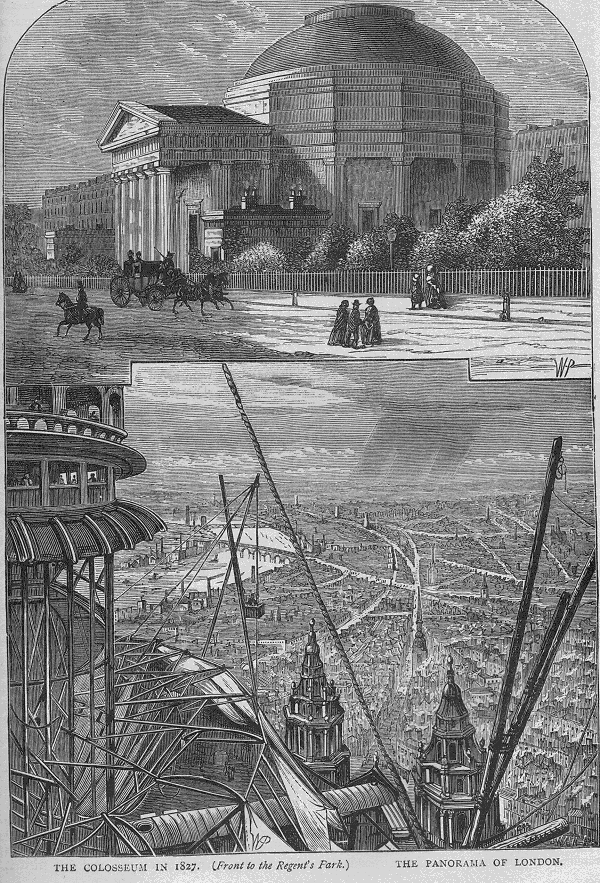
Old and New London, c.1880