
from The Illustrated London News, 1843
East India Company's Museum, The ... is open to the public, free of all charge, on Saturday from 11 to 3; and on Mondays and Thursdays by an order from a director.
East India House is a vast edifice; it was originally founded in 1726, but was in 1798 so much altered and enlarged as to become almost an entire new building; it comprises the principal offices of the East India Company, and contains several noble apartments. The Grand Court Room is a light and elegant apartment. The New Sale Room, a noble apartment, is ornamented with pilasters, and contains several paintings illustrative of Indian and other commerce. The Old Sale Room is embellished with the statues of Sir Eyre Coote, Lord Clive, Sir G. Pocock, and General Laurence. The room for the Committee of Correspondence is embellished with portraits of the Marquis Cornwallis and Warren Hastings, and with numerous views of Indian scenery. The Library, well stored with works on general literature, possesses, in addition, every book published upon the subject of Asia, and a fine collection of Chinese and Indian manuscripts; and the Museum adjoining it abounds in Indian curiosities of every description.
Mogg's New Picture of London and Visitor's Guide to it Sights, 1844
EAST INDIA HOUSE, LEADENHALL STREET, - the House of the East India Company, the largest and most magnificent Company in the world - was built on the site of a former house by Mr. R. Jupp, in 1799, and subsequently enlarged from designs by C.R.Cockerell, R.A., and W. Wilkins, R.A. The pediment (a poor thing) was the work of the younger Bacon. The Company was first incorporated by a charter dated Dec. 31st 1600; confirmed, enlarged, and altered by several subsequent charters. The last great change was made in 1833, when an Act of Parliament was passed, by which the Company is now governed. This act continues the government of India in the hands of the Company until 1854. The home government of the Company consists of "The Court of Proprietors, or General Court," composed of the owners of India stock; "The Court of Directors," selected from the Proprietors; and "The Board of Control," nominated by the Sovereign. Here is a Museum open to the public on Saturdays, from 11 to 3. Observe.- Large and capital drawing of old East India House. Hindu idols in silver and gold. Hindu and Goorkha swords. Pair of Gauntlets made at Lahore, sometimes used by the native chiefs and horsemen in India (beautifully elaborate). Sword of the executioner attached to the palace of the King of Candy, (taken at the capture of Candy). Piece of wood of the ship "Farquharson," containing the horns of a fish called the monodon; the largest horn had penetrated through the copper sheeting and outside lining into one of the floor timbers. An emblematic organ (a tiger on a man), contrived for the amusement of Tippoo Sultan. Surya, the Sun, in his seven-horse car. Buddhist idols, and relics. A perfumed gold necklace. The state howdah of Durgan Sal, usurper of Bhurtpore. Full-length portrait of the famous Nadir Shah. Roman tesselated pavement found in front of the East India House - human figure reclining on a tiger. Babylonian inscription on stone, as sharp and perfect as the day it was cut. Bust of Mr. Colebrooke, by Chantrey. The coins (a most valuable collection under the care of Prof. H.H.Wilson) can only be seen by special permission. Hoole, the translator of Tasso; Charles Lamb, author of Elia; and James Mill, the historian of British India; were clerks in the East India House. "My printed works," said Lamb, "were my recreations - my true works may be found on the shelves in Leadenhall-street, filling some hundred folios."
Peter Cunningham, Hand-Book of London, 1850
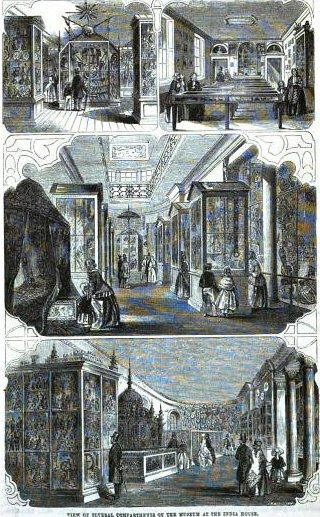
 East India House Museum, 1858 [ILN Picture Library]
A VISIT TO THE EAST INDIA MUSEUM.
This Museum, to which late events have given a more than ordinary interest, occupies a series of apartments, or floors, one above another, in the India House, Leadenhall Street. It is open to the public free on one day of the week, and may be visited on other days by the possessors of tickets, obtainable from members of the Court, or other authorities, but is closed during the month of September. It contains a mass of curious and interesting material, illustrative of the manners, customs, arts, and industry of the people of India, and also in some degree of their religious superstitions and past history. Owing to the absence of systematic classification, and the want of a catalogue—to which we may add, the evident want of room for the proper display of the treasures accumulated—it is not easy at one view to acquire anything like a correct notion of the whole, much less to note every object worthy of observation. The collection is, in fact, well deserving of the closest study and scrutiny, and it is much to be regretted that every facility, with regard to space, to the distribution of annotated catalogues, and the affixing of descriptive labels to the several articles, is not afforded to the public. There is enough here, with the aid of such explanatory notes as the various articles would suggest, to teach the people of England, in a few hours, more of the inner life and social customs of the Hindoos than they are likely to get from years of desultory reading, or, indeed, than is to be got at all from any existing published works. It is sometimes a subject of complaint that the popular mind of England has never been brought into contact with the popular mind of Hindostan. The complaint is just: as a mass, we know next to nothing of the hundred millions of Hindoos who are our fellow-subjects; we gaze with surprise and wonder at their industrial miracles—at their inimitable textile fabrics—at the proofs they send us of their unaccountable perseverance in minute and laborious undertakings, and of their unrivalled skill in such masterpieces of patience and manual dexterity; but of the Indian people—the power that produces these astonishing results—we know nothing, or next to nothing. Now, the East India Museum would afford a key to a good part, at least, of this mystery, and, if rightly used, would render valuable service in enlightening us with regard to a subject which is becoming day by day of more importance to Englishmen.
The visitor will do well to commence his examination upon the basement floor. This is chiefly appropriated to the reception and arrangement of models embracing a large variety of subjects, all of them possessing tho recommendation of novelty to the untravelled spectator, and all more or less curious and interesting. Our space will allow us to notice but a few. The model of Juggernaut's ugly car strikes us with the aspect of an old acquaintance, and, remembering it for thirty years at least in the illustrated pages of the missionary reports, we are not surprised to find it a rather worn-out and dusty affair. A much more sightly thing is a model of a royal chariot-shaped palanquin, of carved wood, leather, and ivory, in which a grandee, who could dispense with the ceremony of stretching his legs, might ride aloft in regal state. Bnt the most notable model is perhaps that of the tomb of Runjeet Singh, at Lahore. This is elaborately carved in a species of dark wood, and represents a magnificent temple, having four facades, each apparently the counterpart of the others, and a grand dome rising in the centre, the dome being crowned by a lofty spire. The design is grand and imposing, but to the eye of an European it has nothing sepulchral about it, and would suggest rather the idea of life, with splendour and luxury within its walls, than of silence, solitude, and death.
A model of the Bridge and Falls at Goluckpore shows one of the peculiarities of river navigation in India, and the mode in which the difficulties arising from the sudden innndations to which the country is liable are met. The models of Indian dwelling-houses of the upper class afford us some insight into the comforts and luxuries of the rich, and, surrounded as several of them are, with groups of the natives employed at their several avocations, enable us to form some notion of the domestic establishment and operations of an Indian household. A most beautiful model, executed in soft white wood, represents a fort on an eminence, surrounded by square, barrack-like buildings at its base; diminutive figures of soldiers are standing singly or in ranks about the ground, and the whole is carved with consummate skill and delicacy of finish.
The models of figures may he numbered by the thousand. Perhaps the most useful and interesting are those which represent the workers at their several crafts and occupations : these, for the most part, are of diminutive size; but they are clad, or half-clad, or unclad, as the case may be, in their national and professional costume, and we see them at work, weaving, digging, carrying water, tilling the soil, grinding the corn, cooking their food, or juggling, conjuring, snake-charming, and exercising themselves in feats of agility or muscular exploits—at all their occupations, in short, as they would be found actually engaged on their native soil. One scene represents a grand procession at the marriage of a native rajah, the models being arrayed in glittering robes and arms, and literally sparkling with gold and gems; some on foot, some on horseback, others on camels or elephants, and others, again, borne in chariots. Another scene is a court of justice, at which a trial is going forward, and all the officials in their robes of office are present, with plaintiff and defendant, and an audience to represent the public. Again, there are models of religions fanatics and ascetics, showing the various modes of torture and self-devotion to which these misguided zealots of heathenism submit themselves at the instigation of their doleful creed.
 The models of tools of all kinds, and of agricultural implements, are interesting as exhibitions of a rude state of knowledge in reference to the arts of cultivation. Then there are models of every species of carriage, whether on poles, as in the palanquin, or on wheels. And finally, among the models, must not be omitted those of their sea and river-craft, whether for purposes of commerce or of which the Indian shipwrights launch upon their waters. Some of them are exceedingly light and handsome, resembling in a degree European yachts, and carrying large, angular, lateen sails, under which they must fly at considerable speed. Others, again, are as heavy and enmbersome as the Chinese junks ; such are some of the cotton-boats; and some, as the cargo-boats, for instance, seem to be mere shapeless masses of floating lumber, compared to which the heaviest Dutch bottom would be a flying Mercury. The stateboots, adapted for regal or religious pageants, seem to vie almost with those of the Venetian doges in point of costliness and splendour.
On the same floor with the models are displayed a collection of Indian musical instruments. All of them are of the portable kind, and they embrace wind-instruments, such as horns, trumpets, clarions, bamboo flutes; stringed instruments of the banjo sort, some apparently of the nature of the viol, and others which look like a hybrid between the harp and the guitar. What is remarkable about them all is the utter ignorance of the principles of acoustics on the part of their makers, and the lavish amount of labour bestowed on their structure and ornamentation. This remark does not, however, apply to the cymbals, gongs, drums, and bells, and other contrivances for the perpetration of uproarious noises.
Leaving the basement floor, the visitor may ascend the staircase, on the walls of which he will have an opportunity of examining a rather comprehensive assortment of Indian woven fabrics of the useful sort. These are principally mattings, rugs, carpets richly wrought in a kind of shawl pattern; mats of willow, straw, or split bamboo; floor-cloths embroidered in silk floss on a silk ground; hangings of the same kind with figures of animals and of human beings mingled with flowers, scrolls, and pattern work. Higher up he will come upon huge buffalo heads and horns, and the heads and antlers of the wild stag. In the cases on the landing, he will see specimens of the hemp plant, and of various kinds of substitutes for hemp prepared from the fibre of other plants. Together with all these are shown some fine samples of the ropes, cables, and cordage, for the manufacture of which they seem to be perfectly well adapted.
The first floor of the Museum is entered through a kind of lobby, in which the visitor stands before a finished model of a nautch, which is a representation of a kind of regal levee, at which a prince, sitting in front of a tent of crimson velvet, fringed with a massive bordering of silver-work, receives the homage of his ministers and chiefs, or perhaps his guestb. The whole affair is of the most gorgeous description, blazing in gold, silver, and brilliant colours.
Near this striking group hang numerous samples of Indian leather; it is mostly of a sound, substantial kind, but in point of dressing is not equal to the work of the western tanner. On the opposite wall are specimens of paper of various sorts, made of exceedingly coarse and inexpensive materials, such as the jute which is so largely used for door-mats, and other common vegetable fibres. In the same lobby are an assortment of baskets, most of them finely woven with straw, willow, split bamboo, etc., and excelling in point of workmanship anything that our artisans can produce.
Passing through the lobby to the right, we are in presence of an exhibition of the choicest works of Indian skill of all kinds. Some paintings on the wall first challenge the eye. They are finished much in the style of our own miniature paintings, and would not suffer much by comparison with the best of them, in point either of colour or effect, or dexterity of handling. Perspective, however, is recognised but in part, and its recognition by the artist leads as often to blundering as it does to truth of outline.
In the kindred walk of sculpture, the Hindoo artist shows to much greater advantage. The carvings in ivory are most numerous, and all, without exception, are of high merit, evidencing remarkable correctness of eye, and skill in the use of the carving tool. Men, horses, camels, elephants—all are sculptured with astonishingfidelity as to form, and the most minute details are given with a scrupulous particularity, unrivalled, so far as we know, in tha works of Europeans, on the same diminutive scale. Equal praise is due to the carvings in stone: the material generally chosen are the varieties of native marble; sometimes it is agate or crystals; but in all the sculptures are of a High class, giving the character of the animals with much truth and vigour; and the whole of them bear the highest polish the material is capable of receiving.
A prominent object is a grand collection of Indian arms, inclosed in a glass-case. These are, nearly one and all, of the most magnificent and costly description, being inlaid or overlaid with ornaments of pure gold, and glittering here and therewith precious gems. The kreeses, or poniards, are fitted in handles of jasper, agate, native crystal, or rare stones; the shields, helmets, gauntlets, etc., are rough with chased work in the precious metals, or sparkling with jewels, and the swords, spears, and battle-axes are no less lavishly adorned. As for tlie matchlocks, their long steel barrels are one mosaic of gold-work, and the stocks and fittings are equally rich and gorgeous.
More elaborated than the arms, and perhaps as costly, are the specimens of cabinet-work in sandalwood. These are inlaid with particles of white metal, ivory, and rare stones, far more minute than the finest mosaic of the Italian school, and many of them must have occupied years of close and patient industry in their construction. Not less remarkable than these are the examples of minate carved work in the same wood, where, in the space of a single square inch, the labour of whole days is concentred; and microscopic blossoms, leaves, and filaments lie clustered together in a mass—all carved with persevering labour in the soft, close-grained wood.
Among the commoner products may be mentioned a curious collection of lacquered ware, and another of brass wares; these consist of lamps, vases, teapots, candlesticks, mortars, dishes, hookah-bottoms, water-vessels, and various domestic implements; also a collection of pottery, including specimens rude and rough, such as calabashes, tiles for paving, plates, cups, etc., and other specimens of elegant design and well finished, somewhat resembling the old Etruscan ware.
In the centre of this department, inclosed in a number of glass-cases, is a fine collection of gems,
jewels, and personal ornaments, together with articles in silver and gold of the choicest kind. Bracelets, armlets, necklaces, rings, amulets, and charms, lie here in heaps, the gems glittering and flashing like eyes in every beam of light. In the same glass-case are some rare specimens of silver and gold work, such as card-baskets, guardchains, metal bracelets, etc. The work bestowed on some of these, if it were paid for at the value of labour in London, would probably outweigh the cost of the material nearly a thousand times. And here we may as well make a remark, the force of which has struck us throughout thewhole of this examination : the distinguishing character of Indian industry is elaboration; the Hindoo artist seems never content with his work so long as it is possible to do anything more; utility he seems never to consider, and only deems his work perfect when he has exhausted all his powers upon it. Thus he makes, too often, articles which must remain untouched by the rude hands of use, to be preserved at all. This useless elaboration is not only perceptible, but prominent in all departments of Hindoo labour, and it tells a tale too plain to be mistaken—namely, that the labour of the native Hindoo has never found cither its proper channel or its merited reward.
Re-crossing the lobby and entering the chamber to the left, we find ourselves in a department in which, to confess the truth, we are not very much at home. This chamber contains a dazzling exhibition of female garniture and dresses, of gold-embroidered cloaks and head-dresses, of muslins bearing patterns printed in gold instead of colours, of chintzes, of shawls of Cashmere, of silk handkerchiefs and gown-pieces, of net-work as fine as gossamer, of delicate embroideries, of kincobs or massive textures ponderous with golden lace-work, of embroidery on velvets, of lace muslins, the lace wrought with threads of gold and minute devices of flat gold laminse—and more of the sort, at which the ladies present are in convulsive raptures, but which poor we want the wit to appreciate or describe. We can appreciate, however, the furniture of the room, which is of the most luxurious and costly kind, all full of that elaboration already hinted at; and we can appreciate the Nawab Schurff of Lucknow, in his niche at the end of the gallery. There he sits, as large as life, and just as natural, smoking his hookah under his awning of crimson velvet, with his legs crossed beneath him on the mat, and surrounded with all the elements of wealth and splendour becoming his condition.
Ascending the stairs to the top floor, we arc among the natural products of India, and surrounded by samples of the commercial staples of the country, derived from the animal, vegetable, and miueral kingdoms. These materials are exceedingly numerous, and we cannot attempt to catalogue them ; they are, however, classified and arranged in tolerable order in the cases and in the shelves. Among them are specimens of the various species of timber, in small blocks ; samples of Indian ceroals, corn, grain, rice in all its varieties, millet and every kind of pulse; tea, coffee, tobacco in leaf; arrowroot, tapioca, sugars, meal of all sorts, etc., etc. Then come the fruits, dried or preserved, as dates, figs, tamarinds, lemons ; and coloured models in plaster of such as cannot be preserved, as apples, pears, pines, and garden fruits. Cotton is exhibited in all stages of production and preparation, and trie same may be said of flax and vegetable fibres. There are silks in skeins from the Punjaub; wools of Cashmere, fine as silk and dazzling in their brilliancy of colour. There are stores of animal substances fit for manufactures, as shells, teeth, horns, elephants' tusks, mother of pearl, gorgeous feathers, dried sinews, etc. There are dyes, as indigo, saffron and cochineal, and there are the substances used for tanning. There are drugs, chemicals, and medicaments without number; there arc countless samples of oils, animal and vegetable; there are stones, pebbles, fossils, and geological specimens; there are paints, pigments, and earths for ceramic uses; and there are ores dug from the mine.
Such is the result of a very rapid survey of the Indian Museum, which we recommend the reader, at his opportunity, to examine deliberately for himself. We have said nothing of the muchtalked—of lions of the place—of Tippoo's tiger, and his invulnerable mantle—of the full length portrait (which is no credit to the artist) of the famous Nadir Shah—of the sword of the Candy executioner, etc. In truth, most of them escaped our view in the crowded masses of treasures with which the chambers are filled. There is occupation here for weeks of profitable study, and the Directors of the East India Company have conferred a boon on the public by giving them access to such an exhibition.
The Leisure Hour, 1858