[this article can also be viewed in the original text, with
pictures, at
Cornell University Library - Making of Amercia
http://cdl.library.cornell.edu/cgi-bin/moa/moa-cgi?notisid=ABK4014-0082-19]
[-190-]
LONDON MUSIC HALLS.
BY F. ANSTEY.
LONDON music halls might be roughly grouped into four classes—first, the aristocratic variety theatre of the West
End, chiefly found in the immediate neighborhood of Leicester Square; then the smaller and less aristocratic West End
halls; next, the large bourgeois music halls of the less fashionable parts and in the suburbs; last, the minor music halls
of the poor and squalid districts. The audiences, as might be expected, correspond to the social scale of the particular
place of entertainment, but the differences in the performances provided by the four classes of music halls are far less strongly
marked.
Let us take a typical establishment of the first class. Its exterior is more
handsome and imposing than that of most London theatres, even of the highest rank. Huge cressets in classical tripods flare between the columns of the facade, the windows and foyer glow with stained glass, the entrance hall, lighted by softened
electric lamps, is richly and tastefully decorated. You pass through wide, airy corridors and down stairs, to find yourself in a magnificent theatre, and the stall
to
which you are shown is wide and luxuriously fitted. Smoking is universal, and a large proportion of the audience promenade the outer circles, or stand in groups before the long refreshment
bars which are a prominent feature on every tier. Most of
the men are in evening dress, and in the boxes are some ladies, also in evening costume, many of them belonging to what is called good society. The women
in the other parts of the house are generally pretty obvious members of a class which, so long as it behaves itself with propriety in the building, it would, whatever fanatics may say to the contrary, be neither desirable nor possible to exclude.
The most noticeable characteristic of the audience is perhaps the very slight attention it pays to whatever is going on upon the stage. In the upper parts of the house the conversation renders it impossible to
hear distinctly anything that is said or sung, though the same remark does not apply to the stalls, where the occupants, if not enthusiastic, are at least languidly attentive. There is a large and excellent
[-191-] orchestra, with just a tendency to overdo the drum and cymbals. Stage footmen,
more gorgeous of livery but far meeker of aspect than their brethren in private
service, slip a giant card hearing a number into a gilded frame on either side of the proscenium before each item of the programme. The electric bell tings, the
lights are raised, the orchestra dashes into a prelude, and the artiste whose “turn” it is comes on. The main and distinctive feature of the entertainment, however, is
the ballet divertissernent, for which all else is scarcely more than padding, and these ballets are magnificent enough to satisfy the most insatiate appetite for splendor. There are two
in one evening, and each lasts about half an hour, during which time the large stage is filled with bewildering combinations of form and color.
Company after company of girls, in costumes of delicately contrasted tints, march, trip, or gallop down the boards, their burnished armor gleaming and their rich dresses scintillating in the limelight; at each fresh stroke of the
stage-manager’s gong they group themselves anew or perform some complicated figure, except when they fall back in a circle and leave the stage clear for the
premiere danseuse.
To the writer this lady’s proceedings are a source of never-failing enjoyment. There never was such artless
naiveté in any other human being.
To see her advance on the points of her toes, her arms curved symmetrically above her head, a smile of innocent childlike delight on her face, as if she had only just discovered the
art of dancing and was quite surprised to find it so agreeable a pastime, is an experience indeed. Then her high-stepping prance round the stage, her little impulsive
runs and bashful retreats, the astonishing complacency with which she submits to being seized and supported in every variety of uncomfortable attitude by the
personage next in importance to herself, her final teetotum whirl, are all evidently charged with a deep
but mysterious significance. It is not uninstructive, too, to watch the
countenances of the corps de ballet during these evolutions. Some are severely critical, and obviously of opinion that they could do it infinitely better themselves;
others whisper disparagement to sympathetic ears; others again study the signorina’ s every movement until she is opposite them, whereupon they assume an ostentatious abstraction, as if she was really
below their notice. And then she stops suddenly, amidst thunders of applause, the infantine smile giving place to a calm supe[-192-]- riority as she haughtily makes her way to
the wings through the ranks of coryphées. At last the end comes; the ballet girls are ranked and massed into brilliant parterres and glittering pyramids, the
premiere danseuse glides on in time to appropriate the credit of the arrangement, and the curtain falls on a blaze of concentrated magnificence.
Such is the main attraction on the programme of a first class music hall. Lately an attempt has been made to introduce an intellectual element into the other portion of the entertainment at one
establishment, where the management engaged a celebrated and justly popular actress to recite dramatic pieces by Lord Tennyson and other poets. On the night when the writer was present, the lady
appeared after a man-serpent and before a couple of child clog-dancers, and was heard with respect and attention, being rewarded by applause quite equal to that accorded
to the clog-dancing, though a shade less enthusiastic than the acclamation which greeted the contortions of the man-serpent.
It is unnecessary to describe the second class of music halls, in which neither audience nor entertainment presents any characteristic features.
Both externally and internally the bourgeois and suburban music hall differs considerably from its more fashionable rival. For one thing, it is generally dingier and gaudier of appearance; the entrance is covered with huge posters and
adorned with tea-garden plaster statues bearing colored lamps; the walls are lined with tarnished looking-glass, gilded trellis-work, or virgin cork. Sometimes
there is a skittle-alley or a shooting-gallery in the “Grand Lounge.”
The interior is as often rectangular as semicircular, and the scheme of decoration of the old gaudy crimson, plaster, and gilding order. In many places, too, the
chairman still lingers. This personage is, of course, a survival from the old “Cave of Harmony” days, and his duties are now confined to sitting at a table either in
front of the orchestra or in the centre of the stalls, from whence he rises at the conclusion of each “turn” to announce “Ladies and gentlemen, that celebrated
comedian. Mr. Paul Pongwell [or that favorite lady vocalist, Miss Peggie Patterville,as the case maybe] will appear next,” after which
he resumes his seat and applauds himself with a little auctioneer’s hammer. There is a melancholy dignity about him, however, which causes him to be approached with much deference and
respect by the young clerks and shop-boys who take their pleasure here, and who are proud to be distinguished by a shake of the hand from him, and flattered when
he condescends to accept liquid refreshment or “one of the best twopenny smokes in London” at their expense. Even the torrent of chaff from a lady
artiste, with
a talent for improvising light badinage which would render an archbishop ridiculous in two minutes, fails to rob him of his prestige.
The audience is not a distinguished-looking one; there are no dress-coats and caped cloaks, no dashing toilets, to be seen
here; but the vast majority are in easy circumstances and eminently respectable. You will see little family parties—father,
mother, and perhaps a grown-up daughter or a child or two—in the stalls. Most of them are probably regular visitors, and have the
entrée here in return for exhibiting bills in their shop-windows; and these family parties all know one another, as can be seen from the smiles and handshakes they exchange as they pass in or
out. Then there are several girls with their sweethearts, respectable young couples employed in neighboring workshops and factories, and a rusty old matron
or two, while the fringe of the audience is made up of gay young clerks, the local “bloods,” who have a jaunty fashion in some districts of
wearing a cigar behind
the ear. Large ham sandwiches are handed round by cooks in white blouses and when a young woman desires to be very stylish indeed, she allows her swain to order a glass of port for her
refreshment. Taken as a whole, the audience is not remarkable for intelligence; it is seldom demonstrative, and never in the least exacting, perfectly ready to be pleased with
dull songs, hoary jokes, stale sentiment, and clap-trap patriotism.
The character of the performances which
find favor maybe best illustrated by a description of part of the actual programme at a well-known music hall in South London when the writer was present. After
a song and some feats by a troupe of acrobats, came an exhibition by a young lady in a large glass tank filled with water. She was a very pretty and graceful young
lady, and she came on accompanied by a [-193-] didactic gentleman in evening dress, who accompanied the announcement of each new feature of her performance by a little
discourse. “Opening and shutting the month under water,” he would say, for example. “It has ion g been a theory among scientific men that by opening the
mouth while under water a vacuum is created, thereby incurring the risk of choking the swimmer. Miss So-and-so, ladies and gentlemen, will now proceed
to demonstrate the fallacy of that opinion by opening and shutting her mouth several times in succession while remaining at the bottom of the tank.” Which Miss
So-and-so accordingly did, to our great edification. Then came “gathering shells under water,” which was accomplished in a highly elaborate manner, so that there
could be no mistake about it. “Sewing” and “writing under water.” “Eating under water,” when the lady consumed a piece of bread with every appearance of
extreme satisfaction. “Drinking from a bottle under water. Most of you,” remarked the manager, sympathetically, “are acquainted with the extreme difficulty of
drinking out of a bottle under any circumstances.” Then a cigar was borrowed from the audience, lighted, and given to the lady, who, shielding it with her hands
retired under the water and smoked vigorously for a minute or two, reappearing with the cigar still unextinguished. Lastly the manager announced, “Ladies and gentlemen, Miss
So-and-so will now adopt
the position of prayer”; whereupon the lady sank gracefully on her knees under water, folded her hands, and appeared rapt in devotion, while the orchestra played
“The Maiden’s Prayer,” and the manager, with head reverently bent, stood delicately aside, as one who felt himself unworthy to intrude upon such
orisons. Then the
lady adopted a pose even more imploring, and a ray, first of crimson and then of green light, was thrown into the tank, presumably to indicate morning and
evening prayer respectively. After some minutes of this, the fair performer, a little out of breath from her spiritual exertions rose, sleek and dripping, to the surface
hopped nimbly out, and bowed herself off. After that there was a lady vocalist who informed us in song of her self-denial on a recent occasion, when
[-194-] “She wouldn’t call for sherry; she wouldn’t call for
beer;
She wouldn’t call for cham, because she knew ‘twould make her queer;
She wouldn’t call for brandy, rum, or anything they’d got;
She only called for Bovril—hot! hot! hot!"
—a ditty to the moral of which not even
the Brick Lane Branch Temperance Association could reasonably take exception. Next we had an exposure of some familiar conjuring tricks by a gentleman with a
foreign accent, who was genuinely amusing; some fantasias performed with hammers on a grisly instrument constructed of bones—veritable skeleton music; and,
to wind up, the great sensational sketch, The Little Stowaway, which apparently touches the hearts of the audience.
Music halls of the fourth and lowest
class are perhaps the most characteristic, and certainly not the least entertaining, although a visit to one of them makes a stronger demand upon one’s powers of
physical endurance. You must penetrate to the heart of some obscure and unsavory region, until, in a narrow thoroughfare of small shops stocked with the most
uninviting comestibles—skinned sheep’s-heads, with a gleam of lackadaisical sentiment in their upturned eyes, pale pigs’ feet, fried
fish, and appalling arrangements in pastry and jam—you come upon a public-house with bills in the window which inform you that it is part of the establishment of
which you are in search. There is no other indication; no transparency or illumination of colored crystal. You find a narrow steep staircase at the side,
leading up from the street, and, half-way up, a rough pay box and barrier. The first performance (for there are two every evening) is just concluding, you are told,
but by paying ninepence you can retain your seat in one of the side boxes as long as you please. You have to force your way
through a dense crowd standing packed at the back of the dress circle, and eventually stumble into a partitioned recess, fitted
with rough benches, cushionless and without backs. The house is dingy and tawdry, and a kind of grimy murk is in the air; the atmosphere is something terrible,
with that acrid sting in it which is so indescribably depressing to an unaccustomed sense. There is a curious absence of color in the audience, probably due to the
scarcity of the female element, the majority being youths of between seventeen and twenty. A man on the stage in crumpled evening dress is giving a series
of imitations of popular music-hall “comiques,” of whom lie speaks with a laudable absence of professional jealousy. “I will now give you an imitation of that
justly celebrated comedian Mr.- , or that quaintly comic vocalist Jerry Something, or [this with a touch of manly pathos] that great singer who has lately
been taken from us, and whom I am sure we all sadly miss, the inimitable Blank,” he says by way of preface to each imitation; and his mimicry, to judge
from the enthusiasm of his hearers, is of a high order, though we are not in a position to form any personal opinion. Then follows
an eccentric performance by two
Irish comedians, who exchange a fire of rapid repartee interspersed with assault, to the unbounded delight of the spectators,
after which the curtain is lowered, and the audience is expected to make way for others. All the dirty youths in the pit
jostle and shove their way to the doors, where they meet an entering stream of equally dirty youths. A cascade of
whooping hobbardyhoydom pours down the steep incline of the gallery; for some minutes there is a deafening babel of the piercing whistles by which the social
greetings of the local society are conveyed. The last puff at the clay pipes is stealthily taken, for smoking is forbidden
here, the seething, sombre mass of pot-hatted youths, many in their shirt sleeves —though these last, being flannel and of
subfusc hues, impart little relief or color to the general effect—slowly settles down, and some produce “penny dreadfuls,”
with which they beguile the interval of waiting. At last the orchestra, a small but fairly efficient body, appears, to be
rapturously “chihyked” and whistled at, and the second performance begins. There are comic songs of precisely the
same kind as may be heard at higher-class music halls, duets and step dances if anything rather better done, and free from
any offensiveness; the refrain, indeed, of one is a recommendation to “Listen to the old church bells,” and is sung by two
pretty young ladies in costumes which, for taste and propriety, would be quite worthy of more ambitious surroundings.
After this comes a farce, “licensed by the Lord Chamberlain expressly for this theatre,” and called
The Tinker’s Holiday.
Here we are introduced to a nobleman [-195-] who bears the aristocratic title of “Lord Crumpet,” and wears evening dress, a gray
dressing-gown, and a brown felt bat in the privacy of his gilded saloons. He is a stout elderly man with a yellow wig and
a black mustache, and he tells us he is desperately in love. Unhappily the object of his passion is a ward in chancery,
and, as he complains, “a strick watch is kep’ over her,” which prevents him from approaching her in his ordinary patrician garb. Consequently be is anxious to
disguise himself in some old clothes, and presently discovers the ragged coat,
leather apron, and brazier of a travelling tinker, who, being, as he says, “out for a
beano,” has naturally deposited them temporarily in his lordship’s apartments. Lord Crumpet exchanges the
dressing-gown and brown pot hat appertaining to
his rank for the tinker’s coat and apron, and departs on his amorous adventures. The tinker, entering later, puts on the
peer’s discarded raiment, and finds himself mistaken by the whole household for their master. His “head-ostler” comes
in to inquire what horse his lordship will ride. “What ‘orses have you got ?“ asks the tinker lord. “Well, there’s old Jumbo and little Jenny.” “Ah! And is little
Jenny a goer?” “Why, surely, my lord, you ‘aven’t forgot seein’ her come in first for the Hascot Cup? You were on the
lawn.” “Right!” says the tinker. “I was there” — adding, “sellin’ ‘ard-boiled eggs,” behind the brown hat. However,
the only directions he can be induced to give are to the effect that the “head-ostler” is to “go and get as drunk as
he can, break
little Jenny’s leg, and bung old Jumbo’s eye up,” a piece of practical pleasantry which convulses the house. The ostler
protests feebly, but eventually departs to carry out his instructions. Next comes the French cook, whom the tinker accosts
as "Old Grub-shunter," and who comes to know what his lordship wishes to have for dinner. “Well, ‘ow’s Kippers—elthy?”
is the only suggestion the tinker can make. But at length he selects what he is pleased to term “a good old full-roed saveloy and
a buster,” with a strict injunction to the cook to get drunk immediately. Then come interviews with the house-maids, who
[-196-] enter to ask in what chamber Lord Crumpet wishes to sleep that night—” the Scarlet Room, the Magenta Room, or the
Lavender Room ?“ But the pseudo-nobleman astonishes them by saying that they may put him “in the rabbit-’utch,” which they
justly regard as an eccentric preference. Needless to say, he makes love to them both, and easily persuades each that he
has long secretly marked her with the eye of affection, or, as he prefers to word it, “kep’ his off-side lamp” on her. Having made two separate appointments to
elope with them both, the tinker retires under the table to enjoy the sequel. The real Lord Crumpet returns, having been completely successful, and, as he says,
“the ‘appiest man in creation.” Whereupon he is surrounded by the ostler, who hiccoughs out that he has broken little Jenny’s leg and bunged old Jumbo’s eye up, the
French cook, who staggers up, presenting a sausage and a penny roll to the perplexed and indignant nobleman, and the two
house-maids, who urge him to keep his promise and elope with them to be married, while the tinker in the background rubs his hands and exclaims, delightedly,
that he “is ‘aving a beano !“ and the curtain falls.
To say that this performance amuses the audience would convey a very faint and inadequate idea of their demeanor.
They rock with laughter, the whole pit swaying like a field of wheat in a breeze. Those who assert that the London poor
are a joyless class, incapable of merriment, should see this crowd when genuinely amused, and consider whether there is not some exaggeration in descriptions of their
hopeless gloom. True, the farce that provokes their risibility is not a masterpiece of refined humor, but there is real humor
of a rough and primitive kind in it nevertheless, in spite of the touch of quite unnecessary brutality in the treatment of the horses, which, it must be owned, was not
the least successful hit in the piece.
At another of the minor music halls we came upon our friends Lord Crumpet and the Tinker in a farce called In the
Law. This time the comedian whom we had last seen as the Tinker enacted a solicitor’s clerk, and
was discovered lunching surreptitiously under the lid of his
desk, upon a pig’s foot, or trotter, which he apostrophized in an eloquent eulogium. “Good ole trotter !“ he remarked,
enthusiastically. “I like a trotter, I do. Some toffs when they lunch ull weigh in their tanner; but I ain’t that sort; no, I go in two an’ a orf; and—well, that’s a
different thing, ain’t it? It ain’t the ‘Orseshoe, nor yet the Criterion, but if you shet your eyes and dab on a bit o’ mustard, why, it’s
like turkey! Ah, the bloke oo invented trotters must ha’ known a bit.” When his employer, a gentleman in whom we immediately recognized Lord Crumpet,
surprised him at his repast, he feared to receive his dismissal, which he characteristically expressed by saying, “I shall cop
the push.”
While he was gone to fetch a certain deed-box, the solicitor soliloquized thus: “‘E little thinks that that box contains the
deed that would make ‘irn a gentleman; but so it is. ‘Is father, the late Colonel Jinks, left ‘im £5000 by will when
he came
of age. As executor under the will, I am entitled to the interest in the mean time, and though he is long past twenty-one, I
cannot bring myself to relinquish the interest yet.”
However, Colonel Jinks’s ill-used son discovered the will, whereupon his ecstasy
was quite lyrical. “What !“ he cried. “All that mine? Five thousand jimmy-oh goblets, five thousand good old golden
sorce-pin lids! To think I’ve bin sech a bloomin’ crackpot all this time and never tumbled on it! I’ll be a gentleman now, and
live in stoyle. No more trotters for me, arter this. I’ll lunch on champagne and faggits every day, I will. ‘Ere”
—and at
this he took the once-lauded pig’s foot from his desk and threw it off the stage-— “outsoide, trotter.”
His employer returned to be confronted by his victim, with the cold.
observation, “Guv’nor, I’ve got you weighed up !“
But eventually the matter is compromised by the couple agreeing to share the £5000, and retire from the practice of the law.
But the dramatic pieces at the minor halls are not all farces. It has been our privilege to see at least two thrilling
miniature melodramas. The first was called The Wrecker, and the principal character was a scandalous old
fisherman, who lured ships to their doom by means of a lantern suspended to a mast. He had an inconvenient daughter, who
disapproved of this form of industry, which drove him to the misogynistic lament that “Adam ever lost a rib.” Having
pacified her, and induced her to retire, he returned to his nefarious occupation, first
[-197-]
cautiously remarking, “I cannot see her, and so I suppose she is out of sight.” He
was next interrupted by a young naval officer, whom he slew, and bending over the body, he said solemnly, as he felt the
heart: “'E’s all right. ‘Es learning the great secret !“ Then, to insure against the rope which hoisted the lantern being
lowered, he artfully lashed a pistol in the fastenings. His daughter reappeared. and implored
him to desist from crime.
“Think of all those poor suffering souls at sea !“ she said (or rather shouted, for in these pieces all the characters shout).
“Think of their lives! Think of their mothers!”
[-198-] “I’ll think of nothing,” was the stern reply.
“Then Heaven help them—and me.”
“Amen !“ said the wrecker, grimly. “You are a woman, and nothing shall
save you”—and here he dropped into blank-verse. ‘The learning of my secret takes from you your life, and I will have it!”
“Take it, then !“ retorted the spirited girl, rushing to the mast, and in the attempt to undo the rope, discharging the
pistol, which, of course, shot her unnatural old parent, greatly to his chagrin.
But the other piece perhaps contained
the stronger situation. There is a wicked step-father who forges bank-notes, and sends his innocent step-daughter out to
change them. He suspects her of an intention to betray him, and resolves that she must die, or, as one of the characters
poetically phrases it, “to put her light out.” “This phial,” he says, speaking through music ‘‘contains a deadly poison which
leaves no trace be’ind. Now, to prepare the draught for Jane.” So, to a chord from the orchestra, he pours the contents
of the phial into one of two glasses on the table, and composedly sits down to await Jane’s return. But he little knows that
a friend of Jane’s, a small and extremely cheeky gamin, has been concealed under the table, from which retreat he has, indeed, been making running and very
audible comments upon the villain’s soliloquy.
While his attention is distracted (he “thought he heard a sound”). the small boy deftly changes the position of the
glasses, and dives behind the table again. Jane returns.
“Jane,” says her perfidious relative, “you look pale, my girl. Drink this glass of wine. Nay, to encourage you, I myself
will drink a glass. The wine for me,” he adds, in a sinister aside; “the poison for Jane!”
Jane drains the glass, whereupon
the forger informs her who and what he is. “The wine you have just drunk contained a deadly poison which leaves no
trace be’ind. In less than ten minutes you will be a corpse !“
“No, she wont, old Tiddlywinks !“ says
the boy, rising suddenly from his hiding-place. “In less than ten minutes you will be a corpse !“
“What mean you ?” cries the villain.
“Why, after you’d filled the glasses, I changed them, and so she got the good
stuff, and you the poison which leaves no trace be’ind.”
“Thank Heaven!” exclaims the girl; “you are caught in your own trap !“
“Have you spoken the trewth?” the baffled forger demands, trembling.
“Ah, you’ll soon see if it’s true or not,
old cock; and the best thing you can do now is to say yer prayers and lay down and die.”
The forger neglects the first part of this recommendation, but adopts the latter, after much clutching at his dressing-gown,
and as lie falls lifeless, the boy pronounces this touching funeral oration: “‘E’s a stiff ‘un, and the devil will ‘ave his doo!”
Whereupon the drama comes to an impressive and highly moral conclusion.
The vocal portion of the entertainment
has been purposely left to be treated last. At every music hall from twenty to thirty songs, or even more, will be sung in the
course of the evening, and of all these, perhaps two or three in a year will catch the popular
favor, be played on barrel-organs, whistled bystreet boys, adapted for burlesques and pantomimes, and overrun the entire country in a marvellously short time, until it palls upon the
very villagers.
Some fifteen years ago, for example, it was impossible to go anywhere in the United Kingdom without hearing a certain
Tommy being vocally adjured to make room for his uncle. It would be curious to resuscitate Tommy and his uncle now and
see how much success they would obtain with the public of to-day. The tune was irresistibly catching; but it would
probably fall on deaf ears now. No superannuated thing is so utterly dead and forgotten as a once popular music-hall song,
compared to which Jonah’s gourd was a hardy annual. Who compose these ephemeral tunes? Their names seldom or
never appear, any more than do those of the gentlemen who write the songs, though it is safe to conclude from internal
evidence in either case that they are not persons of exalted musical and literary eminence. And what are the songs like? Do
they show any graphic or satirical power, any command of the pathos and humor which appeal to popular tastes? One would hesitate to answer in the negative,
since these ditties are found acceptable by those whom they are intended to delight, and yet to hear or read them is apt to produce a conviction that the music-hall
public is entertained with the same facility as excited Mr. Pickwick’s envy in the case of Mr. Peter Magnus’s friends.
[-199-]
Let us take a few typical specimens. The patriotic song is a very frequent feature, and always rouses the most stolid audience to enthusiasm. They like to
hear the national virtues summed up in some refrain of this kind:
“Old John Bull is ever faithful;
His money from his pocket he will pull;
He’s gentle, and he’s kind, and you’ll never, never
find
A better friend than old John Bull
The amorous is another familiar type. A young lady in a startling costume, with yellow hair, and a smile of knowing
artlessness (a paradoxical expression not uncommon with lady vocalists), will trip forward and sing, or more usually half sing and half speak, some verses with the
following chorus:
“Oh! the girls, oh! the girls, and the boys, yes, the
boys!
You’ll find them together in all sorts of weather;
They go kiss, kiss—yes ! they go kiss, kiss!
And they squeeze, and they spoon, and they say,
‘Oh, what joys!’
For the boys are in love with the dear little girls,
And the girls are in love with the boys
Then there is the vocalistic sketch, written to display the singer’s versatility. The comedian appears in ordinary evening
dress, and produces his effects by suggesting a series of typical characters, comic and tragic. For instance, one such song
begins thus:
“On the bridge at midnight stood I in dismay,
Watching weary stragglers passing on their way.”
First comes “the wretched gambler, looking deathly white, All his fortune vanished in one single night.” And his desperate soliloquy, with the refrain,
“Crushed and broken-hearted, too, Across the bridge he goes !“ “Next, with steps erratic, comes the city clerk, Button-hole
and stick, too, ready for a lark,” and so on, who “lights another cigarette, As o’er the bridge he goes.” Then the pretty
little actress, who remarks, “Didn’t they go frantic when I did my dance I I told you I should knock them when I got the
chance.” And lastly, as a tragic contrast, the betrayed one, who “frantically her hands high, In the air she throws. A sigh,
a leap, a scream; ‘tis done, As o’er the bridge she goes!”
Another song of this sort is entitled
“Called to the Bar,” which deals with [-200-]
“the youth of modern culture, where he
fails and where succeeds.” In the refrain to the first verse we are told:
“Now his student days are past,
And he dons the silk at last,
Wig and gown and thoughtful face,
Pleads with telling speech the case.
Nothing his success can mar
Now that he’s called to the bar.”
Unfortunately the young barrister indulges in “midnight orgies” with “chosen friends. Gambling — baccarat they
teach him—anything to gain their ends.” After which he naturally falls into the toils of a barmaid at the Horseshoe.
“Flossie’s his attractive star, Since he’s been called to the bar.” From this to forgery is an easy step, and in the dock,
“He stands there undefended, Who for others used to plead.” Now comes the
melodramatic moment of the song. He is supposed to be in jail, and the jailer has
brought him a letter containing the news of his father’s death. Thereupon the singer, in the rays of green light which are thrown upon the stage, commits suicide,
to the following refrain:
“Poor old father, slain by me!
This small phial shall set me free.
To the great unknown I’ll leap.”
Here he drinks, staggers, and falls, rise presently to impersonate the jailer, while keys and bolts are jingled outside: “Now, then, prisoner, still asleep ?“
Then, to a solemn organ chord, “Passed from earthly justice far, He’s called to the last great Bar I” Songs of this Hogarthian type are
invariably well received, and if they strike some minds as slightly absurd, it must be confessed that they are distinctly above
the general level of music-hall compositions. Then there is the sentimental song, in which the singer touches his audience by reminding them of
“Friends, deah friends, friends we ‘ave left at ‘ome!
Though perchance in di-istant la-ands we
ro-home!”
And the frankly inane, of which perhaps the following specimen, descriptive of a wedding party, will suffice:
“Uncle Thomas’s wooden leg fairly made the people roar.
Some one at him threw an egg, and it made them laugh the more.”
Chorus.—” Sister Mary walked like that—pit, pat, pit-a-pat;
Then came uncle, stout and fat—ho, ho! ho, ho, ho!
Uncle Thomas walked like so—ho, ho ho, ho, ho!
And I walked like this, yon know—ho, ho, ho!’’
In what the fascinations of some of to the female singers precisely consist is a
[-201-] little hard to understand. They cannot
sing in tune, their playfulness is of a kind to cause a shiver, their voices are metallic. and even their personal appearance by no
means prepossessing, as a rule; but still they are always greeted with applause, and parted from with reluctance. It would be infinitely more difficult to fail than
succeed in satisfying a music-hall audience. The songs of the “Lady Serio” are of much the same character, and it is an established rule that two songs cannot
possibly be sung without a change of costume, for which a wait of two or three minutes is always allowed. The performer will come on the stage with that
peculiar walk, as of a puppet hung on wires which Lady Serios affect, and a fixed smile of intensely humorous appreciation of nothing in particular, to deliver herself of a ditty with a tantalizing refrain, such as:
“Oh, I dessay you’d like to—I dessay you would!
I dessay you’d try to steal a kiss upon the sloy
—a liberty which she is very properly pre pared to resent to the utmost.
Comic calamity is of course a favorite topic with male singers, who sing a long song describing, for instance, a visit to
the sea-side, when
“Martha swallowed a jelly-fish,
Janie got the cramp,
My ma-in-law began to jaw
Because the sea was damp!
While I was floundering through the waves,
A crab got ‘old of me!
And when we looked for the bathing-machine,
It had drifted out to sea!”
Disinterested attachment is another frequent subject. A gentleman in evening dress and a tall hat will come before a scene representing a
country lane and
describe his courtship of some rustic beauty, called Mary, who is, of course, “like a fairy, the pride of the dairy,” and so on. Here are some extracts from a
music-hall idyl:
“I leant across the railings, and in conversation got.
She asked me if I’d step inside, as the day was
rather hot.
While I was in her company, I own I felt confused.
I made a proposition, which of course was not refused,
That in the evening, after tea, I should meet her again.”
He tells his love, whereupon
“She said she’d no objection, if her father would consent.
I said I’d go and see him. To wed her I was bent.
[-202-] So now it is all settled, and the day is drawing near
When I shall wed
my farmyard belle. I’ve not
the slightest fear
But what she’ll make me good wife, so I never shall repent
The day I met
my Mary working on the farm in Kent.”
If the reader is spared any further samples from the effusions of the Muse of the music halls, he must not conclude that it is owing to any want of material, which
is practically inexhaustible; but probably the specimens that have been given will be found more than sufficient; possibly, too, they will not inspire any great
respect for the intelligence of a public which derives enjoyment from these and similar productions.
It has often been said, especially of late,
that music-hall audiences are quite capable of appreciating a higher form of
entertainment if they were given the opportunity. This may be so, though they
seem anything but dissatisfied with the amusement at present provided for them; but if the songs and entertainment generally were raised to a higher level, one
fact is certain—artists of a very different calibre would be required to interpret them. There are a few at present with decent voices, a power of humorous or
grotesque invention, and sufficient intelligence to deliver their lines as they are written, but they are the exceptions, and most of them gravitate, sooner or later, to
the regular stage.
And, after all, people who are critical in the matter of amusement do not go to music halls, which are chiefly patronized
by men who can enjoy nothing without the aid of tobacco, and women who dislike any entertainment which entails the slightest mental exertion. Some people,
too, go because although they do not expect to be greatly entertained, they are sure of finding the brightness and comfort which are lacking at home, while
others, no doubt, are influenced by motives which it is unnecessary to particularize here.
F. Anstey, Harper's New Monthly Magazine, January 1891
[-Vol.2-]
[-222-]
MUSIC-HALL LONDON
by
H. CHANCE NEWTON
ONE
of the most remarkable developments in Living London of late years is that of
the modern music-halls - or Theatres of Varieties, as they are mostly called,
except when they are described as Empires or Palaces. The variety form of
entertainment now so prevalent is a real boon to those amusement-seekers who
cannot, even if they would, indulge in playgoing at the so-called regular "
theatres." Working hours have for many to be continued until it is too late
to reach home in time to come out again to the play - especially for those who
are only able to afford unbookable seats.
For these hampered toilers the music-hall or variety form of
entertainment is the only thing of the show kind available. They can take or
leave the entertainment at any hour they please - the programme given being, of
course, everything by "turns" and nothing long. Besides all this - and
it is an important factor - there is the chance of enjoying a smoke, a luxury
prohibited in all theatres run under the Lord Chamberlain's licence.
The most striking examples of the modern variety theatres in
London are the Empire, the Alhambra, and the London Hippodrome. Next to these
would undoubtedly rank those other popular West-End resorts, the Palace Theatre,
the Oxford, the Tivoli, and the London Pavilion.
The Empire is one of the most beautiful buildings, as regards
its interior, to be found in the Metropolis. Its entertainment is of a high
class, and its gorgeous ballets and other extensive and expensive spectacular
productions are patronised not only, in addition to its large general audience,
by our "gilded youth," but by all sorts of society folk, who need an
hour or two's bright and ever changing entertainment after dinner.
The Alhambra - a huge Moorish
building - is in its status and its style of entertainment, similar to the
Empire, with the differeence that it claims - and rightly - precedence of all
neighbouring places of the sort. Indeed, its own proud description is, Thc
Premier Variety Theatre of London. This house was certainly the first to
introduce the big ballet and spectacular form of entertainment. For many years a
large proportion of visitors to the Metropolis made the Alhambra their first
variety house of call. Nowadays, however, these visitors must perforce take in
the Empire and the other important varied palaces.
A few steps from these huge halls is the
London Hippodrome, one of the most remarkable buildings in the great city.
Although so close to the Empire and the Alhambra, the entertainments and the
audiences are of a totally different character. The Hippodrome programme is
principally made up of equestrian, gymnastic, and menagerie "turns,"
plus a burletta or pantomime. This last must include at least one aquatic scene
of some sort, in which the comedians (most of them expert swimmers) disport on
or in the large lake which, by a wonderful mechanical process, when required,
fills up the circus ring. The Hippodrome's audiences are not of the lounging
after dinner or "round the town" kind, but are in a great measure
formed of family groups, headed by pater or mater, or both. Indeed, most of its
patrons are of the sedate domestic sort. There is no doubt that the fact of the
Hippodrome being, like so many of the new large variety theatres, forbidden a
liquor licence, is in itself (however unfair it may seem) an attraction for most
of those who take their youngsters to such entertainments. The Hippodrome - the
auditorium of which is a sight-resembles the Alhambra and the Empire in one
respect, namely that not a few of its artistes are foreigners, and that many of
its performances are in dumb show. Our photographic illustration on page 224
depicts a scene beneath the arena of the Hippodrome. Here are heavy wooden
[-223-]
[-224-]
"properties" about to be conveyed above, while "supers" and
stage hands are crowded together in readiness for their particular duties.
The Oxford, the Tivoli, and the London Pavilion are likewise
sumptuous if somewhat smaller establishments. At these resorts, however, comic
and "serio" singing, sandwiched with short acrobatic, dancing, and
trick cycling "acts," and fifteen or twenty minutes' sketches, are the
rule. The best 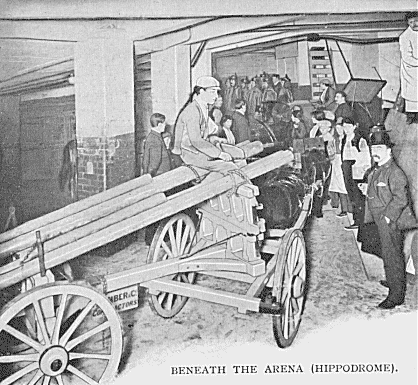 available
artistes are engaged at these three houses. Oftentimes the same
"stars" appear on the same evening at the three halls, which I are
virtually run by one syndicate. When a comic or a "serio" star books
an engagement with this syndicate, he or she is required to stipulate by
contract not to appear at any other hail within a radius of so many miles. This
"barring out" clause, as it is called, has also of late prevailed in
connection with certain of the larger music halls in suburban London.
available
artistes are engaged at these three houses. Oftentimes the same
"stars" appear on the same evening at the three halls, which I are
virtually run by one syndicate. When a comic or a "serio" star books
an engagement with this syndicate, he or she is required to stipulate by
contract not to appear at any other hail within a radius of so many miles. This
"barring out" clause, as it is called, has also of late prevailed in
connection with certain of the larger music halls in suburban London.
The Palace Theatre, in
Shaftesbury Avenue, is a beautiful building, which was opened by Mr. D'Oyley
Carte as the English Opera House. In spite of such excellent operatic works as
Sir Arthur Sullivan's Ivanhoe and André Messager's Le Basoche, Fortune
frowned upon the enterprise. Ere long Sir Augustus Harris transformed it into a
variety theatre, with its present name. Under Sir Augustus's successor, Mr.
Charles Morton, who deserves special mention here as being " the father of
the modern music-hall," the Palace Theatre was lifted into the high
position it has since sustained. Its entertainment is one of the best of its
class, not only as regards its singers and dancers, pantomimists, mimics, sketch
artists, and others of all nations and denominations, but also its beautiful and
realistic tableaux vivants and biograph pictures.
It is no wonder that the old-time stuffy music-hall has been
killed by such places as the splendid variety houses just named, to say nothing
of those other large and admirably conducted halls such as the Royal in Holborn,
the Metropolitan in the Edgware Road, the Canterbury in the densely crowded
Lambeth district, and the Paragon in the still more densely crowded Mile End
region. Besides these resorts there have sprung up several vast
"Empires" such as those respectively at New Cross, Holloway, Stratford
and Hackney, all [-225-] under the direction of the
wealthy syndicate that runs the London Hippodrome and a number of
"Empires" in the provinces.
 |
 |
 |
 |
 |
 |
If one should desire to get some notion of how the "toiling, moiling
myrmidons "(as Béranger calls them) patronise these new "Empires,"
he has only to watch outside any of them just before the doors are opened for
the first or second house. For be it noted that two entire performances are
given at each nightly, and at small prices of admission. Moreover, the
programmes always contain several highly-paid variety artistes - whether of the
comic singing, acrobatic, canine, or sketch kind. Indeed, it is not at all
unusual to find here a favourite performer in receipt of at least one hundred
pounds per week ; not to mention this or that leading serio-comic lady or
"Comedy Queen" at a salary not much lower. Yet, in spite of such
princely salaries, the prices of admission are small, ranging, say, from two
shillings or eighteenpence in the best parts to threepence in the gallery.
That these "Empires," "Palaces," and
similar halls are run not only with excellent programmes but also on strictly
proper lines is proved by the fact that, moderate though the admission prices
may be, the patrons come from some of the best parts of Hampstead, Stoke
Newington, Catford, Blackheath, Woodford, and so forth. Here recreation-seekers
may - and do - have placed before them all sorts of "turns" besides
those above-mentioned, and comprising many examples, such as conjurers,
acrobats, performing elephants, seals, bears, instrumentalists - comic and
otherwise. Often will be found certain old stagers or juvenile performers of
dramatic sketches made up of boiled-down plays - even of Hamlet, in a
twenty- minutes version of that play.
To those amusement-seekers who may prefer to take their
variety entertainment in a rough-and-ready form there are still such haunts as
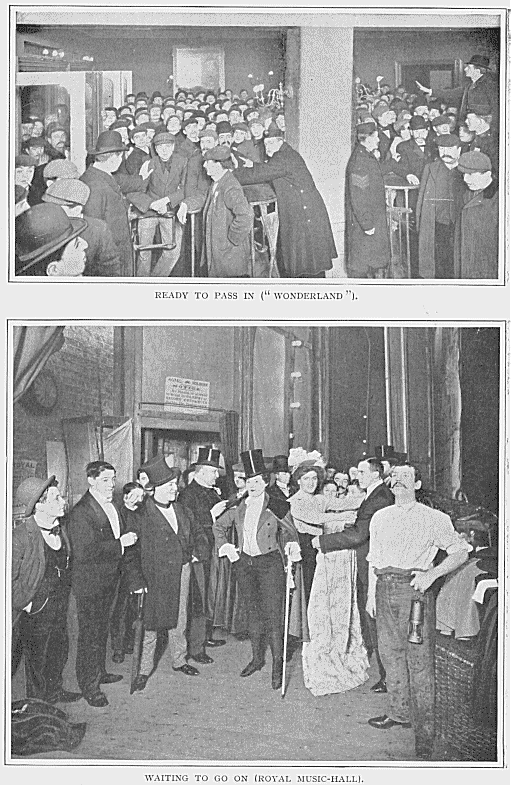
that Whitechapel resort fancifully named "Wonderland."
In this big hall are provided entertainments of the most extraordinary
description. They include little plays, songs, and sketches, given first in
Yiddish dialect and afterwards translated into more or less choice English by,
as a rule, a Hebraic interpreter. This interpreter often improves the occasion
by calling the attention of kind - and mostly alien - friends in front to
certain side shows consisting of all sorts of armless legless, skeleton, or
spotted " freaks " scattered around the recesses of this great
galleryless hall. When once the "freaks" have been examined, or the
"greeners" and other foreign and East-End "sweated" Jew
toilers have utilised the interval to indulge in a little light refreshment
according to their respective tastes, the Yiddish sketches and songs - comic and
otherwise - are resumed until closing time.
It is, however, on its Boxing Nights (which in this
connection means [-226-] Mondays and Saturdays)
that "Wonderland" is to be seen in its most thrilling form. Then it is
indeed difficult either to get in or to get out. In the first place it is hard
to get in because of the great crowds of hard-faring - often hard-faced -
East-End worshippers of the fistic art; several types of which are to be seen in
our photographic illustration on page 223. In the second place, if you do
contrive to get in you speedily find yourself so hemmed in by a sardine-like
packed mob that all egress seems hopeless.
Several other extremely typical East-End variety resorts,
each of a totally different kind, are close at hand. One is the huge Paragon
Theatre of Varieties, further east in the Mile End Road. Another is the much
smaller Cambridge Music-Hall, which is in Commercial Street, a little way
westward from Toynbee Hall. There are also the Queen's Music-Hall at Poplar, the
Royal Albert at Canning Town, and the Eastern Empire at Bow.
In spite of its cheap prices and its seething audiences, the
Paragon entertainment is exactly on a par with those given in the West-End and
South of London Variety Theatres. Indeed, the entertainment at the Paragon is
mostly identical with that supplied at the Canterbury, Westminster Bridge Road,
and is under the same syndicate. As for the Canterbury, the better class South
London tradesfolk and toilers go there, excepting, of course, when they visit
the newer and equally well managed South of London variety shows.
The Cambridge Music Hall, between
Spitalfields and Shoreditch, deserves a few special lines. In point of fact,
ever since the time when, years ago, it was converted from a synagogue into a
music-hall, the Hebrew residents of the locality have made it a point of honour
to attend the Cambridge.
With them they often bring not only their wives, but also
their black-curled, black - eyed infants, who may often be seen toddling calmly
about the stalls - especially during the earlier of the two "houses"
per night.
Round the corner in Shoreditch is the London Music-Hall,
wherein the stranger who pays his first visit will undoubtedly fancy for the
nonce that he has lost his way and has by accident strayed into one of the best
West- End halls.
Further north there are several more or less large and more
or less classy variety houses for example, the new two "houses" per
night resort, the Euston, opposite St. Pancras Station the Bedford, in Camden
Town the still newer Islington Empire, next door to the Agricultural hall the
old-established music-hall, Collins's, on Islington Green and the still older
Sadler's Wells, adjoining the New River Hlead in Rosebery Avenue.
The west-central district and southern suburbs are also well
provided for in a music-hall sense. Among others, one notes the old Middlesex,
or "Mogul," in Drury Lane; a Theatre of Varieties at Walham Green ;
Empires at Balham and Deptford an Empress at Brixton ; a Royal Standard at
Pimlico, and a Star at Bermondsey; and Palaces at Camberwell, the London Road (Southwark),
and Croydon. Besides these [-227-] may be mentioned
Gatti's in the Westminster Bridge Road, another Gatti's at Charing Cross, and a
Grand at Clapham Junction.
Like the halls themselves, the agents who supply the
managers with artistes at so much per cent. commission on the salaries have,
too, not only much improved in character, but have in many cases migrated from
their former dingy haunts in the York Road, Lambeth, to more commodious not to
say palatial - offices in or around the Strand, the Haymarket, and elsewhere.
Some few of them, however, still have their offices near a well-known tavern at
a corner of York Road ; and at certain hours a large number of minor music-hall
entertainers and their agents may - as shown in the above illustration - still
be seeml congregating near this old-established hostelry.
Music-hall "artistes " (as they love to call
themselves) have also vastly improved. Not many years ago these were mostly
shiftless and thriftless from the "stars" downward. Nowadays the
music-hall ranks include large numbers of the worthiest of citizens. And, what
is still better, they have combined together of late years to organise several
protective associations, such as the Variety Club and the Music-Hall Railway
Rates Association, as well as to found some excellent charities for benefiting
their brethren out of health - or out of work - and to provide for the widows
and orphans of comrades who have fallen by the way.
The chief of these charities is the Music-Hall Benevolent
Fund, a very fine organisation, the committee of which consists of many of the
most important and most honourable men to be found in any department of life.
From time to time the smaller associations assist their parent fund, or the
Music-Hall Home for the Sick and Aged, by [-228-]
arranging matinées or sports. In the case of the Music-Hall Railway Rates
Association all the surplus of the money subscribed thereto for the purposes of
getting the fares reduced for travelling "artistes" is handed over to
one or other of the aforesaid charities.
And though the members of the smaller music-hall societies
delight to call themselves by such names as "Water Rats," "
Terriers," and "J's," and to dress themselves as ostriches,
savages, cowboys, Red Indians, and so on at their annual sports, or to disport
as comic cricketers in all sorts of extraordinary costumes - what does it
matter, seeing that they do it all for charity's sake? Thus, by drawing vast
crowds of the general public, they add substantially to the funds of their
excellent charities. In these benevolent affairs Mr. Dan Leno is mostly at the
head (as he is with regard to his profession) On such occasions he is indeed a
Jack of all trades and master of most.
As will be seen from the photographic illustration on
page 223, the "behind the scenes" life of Music-Hall
London is not without its humours. In "Waiting to Go On" we have,
indeed, a motley throng of variety "turns." These include a famous
"serio" in Early Victorian "dandy" costume; a popular
"comic" in the usual battered hat and ill-fitting clothes which such
comedians always adopt a celebrated conjurer, a couple of clever descriptive
singers, a noted strong man, and several others. This "Waiting to Go
On" represents, of course, quite a different state of things from the
arrangements in a regular theatre, where every entrance and exit is fixed, and
where the players have to report themselves, as a rule, some time before the
curtain rises. Music-hall entertainers must, if they wish tq earn a remunerative
amount per week, do three or four "turns" a night and in order to
travel from hall to hall, a brougham - or in the case of a troupe, a private
omnibus - has to be provided. When they arrive they are naturally in a hurry to
get their work over, and are apt to get in each other's way, either in the
dressing-room or at the wings. As most music-hall entertainers start from home
already "made up," and even sometimes change in their vehicles en
route, it does not take them long to be ready for their respective
"turns" ; and their punctuality is remarkable.
To sum up, it may in common fairness be said that without its
Palaces of Variety and its Music-Halls Living London would only be half alive.
George R. Sims (ed.), Living London, 1902