< previous chapter < | THE MYSTERIES OF LONDON | > next chapter >
[-367-]
CHAPTER CXIX.
POOR ELLEN!
IT was evening; and a cheerful fire burned in the grate of the drawing-room
at Markham-Place.
Mr. Monroe and his daughter were seated in that apartment;
the former dozing in an arm-chair, the, latter reading a novel.
Richard was engaged in a literary pursuit in his library.
From time to time Miss Monroe laid aside her book, and fell
into meditation. Not that she had any particular subject for her reflections;
but the events of her life, when taken together, constituted a theme from which
it was impossible to avert her attention for any lengthened period.
There was also a topic upon which she pondered more
frequently as time passed on. She knew that in the course of nature - especiahly
after the rude shocks which his constitution had received from mental suffering
and bodily privation, - her father could not live much longer. Then, she was
well aware that she could not continue to dwell beneath the same roof with
Richard Markham ;- and her pride revolted against the idea of receiving a direct
eleemosynary assistance from him in the shape of a pecuniary allowance. She had
some few pound treasured up in a savings bank, and which she had saved from her
salary when engaged at the theatre; but this sum would not maintain her long.
She therefore looked, with occasional anxiety, to the necessity of adopting some
course that should obtain for her a livelihood. Of all the avocations in which
she had been engaged, she preferred that of the stage; and there were times when
she seriously thought of returning to the profession, even during her father's
life-time.
In sooth, it was a pity that one of the brightest ornaments
of female loveliness should have been lowered by circumstances from the pedestal
of virtue and modesty which she would have so eminently adorned. Should her
transcendent loveliness captivate the heart of any individual whose proposals
were alike honourable and eligible, how could she accept the hand thus extended
to her? She must either deceive him in respect to that wherein no man likes to
be deceived; or she must decline the chance of settling herself advantageously
for life. These were the alternatives ;- for in no case could she reveal her
shame!
Her fate was not, therefore, a happy one; and the reader need
not marvel if she now and then found reflections of a disagreeable nature
stealing into her soul.
She was now past twenty years of age: and in spite of the
severe trials which she had endured, the sweet freshness of her youthful charms
was totally unimpaired. Her faultless Grecian countenance,- her
classically-shaped head, - her swan-like neck,- her symmetrical form,- her
delicate hands and feet, - all those charms which had been perpetuated in the
works of so many artists - these elements of an almost superhuman beauty still
combined to render her passing lovely!
O Ellen! the soul of the philanthropist must mourn for thee,-
for thou wait not wrongly inclined by nature. On a purer being than thou wast,
ere misery drove thee in an evil moment to an evil course, the sun never shone
:- and now thou hast to rue the shame which thine imperious destiny, and not thy
faults, entailed upon thee!
But to our tale.
Old Mr. Monroe was dozing in the arm-chair; and Ellen had
once more turned her eyes upon her book, when Marian entered the room.
She perceived at a glance that Mr. Monroe was asleep; and,
placing her finger upon her lip to enjoin silence, she put a note into Ellen's
hand, saying at the same time in a low whisper, " Mr. Wentworth's servant
has just brought this, with a request that it should be immediately conveyed to
you, Miss."
Marian then withdrew.
Ellen tore open the note, and read as follows:-
"I grieve to state that your little Richard has been
attacked with a sudden and dangerous malady. Come to my house for an hour - if
you can possibly steal away, without exciting suspicion. My servant will convey
this to you through your faithful confldant.
DAVID WENTWORTH"
[-368-] Ellen flung the note
frantically upon the table, and rushed out of the room.
She hurried up stairs, put on her bonnet and cloak, and,
having told Marian to sit up for her, hastened from the house - one sole idea
occupying her mind, - the danger of her well-beloved child!
When she arrived at Mr. Wentworth's abode, she was received
by that gentleman's wife, who immediately said, "The danger is over-the
crisis is past! Do not alarm yourself - my husband no longer fears for your
son's life. He, however, deemed it to be his duty to send for you."
"Oh! he did well - he acted kindly and
considerately," returned Ellen. "But let me assure myself that my boy
is no longer in danger."
Mrs. Wentworth led the way to the chamber where little
Richard was now sleeping tranquilly, the surgeon seated by the bed-side.
From his lips Ellen gathered hope that the perilous crisis
had passed: she nevertheless determined to remain for some time to assure
herself that any return of the spasms might not be fraught with increased
danger. All other considerations were banished from her mind; she thought not of
her father - she remembered not that her absence might alarm both him and
Richard Markham; and when Mr. Wentworth delicately alluded to that subject, as
time slipped by, she uttered some impatient remark intimating that she should
not be at a loss for an excuse to account for her protracted absence.
Thus the pure and holy maternal feeling was now uppermost in
the mind of that young lady: the danger of her child was the all-absorbing
subject of her thoughts.
Bent over the bed, she tenderly gazed upon the pale
countenance of her child.
Oh! where can the artist find a more charming subject for his
pencil, or the poet a more witching theme for his song, than the young mother
watching over her sleeping infant?
Hour after hour passed ; and when the babe awoke, Ellen
nursed him in her arms. In spite of its illness, the little sufferer smiled; but
when the pang of the malady seized upon him, it was Mrs. Wentworth - and not
Ellen - who could pacify him!
Alas! galling indeed to the young mother was this conviction
that her child clung to another rather than to herself.
Nevertheless Ellen watched the babe with the most heartfelt
tenderness; and it was not until near midnight, when the surgeon declared that
the malady had passed without the remotest fear of a relapse, that Ellen thought
of returning home.
She then took her departure, with an intimation that she
should call again in the morning.
She retraced her steps towards the Place, and, passing up the
garden, was admitted through the back entrance by the faithful Marian.
"My child is saved," whispered Ellen to the
servant. " Has my father inquired for me?"
"No, miss," was the reply. " He is still in
the drawing-room; and Mr. Markham is with him."
"They are up late to-night," remarked Ellen.
"But I," she continued, "am weary in mind and body, and shall at
once repair to my own room."
Marian gave the young lady a candle, and wished her a good
night's rest.
Ellen hastened cautiously up-stairs, and in a few minutes
retired to rest.
She was fatigued, as before intimated; and yet slumber
refused to visit her eyes Nevertheless, she dozed uneasily,-m that kind of
semi-sleep which weighs down the heavy lids, and yet does not completely shut
out from the mind the consciousness of what is passing around.
A quarter of an hour had probably elapsed since Ellen had
sought her couch, when the door slowly opened; and her father entered the room,
bearing a light in his hand.
The countenance of the old man was ghastly pale; but there
was a wildness in his eyes which bore testimony to the painful feelings that
agitated him within.
He advanced towards the bed, and contemplated the countenance
of his daughter for a few moments with an expression of profound sorrow.
Ellen opened her eyes, and started up in the bed, exclaiming,
"My dear father, in the name of heaven, what is the matter?"
"O God! Ellen," cried the old man, placing the
light upon a side-table, "tell me that it is not true - say but one word,
to assure me that you are the pure and spotless girl I have always deemed you to
be!"
"Father!" exclaimed the young lady, a horrible
feeling taking possession of her, "why do you ask me that question?"
"Because a fearful suspicion racks my brain,"
answered the old man; "and I could not retire to rest until I knew the
truth - be that truth what it may."
"My dear father - you alarm me cruelly!" said
Ellen, her cheeks at one moment suffused with blushes, and then varying to ashy
whiteness.
"In one word, Ellen," exclaimed the old man,
"what is the meaning of that letter?"
And the almost distracted father threw the surgeon's note
upon the bed
In an instant Ellen remembered that she had left it behind
her in the room where she was seated with her father when she received it.
Joining her hands in a paroxysm of the most acute mental
agony, she burst into tears, crying wildly, "Forgive me! forgive me - my
dear, dear father! Do not curse your wretched - wretched daughter!"
And then she bowed her head upon her bosom, and seemed to
await her parent's reply in a state of mind which no pen can describe.
For some moments Mr. Monroe maintained a profound silence:
but the quivering of his lip, and the working of the veins upon his forehead
betrayed the terrible nature of the conflict of feelings which was taking place
within his breast.
At length he also burst into tears, and covering his face
with his hands, exclaimed, " My God! that I had died ere I had experienced
this bitter - bitter hour!"
These words were uttered in a tone of such intense agony,
that a mortal dread for her father's reason and life suddenly sprang up in
Ellen's mind.
Throwing herself from the bed, she fell upon her knees,
crying, "Forgive me, my dear father. Oh! if my child were here, I would
hold it in my arms towards you; and, when its innocent countenance met your
eyes, you would pardon me!"
"Ellen! Ellen! thou hast broken thy father's
heart," murmured Mr. Monroe, averting his face from his suppliant daughter.
"Oh! heaven be thanked that thy mother has been snatched from us! But tell
me, unhappy girl, who is the villain that has dishonoured thee - for, in the
moment of my intense agony, when I read the fatal letter that disclosed thy
dishonour and marked the name of thy child, I vilely - ungratefully accused our
generous benefactor of thy ruin."
[-369-]
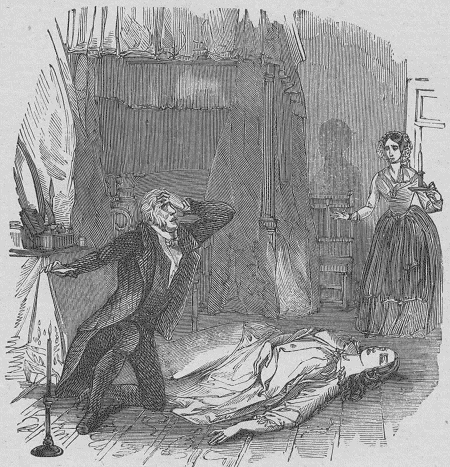
"What! Richard ?-oh! no, no!" ejaculated' Ellen,
in a tone of Ineffable anguish; then, as the thought of who the father of her
child really was flashed across her memory, she gave utterance to a terrible
moan, and sank backwards, senseless, upon the floor.
"Ellen! Ellen!" cried the old man: "Ellen - my
dearest daughter, Ellen - oh! I have killed' her!"
At that moment Marian, bearing a light, entered the room.
"Water! water!" exclaimed the agonised father:-
"she is insensible - she is dying!"
Then hastily filling a tumbler from a decanter of' water
which stood upon the toilet-table, he knelt down by the side of his daughter,
and bathed her temples.
In a few moments Ellen partially recovered, and gazed wildly
around her.
"My sweet child," murmured the old man, pressing
her hand to his lips, "live - live for me: all shall be forgiven - all
forgotten. I was harsh to thee, my Ellen - to thee who have always been so fond,
so tender, and so good to me."
"Leave her, sir, for the present," said Marian
"allow her to compose herself. This discovery has been almost too much for
her !"
"I will," returned Mr. Monroe. "You must stay
with her, good Marian; and in the morning I will come and see her."
The old man then withdrew.
< previous chapter < | THE MYSTERIES OF LONDON | > next chapter >