< previous chapter < | THE MYSTERIES OF LONDON [Vol. II] | > next chapter >
[-115-]
CHAPTER CLXXVII.
THE HISTORY OF AN UNFORTUNATE WOMAN.
"My
name Is Lydia Hutchinson. My father was the curate of a small village near
Guildford; and fortune had frowned upon him with such continuous rancour from
the moment he left the University where be graduated, that it was somewhat late
in life ere he ventured to think of matrimony. After filling several different
curacies, from which he was invariably removed at the deaths of the old
incumbents and the arrival of the new ones, he seemed at length to settle down
in the little village to which I have alluded. There he fell in love with the
daughter of a half-pay officer as poor as himself; and, with only eighty pounds
a-year to depend upon, he embarked in the voyage of matrimony. A year after this
union, a son was born, and christened by the name of Edgar: an interval of
eighteen months elapsed, and I was ushered into the world. But my mother died in
giving birth to me.
"To say that my brother and myself were the only
consolation which my poor father now possessed, were merely to tell the common
tale of parental love in the widowed breast. We were indeed his only
consolation! Often and often has he told us this, when we were old enough to
comprehend his meaning, and appreciate the full value of his kindness. He was an
excellent man. In order to let his children be respectably dressed and maintain
a decent appearance — especially at church on Sunday — he
stinted himself of almost the common necessaries of life. He undertook my
brother's education himself; and from his lips I also learnt the rudiments of
the knowledge which I possess. There was resident in the village, a widow lady
of great accomplishments, but reduced circumstances; and out of his pittance my
father even contrived to spare something to procure her services in giving me
lessons in music, drawing, embroidery, and French. Under her tuition I
progressed rapidly in those branches; and, when I was sixteen. I was considered
to be better educated than if I had been brought up at a boarding-school.
"Since I have mentioned that age, I will not weary
you with any farther details concerning the earlier portion of my life. My
brother Edgar had already obtained a situation as an usher in a school at
Guildford, and my father, though loth to part with us both, was well aware of
the necessity of placing us in positions which would enable us to earn our own
bread. For of course his small income would cease at his death; and it had been
impossible for him to save a single penny. He, however, anticipated that, when
we were both provided for, he should be able to lay aside a few pounds during
the remaining years of his 'life, so as not to leave his dearly-beloved children
completely dependent on themselves at his decease. Under such circumstances he
gladly availed himself of an opportunity of placing me as junior teacher in an
extensive ladies' boarding-school at Kensington.
"My father brought me up to London, and left me at
Mrs. Lambkin's establishment, which was called Belvidere House. He wept when he
took leave of me; but as Mrs. Lambkin (who was a widow, about forty years of
age) spoke very kindly, and promised to take great care of me, the sorrow of
parting was somewhat mitigated on both sides. I was to receive no salary the
first year; but if I suited, my remuneration was fixed at six pounds for the
second year to be increased subsequently.
"When my father took his leave, Mrs. Lambkin said,
'My dear sir, do not be grieved at parting from your daughter. She will find a
mother in me. I will be all to her that her own maternal parent would be, were
she alive. God bless here she's a pretty, amiable looking girl; and I already
love her!' — Then Mrs. Lambkin put her handkerchief to her eyes; and
my poor father was deeply affected. Mrs. Lambkin proceeded to inform him that
she had scarcely ever known a moment's happiness since poor dear Mr. Lambkin's
death, which took place she said, five years previously, and in a most
distressing manner. 'In fact, Mr. Hutchinson, she continued, 'Mr. Lambkin lost
his valuable life when gallantly attempting to rescue an ill-used and most
virtuous young woman from a brutal assault on the part of half-a-dozen
intoxicated policemen My father expressed great sorrow at this information. Mrs.
Lambkin had wine and cake brought in, and at length my father took his leave,
greatly comforted to think that I should have obtained a situation in the
establishment of so kind-hearted and excellent a lady.
"Scarcely had my father left the door, when Mrs.
Lambkin turned round towards me, and in a tone which I considered somewhat
inconsistent with her former manner and language, exclaimed, 'Now, miss, dry
those tears, and go up to your room to make yourself decent for afternoon
school. The young ladies at Belvidere House all belong to the first families of
distinction, and are accustomed to see the teachers well dressed.' Then, ringing
the bell, she said to a smart servant who answered the summons, 'Jessica, show
Miss Hutchinson to her room.' Jessica took a good long stare at me, then turning
sharply round, told me to follow her. We proceeded up two handsome flights of
stairs, beautifully carpetted. On the second floor, the doors of several
bed-rooms stood open; and I could not help admiring the comfort-nay, even the
luxury, which their interior revealed to the hasty glance that I threw into
them. These are the young ladies' rooms,' said Jessica abruptly: 'yours is
higher up.' On the third floor I also observed the doors of several chambers
standing open, and permitting glimpses of great neatness inside. 'These are our
rooms,' said Jessica — alluding, as I afterwards discovered, to the
servants' apartments. Up another flight we went; and now we reached the attics.
'These are the junior teachers' rooms,' cried Jessica, and [-116-]
this is yours,' she added, flinging open the door of a garret, wherein I
perceived nothing save a mean looking bed, one chair, a table with a wash hand
basin on it, a brown stone pitcher in a corner, and a glass as large as the palm
of my hand hanging to a pin stuck in the wood-work of the window
"I was about to offer some observation, thinking
that Jessica had made a mistake in showing me to this garret; but I checked
myself — being unwilling to commence my noviciate at Belvidere House
with any thing in the shape of a complaint. 'Will you have the kindness to bring
me up my trunk and bonnet-box!' said I, in as polite and meek a manner as
possible. — Miss Jessica burst out laughing in my face. 'Well! that
is a pretty thing, I don't think!' she exclaimed, tossing her head haughtily 'an
under teacher to ask an upper servant to bring up her trunk! Well — I
never!' — 'I am very sorry if I have offended you,' I said. — '
If you really don't know better,' answered Jessica, looking at me attentively,
'I don't mind forgiving you this time. And I'll do more, too, for I'll tell the
scullery girl to help you up with your things; but of course even she
wouldn't do it alone.' — My heart rose into my mouth; and it was
only by means of a desperate effort that I restrained my tears. — '
Do the other teachers sleep on this floor?' I asked, more for the sake of
concealing my emotions, than gratifying my curiosity. — ' Miss
Muddle, the head teacher,' replied Jessica, 'sleeps in the room of the first
class young ladies: Miss Spinks, the second teacher, sleeps with the second
class; Miss Pantile, the third teacher, with the third class; Miss Rhodes, Miss
Jessop, and you occupy this part of the house. But I'll go and tell Betsy to
help you up with your things.'
"Jessica walked away in the most stately manner,
preceding me down stairs, and evidently considering me her inferior. Betsy was
summoned; and with no small amount of grumbling, that dirty slattern
condescended to hold one end of my trunk, while I carried the other. Scarcely
had I dressed myself in my second best gown (I had but three) — when
Jessica came up to say that Mrs. Lambkin was excessively angry at the length of
time I took to make myself decent. Jessica herself was in a very bad humour at
being obliged to mount four flights to convey this message, and told me in an
insolent manner not to daudle so again.
"Trembling, miserable, and unhappy, I went down a
to the school-room, where Mrs. Lambkin scolded me, before the other teachers and
the young ladies, in no measured terms. Then, because I cried, she scolded me
the more. At length she set me to teach four little girls, of ages varying from
eight to ten. Miss Muddle, Miss Spinks, and Miss Pantile, all surveyed me with
the most sovereign contempt: Miss Rhodes and Miss Jessop, who were not much
older than myself (whereas the three senior teachers were all past thirty)
looked at me in a more friendly manner. The ages of the boarders varied from
eight to sixteen. They were all beautifully dressed; and some of the elder ones
were very pretty. There were about forty young ladies altogether in the
establishment.
"The four little girls whom I had to teach, were as
stupid as they well could be, and so pert that I scarcely knew how to manage
them. They laughed and giggled at every attempt which I made to instruct them.
Sometimes Mrs. Lambkin would exclaim, 'Hutchinson, there's too much noise with
your class; — and when I spoke very low to my pupils, it was,
'Hutchinson, you're literally doing nothing there!' The three senior teachers
were alone addressed by Mrs. Lambkin as Miss: with the three juniors it
was plain Rhodes, Jessop, and Hutchinson.
"At tea-time, the three senior teachers sate near
the mistress of. the establishment, and had tea and thin bread-and-butter: the
three junior teachers sate amongst the little girls, and had milk-and-water, and
thick bread-and-butter. The same arrangement existed at breakfast. At dinner,
the three junior teachers were expected to eat the cold meat; though none of the
little girls were made to partake of it, and, as I once heard Jessica observe,
'such a thing as cold meat was never touched in the kitchen.' I only mention
these trifling details to give you an idea of Mrs. Lambkin's fashionable
academy. I may add that the junior teachers had to make their own beds, and
fetch up their own water in the great stone pitchers.
"I soon found that Mrs. Lambkin was very far from
being so amiable as she had appeared in the presence of my lather — except
of an evening, after about six or seven o'clock; and then she grew more
cheerful — nay, jovial, and was very familiar with us all. But she
was constantly leaving the room where we all sate, and remaining away for only a
few minutes each time; but the oftener she went out in this strange manner, I
noticed that the more good-humoured she grew.
"Thus some weeks passed away. One evening I had
solicited permission to go out for a few minutes a to take a letter to the post
for my father (for the servants would do nothing to oblige the junior teachers),
when one of the eldest boarders in the establishment (the Honourable Miss
Adeline Enfield) accosted me in the passage, and, in a hasty whisper, said,
'Dear Miss Hutchinson, will you put this letter in the post for me!' — 'Certainly,'
I replied. — 'You need not say a word about it, you know,' added
Miss Enfield; and she glided away. — I did not think very seriously
of the matter knowing that it was against the. rules of the establishment for
the young ladies to write to their friends or parents without allowing Mrs.
Lambkin to inspect their letters; and as I considered this to be a harsh
regulation, I did not hesitate to oblige Miss Enfield — especially
as she had addressed me in so kind a tone. I accordingly posted her letter, and
thought no more of the subject. But the next time I was going out, Miss Enfield
repeated her request, and again ran away ere I could reply. I noticed that this
letter was addressed to the same person as the former one — namely, 'Captain
Cholmondeley, Barracks, Knightsbridge;' — but supposing that he
might be a relative, I did not hesitate to post the epistle.
"That same night, after I had retired to my garret,
the door was opened softly, and the Honourable Miss Enfield entered. She was in
her nightclothes; and, placing her finger on her lip to enjoin caution, she
said, 'My dear Miss Hutchinson, you can do me such a favour, if you
will!" — Certainly I will, if I can,' was my answer. — 'Oh!
you can very easily, continued the young lady, who, by-the-by, was a sweet
pretty girl, and very interesting: 'a letter will come addressed to you, by the
first post to-morrow morning.' — 'Indeed!' I said; 'and how do you
know that?' — ' Because, though the envelop [-117-]
will be addressed to you, the letter inside will be for me,' she answered,
laughing. — 'And what would Mrs. Lambkin say if she knew it?' I
asked. — ' She cannot know it unless you tell her; and I am sure you
will not do that, dear Miss Hutchinson,' returned the Honourable Miss
Enfield. — 'I will oblige you this time,' I said, after some
consideration; 'but pray do not let this take place again.' — Then
she kissed me so affectionately, I was really pleased to have made a friend of
her; for I was so forlorn and unhappy in my situation — though I
never let my father know how completely we had been deceived in Mrs. Lambkin's
disposition.
"On the following morning the letter came: and when
I could find an opportunity, I gave the contents (which was a small note
carefully sealed) to Miss Enfield. She thanked me with a sweet smile. Three or
four days afterwards, another letter came addressed to me, with another,
enclosure for Miss Enfield. I was determined not to give it to her during the
day, because I could find no opportunity to speak to her unobserved.
Accordingly, as I anticipated, she came up to my room in the evening, after we
had all retired to rest. I then gave her the note, but with a firm and decided
assurance that I would not be the intermediate of any further correspondence
carried on in so secret a manner. She cried very bitterly at my resolve, and by
means of some tale which it is not worth while to repeat, but which seemed to me
satisfactory at the time, induced me to convey a letter to the post for her next
day, and receive the answer in the usual manner. I foolishly allowed myself to
be over-persuaded and fulfilled her wishes in both respects. I must observe that
her letter was addressed to the same person as the two preceding ones.
"She was very grateful to me for my kindness, and
treated me with marked attention. Being the daughter of a noble house, her
conduct towards me produced a pleasant effect in respect to the three senior
teachers, who, seeing that Miss Enfield courted my society, began to treat me
more as their equal than they had hitherto done. Mrs. Lambkin also grew less
harsh towards me; and my position acquired some degree of comfort.
"One evening, after I had retired to my garret,
Miss Enfield paid me another visit. She had another favour to ask me. 'The day
after to-morrow,' she said, 'I shall have leave to go out for a little shopping.
Will you accompany me?' — I replied that I should do so with much
pleasure. — 'Very well,' she said; 'leave me to manage it. I will
ask Mrs Lambkin to-morrow night, when she has been out of the room three or four
times — .' — 'I do not understand why you should choose
that moment I said. — 'Oh!' was the answer, 'when she has had her
third or fourth glass, she can refuse me nothing and she is sure to ask whom I
will have of the teachers to accompany me.' — 'Her third or fourth
glass!' I exclaimed. — 'Yes, to be sure,' returned Miss Enfield.
'What! I thought every one knew that she drinks like a fish; although she does
do it on the sly. Her husband was a dreadful drunkard.' — 'Indeed! I
am sorry to hear this,' I observed 'Moreover, I thought that her husband was a
most respectable person.' — 'Oh! I dare say Mrs Lambkin has been
telling you that nonsense about her husband's death,' said Miss Enfield,
laughing. The truth is, he was coming home one night most terribly the worse for
liquor, when he became involved in a dispute with bad woman; and when the police
interfered, he made a desperate assault upon them, and was killed by an unlucky
blow with one of their bludgeons.' — 'She told quite a different
tale to my father,' I observed. — 'Yes, because your father is a
clergyman, and may recommend some boarders to her house,' returned Miss Enfield.
'Did she not also seem mighty civil and polite before him?' — I
confessed that she did. — 'And the moment his back was turned, did
she not turn also?' — This I likewise admitted. — 'She
cannot keep her temper long, you see. But I must go now, for fear Miss Muddle
should awake, and happen to find out that I have left my bed. Good night, dear
Miss Hutchinson. The day after to-morrow we will go out shopping together.'
"Then the Honourable Miss Enfield withdrew, leaving
me greatly astonished at what I had heard. I lay awake the greater part of the
night, reflecting on all that she had told me; and when I thought of this young
lady's rank, youth, beauty, and brilliant prospects, I felt sad at the idea that
the purity of her soul had been in the least degree interfered with by tales of
drunken men, bad women, and police-riots, as well as by the example of an
intemperate school-mistress. Miss Enfield's communication had shed a new light
upon my mind. The term 'bad woman' set me thinking what it could mean;
and at last I comprehended its signification. Oh! — how I shuddered
when that first consciousness of the real extent to which female frailty can
reach, grew more and more defined in my imagination, until I understood its deep
shade of guilt. The first step towards teaching the youthful mind to become
infidel, is to suffer it to know that there live men, in Christian countries,
who deny the truth of revealed religion: — the first step towards
inducing a young girl to harbour impure thoughts, is to show her that female
depravity has, in its worst sense, an indubitable existence!
"The Honourable Miss Enfield was as good as her
word. She obtained permission to go out shopping, and also for me to accompany
her. It was three o'clock, on a beautiful spring afternoon, when Miss Enfield
and myself sallied forth together. 'The best shops lie in this direction,' I
observed, pointing towards the left. — 'Oh! no, my dear Miss
Hutchinson,' she said, with a merry laugh: 'the spot that will suit me is in this
direction;' — and she took the road to London. I made no objection;
my duty was to accompany her for the sake of appearances — not
precisely to take care of her, because, although eight months younger than I,
she was as tall and as matured in form as myself. Indeed she was very
precocious, but, as I have before said, very pretty.
"We passed by several linen-drapers' shops; but the
Honourable Miss Enfield entered none of them. At length we reached Hyde Park.
'Do let us take a walk here, my dear Miss Hutchinson,' she exclaimed: 'see how
beautiful the trees already seem; and what freshness there is in the air!' — I
assented; and we entered the Park. Presently Miss Enfield burst out into a
joyous laugh. I inquired the reason; but she only looked archly at me, and
renewed her merriment. Scarcely had I time to question her a second time
concerning her joyousness, when she pressed my arm significantly; and I beheld
two tall, fine-looking military men approaching. I cast my eyes downwards, for I
perceived [-118-] that they were looking
attentively at us; but in a few moments I heard one of the officers exclaim It is
my dearest Adeline! I felt convinced that she would not disappoint me.' — 'Not
for worlds, Cholmondeley,' she replied; — and, in another moment,
she had left me and was hanging on the officer s arm. — 'Now,
Dunstable, you do the amiable with Miss Hutchinson,' said Captain Cholmondeley
to his companion; and before I could recover from the stupefaction into which
these proceedings threw me I found myself arm-in-arm with a handsome young
officer, whom I soon afterwards ascertained to be Lord Dunstable.
"For some time I walked on in profound silence,
conscious that I was doing wrong, but unable to muster up the courage sufficient
to withdraw from the false position in which Miss Enfield's intrigue had placed
me. At length the gentle tones of a kind but manly voice penetrated through the
chaos of ideas which agitated in my brain. 'Wherefore so silent, Miss
Hutchinson?' said the young officer: 'does my boldness in constituting myself
your companion offend you? If so, I will instantly release you from the
unpleasant contact of my society.' — I made no answer, but burst
into tears. — 'By heaven! you are a sweet girl,' he continued; 'and
I feel that I can love you sincerely. But dry those lovely eyes: there are
persons about who may observe us.' — He was right: I wiped away the
tears; and, after hazarding a few brief replies to his remarks, I insensibly
fell into conversation with him. By degrees I lost the restraint and
embarrassment which had at first possessed me; and ere I had been half an hour
in his society, I laughed heartily at his lively sallies and sprightly
observations. In the mean time Adeline was walking at a considerable distance in
front, with the Honourable Captain Cholmondeley.
"Nearly two hours passed away in this manner; and
then I insisted upon returning to Belvidere House. We accordingly overtook Miss
Enfield and the Captain; and I signified my desire, observing that Mrs Lambkin
would be angry did we remain absent much longer. 'We will not part with you,
ladies,' said the Captain, 'unless you promise to lighten our darkness again
with your presence ere we are all a week older.' — 'This day week we
could manage it again,' immediately observed Miss Enfield. — I
murmured an objection. — 'If you do not come, my dearest Miss
Hutchinson,' whispered Lord Dunstable to me, 'I shall either hang or drown
myself.' — I smiled; and Adeline, who was watching my countenance,
cried, 'Oh! Lydia is such a dear good-natured creature, and we are such friends,
I am sure she will not refuse.' — Again I smiled; and this was taken
for an assent on my part. Then the two gentlemen looked round, and, perceiving
no strangers near at the present, they bade us farewell in a most tender
manner: — I mean that Captain Cholmondeley pressed Adeline in his
arms, while Lord Dunstable literally glued his lips to mine. And I — Oh!
my resistance was but feeble!
"Miss Enfield and myself then retraced our stops
towards Belvidere House; but to save appearances, she purchased some articles at
the first linen draper's shop that we came to. 'Ah! Miss Adeline,' I said, as we
proceeded homewards, 'what have we both been doing?' — 'Enjoying
ourselves very much, dear Lydia,' answered the young lady, laughing heartily. 'I
am sure you ought not to complain, for you have made the conquest of a lord,
handsome and wealthy.' — 'But what will he think of me?' I
exclaimed. — 'That you are a very pretty, amiable, delightful girl,'
rejoined the Honourable Miss Enfield. — 'And all this was planned on
your part, Miss Adeline?' I said. — ' Call me Adeline in
future,' answered Miss Enfield; 'for now you and I are sworn friends. Yes; the
whole matter was pre-arranged so far as my meeting with Cholmondeley was
concerned; and as I told him in my last note that you would accompany me,
he was too gallant not to engage a friend to take charge of you while he and I
were conversing together.' — 'Are you going to be married to Captain
Cholmondeley?' I inquired. — 'He has promised to demand my hand of
my parents the moment I leave school,' replied Adeline: then after a pause, she
added, 'And if you play your cards well, you may become Lady Dunstable.' — This
assurance electrified me: it filled me with new hopes, new visions, new
aspirations. In a few moments I saw myself (in imagination) the wife of a Lord,
my father a Bishop, through my husband's influence, and my brother a rich
gentleman to whose addresses no heiress would turn a deaf ear!
"I could not sleep all that night! I considered my
fortune already assured; and I declare most solemnly that I felt more delight,
In the visions of prosperity and bliss which I conjured up, on account of my
father and brother, than for the sake of myself. The week passed away: I did not
oppose Miss Enfield's intimation to me that we should keep our appointment with
the two officers; and, permission having been obtained as before, we sallied
forth. Hyde Park was soon gained; and we were not kept waiting a moment by our beaux — for
they were already at the place of meeting. They received us with evident
delight; and as Lord Dunstable pressed my hand tenderly, my eyes met his — a
deep blush suffused my countenance — and I felt that I already loved
him.
"Adeline walked apart with the Captain: and I
remained with Lord Dunstable. He spoke to me more freely, but not less
respectfully, than on the former occasion. He assured me that he had thought of
nothing, since we last met, save the prospect of seeing me again; and he forced
from me an avowal that I too had not altogether forgotten him! We had been thus
together for half an hour, when it began to rain. The Honourable Captain
Cholmondeley and Adeline then turned and joined us. 'This rain is a great
nuisance,' said the Captain: 'it is impossible to keep the ladles out in it; and
it is equally impossible to part with them so soon.' — 'What is to
be done?' asked Lord Dunstable. — 'My private residence is close
by,' said the Captain; 'and if the ladies would take shelter there, until the
rain is over, they shall be treated with as much respect as if they were at
home.' — 'Well, on that condition,' exclaimed Miss Enfield, 'we will
assent.' — I was about to offer some remonstrance, when Lord
Dunstable whispered a few tender words in my ear; and the objection died upon my
lips.
"The Honourable Captain Cholmondeley's private
dwelling was in the immediate vicinity of Sloane Street; and thither we
repaired. A servant in livery opened the door: we were conducted into an
elegantly furnished dining-room, and a cold collation was speedily served up.
Champagne was poured out; and, not aware of its strength, I drank two glasses
without much hesitation. The Captain told the servant to leave the room: and I
remem[-119-]ber that we laughed, and chatted, and
ate, and drank as happily as if Adeline and myself were in no way tied to time.
But presently my senses became obscured; my head swam round; and I was ready to
fall from my seat. I have a faint idea of beholding Adeline sitting on the
Captain's knee; and then I recollected no more, until I awoke in the morning!
"But, my God! to what did I awake? Oh! even now I
shudder as I recall to mind my sentiments on that occasion! I was in bed — in
a strange bed; and by my side was Lord Dunstable. Then I comprehended that my
dishonour had been effected! I uttered a scream — a wild, terrific,
appalling scream! Lord Dunstable caught me in his arms, and said all he could to
soothe me. He pleaded the extent of his love, called heaven to witness that he
looked upon me as his wife, and swore by all he held sacred to make me so in the
eyes of the law as soon as he could complete certain arrangements necessary to
such a change in his condition. He spoke with so much apparent sincerity, used
so many arguments to convince me of his love, and expatiated so eloquently upon
the happiness which we should enjoy when united, that my grief was absorbed in a
wild delirium of bliss!
"Then came the sudden thought, 'What was to
become of me in the meantime?' — 'You can return to Belvidere
House,' answered Lord Dunstable: 'Miss Enfield will make it all right for
you.' — 'Return to Belvidere House!' I exclaimed:
'impossible!' — 'Nay, it is very possible,' rejoined my lover:
'Adeline, who is an uncommonly sharp girl, arranged it all last evening before
she left. She said that she should let herself into Belvidere House by the back
way, and that she should proceed straight into the parlour, where she should
assure Mrs. Lambkin that you, Lydia, had come home with such a dreadful headach,
you were obliged to go straight up to bed.' — 'That excuse will do
for last night,' I said wringing my hands in despair: 'but this morning ?' — 'All
is arranged equally well,' answered my noble lover. 'It is only now six o'clock:
you are to be in the neighbourhood of the school by half past seven; Adeline
will steal out and join you: then you can both walk boldly up to the door, enter
and say that you have been out together for a little stroll, In accordance with
a permission to that effect which Adeline declared she would obtain from Mrs.
Lambkin last night, when that respectable lady was in her cups.' — These
stratagems produced a great relief to my mind, because I saw that they were
entirely practicable. But, even in that moment of my agitated soul, I could not
help reflecting upon the deep artifice which lurked in the bosom of so young a
creature as the Honourable Miss Enfield.
"I rose and hastily dressed myself. Then I took
leave of Lord Dunstable. He renewed all his protestations of sincerity,
unalterable love, and honourable intentions; and we arranged a plan of
correspondence and future meetings. I stole from the house, unperceived by any
of the inmates, and proceeded at a rapid pace towards the school. But how
changed was my soul — how altered were all my thoughts! I fancied
that every one whom I met read the history of my shame in my countenance! Then I
consoled myself with Lord Dunstable's assurance that I was his wife in the sight
of heaven, and soon should receive that hallowed name in the eyes of man.
"At a short distance from the school, I met Miss
Enfield. I cast down my eyes, and blushed deeply. She laughed merrily. 'Oh!
Adeline,' I exclaimed, 'to what has all this intriguing brought me?' — 'My
dear Lydia, she returned, 'our positions in that respect are equal; and, as our
lovers will keep their words and marry us, where is the harm?' — I
stared at the young lady with the most profound astonishment. How were our
positions equal in reference to our lovers? She speedily cleared up my doubts.
'If you continue to blush and turn pale alternately, twenty times in a minute,
as you are now doing,' she said, 'we shall both be suspected. We must exercise
the greatest caution; for if it were discovered that we surrendered ourselves to
our lovers — ' — 'We!' I repeated, contemplating
her with increasing astonishment. — 'My dear Lydia,' she continued,
'do you suppose that I was more virtuous than you, or the captain less tender
than the nobleman? I certainly would not have accepted the invitation to visit
Cholmondeley's private abode, if I had foreseen the consequences. But what is
done cannot be undone; and we must make the best of it.' — I offered
no reply: I saw that we were both completely at the mercy of those who had taken
advantage of us, — that our positions were indeed equal in this one
respect; and I fervently hoped that we might not live to rue the adventures of
the last twelve hours!
"The Honourable Miss Enfield had so well arranged
matters, that we entered the house without having excited the least suspicion of
my absence throughout the night. And now commenced a new species of existence
for me. My whole life suddenly appeared to be wrapped up in the promise which
Lord Dunstable had given me to make me his wife. We corresponded often; and his
letters to me invariably contained a note from the Honourable Captain
Cholmondeley to Miss Enfield. A fortnight after the meeting which was so fatal
to my honour, Adeline obtained permission for us to go out again; and we
proceeded to Hyde Park, where our lovers joined us. An invitation to the
Captain's private residence was again given; the weather was, however,
fine — we could walk in the Park — and I positively
refused. But Adeline and Cholmondeley disappeared for more than an hour!
Dunstable was as kind and tender to me as I could wish: still he did not
volunteer a single observation concerning our marriage; and, when I gently
alluded to it, he declared that he was hastening his arrangements. Then he
changed the conversation. At length the Captain and Adeline returned; and we
parted with our lovers, promising to meet them again in a fortnight.
"The two weeks passed away: we met again; and on
this occasion the invitation to Cholmondeley's house was renewed — insisted
upon — and, alas! accepted. I will not dwell upon this portion of my
narrative. Suffice it to say that Cholmondeley's residence was converted into
the scene of unlawful pleasure and voluptuousness, — that Adeline
with her lover in one room, and myself with Dunstable in another, entered upon a
career of wantonness which grew more insatiable as it progressed!
"Seven months had passed since the first meeting in
Hyde Park; and Lord Dunstable never spoke of marriage — never
started the subject of his own accord. I often questioned him on the point; and
he invariably replied that his arrangements [-120-]
were not yet complete. At length the dream of hope and pleasure in which Adeline
and myself had existed for half-a-year, was suddenly dissolved. Hastily-written
letters were one morning received by us from our lovers, stating that they were
about to proceed on a continental tour; that they had not leisure to meet us for
the sake of taking leave; but that, on their return at the expiration of a few
months, they should be delighted to renew the intimacy. Not a word of marriage
in either letter!
"That night, at eleven o'clock, Adeline came to my
garret. I was reduced to despair; and could offer her no consolation, although
she needed it even more — oh! far more than I. The moment she found
herself alone with me, she gave way to a paroxysm of grief — a
convulsion of anguish, which alarmed me. I implored her to restrain her
emotions, or we should be overheard. She sank upon my bed; and I soon perceived
that she was enduring great bodily pain in addition to deep mental affliction.
An idea of the terrible truth flashed through my brain: she was in the agony of
premature labour!
"I had not even suspected her condition until that
moment. I was bewildered — I knew not what to do. At length I
thought it advisable, at all hazards, to alarm the house, and procure medical
attendance. But as I was rushing towards the door for that purpose, Adeline
caught me by the hand; and, turning towards me her countenance — her
ghastly pale countenance, with an expression of indescribable anguish and alarm,
she said, 'For God's sake, remain with me! If another be made acquainted with my
shame, I will not survive this disgrace.' I locked the door cautiously, and
returned to the bed-side. And there — in a miserable garret, and in
the depth of a cold winter's night, — with a nipping frost upon the
window, and the bright moon high in the heavens, — there, attended
only by myself, did the delicately-nurtured Adeline Enfield give birth to a male
child. But the little infant's eyes never opened even for a moment upon this
world: it was born dead!
"An hour afterwards Adeline dragged herself back to
the room in which she slept. That was a fearful night for us both: it was for me — it
must — have been for her I never closed my eyes: this
terrible event weighed upon my soul like a crime. I felt as if I had been the
accomplice in some awful deed of darkness. The cold and placid moon seemed to
reproach me — as if its bright orb were heaven's own all-seeing eye!
"I could not endure that calm — unvarying — steadfast
light, which appeared to be a glance immoveably fixed upon me. It drove
me mad — it pierced my brain. That cloudless moon seemed to shine on
none of earth's denizens, save myself. Methought that from its empyrean height
it surveyed every nook, every crevice of my lonely garret; and at length so icy
became its gaze, that I shuddered from head to foot — my teeth
chattered — my limbs grew rigid. There was a deep conviction in my
soul that the eye of God was upon me!
"I knelt down at last, and tried to pray. I called
upon heaven — I called upon my father — I called upon my
brother, to pardon me! Then once more I turned my eyes towards the moon; and its
reproachful, chilling glance seemed to penetrate to the depths of my secret
soul, — singling me, me out for its maddening scrutiny, — marking
me, alone, of all the human race, for its calm, but bitter contemplation.
"At length the orb of night was no longer visible
from my window, although its silver flood still inundated the dwellings and the
country of which my garret commanded a view. Then I grew more tranquil: — but
I could not sleep!
"Never was morning more welcome to the guilty
imagination haunted by the fearful apparitions of the night, than it was to me.
I composed myself as well as I could; but when I surveyed my countenance in the
glass, I was dismayed by its awful pallor — its haggardness — its
care-worn look. I did not dare plead illness, as an excuse for keeping my
chamber; because I was too anxious to ascertain what course Miss Enfield would
pursue to escape those inquiries that her appearance, I felt convinced, must
elicit. Besides, there was something in my box which — but of
that no matter at present.
"I accordingly descended to the breakfast-room. The
moment I entered, I cast a hurried glance around, and beheld Adeline seated in
her usual place, chatting gaily with Miss Muddle, the senior teacher. We
exchanged rapid and significant looks and I moved in silence to my own chair.
But I fully comprehended the indescribable efforts which Adeline was forced to
make in order to prevent herself from sinking with exhaustion. Others noticed
her extreme pallor, and spoke of the slight indisposition which she declared she
experienced but I saw how ill — how very ill, weak, and
languid she really was. And I was pale and suffering too; and no one inquired
what ailed me. This result of indifference on the part of all save
Adeline, — and of prudence on her side, — was
actually a great source of comfort to me; for had I been questioned, I know not
how I should have replied. My confusion was extreme as it was; and yet I had
much less to tremble for than Adeline.
"The breakfast was over; and we all repaired to the
school-room. As we were proceeding thither, Miss Enfield drew me aside for a
moment, and said in a hurried whisper, 'For heaven's sake, keep my secret,
dearest Lydia: the honour of a noble family depends upon your prudence!' — I
pressed her hand in acquiescence. — 'I will ever be your friend,
dearest — Lydia,' she repeated. — Then we separated to
take our respective places in the school.
"The usual routine was progressing in its
monotonous and wearisome manner, when Jessica, the upper servant-maid, suddenly
burst into the room, and, addressing Mrs. Lambkin, said, 'Ma'am, there's three
silver tea-spoons missing; and as we've been quarrelling about it down stairs, I
beg that all our boxes may be searched. Of course I don't mean the young ladies;
or yet the senior teachers, ma'am.' — The loss of three
silver spoons was sufficient to rouse Mrs. Lambkin's ire; and she vowed that
Jessica's suggestion should be immediately acted upon. The boxes must be
searched. I felt as if struck by a thunderbolt.
"Mrs. Lambkin summoned Miss Rhodes, Miss Jessop,
and myself to accompany her. Then Adeline rose, and exclaimed, ' Surely, Mrs.
Lambkin, you will not subject these three young ladies to the indignity of
examining their trunks?' — 'Yes, but I will though,' cried Mrs.
Lambkin, her anger getting the better of her respect for the scion of
aristocracy. — Adeline sank back in her seat: and never — never
shall I forget the imploring despairing, heart-rend[-121-]
ing
glance which she darted upon me, as I followed the school-mistress from the
room.
"The servants' boxes were all searched, one after
the other; and no spoons were discovered. Then Miss Rhodes was subjected to the
same degradation. When the scrutiny in respect to her trunk was concluded, — and,
of course, without any success in respect to the lost articles, — she
said, 'Madam, I beg to give you one month's warning that I intend to leave your
establishment.' — 'Oh! very well: just as you like,' returned Mrs.
Lambkin. — Miss Jessop's room then passed through the ordeal. 'No
spoons, Madam,' said Miss Jessop, 'I beg to give you one month's notice,
according to the terms of our agreement. I know that my parents will not blame
me, after this insult.' — 'Very well, miss,' cried Mrs. Lambkin;
'you'll repent of leaving a good situation before you're six months older.'
Then, turning towards me, she said, 'This won't prevent me from searching your
boxes, miss; and I shall not a die of grief if you give me notice also.' — 'Such
is not my intention, madam,' I replied, hoping that my submissiveness would
plead in my favour, and prevent her from visiting my room. — 'No; I
should think not,' she retorted; and she walked straight away to the garret
which I occupied.
"Miss Rhodes and Miss Jessop had gone down stairs;
Jessica, Mrs. Lambkin, and myself were alone together. During the few minutes
that intervened between the search in my small boxes and the visit to my large
trunk, I revolved in my mind the only alternatives which a certain discovery
that I now saw to be inevitable, would leave me: namely, to shield Miss Enfield
by accusing myself; or to save myself by exposing her. Then I thought whether I
really should save my own honour by this latter course; for, although my frailty
had led to none such consequences as those which were connected with Adeline,
nevertheless she might proclaim me to have been the paramour of Lord Dunstable.
Moreover, I remembered her appealing, despairing look; — I called to
mind all the promises of friendship and assistance which she had made me; I knew
that she belonged to a noble, wealthy, and influential family; and I had such
confidence in the generosity and grateful nature of her disposition [-122-]
that I felt fully persuaded she would never abandon me.
"But, oh! I did not thus reason so calmly nor so
deliberately as I am now speaking. My brain was a whirlwind — my
soul was a chaos; and it was only with considerable mental effort, that I could
separate and classify my ideas in the slightest degree. And now the
school-mistress approached my trunk: she raised the lid — I
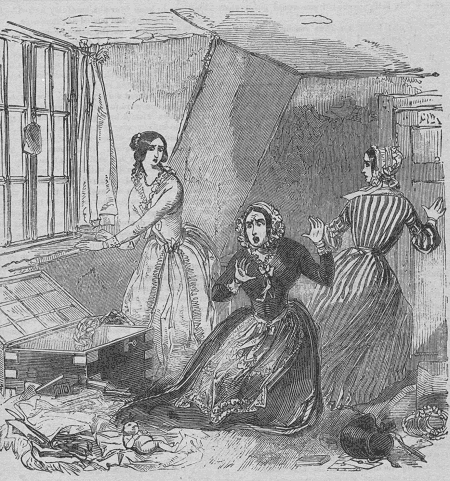
leant against the wall for support. My clothes were tumbled out on the floor: at
the bottom of the box was a small bundle, wrapped round with linen articles. The
schoolmistress drew it forth — a terrific scream escaped my
lips — the corpse of the infant rolled upon the floor!
"Jessica gave vent to an exclamation of horror and
alarm, and was rushing towards the door, when Mrs. Lambkin, recovering from the
sudden shock which this spectacle had occasioned, held her back, saying, 'In the
name of God be cautious; or my establishment will be ruined!' Then turning
towards me, her lips quivering and white with rage, she said, in a low hollow
tone, 'No wonder you are so pale and ill this morning! But must I look upon you
as the murderess — .' — — 'Oh!
no, no, madam,' I exclaimed, falling on my knees, and joining my hands together;
'that child was born dead. Listen to me, and I will tell you all; I will confess
every thing!' — 'There appears to be but little now to
confess,' returned Mrs. Lambkin; 'and I have no time for idle conversation. 'The
honour of my institution is seriously compromised: I will pay you the amount due
to you, and you can leave my service this minute. It will be your fault if the
real cause ever transpires.' — 'Ah! madam,' I exclaimed, 'shall
I not then be looked upon as the thief who stole your spoons?' — 'No,'
answered the school-mistress. 'I will declare in the presence of the entire
establishment that my search has proved ineffectual in all quarters; and I will
even allow you the merit of having left of your own accord, for the same reason
which prompted Miss Rhodes and Miss Jessop to give me notice,' Mrs. Lambkin then
turned towards Jessica, to whom she enjoined the strictest secrecy concerning
the discovery of the dead child.
"At one moment, when on my knees before Mrs.
Lambkin, I was about to confess the whole truth: but, now perceiving the turn
which matters had taken, and that she herself was most solicitous to hush up the
affair for the credit of her establishment, I saw that no exposure awaited me,
and that might save Adeline from disgrace and ruin without farther compromising
myself. I accordingly intimated my readiness to leave on condition that the real
motive should never transpire. Then I thrust my things back again into the
trunk: but the corpse of the child, wrapped in linen, I left lying on the floor.
'Put every thing into the trunk — that, and all!' said
Mrs. Lambkin. — 'Not for worlds, madam,' I exclaimed, 'would I
remove my effects elsewhere, with that amongst them!' — 'Wretch!'
she cried, 'would you have me dispose of your bastard's corpse for you?' — This
insulting question brought the blood into my cheeks. Oh! it was too much to be
thus reviled for a disgrace which did not really belong to me. Mrs. Lambkin saw
how I was agitated, and, dreading a scene, she said in a low tone, 'You can
remain here till tomorrow, Miss Hutchinson. If you choose to walk out this
evening, when it is dark, you have my permission. But, in the meantime,
you will have the kindness to keep your box carefully locked.'-I understood the
hint, and bowed acquiescence.
"We descended to the school-room once more. The
moment I entered I darted a glance towards Adeline which convinced her that she
was saved. The one she gave in return was replete with gratitude, Oh! how much
had I sacrificed, and how deeply had I suffered for her!
"The day passed slowly away. Fortunately the
missing spoons were found in the evening: they had merely been mislaid by the
cook or scullery-girl. I retired to my chamber at an earlier hour than usual:
the presence of the school-mistress was irksome to me in the room below. In a
short time Adeline came to me. She had stolen away to have an opportunity of
conversing with me. Then I narrated to her all that had occurred in the morning.
She threw herself upon my neck, and thanked me with tears in her eyes for having
saved her from the depths of disgrace. She called me her 'sister' — her
'friend ' — her 'dearest, dearest friend;' and vowed she would
never forget the immense service which I had rendered her. Then I felt glad that
I had acted as I had done. She even offered to go out, when the other inmates of
the house had retired to rest, and dispose of the corpse of the child; but I
knew that it would be death to one in her condition to venture abroad in the
night-air. I accordingly undertook to perform that task also. We next conversed
on my own prospects. I was averse to return home: I dreaded the numerous
questions which my father and brother were certain to put to me. Adeline, who
was an uncommonly worldly-minded girl for her age, instantly suggested that I
should take a respectable lodging in London, and she would undertake to procure
for me a situation as a nursery-governess. The Christmas holidays were at hand:
she would be returning in the course of ten days to her parents' house in
Belgrave Square; and she assured me that she should then have an opportunity of
exercising her influence in my favour. To these proposals I assented; and she
withdrew.
"When the house was quiet, I put on my bonnet and
cloak, concealing beneath the latter the corpse of Miss Enfield's child. I then
slipped out by the back way, and striking into the bye-lane leading towards
Brompton, at length reached a pond, into which a muddy ditch emptied itself. The
moon was bright, and thus enabled me to discover a spot fitted for my purpose. I
placed two or three large stones in the bundle containing the body of the child:
then I threw the whole into the pond. The dark water splashed and gurgled; and
in a few moments all was still once more.
"I now breathed more easily; but it was not without
some difficulty that I found my way back to Belvedere House.
"On the following morning I took my leave of the
inmates of that establishment. I received the money that was due to me; and I
requested Mrs. Lambkin to allow me to leave my boxes until I should send for
them in the evening. To this she assented; and I repaired by the omnibus to
London. Miss Enfield had given me the necessary advice to guide me in searching
for a lodging; and I engaged a room in the house of a respectable widow in Bury
Street, St. James's. Her husband had been an upper servant in the family of Lord
and Lady Rossville (Miss Enfield's parents); and, by using [-123-]
Adeline's
name, I was immediately received with civility by the widow.
"I sent a porter for my boxes; and then my first
care was to write a letter to my father. This I found to be no easy task. I
recoiled from the idea of sending a tissue of falsehoods to that dear, confiding
parent. Nevertheless, the duty was imperative. I accordingly concocted a letter,
in which I informed him 'that having been grievously insulted by Mrs. Lambkin, I
had left her service; but that I had met with a sincere friend in the Honourable
Miss Adeline Enfield, one of the young ladies of the establishment, who had
taken a great interest in me, and had not only promised to procure me a
situation as a nursery-governess in a wealthy family, but had also recommended
me, in the interval, to the care of a most respectable widow.' By return of post
I received my father's answer. He regretted my precipitation in leaving Mrs.
Lambkin until I had written to consult him; but admitted that the provocation in
searching my boxes was grave. He expressed his entire confidence in my
discretion, and declared his delight at the friendship I had formed with Miss
Enfield. But he charged me to return home the moment I experienced the least
difficulty in obtaining another situation. He concluded by stating that either
he or Edgar would have repaired to London to see me; but that the expense was an
almost insuperable barrier to such a step, their limited means being considered.
"Ten days elapsed; and then I knew that Miss
Enfield must have returned home for the Christmas holidays. I accordingly
expected an early visit from her. Nor was I mistaken. A magnificent equipage one
afternoon drove up to the door; and Adeline stepped out. In a few moments she
was seated in my little room. 'You see that I have not forgotten you, dear
Lydia.' she exclaimed. 'I have told my mother, Lady Rossviile, such a fine story
about you, — how good and kind you always were to me, and how
Mrs. Lambkin persecuted you without any reason, — that she has
permitted me to visit you; and, more than that, she has recommended you to Lady
Penfeather as a nursery-governess. There is Lady Penfeather's address; and you
may call on her to-morrow afternoon. I have already said so much to her ladyship
concerning you, and assured her of the respectability of yourself and family
with such effect, that you will be received immediately.' — I
cordially thanked Adeline for this goodness on her part; and she insisted so
earnestly upon pressing on me a sum of money to enable me to improve my
wardrobe, that I could not refuse her offer. She then embraced me, and took her
leave.
"I will not dwell tediously on this portion of my
narrative. On the following day I called upon Lady Penfeather, and was received
very graciously. After some conversation, she engaged me at a salary of twenty
guineas a-year; and I was to remove to her house immediately. She was an easy,
affable, good-natured person — about thirty-six years of age,
and not very handsome. Her husband, Sir Wentworth Penfeather, was three or four
years older than herself, and was a fine, tall, good-looking man. They had three
children, whose ages were between six and ten: the two eldest were girls, and
the youngest a boy. These were to be my pupils. I hastened back to my lodging,
and wrote a letter to my father informing him of my good luck. Then I settled
with my kind landlady, and removed to Sir Wentworth Penfeather's residence in
Cavendish Square.
"I was very well treated in this family. The
servants were all civil and attentive to me; and the children were as ready to
learn as children of much an age could possibly be. Sir Wentworth was very
frequently in the apartment where I sate with them; and he was particularly kind
in his manners toward me. He even laughed and joked, and conversed with me in a
very friendly way. But in the presence of his wife, he was reserved, and never
addressed a word to me. At length his attentions when unperceived by Lady
Penfeather, grew daily more significant; and he paid me many compliments on my
beauty. I discouraged his familiarity as much as possible; but he soon grew more
bold, and one day declared in plain terms that he adored me. I rose and left the
room.
"Three months had now passed; and I had never seen
Adeline since she called upon me at my lodging. I knew that she was not to
return to Mrs. Lambkin's establishment, her education being completed (completed
indeed!); and I felt hurt that she had not found a leisure moment either to call
or write to me. I accordingly wrote a note requesting to see her. I was anxious
to obtain another situation, and thus escape from Sir Wentworth Penfeather's
importunities. On the following day Adeline called, and desired to see me alone.
I was struck by her cold and distant manner. 'Miss Hutchinson,' she said, 'you
must not be astonished at my conduct in not visiting you. You did me a great
service: I have returned the obligation by procuring you a good situation. There
are now no debts on either side. Our ways lie so totally different in the world,
that were I to maintain an intimacy with you, my behaviour would be subject to
the most annoying comments. We have both of us a deep interest in keeping each
other's secrets. Were you, in a moment of anger against us, to state that it was
my child that was discovered in your trunk, who would believe you?
whereas, if you proclaim our respective amours with Captain Cholmondeley and
Lord Dunstable, you publish your own shame at the time you denounce me. I am
sorry to be compelled to speak thus to you; but I should have thought that your
own good sense would have taught you the immeasurable distance which lies
between you and me. Henceforth we are mere acquaintances, and nothing more'
"With these words the honourable Adeline Enfield
sailed out of the room, leaving me lost in astonishment — absolutely
bewildered — at her behaviour. Then I felt for the first time
the bitter ingratitude of the world, and I wept. Oh! I wept abundantly. My head
had fallen forward on the table near which I was sitting; and I was giving way
to my sorrow, when I heard Lady Penfeather's voice in the passage. She was
saying, 'This way, my lord: I am a sure you will be delighted to see the dear
children. They are all so fond of your lordship! Really it is [-124-]
quite an
age since we have seen you!' — 'I have been on the continent
with my friend Cholmondeley,' was the answer: but the voice in which it was
delivered touched the tenderest chord in my heart. In another moment the door
opened, and Lady Penfeather entered, followed by Lord Dunstable. 'This is the
little school-room, you see, my lord,' she said; 'and this is my governess, Miss
Hutchinson. But where are the children?' — 'Miss Hutchinson!'
exclaimed Lord Dunstable; 'Oh! we are old acquaintances: I have had the honour
of meeting Miss Hutchinson before. I used to visit at her father's house,
at — at — ;' and he hesitated. — 'At
the Parsonage, near Guilford, my lord,' I instantly added, my courage reviving
when I felt my hand tenderly pressed in his. — 'Ah! to be
sure,' he exclaimed; 'and how is my respectable friend, your father?' he
continued, casting a significant look upon me. — I answered the
query; and Lady Penfeather was quite satisfied with the manner in which Lord
Dunstable's knowledge of me was accounted for. His lordship went on talking to
me about Guilford, (which, I really believe, he had never seen in his life); and
Lady Penfeather went herself into the next room to fetch the children.
"The moment her back was turned, Lord Dunstable
said to me in a hurried whisper, 'Dearest Lydia, you look more beautiful than
ever! I have never ceased to think of you since we last met. I have much to say
to you: will you meet me tomorrow afternoon, somewhere? Say in the Pantheon, (it
is not very far from hence) at three o'clock precisely?' — I
murmured an affirmative; and at that moment Lady Penfeather returned,
accompanied by the children. Lord Dunstable affected to admire them very highly;
and the mother was quite charmed with his amiability. I could not help noticing
how much his continental tour had improved him; indeed, I had never seen him
looking so handsome before: my heart was once more filled with the fondest
hopes; — for I really loved that man.
"When his lordship retired, he shook hands with me
again, and we exchanged significant glances. The pleasure I experienced at this
unexpected meeting, and the interest he manifested in my behalf, banished from
my mind the disagreeable impression created by Adeline's unfeeling conduct
towards me. Oh! how slowly passed the hours until the time of our appointment
drew nigh! I was so completely my own mistress in Lady Penfeather's family, that
I could go out when I chose; and thus I had no difficulty in repairing to the rendez-vous.
Lord Dunstable was there; and he advanced to meet me with pleasure depicted on
his countenance. I took his arm, and we retired to the picture-gallery, where
there happened to be but few loungers at the moment.
"He began by saying 'What must you have thought of
my conduct in leaving England so abruptly?' — 'It gave me very
great pain,' I answered; 'and, after all your promises to me, I considered that
I had reason to be both dissatisfied and unhappy.' — 'Let me
speak candidly to you,' he continued. 'I am so circumstanced, in consequence of
being entirely dependent on my father, that marriage is for the present
impossible. But I love you very sincerely, and absence has augmented my
attachment. Are you happy where you are?' — I then candidly
acquainted him with Sir Wentworth Penfeather's conduct towards me, and stated my
determination to leave my present situation as soon as I could obtain
another.' — 'Sir Wentworth,' continued Lord Dunstable, 'is the
greatest scoundrel in respect to women, in London. If you do not yield to his
wishes, he will slander you to his wife in private: and you will be turned away
some fine morning without knowing why, and without a character.' — 'Can
he be so base?' I exclaimed, alarmed at this information. — 'He
is indeed,' replied Dunstable.
"Then, in a language so plausible — so
earnest-so seductive, that I am unable to give you an idea of its speciousness,
he proposed that I should at once place myself under his protection. At first I
scorned the offer: he implored me to listen to him; he declared that he loved me
to distraction, and that the moment his father was dead he would marry me. I
wavered — he redoubled his entreaties his prayers; and at
length he wrung from me a consent to his proposition! It was agreed that should
invent some excuse to quit Lady Penfeather in the course of the week; and
Dunstable promised. in the meantime to provide suitable apartments for me. Then
we separated.
"But do not imagine that I did all this without a
pang, when I thought of my poor father and my brother! Oh! no — I
wept bitter, burning tears at my weakness, after I quitted my lover; and I
resolved to recall my promise to accept his protection. In this better frame of
mind I returned to Cavendish Square. The moment I entered, the servant who
opened the door informed me that Lady Penfeather desired to speak to me. I
proceeded to the drawing-room, where her ladyship was sitting. Sir Wentworth was
also there. I immediately suspected that there was something wrong. Lady
Penfeather said, in a cold and freezing tone, 'Miss Hutchinson, I have no
farther need of your services. Here is the amount due to you, together with a
quarter's salary in addition, as I have not given you a quarter's notice.' — 'This
is somewhat peremptory, madam,' I observed, when I could recover from this
sudden and unexpected announcement. — 'I should be even
justified in turning you out of the house, without the quarter's salary, Miss,'
retorted the lady: 'but I do not wish to behave too harshly to you; I could not,
however, advise you to apply to me for a character.' — 'My
God!' I exclaimed; 'what have I done?' — 'The. levity of your
conduct has been noticed by Sir Wentworth,' returned Lady Penfeather. — 'Sir
Wentworth!' I repeated, unable to believe my own ears; and then, in a moment,
Lord Dunstable's words flashed to my memory. — 'Yes, Miss
Hutchinson, continued Lady Penfeather; 'and as I recalled to mind the
significant glances which you exchanged with Lord Dunstable yesterday, I deemed
it my duty to have you watched this afternoon. Do you desire to know any
more?' — 'It is perfectly true that I have been with Lord
Dunstable ere now,' I exclaimed, my blood boiling with indignation: 'but it is
because I would not listen to the infamous proposals of your husband, madam,
that I have been maligned, and am treated thus.' — Sir
Wentworth started from his seat, livid with rage; and her ladyship ordered me to
quit the room. I perceived that all attempts at explanation in respect to her
husband's conduct were vain; and I accordingly obeyed this mandate.
"I now resolved to return straight home to my
father. I accordingly repaired, with my baggage in a hackney-coach to the White
Horse Cellar, for the purpose of taking the first conveyance to Guilford.
But my evil star interfered to prevent this prudential arrangement; for it
happened that as I alighted at the coach-office in Piccadilly, Lord Dunstable
was passing at the moment. I shrank back to avoid him; but he saw me, and was
immediately [-125-] by my side. I then told him all that had occurred at the
Penfeathers', and acquainted him with my firm resolution to return home. Need I
say how he implored me to abandon this determination? need I describe the
earnestness with which he besought me not to make him miserable for life? His
language was eloquent — he was handsome-I loved him — I
was weak — and I consented to pass a few days with him ore I
returned to my father.
Alas! those few days were prolonged into a few weeks. I
did not dare to write home: I fondly hoped that my father imagined me still to
be in Lady Penfeather's establishment; and I felt convinced there was no chance
of his coming to London so long as he entertained this impression. Lord
Dunstable continued very kind to me. He had hired magnificent apartments for me
in Jermyn Street, and allowed me a carriage, besides a handsome weekly
allowance. He passed with me all the time he could spare from his regimental
duties; but he never went abroad with me — except to a private
box at the theatre on two or three occasions; and then he was so afraid of being
seen by his relations, that I was quite miserable.
"Several times I made up mind to leave him and
return home; for the remembrance of my beloved father and brother cut me to the
quick. But how could I seek their presence, — I who was now
polluted not merely through the treachery of my lover, but also through my own
weakness? Nevertheless, day after day I resolved to abandon my present mode of
life-retrace my steps to the home of my childhood — throw
myself at my father's feet — confess all my errors — implore
his blessing — and devote the remainder of my existence to
penitence and virtue. Then my lover would make his appearance; and all my
prudent designs would flit away as if they had never been.
"But one morning I was aroused from this dream of
irresolution-vacillation-weakness-and crime. I was seated alone at breakfast,
whiling away an hour with the newspaper. Suddenly my eyes fell upon an
advertisement at the head of the second column of the first page. Oh! never
shall I forget the agony of my feelings — the deep, deep
anguish of my soil, as I read these words: — 'L. H., your
father is at the point of death. Your afflicted brother implores you to return
home. For God's sake, delay not or it will be too late! All shall be forgiven
and forgotten.' — And in the corner was the name of my
father's village!
"For an instant I felt as if I should go raving
mad. My brain seemed actually to whirl. Oh! what a wretch did I conceive myself
to be! Another moment, and I became all activity — hurrying the
small preparations which were necessary for my departure. The terrible words, 'Delay
not, or it will be too late,' seemed fraught with an electric impulse. A
post-chaise and four were immediately ordered: I took with me but a small parcel
containing necessaries; — all the trinkets, all the jewels, all
the valuables which Dunstable had given to me, I sealed up and left behind me. I
moreover penned a hasty note to bid him farewell for ever!
"I lavished gold upon the postillions to induce
them to spare not their horses. The chaise rushed along like the wind. God knows
what were my feelings during the few hours which that terrible journey lasted. I
cannot attempt to describe them. Oh! if indiscretion and crime have their
enjoyments, they are also doomed to experience bitter — bitter
penalties. And my punishment was now at hand. It was not so long since I had
journeyed along that road with my father — when he first
conducted me up to London. Then we had travelled by the coach, and not so
rapidly as I was now retracing the same path. Then, too, I had marked many of
the most prominent features on the road and in the adjacent country, — here
a church — there a picturesque farm — a
cottage — a mill — or a hamlet! As I was
hurried along in the post-chaise, I looked ever and anon from the window; oh!
there were the same objects I had before observed; — there they
were, apparently unchanged; — but I — my
God — was I the same?
"But it was as I drew nearer and nearer to the
little village where I was born, that my eyes encountered a thousand objects
which aroused feelings of the most acute anguish within me. There was a
beautiful hill to the summit of which I had often climbed in my youthful days,
accompanied by my brother. There was the stream which turned the huge wheel of
the water-mill in the alley, and the path along whose banks was a favourite walk
of my father's. The wheel was turning still: my eye could trace the path on the
river's margin; — but the days of innocence, in which I had
rambled there — a fond, loving, and confiding girl, hanging on
my father's arm, or skipping playfully away from him to pluck the wild-flowers
in the fields — those days of innocence, where were they? The
chaise rolled on; and now the spire of the village church, peeping above the
mighty yew-trees which surrounded the sacred temple, met my view. But, ah! what
was that sound? The bell was speaking with its iron tongue: its well-known clang
boomed over hill and valley. Merciful heavens! it was a knell! 'Oh no — no,'
I exclaimed aloud, clasping my hands together in bitter agony; 'it cannot be!
God grant that it is not so!'
"And now the chaise rolled through the village; the
humble inhabitants rushed to their doors — Ah! how many faces
that I knew, were thrust forth to gaze at the equipage. I can picture to myself
that when the condemned malefactor, on the morning of his death, is advancing
towards the scaffold, he closes his eyes just at the moment when he feels that
he has reached that point whence his glance might embrace all its hideous
reality. Urged by a similar impulse, I covered my face with my hands the instant
the chaise swept from the main-road towards the home of my childhood. I dared
not glance in that direction!
"But in a few moments the vehicle stopped. The
knell from the church-tower was still ringing in my ears: by an almost
superhuman effort I withdrew my hands from my countenance, and cast a shuddering
look towards the house. My terrible apprehensions were confirmed: the shutters
were all closed; and I saw in a moment that there was death in that abode!
"From that instant all consciousness abandoned me
for several hours. Indeed, it was not until the next morning that I awoke as it
were from a hideous dream, — and yet awoke to find it all a
fearful reality. I was in bed: my poor brother — pale and
careworn — was leaning over me. In a short time I learnt all.
My father was indeed no more. He had breathed his last while I was yet on my way
to implore his dying blessing. And he had left me his [-126-]
blessing — he
did not curse me, although I had been the cause of his death! Nor did my brother
reproach me: on the contrary, he whispered to me words of consolation, and even
of hope! Poor father — beloved brother!
"But I cannot dwell upon this portion of my
narrative: it rends my heart — lost, guilty, wretched as I
am, — it rends my heart to recall those terrible events to
mind! Suffice it to say that Lady Penfeather had written to my father, to state
that she had been compelled to discharge me at a moment's notice 'in
consequence of the levity of my behaviour;' and she had added that, 'in
spite of the excellent admonitions and example of herself and Sir Wentworth,'
she was afraid I had formed evil acquaintances. This letter was enough to induce
a parent even less loving than my poor father, to hasten immediately to London,
where he commenced a vigilant search after me. He traced me to the White
Horse Cellar; -and there, by dint of inquiry, he discovered that I had met a
gentleman with whom I had gone away. He proceeded to Mrs. Lambkin, with the
feeble hope that she might know something about me; and that lady told him
sufficient (without, however, mentioning a word about the discovery of the dead
infant in my box) to confirm his worst fears that I was indeed a lost and ruined
creature! After passing several weeks in London in a vain and ineffectual search
after his still dearly-beloved daughter, the poor old man had returned home,
heart-broken — to die!
"And I gazed upon his cold clay — and
I followed him to the grave which was hollowed for him near the walls of that
church wherein for twenty years he had preached the ways of virtue — those
ways which he himself had so steadily pursued. Oh! when the minister came to
those solemn words 'Earth to earth, and ashes to ashes,' — and
when the cold clay rattled down upon the coffin-lid, — what
feelings were mine! You may probably divine them; but the world has no language
that can express them!
"Scarcely was my father consigned to his last home,
when my brother demanded of me a full account of my late proceedings. He could
not believe that one who had been reared with such care, and in whose soul such
sublime moral lessons had been inculcated, could have erred willingly. He
expressed his conviction that some infernal treachery had been practised towards
me. I threw myself upon his breast: I wept — and I told him
all, — all, as I have now related these particulars to you. On
time following morning he had left home when I descended to the breakfast-table.
His absence alarmed me sorely; I was full of vague and undefined apprehensions.
Alas! how speedily were they confirmed! Four days afterwards I received a letter
from a surgeon in London, breaking to me the fearful news 'that my brother
had died of a wound received its a duel with a certain Lord Dunstable.' — A
certain Lord Dunstable; — as if I did not know him too well!
"Was I, then, the murderess of my poor father and
my noble-hearted brother! If my hand had not struck a dagger into their hearts,
my conduct had nevertheless hurried them to the grave. I hated — I
abhorred myself. But the bitterness of my reflections was in some degree
mitigated by the hasty preparations which I was compelled to make for an
immediate return to London. I had not money enough to enable me to take a
post-chaise, and I was therefore obliged to wait for the Portsmouth coach, which
passed through the village on its way to the metropolis. I had already made up
my mind what course to adopt. Now that my father and brother were no more, I
could not bear the idea of remaining in the place where we had all been once so
happy together: I moreover knew that the parsonage-house would soon be required
by the new curate who had been appointed as my late father's successor. I
accordingly sent for the village lawyer. and gave him instructions to realize in
ready money all the little property which had become my sad inheritance. I told
him that in a few days I would let him know my address in London; and that he
was to forward me the proceeds of the sale. But I retained a few relics to
remind me of my departed relatives; and as I wept bitterly over them, I took a
solemn vow that my future conduct should prove the sincerity of my repentance
for the past!
The coach made its appearance soon after midday: there
was not a single person inside; and thus I was enabled to pour forth, without
restraint, that grief — that acute anguish which I experienced
at being compelled, by my own misconduct, to quit for ever the place of my
birth. Oh! then I felt how hard, how bitter it was to arrive at the conviction
that I had no longer a home, I was now wretched in the extreme: I had lost those
who were nearest and dearest to me! Not to me was it given to close the eyes of
the author of my being: not to me was it allowed to receive the parting sigh of
that brother who had met his death in the cause of his sister's outraged honour!
Wretch that I was; — I had no longer a friend — and
no longer a home!
The coach, on its arrival In London, stopped at the
White Horse Cellar. I took a cab, and immediately proceeded to the house of the
surgeon who had written to me. There it was that my brother had breathed his
last! The duel had taken place in the neighbourhood of Bayswater: my brother
received his adversary's ball in the breast; and although he lived for some
hours afterwards, he never spoke again. Lord Dunstable conjured the surgeon to
show the unfortunate young man every attention, and then took his immediate
departure for the continent. But, from motives of delicacy, neither poor Edgar
nor his lordship had communicated to the medical man the cause of the duel. It
was only by means of papers found about my brother's person that the surgeon
discovered that he had a sister, and ascertained where that sister lived. In the
hurry, alarm, and confusion which followed the duel, the surgeon had forgotten
to demand, and Lord Dunstable was too bewildered to communicate, any particulars
relative to the family or friends of the young man who had fallen in the hostile
encounter. Thus, had it not been for certain memoranda which were discovered in
my poor brother's pocket-book, the surgeon would not have known to whom to
write, and I might have remained for months — or even
years — in ignorance of that dear relative's untimely fate.
Full well did I comprehend the delicacy of his own conduct: he had not left a
written trace which might expose my shame by revealing the motives that had led
to the duel!
"There was a coroner's inquest; but, as it was
stated that I was not in London at the time when the hostile encounter took
place, I was not examined. Thus were my feelings spared a most pain[-127-]ful
ordeal! The funeral took place; — and the earth closed over the
remains of him who was cut off in the flower of his youth — a
victim to my misdeeds! The kindness of the surgeon's family had hitherto made me
their guest; but on the day after the mournful obsequies, I perceived the
necessity of adopting some decided course, so as to intrude no longer on that
generous hospitality. But the worthy surgeon questioned me closely; and finding
that I had only recently been left an orphan, and was totally friendless, he
insisted that I should pass a few weeks longer with his family, until he could
obtain for me a situation as governess. I wrote to the lawyer of my native
village; and by return of post he forwarded me an order on a London banker for
thirty-seven pounds — the poor proceeds of the sale of the
furniture in the parsonage house.
"Six months passed away: during that period I was
treated with the utmost kindness by the surgeon and his family. But misfortune
suddenly overtook that excellent man. The villany of a false friend plunged him
from affluence into comparative poverty. This abrupt change preyed so deeply on
his mind, that he put a period to his existence. His brother — a
man of morose disposition and selfish character — undertook to
provide for the widow and her children; and I was then compelled once more to
shift for myself. I took an affectionate farewell of those who had behaved so
well towards me, and removed to a humble lodging, where I soon experienced all
the wretchedness of my lonely and unfriended position. I inserted advertisements
in the newspapers, for the purpose of obtaining a situation as teacher in a
school or governess in a respectable family; and although I received many
replies, I failed to give a satisfactory account of myself. I could not refer to
Mrs. Lambkin, nor to Lady Penfeather; and I found that my orphan condition
excited but little sympathy in my favour. Thus a year — an
entire year — passed; and at the end, I found myself without
hope, and without resources. I knew not what would become of me. At length I
mustered up all my courage, and proceeded to Rossville House. I inquired for
Miss Adeline Enfield. The servant demanded my name, and left me standing in the
hall for nearly ten minutes until his return. I was then shown into a small but
magnificently furnished parlour; and almost immediately afterwards Adeline made
her appearance. She advanced towards me with the most chilling hauteur of
manner, and desired to know 'my business.' — 'Oh! Miss
Adeline,' I exclaimed,' have I no claims upon your friendship!' — '
You must remember what took place between us the last time we met,' she
answered. 'If you require pecuniary assistance, I will succour you for the last
time; but circumstances compel me to decline seeing you, or even knowing you in
future.' — 'And is this the way you treat me after all I
suffered on your account? I said, bursting into tears. 'Do you not reflect that
your reputation is in my hands?' — 'If you menace me, Miss
Hutchinson,' she said, 'I shall know how to treat you. In a word, who would
believe your story were you to proclaim it? You would only draw down upon
yourself the vengeance of my family by endeavouring to shift your own disgrace
on to my shoulders. The whole world would denounce you as a common impostress.' — An
instant's reflection showed me that these assurances were strictly true. But my
pride was hurt, and my feelings were poignantly wrung by the blackness of
Adeline's ingratitude. Pushing aside her hand which tendered me a purse of gold,
I exclaimed, 'From this moment, Miss Enfield, I consider myself absolved from
all motives of secrecy on your account;' — and, before she
could utter a word of reply, I left the room.
"I hurried back to the house where I lodged. The
landlady met me upon the threshold of the door. 'Come, young woman,' she said,
'can you pay the fortnight's rent you owe me?' — 'I have been
disappointed,' was my reply: 'but in a few days--'-'People are always being
disappointed when they owe money,' she exclaimed. 'I shall keep your things till
you settle your rent; and I shall let the room to those who can and will pay.'
And she banged the door in my face. This cruel calamity reduced me to despair. I
turned away from that inhospitable abode, — not with tears, for
there is a grief too profound to find a vent by the eyes-but with an utter
hopelessness that was distraction!
"I had eaten nothing since the morning: I was
hungry, and I had not a farthing in my pocket. it was moreover cold; and I knew
not where to sleep that night. Oh! then how bitterly did I regret the ebullition
of pride and feeling which had prevented me from accepting the purse which
Adeline had proffered me! It was now too late to conciliate her: I had used
menaces; and I felt convinced that it would be impossible to make my peace with
that proud and determined spirit. I wandered about the streets in a state of
mind which every moment suggested suicide. Then did all the happiness of home
and of the days of innocence recur to my memory with a force that nearly crushed
me! I thought of my dear departed father and my noble-hearted brother — both
hurried to the grave by my wickedness! Evening came-and I was still a wanderer
in the streets, without a hope-without a feasible project! Hour after hour
passed: midnight was proclaimed by the iron tongues of the thousand towers of
this mighty city; — and I sank exhausted on the step of a door
in Gerrard Street, Soho. I then became insensible.
"When I awoke, I was in a comfortable bed; and the
day-light streamed through the windows of a nicely-furnished room. I started up,
and glanced around me. On a small table by the side of the bed stood a decanter
with some port wine, and a bowl half-filled with broth. I immediately judged by
those appearances, and by my own sensations, that the kind hand of charity had
administered sustenance to me, as well as providing me with an asylum. From
those objects on the table my eyes wandered round the room; and I was surprised
and shocked to observe that the pictures on the walls were of a somewhat
indecent description. The unpleasant reflections which this circumstance
occasioned were interrupted by the entrance of an elderly woman, —
very stout, with small grey eyes, and a red nose. She seemed to have literally
flung on the cotton gown which she wore; and a dirty night-cap was perched on
the top of her head. She advanced with a good-natured smile towards the bed,
and, surveying me with great apparent satisfaction, exclaimed, 'How do you feel,
my poor child? I am delighted to see you looking so much better! Dear me, what a
state you were in when I found you, in the middle of the night, on the step of
my door.' — 'Ah! madam,' I said, extending my hand towards her,
'how can I ever repay you for this [-128-] goodness?' — She
pressed my hand warmly, and declared that she was charmed at being able to serve
so sweet a young creature. Then she asked me a great many questions; and I gave
her to understand that I was the orphan daughter of a clergyman; that I had
failed to obtain the renewal of my engagements as a nursery-governess: that I
had been turned into the streets by my landlady, who had detained my boxes; and
that I should have perished had it not been for the kindness and benevolence of
my present benefactress. When I had concluded this statement of as much of my
past life as I chose to reveal, the elderly lady exclaimed, 'And so you are a
clergyman's orphan, my dear! How very singular! Poor curates' daughters are
always falling into difficulties. But cheer up, my dear: I will be a friend to
you. And first tell me the address of your hard-hearted landlady: I will send at
once and redeem your things for you.' — I gave her the
information which she asked, and once more expressed my profound gratitude for
her goodness towards me. She patted my cheek, and then left the room, observing
that she would send me up breakfast. In a few minutes a good-looking and
smartly-dressed servant entered the chamber, bearing a tray containing coffee,
hot rolls, eggs, and the usual concomitants of a good meal. 'What is the name of
your excellent mistress? I inquired. — 'Mrs. Harpy,' was the
reply, given with a smile the nature of which struck me as being somewhat
strange. — 'What is she?' I asked. — ' She
keeps a very respectable boarding-house,' answered the servant, — I
did not like to put any farther questions; and the girl withdrew.
"I ate a very hearty breakfast, and then lay down
again; for I was not quite recovered from the fatigues of the preceding day. I
fell into a doze; and when I awoke, Mrs. Harpy was once more standing by the
side of the bed. 'Here are your things, my dear,' she said: 'I paid your
landlady fifteen shillings. That was for two weeks' rent owing, and a week she
claimed because you had left without giving notice. She gives an excellent
character of you, and proves all you have told me to be quite true. I am really
as fond of you as if you were my own daughter. You are looking much better; and
a nice little boiled fowl, with a glass of Port, will set you to rights. What
time do you like to dine, dear?' — 'My good lady,' I replied,
'you are heaping favours upon me, and I have not the means of paying you for any
one of them.' — 'Don't talk of that, my dear girl,' ejaculated
Mrs. Harpy. 'I 'm sure it is quite a pleasure to do any thing for you. But,
by-the-by,' she added, 'you may just as well give me a memorandum for what I am
paying for you; and as I shall be able to procure some nice, easy, genteel
avocation for you, you can reimburse me at your convenience.' — Of
course I was delighted at this opportunity of testifying my honest intentions
and good-will; and I instantly affixed my signature to a slip of paper which she
produced from her pocket. Mrs. Harpy kissed me very affectionately; and then,
casually observing that she kept a very genteel boarding-house, concluded by
saying that she would ask some of the young ladies to come up after dinner and
keep me company for an hour or two.
"At four o'clock the pretty servant made her
appearance with the boiled fowl and a small decanter of wine; and when the
things were cleared away, the young ladies were duly ushered in. There were five
of them. Their ages varied from seventeen to twenty-three; and they were all
remarkably good-looking. It however struck me as somewhat singular that they
were every one dressed in extremely low-bodied gowns, so as to exhibit a great
deal more of the bust than was consistent with my notions of decorum. But as
they were very affable and kind in their manners, and 'dear'd' me with much
apparent sincerity, I ceased to think of that peculiarity. Presently Mrs. Harpy
sent up a bottle of wine and some fruit, with her kindest compliments; and then
the young ladies laughed and enjoyed themselves in the happiest manner possible.
They drank the wine with great freedom and relish; and by degrees their
conversation turned upon the topic of love. With this subject they were quite
familiar; and the more they drank, the more license they allowed their tongues.
They spoke of the kindness of Mrs. Harpy, of the gaiety of the life which they
led in her establishment, and of the high acquaintance which they enjoyed. They
seemed to know every young lord and wealthy gentleman about town, and compared
the various qualifications of those personages. Their discourse became more and
more animated in proportion as their imaginations were warmed with the wine; and
at length they allowed such observations to escape them which made me blush. I
was surprised at their levity, and had already begun to entertain strange
suspicions of their virtue, when a hell suddenly rang on the landing. They all
started up, and rushed out of the room, — leaving me a prey to
the reflections which their remarkable conduct had very naturally excited.
"I kept my bed, by Mrs. Harpy's advice, all that
day; but I did not feel sleepy in the evening, after the young ladies had left
me; — and even if the contrary were the case, I should not have
been able to indulge a wish for repose, for after eleven o'clock the whole
establishment seemed to be in a constant bustle. People ran up and down stairs;
doors were banged; shouts of laughter awoke every echo in the place; glasses
rattled on trays that were carried to the different rooms; and the boisterous
mirth of men rose at intervals above the other sounds and noises. This
confusion, as it appeared to me, continued until about two o'clock; and then the
house became quiet. My suspicions were seriously excited relative to the
respectability of Mrs. Harpy's establishment; but I endeavoured to quiet them by
all the arguments I could conceive in that lady's favour, and which were
prompted by my gratitude towards her. At length I fell asleep.
"In the morning the servant brought me up my
breakfast. I asked her the meaning of the bustle I had heard during the night.
She answered carelessly, 'Oh! Mrs. Harpy is very gay, Miss, and is fond of
company.' — After breakfast I got up, and bad just dressed
myself, when a door was opened violently on the opposite side of the landing,
and a male voice exclaimed, 'Well, if the old woman won't give me credit for a
miserable bottle of champagne, after all the money I've spent in the place, I'll
never set foot in. it again. So good bye, 'Tilda. Here's a sovereign for you, my
girl. It's the last time I shall ever sleep in this house.' — Thereupon
the individual, who had so expressed himself, descended the stairs with a
tremendous stamping of his feet, as if he were very indignant at the treatment
he had complained of; and Miss Matilda — one [-129-]

of the
young ladies who had visited in my room on the preceding evening — returned
into her apartment. banging the door violently behind her. This incident opened
my eyes to the dread truth: — I was in a brothel!
"I threw myself on a chair and burst into a flood
of tears. Merciful heavens! for what fate was I reserved? Had I indeed fallen so
low that my only home was a loathsome den of iniquity like that? For some
minutes after the occurrence of the incident just related, I felt as if my
senses were leaving me. Suddenly the door opened, and Mrs. Harpy made her
appearance. She seemed astonished at the condition in which she found me, and
was about to make some remark, when I threw myself at her feet, exclaiming, 'I
conjure you, madam — if you have any pity for a poor friendless
orphan — let me leave your house this moment!' — 'And
where will you go, my dear child?' she said. — 'To the
workhouse, ma'am: anywhere, rather than remain here!' I answered. — 'This
is a pretty recompense for my kindness towards you,' she observed. 'If it had
not been for me, you would have died in the streets.' — 'Far
better for me were it had I so perished!' I exclaimed. — 'Now,
Miss,' cried Mrs. Harpy growing angry, 'what is the meaning of all this
nonsense?' — 'Can you ask me?' I demanded. 'Oh, that the
feelings which prompted you to assist me, should have been any other save the
disinterested benevolence for which I so sincerely thanked you!' — 'Then
you know where you are, Miss, I suppose?' she said, with a leer; and, before I
had time to give any reply, she added, 'I meant you to find it out in a day or
two; and it is as well now as a few hours later. Here you are and here you will
stay. You shall be treated just in proportion as you behave; and this evening, I
shall introduce some fine nobleman or gentleman to you.' — 'Never!'
I cried: then moving towards the door, I said, 'Detain me at your peril!' — 'So
I shall,' answered Mrs. Harpy, coolly. 'I've got your I.O.U. for twenty pounds;
and if you go anywhere it will be to Whitecross Street prison, before you're
many hours older. Remember, it's for necessaries; and no plea of minority or any
other gammon of that kind, will avail you.' — I remembered the
slip of paper which I had signed; [-130-] and my heart sank within me, as I saw
how completely I was in the power of that vile woman. — 'So
now you understand how you are situated,' she continued, softening in her tone
and manner. 'This is what all young girls like you must come to, sooner or
later; and you'll be very happy here, I can assure you. This evening a nobleman
who patronizes my house, will call upon you; and if you have any of your
nonsense with him, I'll send you straight to Whitecross Street to-morrow
morning.' — With these words she left the room, locking the
door behind her.
"I cannot attempt to explain the nature of my
feelings during the remainder of that day. A good dinner was sent up to me; but
I could not eat a mouthful. The servant asked if I should like to see any of the
'young ladies;' and I answered in a manner which convinced her how I recoiled
from the detestable proposal. She smiled — as I thought,
significantly, — as much as to say, 'You will talk differently
in a very short time.' — At about nine o'clock Mrs. Harpy sent
up word that I was to dress myself in my best attire — a
command with which I positively refused to comply; for I was determined that,
happen what might, I would not assist in the sacrifice of myself!
"At ten o'clock the servant brought up wax-lights,
and a tray containing a bottle of champagne, glasses, and several plates of
fruits and cakes. I watched these preparations in a state of dumb despair,
bordering on stupefaction. Another half hour passed; and steps once more
ascended the stairs. My heart palpitated violently! The door was thrown
open; — a man elegantly dressed entered the room; — I
cast one glance towards him, and, uttering a faint cry, sank insensible on the
carpet. It was Lord Dunstable!
"When I awoke, I found that nobleman hanging over
me, bathing my temples. He compelled me to drink a glass of wine; and I soon
recovered full consciousness of the miseries of my condition. Starting from the
half-embrace in which Lord Dunstable had clasped me, I surveyed him with horror.
'Do I frighten you, Lydia?' he exclaimed. 'I must confess that our meeting is a
strange one. The old woman sent to tell me that she had a prize; but I little
expected to find you here.' — 'My presence in this house of
infamy, my lord,' I answered, 'is one of the links in that chain of degradation
of which you forged the first link. To you I owe all the disgrace and all the
sorrow that I have endured. Not contented with my ruin, you deprived me of my
brother.' — 'Come, Lydia, this is absurd,' he cried. 'In the
first place, a young female who meets a gentleman and walks with him in Parks or
elsewhere, must not expect to escape the usual consequences. Secondly, your
brother challenged me, like a rash and headstrong young fellow as he was: I sent
him due warning by my second that I was certain to shoot him; but he would not
take good advice, and I did shoot him.' — 'And had you no
regard for me at that moment?' I asked. — 'Egad!' he replied,
'I only thought of myself. I fancied that if I did not shoot him, he might
perform that good office for me; and so I was resolved not to give him a second
chance.' — 'Surely you cannot be in your senses, my lord,' I
exclaimed, 'to talk of so serious a matter in such a flippant style?' — 'Come,
let us understand each other, Lydia,' he said. 'I did not come to such a house
as this to receive a lesson in morals. Do you wish me to remain here with you
until to-morrow?' — 'No: a thousand times no,' I replied. 'Your
hand is red with the blood of my poor brother.' — 'Very well,
Lydia,' he answered coolly; 'then I will take myself off as quietly as I came.
But for old acquaintance' sake, I must do the thing handsomely.' — I
heard his observation, the flippant tone of which made me avert my head from him
in disgust; and I did not therefore see why he lingered for a few moments. At
length he left the room, saying, 'Bye, bye, Liddy;' and when the door closed
behind him, he began to hum an opera-tune, as he descended the stairs.
"Scarcely could he have had time to gain the street
door, when Mrs. Harpy bounded into my room, exclaiming, 'Well, my dear, you have
behaved very well, for his lordship went away in an excellent humour. What did
he give you?' — 'Give me! I repeated, surveying that horrible
woman with mingled indignation and terror. — 'By Jove, he's a
lord in name and nature both!' ejaculated Mrs. Harpy, as her eyes caught sight
of a bank-note which lay upon the table. 'Twenty pounds, as I'm a living woman!'
and she clutched the object of her delighted avarice. — 'Hold,
madam!' I exclaimed. 'Not one farthing of that money will I retain! The man who
gave it killed my brother!' — 'I don't care who he's killed, or
who he means to kill,' answered the old woman, here's his money; and that I
intend to keep.' — 'You keep it!" I cried. — 'Yes;
who else? What an ungrateful hussey you must be, after I took you out of the
street! This room and your board will cost you a guinea a-day. Then your
clothes, washing, and other things are all extra. So I'll keep nineteen pound
fifteen shillings on account; and you shall have a crown for pocket money. If
that is not generous, I don't know what is; but I like to do the thing what's
right.' — With these words she threw five shillings on the
table, and walked of with the twenty-pound note.
"This unexpected interview with Lord Dunstable and
its result stamped my degradation, and made me reckless. He had seen me in a
brothel; and in the excitement of our meeting, I had not explained to him how I
became an inmate of that house. Then he left behind him a sum of money; and, as
I was unable to restore it to him with an indignant refusal of any succour at
his hands, he would naturally conceive that I availed myself of his bounty. My
pride was wounded to such an irreparable degree, that I felt, if you can
understand me, a total unwillingness to endeavour to maintain it any longer. I
was spirit-crushed. I fancied that it was no use to contend any more against my
fate. I considered myself to be now so lost and degraded in the estimation of
that one man whom I had loved, that I had nothing else in the world to induce me
to study character, reputation, or pride. I accordingly abandoned myself to what
I firmly believed to be my destiny; and, seating myself at the table, I poured
out a glass of champagne. For a moment, I sighed as I remembered that it was
champagne that had led to my ruin in the first instance: — then
I laughed at what I called 'my folly,' and emptied the glass. The wine cheered
me, but, at the same time, confirmed me in that recklessness which had succeeded
the first feeling of utter and irredeemable degradation. I drank another glass:
the last spark of virtuous aspiration was then extinguished in my [-131-]
bosom.
The other young ladies suddenly made their appearance: I received them with open
arms; — we sate down to drink and chat; — I
was put to bed in a disgusting state of intoxication; and on the following
morning I awoke — reconciled to a life of infamy!
"Pardon me, if I dwell for a few minutes upon the
characteristics of those houses of abomination, in one of which I was now
located. Mrs. Harpy was an admirable type of her profession. She was mean and
griping in the extreme when wringing an extra shilling, or even an extra penny,
from her boarders, as we were called; and yet she was profuse and liberal in
supplying us with costly wine. If we complained of having to eat cold meat two
days running, she would storm, and declare that we lived too well as it
was; — but she would think nothing of giving us a bottle of
champagne, which could not have cost her less than eight or ten shillings, after
dinner. She took from us every farthing that we received, and invariably made us
out her debtors, although she never showed us any accounts. To give you an idea
of her way of managing, I will relate a little anecdote. One Saturday afternoon,
Matilda (whom I have before mentioned) ~ asked her for a sovereign; adding, 'You
know I have given you altogether thirteen guineas this week.' — 'Thirteen
guineas!' screamed the old woman: 'I'll take my Bible oath it was only
twelve.' — 'Well, call it even twelve, if you like,' said the
young female: 'you can well spare me a sovereign.' — 'Lord
bless the girl!' cried Mrs. Harpy. 'Why, there's seven guineas for your board
and lodging; two guineas for your washing; that's ten; a guinea for pocket
money; and a guinea for letters and needles and thread; that makes up the
twelve, or else I never went to school to learn compound addition.' — 'And
multiplication too,' said Matilda. 'Why, I had but one letter all the week, and
that was paid.' — 'Well, my dear,' answered Mrs. Harpy, 'we
will ask the postman. Come! I'll stand another bottle of champagne now, and you
shall have an extra sovereign for yourself next Saturday, if you're lucky in the
meantime.'
"We were complete slaves to this Mrs. Harpy. She
had got a note-of-hand for twenty pounds from each of us; and if any one even so
much as hinted at leaving her, she immediately threatened to wreak her vengeance
by means of the sheriffs' officer. She seldom allowed us to go out to take any
exercise, for fear we should decamp altogether; but every now and then we would
all go together to Gravesend or Richmond by the steam-boats, or else to
Copenhagen House, in the summer time, and to some minor theatre in the winter.
Oh! the misery of that existence! We were slaves to an old wretch who was
enriching herself at our expense, whilst we had not an opportunity of hoarding a
single guinea against any sudden necessity or misfortune. Then, what atrocious
proceedings were frequently enacted in that house! Hard by lived three or four
idle fellows, who dressed flashily, spent a great deal of money, and yet had no
visible employment or resources. Those ruffians were the blinks, or bullies,
belonging to Mrs. Harpy a establishment. Their tricks were manifold. For
instance, they would pick up, at a tavern, coach-office, the theatre, or other
public place, some country gentleman, or even a clergyman, whom they would ply
with liquor, and then induce to accompany them to 'their aunt's,' where they
would meet 'some delightful girls.' Of course this was Mrs. Harpy's
establishment. The respectable country gentleman, or clergyman, was plied with
more liquor; and, if he would not drink fast enough, his wine was drugged for
him. When he awoke in the morning, he would find himself in bed with one of the
'delightful girls.' Presently, one of the bullies would rush into the room,
declare that the gentleman had debauched 'his cousin,' and threaten an exposure.
Then the poor victim was glad to compromise the business by paying a
considerable sum, in order to hush up the matter at once.
"Sometimes, the bullies would attempt a similar
scheme of extortion in reference to individuals who came voluntarily to the
house; and if the latter resisted the exorbitant demands made upon them, they
were not unfrequently maltreated in a most shameful manner. It often happened
that a gentleman would become a regular visitor to the house, if he took a fancy
to one particular boarder: in such a case he probably adopted a false name, and
took every precaution to avoid discovery as to who he was. The girl whom he
visited, was then directed to pump him; and if she failed to elicit the desired
particulars, one of the bullies was instructed to watch and dog him when he left
the house. By these means, his real name, residence, position, and
circumstances, were speedily ascertained. If he were moving in a very
respectable sphere, was married, or had any particular motives to induce him to
keep his intrigue secret, he was the very kind of person who suited Mrs. Harpy
and her bullies. The next time he visited the house, he would be surrounded by
those ruffians, menaced with exposure, and forced to pay a considerable sum of
money to purchase silence. But the evil did not terminate there. From that time
forth, the unfortunate gentleman would be periodically beset by his persecutors;
and fresh extortions would be effected to renew the pledge of secrecy on their
part. Married men, moving in respectable spheres, have been driven to suicide by
this atrocious system! Many a time have I read, in the newspapers, instances of
self-destruction on the part of gentlemen whose pecuniary, social, or domestic
circumstances afforded not the least appearance of any possible motive for such
a deed; — and then I have thought within myself that those poor
victims had been hunted to death by extortioners of the class which I have
described! The man who has a character to lose, or who has the peace of his
family to consider, knows not how fearfully both are compromised, both
endangered, when he so far forgets himself as to set foot in a house of infamy.
He may imagine that his secret never can transpire — that
neither his family nor friends can, by any possible means, ever discover that he
has thus erred, — but, if he be an individual, who, by his
wealth and social position, appears worth the trouble of looking after, he will
most assuredly find himself a prey to the vilest of extortioners. His happiness
will be undermined and destroyed; he will live in constant dread of exposure:
and deeply — deeply will he rue the day that he ever set foot
in a brothel!
"The most bare-faced robberies are practised in
even what are called 'the respectable dress-houses.' A gentleman, wearing a
handsome watch and chain, is pretty certain to have it stolen from him; and when
he remonstrates, he is perhaps met with a [-132-] counter-accusation of having
given a bad sovereign in payment for champagne, on the preceding evening. On one
occasion, a young gentleman who was so plundered, and so accused, carried the
business to the Marlborough Street Police Office. Mrs. Harpy attended, denied
the robbery in the most indignant manner, and persisted in the accusation
relative to the base sovereign. The proceedings took such a turn that the young
gentleman was searched; and in his pockets were found other counterfeit
sovereigns, exactly resembling the one produced by Mrs. Harpy. Then Mrs. Harpy
sent for her wine-merchant, her butcher, and her baker, who were all her near
neighbours: and those tradesmen declared that Mrs. Harpy kept a most respectable
boarding-house, and that she was a lady of good connexions and undoubted
integrity. The magistrate then appealed to the policeman within whose beat
Gerrard Street was included; and as he received five guineas a year from Mrs.
Harpy for shutting his eyes, it was not likely that he would open them on that
occasion. He fully corroborated the evidence of the wine-merchant, butcher, and
baker; and the young gentleman was committed for trial for passing base money.
Mrs. Harpy's story was that he had presented himself on the preceding evening at
her house, and arranged to become a boarder in her establishment; that he
obtained from her the change for the bad sovereign; and that, when accused of
the act, he had turned round with a counter-charge relative to his watch. The
magistrate declared that there was no doubt of Mrs. Harpy's perfect
respectability, and commented severely on the 'infamous behaviour of the
prisoner, in trumping up so vile an accusation, as a means of releasing himself
from the odium of the charge laid against him.' This young man belonged to a
highly respectable family; and he had given a fictitious name in answer to the
magistrate's question, for he had only been married six months, and was
naturally anxious to conceal his visit to the brothel from the knowledge of his
friends. But when he was committed for trial, he was forced to send for them,
confess his indiscretion, and implore them to save him from the ignominy of
exposure in a court of justice. A compromise with Mrs. Harpy was accordingly
effected: she paid fifty pounds in forfeit of her recognizances to prosecute:
and she received two hundred to abstain from farther proceedings! I need
scarcely say that the young gentleman really had been plundered of his watch,
and that the entire business of the counterfeit money had been arranged to ruin
him. Again I declare that no one knows the woeful risks he incurs when he sets
foot in a house of ill-fame. That one false step may embitter the remainder of
his days!
"Some weeks elapsed ere I was completely aware of
the infamies which were perpetrated in Mrs. Harpy's den; and then I resolved to
leave the place, whatever might subsequently become of me. At length an
opportunity served; and one evening, with only a small parcel of necessaries
under my arm, and a few shillings in my purse, I slipped out of that scene of
iniquities. I cannot enter into further details: suffice it to say, from that
moment commenced an existence of fearful vicissitudes, — starvation
one day, luxury the next, — the most abrupt descents into the
lowest abyss of destitution, and the most sudden elevations to comfort, though
still a career of infamy, — wanderings for many, many nights
together, without knowing where to lay my head, and then a lodging and a good
bed! Oh! it was horrible, that precariousness of life to which I was doomed!
"How often did I reflect upon the times of my
innocence! Now and then I saw well-known names mentioned in the newspapers. The
consecutive and rapid promotions of Lord Dunstable and Cholmondeley were not
unnoticed by me. The presentation of the Honourable Adeline Enfield to court was
an incident which affected me deeply; for it naturally led me to compare her
elevated position with my degraded and wretched state. But one event, which was
recorded in the newspapers, gave me, I must confess, some satisfaction: this was
the bankruptcy of Mrs. Lambkin and her committal to Newgate for having
fraudulently disposed of her property. I afterwards learnt that she died
miserably in that gaol.
"But my own vicissitudes continued! Oh! let those
who are prone to turn away from the unfortunate woman with disgust and
abhorrence, rather exercise a feeling of sympathy in her behalf. She does not
drag her weary frame nightly along the pavement, through choice, but from
necessity. In all weathers must she ply her miserable trade-or starve. Then to
what indignities is she subjected! Every drunken ruffian considers himself
justified in ill-using her: every brutal fellow jostles against her, and
addresses her in terms of insult. Do they think that, because she is compelled
to ply her hideous trade, she has no feelings? But it is chiefly from the young
men who rove about the streets at night, smoking cigars, wearing pea-coats, and
carrying sticks, that the unfortunate woman is doomed to receive the deepest
indignity: — yes, from those who ought to have more chivalry in
their dispositions! There is one base extortion to which the unfortunate woman
is subjected, and which I must mention. I allude to the necessity of feeing the
policeman belonging to that beat where the unhappy creature walks. The miserable
wretch who deviated from this practice, either through inability or
unwillingness, would never have a moment's peace. The moment she was accosted in
the street by a gentleman, the officer would come up and order her brutally to
move on; and perhaps he would add violence to harsh words. Then, on the
slightest pretence — and often without any at all — the
miserable woman is dragged off to the station-house, charged with creating a
disturbance, and taken next morning before the magistrate. In vain may she
protest her innocence of the offence charged against her: in vain may she
denounce the vindictive motives of the officer. The word of one policeman is
deemed worth the oaths of ten thousand degraded females; and the accused is
sentenced to Bridewell accordingly. No one can conceive the amount of the wrongs
inflicted by the police upon the most miserable class of women!
"I could enter into details respecting the lives of
unfortunate females, which would inspire you with horror — and
yet with deep compassion. But I have already dwelt too long on a subject which
should never be mentioned without caution to the pure-minded woman. In reference
to myself, I need only add that having passed through all the terrible phases of
a career of infamy, — each day beholding me more degraded, and
sinking lower and lower amongst the low, — I was reduced to a
condition when beggary appeared the only resource left [-133-]
From this
appalling condition your goodness has relieved me; and God alone must reward
you — I never can!"
< previous chapter < | THE MYSTERIES OF LONDON [Vol. II] | > next chapter >