< previous chapter < | THE MYSTERIES OF LONDON [Vol. II] | > next chapter >
[-135-]
CHAPTER CLXXIX.
THE JOURNEY.
RICHARD
MARKHAM struck into the fields, and pursued his way in a southerly direction.
He avoided even the small hamlets, and kept as much as
possible in the open country.
Being unaware of the precise nature of the danger which
menaced his life, — although of course connecting it with the part
which he had recently played in the invasion, — he feared lest
printed descriptions of his person, with rewards for his apprehension, might be
circulated; and this source of terror induced him to choose the most secluded
paths.
It was long after sunset when he stopped at a small
country public-house, where he determined to rest for the night.
To his great joy the coffee-room was unoccupied by other
travellers; and the landlord appeared a simple, honest kind of half-farmer,
half-publican [-136-] who never troubled himself
about any one's business save his own.
A good supper and a bottle of very excellent wine tended
to raise our hero's spirits: and when the meal was concluded, he fell into a
train of meditation on the events of the preceding evening.
A thousand times did he ask himself who could be the
occupant of that chaise which was journeying in such haste? for that there was
some person inside the vehicle, who had urgent reasons for the utmost
circumspection, the fact of the drawn blinds would not permit him to doubt.
Moreover, the young aide-de-camp was evidently riding outside for
the purpose of answering any questions that might be put, paying the bills,
directing the postillions, and in all respects acting with a view to save the
person or persons inside from the necessity of giving their own orders.
The words — "Terrible events have
occurred at Montoni" — were also fraught with a most
menacing and mysterious importance. What could they mean? whom had these events
endangered? Was it possible that the kindness of the Grand Duchess towards
himself had been detected? And if so, what results could such a discovery have
produced?
While he was thus lost in the most painful conjectures,
a horseman suddenly galloped up to the door of the inn; and in a few moments the
traveller himself entered the coffee-room.
He was a slightly-built, middle-aged man, with a good-humoured
expression of countenance. He was attired in a kind of undress cavalry uniform,.
consisting of a foraging-cap with a broad gold band, a laced jacket, trousers
with a red stripe down each leg, and a very small black leathern knapsack at his
back.
"Now, landlord," he exclaimed, as he entered
the room, followed by the individual whom ho thus addressed, "some supper
at once-not a moment's unnecessary delay — and see that a fresh
horse is ready in twenty minutes. That is all the rest I can allow myself
here."
The landlord bustled about to serve up the best his
house could afford in such haste; and in the meantime the new-corner addressed
himself to our hero.
"Rather chilly this evening, sir," he said.
"And yet you can scarcely feel the cold,
considering the pace at which you appear to ride," returned Richard with a
smile.
"Egad! I do not ride so for pleasure, I can assure
you," observed the man. "But I presume that you are travelling in this
country for your amusement," he added: "for I perceive by your accent
that you are not a Castelcicalan, and I can judge your avocation by that
portfolio lying near you."
"You have guessed correctly," answered
Richard. "Have you travelled far to-day?"
"A considerable distance. I am, as perhaps you may
know by my dress, a government courier: and I am the bearer of dispatches from
Montoni to the Captain-General of Montecuculi."
"Any thing new in the capital?" asked Richard,
scarcely able to conceal the anxiety with which he waited for a reply.
"Great news," was the answer. "The Grand
Duchess has fled."
"Fled!" ejaculated Markham.
"Yes — left the capital — gone
no one knows where, and no-one knows why." continued the courier. "Montoni
is in a dreadful ferment. Martial law was proclaimed there the day before
yesterday; and a tremendous crowd collected in the Palace-square in the evening.
The military were called out, but refused to fire upon the people. Numerous
conflicting reports are in circulation: some say that the Grand Duke has sent to
demand the aid of an Austrian force. The people attacked the mansion of the
Prime Minister; and the firmness of the Political Prefect alone prevented
serious mischief. In fact, sir," added the courier, sinking his voice to a
whisper, "we are on the eve of great events; and for my part-although I am
in the government employment-I don't think it a treason to say that I would as
soon serve Alberto as Angelo."
At that moment the landlord entered with a tray
containing the courier's supper; and the conversation ceased. Nor had our hero
an opportunity of reviving it; for the courier was too busily engaged with his
knife and fork to utter a word during his meal; and the moment it was
terminated, he wished Markham good night and took his departure.
Still our hero had gleaned enough to afford him some
clue to the mystery of the post-chaise. The Grand Duchess had fled: the reason
of her flight was not publicly known. Was it not probable that she was an
occupant of the post-chaise which journeyed so swiftly? did not this idea
receive confirmation from the fact that Mario Bazzano accompanied the vehicle?
Then again occurred the question, had the Grand Duchess
involved herself in difficulty by her generosity towards him? The bare
supposition of such an occurrence was the source of the most poignant anguish in
the breast of Richard Markham.
He retired to rest; but his sleep was uneasy; and he
awoke at an early hour, little refreshed. He was however compelled to pursue his
melancholy journey, which he resumed with a heavy heart and with a mind
oppressed by a thousand vague apprehensions.
There was one circumstance which especially afflicted
him. He had not dared to write a letter to Isabella; and he knew that the
tidings of the failure of the invasion would shortly reach her. Then what must
be her feelings! She would believe that he had either fallen in the conflict, or
was a prisoner in some Castelcicalan fortress; and he entertained so profound a
conviction of her love for him, — a love as sincere as that which he
experienced for her, — that he dreaded the effects which would be
produced upon her by the most painful uncertainty or the worst apprehensions
concerning his fate.
Still, how could he write to her with any hope that the
letter would reach her? In the existing condition of Castelcicala, he felt
persuaded that all correspondence addressed to Prince Alberto or any member of
his family, would be intercepted. This conviction had hitherto prevented him
from addressing a word to that charming girl whose image was ever present to his
mind.
But as he journeyed wearily along, it suddenly struck
him that he might write to Whittingham, and enclose a note for Isabella.
Besides, he was also anxious to acquaint that faithful servant, as well as Mr.
Monroe and Ellen, with the hopes that he entertained of being shortly enabled to
return to his native land. He accordingly resolved to put the project into
execution.
For that purpose he was compelled to pass the [-137-]
next
night at a town where there was a post-office. He wrote his letters in the most
guarded manner, and omitted the signature. When they were safely consigned to
the letter-box, he felt as if a considerable load had been taken off his mind.
At this town he gleaned a great deal of information
concerning the agitated condition of the country. Martial law had been
proclaimed in every province; and the worst fears existed as to the Grand Duke's
ulterior views. The idea of Austrian intervention appeared to be general; and
deep, though not loud, were the curses which were levelled against the policy of
that sovereign who could venture to call in a foreign soldiery to rivet the
shackles of slavery which he had imposed upon his subjects.
One circumstance peculiarly struck our hero: the Grand
Duke seemed to possess no supporters — no apologists. The hatred
excited by his tyranny was universal. Castelcicala only required a champion to
stand forward — a leader to proclaim the cause of liberty — and
Richard felt convinced that the whole nation would rise as one man against the
despot.
That the Grand Duchess had fled precipitately from
Montoni, was a fact now well known; but the motives and details of her departure
were still veiled in the most profound mystery.
There was another circumstance which forced itself on
Markham's observation: this was that the deepest sympathy existed in behalf of
the prisoners who had been taken in the conflict near Ossore, and who, it
seemed, had all been despatched to the fortress of Estella. Richard's prowess in
rallying the troops also appeared to be well known; and on more occasions than
one, during his wanderings in Castelcicala, did he find himself the object of
the most flattering discourse, while those who eulogised him little suspected
that the hero of their panegyric was so near.
But it is not our intention to follow him through those
wanderings. Suffice it to say that he found his journey more wearisome than he
had anticipated; and that he was frequently compelled to avail himself of a
carrier's van along the by-roads, or to hire a horse, in order to diminish the
fatigue. of his wayfaring.
It was on the twelfth evening after he left Friuli, [-138-]
where he had parted with Morcar, that he crossed the river Usiglio at a ferry
about four miles to the east of Pinalla.
He was now only forty miles from the Neapolitan
frontier; and in twenty-four hours more he fondly hoped to be beyond the reach
of danger.
He had partaken of but little refreshment during that
day, for the nearer he approached the point where peril would cease and safety
begin, the more anxious did he become.
Having crossed the ferry, he inquired of the boatman the
way to the nearest inn. A dreary by-lane was pointed out to him, with an
intimation that it would lead to a small public-house, at the distance of about
a mile.
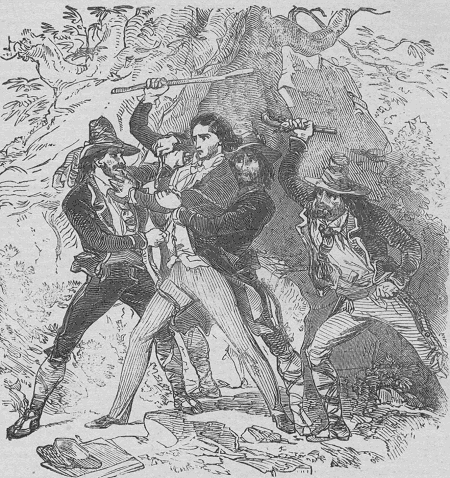
Richard pursed his way, and had proceeded about three
hundred yards down the lane, which was shaded on either side by large chesnut-trees,
when several individuals rushed upon him so suddenly that he had no time to
offer any effectual resistance.
He, however, struggled desperately, as two of the
banditti (for such his assailants were) attempted to bind his arms with cords.
But his endeavour to free himself from their grasp were
vain and fruitless, and only provoked a rougher treatment at their hands; for
one of the banditti drew a pistol from his belt, and with the butt-end of the
weapon aimed a desperate blow at our hero's head.
Richard fell, bleeding and insensible, upon the ground.
* * * * *
When
he opened his eyes again, he found himself lying in a comfortable bed.
Putting aside the damask-silk curtains, he glanced
anxiously around the room, which was sumptuously furnished.
He fell back on his pillow, and strove to collect his
scattered ideas. His head pained him: he raised his hand to his forehead, and
found that it was bandaged.
Then the attack of the banditti in the dark lane flashed
across his mind; and he mechanically thrust his hand into his bosom.
Alas! Armstrong's letter was gone!
< previous chapter < | THE MYSTERIES OF LONDON [Vol. II] | > next chapter >