< previous chapter < | THE MYSTERIES OF LONDON [Vol. II] | > next chapter >
[-288-]
CHAPTER CCXXIV
MR. BANKS'S HOUSE IN GLOBE LANE.
The
evening appointed by Katherine, in her note to Mr. Banks, for the purchase of
the papers relating to her birth, had now arrived.
It was nearly eight o'clock.
The undertaker was at work in his shop, the door of
which stood open; and several idle vagabonds were standing near the entrance,
watching the progress that was made in bringing a new coffin to completion.
Somehow or another, people always do stop at the doors of undertakers'
workshops — doubtless actuated by feelings of the same morbid nature
as those which call crowds of faces to the windows in a street along which a
funeral is passing.
Mr. Banks had laid aside his coat, and appeared in his
dingy shirt sleeves: he wore a paper cap upon his head; and at long apron was
tied very high up — above his waist — reaching, indeed,
almost to the waistcoat pockets. As the gas was not laid on in his
establishment, he was working by the light of a couple of tallow candles, that
flickered in a most tantalizing manner with the draught from the open door — leaving
Mr. Banks every other minute in a state of exciting suspense as to whether they
were about to be extinguished or to revive again. Still he did not choose to
adopt the very natural precaution of closing the shop-door, because he
considered it business-like to have a group of idlers collected at the entrance.
And there was an air of business about Mr. Banks's
establishment. There were shining white coffin-plates hanging along one row of
panes in the window; and black japanned ones suspended along another row, At a
central pane hung a miniature coffin-lid, covered with black cloth, and studded
with nails in the usual manner. The shop itself was crowded with coffins, in
different stages towards completion: the floor was ankle deep in shavings and
saw-dust; and carpenters' tools of all kinds lay scattered about. But,
pre-eminently conspicuous amongst all those objects, was a glass-case standing
upon a little shelf, and enclosing that very miniature model of the patent
coffin which he had displayed at the farm-house near Hounslow.
Mr. Banks was busily employed in fitting a lid to a
coffin which stood upon trestles in the middle of the shop; and his two eldest
boys, one fifteen and the other thirteen, were occupied, the first in planing a
board, and the second in sawing a plank.
"Well," mused Mr. Banks to himself, as he
proceeded with his work, "I hope Miss Kate won't fail to keep her
appintment — partickler as Tidkins seems so sure of the job. That
other feller which came yesterday to look at my first floor front as is to let,
never returned. And yet he appeared to like the blessed place well enow.
Goodness knows he asked questions by the dozen, and looked in every cranny about
the house. What did he want to bother his-self like that as to whether there was
a good yard for his missus to hang her clothes in on washing days? He should
have sent her to see all about that. Then he would see where the yard-wall
looked — and whether there was a yard or a street t'other side — and
all about it. I raly thought he would have taken the rooms. But p'rhaps he
didn't like the coffins: p'rhaps his missus don't fancy that there constant
hammering. Ah! it's a sinful world!"
And, as if deeply impressed by this conviction, the
undertaker shook his head solemnly.
He then continued his employment for some time without
musing upon any one topic in particular.
At length he broke silence altogether.
"Now, Ned," said he to his eldest-born (he had
five or six smaller specimens of the Banks' breed in-doors), as he raised his
head from his work, and looked severely round towards the lad; "that's
quite planing enow: the board'll be veared as thin as a egg-case before it's
used. Make it on economic principles, boy — economic principles, I
say, mind!" added Mr. Banks, sternly.
"It ain't economic principles to turn out coffins
as rough as if they didn't know what planing is," returned the youth;
"'cause the friends of the defuncks'll only send them back again."
"The friends of the defuncts will do no such a
thing to a 'spectable furnisher of funerals like me, as has lived, man and boy,
in the same house foe fifty year, and paid his way reglar," responded Mr,
Banks. "If we adopts economic principles, we can't waste wood or time
either."
"And do you mean to say, father," cried the
boy, "that this here plank is planed enow? Pass your hand along it, and
it'll get kivered with splinters — stuck all over like a porkipine."
"It will do exceeding well for the blessed carkiss
that'll rejice in such a lid as that board will help to make him," said
Banks, sweeping his horny palm over the plank. "That's good enow — that's
economic principles."
"Then economic principles is a fool and a
humbug," returned the lad, sulkily: "that's all I can say about the
matter."
"Oh! that's it — is it!" cried
Banks, assuming a threatening attitude.
"Yes — with a wengeance," added
his son.
"No — that's the wengeance," said
Mr. Banks, coolly, as he dealt his heir a tremendous box on the ear, which
forced the young man nearly over the plank that had caused the dispute; but as
the lad was not quite floored, his father bestowed on him a kick which, speedily
succeeding the slap, levelled the youthful coffin-maker altogether.
"Brayvo!" shouted the idlers at the door.
The discomfited son of Mr. Banks got up, retreated to
the farther end of the shop, and was about to discharge a volley of insolence at
his father when [-289-]
a
gentleman and lady suddenly appeared on the threshold of the shop.
"Ah! Miss Wilmot," exclaimed Mr. Banks — "punctual
to the time! Your most obedient~ sir," he added, turning towards Kate's
companion, whom he did not know personally, but who was really Richard Markham.
"Walk in, Miss — walk in, sir."
Then, without farther ceremony, the undertaker banged
the door violently in the faces of the loungers at the shop-entrance.
"Please to come this way," he said, again
turning to his visitors. "Take care of that lid, Miss; it'll soon cover a
blessed defunct as a widder and seven small childern is now a-weeping for. I'm
doing it cheap for 'em, poor things — eighteen-pence under the
reg'lar charge, 'cause they had to sell their bed to pay for it — in
adwance. This way, sir: mind them trestles. Ah! a many coffins has stood on 'em — all
made on the newest and most economic principles; for my maxim is that a cheap
and good undertaker is a real blessin' to society — a perfect
god-send in this world of wanity and wexation. What would the poor sinful
weasels in this neighbourhood do without me? — what indeed?"
Thus talking, and shaking his head in a most solemn
manner, Mr. Banks led the way to a parlour behind the shop: and when his two
visitors had entered it he closed the door to prevent the intrusion of his sons.
"Pray, sit down, Miss — sit down,
sir," said the undertaker, doing the honour, of his abode with all the
politeness of which he was master. "I am truly glad to behold your blessed
countenance again, Miss; — for it's a sinful world, and blessed
countenances is scarce — wery scarce, And this gentleman is
Mr. — Mr. — ahem! — I haven't the pleasure
of knowing him."
"It's no matter who I am," said Richard.
"The agreement between Miss Wilmot and yourself was that she should visit
you, accompanied by a friend:- — I am that friend. Let us now
proceed to business,"
And as he spoke, our hero coolly produced a brace of
pistols, which he laid upon the table.
"Sir — Miss Kate — I — I
hope — " stammered the undertaker, turning pale, and recoiling
in alarm.
"Fear nothing," said Markham: "it is
merely a necessary precaution, This young lady and myself [-290-]
are in a strange neighbourhood: — I have about me a considerable sum
of money, for the purpose of buying certain papers which you profess to have;
and you will pardon me if I have thought fit to adopt every precaution — yes,
every precaution," he added emphatically, "to guard against
treachery."
"But surely that dear crater, Miss Katherine with
her angelic countenance," said Banks, "must have told you, sir, that
I'm a 'spectacle man as was well known to Mr. Smithers, and that I should scorn
to act dishonourable to any blessed living wessel."
"We will not dispute upon the point, Sir,"
returned our hero, in an authoritative tone. "I have my reasons for acting
with caution. If you intend us no harm — none can befall you. Where
are these papers?"
"The papers, sir? Oh! the papers is safe enow,"
said Banks, still hesitating; "but them pistols — "
"Will remain there until the bargain is
concluded," added Markham. "Again I say that I mean fairly if you
do."
Thus speaking, he drew forth a pocket-book, and, opening
it, displayed to the undertaker's eager eyes a number of Bank notes.
"Business — it looks like business,'
murmured Banks; "in spite of them bles — cussed pistols. You
see, dear pretty Miss — and you, good sir, — that a man
moving in such a important speer as myself — sees so much of the
pomps and wanities — "
"A truce to these unnecessary observations, Mr.
Banks," said Markham, somewhat sternly; "or you will compel me to
think that you are only talking to gain time — which could. not be
for any proper motive. In one word, then — have you the papers which
relate to this young lady's parentage?"
"I have, sir — I have indeed,"
returned the undertaker.
With these words, he slowly unlocked an old walnut-wood
desk, which stood in a recess; and thence he took a brown-paper parcel, tied
round with coarse string and sealed in several places.
"This is just as I received the blessed dokiments
from my friend," he said, leisurely advancing towards the table: then,
taking a seat, he handed the parcel to Markham, observing, "You may break
it open, and satisfy yourself that its contents is geniwine. Two minutes will be
enow for that — and two minutes is all my friend told me to give for
the purpose. I haven't read a line of them myself; and I know nothink of what
they say; but my friend is as sharp a feller as here and there one, and he
assures me they're going dirt cheap-like workus coffins."
While Banks was thus indulging his garrulity, Markham
had opened the parcel by the aid of a pair of scissors which lay upon the table;
and the first thing which struck him was a letter addressed to "Mr.
Markham, Markham Place."
Katherine, who watched him attentively, without,
however, looking at the papers herself, observed him start as if with sudden
surprise: then he tore open the letter with almost a wild precipitation, and
glanced rapidly over the contents. As he read, his countenance became flushed,
and his features expressed mingled joy and astonishment — joy the
most fervent, astonishment the most profound.
"My God!" he exclaimed, throwing down the
letter, ere he had fully perused it: "how wondrous are thy ways! Katherine,
dearest girl — come to my arms — for you are my
sister-my own sister!"
"Your sister, Richard!" murmured the young
maiden, as she sank almost fainting upon her brother's breast.
"Yes — my sister, Kate — my
own sister!" — and he embraced her tenderly. "Compose
yourself, dear girl — compose yourself: this is no place for
explanations! But you are not the less my sister — and I thank God
for it! I have now a natural right to be your protector — and a
protector as well as an affectionate brother will you ever find me!"
"Oh! Richard — this sudden — this
unexpected happiness is too much!" exclaimed Katherine, weeping through
varied but ineffable emotions. "Is it possible that he whom I have known as
a benefactor is indeed a brother?"
"I cannot doubt it — I do not wish to
doubt it, returned Markham. "No — I am happy that I have found
a sister in her whom I already loved as one!"
And again he embraced her tenderly.
"And I to find a brother in the noblest and best of
men!" murmured Katherine: "it appears to be a dream — a
delicious dream!"
"It is a reality,' said Richard; "and we shall
now all be happier than ever. Oh! what a surprise for those at home!"
"Then you perceive, my lord, that the dokiments is
of some wally," observed Mr. Banks, wiping his eye, with the limp ends of
his cravat, as if deeply affected by the scene. "I knowed they was, and I
now begin to think that I have found out your name. I'm sure it's a unspeakable
honour that a great lord and prince like you has done my poor house by setting
foot in it — and all amongst the coffins too!"
"Let us now conclude this business, sir,"
exclaimed Richard, with whom the undertakers remarks passed unheeded, so
absorbed were his thoughts in the signal discovery which he had just made.
"These papers are mine; and this pocketbook is yours. You may examine its
contents."
"Oh! I've no doubt they're all right, my
lord," said Banks, grasping the treasure now handed to him; "but I'll
just look over 'em — merely for form's sake. It's more
business-like. And nice new flimsies they are, too," continued the
undertaker, as he scrutinised the notes one by one, "Ah! what miserable
wessels we should be without money, my lord — in this wicked
world; — mind what would become of us if our friends had no cash to
buy us nice coffins when we are blessed defunct carkisses! It's awful to think
of! Four fifties — two hundreds — and ten tens: that's
five hundred — sure enow."
And Mr. Banks proceeded to lock up the pocketbook, with
its valuable contents, in his desk.
Richard and Katherine rose, as if to depart. "May
be, your lordship and this pretty young lady will just wash your mouths
out," said Mr. Banks, attempting a pleasant smile. "A leetle drop of
wine — one glass; and I'll step myself to the public-house to fetch
it."
"Do so,' returned Markham, throwing a sovereign
upon the table.
Katherine looked at her brother in astonishment; but he
affected not to perceive the impression which his strange conduct had thus
created.
Banks seemed overjoyed at the affability of the [-291-]
nobleman; and gathering up the piece of gold, the change out of which he already
considered as his own perquisite, he hastened to execute the commission; — but
not without trying the lid of the desk ere he left the room, to convince himself
that it was securely locked.
He passed through the shop, which was empty; and,
muttering to himself something about "his unnat'ral boys who had gone off
to the pubic without finishing the economic coffins," opened the street
door and went out.
The moment he was gone, Richard seized his pistol., and
saying in a hurried tone to Katherine, "Remain here, dear sister, for a few
moments," hastened from the room by a door leading to the inner part of the
dwelling.
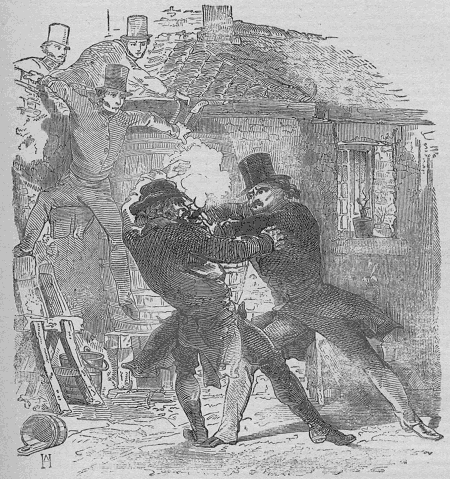
He rushed down a passage, and entered the yard — as
if well acquainted with the undertaker's premises.
The moment he set foot in the yard, he whistled in a
peculiar manner.
"Damnation! — treachery!" cried a
man, darting forward from the corner near the window.
"Stand — or I fire!" exclaimed
Markham, advancing towards him, and presenting a pistol.
"Fool!" said the man; and he threw himself
with desperate fury upon our hero.
But Richard, maintaining his footing gallantly, closed
with his assailant, and threw him to the ground, his pistol going off with the
shock — without, however, inflicting any injury.
And at the same moment three police-officers leapt over
the wall, in time to put an end to the struggle between Markham and his
opponent, the latter of whom they made their prisoner and immediately bound with
strong cords.
"Is your Highness hurt?" asked one of the
officers.
"No, Benstead," was the reply: "a little
bruised, perhaps — but it is nothing. Bring the prisoner this
way."
The whole transaction, — from the moment
when Richard left the undertaker's parlour to that when he re-entered it,
followed by the policemen with the captive, — had not occupied two
minutes.
He found Katherine reclining back in her chair — half
fainting and paralysed by terror, so deeply had the report of the pistol and the
concomitant scuffle in the yard alarmed her.
But the moment she heard her brother's voice, she
started up, gazed wildly around, and threw herself into his arms.
"You are not hurt, Richard? Oh! tell me-that
pistol!" she exclaimed, terror still depicted on her countenance.
"No, dear sister — I am not hurt,"
exclaimed Richard. "Calm yourself. Every thing has resulted according to my
expectations. Look, Kate — that terrible man is at length in
the hands of the officers of justice."
Katherine turned a rapid glance towards the group on the
other side of the room, and beheld the sinister and ferocious countenance of the
individual whom she had seen in the company of the old hag near Bonnet's farm.
At this moment the door communicating with the shop
opened, and Mr. Banks made his appearance, carrying a bottle in his hand.
He started back in astonishment and alarm when his eyes
encountered the police-officers, with his friend Anthony Tidkins securely bound
in the midst of them.
But as his glances wandered from one to another, he
suddenly appeared to recollect something; and fixing his eyes on Benstead, he
examined, "Ah! now I twig it all. What a cussed fool I was not to know a
trap even in plain clothes! But I was blind, 'cause I thought I'd got a 'spectable
man coming as a fust floor lodger. No wonder you poked your nose in every hole
and corner — specially the yard. I was a idiot — a
ass — a addle-pated old wessel! But p'rhaps the gen'lemen will take
a glass of wine, since they're here?" added Mr. Banks, with a smirking
countenance.
This semi-pleasantry on his part was only assumed; for
his own life had not been so immaculate as to preclude the existence of certain
fears when he found himself in the dangerous vicinity of the police.
He was, however, speedily reassurred on this head.
"Keep your wine, sir," exclaimed Markham,
"for those who can enjoy it in your company; and consider yourself
fortunate that, in becoming the agent of that man," — pointing
with deep disgust towards Tidkins, — "you have not committed
yourself in any way which at present endangers your safety. I see that you
glance uneasily at your desk: — you need not fear that I shall
attempt to deprive you of the sum which you have extorted as the purchase-money
for the papers now in my possession. No: — although I do not envy
you the feelings which could prompt you thus to lend yourself to make a market
of secrets so sacred as those which the documents contain, I cannot question
your right thus to act, seeing that the papers were in your possession. And were
I compelled to pay a thousand times the sum given to obtain them, I should
consider they were cheaply bought, inasmuch — But youcannot
understand such feelings!" he added, addressing these wards to the
undertaker, but glancing affectionately towards where Katherine was standing.
"I hope there's no offence, my lord," said
Banks, shaking in every limb with vague fears and suspicions. "I'm a poor
man, which tries to live honestly by undertaking on the most economic
principles; and there isn't a carkiss as goes through my hands that wouldn't
sign a certifikit in my favour if it could."
Richard turned his back contemptuously upon Mr. Banks,
and, addressing himself to Benstead, asked where he intended to lodge the
prisoner for the night.
"There isn't a station-house in London that would
be safe to put such a desperate feller in," was the reply. 'He'd get out as
sure as my name is Morris Benstead. I shall take him direct to Coldbath Fields,
where the keeper will be sure to give him accommodation. To-morrow your Highness
will be so kind as to appear against him, and give what evidence you know, at
Lambeth Street."
Markham promised compliance with this request. A cab was
sent for; and the Resurrection Man, who had maintained a moody silence, although
he never ceased from looking vindictively upon our hero, from the moment he was
arrested, was now removed in safe custody to Coldbath Fields, where he was
closely watched by the officials of that prison.
The Prince then conducted Katherine to the carriage that
was waiting for them in another street; and after a sharp trot, they shortly
after ten o'clock reached their destination — Markham Place.
We shall pass over all elaborate details of the [-292-]
surprise and joy with which Isabella, Ellen, and Mr. Monroe received the
intelligence that Katherine was our hero's sister, — his sister
without what the world calls the stigma of illegitimacy! Suffice it to
say, that the discovery produced the most unfeigned pleasure in the breasts of
all, and that Kate became the object of the sincerest congratulations.
Richard then related as succinctly as possible, — for
he longed to peruse the precious documents in his possession, — the
capture of the Resurrection Man and the scheme by which he had placed that
villain in the hands of the officers of justice.
"I felt persuaded," he said, "that
Tidkins did not put implicit confidence in Banks, and that he intended to watch
the negotiation. His avarice engendered suspicions and got the better of his
prudence. I communicated my views yesterday morning to a faithful officer whom I
know; and Morris Benstead — the person to whom I allude — visited
the undertaker's house on a pretence of hiring apartments which were to let. By
those means he was enabled to reconnoitre the premises, and adopt
measures accordingly. The result has answered my anticipations; and that
consummate villain, who twice attempted my life, and whose atrocities are
numerous as the hairs on his head, is at length in custody."
"Ah! dearest Richard," said Isabella,
"wherefore should you have thus perilled your precious life!"
"Do not chide me, Isabel," exclaimed the
Prince, kissing her tenderly. "I only performed a duty that I owed alike to
society and to myself. Let us now examine these documents which have already
made so strange, and yet so welcome a revelation."
The members of that happy party drew round the table;
and Richard began by reading the various letters that accompanied the old
woman's narrative. But as those epistles merely corroborated the main points of
her tale, we shall not quote them.
The narrative itself will explain all; and that
important document may be found in the ensuing chapter.
< previous chapter < | THE MYSTERIES OF LONDON [Vol. II] | > next chapter >