< previous chapter < | THE MYSTERIES OF LONDON [Vol. II] | > next chapter >
[-303-]
CHAPTER CCXXVII.
COLDBATH FIELDS' PRISON.
Return
we now to the Resurrection Man, that incarnate fiend whose crimes were so
numerous, and all of so black a dye.
Firmly bound, and guarded by three officers, who kept
their bludgeons in their hands, the miscreant saw that all resistance was vain:
he accordingly threw himself back in the cab that was bearing him to prison, and
gave way to his saturnine reflections.
"If I had only thought that Richard Markham would
have accompanied that young girl Katherine," — it was thus he
mused, — "a very different song would have been sung. But I
knew that he was married only a week ago, and never dreamt that he would leave
his pretty wife to poke his nose into Banks's crib. What an infernal oversight
on my part! And now — here I am, regularly lumbered; and all the
swag arising from Kate Wilmot's business is in the hands of that canting sneak
Banks! Damnation to Richard Markham! I shall swing for this if I don't take
precious good care. He'll swear to two different attempts on his life — one
at the old house near Bird-cage Walk, and t'other at Twig Folly. What a
cursed — ten times cursed fool I was to let myself tumble into a
snare in this way! Some one else will find the gold that I have saved up; and
when I shall be cold and stiff under the pavement of Newgate, others will riot
on my treasure! But no — it can't happen in that way: impossible
that my time is come yet — impossible! I shall escape somehow or
another; — I must escape — I will escape!
But how? That question is the devil of the difficulty. Never mind — escape
I will — so I mustn't be down-hearted!"
These and numberless other reflections, in which
despondency and hope alternately asserted a predominant influence, occupied the
mind of Anthony Tidkins as the cab proceeded rapidly through Bethnal-Green and
Shoreditch, — then along Old Street — up the Goswell
Road — through Northampton Square — and lastly along
Exmouth Street, in its way to Coldbath Fields' Prison.
At length the cab turned into the short road which forms
the approach, within the wooden railings in front of the governor's dwelling, to
the great gates of the gaol, — those gates over which may be read in
large letters, "MIDDLESEX HOUSE OF CORRECTION."
A shudder crept over even the iron frame of Anthony
Tidkins, as those huge portals, towering high above the cab which now drew up
close to them, seemed to frown upon him like a colossal genius of evil amidst
the obscurity of night.
Benstead leapt from the cab, and knocked loudly at the
gate.
The iron din was responded to by gloomy echoes from the
courts inside.
In a few minutes heavy chains fell, and the wicket was
opened by a man bearing a lantern.
Benstead whispered to him for a few moments; and Tidkins
was conducted into a little lobby on the left hand.
The turnkey, who had opened the gate, then proceeded to
the governor's house, which was close by within the walls; and, after an absence
of ten minutes, he returned with an affirmative answer to Benstead's request
that the prisoner might be retained in custody in that gaol until a magistrate
should otherwise dispose of him.
The turnkey accordingly led the way through the wicket
of a strong iron grating, across a yard where a watchman armed with a loaded
blunderbuss was stationed, and thence into a building, up the narrow stone
staircase of which the party proceeded, until they reached a cell, where the
Resurrection Man, who was now released from his bonds, was left.
Tidkins threw himself upon the bed and soon fell asleep.
He was not an individual to whom danger or even the prospect of death could
bring remorse: darkness and solitude had no alarms for him; — and,
thus, in spite of the profound vexation he experienced at his present
predicament, he yielded to the influence of fatigue and slept soundly.
On the following morning a bowl of gruel and a piece of
bread were supplied for his breakfast; and he washed at the common sink
belonging to that department of the gaol.
At ten o'clock Benstead and two other officers arrived,
placed manacles upon him, and conveyed him to a cab, in which they seated
themselves with him.
In about half an hour the Resurrection Man was [-304-]
placed in the dock at the Lambeth Street Police Office.
The Prince of Montoni, attended by his solicitor, Mr.
Dyson, had entered the court a few moments before; and the magistrate, upon
being made acquainted with his name and rank, immediately threw down the
newspaper, saying, "It is by no means necessary that your Highness should
enter the witness-box: your Highness will do me the honour to accept a seat on
the bench; and the clerk will take down your Highness's evidence at your
Highness's leisure. Make room there, for his Highness: usher, clear the way for
his Highness."
Scarcely able to conceal his disgust at this fulsome
behaviour of the magistrate, the Prince coldly said, "I thank you, sir, for
your politeness: but I cannot consent to receive a favour which would not be
shown to a poor and obscure individual."
The magistrate turned very red, and bowed meekly, but
without repeating his offer.
The case was then entered upon.
The Prince detailed the particulars of that adventure at
the Resurrection Man's house in the neighbourhood of the Bird-cage Walk, with
which the reader is already acquainted: and he also related the subsequent
circumstances connected with the blowing up of the den — a deed
which had cost several persons their lives, and which (added Markham) was no
doubt perpetrated by Tidkins himself.
When these depositions were taken down, the Prince was
about to enter upon his second charge — namely, the attack made upon
him at Twig Folly: but the magistrate thought the first, case had better be
previously completed, and resolved upon remanding the prisoner for three days,
in order to allow time to procure the evidence of those surviving policemen who
had witnessed the fate of their brother-officers on the occasion of the blowing
up of the house.
Tidkins was accordingly remanded to Coldbath Fields'
Prison; and the Prince of Montoni immediately repaired in his carriage to
Holmesford House — the particulars of which visit have been detailed
in the preceding chapter.
On his return to the gaol, Tidkins was allowed to walk
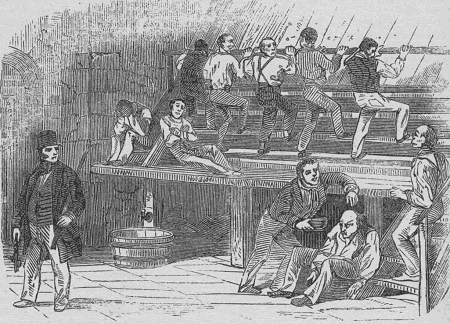
for an hour in the tread-wheel yard nearest to the entrance of the prison. There
are several tread-mill yards in Coldbath Fields' gaol, alike for males and
females; but we specify the particular yard in which the Resurrection Man was
permitted to take exercise, because it has relation to a certain event which is
to follow. It is also of the wheel in
this
yard that the fan, or balance, is seen above the wall near the south. western
angle of the prison, by persons passing through Coldbath Square.
The tread-wheel is an enormous drum, or cylinder, with
ranges of steps all round it, at a distance of about a foot and a half from each
other. Between forty and fifty persons can work on the wheel at one time. It
moves slowly round towards the prisoners placed upon it; and thus the step on
which the foot stands descends, while the next step presents itself. A platform
is built to half the height of the wheel; and from this platform the prisoners
step upon the wheel itself. They support themselves by a railing, and their
weight keeps the wheel in motion. Thus they must sink with all their weight
as they work on that rotatory engine of diabolical torture. The action is that
of going up stairs, without, however, actually rising higher; for every step so
reached sinks beneath the feet, and the prisoner is compelled to get upon the
next one in its descent. Those prisoners who wait their turns to go on, sit upon
the platform; and the task-master in the yard directs the intervals of labour
and those of rest.
And upon this engine of torture, as we ere now
denominated the tread-mill, not only boys of twelve years of age are placed, but
even women!
Yes: — in this civilised country, — in
this land where novelists and poets celebrate the chivalrous devotion which
should be paid to the softer sex — in this great city, where the
pseudo-saints blurt [-305-]
forth
their nauseating hypocrisy at Exeter Hall, and swindle the charitable of alms
for the purpose of improving the condition of savages thousands of miles off,
while there is such an awful want of instruction and moralising elements at
home, in the very centre of the English capital are women subjected to the
ferocious torture of the tread-mill!
The food is scanty; — and yet the labour
thus forced upon the poor sickly, half-starved wretches, is horribly severe.
Three-quarters of the crimes which send prisoners to
Coldbath Fields, are larcenies and robberies caused by dire penury and pinching
want: the miserable beings are half-famished already when they enter that gaol;
but they are nevertheless retained in something closely bordering on that state
of constant hunger, while the hardest possible labour is required from them!
Remember, reader, that we do not wish idleness to
prevail in a prison. It is just the place where habits of industry should be
inculcated. We therefore approve of the system of workshops established in
Coldbath Fields: we admire the oakum-room — the room, too, where
shoe-making is taught — and that department of the prison in which
rugs are manufactured for a wholesale warehouse that contracts for the purchase
of the same.
But we abhor torture — we detest cruelty;
and the tread-wheel is alike a torture and a cruelty!
It makes the heart bleed in the breast of the visitor to
the female-division of Coldbath Fields, to behold women nursing their babes at
one moment, and then compelled to deliver their sucklings to the care of their
fellow-prisoners, while they themselves repair to take their turn upon the
tread-mill!
Talk of the despotism of Turkey, Russia, Austria, or
Prussia, — talk of the tyranny of those countries where the will of
one man is a law, be it for good or evil, — we solemnly and
emphatically cry, "Look at home!"
Flogging in the Army and Navy, private whipping in
prisons, semi-starvation in workhouses and gaols, and the tread-wheel, — these
are the tortures which exist in this land of boasted civilisation — these
are the instances in which our rulers seek to emulate the barbarism of past
ages, and the wanton inhumanity of foreign autocrats!
We must in justice observe that Coldbath Fields' [-306-]
Prison is kept in a most cleanly state. Perhaps the ventilation is not as
perfect as it might be and certainly the stone cells must be awfully cold in
winter, for there are no means of imparting to them any artificial warmth. But
as far as wholesome cleanliness is concerned, there is not the slightest ground
whereon to raise a cavil against the establishment.
The discipline maintained in that gaol is on the Silent
System. There is no separation — no classification — during
the day; but the plan of silence prevents the corruption of the only moderately
bad by the inveterately wicked. At night each individual sleeps apart in a cell.
Anthony Tidkins walked about the yard, affecting a moody
and sullen air of indifference, but in reality catching with rapid glance every
point of the buildings around him — every object within the range of
his vision; so that he committed to memory a complete map of that division of
the prison where he was now taking exercise.
Having walked an hour, he was re-conducted to his room
where a bowl of pease-soup with a slice of bread was given to him for his
dinner. In the evening he was supplied with a basin of gruel and another piece
of bread, and was then looked in for the night.
< previous chapter < | THE MYSTERIES OF LONDON [Vol. II] | > next chapter >