BREWERIES AND BEER IN LONDON. The Great Breweries are those of:
Barclay, Perkins, and Co., Park-st., Southwark.
Meux and Co., Tottenham-Court-road.
Combe, Delafield, and Co., Castle-st., Long-acre.
Whitbread and Co., Chiswell-street.
Truman, Hanbury, and Co., Brick-lane, Spitalfields.
Goding and Co., Belvedere-road, Lambeth.
Reid and Co., Liquorpond-st., Gray's-Inn-lane.
Calvert and Co., 89, Upper Thames-st.
Elliot and Co., Pimlico.
The visitor should exert his influence among his friends to obtain an order of
admission to any one of the largest I have named. The best London porter and
stout in draught is to be had at the Cock Tavern, 201, Fleet-street, and at the
Rainbow Tavern, 15, Fleet-street, immediately opposite. Judges of ale recommend
John O'Groat's, 61, Rupert-street, Haymarket; and the Edinburgh Castle, 322,
Strand.
Peter Cunningham, Hand-Book of London, 1850
BARCLAY AND PERKINS'S BREW-HOUSE, PARK STREET, SOUTHWARK, was founded by Henry Thrale, the friend of Dr. Johnson, and sold by Johnson and his brother executor in behalf of Mrs. Thrale, for 135,000l. Barclay was a descendant of the famous Barclay, who wrote the Apology for the Quakers, and Perkins was the chief clerk on Thrale's establishment. While on his tour to the Hebrides in 1773, Johnson mentioned that Thrale "paid 20,000l. a year to the revenue, and that he had four vats, each of which held 1600 barrels, above a thousand hogsheads." The establishment in Park-street is now the largest of its kind in the world. The buildings extend over ten acres, and the machinery includes two steam engines. The store-cellars contain 126 vats, varying in their contents from 4000 barrels down to 500. About 160 horses are employed in conveying beer to different parts of London. The quantity brewed in 1826 was 380,180 barrels, upon which a duty of ten shillings the barrel, 180,090l., was paid to the revenue; and in 1835, the malt consumed exceeded 100,000 quarters.
Peter Cunningham, Hand-Book of London, 1850
The following Breweries consume
annually the number of quarters of malt hereinunder set forth, which we take -
from the last published account; but of course a considerable quantity of London
ales and porter is brewed for the country consumers and for exportation.
Quarters.
Barclay, Perkins, & Co., Park Street, Southwark 129,382
Hanbury & Co., Brick Lane, Spitalfields . . 140,090
Meux & Co., Tottenham Court Road . . . . 66,509
Whitbread & Co., Chiswell Street St. Luke's . 53,236
Coombe & Co., Castle Street, Long Acre . . 47,304:
Calvert & Co., 89 Upper Thames Street . . 32,310
Reid & Co., Liquorpond Street, Gray's Inn Lane 63,450
Cruchley's London in 1865 : A Handbook for Strangers, 1865
see also Andrew Wynter in Our Social Bees - click here
BREWERIES.
Breweries of London are described by Stow, in 1598, as for the most remaining near to the friendly water of Thames, which was long thought to be superior to any other for brewing; but Richardson, an experienced authority, alleges this to be a mistake, as some of the principal brewers find the New River water equally good; they have also been at great expense in sinking wells upon their own premises. In the Annual Register for 1760 the London beer trade is traced from the Revolution down to the accession of George the Third. The great increase in the trade appears to date from the origin of Porter.
"Prior to the year 1730, publicans were in the habit of selling ale, beer, and two-penny, and the 'thirsty souls' of that day were accustomed to combine either of these in a drink called half-and-half. From this they proceeded to spin 'three threads,' as they called it, or to have their glasses filled from each of the three taps. In the year 1730, however, a certain publican, named Horwood, to save himself the trouble of making this triune mixture, brewed a liquor intended to imitate the taste of the 'three threads,' and to this be applied the term 'entire.' This concoction was approved, and being puffed as good porter's drink, it speedily came to be called Porter itself." -Quarterly Review, 1854.
By Act of Parliament, beer and porter can only be made of
malt and hops, the great council of the nation having omitted all mention of the
water, which the brewers have added as a necessary ingredient. It has been well
said that all nations know that London is the place where porter was invented;
and Jews, Turks, Germans, Negroes, Persians, Chinese, New Zealanders, Esquimaux,
Copper Indians, Yankees, and Spanish Americans, are united in one feeling of
respect for the native city of the most universally favourite liquor the
world has ever known.
The increase of brewers has kept pace with London's increase
in other respects. Whitbread's Brewery, in Chiswell-street, Finsbury, dates more
than two centuries back:
we find it at the head of the list in 1787; and so it continued until 1806 in the Picture of London, for which year Whitbread's is
described as the largest Brewery in the metropolis, the year's brewing of Porter
being above 200,000 barrels.
"There is one stone cistern," says the account, "that contains 3600 barrels; and there are 49 large oak vats, some of which contain 3500 barrels; one is 27 feet in height and 22 feet in diameter. There are three boilers, each of which holds about 5000 barrels. One of Mr. Watt's steam-engines works the machinery. It pumps the water, won, and beer; grinds the malt, stirs the mash-tubs, and raises the tasks out of the cellars. it is able to do the work of seventy horses, though it is of a small size, being only a twenty-four inch cylinder, and does not make more noise than a spinning-wheel. Whether the magnitude or ingenuity of contrivance is considered, this Brewery is one of the greatest curiosities that is to be anywhere seen; and little less than half a million sterling is employed in machinery, buildings, and materials.
To the Brewery of Barclay, Perkins and Co., in
Park-street, Sonthwark, has, however, attached a greater celebrity, from its
great extent. It may be inspected by a letter of introduction to the
proprietors; and a great number of the foreigners of distinction who visit the
metropolis avail themselves of such permission. The Brewery and its
appurtenances occupy about twelve acres of ground, immediately adjoining
Bankside, and extending from the land-arches of
Southwark Bridge nearly half of tire distance to those of London Bridge. Within
the Brewery walls is said to be included the site of the famous Globe
Theatre, "which Shakspeare has bound so closely up with his own
history. In an account of the neighbourhood, dated 1795, it is stated that
"the passage which led to the Globe Tavern, of which the playhouse formed a
part, was, till within these few years, known by the name of Globe-alley, and
upon its site now stands a large store house for Porter." We are inclined to
regard this evidence merely as traditional. However, the last Globe Theatre was
taken down about tine time of the Commonwealth; and so late as 1720, Maid-lane
(now called New Park-street), of which Globe-alley was an offshoot, was a long,
straggling place, with ditches on each side, the passage to the houses being
over little bridges with little garden-plots before them (Strype's Stow).
Early in the last century there was a Brewery here,
comparatively very small; it then belonged to a Mr. Halsey, who, on retiring
from it with a large fortune, sold it to the elder Mr. Thrale; he became
Sheriff of Surrey and M.P. for Southwark, and died in 1758. About this time the
produce of the Brewery was 30,000 barrels a year. Mr. Thrale's son succeeded
him, and found the Brewery so profitable and secure an income, that, although
educated to other tastes and habits, he did not part with it; yet the Brewery,
through Thrale's unfortunate speculation elsewhere, was at one time, according
to Mrs. Thrale, 130,000l. in debt, besides borrowed money; but in nine years
every shilling was paid. Thrale was the warm friend of Dr. Johnson, who, from
1765 to the brewer's death, lived partly in a mouse near the Brewery, and at
his villa at Streatham. Before the fire at the Brewery, in 1832, a room was
pointed out, near the entrance gateway, which the Doctor used as a study. In 1781
Mr. Thrale died, and his executors, of whom Johnson was one, sold the Brewery
to David Barclay, junior, then the head of the banking firm of Barclay and
Co., for the sum of 135,000l. " We are not here," said Johnson, on the day
of the sale, "to sell a parcel of boilers and vats, but the potentiality
of growing rich beyond the dreams of avarice." While on his tour to the
Hebrides, Johnson mentioned that Thrale paid 20,000l a year to tire revenue, and
that he had four vats, each of which held 1600 barrels, above 1000
hogsheads. David Barclay placed in the brewing firm his nephrew from
America, Robert Barclay, who became of Bury Hill; and Mr. Perkins, who had been in Mr.
Thrale's establishment - hence the firm of "Barclay
and Perkins." Robert Barclay was succeeded by his son, Charles Barclay, who
sat in Parliament for Southwark; and by his sons and grandsons. Forty
years since, the Brewery was of great extent; in 1832 a great portion of the
old premises was destroyed by fire, but was rebuilt, mostly of iron, stone,
arid brick. The premises extend from New Park-street, southward, through
Park-street, both sides of which are the Brewery buildings, connected by a
light suspension bridge; to the right is the vast brewhouse and principal
entrance. There are extensive ranges of malt-houses extending northward, with
a wharf to Bankside. From the roof of nearly the middle of the premises may be
had a bird's-eye view of the whole.
The water used for brewing is pumped up by a steam-engine
through a large iron main, which passes under the malt warehouses, and leads
to the "liquor-backs," two cast-iron cisterns, on columns, reaching an
elevation of some 40 feet. By this means the establishment may be supplied
with water for brewing to the extent of a hundred thousand gallons daily. There
is on the premises an Artesian well 367 feet deep; but its water, on account
of its low temperature, is principally used for cooling the beer in hot weather.
The machinery is worked throughout the Brewery by steam. The furnace-shaft is 19 feet below the surface, and 110 feet above; and, by its
great height, denotes the situation of this gigantic establishment among the
forest of Southwark chimneys.
The malt is deposited in enormous bins, each of the height
or depth of an ordinary three-storied house. The rats are kept in check by a
standing army of cats, who are regularly fed and maintained.
The malt is conveyed to be ground in tin buckets upon an
endless leather band (" Jacob's Ladder"); and thus carried to the height
of 60 or 70 feet, in the middle of the Great Brewhouse, built entirely of iron
and brick, and lighted by eight large and lofty windows. The Brewhouse is 225 feet long by 60 in width, and of
prodigious height, with an elaborate iron roof, the proportions reminding
us of Westminster Hall. Within this compass are complete sets of brewing
apparatus, perfectly distinct in themselves, but connected with the great
supply of malt from above, of water from below, and of motive force from the
steam-engine behind, vast coolers, fermenting vats, &c. Each of the
copper boilers cost nearly 5000l., and consists of a furnace, a globular copper holding 320 barrels,
and a cylindrical cistern to contain 120 barrels,
an arrangement equally beautiful and useful from its compactness and the economy of heat. There is no
continuous floor; but looking upwards, whenever the steamy vapour permits, there
may be seen at various heights, stages,
platforms, and flights of stairs, all subsidiary to the Cyclopean piles of
brewing vessels. The coals, many tons per day, are drawn up from below by
tackle, and wheeled along a railway.
"The hot water is drawn from one of the copper boilers to the corresponding mash-vat below; and machinery working from a centre on a cog-rail that extends ever the circumference of the vat, stirs the malt. The mash-vat has a false bottom, which in due time lets off the wort through small holes to an under-pan, whence it is pumped back to the emptied copper, from whence it receives the hot water, and there, mixed with hops, it is boiled, and again run off into a vast cistern, where passing through a perforated bottom, it leaves the hops, and is pumped through the cooling tubes or refrigerators into the open cooler, and thence to the fermenting cases; whence, in a few days, it is drawn off into casks, again fermented, and when clearer put unto the large vat.
The surface of one of the fermenting cases nearly filled is a strange sight:
the yeast rises in rock-like masses, which yield to the least wind, and the gas
hovers in pungent mistiness over the ocean of beer. The largest vat which contains about 3500 barrels of
porter, which, at the retail price, would yield 9000l. The "Great
Tun of Heidelberg" would hold but half this quantity.
Nearly every portion of the heavy toil is accomplished by the steam-engine.
The malt is conveyed from one building to another, even across the street,
by machinery and again to the crushing rollers and mash vat. The cold and hot
water, the wort and beer, are pumped in various directions, almost to the
exclusion of human exertion. With so much machinery and order, few men
comparatively are required for the enormous brewing of 3000 bushels of malt a
day. The stables are a pattern of order. The mane of each horse is painted
upon a board over the rack of each stall. The horses are mostly from Flanders, are about 200 in number,
and cost from 70l. to 80l. each.
Truman, Hanbury, Buxton, & Co.'s Brewery is situated
in Brick-lane, Spitalfields, and covers nearly six acres of ground. Here are two
mash tuns, each to contain 800 barrels, the mashing being performed by a
revolving spindle with huge arms, like a chocolate-mill. The wort is then pumped
into large coppers, of which there are five, containing from 300 to 400 barrels
each; it is then boiled with the hops, of which often two tons are used in a
day. The boiling beer is now pumped up to the cooler on the roof of the brewery,
which presents a black sea of 32,000 square feet, partly open to the air. There
are sixteen large furnace-chimneys connected with this brewery, the smoke of
which is consumed by Juckes's apparatus. There is a vast cooperage for the
80,000 barrels; a farrier's, millwright's, carpenter's and wheelwright's shop; a
painter's shop for sign-boards; all which surround thecentral gear or
beer-barrel depot. The malt bins are 20 feet across and 35 deep. The stables are
of great extent, and there are a score of farriers. The drayman is sui
generis; there are some 80 in numbers, taller than the Guardsmen, and
heavier by two stone.
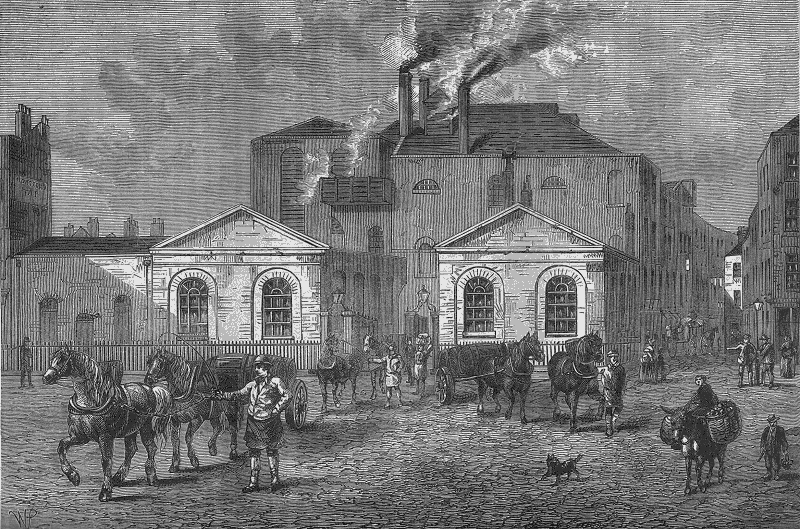
Meux's Brewery (now Reid & Co's) in
Liquorpond-street, Gray's Inn-lane, was described by Pennant, in 1795, as
"of magnificence unspeakable." In this year, Meux built a vessel 60
feet in diameter, and 23 feet in height, which cost 5000l. building, and
would contain from 10,000 to 12,000 barrels of beer, valued at 20,000l.
Their vats then held 100,000 barrels. Messrs. Meux removed from Liquorpond-street
to their great brewery at the end of Tottenham Court-road. The head of the firm,
Sir Henry Meux was created a baronet in 1831, when he had a fortune of 200,000l.,
which by his income from the brewery, increased in after years to between
500,000l. and 600,000l.
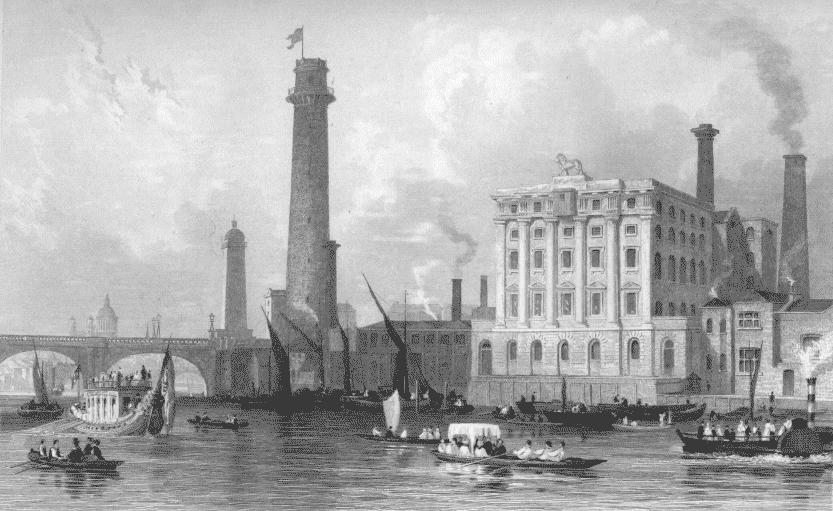
THE LION BREWERY, LAMBETH
LONDON VIRTUE & CO. LIMITED
The handsomest edifice of this class its the metropolis is the Lion
Brewery, built for Goding, in 1836, in Belvedere-road, next Waterloo-bridge, and
surmounted with a colossal stone lion. The top of the building is a
tank to contain 1000 barrels of water, pumped up from a well 230 feet deep,
or from the Thames; this supplies the floor below, where the boiled liquor is
cooled-200 barrels in less than an hour; when
cooled it is received on the floor beneath into the fermenting tuns; next it
descends to the floor for fining; and lastly, to the cellars or store-vats. The steam-engine passes the beer under the Belvedere-road; loads or unloads
barges; conveys malt by the Archimedes Screw or Jacob's Ladder; and pumps water and beer to every height and extreme position, displaying the advantage
of mechanic power, by its steady, quiet regularity.
The Metropolitan Breweries have their signs, which figure
upon the harness of their dray-horses ; thus, Rat-clay and Perkins, the Anchor;
Calvert's (now the City of London), the Hour-glass; Meux, Horseshoe,
&c.
John Timbs, Curiosities of London, 1867
Victorian London - Publications - Social Investigation/Journalism - London : A pilgrimage, by Gustave Dore and Blanchard Jerrold, 1872
CHAPTER XVI
THE TOWN OF MALT
Among the earliest of risers in London are those who supply
it with its beer. Having seen the opening of Covent Garden Market on a summer
morning (and there is not a more striking picture by the banks of the Thames),
stroll along the Strand and Fleet Street, alive with newsboys and newsmen, and
home-returning compositors; through Thames Street, over Southwark Bridge, to
Park Street. Your nose will lead you to the town of Malt and Hops. The massive
drays are
out; the prodigious draymen are arrayed in their leather, that would gall any
limbs but theirs of Titan build ; the stately horses that are the astonishment
of the foreigner and the pride of the English brewer are tossing their noble
heads and pawing the ground. The barrels are rolling and swinging in all
directions. Thirsty London is being attended to, with a will: and with perfect
order, under the control of matutinal clerks and overseers. Before the ordinary
tradesman has touched his shutters, lumbering processions of heavily laden drays
are debouching on various quarters of London, bearing the famous
"entire" to scores of customers.
Within the gates are the government houses of the town of
Malt and Hops, in which there are upwards of forty officials, who direct the
coming and going, the filling and repairing, the brewing and selling of a
rolling army of something like eighty thousand barrels. Their domain covers an
acre of land, and comprises several streets bridged by light iron bridges, that
look slight as spider-webs from the pavements.
A journey through the town of Malt and Hops is heavy work.
The departments are many, and are all spacious. They follow in well-considered
sequence. The mashing, the boiling, the cooling, the fermenting, the cleansing,
the barrel-filling, the storing, the despatching, are so many departments of the
government; with a sustaining aroma holding all in one atmosphere and which
keeps the mind in an unbroken train of thought even when contemplating the
stables where the famous horses are kept as daintily as in the Royal Mews.
Perhaps the first startling scene in the round is the mash-tun.
Mashing is the elementary process of beer making, and
the object of these strange workers with wooden spades is to mix the malt
thoroughly with the water. The result is an amber liquid, called wort, lakes of
which we proceed to view, lying placidly in tanks. During its progression to
perfect beer the sweet wort grows sour. On its way it is pumped up from the cool
lakes into gigantic copper boilers, and boiled with great care, for here the
experienced and learned brewer shows himself. The boiling satisfactorily done,
the wort flows out into broad lakes, airily situated, where it can become
rapidly cool, without getting sour; and then it gradually subsides into these
prodigious gyle tuns, about which staircases are ranged, and in which you
would have to drag carefully for the body of an elephant. In these towers,
against which men look like flies, the wort ferments and we have porter, or
"entire." I should explain that "entire" is a combination of
the qualities of three beers, that, in primitive London brewing days, were made
separately, and mixed from different barrels in the customer's glass. Hence the
"Barclay, Perkins and Co.'s Entire" that is all over England, and the
painting of which upon gaudy signboards occupies a distinct department in the
town of Malt.
Looking over London from one of the high-perched galleries
that traverse the streets of these mighty brewers' realm, with St. Paul's
dominating the view from the north, our guide gently interposes the figure of
Mr. Thrale, and his illustrious friend, that Londoner among Londoners, Samuel
Johnson. We are upon classic ground. Where the coopers are overhauling hundreds
of damaged barrels, and giving them their proper adjustment of hoops; where the
red-capped draymen are gossiping in groups; where the enormous butts are ranged;
where the smiths are shoeing the colossal horses, and where the 300 feet of
stables stretches; Samuel Johnson lounged and talked, -and worked at his
dictionary, under the protecting friendship of Mr. Thrale, then owner of
the brewery. The rough old Doctor was executor to the will under which Mr.
Thrale's property passed into the families of its present owners, who have
realised his description of its capabilities by extending it until it has become
one of the representative industries of the world. "We are not," said
executor Johnson "to sell a parcel of boilers and vats, but the
potentiality of growing rich beyond the dream of avarice." The boilers and
vats of the city of Malt realised ?135,000, even when Messrs. Barclay and
Perkins bought it.
How much would the boilers and vats: the drays and barrels,
realise to-day ?
The potentiality of growing rich beyond the dream of avarice
may not have been reached even now by the firm; but a good step along the
doctor's highway has been taken. If "he who drinks beer thinks beer,"
this must be a beer-thinking age, for how many foaming tankards take their
laughing rise in this town of Malt! How many hop-yards to feed these vats and
lakes? A humorous speculator, who accompanied us, and sat in a little office
where we finally tasted the various brews, suggested, "Yes, and how many
temperance advocates do these stupendous men and horses keep going, the
ungrateful varlets!"
"There's a good deal of 'talkee' yet to be done,
sir," a sensible drayman said to us, flirting a flower between his lips as
he spoke, "before they teach English workmen that there's sin and
wickedness in a pint of honest beer."
And with this he set his heavy dray in motion.
Meux's Brewery, 1830
Old and New London, c.1880