 In his savage state, whether inhabiting the marshes of Equatorial
Africa, or the mountain ranges of Formosa, man is fain to wander,
seeking his sustenance in the fruits of the earth or products of the chase. On the other hand, in the most civilized communities the
wanderers become distributors of food and of industrial products to
those who spend their days in the ceaseless toil of city life. Hence
it is that in London there are a number of what may be termed,
owing to their wandering, unsettled habits, nomadic tribes. These
people, who neither follow a regular pursuit, nor have a permanent place of
abode, form a section of urban and suburban street folks so divided and
subdivided, and yet so mingled into one confused whole, as to render
abortive any attempt at systematic classification. The wares, also, in which
they deal are almost as diverse as the families to which the dealers belong. They
are the people who would rather not be trammelled by the usages that regulate settled
labour, or by the laws that bind together communities.
In his savage state, whether inhabiting the marshes of Equatorial
Africa, or the mountain ranges of Formosa, man is fain to wander,
seeking his sustenance in the fruits of the earth or products of the chase. On the other hand, in the most civilized communities the
wanderers become distributors of food and of industrial products to
those who spend their days in the ceaseless toil of city life. Hence
it is that in London there are a number of what may be termed,
owing to their wandering, unsettled habits, nomadic tribes. These
people, who neither follow a regular pursuit, nor have a permanent place of
abode, form a section of urban and suburban street folks so divided and
subdivided, and yet so mingled into one confused whole, as to render
abortive any attempt at systematic classification. The wares, also, in which
they deal are almost as diverse as the families to which the dealers belong. They
are the people who would rather not be trammelled by the usages that regulate settled
labour, or by the laws that bind together communities.The class of Nomades with which I propose to deal makes some show of industry. These people attend fairs, markets, and hawk cheap ornaments or useful wares from door to door. At certain seasons this class "works" regular wards, or sections of the city and suburbs. At other seasons its members migrate to the provinces, to engage in harvesting, hop-picking, or to attend fairs, where they figure as owners of Puff and Darts, "Spin em rounds," and other games. Their movements, however, are so uncertain and erratic, as to render them generally unable to name a day when they will shift their camp to a new neighbourhood. Changes of locality with them, are partly caused by caprice, partly by necessity. At times sickness may drive them to seek change of air, or some trouble comes upon them, or a sentimental longing leads them to the green lanes, and budding hedge-rows of the country. As a rule, they are improvident, and, like most Nomades, unable to follow any intelligent plan of life. To them the future is almost as uncertain, and as far beyond their control, as the changes of wind and weather.
London gipsies proper, are a distinct class, to which, however, many of the Nomades I am now describing, are in some way allied. The traces of kinship may be noted in their appearance as well as in their mode of life, although some of them are as careful to disclaim what they deem a discreditable relationship as are the gipsies to boast of their purity of descent from the old Romany stock.
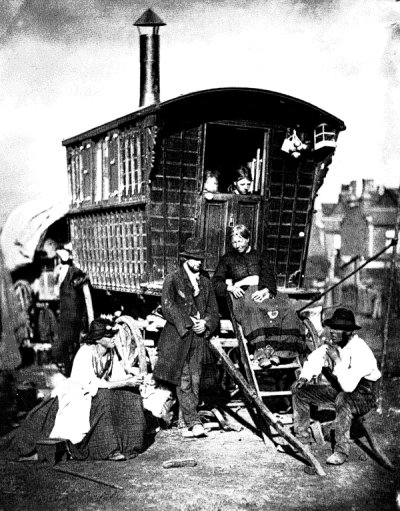
The accompanying photograph, taken on a piece of vacant land at Battersea, represents a friendly group gathered around the caravan of William Hampton, a man who enjoys the reputation among his fellows, of being "a fair-spoken, honest gentleman." Nor has subsequent intercourse with the gentleman in question led me to suppose that his character has been unduly overrated. He had never enjoyed the privilege of education, but matured in total ignorance of the arts of reading and writing.
This I found to be the condition of many of his associates, and also of other families of hawkers which I have visited.
William Hampton is, for all that, a man of fair intelligence and good natural ability. But the lack of education other than that picked up in the streets and highways, has impressed upon him a stamp that reminded me of the Nomades who wander over the Mongolian steppes, drifting about with their flocks and herds, seeking the purest springs and greenest pastures.
He honestly owned his restless love of a roving life, and his inability to settle in any fixed spot. He also held that the progress of education was one of the most dangerous symptoms of the times, and spoke in a tone of deep regret of the manner in which decent children were forced now-a-days to go to school. " Edication, sir Why what do I want with edication? Edication to them what has it makes them wusser. They knows tricks what don't b'long to the nat'ral gent. That's my pinion. They knows a sight too much, they do! No offence, sir. There's good gents and kind arted scholards, no doubt. But when a man is bad, and God knows most of us aint wery good, it makes him wuss. Any chaps of my acquaintance what knows how to write and count proper aint much to be trusted at a bargain."
Happily this dread of education is not generally characteristic of the London poor, although, at the same time, it is shared by many men of the class of which William Hampton is a fair type.
While admitting that his conclusions were probably justified by his experience, I caused a diversion by presenting him with a photograph, which he gleefully accepted. "Bless ye!" he exclaimed, "that's old Mary Pradd, sitting on the steps of the wan, wot was murdered in the Borough, middle of last month."
This was a revelation so startling, that I at once determined to make myself acquainted with the particulars of the event. The story of the mysterious death of Mary Pradd, however, will hardly bear repeating in detail. She was the widow of a tinker named Lamb, and had latterly taken to travelling the country with two men, one of them is said to have been of gipsy origin and very well known in Kent Street.
The photograph was taken some weeks previous to the event. The deceased was spending an afternoon with her friends at Battersea, when I chanced to meet them and obtained permission to photograph the group. It was on the 18th of November last that the inquest was held concerning this unfortunate woman, at the workhouse, Mint Street. Mary Pradd was fifty-five years old at the time, and her death was reported as involving grave suspicion. A woman named Harriet Lamb gave evidence to the effect that deceased was her mother, the widow of a tinker, and lived with Edward Roland, at 40, Kent Street, Borough. She gave way occasionally to drink, but the witness had seen her alive and well, though not sober, between two and three on the previous day. Mary Pradd was in the habit of travelling through the country with a man named Gamble and with Roland.
Witness had seen her mother strike the latter, but had never seen Roland illtreat her.
Susan Hill, 40, Kent Street, deposed to hearing a noise early in the morning of Thursday, and to being subsequently called up by a woman to the deceased's room, where she found her dressed, lying on her back, dead on the floor, and the two men dressed, and lying asleep on the bed.
Caroline Brewington, with whom Gamble lived, gave evidence that the men had been drinking together during the day, and finding that Gamble did not return, she ~vent to fetch him about midnight, and found the scene as described.
Roland and Gamble, who had been taken into custody on suspicion of having caused the death of the woman, pleaded total ignorance of the whole circumstances.
The medical evidence showed that she had died from hemorrhage, and that there was one external wound on her person.
The jury returned a verdict, "That the deceased died from injuries, but that there was not sufficient evidence to show how such injuries were caused."
The poor woman who met her end in so mysterious a manner had in life the look of being a decent, inoffensive creature. Clean and respectable in her dress, she might in her youth have been even of comely appearance, but now she wore the indelible stamp of a woman who had been dulled and deadened by a hard life. One of her neighbours described her as "a well-conducted, comfortable-looking, old lady. But the life she led latterly sent her sadly to drink. I have often said to her, Mary, you should not give your mind to the drink so."
Mary Pradd was evidently above the common run of these people, and, continued my informant, "She might have done well, for some travelling hawkers make heaps of money, but they never look much above the gutter. I once knew one, Old Mo, they called him I used to serve him with his wares, brushes, baskets, mats, and tin things; for these are the sort of goods I send all over the country to that class of people. Cash first, you know, with them. I would not trust the best of them, not even Mo, though he used to carry £9000 about with him tied up in a sack in his van. He is now settled at Hastings; he has bought property. Never saw a curiouser old man, and as for his father, he was worse than him, a rich old miser. Bought and sold chipped apples because they were cheap. Sat at a corner where he owned houses, and sold halfpenny-worths.
"He had untold ways of making money; lending it, I think. Mo once bet me he had more old sovereigns, guineas, and half-guineas than any man living, unless a dealer.
"One thing I thought would have killed him. He was once robbed of £1400 in gold and silver, by two men, who sent the boy watching the van off to buy apples. They took as many bags of money out of the sack as the two could carry.
"I have lost the run of him now."
Such is the story of Mo, as it was related to me, and I am further assured that most of these wanderers make money, or have the chance of doing so, their trade expenses being only nominal and their profits frequently large. I myself have been introduced to a man of this class in London, who owns houses and yet lives in his van pursuing his itinerant trade in the suburbs.
The dealer in hawkers' wares in Kent Street, tells me that when in the country the wanderers "live wonderful hard, almost starve, unless food comes cheap. Their women carrying about baskets of cheap and tempting things, get along of the servants at gentry's houses, and come in for wonderful scraps. But most of them, when they get flush of money, have a regular go, and drink for weeks; then after that they are all for saving.
"They have suffered severely lately from colds, small pox, and other diseases, but in spite of bad times, they still continue buying cheap, selling dear, and gambling fiercely.
Declining an invitation to "come and see them at dominoes in a public over the way, I hastened to note down as fast as possible the information received word for word in the original language in which it was delivered, believing that this unvarnished story would at least be more characteristic and true to life.