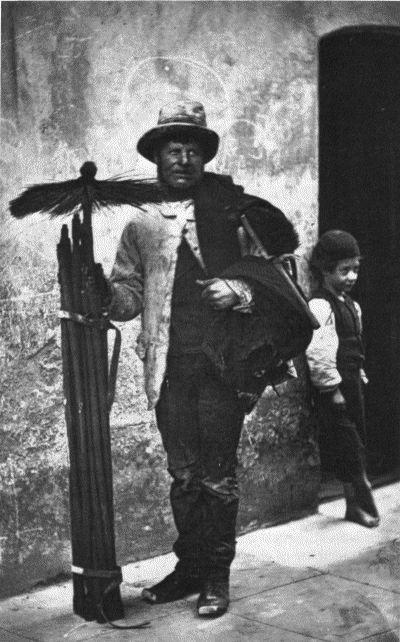
 MAY-DAY festivities are still commemorated by, at least, one class of
the community; and the presence of "Jack-in-the-green" naturally
suggests a few words on sweeps as a seasonable subject. The story of
Lady Mary Montagu's lost child is, however, too old to bear
repetition; and I will content myself by recording that the London
sweeps are highly dissatisfied with the abolition of the grand yearly
May feast she was the first to institute. They, however, still maintain the representation of Jack-in-the-green, which is supposed to be for the benefit
of the sweeping fraternity. A master sweep often employs persons to parade and dance in the streets, pays all the costs, and receives all the benefits. As
chief clown on these occasions, Caney, whose biography will be found in another chapter, often officiated. The green which he accompanied was
made of large cooper's hoops, joined together by eight poles or standards, as they are
called. Glazed calico, garlands of leaves, and rosettes, covered this rough framework.
But to dance inside so cumbersome a contrivance is no easy matter. Coal-heavers,
or persons accustomed to heavy work, are generally employed; they are stripped of
nearly all their clothes, receive unlimited libations of beer, and 3s. 6d. per day. The
dresses for the clown, the pantaloon, Black Sal, and Dusty Bob, are generally bought in
Petticoat Lane, and cost in all about £5; and it therefore requires capital to start a
Jack-in-the-green. On the other hand, ample receipts are made, though it is in the
East End and poorer quarters that these street performers meet with the greatest
success, Of course, as there is money to be made in this manner, other persons
besides sweeps have sent out Jacks-in-the-green; but such a venture is not altogether
safe, for, if found out, the performers run the risk of being mobbed and the green
destroyed by those who really belong to the trade.
MAY-DAY festivities are still commemorated by, at least, one class of
the community; and the presence of "Jack-in-the-green" naturally
suggests a few words on sweeps as a seasonable subject. The story of
Lady Mary Montagu's lost child is, however, too old to bear
repetition; and I will content myself by recording that the London
sweeps are highly dissatisfied with the abolition of the grand yearly
May feast she was the first to institute. They, however, still maintain the representation of Jack-in-the-green, which is supposed to be for the benefit
of the sweeping fraternity. A master sweep often employs persons to parade and dance in the streets, pays all the costs, and receives all the benefits. As
chief clown on these occasions, Caney, whose biography will be found in another chapter, often officiated. The green which he accompanied was
made of large cooper's hoops, joined together by eight poles or standards, as they are
called. Glazed calico, garlands of leaves, and rosettes, covered this rough framework.
But to dance inside so cumbersome a contrivance is no easy matter. Coal-heavers,
or persons accustomed to heavy work, are generally employed; they are stripped of
nearly all their clothes, receive unlimited libations of beer, and 3s. 6d. per day. The
dresses for the clown, the pantaloon, Black Sal, and Dusty Bob, are generally bought in
Petticoat Lane, and cost in all about £5; and it therefore requires capital to start a
Jack-in-the-green. On the other hand, ample receipts are made, though it is in the
East End and poorer quarters that these street performers meet with the greatest
success, Of course, as there is money to be made in this manner, other persons
besides sweeps have sent out Jacks-in-the-green; but such a venture is not altogether
safe, for, if found out, the performers run the risk of being mobbed and the green
destroyed by those who really belong to the trade.Unfortunately, the apparently innocent and somewhat child-like capers of the Jack-in-the-green and his jovial troop, engender and increase the vice of drinking. At each halt, more refreshments are produced, and sobriety is not a distinctive quality of the poor in general, or of chimney-sweeps in particular. The past experiences of John Day will illustrate this fact; and, as a temperance sweep is certainly a rara avis, his biography may prove of interest.
Born in Lambeth, the son of a road-mender, John Day was sent out to work when scarcely more than ten years old. His father was decidedly addicted to drink, and was in the habit of taking his son on Sunday to public-houses, where drink was sold in defiance of the Licensing Act. So long as the child had a few halfpence for beer, he was in the parental eyes a good boy; but when his meagre earnings had been thus uselessly spent, his father came to the conclusion that he could not afford to keep him, and that it was high time the boy should fight his own way in the world. He was therefore turned out of his home, and had to resort to the friendly, if cheerless shelter of railway arches; or at times he would sleep on a barge, and profited by the opportunity to wash his solitary shirt in the canal, and hang it up on the rigging of his temporary home, while he disported himself amidst the tarpaulin till it dried. At times when there was nothing to be done at the flour-mill, he obtained a little work as assistant to a neighbouring chimney-sweep; but in either employ he rarely made more than 3s. per week.
At last Day's parents, stirred to a sense of the protection they owed to their son, determined to find him some more satisfactory employment; and they arranged that he should follow an itinerant fish-hawker in his travels, and for this he was to receive a fair remuneration. Accordingly, the hawker and boy started and tramped to Farnham, in Kent, but here the man left his young charge with twopence, and orders to join him at Kingston. Alone with a coster-barrow to drag along, the poor boy started on his journey, barefooted, till he met a farmer, who gave him a pair of old boots twice too big for his slender feet. On reaching Kingston, he found that his employer had failed to keep the appointment. Hungry, pennyless, and drenched with the rain, Day had to sleep on his barrow in the open air, and covered with one or two wet sacks! On the morrow, however, fortune dawned upon him; some compassionate cabmen subscribed a penny each to procure breakfast for the boy; and a gentleman who happened to be passing gave him eighteenpence to carry his fishing-rod, &c., to a neighbouring stream.
After loitering some time longer at Kingston, Day at last met his employer, and continued in his service for five weeks, but failed to obtain any wages, or clothes, nor even a change of linen! Foot-sore, in rags, and in a state of incomparable filth, Day at last, made up his mind to abandon such unprofitable work, and started for home. At Battersea he passed by a potato-field, where he obtained some small potatoes, which he sold for a penny, and therewith procured himself a slice of pudding. Thus fortified, he once more made his entrance into the great metropolis, but as he neared home, and met some friends, the boy's pride brought tears to his eyes, when he noticed how they stared at the sorry appearance he presented. Even his parents were moved, and his mother actually gave him her own boots to wear.
As Day grew older he inherited his father's propensity for strong liquor, and was often arrested for drunken and disorderly conduct. On these occasions he took special delight in fighting the police, and when finally incarcerated, his clothes had generally been torn to pieces in the previous struggle. The bounty-money offered for volunteers to join the Crimean army, and the prospect of an adventurous career, ultimately inflamed this desperate and reckless character, and he enlisted for the campaign. He was enrolled in the transport corps, served in the trenches before Sebastopol, where he fell ill with fever. The danger of this disease was increased by his intemperate habits. He remembers on one occasion spending together with three other soldiers £2 in drink, and on this they succeeded in attaining that extreme stage of intoxication which rendered medical assistance indispensable, or their lives might have been sacrificed.
On his return from the seat of war, Day's parents seem once more to have shown some feeling; for, to use his own words, "Father began to cry at seeing me, and of course I sent for beer, and that soon stopped the crying." This burst of affection was, however, of short duration; and, when the soldier had spent all his money, he was again turned out of his home, and again resumed his old calling as chimney-sweep. He then happened to meet a man who used to clean the pans and boilers at a candle- factory, but who was generally so intoxicated that he could not do the work, and consequently employed Day in his stead, giving him about a quarter of the money. In time, however, he was forced into the workhouse, and Day succeeded to the post, which is worth about £2 per month. Though Day received so little from his predecessor, he nevertheless allowed him 3s. a week while he remained in the workhouse. But he soon died, and this miserable end, together with his previous experience, served as another warning of the evils of intemperance. Day, nevertheless, continued to drink steadily till 1864. When Garibaldi came to Nine Elms, Day celebrated the occasion by getting even more drunk than usual; but on the morrow, while intent on resuming his libations, he chanced to obtain a glimpse of his own countenance reflected in a public-house mirror. His bleared eyes, his distorted features and ignominious, degraded appearance produced so sudden and forcible an impression, that he turned round to his friends, confessed that he had wasted his life was but a miserable fool, called for a penny glass of beer, and swore that it should be the last. Of course they merely laughed and jeered, and thought he had not yet recovered from the excesses of the previous night. But, to his credit be it said, John Day was true to his word, and from that time he never again touched any intoxicating liquor, or even smoked a pipe of tobacco. The latter he assured me was the most difficult to abandon. To this newly-acquired sobriety monetary prosperity soon ensued. He is now the happy father of a large family, he lives in a house near Lambeth Walk, where he once humbly worked in the capacity of a mere assistant. As a master sweep he has an extensive connexion. The money he earns enables him to subscribe to several benefit societies, and he is entitled to receive from them 10s. a week in sickness, while his wife will have £46 given her at his death, or he will receive £18 should she die first. Altogether he is both prosperous and respected throughout the neighbourhood, where he ardently advocates the cause of total abstinence, and is well known as the temperance sweep.
Chimney-sweeps of the present day have lost one important source of income. The soot they so carefully collect, and have to sift from the cinders and ashes taken away from the grate at the same time, has no longer any great marketable value. It was used extensively on meadow and on wheat land, where it was especially beneficent in its effects by destroying slugs and other injurious animals. As much as a shilling a bushel was therefore given for soot; but the recent introduction of new manures has reduced the price of soot to about threepence or fourpence per bushel. As a natural result the sweepers charge more for cleaning chimneys, the price varying from sixpence to two shillings or three shillings, according to the height of the chimney, and the probable wealth of the persons who inhabit the house; while five shillings is generally given for putting out a fire. The assistant or journeymen sweeps receive six shillings a week and board and lodging, or about one pound a week and keep themselves; and there must be altogether upwards of 2000 persons earning their living by sweeping the chimneys of the metropolis.