 THE season for strawberries, the most delicious of English fruits, has
ended. This delicacy was brought in numberless barrow-loads to the
doors of the poorest inhabitants of London. The familiar cry, "Fine
strawberries. All ripe! all ripe!" is silenced for a season by sounds
less welcome. The fragrance of the ripe fruit wafted by the summer
breeze from the coster's cart as it passed through the alleys, is
replaced by less grateful odours - by the normal atmosphere of
overcrowded neighbourhoods, by the autumn taint of animal and vegetable
decay, which invests the low-lying districts of London.
THE season for strawberries, the most delicious of English fruits, has
ended. This delicacy was brought in numberless barrow-loads to the
doors of the poorest inhabitants of London. The familiar cry, "Fine
strawberries. All ripe! all ripe!" is silenced for a season by sounds
less welcome. The fragrance of the ripe fruit wafted by the summer
breeze from the coster's cart as it passed through the alleys, is
replaced by less grateful odours - by the normal atmosphere of
overcrowded neighbourhoods, by the autumn taint of animal and vegetable
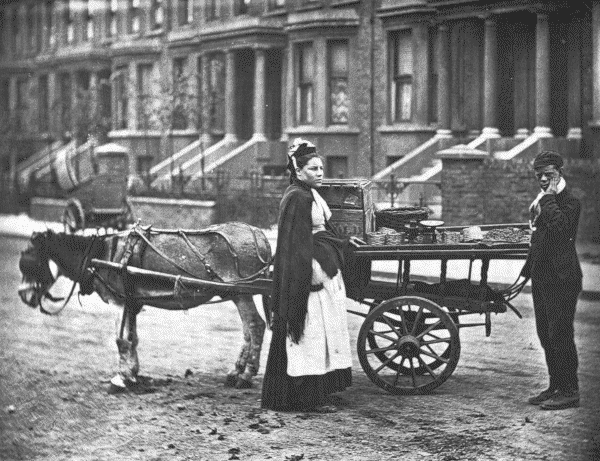
decay, which invests the low-lying districts of London. One of the most agreeable phases of our modern civilization, is the supply of luxuries brought to the doors of the poorest inhabitants of this vast city, and offered at such prices as to place them within the reach of all. The illustration will convey some idea of the manner in which one luxury at least is distributed among the lower orders of the community.
The strawberry season began late this year, owing to cold winds in spring retarding the growth of the plant. The fruit was nevertheless so plentiful as to prove unremunerative to many of the growers. West of England strawberries should appear in the London markets about the end of May, and continue until about the 10th of June, after which the fruit grown around the metropolis takes the lead. The crop, when brought from the western counties, had to compete with supplies from other sources. The prices offered in Covent Garden were so low as to induce some of the growers to dispose of their entire crop at home to manufacturers of preserved fruits.
Foreign strawberries during the height of the season are sold at prices ranging from ninepence to one shilling and sixpence per six-pound box. One of the wholesale merchants in Covent Garden, informed me that he thought about eighty pounds sterling would be the monthly value of the trade in strawberries in this market alone, while the fruit lasted. About one-half of the monthly supply of this fruit is bought by costermongers. But, as a rule, the costers do not venture to buy until the price falls so as to enable them to retail the fruit at fourpence or sixpence a punnet-basket. The rough native and foreign sorts fall to their share. They not unfrequently club, two or three together, and purchase cheap lots at the morning auctions held in the Garden. Three partners, with a joint capital of £4, may invest in a lot that will turn out thirty-five or forty dozen "punnets." These they will readily dispose of the same day at an average price of fourpence a basket, or a trifle less. Each partner expects to realize a profit of about three halfpence on each basket. At that rate one gross of baskets would yield eighteen shillings. This sum represents more than the average day's earnings of a prosperous costermonger. From this amount working expenses have to be deducted. He may probably have to pay two shillings interest on borrowed capital, food for himself and his donkey two shillings, and porterage fourpence.
A coster, from whom I obtained some information relating to this branch of street industry, set down his private expenditure and other matters thus,- "I should think a good clean day's work with strawberries will turn in about ten bob - shillings - perhaps not so much, and at times sum'at below that' figar.' Strawberries ain't like marbles that stand chuckin' about. They are wot you may call fancy goods. On a 'ot night I'd rather sell 'em than eat 'em! You should never let 'em know you ye got fingers, leastwise fingers like mine - all thumbs. They don't like it. They must be worked without touching, and kep' - them on top - as fresh as they was pulled. They won't hardly bear to be looked at. When I've got to my last dozen baskets they must be worked off for wot they'll fetch. They gets soft, and only want mixin' with sugar to make jam. They won't stand a coster's lodgin', not a single night. They like it so bad you'd find 'em all muck and mildew in the morning. There's no trouble in sellin', folks will buy anythink if its cheap and can be swallered. I can tell you in these times my profit goes like winkin'. I have a missus and four young 'uns, all lookin' hungry and naked, for they never seem better off, though they gets wittles, and wot not, reg'lar. My missus as four bob' a day, and six on Sundays, the two extra for a good dinner, and such like, when I'm at 'ome. Besides that I pays four bob' a week rent for two rooms in a very aristocratic street not far off." My informant, although he could neither read nor write, had a simple mode of keeping his accounts. He had acquired the use of numerals, and was in the habit of jotting down his daily expenditure in detail. His memoranda consisted of numerals only, so arranged on a piece of paper as to represent to this simple accountant £ s. d. The articles he bought at the morning sale were set down in the order in which they were purchased. Thus in his day book 2 8 4 were placed so as to denote two sacks of potatoes, price eight shillings, porterage fourpence. In the same way, 2 6 2 stood for two bushels of peas, price six shillings, money left on baskets two shillings, and so on. He assured me that by this system, supplemented by the use of the ten digits, he was enabled to keep his accounts with unerring accuracy. I found that by following his own plan he could solve simple problems in arithmetic with marvellous facility. He himself thought that the method was somewhat involved, and that it would be greatly simplified by education. After he had acquired the use of figures from a learned friend, who could read the best newspapers, the difficulty presented itself how to employ them. He could count the number of strawberries in a basket, or of potatoes in a sack, but that led to no good, as the articles in question varied in size, and the operation involved was complicated. The notion was then suggested of indicating gold, silver, copper, and wares, by their relative positions on paper, and by the aid of memory.
Like many other petty traders in London, equally ignorant of the science of numbers, he conferred new properties on numbers only understood by himself, but which at once facilitated his trading operations. I have found that an independent system of notation is made use of by individual costers, some of whom employ marks which they themselves alone can decipher.
Touching the subject of the borrowed capital used by costermongers, space will only permit me to say, in conclusion, that were offices instituted where small sums of money could be borrowed, on such security as might be forthcoming, they would prove a great boon to the poor traders of the London streets, while the profit accruing from the loans might satisfy even a Shylock.