
[-50-]
[-85-]

[-109-]

[-112-]

¶ i.
Half-way along that extreme northern thoroughfare which runs almost
parallel with the Thames, and which, under the name of the New Road, stretches
from the "YORKSHIRE STINGO" by Paddington, to that great metropolitan
anomaly the city turnpike, there stands an obeliskine lamp-post in the centre of
the roadway. This spot is now known as "King's Cross," in
commemoration of a rude stucco statue of George the Fourth, that was once
erected here by an artistic bricklayer, and had a small police station in its
pedestal, but which has long since been broken up and used to mend the highway
that it formerly encumbered.
Here is seen the terminus of the Great Northern Railway, with
its brace of huge glass archways, looking like a crystal imitation of the Thames
Tunnel; here, too, are found giant public-houses, with "double
frontage," or doors before and behind; and would-be grand architectural
depots for quack medicines; and enormous "crystal-palace" slop-shops,
with the front walls converted into one broad and high window, where the "Oxonian
coats," and "Talma capes," and "Sydenham trousers," and
"Fancy vests," are piled up several storeys high, while the doorway is
set round with sprucely-dressed "dummies" of young gentlemen that have
their gloved fingers spread out like bunches of radishes, and images of grinning
countrymen in "wide-awakes," and red plush waistcoats.
This same King's Cross is the Seven Dials of the New Road,
whence a series of streets [-113-] diverge like
spokes from the nave of a wheel; and there is almost always the same crowd of
"cads" and "do-nothings" loitering about the public-houses
in this quarter, and waiting either for a job or a share of a gratuitous
"quartern and three outs."
Proceeding hence by the roadway that radiates in a
north-easterly direction, we cross the vault-like bridge that spans the Regent's
Canal, whose banks here bristle with a crowd of tall factory chimneys; and then,
after passing a series of newly-built "genteel" suburban
"terraces," the houses of which have each a little strip of garden, or
rather grass-plot, in front of them, we see the viaduct of the railway
stretching across the road, high above the pavement, and the tall signal posts,
with their telegraphic arms, piercing the air. Immediately beyond this we behold
a large new building walled all round, with a long series of mad-house-like
windows, showing above the tall bricken boundary. In front of this, upon the
raised bank beside the roadway, stands a remarkable portcullis-like gateway,
jutting, like a huge square porch or palatial archway, from the main entrance of
the building, and with a little square clock-tower just peeping up behind it.
This is Pentonville Prison, vulgarly known as "the
Model," and situate in the Caledonian Road, that stretches from Bagnigge
Wells to Holloway.
The History and Architectural Details of the Prison.
Before entering the prison, let us gather
all we can concerning the history and character of the building.
It is a somewhat curious coincidence, that the system of
separate confinement which the Model Prison at Pentonville was built to carry
out, was originally commenced at the House of Correction, at Gloucester, under
the auspices of (among others) Sir George Onesiphorus Paul, the relative of one
who is at present suffering imprisonment within its walls.
This system of penal discipline was originally advocated by
Sir William Blackstone and the great prison reformer, Howard; and though it was
made the subject of an Act of Parliament in 1778, it was not put in practice
till some few years afterwards, and even then the experiment at Gloucester
"was not prosecuted," says the Government Reports, " so as to
lead to any definite result.
The subject of separate confinement, however, was afterwards
warmly taken up at Philadelphia; "and the late Mr. Crawford," we are
told, "was sent to America, in 1834, to examine into and report his opinion
upon the mode of penal discipline as there established."
On the presentation to Parliament of the very able papers
drawn up by Mr. Crawford and Mr. Whitworth Russell, the Inspectors of the
Prisons for the Home District, the subject came to be much discussed; and, in
1837, Lord John Russell, then Secretary of State for the Home Department, issued
a circular to the magistracy, recommending the separate system of penal
discipline to their consideration.
Shortly after this it was determined to erect Pentonville
Prison, as a preliminary step, for the purpose of practically testing this
"separate" method of penal treatment, and the name originally applied
to it was "the Model Prison, on the separate system," it being
proposed to apply the plan, if successful, to the several jails throughout the
kingdom.
The building was commenced on the 10th of April, 1840, and
completed in 1842, at a cost of about £85,000, after plans furnished by
Lieut.-Col. Jebb, RE. It was first occupied in December of the latter year, and
was appropriated, by direction of Sir James Graham, the Home Secretary at that
period, to the reception of a selected body of convicts, who were [-114-]
there to undergo a term of probationary discipline previous to their
transportation to the colonies. Indeed, the letter which Sir James Graham
addressed to the Commissioners who had been appointed to superintend the penal
experiment, is so admirably illustrative of the objects aimed at in the
institution of the prison at Pentonville, that we cannot do better than repeat
it here.
"Considering the excessive supply of labour in this
country," says Sir James, "its consequent depreciation, and the
fastidious rejection of all those whose character is tainted, I wish to admit no
prisoner into Pentonville who is not sentenced to transportation, and who is not
doomed to be transported; for the convict on whom such discipline might produce
the most salutary effect would, when liberated and thrown back on society in
this country, be still branded as a criminal, and have but an indifferent chance
of a livelihood from the profitable exercise of honest industry I propose,
therefore, that no prisoner shall be admitted into Pentonville without the
knowledge that it is the portal to the penal colony, and without the certainty
that he bids adieu to his connections in England, and that he must henceforth
look forward to a life of labour in another hemisphere.
"But from the day of his entrance into prison, while I
extinguish the hope of return to his family and friends, I would open to him,
fully and distinctly, the fate which awaits him, and the degree of influence
which his own conduct will infallibly have over his future fortunes.
"He should be made to feel that from that day he enters
on a new career. He should be told that his imprisonment is a period of
probation; that it will not be prolonged above eighteen months; that an
opportunity of learning those arts which will enable him to earn his bread will
be afforded under the best instructors; that moral and religious knowledge will
be imparted to him as a guide to his future life; that at the end of eighteen
months, when a just estimate can be formed of the effect produced by the
discipline on his character, he will be sent to Van Diemen's Land; there, if he
behave well, at once to receive a ticket- of-leave, which is equivalent to
freedom, with a certainty of abundant maintenance - the fruit of industry.
"If, however, he behave indifferently, he will, on being
transported to Van Diemen's Land, receive a probationary pass, which will secure
to him only a limited portion of his earnings, and impose certain galling
restraints on his personal liberty.
"If, on the other hand, he behave ill, and the
discipline of the prison be ineffectual, he will be transported to Tasman's
Peninsula, there to work in a probationary gang, without wages, and deprived of
liberty - an abject convict."
Now, for the due carrying out of these objects, a Board of
Commissioners was appointed, among whom were two medical gentlemen of the
highest reputation in their profession, and whose duty it was to watch narrowly
the effect of the system upon the health of the prisoners.
"Eighteen months of the discipline, said Sir James
Graham, in his letter to these gentlemen, "appear to me to be ample for its
full application. In that time the real character will be developed, instruction
will be imparted, new habits will be formed, a better frame of mind will have
been moulded, or else the heart will have been hardened, and the case be
desperate. The period of imprisonment at Pentonville, therefore," he adds,
"will be strictly limited to eighteen months."
Thus we perceive that the Model Prison was intended to be a
place of instruction and probation, rather than one of oppressive discipline,
and was originally limited to adults only, between the ages of eighteen and
thirty-five.
From the year 1843 to 1848, with a slight exception on the
opening of the establishment, the prisoners admitted into Pentonville were most
carefully selected from the whole body of convicts. A change, however, in the
class of prisoners was the cause of some adverse results in the year 1848, and
in their Report for that year the Commissioners say- "We [-115-]
are sorry that, as to the health and mental condition of the prisoners,
we have to make a a much less satisfactory report than in any of the former
years since the prison was established It may be difficult, they add, "to
offer a certain explanation of the great number of cases of death and of
insanity that have occurred within the last year. We have, however, reason to
believe that in the earlier years of this institution, the convicts sent here
were selected from a large number, and the selection was made with a more
exclusive regard to their physical capacity for undergoing this species of
punishment."
Experience, then, appearing to indicate the necessity of some
modification of the discipline at Pentonville, which, without any sacrifice of
its efficiency, would render it more safe and more generally available to all
classes of convicts, "Sir George Grey, we are told, "concurred in the
opinion of Sir Benjamin Brodie and Dr. Ferguson, that the utmost watchfulness
and discretion on the part of the governor, chaplain, and medical attendants
would be requisite, in order to administer, with safety, the system established
there.
It being no longer necessary to continue the experiment upon
prison discipline, which had been in full operation from 1843 to 1849, it was
brought to a close, and the accommodation in Pentonville prison was thus
rendered available for the general purposes of the convict service.
Accordingly, the period of confinement in Pentonville Prison
was first reduced from eighteen to twelve months, and subsequently to nine
months. Nevertheless, at the commencement of 1852, says an official document,
"there occurred an unusually large number of cases of mental
affection among the prisoners, and it was therefore deemed necessary to increase
the amount of exercise in the open air, and to introduce the plan of brisk
walking, as pursued at Wakefield. The change, we are told, produced a most
marked and beneficial effect upon the general health of the inmates. Indeed, so
much so, that "in the course of the year following, there was," say
the reports, "not one removal to Bedlam. *
* The number of removals from Pentonville to Bedlam, on the ground of insanity, as compared with the preceding years, was, in the year 1851, found to be-
27 in 10,000 from 1842-49
32 in 10,000 from 1850
16 in 10,000 from 1851
16 in 10,000 from 1852
0 in 10,000 from 1853
10 in 10,000 from 1854
20 in 10,000 from 1854 [sic, ed]The above ratio, however, expresses only the proportion per 10,000 prisoners removed to Bedlam as insane, but the following table, which has been kindly furnished us by Mr. Bradley, the eminent medical officer of Pentonville prison, gives the proportion of cases of mental disease occurring annually, after first 10 years:-
In 10 years, from 1843 to 1852 ... 120 per 10,000 prisoners.
In 10 years, from 1843 to 1853 ... 60 per 10,000 prisoners.
In 10 years, from 1843 to 1854 ... 38 per 10,000 prisoners.
In 10 years, from 1843 to 1855 ... 59 per 10,000 prisoners.Hence it would appear that the improved treatment of shortened term of separation, rapid exercise, and superior ventilation, has decreased the rate of insane cases to less than one-half what it was in the first 10 years. Still, much has to be done to bring the proportion down to the normal standard of all other prisons, which is only 5.8 per 10,000 prisoners. Vide p. 103 of GREAT WORLD OF LONDON.
It is but just to state here that the Reports of the Commissioners, one and all, evince a marked consideration and anxiety for the health of the convicts placed under their care; and we are happy to have it in our power to add, that our own personal experience teaches us that none could possibly show a greater interest, sympathy, and kindness, for all "prisoners and captives," than the Surveyor-General of Prisons. It is a high satisfaction to find, when one comes to deal with prisons and prisoners, that almost every gentleman placed in authority over the convicts appears to be actuated by the most humane and kindly motives towards them. Nor do we, in saying thus much, judge merely from manner and external appearances. Our peculiar investigations throw us into communication with many a liberated convict, who has served his probationary term at the Model, and we can conscientiously aver, that we have never heard any speak but in the very highest terms, both of the Governor of Pentonville, the Chaplain, and the Surveyor-General himself.
[-116-] The ventilation was also improved by admitting the outer air direct to the cells, and the discipline was at once relaxed when any injury to health was apprehended. Farther, whenever there was reason to believe that a prisoner was likely to be injuriously affected by the discipline, he was, in conformity with the instructions of the directors, removed from strict separate confinement, and put to work in association with other prisoners.*
The total number withdrawn from separation in the year 1854 was 66, and 23 of these were put to work in association on mental grounds, consisting of cases in which men of low intellect began under separate confinement to exhibit mental excitement, depression, or irritability, whilst 12 more were removed to public works before the expiration of their term of separate confinement, because they were, in the words of the medical officer, "likely to be injuriously affected by the discipline of the prison." By a summary of a list of the cases requiring medical treatment-as given in the Medical Officer's Report for 1855-we find, that of the diseases, 35.9 per cent. Consist of constipation, and 16.5 per cent, of dyspepsia-the other affections being catarrhs, of which the proportion is 20.7 per cent.,and diarrhoea 100 per cent., whilst the remaining 16.9 per cent. was made up of a variety of trivial and anomalous cases.
Such, then, is the history of the institution, and the
reasons for the changes connected with the discipline, of Pentonville Prison.
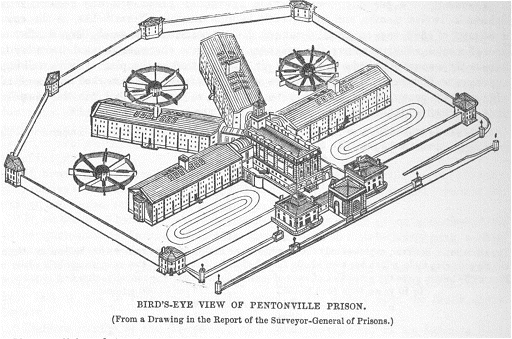
As regards the details of the building itself, the following
are the technical particulars:- The prison occupies an area of 6¾ acres. It has
"a curtain wall with massive posterns in front," where, as we have said,
stands a large entrance gateway, the latter designed by Barry, whose arches are
filled with portcullis work; whilst from the main building rises an
"Italian" clock-tower. From the central corridor within radiate four wings,
constructed after the fashion of spokes to a half-wheel, and one long entrance
hall, leading to the central point. The interior of each of the four wings or
"corridors" is fitted with 130 cells, arranged in thee "galleries" or
storeys, one above the other, and each floor contains some forty-odd apartments
for separate confinement.
Every cell is 13½ feet long by 7½ feet broad, and 9 feet
high, and contains an earthenware water-closet, and copper wash-basin, supplied
with water; a three-legged stool, table, and shaded gas-burner-besides a hammock
for slinging at night, furnished with mattress and [-117-]
blankets. In the door of every cell is an eyelet-hole,
through which the officer on duty may observe what is going on within from
without. Each of the cells is said to have cost, on an average, upwards of £150.
The building is heated by hot water on the basement, and the
ventilation is maintained by an immense shaft in the roof of each wing. The
prison has also a chapel on the separate system, fitted with some four hundred
distinct stalls or sittings, for the prisoners, and so arranged that the
officers on duty, during divine service, may have each man under their surveillance.
There are also exercising yards for single prisoners, between each of the
radiating wings, and two larger yards-one on either side of the
entrance-hall-for exercising large bodies of the prisoners collectively.
Moreover, there are artesian wells for supplying the prison
with water, and a gas-factory for lighting the building. Indeed, the prison is
constructed and fitted according to all the refinements of modern science, and
complete in all its app1iances.*
*
On March the 13th, 1856, there were 368 prisoners
confined here; and these were thus distributed over the building:-
| Corridor A | No.1 Ward 24 prisoners No.2 Ward 27 prisoners No.3 Ward 42a prisoners |
93 | Corridor C | No.1 Ward 26 prisoners No.2 Ward 21 prisoners No.3 Ward 38 prisoners |
85 |
| Corridor B | No.1 Ward 26a prisoners No.2 Ward 22 prisoners No.3 Ward 32 prisoners |
80 | Corridor D | No.1 Ward 20b prisoners No.2 Ward 40a prisoners No.3 Ward 21aa prisoners No.4 Ward 29 prisoners |
110 |
| 368 |
The
letter a affixed to some of the numbers above given, signifies that one man,
and aa, two men, out of that ward were confined in the refractory cells; and
b that there was one
from that part of the building sick in the infirmary-ward. D 4 is
the associated ward, and at the basement of the southern part of the building.
The
following table gives a statement of the number of prisoners received and sent
away in the course of a year:-
NUMBER AND DISPOSAL OF PRISONERS AT PENTONVILLE PRISON DURING THE YEAR 1854
| Remaining 31st December, 1853 | 489 | Pardoned free | 1 |
| Admitting during the year 1854 | 436 | " conditional | 3 |
| 925 | " on medical grounds | 1 | |
| These 925 prisoners were disposed of as follows:- | " on licence | 37 | |
| Transferred to Portland Prison | 193 | Died | 8 |
| Transferred to Portsmouth | 120 | Suicide | 1 |
| Transferred to Dartmoor | 20 | 387 | |
| Transferred to "Stirling Castle" Hulk | 2 | Remaining 31st December | 538 |
| Transferred to Bethlehem Hospital (insane) | 1 | 925 | |
| Of the 436 admitted during 1854, the following is a statement of the ages:- | |||
| 3 were under the age of | 17 years | 13 were between the age of | 45 and 50 years |
| 243 were between | 17 and 25 years | 6 were between the age of | 50 and 55 years |
| 79 were between | 25 and 30 years | 2 were between the age of | 55 and 60 years |
| 51 were between | 30 and 35 years | 436 | |
| 28 were between | 35 and 40 years | Proportion of prisoners between 17 and 25 years, 55.7 | |
| 11 were between | 40 and 45 years | ||
The Interior of Pentonville Prison.
Artists and Poets clamour loudly about "ideals," but
these same artistic and poetic idealities are, in most cases, utterly unlike the
realities of life, being usually images begotten by narrow sentiments rather
than the abstract results of large observation; for idealization is - or at least should
be - in matters of art what generalization is in science,
since a pictorial "type" is but the esthetic equivalent of a natural
"order;" and as the "genus" in philosophy should express merely the
point of agreement among a number of diverse phenomena, even so that graphic
essence which is termed "character" should represent the peculiar form
common to a variety of visible things.
We remember once seeing an engraving that was intended for an ideal portrait
of the common hangman, in which the hair was of the approved convict cut, with a
small villainous valance left dangling in front - the forehead as low as an
ape's - the brow repulsively beetled and overhanging as eaves, whilst the sunken
eyes were like miniature embrasures pregnant with their black artillery. And
yet, when we made the acquaintance of Calcraft, we found him bearing the impress
of no such monster, but rather so "respectable" in his appearance, that on
first beholding a gentleman in a broad brimmed hat and bushy iron gray hair,
seated at the little table in the lobby of Newgate, with his hands, too,
resting on the knob of his Malacca cane, we mistook him for some dissenting
minister, who had come to offer consolation to one of the wretched inmates. Nor
could we help mentally contrasting the loathsome artistic ideality with the
almost humane-looking reality before us.
The same violence, too, is done to our preconceived notions by the first
sight of the jailer of the present day. The ideal leads us to picture such a
functionary in our minds as a kind of human Cerberus - a creature that
looks as surly and sullen as an officer of the Inquisition, and with a bunch of
huge keys fastened to his waist, whose jangle, as he moves, reminds one of the
clink of fetters. The reality, however, proves on acquaintance to be generally a
gentleman with a half military air, who, so far from being characterized by any
of the vulgar notions of the stern and cruel-minded prison-keeper, is usually
marked by an almost tender consideration for those placed under his charge,
and who is certainly prompted by the same desire that distinguishes all
better-class people now-a-days, to ameliorate the condition of their unfortunate
fellows
At Pentonville, the same mental conflict between vulgar preconceptions and
strange matter of fact ensues; for the prison there is utterly unlike all our
imaginary pictures of prisons - the governor a kind-hearted gentleman, rather than
approaching to the fanciful type of the unfeeling jailer - and the turnkeys a
kind of mixture between policemen and military officers in undress, instead of the ferocious-looking prison-officials ordinarily represented
on the stage.
No sooner is the prison door opened in answer to our summons at the hell,
than we might believe we were inside some little park lodge, so tidy and cozy
and unjail-like is the place; and here is the same capacious hooded chair, like
the head of a gigantic cradle that is usually found in the hail of large
mansions.
The officer, as he holds back the portal, and listens to our inquiry as to
whether the Governor be visible, raises his hand to his glazed military cap,
and salutes us soldier-fashion, as he replies briskly, "Yessir."
Having produced our Government order, to allow us to inspect the prison, we
are ushered across a small paved court-yard, and then up a broad flight of
stone steps to the large glass door that admits us to the passage leading to the
prison itself. The officer who accompanies us is habited in a single-breasted,
policeman-like, frock coat, with a bright brass crown bulging from its stiff,
stand-up collar, and round his waist he wears a broad leathern strap, with a
shiny cartouche-box behind, in which he carries his keys. These keys are now
withdrawn, and the semi-glass door - that is so utterly unlike the gloomy and
ponderous prison portal of olden times - is thrown back for us to pass through.
We are then at the end of a long and broad passage, which is more like the
lengthy hail to some Government office, than the entrance to an old-fashioned
jail, and at the opposite extremity we can just see, through the windows of the
other door there, figures flitting backwards and forwards in the bright light of
what we afterwards learn is the "centre corridor" of the building.
[-119-] The first thing that strikes the mind on entering the prison passage, is the
wondrous and perfectly Dutch-like cleanliness pervading the place. The floor,
which is of asphalte, has been polished, by continual sweeping, so bright that
we can hardly believe it has not been black-leaded, and so utterly free from
dust are all the mouldings of the trim stucco walls, that we would defy the
sharpest housewife to get as much off upon her
fingers as she could brush even from a butterfly's wing.
 In no private house is it possible to see the like of this dainty
cleanliness, and as we walk along the passage we cannot help wondering why it is
that we should find the perfection of the domestic virtue in such an
abiding-place.
In no private house is it possible to see the like of this dainty
cleanliness, and as we walk along the passage we cannot help wondering why it is
that we should find the perfection of the domestic virtue in such an
abiding-place.
We are shown into a small waiting-room on one side of the passage, while the
officer goes to apprise the governor of our presence; and here we have to enter
our name in a book, and specify the date, as well as by whose permission we have
come. Here, too, we find the same scrupulous tidiness, and utter freedom from
dirt-the stove being as lustrous, from its frequent coats of "black-lead,"
as if it had been newly carved out of solid plumbago.
A few minutes afterwards, we are handed over to a warder, who receives
instructions to accompany us round the prison; and then, being conducted through
the glass door at the other end of the passage, we stand, for the first time, in
the "centre corridor" of the "Model Prison."
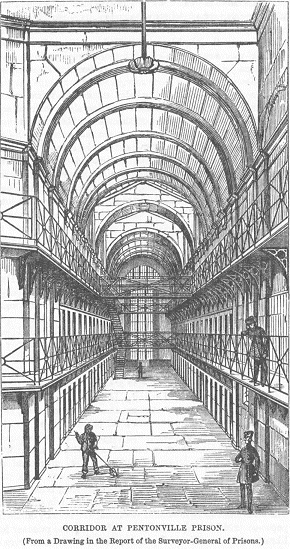
To conceive the peculiar character of this building, the reader must imagine
four long "wings," or "corridors," as they are officially styled, radiating
from a centre, like the spokes in a half-wheel; or, what is better, a series of
light and lofty tunnels, all diverging from one point, after the manner of the
prongs in an open fan. Indeed, when we first entered the inner part of the
prison, the lengthy and high corridors, with their sky-light [-120-]
roofs, seemed to us like a bunch of Burlington Arcades, that
had been fitted up in the style of the opera-box lobbies, with an infinity of
little doors-these same doors being ranged, not only one after another,
but one above another, three storeys high, till the walls of the arcades
were pierced as thick with them as the tall and lengthy sides of a man-of-war
with its hundred port-holes.
Then there are narrow iron galleries stretching along in
front of each of the upper floors, after the manner of lengthy balconies, and
reaching from one end of the arcades to the other, whilst these are so light in
their construction, that in the extreme length of the several wings they
look almost like ledges jutting from the walls.
Half-way down each corridor, too, there is seen, high in the
air, a light bridge, similar to the one joining the paddle-boxes on board a
steamer, connecting the galleries on either side of every floor.
Nevertheless, it is not the long, arcade-like corridors, nor
the opera-lobby-like series of doors, nor the lengthy balconies stretching along
each gallery, nor the paddle-box-like bridges connecting the opposite sides of
the arcade, that constitute the peculiar character of Pentonville prison. Its
distinctive feature, on the contrary-the one that renders it utterly dissimilar
from all other jails- is the extremely bright, and cheerful, and airy quality of
the building; so that, with its long, light corridors, it strikes the mind, on
first entering it, as a bit of the Crystal Palace, stripped of all its contents.
There is none of the gloom, nor dungeon- like character of a jail appertaining
to it; nor are there bolts and heavy locks to grate upon the ear at every turn;
whilst even the windows are destitute of the proverbial prison-bars - the
frames of these being made of iron, and the panes so small that they serve at
once as safeguards and sashes.
Moreover, so admirably is the ventilation of the building
contrived and kept up, that there is not the least sense of closeness pervading
it, for we feel, immediately we set foot in the place, how fresh and pure is the
atmosphere there; and that, at least, in that prison, no wretched captive
can sigh to breathe the "free air of Heaven," since in the open country
itself it could not be less stagnant than in the "model" jail - even though
there be, as at the time of our visit, upwards of 400 men confined day and night
- sleeping, breathing, and performing all the functions of nature in their
400 separate cells throughout the place.
The cells distributed throughout this magnificent building
are about the size of the interior of a large and roomy omnibus, but some feet
higher, and they seem to those who are not doomed to dwell in them - apart from
all the world without-really comfortable apartments. In such, however, as
contain a loom (and a large number of the cells on the ground-floor are fitted
with those instruments), there is not a superabundance of spare room.
Nevertheless, there is sufficient capacity, as well as light, in each, to make
the place seem to a free man a light, airy, and cheerful abode. Against the
wall, on one side, is set the bright, copper hand-basin - not unlike a big
funnel - with a tap of water immediately
above it; at the extreme end of the cell is the small closet, well supplied with
water-pipes; and in another part you see the shaded gas-jet, whilst in one of
the corners by the door are some two or three triangular shelves, where the
prisoner's spoon, platter, mug, and soap-box, &c., are stowed. On the upper
of these shelves, the rolled-up hammock, with its bedding, stands on end, like a
huge muff, and let into the wall on either side, some three feet from the
ground, are two large bright eyelet holes, to which the hammock is slung at
night, as shown in the engraving. Then there is a little table and stool, and
occasionally on the former may be found some brown paper-covered book or
periodical, with which the prisoner has been supplied from the prison library.
In one cell which we entered, while the men were at exercise in the yard, we
found a copy of "OLD HUMPHREY'S THOUGHTS" and in another, a recent
number of " CHAMBER'S EDINBURGH JOURNAL" left open on the table.
Moreover, hanging against the wall is a pasteboard bill, headed, "NOTICE TO
CONVICTS", and the "RULES AND REGULATIONS" of the prison, as well
as the little card inscribed with the prisoner's "registered number" (for in
Pentonville prison all names cease), and citing not only his previous
occupation, but term [-121-] of sentence, date of conviction, &c. Further, there is,
in the corner near the cupboard, a button, which, on being turned, causes a
small gong to be struck in the corridor without, and at the same moment makes a
metal plate or "index outside the door start out at right angles to the
wall, so that the warder, when summoned by the bell, may know which prisoner has
rung.
On this index is painted the number of the cell, and as you
walk along the corridors you observe, not only a large black letter painted at
the entrance of each arcade, but a series of these same indices, each inscribed
with a different number, and (except where the gong has been recently sounded)
flat against the wall beside the door. Now these letters on the corridors, as
well as the indices beside the doors, are used not only to express the position
of the cell, but, strange to say, the name of the prisoner confined within it;
for here, as we said, men have no longer Christian and surnames to distinguish
them one from the other, but are called merely after the position of cell they
occupy. Hence, no matter what the appellation of a man may have been-or even
whether he bore a noble title before entering the prison-immediately he comes as
a convict within its precincts, he is from that time known as D 3, 4, or B 2,
10, as the case may be, and wears at his breast a charity-boy-like brass badge
so inscribed, to mark him from the rest. Thus he is no longer James This, or Mr.
That, or even Sir John So-and-so, but simply the prisoner confined in corridor
D, gallery 3, and cell 4, or else the one in corridor B, gallery 2, and cell 10;
so that instead of addressing prisoners here as Brown, Jones, and Robinson, the
warder in whose gallery and corridor those convicts may happen to be calls them,
for brevity sake, simply and individually by the number of the cells they occupy
in his part of the building. Accordingly the officer on duty may occasionally be
heard to cry to some one of the prisoners under his charge, "Now step out
there 4, will you?" or, "Turn out here, Number 6." *
* The following is a list of the several officers of Pentonville Prison in the year 1856:-
Name Rank Robert Husking
Governor Rev. Joseph Kingsmill
Chaplain Ambrose Sherwin
Assistant do. Charles L. Bradley
Medical Officer
William H. Foster
Steward and Manufactuer Alfred P. Nantes
Governor's Clerk Angus Macpherson
Accountant Clerk Edward Tottenham
Steward's Clerk Robert Yellsly
Assistant do. Thomas Carr Manufacturer's Clerk James Maya Assistant do. John Wilson Schoolmaster Charles Gregg Assistant do. Edward J. Hoare Do. and Organist Terence Nulty Chief Warder John Jenkins Principal Warder David Adamson Ditto John Smart Warder William Wood " Adam Corrie " William Keating " Senthil Lindsay " David Darling " Michael Laffan " Robert Green " John Snellgrove " Edward Edwards " James Snowball Assistant Warder Richard Wilcocks " Peter Cameron " John Whitehurst " John Donegan Assistant Warder James Hampton " Joseph Matthews Warder Instructor John Baptie " Thomas Hirst " John Armstrong " John Fitzgerald " Martin Burke " Amos Driver " William Callway Assist. Warder Instructor John White " Edward Bevan " Thomas Charlesworth " Samuel Whitley " Arthur Keenan Infirmary Warder William Matthis Gate Porter George Larkin Inner Gate Porter Thomas R. Yeates Messenger Thomas Rogers Foreman of Works Stephen Oatley Plumber Robert Lyon Gasmaker Charles Poole Assistant ditto. John Pride Engine-man Edward Gannon Stoker Matthew Yates Steward's Porter William Butler Manufacturer's Porter Griffin Crannis Carter John Beckley Cook John Cladingbowl Baker
[-122-]
¶ iii-c[gamma in original, ed.]
A Work-Day at Pentonville.
To understand the "routine" of
Pentonville Prison, it is
necessary to spend one entire long day in the establishment, from the very
opening to the closing of the prison; and if there be any convicts leaving for
the public works, as on the day we chose for our visit, the stranger must be
prepared to stay at least eighteen hours within the walls. Nor, to our mind, can
time be more interestingly passed.
The stars were still shining coldly in the silver gray sky on
the morning when we left our home to witness the departure of some thirty-odd
prisoners from Pentonville for Portsmouth. We were anxious to discover with what
feelings the poor wretches, who had spent their nine months at the Model,
excluded from all intercourse but that of prison officers, would look forward to
their liberation from separate confinement; and though we had been informed
over-night that the "batch" was to leave as early as a quarter past 5 am.,
we did not regret having to turn out into the streets, with the cold March
morning winds blowing so sharp in the face as to fill the eyes with tears.
As we slammed our door after us, the deserted street seemed
to tremble as it echoed again with the noise. On the opposite side of the way,
the policeman, in his long great coat, was busy throwing the light of his
bull's-eye upon the doors and parlour windows, and down into the areas, as he
passed on his rounds, making the dark walls flicker with the glare as if a
Jack-a-Dandy had been cast upon them, and, startled by the sound, he turned
suddenly round to direct his lantern towards us as if he really took us for one
of the burglarious characters we were about to visit.
The cabmen at the nearest stand were asleep inside their
rickety old broughams, and as we turned into Tottenham Court Road we encountered
the early street coffee-stall keeper with his large coffee-cans dangling from
either end of a yoke across his shoulders, and the red fire shining through the
holes of the fire-pan beneath like spots of crimson foil.
Then, as we hurried on, we passed here and there a butcher's
light "chay-cart" with the name painted on the side, hurrying off to the
early meat-markets, and the men huddled in the bottom of the vehicle, behind the
driver with their coat-collars turned up, and dozing as they went. Next came
some tall and stalwart brewer's drayman (they are always the first in the
streets), in his dirty drab flushing jacket, and leathern leggings, hastening
towards the brewery; and, at some long distance after him, we met an old ragged
crone, tottering on her way to the Farringdon water-cress market with her
"shallow under her arm, and her old rusty frayed shawl drawn tight round
her; whilst here and there we should see a stray bone-grubber, or "pure
finder," in his shiny grimy tatters, "routing" among the precious muck-heaps
for rich rags and valuable refuse.
Strange and almost fearful was the silence of the streets, at
that hour! So still, indeed, were they that we could hear the heavy single
knock, followed by the shrill cry of the chimney-sweep, echoing through the
desolate thoroughfares, as he waited at some door hard by and shrieked, "Swe-e--eep!" to rouse the sleeping cook-maid. Then every foot-fail seemed to
tell upon the pavement like the tramp of the night-police, and we could hear the
early workmen trudging away, long before we saw them coming towards us, some
with their basin of food for the day done up in a handkerchief, and dangling
from their hand-and others like the smoky and unwashed smiths with an old
nut-basket full of tools slung over their shoulder upon the head of a hammer-the
bricklayer with his large wooden level and coarse nailbag full of trowels
hanging at his back-and the carpenter on his way to some new suburban building
in his flannel jacket and rolled-up apron, and with the end of his saw and
jack-plane peeping from his tool-basket behind; while here and there, as we got
into the [-123-] neighbourhood of King's Cross, we should pass some railway
guard or porter on his way to the terminus for the early trains.
While jogging along in the darkness - for still there was not a
gleam of daybreak visible - we could not help thinking, what would the wretched
creatures we were about to visit not give to be allowed one half-hour's walk
through those cold and gloomy streets, and how beautiful one such stroll in the
London thoroughfares would appear to them-beautiful as quitting the house,
after a long sickness, is to us.
Nor could we help, at the same time, speculating as to the
perversity of the natures that, despite all the long privations of jail, and the
severe trial of separate confinement, would, nevertheless, many of them, as we
knew, return to their former practices immediately they were liberated. Granted,
said we to ourselves (forgetting, in our reveries, to continue our observations
of the passing objects), that some would be honest if society would but cease to
persecute them for their former crimes. Still many, we were aware, were utterly
incapable of reformation, for figures prove to us that there is a certain per
centage among the criminal class who are absolutely incorrigible. Nevertheless,
the very fact of there being such a per centage, and this same perversity
of nature being reducible to a law, seemed to us to rank it like lunacy, among
the inscrutable decrees of the All-Wise, and thus to temper our indignation with
pity. Then we could not help thinking of the tearful homes that these wretched
people had left outside their prison walls, for, hardened as we may fancy them,
they and theirs are marked by the same love of kindred as ourselves-such love,
indeed, being often the only channel left open to their heart; and, moreover,
how sorely, in punishing the guilty, we are compelled to punish the innocent
also.*
* As a proof that no "morbid sentimentality" gave rise to the above remarks, we will quote the following letter as one among many that it is our lot to receive:-
"March 24th, 1856.
"SIR,-An anxious mother, who has an unfortunate son now about to be liberated from the convict prison, Portsmouth, is very desirous of obtaining an interview with you on his behalf, and would feel truly grateful for such a favour.-.From your most obedient and humble servant,
"A.S."
Here is another illustration of the fact, that one guilty man's misery involves that of many innocent people
"March 19th, 1845.
"SIR,-I am a poor, unfortunate, characterless man, who have returned from jail, with a desire to earn an honest living for the future, and I make bold to write to you, begging your kind assistance in my present distress.
"I left the House of Correction on Wednesday last, 12th inst., after an incarceration of six calendar months, to which I was sentenced for obtaining money by means of representing myself as a solicitor, and to which offence I pleaded guilty. My prosecutors, finding that I was induced to commit myself through poverty, would gladly have withdrawn from the case, but could not, being bound over.
"Coming home, I found a wife and five children depending upon me for support-the parish having at once stopped the relief, and the army work (at which they earned a few shillings) having fallen off altogether; therefore I am in a most distressed position, not having clothes out of pledge to go after employment in, or I doubt not but that I could get employment, as I have a friend who would become surety for me in a situation.
"If, therefore, you can render me any assistance, you will indeed confer a favour on, Sir, your very obedient servant,
"J. B."
We were suddenly aroused from our reverie by the scream of
the early goods' train, and presently the long line of railway wagons came
rattling and rumbling across the viaduct over the street, the clouds of steam
from the engine seeming almost an iron gray colour in the darkness.
The next minute we were at the Model Prison, Pentonville; but
as the warders were not yet assembled outside the gate, and we saw bright lines
of light shining through the cracks over and under the door of one of the
neighbouring shops, we made bold to knock and claim a short shelter there.
[-124-] It happened to be a coffee-shop. We found the little room in
a thick fog of smoke from the newly-lighted fire, and the proprietor busy making
the morning's supply of the "best Mocha "-possible, at a penny a cup.
We had not long to wait, for presently the shopkeeper
apprised us that the warders were beginning to assemble; and truly, on reaching
the gateway once more, we found a group of some two dozen officers waiting to be
admitted to the prison.
Presently the outer door was opened, when the warders passed
into the court-yard and stood upon the broad flight of steps, in a group round
the glass door leading to the entrance- hail. Here they reckoned among
themselves as to whether they were all assembled, and finding that one or two
were wanting, the rest looked up at the clock and said, "Oh, it wants five
minutes to the quarter yet."
"They are safe to be here," said one to us, privately;
"for there's a heavy fine if a man isn't true to his time2. Sure enough, the
next moment the two missing warders entered the yard, and the glass door being
opened, we all proceeded, in company with one of the principal warders - marked by
the gold lace band round his cap - into a small room on the left-hand side of the
passage.
"The chief warder sleeps here, sir," said the officer
whom the governor had kindly directed to attend us through the day, and to
instruct us upon all the details of the prison.
There was no sign of bed in the room, and the only
indication we had that the chief officer had passed the night in the building
was, that he was in the act of slipping on his coat as we entered the apartment.
A large iron safe, let into the wall of this room, was
now unlocked, and a covered tray, or drawer, that was not unlike an immense
wooden portable desk, was withdrawn and carried into the lobby, while the
contents jangled so loudly with the motion, that it was not difficult to surmise
that in it the officers' keys were kept. Here it was placed upon a chair, and,
when opened, revealed some twenty-eight bunches of large keys hanging upon as
many different hooks.
These were distributed by one o~ the principal warders to the
several officers throughout the building, and this done, we were once more
conducted into the interior of the prison, where we found the gas still burning
in the corridors and the lights shining on the polished asphalte floors, in long
luminous lines, like the lamps in the streets reflected upon the pavement on
a wet night.
The blue light of early dawn was now just beginning to show
through the skylights of the long arcades, but hardly had we noticed the cold
azure look of the coming day, contrasting, as it did, with the warm yellow light
of the gas within, than the corridors began to hum again with the booming of the
clock-tower bell, ringing, as usual, at half-past five, to call the officials.
We walked with the warder down the several corridors, and, as
we did so, the officers on duty proceeded to carry the bread and cocoa round to
the prisoners who were about to leave that morning for the public works at
Portsmouth. And then the halls rang, now with the rattling of the trucks on
which the breakfast was being wheeled from cell to cell, and now with the
opening and shutting of the little trap in each cell-door, through which the
food was given to the prisoner within; the rapid succession of the noises
telling you how briskly and dexterously the work was done.
"You see those clothes, and tables, and chairs outside
the cell-doors, there?" said the warder, as he led us along the corridors;
"they belong to men who have attempted to break out of other prisons, so we
leave them nothing but their bed and bare walls for the night. Now there, at
that door, you perceive, are merely the clothes, and shoes, and tools of the
prisoner within; he's one of the bricklayers who has worked out in the grounds,
so we trust such as him with nothing but the flannel drawers they sleep in from
nine at night till sax in the morning. Oh, yes, sir! we are obliged to be very
particular here, for the men have [-125-] tools given them to work with, and therefore we make them put
all such articles outside their cell-doors just before they go to bed; but when
a man is a notoriously desperate prison- breaker, we don't even allow him so
much as a tin can for his soup, for we know that, if we did so, he would
probably convert the wire round the rim into a pick-lock, to open his door. Yes,
sir, convicts are mostly very ingenious at such things."
By this time we had reached the end of the ward, where stood
a small counting-house- like desk, partitioned off from the other part of the
corridor.
"This is the warders' office," our informant continued,
"and the clock you see there, in front of it, is the 'tell-tale.' There is
one such in each ward. It has, you observe, a number of pegs, one at every
quarter of an hour, projecting like cogs from round the edge of the dial- plate,
which is here made to revolve instead of the hands. At the side, you perceive,
there's a string for pulling down the small metal tongue that stands just over
the top peg, and the consequence is, that unless the officer who is on duty in
the night comes here on his rounds precisely at the moment when that top
peg should be pushed down, it will have passed from under the tongue, and stand
up as a register of neglect of duty against him. There are a number of these
clocks throughout the prison, and the warders have to pull some of the pegs at
the quarters, some at the half-hours, and others at the hours. They are all set
by the large time-piece in the centre, and so as just to allow the officer to go
from one ward to the other.
"If a man's bell rings in the night?" asked we.
"Why," was the ready answer, "the trap of his
cell-door is let down, and the officer on duty thrusts in a bull's-eye lantern
so as to see what is the matter; the prisoner makes his complaint, and, if sick,
the chief warder is called, who orders, if he thinks it necessary, the
infirmary warder to come to him. There are four warders on duty every night,
from ten till six the next morning, and each of the four has to keep two hours'
watch.
*** Departure of Convicts.-Scarcely had our attendant
finished his account of the night duties, when a large town-crier's bell
clattered through the building. This was the quarter- to-six summons to wake the
prisoners; and, five minutes afterwards, the bell was rung again, to call the
officers a second time.
The chief warder now took up his station in the centre
corridor, and saying to the officer near him, "Turn down!" the big brass
bell once more rattled in the ears, whereupon a stream of brown-clad convicts
came pouring from out their cells, and marched at a rapid pace along the
northern corridor (A) towards the centre of the building. These were some of the
prisoners who were about to leave for the public works at Portsmouth. The smiles
upon their faces said as much.
"Fall in!" cried the chief warder, and in a moment the
whole of the men drew themselves up, like soldiers, in a line across the centre
corridor, each holding his registry-card close up at his breast; but now the
deep cloth peaks to their prison caps were bent up, and no longer served as a
mask to the face.
Hardly was this over before another brown gang of prisoners
hastened from the southern corridor (D), and drew themselves briskly up in the
rear of the others.
Then the chief warder proceeded to call over the registered
number and name of each convict, whilst one of the principals stood by to check
the card as the name was cried out; and directly this was finished, the gang was
made to "face" and march, through the glass doors, into the entrance
hall.
Here they were drawn up on one side of the passage; then an
officer cried, in a military tone, "Turn up your right-hand cuffs, all of
you!" and thereupon the warders proceeded to fasten round each of
their wrists one of the bright steel handcuffs that were ranged upon a little
table in the lobby. This done, a stout steel chain was reaved through each of
the eyelet [-126-] holes attached to the cuffs, and some ten or a dozen of the
prisoners thus strung together. When the first detachment was chained to each
other, another half-score went through the same operation, whilst the previous
string of prisoners moved down towards the end of the passage, each pulling a
different way, like coupled hounds, and the chain grating as they dragged one
another along.
We followed the wretched fellows to the door, to watch the
expression of their faces when they beheld the three omnibuses waiting in the
court-yard to carry them to the Terminus of the South-Western Railway. As the
men stood ranged along the passage beside the doorway, many of them craned their
necks forward to get a peep at the vehicles without, smiling again as they
beheld them.
"Yes, sir, they like it well enough," said our attendant,
who was still at our elbow; "it's a great change for them-a great
change-after being nine months in one place."
"Are you pleased to go away, my man?" said
we, to the one nearest the door.
"Oh, yes!" replied he, in a country accent.
He had been convicted of sheep-stealing, and the agricultural class of
convicts, the prison authorities all agree, is the best disposed of the men who
come under their charge. As the prisoner spake the words, we could see his very
eyes twinkle again at the prospect of another peep at the fields.
"What have you got there?" cried an
officer, in a commanding tone, to one of the gang, who had a bundle of something
tied in a handkerchief.
"They're books, sir; hymn-hooks and tracts that the
chaplain has allowed me to have," replied the prisoner in a meek tone.
"That man yonder," whispered a warder to us, "two
off from the one with the books, has passed thirty-eight years of his life in
prison, and he's only forty-seven years old."
"Remember, men," said the chief warder, addressing the
prisoners before they passed into the court-yard, "the officer who goes
with you has power to speak well of you; and the first thing that will be asked
of him at Portsmouth will be, 'How have the men behaved on the way down?' So do
you all take care and have a good character from him, for it will serve you
where you're going."
"Now, warder Corrie!" the chief officer
adds to the warder on duty; and instantly the doors are unlocked, and the three
strings of prisoners are let out into the court-yard, one after the other-the
foremost man of each dragging at the chain to pull the others after him, and
those in the rear holding back so as to prevent their wrists being suddenly
jerked forwards, while the iron links almost crackle again as they reave to and
fro.
The omnibuses waiting in the court-yard were the ordinary
public vehicles, such as one sees, every day, streaming through the streets to
the Bank; and perched high on the little coach-box sat the usual seedy and
would-be "fast"-looking driver, whilst beside the door, instead of the
customary placard of "6d. all the way," was pasted on each carriage a large
sheet of paper, inscribed either 1, 2, or 3, for the occasion.
The prisoners went scrambling up the steps of the vehicles,
dragging at the chain as before, while the officers in attendance cried to those
who hung back to keep off the strain- "Come, move on there behind-will you?"
`When the omnibuses were filled with their ten or twelve
prisoners, an officer entered each, and seated himself near the doorway,
whereupon the chief warder proceeded to the steps of the vehicles one after
another, and asked- Now, warder, how many men have you go?" "Ten!" was shouted, in reply, from the
interior of one carriage, and "Twelve!" from another. After
which one of the principal warders-distinguished by the gold-lace band round his
cap-mounted the box of the first, and sat down beside the driver.
"He goes with them, sir, to clear the bridges,"
whispered our attendant; and scarcely had he spoken the words before there was a
cry of "All right !-go on!" and instantly the huge, massive
gates that open out upon the stately porch in front of the prison were thrown
back, and we could see the light of early morning glittering through the squares
of the port-[-127-]cullis without. Then the stones clattered with the patter of
the iron hoofs and rumble of the wheels; and one could observe the heads of the
prisoners all in motion within the vehicle - some looking through the doorway back upon the prison, and
others peeping through the windows at the comparatively new scene outside the
walls.
And, it must be confessed, there was not one tearful eye to
be noted among that unfortunate convict troop; on the contrary, every check was
puckered with smiles at the sense that they were bidding adieu to the place of
their long isolation from the world.
*** We would cheerfully, had it been possible, have travelled
with the prisoners to their destination at Portsmouth; for, to the student of
human nature, it would have been a high lesson to hare seen the sudden delight
beam in every face as the omnibus passed by some familiar scene, or, may-be, the
dwellings of their friends or kindred, by the way; and, as the railway train
darted with them through the country, to have watched the various emotions play
in their countenances as they beheld once more the green fields, and river, and
the hills and woods, and envied, perhaps, the very sheep and cattle grazing at
liberty upon the plains.
"Still," said we to ourselves, as we mused mournfully
after the departure of the convict vehicles, "the reality doubtlessly would
be wholly unlike our preconceptions of the scene;" for with such men as those we had watched away there is often
a mere vacuity of mind - a kind of waking dreaminess - a mental and moral
anaesthesia, as it were, that renders them insensible to the more delicate
impressions of human nature, so that the beauties of the outer, and indeed
inner, world are almost wasted upon them, and it becomes half sentimentalism to
imagine that their duller brains would be moved in the same manner as our own.
Nevertheless, we must not, on the other hand, believe this class of people to be
utterly callous to every tender tie, or indeed the ruder physical pleasures of
external life. We ourselves have seen a body of such beings melted to tears as
the chaplain touched feelingly upon their separation from their families; and
they would be little removed from polypes - mere living stomachs - if after nine
long months' entombment, as it were, in separate cells, they did not feel, upon
going back into the world of light and colour, almost the same strange thrill
tingling through their veins as moved Lazarus himself when summoned by the
trumpet-tongue of Christ from out his very grave.
Some there are, however, who think and speak of these
wretched men as very dogs - creatures fit only, as one of our modern philosophers
has preached, to be shot down and swept into the dust-bin. But surely even he
who has seen a dog, after it has been chained night and day close to its kennel,
and rendered dangerously furious by the continual chafing of its collar, burst
off with a spasmodic energy in every limb directly it was let loose, and go
bounding along and springing into the air, as it wheeled round and round,
gasping and panting the while, as if it could not sufficiently feel and taste
the exquisite delight of its freedom-he who, we say, has watched such a scene,
must have possessed a nature as callous even as the wretched convicts
themselves, could he have witnessed them pass out of those prison gates into the
outward world without feeling the hot tears stinging his eyes, and without
uttering in his heart a faint "God speed you."
How is it possible for you, or ourselves, reader, to make out
to our imaginations the terrors of separate confinement? How can we, whose lives
are blessed with continual liberty, and upon whose will there is scarcely any
restraint - we, who can live among those we lore, and move where we list - we, to
whom the wide world, with its infinite beauties of sunshine and tint, and form,
and air, and odour, and even sound, are a perpetual fountain of health and joy;
how, we say, can we possibly comprehend what intense misery it is to be
cut off from all such enjoyments - to have our lives hemmed in by four white blank
walls - to see no faces but those of task-masters - to hear no voice but that of commanding
officers - to be denied all exercise of will whatever - and to be converted into
mere living automata, forced to do the bidding of others?
[-128-] If you have ever lain on a sick-bed, day after day and week
after week, till you knew every speck and tiny crack of the walls that
surrounded you-if you have seen the golden lustre of the spring sun shining
without, and heard the voices of the birds- telling their love of liberty in a
very spasm, as it were, of melody, and then felt the unquenchable thirst that
comes upon the soul to be out in the open air; and if you remember the grateful
joy you have experienced at such times to have friends and relations near you to
comfort and relieve your sufferings, not only by their love and care, but by
reading to you the thoughts or fancies of the wisest and kindest minds, then you
may perhaps be able to appreciate the subtle agony that must be endured
by men in separate confinement - men, too, who are perhaps the most self- willed
of all God's creatures, and consequently likely to feel any restraint tenfold
more irksome than we; and men whose untutored minds are incapable of knowing the
charms of intellectual culture or occupation; and who, therefore, can only fret
and chafe under their terrible imprisonment, even as the tameless hyaena may be
seen at the beast-garden for ever fretting and chafing in its cage.
*** Cleaning the Prison.-It
was now only six o'clock,
and as we returned from the court-yard to the corridors, we heard the chief
warder cry, "Unlock!" and instantly the officers attached to the different
wards proceeded to pass rapidly from cell-door to cell-door, with their keys in
their hands, turning the locks as they went, and the noise resounding throughout
the long and echoing corridors like the click of so many musket-triggers. Then
the doors began to bang, and the metal pail-bandies to jangle, till the very
prison seemed suddenly roused out of its silent sleep into busy life.
As we passed up and down the wards, we saw the prisoners in
their flannel drawers come to the door to take in their clothes, and the tub to
wash their cell; and, on glancing in at the doorway, we caught sight of the
long, narrow hammock slung across the cell, just above the ground, and the dark
frame of the loom showing at the back.
The next moment a stream of some dozen or two prisoners
poured from the cells, carrying their coats on their arms, and drew themselves
up in two files across the centre corridor. Then we heard the warder cry,
"Cleaners, face! - Cooks, face! - Bakers, face!" whereupon the men wheeled
round with almost military precision, and retired, some to wash the entrance
passages and offices, others to help in the kitchen, and others in the bakehouse.
By this time (ten minutes past six), the prison was all
alive, and humming like a hive with the activity of its inmates. Some of the
convicts, clad in their suits of mud-brown cloth, were out in the long corridors
sweeping the black asphalte pavement till it glistened again as if polished with
black-lead. Others, in the narrow galleries above, were on their knees washing
the flags of slate that now grew blue-black around them with the water; others,
again, in the centre corridor, were hearthstoning the steps, and making them as
white as slabs of biscuit-china; and others, too, in their cells, cleaning the
floors and furniture there. A warder stood watching the work on each of the
little mid-air bridges that connect the opposite storeys of every
corridor, whilst other officers were distributed throughout the building, so as
to command the best points for observing the movements of the prisoners.
Our attendant led us to an elevated part of the building, so
that we might have a bird's-eye view of the scene; and assuredly it was a
strange sight to look down upon the long arcade-like corridors, that were now
half-fogged with the cloud of dust rising from the sweepers' brooms, and witness
the bustle and life of that place, which on our entrance seemed as still as so
many cloisters; while the commingling of the many different sounds-the rattling
of pails, the banging of doors, the scouring of the stones, the rumbling of
trucks, the tramping of feet up the metal stairs, all echoing through the long
tunnels-added greatly to the peculiarity of the scene.
"Ah, sir," said our attendant warder, "everything is
done with great precision here; [-129-] there's just so many minutes allowed for each part of the
work. You will notice, sir, that it will take from twelve minutes to a quarter
of an hour to wash either side of the building; and directly the clock comes to
twenty-five minutes past six, we shall begin to unlock the opposite side of the
corridors to that where the men are now at work-when a new set of cleaners will
come out, and the present ones retire into their cells. This is done to prevent
communication, which would be almost sure to take place if the men worked on
opposite sides of the galleries at the same time. For the cleaning," continued
our communicative friend, "each gallery contributes five men to each side,
or ten in all, and each ward gives one man to the centre corridor, arid each
corridor four men for sweeping below."
The officer now drew our attention to the fact that the hands
of the clock were pointing to the time he had mentioned, and that the men who
had been at work along one side of the galleries had all finished, and
withdrawn. Then began the same succession of noises - like the clicking, as we
have said, of so many musket-triggers - indicating the unlocking of the opposite
cells; and we could see, whence we stood, the officers hastening along the
corridors, unfastening each door, as they went, with greater rapidity than even
lamplighters travel from lamp to lamp along a street; and immediately afterwards
we beheld a fresh batch of cleaners come out into each gallery, and the sweepers
below cross over and begin working under them, whilst the same noises resounded
through the building as before.
A few moments after this the big brass hand-bell clattered
once more through the building. This was the half-past six o'clock summons for
the prisoners to commence work in their cells, and soon afterwards we saw the
"trade instructors" going round the several wards, to see that the men had
sufficient materials for their labour; whilst, in a few minutes, the lower wards
echoed with the rattling of the looms, and we could hear the prolonged tapping
of the shoemakers up above, hammering away at the leather, so that now the
building assumed the busy aspect of a large factory, giving forth the same
half-bewildering noise of work and machinery.
The next part of the cleansing operations was the gathering
the dust from the cells, and this was performed as rapidly and dexterously as
the other processes. A convict, carrying a large wicker basket lined with tin
(such as is ordinarily used for dinner plates), went before one of the officers,
who held a dust-pan in his hand, and as the warder unlocked each cell- door on
his round, and thrust his pan within, the prisoner in the cell emptied the dust,
which he had ready collected, into the officer's pan, closing the door
immediately afterwards, whilst the convict bearing the basket stood a few paces
in advance of the warder, so as to receive the contents of his pan when filled.
This process was performed more rapidly than it can be told, and so quickly,
indeed, that though we walked by the side of the officer, we had hardly to halt
by the way, and as we went the corridor rang again with the twanging of the
prisoners' dust-pans, thrown, as they were emptied, one after another, out of
their cells.
On our return from watching the last-mentioned operation, we
found the corridors almost empty again - the cleaners having finished their work,
and retired to their cells, and the building being comparatively quiet. It was,
however, but a temporary lull; for a few moments after, the seven o'clock bell
rang, and this was the signal for "double-locking," whereupon the same
trigger-like noise pervaded every part of the building.
"Each cell-door, you see, sir, is always on the single
lock," said our guide; "but before the warders go to breakfast (and the last
bell was the signal for their doing so), the prisoners' doors and every outlet
to the building is 'double-shotted' for the sake of security."
Scarcely had our attendant communicated the intelligence to
us before the work was done, and the warders came thronging to the spiral
staircase, and went twisting round and round, one after another, as they
descended to their breakfast in the mess-room below.
*** The
Prison Breakfast-From seven to half-past the corridors of Pentonville Prison
[-130-] are as deserted as Burlington Arcade on a Sunday, and nothing
is heard the while but the clacking of the prisoners' looms, and the tapping of
the convict-shoemakers' hammers, and occasionally the sharp "ting-ng-ng!" of
the gong in connection with the cells, for summoning the solitary warder left in
attendance.
"If you like, sir, we will now go below to the kitchen
and bakehouse," said the officer, who still remained at our side, "and see
them preparing the breakfast for the prisoners."
Accordingly, we descended the spiral staircase into the
basement; and after traversing sundry passages, we knew, by the peculiar smell
of bread pervading the place, that we had entered the bakery. There was but
little distinctive about this part of the prison; for we found the same heap of
dusty white-looking sacks. and the same lot of men, with the flour, like
hair-powder, clinging to their eyebrows and whiskers (four of these were
prisoners, and the other a free man - "the master baker" placed over them), as
usually characterises such a place. It was, however, infinitely cleaner than all
ordinary bakehouses; neither were the men slip-shod and without stockings, nor
had they the appearance of walking plaster-casts, like the generality of
journeymen bakers when at work. here we learnt that the bread of the prison was
unfermented, owing to the impossibility of working "the sponge" there during
the night; and of course we were invited to taste a bit. It was really what
would have been considered "cake" in some continental states; indeed, a
German servant, to whom we gave a piece of the prison loaf, was absolutely
amazed at the English prodigality, and crying, "Wunder-schön!" assured
us that the "König von Preussen" himself hardly ate better stuff.
From the bakery we passed to the kitchen, where the floor was
like a newly-cleaned bird-cage, with its layer of fresh sand that crunched, as
garden walks are wont to do, beneath the feet. Here was a strong odour of the
steaming cocoa that one of the assistant cooks (a prisoner) was busy serving,
out of huge bright coppers, into large tin pails, like milk-cans. The master
cook was in the ordinary white jacket and cap, and the assistants had white
aprons over their brown convict trowsers, so that it would have been hard to
have told that any were prisoners there.
The allowance for breakfast "is ten ounces of bread,"
said the master cook to us, "and three-quarters of a pint of cocoa, made
with three-quarters of an ounce of the solid flake, and flavoured with two
ounces of pure milk and six drachms of molasses. Please to taste a little of
the cocoa, sir. It s such as you'd find it difficult to get outside, I can
assure you; for the berries are ground on the premises by the steam-engine, and
so we can vouch for its being perfectly pure."
It struck us as strange evidence of the "civilization" of
our time, that a person must - in these days of "lie-tea," and chicory-mocha,
and alumed bread, and brain-thickened milk, and watered butter - really go to
prison to live upon unadulterated food. The best porter we ever drank was at a
parish union-for the British pauper alone can enjoy the decoction of veritable
malt and hops; and certainly the most genuine cocoa we ever sipped was at this
same Model Prison, for not only was it made of the unsophisticated berries, but
with the very purest water, too - water, not of the slushy Thames, but which had
been raised from an artesian well several hundred feet below the surface,
expressly for the use of these same Convicts.
"For dinner," continued the cook, "the rations
are - half a pint of good soup, four ounces of meat every day - beef and mutton
alternately - without bone, and which is equal to about half a pound of uncooked
meat with an ordinary quantity of bone; besides this there arc five ounces of
bread and one pound of potatoes for each man, except those working in
association, who have two pounds. For supper every prisoner gets a pint of
gruel, made with an ounce and a half of meal, and sweetened with six drachms of
molasses, together with five more ounces of bread, so that each convict has
twenty ounces of bread throughout the day."
[-131-] "Yonder are some of the ten-ounce loaves, that are just
going to be served out for breakfast," added the cook; and, as he said the words,
he pointed to a slab of miniature half-quarterns, that looked not unlike a block
of small paving-stones cemented together. "Anything additional," continued
the cook, "is ordered by the medical officer. There you see, sir, that free
man yonder has just brought in some extras; they're for a prisoner in the
infirmary. It's two ounces of butter, you observe, and an egg.
"Yes, sir, that's my slate," added the man, as he saw us
looking up at a long black board that was nailed against the wall in the
serving-room, and inscribed with the letters and figures of the several wards of
the prison, together with various hieroglyphics that needed the cook himself to
interpret. "On that board I chalk up," he proceeded, "the number of
prisoners in each ward, so as to know what rations I have to serve. The letter K
there, underneath the figures, signifies that one man out of that particular
ward is at work in the kitchen, and B, that one prisoner is employed in the
bakehouse. That mark up there stands for an extra loaf to be sent up to the ward
it's placed under, and these dots here for two extra meats; whilst yonder sign
is to tell me that there is one man out of that part of the building gone into
the infirmary. Yes, sir, we let the infirmary prisoners have just whatever the
medical officer pleases to order-jelly, or fish, or indeed chicken if required."
We then inquired what was the diet for men under punishment.
"Why, sir," answered the cook, "the punishment
allowance is sixteen ounces of bread per diem, and nothing else except water.
You see I am just going to cut up the rations for the three prisoners in the
refractory wards to-day; and so I take one of these twenty-ounce loaves, and cut
it into three, and let the prisoner have the benefit of the trilling excess, for
six ounces for breakfast, five for dinner, and five for supper, is all he's
entitled to."
"How much," said we, "will a prisoner lose in weight
upon such diet ?"
"Why, I have known men to come out as much as four or
five pounds lighter after three days of it," replied the cook; "but there's
a register book upstairs that will tell you exactly, sir.*
* We were afterwards favoured with a sight of the above-named register, from which we made the following extracts as to the weights of the men before being placed upon punishment diet, and at the expiration of the sentence
Registered Number of Prisoners placed in dark cell on Punishment Diet Weight of Prisoner on going in. Weight of Prisoner on coming out. Number of Days under Punishment. Average Loss of Weight per diem. 6216 9st. 2lbs. 8st. 13lbs 3 days 1lb 6257 9st. 2lbs 8st. 11lbs 2 " 2½lbs 6419 12st. 11st. 11lbs. 1 " 3lbs 6257 9st. Not yet out of dark cell 6 " The above table indicates that the main loss of weight occurs upon the first day-the severity of the punishment doubtlessly affecting the body through the mind less intensely after the first twenty-four hours. We, at the same time, were allowed to inspect the sick report for the day of our visit, appended to which were the following recommendations of the medical officer:-
"6,144, A I, 15, to have one pint of arrowroot and five ounces of bread for dinner per diem, and to keep cell.
"6,277, D I, 23, to have cocoa for supper instead of gruel.
"6,076, A III, 27, to go to the infirmary."
Others were to be off trade, others to keep their cell. "If the doctor suspects a man to be scheming," whispered the warder to us, as we glanced over the sick report, "he puts him on low diet; and that soon brings him to, especially when he's kept off his meat and potatoes."
When a man is under
long punishment," continued the cook, "for instance, when he has got
twenty-eight days, he has full rations every fourth day, and is then found to
gain flesh upon the food."
"I have known some prisoners come out as much as three
pounds lighter than when they were first locked up," chimed in the warder;
"though it depends mainly upon the temper [-132-] of the men, for if they fret much over their punishment they
lose the more in weight; and we know by that whether the punishment has worked
upon them or not.
"Yes, sir," said the cook, "there are few persons
that can hold out against short commons; the belly can tame every man. Now
there's that man in A 8, he declared that no mortal thing should pass his lips,
and that he meant to starve himself to death; that was the day before yesterday,
but last night he was forced to give in, and take his gruel. Ah, sir, it takes stronger-minded men than they are to
hold out against the cravings of the stomach. Just dock a prisoner's food, and
it hurts him more than any 'cat' that could be laid across his back."
It was nearly half-past seven, and the warders were beginning
to ascend the spiral staircase from below, and the corridors to rumble
with the rolling of the trucks along the pavement, and that of the
"food-carriages along the tops of the gallery railings, in preparation for
the serving of the prisoners' breakfast.
At the time of our visit there were nearly three hundred and
seventy convicts in the prison, and the warder had told us that the rations were
distributed to the whole of these men in about eight minutes. We had seen
sufficient of the admirable regulations of this prison to satisfy us that
if the enormous building could be cleansed from end to end, and that in a manner
surpassing all private establishments, in little more than half an hour, it was
quite possible to accomplish the distribution of nearly four hundred breakfasts
in less than ten minutes. Still we could not help wondering by what division of
labour the task was to be achieved, especially when it is remembered that each
of the four corridors is as long as an arcade, and as high as the nave of a
large church, having double galleries one above the other.
While we were speculating as to the process, the brass
hand-bell was rung once more, to announce that the prisoners' breakfast hour
(half-past seven) had arrived; and the bell had scarcely ceased pealing before
the two oaken flaps let into the black asphalte pavement at the corners of the
central hall, so that each stood between two of the four corridors, raised
themselves as if by magic, and there ascended from below, through either
flap, a tray laden with four large cans of cocoa, and two baskets
of bread. These trays were raised by means of a "lifting machine,"
the bright iron rods of which stretched from the bottom to the top of the
building, and served as guides for the friction-rollers of the trays. No sooner
were the cans and bread-baskets brought up from below, than a couple of wanders
and trade instructors, two to either of the adjoining corridors, seized each
half the quantity, and placing it on the trucks that stood ready by the flaps,
away the warder and instructor went, the one wheeling the barrow of cocoa along
the side of the corridor, and the other hastening to open the small trap in each
cell-door as he served the men with the bread.
This is done almost as rapidly as walking, for no sooner does
the trade-instructor apply his key to the cell-door than the little trap falls
down and forms a kind of ledge, on which the officer may place the loaf, and the
prisoner at the same time deposit his mug for the cocoa. This mug the warder who
wheels the cocoa truck fills with the beverage, ladling it out as milkmen do the
contents of their pails, and, when full, he thrusts the mug back through the
aperture in the cell-door, and closes the trap with a slam.
The process goes on in each ground-floor of the four
corridors at one and the same time and scarely has it commenced before the
bell of the lifting apparatus tinkles, and the emptied tray descends and brings
up another load of steaming cans and bread. But these an now earned up to the
galleries of the first floor, and there being received by the warders as before. the contents are placed upon the food-carriages,
which are not unlike the small vehicles on tram-roads, and reach from side to
side of each arcade, the top of the iron balcony to the galleries serving as
rails for the carriage wheels to travel along.
The distribution here goes on in the same rapid manner as
below, and while this is taking place the lifting bell tinkles again,
and the trays having descended once more, up they

[-135-] come a third time laden with a fresh supply of food, which
now mounts to the upper floor, and being there received in the same manner as
previously, is immediately distributed by means of the same kind of
food-carriages throughout the upper ward.
The sound of the rumbling of the trucks and food-carriages as
the wheels travel along the pavement and the rails, the tinkling of the bell of
the lifting apparatus, and the rapid succession of reports made by the slamming
of the traps of the 360 cell-doors, are all necessary in order to give the
reader a vivid sense of the rapidity of the distribution-which is assuredly
about as curious and busy a process as one can well witness, every portion of
the duty being conducted with such ease, and yet with such marvellous despatch,
that there is hardly a finer instance of the feats that can be accomplished by
the division of labour than this same serving of nearly 400 breakfasts in less
than ten minutes.
*** The Refractory Ward and Prison
Punishments.-A few
moments after the above busy scene has come to an end, the prison is as still
and quiet as the City on the Sabbath. The warders have nearly all gone below to
"clean themselves," the looms have ceased clacking, and the shoemakers
tapping, and even the gong in connection with the cells is no longer heard to
sound in the corridors. For a time one would fancy the whole prison was asleep
again.
Presently, however, the glass doors at the end of the passage
are thrown open, and the governor enters with his keys in his hand. Then one of the warders who remains on duty hurries on before him, crying,
"Governor-r-r! Governor-r-r! Governor-r-r!" as he opens each
of the cell-doors. The chief prison authority walks past the several cells,
saying, as he goes, "All right ! All right!" to each prisoner, who stands
ready drawn up at the door, as stiff as a soldier in his sentry-box, with his
hand raised, by way of salute, to the side of his cap; whilst no sooner have the
words been spoken than the door is closed again, and the building echoes with
the concussion.
This done, the governor proceeds to visit the refractory
cells; but before accompanying him thither, let us prepare the reader with an
idea of the nature of such places.
The refractory, or, as they are sometimes called, "dark
cells, are situate in the basement of corridor C. It was mid-day when we first
visited these apartments at Pentonville.
"Light a lantern, Wood," said the chief warder to one of
the subordinate officers, "so that this gentleman may look at the dark
cells."
The lamp lighted at noon gave us a notion of what we were to
expect, and yet it was a poor conception of what we saw.
Descending a small flight of stairs, we came to a narrow
passage, hardly as wide as the area before second-rate houses; and here was a
line of black doors, not unlike the entrances to the front cellars of such
houses. These were the refractory cells.
The officer who accompanied us threw back one of the doors,
which turned as heavily on its hinges, and gave forth the same hollow sound, as
the massive door of an iron safe. The interior which it revealed was absolutely
and literally "pitch dark." Not a thing was visible in the cell; and
so utterly black did it look within, that we could not believe but that there
was another door between us and the interior. The officer, however, introduced
his lantern, and then we could see the rays diverging from the bull's-eye, and
streaking the darkness with a bright, luminous mist, as we have all seen a
sunbeam stripe the dusky atmosphere of some cathedral. The light from the
lantern fell in a bright, Jack-a-dandy-like patch upon the white walls, and we
then discovered, as the warder flickered the rays into the several corners of
the chamber, that the refractory cell was about the size of the other cells in
which the men lived, but that it was utterly bare of all furniture, excepting,
in one corner, a small raised bench, with a sloping head-piece, that was like a
wooden mattress, placed upon the ground. This, we were told, was, with a rug for
covering, the only bed allowed.
"Would you like to step inside," asked the warder,
"and see how dark it is when the door is closed?"
[-136-] We entered the terrible place with a shudder, for there is
something intensely horrible in absolute darkness to all minds, confess it or
not as they may; and as the warder shut the door upon us-and we felt the cell
walls shake and moan again, like a tomb, as he did so - the utter darkness was, as Milton sublimely says-
"visible".
The eyes not only saw, but felt the absolute negation of their sense
in such a place. Let them strain their utmost not one luminous chink or crack
could the sight detect. Indeed, the very air seemed as impervious to vision as
so much black marble, and the body seemed to be positively encompassed with the
blackness, as if it were buried alive, deep down in the earth itself. Though we
remained several minutes in the hope that we should shortly gain the use of our
eyes, and begin to make out, in the thick dusk, bit after bit of the apartment,
the darkness was at the end of the time quite as impenetrable as at first, so
that the continual straining of the eye-balls, and taxing of the brains, in
order to get them to do their wonted duty, soon produced a sense of mental
fatigue, that we could readily understand would end in conjuring up all kinds of
terrible apparitions to the mind.
"Have you had enough, sir?" inquired the
wander to us, as he re-opened the door, and whisked the light of his
lantern in our eyes.
An owl, suddenly roused from its sleep in the daylight, could
not have been more dazzled and bewildered with the glitter of the rays than we.
The light was now as blinding to us as had been the darkness itself, and such
was the dilatation of the pupils that we had to rub our eyes, like one newly
waked from sleep, before we could distingnish anything on leaving the place; and
when we mounted the steps and entered the corridor once more, the air had the
same blue tint to us as that of early morning.
"Well, sir, I think," said the warder, in answer to our
question as to how many intractables the prison contained, "we have
altogether about three or four per cent. of refractory people here, and they are
mostly the boys and second probation men, as we call them. Separate confinement
in Pentonvile Prison for nine months now constitutes the first or probationary
stage to the convict; and then he is transferred to the public works, either at
Woolwich, or Portsmouth, or Portland, as the case may be, which forms the second
stage. But if the man won't conform to discipline at the public works, why then
he is sent back to us again, and such people constitute what we call 'second
probation men.' Some of them are very difficult to deal with, I can assure you,
sir. The Glasgow boys in the prison are perhaps the worst class of all. I can
hardly say what is the reason of their being so bad. I don't think it is the lax discipline of the Glasgow prison; but the race, ye a see, is half
Scotch and half Irish, and that is a very bad mixture, to my mind. On the other
hand, the sheep-stealers and the convicts who have been farm-labourers are about
the easiest managed of all the prisoners here. Then, what we call the
first-class men, such as those who have been well educated, like the clerks, and
forgers, and embezzlers, and so forth, give us little or no trouble; and,
generally speaking, the old jail-birds fall into the discipline very well, for
they know it is no use knocking their head against the wall. The boys,
however, who come here for the first time, are sad, troublesome fellows, and
will stand an awful deal of punishment surely before their temper is
broke."
We had visited the dark cells at six o'clock in the morning
of the day which we spent within the prison. At that time there were four
prisoners confined in the refractory ward, and we found a boy, with an officer
in attendance, turned out into the passage to wash himself at the sink, and to
fold up the rug he had to cover himself with during the night. He had been
sentenced to one day's confinement in the dark cell, we were told, for
communicating in chapel.
"Any complaint?" said the warder. "None," was the
brief reply. Then the bull's-eye was thrust into the cell, and the light flirted
through every part of the chamber so as to show whether or not any depredations
had been committed. The boy gave us a sullen look [-137-] as we passed by him, and the warder told us, while we mounted
the steps, that when the lad had ftnished washing, another prisoner would be let
out to perform the same operation.
Some hour and a half after this, during the governor~ s
morning visit, we went once more to the same place. The officer, who preceded
the governor, threw open the doors one by one, crying, "Governor-r-r!" as
before, and the prisoners stood drawn up at the cell-doors as the others had
done.
"Please to release me, sir," said the first under
punishment, "and I'll promise you I won't do so again."
"We never remit any punishment here," was the governor's
brief answer; and immediately the door of the dark cell was closed upon the
prisoner once more.
The second man had a less dogged and surly expression, and
the governor exclaimed, as his quick eye detected the signs of yielding temper
in his face, "Oh! you're coming to your senses are you? Well, I am glad to
hear it; and you'll be more careful for the future."
The last but one under confinement was "a bad fellow,"
the governor told us, and was in for six days; whilst the last of all had been
sent back from the works at Portland as incorrigible. These two were merely
inspected, and asked whether all was right; but not a word was spoken in return
by the men, who looked the very picture of bitter sullenness. So the heavy doors
closed upon them, and the wretched creatures were again shut up in their living
tombs.
"Ah! sir," said one of the warders to us, at a later part
of the day, "some of the convicts are very difficult to deal with. I
remember once we had forty of the worst fellows sent to us here - the forty
thieves we used to call them. They were men who had gone the round of the
public prisons and the "hulks," and some of thorn had been sent back, before
their sentences expired, from the public works at Gibraltar. When they came in,
the governor was told that one of the men, who was in chains, was so dangerous
that it wouldn't be safe to allow him anything but a wooden spoon to eat with.
Well, sir, the governor spoke to them all, and said if they would only obey
orders they should be treated like other men; but if they would not conform to
discipline, why he was prepared to compel them. So he made no more ado but
ordered the irons to be took off the most dangerous of them; and sure enough
that man became quite an altered character. However, we didn't like having such
people here, I can tell you; for we always expected an attempt would be made to
break prison by the lot of them all at once; and whenever many of them were
brought together (as in the chapel, for instance), a sufficient number of
officers was kept under arms, within call, ready to act in case of need. But,
thank goodness, all went well, anti the greater part of those very men not only
left here with good characters, but merely a few of them had to be punished. But
another prisoner, not of the same gang, but a returned convict who had been in
Norfolk Island, was much more difficult to manage than even these; and I
remember, after he had been confined in the refractory cell, he swore, on being
let out, that he would murder any man who attempted to come down to him there.
He had made a spring at the officer near him, and would assuredly have bitten
his nose off had the warder not retreated up the stairs, so that the man was
down below all alone, vowing and declaring he would have the life of the first
person that tried to get him up. Well, you see, we knew we could master him
directly we had him in the corridor; but as we couldn't take his life,
and he could ours, he was more than a match for us down in the refractory
ward. Accordingly the governor had to devise some means by which to get him up
stairs without hurting him - and how d'ye think he did it, sir? Why, he got some
cayenne pepper and burnt it in a fumigating bellows, and then blew the smoke
down into the ward where the fellow was. The man stood it for some time; but,
bless you, he was soon glad to surrender, for, as we sent in puff after puff it
set him coughing and sneezing, and rubbing his eyes, and stamping with the pain,
as the fumes got not only into his throat and up his nose, but under his
eyelids, and made them smart, till the tears ran down his cheeks as if he had
been a little child. Then immediately after-[-138-]wards we threw ourselves upon him, and effectually secured
him against doing any further harm. Oh! no, sir," added the officer, with a smile
and a knowing shake of the head, "he never tried the same game on after
that; one dose of cayenne pepper smoke was quite enough for him, I can assure
you."
"When we first came here," continued our informant,
"we used to have some weapons to prevent a prisoner from injuring any of us
in his cell; for, you see, we are obliged to allow the convicts knives and
hammers when they are employed as shoemakers, so that they may do their work in
their cells. Well, some one or other of the prisoners used occasionally to get
furious, and swear that they would stick us with their knives or knock our
brains out with their hammers if we dared to come near them, and we could see by
their expressions that they meant it too. But how do you think we used to do in
such cases? Why, one of us used to put on a large shield that was made of
basket-work, well stuffed and covered with leather, and almost big enough to
screen a person's whole body behind it; and when the officer saw a good
opportunity, he would suddenly rush into the cell, thrusting the shield right
in front of the prisoner, end whilst the fellow was taken aback with this,
another officer would dart in, holding a long pole with a large padded crutch
like an enormous pitchfork at the end of it; and thrusting this at the upper
part of the prisoner's body, he would pinion him right up against the wall. No
sooner, too, would this be done than another officer, bearing a similar crutch,
but somewhat smaller, would make a drive at the fellow's legs, and pin these in
a like manner; whilst immediately that was accomplished, the other warders
would pour in and over-power the man. We have, however, now done away with all
such things, for we find that if a convict is rebellious he is much sooner
brought to himself by putting him on low diet than by all the fetters in the
world. Only stop his meat and potatoes, as the cook said to you this
morning, sir, and he'll soon give in, I warrant."
Later in the day we were present when two prisoners, who had
been reported for refractory conduct, were brought in for examination before the
governor in his office. The report-book lay upon the table, and the governor
pointed out to us that the offence of the one was refusal to wash the slates and
go to chapel, and that of the other wilful disturbance of the congregation in
the chapel by clapping his hands.
The former of these had been liberated from the dark cell
only that morning. He was, comparatively speaking, a mere boy, and entered the
governor's office in a determined manner. but seeing us there he became
frightened, mistaking us, we were told, for some awful government authority.
So when the governor asked him what he had to say, and whether he admitted the
charge, he nodded his head sullenly in assent, and was immediately marched off
to the dark cell once more.
The next offender was the church-disturber. He was one of
the Glasgow boys of whom we have before spoken, and had been sent back to
Pentonville from Parkhurst. He had already been punished four times before. His
face, which was almost flat and broad, was remarkable for the extreme self-will
depicted in him, and he had that peculiar thick bull-neck which is so
characteristic of stubbornness of temper.
On being asked what he had to say, he stoutly denied the
charge, declaring that it was all false, and that the officer had a spite
against him. "Then," said the governor, "let the officer state his
case." The warder stepped forward and declared that, during prayers that morning,
the boy had clapped his hands loudly at the end of the service. The officer said
he was sure it was the prisoner, because the lad stood upon a stool in the
chapel, being short, and he had his eyes fixed upon him while he committed the
offence.
"Well," said the governor, "what have you to say now?"
"I say it aint true," muttered the boy, shaking his head,
and frowning with a determined air.
"Take him away to the dark cell," said the governor; and
he proceeded to write in the book that his punishment was to be three days'
confinement in the refractory ward upon [-139-] punishment diet, with loss of stripe and removal from the A
division, which is the part of the prison occupied by the convicts who are
permitted to work in partial association after having passed nine months in
separation.
"You see," said the governor, turning to us when the boy
had left, "I am obliged to support my officers."*
*The following is an epitome of the punishments in this prison for one entire year:-
LIST OF PUNISHMENTS IN PENTONVILLE PRISON DURING 1854
No. of Prisoners Punished No. of Times Punished No. of Punishments No. of Prisoners Punished No. of Times Punished No. of Punishments 158 Once 158 1 11 times 11 43 Twice 86 2 12 " 24 24 Thrice 72 1 14 " 14 13 Four times 52 1 16 " 16 7 5 " 35 1 17 " 17 4 6 " 24 1 23 " 23 4 7 " 28 1 24 " 24 1 8 " 8 [total] [total] 1 9 " 9 263 601 The offences for which the prisoners were punished wore as under:-
149 were for disobedience (such as refusing to work or attend school or exercise); 83 for disturbing prison by shouting, whistling, or singing obscene and other songs; 102 for misconduct in school, such as talking, whistling, &c.; 33 for obscene communications or drawings (on books and chapel-stalls) ; 33 for misconduct in chapel during service; 171 for communicating with fellow-prisoners (either by writing, talking at exercise, or by knocking on cell-walls or through water-pipes); 2 for trying to scud letters out of prison; 64 for wilfully destroying prison property; 25 for boring holes in cell-window, &c.; 9 for assaulting officers; 29 for using bad language to officers, &c.; 5 for false charges against officers; 30 for fighting and wrangling with fellow prisoners in association; 9 for attempting to escape; 3 for proposing to other prisoners to escape; 4 for feigning suicide; 3 for threatening to commit ditto; 4 for dirty cells; 22 for purloining bread, meat, &c. ; 14 for having tobacco, &c., in possession.
The nature of the punishments for the above offences was as follows:-
534 were confined to the dark cell (292 of these with punishment diet, and 244 with ordinary diet, 18 with loss of stripes, and 10 with loss of one stripe); 40 of these 534 were so confined for one day, 236 for two days, 249 for three days, 4 between five and ten days, and 4 between ten and twenty-one days. 11 were confined to the light cell (9 with punishment diet, and 2 with ordinary diet). 26 were confined to their own cell (19 with ordinary diet, and 7 with their secular books withdrawn). 18 were withdrawn from working in association, and 7 from school. 1 suffered corporal punishment (36 lashes); and 4 were removed from the working party in A division.
But if there be punishments at Pentonville, there are, on the
other hand, rewards; and many of the penal infiictions for breaches of
discipline and riotous conduct consist merely in the withdrawal of the premiums
given for good behaviour. "Do you find," said we, some time back to
one of the turnkeys of another prison (Newgate), as he walked with us through
the ancient "press-yard "-where formerly prisoners who had refused to
plead at the bar, in order to save their property, suffered the "peine
forte at dure," or, in other words, were "pressed to death" -
"Do
you find," we asked, "that you have the inmates of the jail under the same
control now as in the days of 'thumb-screws,' and 'gags,' and brandings?"
"I think we have greater power over them, sir," was the
answer; "for at present, you see, we cut off the right of receiving and
sending letters, as well as stop the visits of their friends; and a man feels
those things much more than any torture that he could be put to."
The prison authorities now-a-days, therefore, have learnt
that negative punishments are far more effective than positive ones.
But as these same negative punishments consist merely of the deprivation
of certain privileges or enjoyments, rather than the infliction of actual
cruelties, it is essential that the granting of such privileges, as
rewards for good conduct, should form part of the modern prison discipline.
Accordingly, in Pentonvihle Prison, as we have already seen,
one part of the punishment consists in the reduction of the ordinary diet to
bread and water; whilst another form of punishment, to which we have
before alluded, is the loss of the red stripe or stripes decorating [-140-]
the arm of those who have conducted themselves well during
the first six months of their incarceration.*
* The following are the official rules and regulations concerning good and bad conduct, a copy of which is suspended in each cell
"NOTICE TO CONVICTS UNDER SENTENCE OP TRANSPORTATION AND PENAL SERVITUDE.
"Transportation for certain offences having been abolished by Act of Parliament, and certain periods of imprisonment of much shorter duration, under the term "penal servitude," having been substituted in place of the sentences of seven and ten years' transportation, which had been usually awarded, no remission, as a general rule, of any part of the term of penal servitude will be granted; the period of detention, in place of a longer sentence of transportation, having been settled by law. The Secretary of State will, however, be prepared to consider any case of any convict whose conduct may be the subject of special recommendation. The Secretary of State is also desirous, as a general rule, of holding out encouragement to good conduct by establishing successive stages of discipline, to each of which some special privileges will be attached. Convicts of good conduct, maintaining a character for willing industry, will by this rule be enabled, after certain fixed periods, to obtain the higher stages, and gain the privileges attached to them.
"For the present, and until further orders, the following rules will be observed:-
"All convicts under sentence of penal servitude will be subjected to a period of separate confinement, followed by labour on public works.
"Convicts under sentence of transportation will be subject to the same discipline so long as they are imprisoned in this country."SEPARATE CONFINEMENT
"1. Convicts, as a general rule, will be detained in separate confinement for a period of nine months from the date of their reception in a government prison.
"2. Every convict who, during a detention of six months in the prison, may have conducted himself in a satisfactory manner, will be allowed to wear a badge, which will entitle him to receive a visit from his friends. A second badge, with the privilege of a second visit, will be granted at the end of three additional months, provided his conduct has continued to be satisfactory.
"3. Convicts wearing badges will be recommended for gratuities to be placed to their credit, according to the scale approved by the Secretary of State.
"4. In the event of a convict being deprived of a badge through misconduct, ho will, at the same time, forfeit all advantages he had derived from it, including the gratuity already credited to him (if so ordered). He may, however, regain the forfeited badge after an interval of two months if specially recommended by the Governor and Chaplain.
"5. On removal of convicts from separate confinement to public works, they will be placed in the first, second, or third class, according to their conduct, attention to instruction, and industry. This classification will affect their position in the following stages of their servitude.
"6. Convicts deemed to be incorrigible, will be specially dealt with.
Nor is this badge of good conduct a mere
honorary distinction, for those who have obtained it become entitled to receive
a certain gratuity for their labour, according to the quantity of work done; and
only the best behaved among these are removed from separate confinement in the
day, and allowed to work in association-a privilege, moreover, which entitles
them to an extra pound of potatoes at dinner.
At the time of our visit, there was about 8 per cent. of the
prisoners (or 29 in 368) working together; and so highly is this indulgence
prized, that it becomes one of the severest inflictions to send an associated
man back to separate confinement.
Again, only well-conducted prisoners are allowed to receive a
visit from their friends. **
**The subjoined are the regulations respecting such visits:-
"The prisoner has leave to receive one visit from his friends, provided-
"1st. If the visit is made within one month.
"2nd. If the prisoner is well behaved in the mean time; badly behaved prisoners are not allowed to see friends when they come.
"3rd. The visit to last only fifteen minutes.
"4th. Visitors admitted only between the hours of 2 and 4 o'clock in the afternoon.
"5th. No visit allowed on Sundays.
"6th. Such of the above-named friends as wish to visit, must all attend at the same time, and produce this order.'
[-141-] Farther, another curious privilege granted to well-conducted
prisoners in Pentonville, is the liberty of labouring; for so terrible is
separate confinement found to be, without occupation, that one of the forms of
punishment peculiar to this prison is the stoppage of a man's work, and forcing
him to remain in his own cell in a state of idleness throughout the day.
What high penal refinement is here shown, in making the
feelings of monotony and vacuity of mind so keen a pain to the erratic natures
of criminals (ever bent as they are upon change and amusement) that, though the
convicts be remarkable for their innate avcrsion to labour outside the prison
walls, the deprivation of work within them becomes a means of discipline to such
characters!
*** Exercising and Health of the
Prisoners.-At eight
o'clock in the morning the "Model Prison" is noisier and fuller of life and
bustle than ever, and the transition from the silence during
breakfast-time to the sudden outpouring of the convicts is a strongly-marked
feature of the place.
No sooner does the clock point to the hour above mentioned,
than the bell for morning prayers m the chapel is heard booming and humming
overhead throughout the resonant arcades, and instantly the cell-doors are
successively thrown open, and the brown-clad prisoners stream forth from every
part of the building; above, below, on this side, and on that, lines of convicts
come hurrying along the corridors and galleries at a rapid pace, one after the
other, and each at the distance of some four or five yards apart, while the
warders, who stand by, watching their movements, keep crying to the men as they
pass, "Now, step out there, will you-step out!"
This is accompanied with a noise and clatter that is as
bewildering as the sight-the tramping of the feet, the rattling of the iron
staircases by the bridges as the prisoners pass up and down them, the slamming
of the cell-doors, and the tolling of the bell overhead-all keep up such an
incessant commotion in the brain that the mind becomes half-distracted with what
it sees and hears. Nor does the tumult cease in a second or two, for as it takes
some seven or eight minutes to empty the prison when full, the lines of convicts
streaming along from all parts of the building seem to be endless, and impress
you with the idea of the number being positively infinite.
Moreover, each of the prisoners is not only clad alike - and
brown as so many bees pouring from the countless cells of a hive - but every one
wears a peculiar brown cloth cap, and the peak of this (which is also of cloth)
hangs so low down as to cover the face like a mask, the eyes alone of the
individual appearing through the two holes cut in the front, and seeming almost
like phosphoric lights shining through the sockets of a skull. This gives to the
prisoners a half-spectral look, and though they have hardly the same hideous
appearance as the diver at the Polytechnic, with his big hydrocephalous head and
glass-window eyes, nevertheless the costume of the men seems like the outward
vestment to some wandering soul rather than that of a human being; for the
eyes, glistening through the apertures in the mask, give one the notion of a
spirit peeping out behind it, so that there is something positively terrible in
the idea that these are men whose crimes have caused their very features to be
hidden from the world. It is strange, too, how different the convicts look under
such circumstances from the ordinary coarse-featured men seen in the chapel; for
at Pentonville the screening of the faces gives a kind of tragic solemnity to
the figures, and thus there appeals to be nothing vulgar nor brutal about them.
We are here speaking of first impressions only, for after a
time, when the spectral sentiment has worn off, the imposition of these same
masks - though originally designed, it must be confessed, with every kindness and
consideration to the prisoners, in order that their faces might not be seen in
their shame - cannot but be regarded as a piece of wretched frippery, and as idle
in use as they are theatrical in character; for the men at "the Model" being
all [-142-] destined either for transportation abroad, or for labour
at
the public works at home, where no such masquerading is indulged in, it becomes
positively silly to impose such a costume on the prisoners as a means of
preventing recognition in after life, since all such restraints are removed
during the latter part of their punishment.*
* It is but right to add, that this bit of prison foppery is to be abolished. Colonel Jebb, in a letter addressed to the Under-Secretary of State, quotes the following resolution come to by a Board of Inquiry in favour of its discontinuance :-" That the mask or peak does not prevent prisoners from recognising each other in the prison; moreover, that as prisoners see each other before they are brought to the prison, come in considerable bodies, and are assembled together when they leave the prison, it would be desirable to discontinue it, since the use of it appears calculated to depress the spirits of the men, without obtaining any corresponding advantage. -Report on the Discipline the and Management of Convict Prisons for the Year 1853.
At the same hour as that for morning service, exercise begins
in the "rope-walk," as it is called, and two divisions of the men, who then
come pouring forth from their cells, are led off for airing into a spacious
yard, while the other two divisions are sent into the chapel- the prisoners from
B and D corridors being at exercise while those from A and C are at prayers, so
that the prison at this hour is emptied of all but such as may be invalided at
the time.
Let us follow the men to their exercise now, and reserve the
scene in the chapel for future description.
At Pentonville there are five exercising yards, and it will
be seen, on reference to the bird's-eye view of the prison given at page 116,
that the two larger yards, which are for exercising in common, and called the
"rope-yards," are situate on either side of the long entrance hall leading
from the portcullis porch, and marked by a series of concentric rings, whilst
the three others (which are for exercising apart) lie between the several
corridors, and are wheel-shaped, the several radii, or spokes, consisting of
walls or partitions, to separate the men walking there one from the other, and
the centre serving as a small argus, or station, for a warder, whence to survey the whole
of the prisoners at one glance. These exercising yards are numbered in rotation,
that on the left-hand side of the entrance hail being called No. 1, and that on
the right-hand side No. 5, and the smaller private yards styled No. 2, 3, and
4,. respectively.
The men who were put to exercise at the hour above mentioned,
turned out into yard No. 1; and as they descended a small flight of steps a
warder standing there cried out, "Left!" "Right!" according to the appointed station of the convicts. The concentric rings
here consisted of a narrow line of bricken paving let into the soil, and on this
lay a long rope knotted at distances of fifteen feet apart. Here the prisoners
took up their station, one at every knot, all with masks down, and with a warder
to watch over each of the circles of men at exercise, so as to prevent all
communication between them individually.
When the whole of the men were assembled in the yard, and
each at their different stations, holding the rope in their hands, the principal
warder cried in a loud voice, "Forwar-r-r-d!" and instantly the whole of the
130 convicts there began to wheel round aid round, and to move along at the same
rapid pace as if they were so many circles of lamp-lighters.
There was a sharp easterly wind blowing on the morning of our
visit that stung the skin and flooded the eyes, as it swept by, and made one
really envy the brisk movements of the prisoners. "Now, move on, will
you-come, move on!" one warder would cry to the flagging ones. "Step out
there, men, step out!" another would exclaim, as the convicts filed rapidly by
them.
Presently the principal warder roared, "Ha-a-a-lt!" and
instantaneously the whole of the brown rings that before were circling round and
round, like some cavalcade at a circus, came to a sudden stop with almost
military precision; and immediately afterwards the warder shouted, "Face
about! whereupon they one and all turned on their heels and
[-143-] commented pacing in an opposite direction, the officers
crying as before, " Step out, men," and "Move on there," as they one after
another went striding past them.
At first one is astonished at the rapid rate at which the
prisoners keep moving, but a reference to the Government reports tells us that
this mode of exercise has been adopted after the plan pursued at Wakefield,
where we are informed the prisoners are made to walk briskly round paved paths,
forming three concentric rings; and which plan has been introduced at
Pentonville, because, as Colonel Jebb says, experience has shown the necessity
of the greatest precautions in the administration of the discipline of strict
separation, in order to guard against its tendency to depress and otherwise
affect the mental energies of the prisoners.''
The rapid exercise, therefore, at Pentonville Prison
partakes more of the character of a shaking to a drowsy man, than an airing to
a wakeful one ; and as medical instructions enjoin us to drag, pinch, kick, or
indeed to resort to any forcible means to induce muscular exercise in a person
who is suffering from an opiate, so the "brisk walking" at "the Model" is intended to rouse and stir the men out of the
depression
induced by separate confinemnent - to shake up their half-thickened blood, as one
does a doctor's draught before it can he made to do its duty.
Indeed, we find in the report of the medical officer of the
prison (given at page 116), that the diseases prevalent at Pentonville are
precisely those which are known to arise from undue confinement - no less than 52
per cent. of the entire disorders consisting of dyspepsia and constipation-so
that out of a total of 1732 cases requiring medical treatment, no less than 1103
were affections of the organs of digestion.
Nevertheless, it must he confessed that the men whom we saw
previous to their departure for Portsmouth appeared to be perfectly healthy, and
to be in no way subject to any depression of spirits.*
* Since the publication of the previous part of THE GREAT WORLD OF LONDON, we have received a letter from a gentleman, who is at once a strenuous and well-meaning advocate of the separate system, remonstrating against the conclusions we have drawn as to the operation of this mode of prison discipline; and as we ourselves have no other object than the truth, we readily append his remarks-which are worthy of every consideration, as well from the character as position of the writer-so that the public may decide fairly upon the subject. (1.) He writes, "At pages 103 and 104, you attempt to show that the discipline of Pentonville produced, in a given time, upwards of ten times more than the average proportion of lunacy in all other prisons throughout England and Wales; whereas it is impossible to institute any fair comparison in such a case. For what parallel is there between Pentonville, in which, under the separate system, the term was 18 months, and upwards, and 'all other prisons,' &c., in which, under short sentences and summary convictions, it averaged so very much less?
(2.) "Again, your rate of 5.8 of criminal lunatics in every 10,000 of an average annual population in 'all prisons,' &c.-(which, although not so stated, was probably derived from the number found to have been insane on trial - must fall very far short of the cases of insanity which actually occurred in every such 10,000 in the year. For, as shown by Mr. Burt, at p.99 of his book, the proportion of lunatics was ascertained to have been 13 (persons acquitted as insane) in every 10,000 of the prison population (tried) ; but it being impossible to discover the average period that elapsed between the attack (of insanity) and the prisoners' trial, the interval was assumed, for example, to have been 6 or 4 months-and thus the cases of insanity occurring during the entire year must have been, according to that rate, in the proportion of 26 or 39 in 10,000. And it did not appear that the highest of such proportions was too high.
(3.) "Mr. Burt further showed, from another table, that the annual mean number of cases of lunacy throughout the prisons of England and Wales reported for each year between 1843 and 1847 was 89.4 - the average daily population being 14,689 - giving a proportion of 63 cases of insanity in every 10,000, which is a far larger proportion than occurred under the separate system, when carried out in its integrity, for the longest terms, with the greatest strictness, and co-extensively with that same period of time, at Pentonville.
(4.) "Again, at the pages referred to, and at page 115, you ascribe to the separate system, properly so called, results which it utterly repudiates. That system, commencing in 1843, and ending in 1847, or at latest in February, 1848, lasted 5 years and 2 months, and no longer. Within that period, when its own conditions and requirements were fulfilled - and not beyond that period, when they were violated and distorted, [-144-] and when innovations, against which it protests, were introduced - you must therefore look for its legitimate results ; and these, whatever may be said, and by whomsoever, to the contrary, are the very reverse of the hideous dimensions you describe. But instead of drawing a broad line after the termination of these five years (the duration of the system), so as unmistakably to distinguish it from that other system - for which I know no name - which succeeded it, and which in the three following years of 1848, 1849, 1850, was attended with the most disastrous results, viz., with at least a four-fold larger proportion of insanity than occurred under the separate system altogether; results which, as compared with the last four consecutive years of it, were greater, by eight times and upwards, than under the original system - (instead of distinguishing between these different systems) you have confounded the results of the two under a common name; not, I believe, intentionally, but probably because others whose writings you may have consulted had done so before."
Now, against the first of the above remarks, we would urge that it is asserted by the advocates of the separate system, as "carried out in its integrity" at Pentonville, that the greatest number of cases of insanity occur during the early part of the imprisonment; and Mr. Burt, in his "Results of Separate Confinement" (page 132), cites a table in which he shows that, out of 51 cases of mental affliction, no less than 29 occurred within the first six months and under; and 15 between six and twelve months; whereas only 5 occurred between twelve and eighteen months; and not more than 2 between eighteen months and two years; or, in other words, that whereas 44 cases of mental disorder occurred within the first year, there were but 7 within the second. Hence, in opposition to the first of the above objections, we say - with all deference - that there is some parallel between Pentonville, " where the term of imprisonment used to be eighteen months and upwards," and all other prisons where "the term averages so much less."
Against the second observation we can only adduce the fact that, in the Government tables from which the normal rate of lunacy was deduced, it is not stated that the number of lunatics there given refers to the persons acquitted as insane "upon trial," and that no reason appears for making such an assumption. But even assuming such to be the case, and increasing the ratio to the same extent as Mr. Burt for the entire year, we raise the proportion of lunacy merely to 11.6 or 17.4 in the 10,000 prisoners, which is still widely different from 62.0 to the 10,000 which is the proportion at Pentonville.
In opposition to the third remark, in which it is shown that the proportion of eases of insanity to the average daily population of the whole prisons of England and Wales, is 63 in every 10,000 prisoners, we answer, that there is assuredly no parallel here, since the Pentonville returns are made out according to the gross number of convicts entering the prison, and not according to the daily aveerage number of prisoners (see Burt's "Results," page 122). whilst these from which the normal rate of lunacy was deduced refer, also, not to the daily average of prisoners, hut to the gross prison population of England and Wales.
With reference to the fourth remark, we can but quote the following table given by Mr. Bradley, the medical officer of the prison, in his trport for the year 1853, and which is arranged to show the proportion of lunacy in every thousand prisoners seriatim as they entered "the Model," but which we have here increased to ten thousand, by the addition of a cypher to the ratio, in order to reduce the whole of the statistics to one uniform standard, and so facilitate the comparison
No. of Cases of Insanity No. of Cases of Delusion No. of Suicides Total Among the 1st (ten) thousand prisoners 60 100 0 160 Among the 2nd (ten) thousand prisoners 100 50 10 160 Among the 3rd (ten) thousand prisoners 40 90 20 150 Among the 4th (ten) thousand prisoners 90 70 0 160 Among the 5th (ten) thousand prisoners 20 0 0 20 Among the 6th (ten) thousand prisoners 10 0 10 20 For the first and second items the term of imprisonment in Pentonville, says Mr. Bradley (a gentleman, be it observed, who is often commended by the Surveyor-General of Prisons for the accuracy and lucidity of his statistical tables), was eighteen months, whereas with the third and fourth it was only twelve months, so that if calculated for an uniform period, he says, there would be an increase of one-third in the ratio of lunacy for the third and fourth items over that of the first and second. This increase Mr. Bradley attributes to the fact that the earlier prisoners were picked men, whereas the later ones were the ordinary convicts of a low intellectual standard. The diminution in the ratio of insanity in the fifth item the medical officer ascribes to the following causes -(1) The shortening of the term of imprisonment in Pentonville. (2) Increased quantity of out-door exercise, and the substitution of exercise in common for exercise in separate yards. (3) Better ventilation of the cells. (4) Relaxation of the discipline in all cases of danger. (5) Awakening the prisoner's interest in the pursuit of his trade. (6) Increased amount of school instruction given to the most ignorant.
The same officer, moreover, adds that though much has been gained by the measures adopted during [-145-] recent years as regards the reduction of the eases of mental disorder, the limits of safety have scarcely yet been reached.
To Mr. Bradley, again, the merit seems to be due of recommending that the daily amount of out-door exercise should be increased, and that such exercise should be of a healthy and exhilarating character rather than the monotonous and listless walk of separate yards, as formerly practised at the prison.
Now such statements and figures, it will be observed, are at variance with the strictures of our correspondent; and we can but add that, when authorities disagree, it is our duty to state the two cases as fairly as possible, and leave the public to decide.
At a later hour of the day - for from eight to half-past twelve
the prisoners are continually going to and returning from exercise - we were led towards the
private exercising yards, and, [-145-] as we went, we passed a detachment of "associated"
convicts at work with barrows and spades in the prison grounds, and with an
officer attending in their rear.
These private yards consist, as we have said, each of a
series of eight compartments, or deep narrow dens, as it were, that
seem, with their partitions, not unlike the elongated stalls of a stable, all
radiating from a small octagonal house in the centre, where sits a warder
watching the prisoners. Here the invalids and refractory or dangerous prisoners
are put to exercise.
As we neared yard No. 4, the warder whispered in our ear that
the short man with red hair, whom we should see exercising in one of the
compartments, was in for a murder committed at Carlisle; and, indeed, had had
so narrow an escape from the gallows, that his respite had arrived only on the
Saturday before his appointed execution on the Monday.
As we passed, we could not help fixing our gaze upon the
blood-shedder, who was pacing the yard moodily, with his hands buried in his
pockets; and as the men, in this part of the prison, exercise with their
cap-peaks up, we saw sufficient of the features of the felon - for he returned our
glance with a storage stare and scowl - to teach us, or rather to make us believe
(and it is astonishing what physiognomical foresight we obtain after such
traits of character), that he was thoroughly capable of' the act for which he
was suffering. He had been a pitman in the north, and had the peculiar
freckled, iron-mouldy, Scotch complexion, whilst his cheek bones were high, Isis
face broad and fiat, and his neck short and thick as a bull-terrier's, to which
animal, indeed, he appeared to be a kind of human counterpart. As we saw him
prowling there, round and round within his deep, narrow yard, he reminded us of a man-beast caged up in some anthropo-zoological
gardens.
Scarcely had we passed this one, before our eye fell upon
another prisoner, whose more "respectable" features and figure, as well as
silver hair, told that he did not belong to the ordinary convict class; and
though we could not but consider his sentence an honour and glory to the
unswerving justice of the country, as proving the falsity of there being one law
for the rich and another for the poor, nevertheless, we could not, at the same
time, refrain from sympathising with the misery and shame of those innocent
relatives and friends whom the crime of this wretched man has involved in utter
social ruin.
It forms no part of our office to pander to the idle
curiosity of the public as to how a titled criminal may bear himself in prison,
and as we knew that every word we penned on the subject would be gall and
wormwood to the bruised hearts of those belonging to, or connected with the
family, we closed our note-book before reaching the private yard where the
individual was exercising, and turned our head away, so that even he might not
fancy that we had come to exult over, and make still more public, his
degradation.
*** Arrival of Convicts.-At a little before nine,
A.M., the men return from their morning's exercise and prayer, and the corridors,
which have remained for nearly an hour drained of all their inmates, begin to
swarm again with prisoners, as the men come pouring back from the yards and
chapel; and then the arcades, and galleries, and staircases are once more lined
with the masked convict troops filing along, one after another, as rapidly as
they can stride towards their separate cells.
At nine o'clock the parade of the prison officers takes
place.
[-146-] "Fall in!" cries the chief warder as the hour is
striking, and instantly the twenty and odd officers draw themselves up in a
double line across the centre corridor. They are habited in their glazed caps
and short work-day jackets, that are not unlike a policeman's coat shorn of its
tails, and ornamented with a small brass crown on the stand-up collar, whilst
each wears a broad black leathern belt round the waist, with a shiny
cartouche-box
for his prison keys projecting from the hip.
No sooner are the men arranged in military lines than the
head warder shouts- "Stand at ease !-Eyes front !-Rear rank fall back!" and
instantly the officers behind step a pace backwards, their feet moving as one
man. The chief warder passes between the ranks, and when he has finished his
inspection of the warders, cries again- "Rear rank, forward!" whereupon the
men behind draw close up to the rank in front, and then the head officer
proceeds to read over the regulations and duties for the next day; after which
he shouts "Break!" and immediately the warders disperse to their several
quarters - the regulations just read over being placed on the desk in the centre
corridor for the inspection of the officers throughout the day.
Presently a man appears carrying a letter-box, with a padlock
at its side and a slit at the top. The one we saw was marked B, for it was the
receiving-box for the corridor so inscribed, and contained the convicts' letters
to their friends, which had been just collected from that division of the
prison.
"That box, sir," said the warder who acted as our guide,
"is taken to the chaplain, who reads the letters in it, and after that to
the governor, who does the same; and if they are found to contain nothing
improper or contrary to the prison rules, they are despatchcd to the prisoners'
friends. The schoolmaster supplies the men with the paper," continued our
informant, "and the prisoner writing to his friends says, over night, to
the officer on duty, 'I shall have a letter to send to-morrow morning.' "*
* The following are the official regulations respecting the sending and receiving of letters by convicts, and which are usually printed on the first page of the letter-paper supplied to them:-
"Convicts are permitted to write one letter on reception, and another at the end of three months. They may also receive one letter (prepaid) every three months during their stay. Matters of private importance to a convict may be communicated at any time by letter (prepaid) to the Governor or Chaplain, who will inform the convict thereof, if expedient.
"In case of misconduct, the privilege of receiving or writing a letter may be forfeited for the time.
"All letters of an improper or idle tendency, either to or from conviets, or containing slang or other objectionable expressions, will be suppressed. The permission to write and receive letters is given to the convicts for the purpose of enabling them to keep up a connection with their respectable friends, and not that they may hear time news of the them, and not that they may hear the news of the day.
"All letters are read by the Governor or chaplain, and must be legibly written, and not crossed.
"Neither clothes, money, nor any other articles are allowed to be received at the prison for the use of convicts, except through the Governor. Persons attempting otherwise to introduce any article to or for a convict, are liable to fine or imprisonment, and the convict concerned is liable to be severely punished.By way of showing the kind of letters written by convicts of the better class, we here append one from a youth who had been imprisoned for defrauding his employer. It is headed by the subjoincd official instructions:- "The convict's writing to be confined to the two inner pages. In writing to the convict, direct to No.- C- J- . The letter itself is as follows:-
"My DEAR MOTHER,
"I am sorry that you should have been kept waiting so long to hear from me but the reason is because I wanted to let you know what Mr. D-.----- said and I did not hear from him until last Monday and he did not answer my letter sooner because he had been waiting to see if he could hear of anything that would suit me and he says he was sorry that he had not at that time he seems to think that it would be advisable not to return to L .- and he also says that he should have no objections to employ me as far as he himself is concerned but that is business concerns other people so much that they might not think it advisable he wishes me well and hopes you may be able to meet with something to suit me I was recommended for my liberty last Saturday but cannot say to a month when I shall come home when called upon by the Chaplain I could [-147-] only give yourself as a reference and the Governor told me on Saturday that I had a good one come I shall be here to write another letter and think to be at home the beginning of April but perhaps can tell more about it in my next
"Wishing you all well I conclude with say kindest love to my dear brothers sisters relations and friends and accept the same dear Mother yourself
"I remain,
"Your affectionate and loving Son,
"Please to write soon God bless you " "Cs. J-
The writer of the above letter has since been liberated on "license, and been provided with a situation, through the kindness of one of our own friends. He seems likely to go on well.
[-147-] By a curious coincidence, it so happened that we were able
to witness the arrival as well as the departure of a batch of convicts in the
course of the same day; and early on the morning of our visit we had seen placed
in the corridor bundles of clothes, which we were told had been sorted ready for
the coming prisoners from Millbank.
Pentonville Prison, it should here be observed, is a kind of
probationary asylum, where convicts are qualified, either for transportation
abroad, or for duty at the public works at home, such as Woolwich, Portsmouth,
Portland, &c.; indeed, it is a kind of penal purgatory, where men are
submitted to the chastisement of separate confinement, so as to fit them for
the after state. Originally, the Model Prison was designed as a convict academy
for transports, where the inmates were not only to be taught a trade that would
he a means of subsistence to them in the colonies, but where a certain moral, if
not religious, impression was to be made upon them, in order to render them good
members of the new society they were about to enter upon; and, in the first
years of the working of this institution, the prisoners used to be fitted out
in a kind of sailors' costume, and assembled in the central corridor, in their
straw hats, and with their "kits" at their side, previous to their departure
for the convict ship.
Since the comparative abolition of the transport system,
however, the convicts leaving Pentonville are sent either to Portsmouth
(as we have seen), or else to Woolwich or to Portland, according as men are
wanted at one or other of those establishments. On the other hand, convicts arriving
at Pentonville come from Millbank, which prison now serves as a kind of depot
for the reception of convicts generally, and whither they are sent from the
several detentional prisons after they have been found guilty, and sentenced for
the offences with which they were charged.
Early in the forenoon of the day that we passed at
Pentonville, we were informed that the expected new batch of convicts was
outside the gates; and that, if we would step towards the court-yard, we could
see them received at the doors.
We found the governor, with the chief warder and other
officers, assembled on the steps at the end of the prison hall. As soon as we
reached the spot a whistle was given, and, the outer gates being thrown back, we
saw some omnibuses drawn up in the large portcullis porch without. Then the
doors of the several vehicles were opened, and out came a string of some ten
convicts from each of the carriages.
The miserable wretches were chained together by the wrists in
lines, after the same fashion as we have already described. Some were habited in
the ordinary light snuff-brown convict suits, and others wore gray jackets, all
having Scotch caps, and small bundles of Bibles and hymn-books, tied in
handkerchiefs, under their arm; whilst all the articles they wore - jacket,
trousers, cap, and even their gray stockings - were marked by the red stripe
which is characteristic of all convict apparel; for not only are the clothes,
but even the sheets and flannels of the Government prisons so distinguished.
On descending from the omnibus, the new prisoners were drawn
up in five rows on one side of the court-yard. They were of all ages-from mere
boys to old men of between fifty and sixty. Nor were their expressions of
features less various; some looked, as a phvsiognomist would say, "really
bad fellows," whilst others appeared to have even a "respectable"
cast of [-148-] countenance, the features being well formed rather than
coarse, and the expression marked by frankness rather than cunning, so that one
could not help wondering what hard pressure of' circumstances had brought them
there. It did not require much skill in detecting character to pick out the
habitual offender from the casual criminal, or to distinguish the simple, broad
brown face of the agricultural convict from the knowing, sharp, pale features of
the town thief.
"That's the youngest boy I ever saw in this prison," said
one of the warders, as he pointed to a convict-lad among the troop, who seemed
scarcely fourteen years of age.
"No wonder we get them here so young," exclaimed the
chief warder, "for late last evening I saw three boys stuffed in a hole
under the railway, just where the man has a fire in the day-time to roast his
nuts and apples, so that the place is a little warm at night for the poor
things."
Here an officer, with a gold-lace band round his cap, marking
him as the principal warder who had come with the convict batch, stepped forward
and delivered his papers to the Pentonville authorities.
"You see," said the governor to us, "the officer
from Millbank brings us the caption-papers, with the sentence and order of Court,
as well as the certificates of conduct in connection with each man during his
imprisonment, so that we may know all the antecedents of those we receive. Then
we give a receipt for the bodies on the warrant of the Secretary of State, a
duplicate of which has been lodged with us some days previously."
"Please to unlock them," said the Pentonville chief warder to the
Millbank officer; and instantly the official with the gold-lace band proceeded
to do as requested, whilst the other Millbank officers drew the stout curb-chain
through the holes of the handcuffs, and so detached the prisoners one from the
other.
Then the governor's clerk called over the names of the men contained in the
Secretary of State's warrant; and as the convicts cried, "Here, sir!" they
passed over, one after another, to the other side of the yard.
After this the medical officer inspected the new prisoners, even though he
had been furnished with a certificate that the convicts sent were "free
from infectious or contagious disease, and fit to be removed."
"Are you in good health ?" the doctor asks of each man, as
he walks along the line with a note-book in his hand, and ready to enter any
answer to the contrary- "Are you in good health ?" and if the reply
be in the affirmative, the man is dismissed to the reception wards below, there
to pass through the other preliminary examinations.
On the day on which we were present there were but one or two men among the
fresh arrivals who complained of being sickly, and one of these was a ghastly,
featureless spectacle from syphilis.
"What
can we do with such a man here ?" said the doctor, turning to
us.
"Can you read, my man ?" he asked of another prisoner,
the "facial angle" of whose head showed him to be a man of low intellect. "No, sir," was the answer,
"but I know my letters." "And he will never know anything more," added
the medical officer in an under-tone, when he had dismissed the prisoner,
"for he is one of the men we often get here that no teaching on earth could
instruct."
"Do you find the convicts generally persons of inferior understanding
?" asked we.
" Generally speaking, I should say certainly," was the cautious
reply. "There are exceptions, of course; but as a body, I consider them to
be badly developed people. Yonder, however, is one of the contradictions
we occasionally meet with," whispered the medical officer to us.
The man the doctor alluded to was a person of a highly intellectual cast of
countenance, and, what struck us as being more peculiar, his forehead was not
only broad and high, but the head bald-for it is rather an extraordinary
circumstance, that when the convicts at [-149-] a Government prison are mustered altogether, as in chapel, we
seldom or never see one bald or gray head among the 400 or 500 individuals that
may be there assembled.
On inquiry, the new prisoner proved to be a German
"physician," or natural philosopher (for in Germany the term physician is
used in a different sense from what it is in England), belonging to Berlin. He
had been sentenced for stealing a portmanteau at a railway station, and not only
tried under a false name, but refused to give any information as to his friends.
The medical officer then informed us that they were often
awkwardly situated with the foreigners sent to the prison. A little while ago
there had been two Chinamen there, and among the "batch" that we saw
arrive, there were, besides the German physician above alluded to, no less than
three Frenchmen; there was, moreover, a Spaniard already in the prison, who
called himself a physician, and who, being unable to speak English, communicated
with the doctor in a kind of Spanish dog-Latin.*
* The medical officer of Pentonville obliged us with the last letter he had received from this Spanish convict. It ran as follows - "Abitavid in est dome non manducavid sine panis et potatorum, caro non posum masticare, et debilitacio apod eravid ore et enfirmetas aumentaverum, ego vole si posum sine manducare ad expensas meas, abeo domus et terras cui sua productione dad suficiens rentam; enfirmetas incas sunt anticuarum, ego abeo metodum (almor) in iniectionem aquarum malv: calida (reumata) Lac cum decoctum Sarsparill calidum et multarum rerum."
We append as literal a translation as is possible of the above jargon:-
"I have lived in this house, not eating anything except bread and potatoes-flesh I cannot chew, and my debility and infirmities augment. I wish, if I can, to eat at my own expense. I have houses and lands, the produce (or income) of which gives a sufficient rent. My infirmities are ancient; I have a method-or system of cure-(almor) in an injection of water of mallows hot (rheum), milk with a decoction of sarsaparilla hot, and many things.
When the medical officer has finished his examination of the
fresh prisoners, the governor proceeds below to say a few words to the men, as
to the rules and regulations of the prison.
We accompanied the governor down to the reception ward for
this purpose, and there found the convicts drawn up partly in a narrow passage,
and partly in a small room at the side. The address was at once dignified and
kindly. The governor told the men that he hoped they would conform to the
distressing circumstances in which they had placed themselves, and save him the
pain of punishing them for a breach of the prison rules. It was his duty, he
said, to see those rules strictly carried out, and he made a point of never
swerving from it. At that prison, all intercommunication among prisoners was
strictly forbidden, and though some might think an infringement of this rule a
trivial offence, nevertheless the authorities could not look upon it in such a
light, and therefore an attempt on the part of any man to hold communion with
his fellow-prisoners would be immediately punished. But if there were
punishments, the men would find that there were rewards also; and these rewards
were open to any prisoner to gain by good conduct, without the least favour.
They would find, too, that exemplary behaviour would serve them, not only in
that prison, but in the one to which they might be sent hereafter; so he trusted
they would spare him the exercise of the painful duty of punishing, and allow
him the more pleasant office of rewarding them there, so that he might give them
each a first-class character when they loft, and thus render their imprisonment
as light as it possibly could be made consistently with public duty.
When the governor had finished his oration, the chaplain came
and spoke to them also. His address was of a more touching character; for
the clergyman said he was well aware what a sad trial it was for them to be
parted from all their friends, and it was the most painful part of his office to
be visited by the relatives of prisoners-to witness the heavy affliction that
convicts brought upon their families by their disgrace and punishment. He begged
of them, therefore, to conduct themselves well, and to turn their thoughts to
the one Great Being who was still ready to receive and welcome them to a share
of His love; and to remember that though all the world might shun them in their
shame, and that though they [-150-] had hardly one friend left to say a kindly word for them,
there was One who had suffered on earth for their sakes, and who was ever ready
to plead for mercy - where mercy was most needed - in their behalf. He hoped that
they would all do this, so that when their friends came or wrote to him, to
learn some tidings of them, he might he able to soothe their anguish with the
assurance that they had become better men, and might still live to be a comfort
and a joy to those upon whose heads they had, as yet, only brought down shame
and sorrow.
We watched the men intently while the tender exhortation was
being delivered to them, and when the chaplain spoke of their friends and
relatives, they one and all hung their heads, whilst some, we could see, bit
their lip to stay the rising tear; and when the speech was finished, there was
many a moistened eye, and many a cry of "Bless you, sir !" as
the minister took his leave.
After the new-comers had been spoken to as above by the
governor and chaplain, they were ordered into two small rooms in the same part
of the building as that in which they had been addressed; and on our returning
to the "reception-room" a few moments afterwards, we heard the buzz of many
voices, and found the men chattering away as hard as school boys in play-time,
for they knew it was the last talk they would be able to indulge in for the next
three-quarters of a year; whilst outside the door was an officer giving notice
to the men that they would not be allowed to take anything into the prison but
their Bibles and Prayer-books.
"Have any of you got any letters, or locks of hair, or
anything else to give up?" cried the officer, as he put his head into the room;
"for if they're found on you in the prison they'll be destroyed."
"I've got a letter," exclaimed one, holding out a piece
of paper, and as he handed over the article, the officer proceeded to write on
the back the owner's name, and to deposit it in a tray by his side. The warder
then told us that the various packets collected would be put under the care of
the steward, who kept a book of all that was entrusted to him, and on the
convicts' leaving, the articles would be either restored or transferred to the
prison to which they might be sent. He added, that the prisoners set great store
upon such things, and that numbers of them entered the prison with locks of hair
hung round their neck. "There arc several locks there, you see, sir, that I
have collected already," said the warder, pointing to some small packets
done
up after the fashion of "kisses" at a confectioner's.
By this time the usual preliminary bath was ready, whilst the
other end of the passage was filled with a white fog of steam as thick as that
pervading a laundry.
Then began the examination of the prisoners previous to
bathing. For this purpose they were had out into the passage one by one, as soon
as they had stripped themselves of their clothes, and made to stand before the
officer in a perfect state of nudity, while he examined every part of their
person.
"There now, place your fret on the mat. What's the use
of you're going on the cold stones when there's a rug put for you?" exclaimed the
officer in an authoritative tone. "Now, open your mouth," he continued,
when the prisoner had stationed himself as directed, "and lift up your
tongue. Did I say put out your tongue, man? Lift it up, don't you hear
?" whereupon the officer proceeded to spy into the open jaws of the
convict, as closely as a magpie does down a bone; and when he had satisfied
himself that there was no money nor anything else secreted within it, he
moved to the back of the man and cried "Bend your head down!" and then
commenced examining the roots of the prisoner's hair, as well as
behind his ears. This done, the next order was, "Hold up your arms!" and
then the naked man raised his hands high above his head, one after the other,
while the officer assured himself that he had nothing hidden there.
After this, the convict was commanded to place himself on
all fours, so as to rest on his hands and feet, and then to raise his legs one
at a time, so that the warder might see whether anything were concealed under
his toes.
[-151-] "There, that'll do. Clap this rug over your shoulders
and run away to the bath," added the official, when the examination was
concluded.
"We can't he too careful, sir," said the warder, turning
to us, as he held up the man's Bible by the covers, and proceeded to shake the
pendent leaves backwards and forwards, in order to satisfy himself that nothing
had been inserted between the pages. " Sometimes a piece of silver has been
found stowed away in a man's mouth, and some convicts have been known to bring
in keys and pick-locks hidden about their bodies in the most inconceivable
places.
The next process was the bathing, and as we entered the
bath-room we found the floor strewn with bundles of clothes, and a prisoner,
with his hair wet and clinging in matted "pencils" about his face, busy
dressing himself in the Pentonville flannels, shirt, and stockings, and with a
couple of warders in large aprons standing by. In the adjoining bath-room was
another convict splashing about in the warm-bath, and evidently enjoying the
luxury of the brief immersion in the hot water.
"There, go outside into the passage and get your coat
and trousers," said the warder to the man who was half-dressed; whilst to the
naked one, who came running along with a rug over his shoulders, he cried,
"In you go, and look sharp!" as he beckoned him towards the bath and ordered
the other to come out.
On the opposite side of the passage to the bath-room the
governor's clerk and another were busy making out the register-number for each
of the new-corners, and examining the men and their papers previous to entering
their names on the prison books, as well as assigning to them their several
trades.
On entering this room we found the boy that the chief warder
had before drawn our attention to, as being the youngest lad that had ever been
confined within the walls ct that prison, undergoing his examination. In his
caption-papers he was marked sixteen years of age, but certainly did not look
fourteen. He had been imprisoned twelve times for one month, two months, and so
on up to twelve months, and was now sentenced to four years' penal servitude for
stealing a handkerchief value one shilling, he had all the sharp, cunning
appearance of the habitual London thief, and as he spoke he feigned a simplicity
that you could see, by the curl and quivering at the corners of his mouth,
required but the least frivolous word to make him break through and burst into
laughter.
The next convict who entered belonged to the agricultural
class, and he had been sentenced to four years' penal service also, for
stealing a broom and a pair of leathern mittens. " What have you been
?" inquired one of the clerks of the man. "A gardener," was the brief
and timid reply. "Ever worked at anything else?" was the next question.
"Always at that kind of work," the man answered. "Been in prison
before?" "Yes, sir." "Learn anything there?" "I learnt
mat-making, if you please, sir." "Can you make a mat? "Well, I'll try,
sir." Whereupon the man was dismissed.
The trades carried on in Pentonville Prison, we were told,
consisted of weaving, mat-making, tailoring, and shoemaking; and, in the
distribution of these employments, the officers look principally to the physical
and mental capabilities of the convicts. Strong, broad-shouldered men are put to
weaving and to mat-making, whilst the more feeble class of prisoners are set to
work as tailors.
At Pentonville the authorities make four distinct classes of
prisoners. (1) The dangerous men, or those that are notorious prison-breakers,
and convicts of known desperate characters; (2) Second probation men, or those
unruly prisoners who have been sent back from the public works to undergo
another term of separate confinement; (3) Ordinary "separate men," or those
who are working out their first probation of nine months ; and (4) The
associated men, or those who, having conducted themselves well while in
separation, are allowed to work in company with other well-conducted convicts.
There are, moreover, prisoners of first, second, and third
class characters, according to [-152-] their behaviour during their term of incarceration. The first
class constitutes by far the largest proportion, and consists generally of the
well-educated embezzlers and forgers, as well as the more ignorant agricultural
prisoners, together with the first-offence men, and the old jail- birds. The
second class characters mostly belong to the more thoughtless and careless of
the convicts, who are carried away by temptation or temper; whilst the third
class characters usually appertain to the self-willed and refractory boys, who
are from 15 to 25 years of age.*
* We were present on another occasion, when some 24 prisoners, who were going away to Portland on the following morning, were had into the governor's room, so that he might say a few words to them previous to their departure. Of these, 21 were about to leave with first class characters, whilst only two had second class ones, and the remaining prisoner a third class. Among the first-class prisoners, there were 4 who had been sentenced for 6 years, one for 5, one for 8, one for 21, and one for life, whilst the majority had been condemned to 4 years' penal service. Among the number, too, one had been in prison six times before, and another seven; but few had been punished while at Pentonville, and of these only two had been punished more than once; one of these two, however, had been seven times in the dark cell. The first class men were told that their good conduct would serve them where they were going to, and that they would find it to their welfare to strive and keep the good character they had earned. The two with the second class characters were mere boys, and they were had in separately, and exhorted to behave better for the future; whilst the other, having the third class character, was likewise spoken to alone, and entreated to try and be a good lad at the place he was going to; whereupon he said that he had made up his mind to turn over a new leaf. This boy was far from ill-looking, and his expression betokened no depraved nature. He had come to Pentonville, however, with a bad character from Birmingham; still the governor told us that he did not believe the lad to be utterly vicious, but weak and wayward in character. "If he falls in with boys, he will most likely turn out badly, but if he gets among sensible men, he may do well enough," were the governor's observations to us on the lad's leaving.
Again, as regards the mental qualifications of the convicts,
they are divided into first, second, and third class men. The first class
consists of prisoners who have no necessity to go to school, being able, not
only to read and write well, but acquainted with arithmetic as far as the rule
of proportion. The second class comprises men who can read and write, and work
sums as far as the compound rules; whereas the third class men are those who are
imperfectly educated, and whose arithmetical knowledge extends no farther than
the simple rules. This third class again is sub-divided into three sub-classes;
the first of which includes those who can read and write, and do the simple
rules in arithmetic, whilst to the second belong such as are learning the simple
rules, and the third comprises all who can read, write, and cypher only
imperfectly, or not at all.
Of the well-educated class of prisoners the proportion is
about 14 per cent. of the whole; of the moderately-educated class there is not
quite 8 per cent.; whilst the imperfectly-educated prisoners average very
nearly 80 per cent. **
** Mr. Wilson, the schoolmaster of Pentonville Prison, was kind enough to prepare the following return for us in connection with this part of the subject
RETURN SHOWING THE PER CENTAGE OP PRISONERS BELONGING TO EACH OF THE SCHOOL CLASSES IN PENTONVILLE PRISON.
[No of Scholars in every 100]
Belonging to the first class (or those who can read and write well and cypher as far as the rule of proportion) . . . . . . . . . 14
Belonging to the second class (or those who can read and write well, and cypher as far as the compound rules) . . . . . . . . 6.75
Belonging to the third class (or those whose arithmetical knowledge extends no farther than the simple rules)-
Belonging to the first sub-class (or those who can work the simple rules of arithmetic) 17.75
Belonging to the second sub-class (or those who are learning the simple rules of arithmetic) 41.75
Belonging to the third sub-class (or those who can read, write, and cypher only imperfectly, or not at all) 19.75
[total] 79.25
N.B.-The above average is deduced from four hundred examples.
*** Prison Work and
Gratuities.-We have already spoken
incidentally of the work done by the Pentonville prisoners, and we shall now
proceed to set forth the details in connection with that part of our subject.
As early as half-past six, AM., the prison labour
begins, and continues throughout the day-with the intervals of meal time, and
the chapel service, as well as the period set apart for exercise - up to seven
o'clock, P.M.
The trades carried on within the "Model Prison," consist
of weaving and mat-making, occupations which are pursued principally in the
lower wards; tailoring, at which the prisoners on the first tier are set to
work; and shoemaking, in which trade the men on the upper tier are generally
engaged. In addition to these, there are a few convicts employed as carpenters
and blacksmiths, and to them the "shops "in the basement of C division are
devoted, whilst there are still some others working as cooks, bakers, and
cleaners, besides a few bricklayers employed in the grounds.*
The sentences of the prisoners confined at Pentonville in the year 1854 were as follows, out of a total of 387 prisoners
210 men or 54.2 per cent of the whole, were sentenced to 7 years' transportation 94 " 24.3 " 10 " 33 " 8.5 " 15 " 15 " 3.9 " 14 " 14 " 3.6 " transportation for life 1 " 0.3 " 12 years' transportation 1 " 0.3 " 20 " 1 " 0.3 " 21 " 15 " 3.9 " 4 years' penal servitude 3 " 1.7 " 5 " [total] 387 100 * In the year 1854, the distribution of trades among the Pentonville prisoners was as follows -
Out of a gross average of 523 convicts employed throughout the year, there were 181, or 34 per cent., occupied as tailors; 108, or 21 per cent., working as shoemakers; 107, or 20 per cent., as weavers; 81, or 16 per cent., as matmakers; 30, or 6 per cent., as bricklayers, carpenters, smiths, &c.; whilst the remaining 16, or 3 per cent., were sick, and put to no employment whatever.
Moreover, of the gross average of 523 prisoners, about 456, or 87 per cent., were at work in a state of separation from the others, and the remaining 67, or 13 per cent., placed in association; whilst of the 67 "associated men", 4 were tailors, 4 shoemakers, 7 weavers, 5 mat-makers, 4 carpenters, 5 cooks, 4 bakers, 13 were at work at other trades on medical grounds; 7 were sick in the infirmary, and 11 were other prisoners working in the cleaning department.
The labour at Pentonville, owing to the monotony of separate
confinement is, as we said before, so far from being looked upon as a
punishment, regarded rather as an indulgence by the generality of prisoners, so
that one of the penal inflictions in that institution is to stop a man s work.
"There are some men, however," said the warder to
us, as we walked through the various work-shops, "who are so naturally
averse to all kinds of employment, that they would rather lie down like pigs
than be put to any labour. 'If you don't do your work quicker and better,'
perhaps an officer may say to such men, 'I shall report you.' 'Do!' they'll
answer, 'that's just what I want, for then I shall have a little rest.'
"With the greater part of the men, however," continued
our attendant, "an occupation attracts a man's mind, and he gets to feel a
bit proud of' his abilities when he finds he's able to do something for
himself, even though it's only to make a pair of shoes, or to turn out a few
yards of cloth. He seems to think himself more of a man directly he knows he's
got some trade at his fingers' ends at which he can earn a living, if he likes,
when his time's up.**
** The great defect of the industrial training at Pentonville is, that it leads to no definite end. The "Model Prison" was originally designed, as we have seen, as a kind of moral and industrial school for con-[-154-]victs intended for transportation to the colonies; and yet the trades which the men were taught there were precisely those that were the least of all needed in young countries, since the products of the weavers', tailors', and shoemakers' crafts admit of being imported from other parts, so that there is necessarily but little demand in those countries for such forms of labour; and, notwithstanding farming and agricultural work are naturally the most desirable and valuable of all occupations in primitive states, these were exactly the employments that were not taught at the Model, even though at the time of its erection there seas no deficiency of land in the neighbourhood.
But if the forms of labour taught at Pentonville were ill-adapted to the requirements of the convicts in the first instance, they are worse than useless as a means of benefiting them at present; for now that the transportation of offenders has been comparatively abolished, and our convicts are mostly sent to the public works at home, either to labour in the quarries, or to do mere manual work in the arsenal and dockyards, where on earth can be the good of giving prisoners a nine months' course in tailoring, shoemaking. or weaving, previous to going to such places? The main object, we fancy, of teaching men trades in prison is (apart from making them contribute to their own support), to furnish them with a means of subsistence on their leaving jail. This should, under a high system of prison discipline, always constitute one of the principal ends in view, viz,, to convert a member of the community, who is not only valueless, but positively an incumbrance to the state, into a productive agent, and so make him individually contribute some little to, rather than abstracting a considerable quantity from, the general stock of wealth. Such an end, however, can only ho attained by long- continued industrial training and teaching, and certainly not by putting men to school for nine months at handicrafts which require several years' hard practice before any proficiency can be attained in them, and afterwards setting these incipient tailors, shoemakers, and wearers to dig, drag, break stones, or quarry, according to the exigencies of the public works. What amount of skill, for instance, can possibly be acquired in the arts of tailoring, shoemaking, or weaving, after working for only three-quarters of a year at the craft? The instruction in such trades, so far from elevating a man into the dignity of a skilled labourer, degrades him to the level of the slop-worker; and we have known many such who, on leaving jail, served only to swell the ranks of those rude and inexperienced work-people, who become the prey of the cheap Jew manufacturers, and who, consequently, are made the means of dragging down the earnings of the better-class workman, while they themselves do not get even scavengers' wages at the labour. Again, some convicts learn in prison only just sufficient of carpenters' or smiths' work to render them adepts in the art of housebreaking, though mere bunglers in the fashioning of wood or metal into useful forms; and we know one "cracksman" who learnt his trade as a burglar at the Government works at Bermuda. Surely, however, when convicts arc sentenced to several years' penal servitude, the time might be profitably employed is perfecting them in some one handicraft, rather than putting them for a few months to an art, and then keeping them for several years afterwards at the ruder forms of manual labour, If it be thought expedient to employ convicts at the dockyards and the arsenal, assuredly in the ten years' penal servitude that many of the men have to undergo, there would be time enough to render them experienced and skillful ship-wrights, or anchor-smiths, or cannon-founders, or sail-makers; so that not only might they be made to take part in the building or fitting of our ships, but at the expiration of their sentence they would be proficients in a trade that would at once yield them a considerable income, and be an attractive and honourable art for them to pursue; whilst to those convicts who had conducted themselves well during their servitude, the Government might offer, on their liberation, to continue their employment at the wages of free men.
Indeed, until some such industrial schools be established for perfecting dexterous prisoners in the higher forms of labour, in which Government itself has the means of finding employment for them when liberated, there can be but little hope of reducing the criminal population of the country, or of preventing those who have been once or twice in prison continually returning to it, The experience of Pentonville is so far satisfactory that it shows a strong desire on the part of the convicts to be made acquainted with the skilled forms-of labour, as welt as great aptitude for learning such matters, for all the prison authorities there agree, that the majority of the convicts get to think more highly of themselves, and to have a greater sense of self-reliance, when they find that they are able to produce the smallest article of utility; so that it is really lamentable to see such experience wasted as it is at the present day.
[-154-] At half-past six, as we said, the trade-instructors go round
the several wards to Sec whether the men have sufficient work, though enough is
usually given out by them on the preceding day to last the prisoners till eight
or ten o'clock the next morning; and early in the forenoon, as we went our
rounds with the warder, we found, lying on the asphalte pavement in one of the
corridors, two large bright-coloured mats, like hearth-rugs; these were the
work, we were told, of the man in the neighbouring cell,
"He's only been four months at mat-making, sir," said
the trade-warder to us; "and yet he's very clever at it now-isn't he?"
[-155-] "It's astonishing," rejoined our guide, "the
quickness that some men display at learning their trades."
The trade-instructor proceeded to spread the rugs out upon
the pavement, so that we might see them to better advantage. They were both of a
kind of rude velvet pile-work, and the one had a blue ground, with a red and
white pattern tastefully worked upon it, while the ground of the other was a
chocolate-brown, with red and blue figures. They had been made by the same man,
and the trade-instructor, we could see, was not a little proud of his pupil.
After this we were led by our guide to the shoemakers' little
shop, at the corner of one of the corridors. Here, of course, there was a strong
smell of leather, and the place was littered with lasts, and boots, and small
stacks of soles, like cakes of gutta-percha. The officer who had charge of the
shop showed us a pair of high-lows that had been made in the prison by an
agricultural labourer. "He had never put stitch to leather, sir, before
coming into the prison," said the official, as he twisted the boots over and over
for our inspection. Then he produced a pair of convict boots with upper leathers
as stiff as mill-board, and heavy soles the hob-nails upon which reminded one of
a prison-door. These had been made by a farm servant who is a convict, and were
worth, said the officer, "at least twelve shillings." Some men, he informed
us, would do a pair of such boots in the course of a day's work at Pentonville,
which was not like a day outside, he continued, on account of the many
interruptions.
"It's strange," repeated our attendant warder, "how
some men pick up a trade. We always find farm servants learn the quickest, and
that simply because they aint above doing as they are told, like the well-educated clerks and others
that we get here." The trade-instructor then produced a pair of cloth boots,
with patent leather at the toes and sides; these had been made, he told us, by one who was not a very good
hand when he came to the prison, but had so far improved as to turn out a pair
of boots like those, which would pass muster in many a shop.
Next we were shown a pair with elastic sides. "A farm-labouring
lad closed that pair, he went on, "and a regular shoemaker (who is in the
prison) finished them."
After this we descended to the steward's stores in the
basement of the building. Here we found immense rolls of the peculiar
gingerbread-coloured convict cloth, with a red stripe in it; and there was the usual woollen-drapery smell
clinging to the place.
"We supply all the Government prisons, sir, with the
convict cloth," said the storekeeper; "and in some years we weave upwards of
50,000 yards here. But we not only weave the cloth, sir - we make up the clothes as well; and in
the year 1853 the tailors here turned out more than 5,000 jackets, 4,000 vests, and nearly
7,000 trousers, besides repairing 4,500 old ones; and that isn't such a very bad allowance of
work, seeing that we had only 150 tailors in the prison.
"Perhaps you've seen some of the shoes we make here, sir?"
continued the storekeeper, as he grew proud of the prison labour.
"That's what I call a good, strong, useful article,"
exclaimed the clerk, as he produced a pair of the heavy convict boots before
described; "and it's quite a credit to the men how readily they take to the
work. A year or two ago, sir, we manufactured very nearly 5,000 pairs of boots
and shoes for the Government prisons."
Then the attendant drew our attention to some really handsome
mats and rugs, the surface of which was almost like Utrecht velvet. "Some
of those, sir, I call uncommon tasty things," continued the official, "and
such as no regular factory might be ashamed of. Our average manufacture here is
about 4,000 of those bordered mats and rugs, and about 2,000 of those 'double-thrumb'
there," he added, as he directed our attention to a commoner sort. "Yes,
sir, a man gets to see his value when he begins to do such things as those.
Besides this, we make up all the hammocks for the men at the Hulks and at
Chatham."
[-156-] "Have you got a hammock you can let the gentleman see?" asked the guide of the
storekeeper.
"Oh, yes! certainly," was the willing reply, as the man hurried off to
produce one of the convict beds.
"There, now, that's a really good, strong, serviceable hammock, sir, as
good a one as could be bought in the shops. It's for Chatham, I believe; for I know we've got an
order for that place. Last year we made up more than 500 hammocks here, and
fitted the heads and supplied double the number of straps and girths. Our shoemakers make the one,
and the tailors the others. Then, again, we manufacture all the check-lining,
and all the twill for the convicts' handkerchiefs, besides about 10,000 yards of
skirting for the prisoners, and some 5,000 yards of sheeting and towelling as
well. Yes, sir, everything made for the a convicts has a red stripe in
it-sheets, stockings, towels, flannels, and all. We make those bed-rugs, too,
sir, "added the officer, pointing up to a roll of yellowish-brown counterpanes,
that were packed above the large presses. "We supply all the convict
prisons with those rugs. We make, indeed, almost every bit of clothing that the
convicts require. The work makes a man think more of himself than if he could
do nothing."
We inquired as to the time it took for the convicts to learn the different
trades.
"Now that twill, sir, is beautifully done; and a man will do such an one
after two months a teaching," was the reply. " I don't think that the
prisoner who made that has been quite so long here. In three months we reckon
that a man ought to be able to sew all prison garments, or, if he's been put to
shoemaking, to make the prison boots and shoes. Some do it in less
time, and some never do it at all. In each ward, you see, sir," continued the
storekeeper, "there is a discipline officer that we call the
trade-instructor, or trade-warder, and he has to take part in the prison
discipline as well as to teach the men their work; and for that purpose he has
to see his prisoner in his cell as often as he can, and to show him how to a do
the work, as well as to observe how he gets on. We've got twelve such
instructors here, sir, and they take their turn at watching every sixth night,
as well as the regular warders -~ they're on duty from six in the morning until
six at night, just the same as the other officers."
In answer to a question of ours as to whether the prisoners received any
reward for their labour, and whether they had a certain task or quantity of
work given out to them, the official informed us that after a man had been six
months in the prison, and he had obtained a badge for good conduct, he was
entitled to receive a certain gratuity, which varied from fourpence to
eightpence a week, according to the work done.*
* We subjoin the official regulations concerning the remuneration given to the prisoners for their work:-
"The following Rules and Scale for Regulating Gratuities to Convicts in Separate Confinement for work performed will be for the present in force
"1. Prisoners who have passed six months in the prison, and whose good conduct entitles them to a badge, will be credited with gratuities according to the following scale, viz.
Trade or Occupation 4d. per week 6d. per week 8d. per week Shoemakers (work equal to) 2½ pairs of Shoes 3 pairs 4 pairs Tailors " 2 suits of Prison Garments 3 suits 4 suits Mat-workers " 36 square feet (red bordered) 45 square feet 54 square yard Cloth-weavers " 33 yards of Prison Cloth, including winding bobbins 36 yards 42 yards Cotton weavers " 24 yards 30 yards 36 yards Cotton handkerchiefs " 2 dozen Handkerchiefs 2½ dozen 3 dozen Carpenters, Smiths, Other Trades } according to industry and superior workmanship
Cooks, Bakers} 8d. per week
Washers} 6d. per week
[-157-] "2. No gratuity will be allowed unless the work be done to the satisfaction of the manufacturer.
"3. No prisoner on the sick list will be allowed any gratuity while unable to work.
"4. No fraction of a week can be allowed.
"5. No prisoner under punishment shall be allowed any gratuity for the week in which he may be punished.
"6. Any prisoner forfeiting his badge will cease to be credited with a gratuity until he has regained his badge; and in the event of the prisoner committing a serious offence, he may, at the discretion of the directors, be liable to forfeit all former gratuity to which he would otherwise have had a claim.
"This gratuity," he added,
[-157-] "is placed to the convict's account in the prison books,
and transferred to the public works when he leaves here, so that it goes to form
a fund for him on the expiration of his term of imprisonment. Some long-sentence
men have as much as £20 to receive on getting their liberty, and then they have
a good suit of clothes given to them as well-according to their station-in order
that they may have a fair start in the world again."
"Would you like to see some of the 'liberty clothing,'
sir?" inquired the storekeeper, as he pulled down a bundle of new clothes.
"There, sir," he continued, "that's as genteel a paletot as a man could
wish to put on, and one in which no one could be taken for a person just fresh
from a convict prison. We give such as these to men who have been clerks or
better-class mechanics. We buy them, I should tell you, and they stand us in
about fifteen shillings the suit. The clothing for the prisoners who have been
farm servants and agricultural labourers, we mostly make ourselves. That bale of
moleskin you see there," he added, pointing to a roll of mouse-coloured fustian,
"is intended for those who have been labouring men, and who may be released
upon ticket-of-leave."
"I know a man," chimed in our attendant warder, "who
was a forger, and had seven years of it, but he got off with a ticket-of-leave,
and is now earning his three pounds a week regular, at a respectable trade. It's
quite wonderful what a few ticket-of-leave men come back, sir, whatever people
may say."
From the store-rooms, we passed into the shops and wards for
the associated prisoners.
We have before said that the A, B, and C divisions of
Pentonville Prison have only three wards in connection with them, whilst the D division has four, viz. one under-ground, or in the basement of the building,
where some thirty associated prisoners have their cells. This is somewhat like a
crypt, and was formerly the old refractory-ward; but since the modification of
the separate system at Pentonville, and the admission of a small number of the
best-conducted prisoners to associated labour, the lower part of the prison has
been devoted to this purpose.
"It's only the very well-behaved men that we put into
association, sir," said the warder who still accompanied us on our rounds;
"we very rarely allow prisoners to associate who have been even so much as
once reported; and it's merely on medical grounds if we do occasionally
break through the rules. The cleaners you saw this morning, sir," continued the
officer, "and the prisoners working out in the grounds, and the carpenters
and blacksmiths put to labour in the shops, under C division, as well as the men
in the bakehouse and kitchen, are all chosen from the best class of prisoners;
for the liberty to labour in common, with the cap-peak up, is one of the highest
rewards we have here for good conduct."
"This is the tailors' shop, or cutting-room," said our
guide, as he led us down a passage out of the associated ward towards a largish
room, that had a kind of dresser or shop-board along one side of it. Here we
found the place littered with bales of cloth, and three prisoners at work; one
seated on the board cross-legged like an Indian idol, said without shoes or
braces, in true tailor fashion, whilst he stitched away at a "bespoke"
waistcoat; and the other two cutting out the brown convict cloth with huge
shears, the blades of which gnashed at every snip. Here, too, there was the same
unpleasant smell of scorched wool, or hair, so peculiar to Sartorian
establishments, and which seems to be a kind of odoriferous mixture of a
washerwoman' s ironing-room and a barber's shop. One of the convicts at work in
this shop, [-158-] and who had formerly been employed as cutter at a large
outfitting warehouse, showed us the American sewing-machine that was
occasionally employed at Pentonville for stitching the seams of the prison
trousers.
Hence we passed to the shop where the warps are arranged for
the convict weavers, and the floor of this place was littered with baskets full
of red and brown thread, whilst there were large hanks or skeins of blue and
white yarn lying about. here were four men engaged in preparing the warp for a
piece of prison handkerchiefs, two were winding the threads, whilst the others
were busy holding the large comb through the teeth of which the threads passed.
One of these men was of "noble family," and had been
convicted for forgery in a merchant's office.
From this we went to the shop for the associated mat-makers,
where the mats that are made in the cells are cut to a uniform length of pile,
by means of a shearing-machine that stands in the centre of the room. The three
prisoners engaged at this work were, when we entered, busy setting the spiral
knives that extend from end to end along the narrow cylinder; and when the
cutters were sharp enough a mat was put through and through the machine, whilst
one turned the wheel and the others helped to pass the mat in and out the
instrument, the air being charged with a cloud of fibres by the time the
operation was finished. Here, too, were bundles of coir, and large sheep-shears
for clipping the coarser kind of mats.
After this we were led back to the A division of the
building, where, it was explained to us, convicts who had been nine months and
more in separate confinement were placed, and allowed to work with their
cell-doors open from nine till one, and from two till five every day except
Sundays.*
* We append the official rules concerning the association of those convicts who have been upwards of nine months on separate confinement:-
"Prisoners who shall have been nine months and upwards in this, or any other separate prison, since conviction, are to occupy the cells in A division, and undergo the discipline presently described.
"As a general rule they must be qualified with one or more good conduct badges; nevertheless, prisoners who shall not have been in this prison long enough to have obtained a badge - but whose good conduct, in this and other separate prisons, since conviction, would entitle them thereto, had the whole time been passed in this prison - will be eligible for the privilege.
"The loss of, or misconduct which would incur the loss of badges, if possessed, will be a disqualification.
"The cell-doors (circumstances permitting) arc always, except on Sundays, to be open from 9 till 1, and from 2 till 5 o'clock. The prisoners may sit close thereto, and work with cap-peaks turned up, but not pass out of their cells or other places assigned to them, as presently mentioned; or intercommunicate, or in any way violate good order.
"Should the qualified prisoners exceed the number of cells in A division, the excess are to be brought, during the hours aforesaid, from the other divisions into the corridor of that division, and kept together according to their trades, and the divisions whence they came, but each apart at least --- feet from the others.
"These are to bring with them their necessary work-seats, tools, and implements for labour, and remove them back again on return to their cells.
"Medical prisoners (so far as circumstances permit) are to be subject to the same form of discipline, but to be kept together, and, as a body, as far apart as possible from the others.
"The manufacturer is to arrange that the prisoners generally are properly attended to and instructed in trades. Besides the proper discipline officers of A division, and the trade-warder,, who impart instruction, at least two will be appointed specially to exercise supervision, to be selected alternately from the different divisions and wards, with regard to a strict equalization of time and labour.
"The prisoners are to be exercised with cap-peaks turned up, two hours, and one hour on alternate days."
Finally, we learnt that the estimated amount of the earnings of the gross number of prisoners in Pentonville, in 1854, was, in round numbers, £2,850; whilst the gross expense of the prison was nearly £17,000; - so that the convicts at the establishment contribute not quite one-sixth to the annual cost of the establishment-indeed, [-159-] the estimated value of their labour is but one-half that of their food, so that the convicts there are still far from being a self-supporting body.*
* The annexed are the official returns in connection with this part of the subject
STATEMENT OF THE AVERAGE NUMBER OF PRISONERS EMPLOYED IN EACH TRADE, AND THE ESTIMATED AMOUNT OF EARNINGS PER PRISONER.
Average number of Prisoners Employed Trades Total Earnings Average Earnings per Prisoner £ s d. £ s d. 181 Tailors 708 5 3½ 3 18 2¾ 107 Weavers 1,096 13 2 10 4 11¾ 108 Shoemakers 567 13 2 5 5 1¼ 81 Matmakers 365 5 6¼ 4 10 2½ 30 Bricklayers, carpenters and similar 116 1 5 3 14 0½ 16 Sick nil nil [total] 523 £2,853 18 6¾
*** Closing the Prison for
the Night.-The
remainder of the routine at Pentonville consists merely of repetitions of
processes that have been already described.
At one o'clock the prisoners dine (the principals, as usual,
having taken their meal previously), and the distribution of the dinner is
effected in the seine manner as that of the breakfast, with the exception that
it is served up from the kitchen (where each portion is regularly weighed) in
wooden trays, each containing sixteen tins - not unlike the vessels in which
bill-stickers carry their paste - having a division in the middle, on one side of
which the potatoes are placed, and on the other the meat and soup.
This soup we were invited to try, of course, and found it far
superior to the thickened trash sold at the pastry-cooks', and really tasting
of meat instead of flour. We discovered at the same time, too, that the convicts
in the infirmary were allowed their mug of porter in addition to the mutton-chop
or bit of codfish that may have been ordered for their dinner.
Then at half-past five the prisoners have their supper of
gruel and bread, and the work is given out by the trade-instructor for the next
day. A little before six o'clock two warders go round each ward-one a-head
turning the tops of the gas-pipes, whilst the other lets down the trap of each
cell-door, and introduces a small lantern for the prisoner to light the jet in
his cell. After this the officers assemble in the centre corridor previous to
going off duty- each with his great-coat on and his keys in his hand ready to be
delivered up to his principal. Then the chief warder cries, "Fall in!" and
"'Tention!" as at the morning parade; whereupon, the warders being arranged
in rank and file, the head officer reads over the list of prisoners who have
been received that day, as well as the register-number of those who are to be
specially watched on account of their having attempted to escape from other
prisons.
Then the keys are collected from the discipline officers
(those of the non-discipline officers-such as the cook, baker, plumber,
engineer, &c.-having been given up at the gate some five minutes before),
and this is done in the entrance passage, the same as during the giving of them
out in the morning-the key-box being placed upon a chair, and each man
proceeding to hang up his bunch on the hook assigned to him, while one of the
principal warder a standing by sees that the number taffies with the list on the
back of the box. At this hour all but eight sets of keys are de1iver~d in, four
of which remain to be collected at the final closing of the prison at ten at
night. And when the principal has satisfied himself that all the keys which
should be delivered in at six are there, the box is removed to the iron-safe in
the chief warder's room by way of security.
At seven o'clock in the evening, the prisoners' work is
suspended, and then there is [-160-] scarcely a sound, except that of the occasional stroke of the
gong, to be heard in the corridors. From this time till nine o'clock, the
prisoners are allowed to read such books as they may have obtained from the
library. To show us that the men were generally so occupied, the officer who had
attended us throughout the day led us now from cell to cell, and drew aside the
small metal screen that hung down before the little peep-hole in each door,
when, on looking through it, we found almost every prisoner whom we peeped in
upon seated close to the gas-light, and busily engaged in perusing either some
book or periodical that was spread out before him.
Eight o'clock is the hour for the table, tools, tub, &c.,
to be placed outside the cell-door of those convicts who have attempted to break
out of prison; the tools and brooms of all other convicts confined within the
walls are also put out at the same hour. The prison now once more resounds with
the successive slamming of some hundred doors, and scarcely has this ceased
before the noise is heard of the warder double-locking each prisoner's cell,
while the officers are seen flitting along in the dusk of the corridors as they
pass rapidly from door to door.
This done, the night-duty roll is placed upon the desk in the
centre corridor, inscribed with the number of prisoners contained in each of the
wards of the four divisions of the prison, together with the name of the officer
attached to each of those divisions for the night.
At a quarter to nine, the last bell rings for the prisoners
to prepare for bed, as well as for the dangerous or suspicions men to put out
their clothes, so that in case of their breaking prison in the night they may
have nothing to go away in; after this the cell-lights are extinguished, the
sailor-like cutlasses that are worn by the warders during the night are brought
out, and placed ready in the corner of the central corridor, whilst the warders
on duty pass rapidly along, turning the tap of each gas-jet outside every cell
as they go. Then the corridor lights are lowered, and the officers put on their
felt overshoes, so that by the time the hour of nine sounds through the
galleries, all is as still as a catacomb-the few remaining gas-lights shining in
the black pavement in long, yellow, luminous lines, and the only sound heard
there being the faint jangling of the warder's keys, as he moves from place to
place. Nor is there any other living creature seen moving about,
excepting the solitary "convict-cat" that is attached to the prison.
Now begins the inspection of every part of the building, and
the trial of every outlet, in order to be assured that all is safe for the
night.
We followed the principal warder on his rounds to ascertain
the security of the place, and first mounted to the warders' sleeping-room,
where the officers who are on duty for the night retire to rest, until the time
for their watch comes on. Here in one corner was an alarum fastened to the wall;
this was to rouse the warders, and had a series of pendulums marked A, B, C, D,
to indicate the division of the prison whence the signal might come. The alarum
was set by the principal for the night, so that the officer on duty might ring
it in case of danger.
Thence we were led into the chapel with merely a bull's-eye
lantern to light us by the way, and we went scrambling up the dark stairs, one
after another, as hard as we could go, for there are upwards of sixty doors to
see secured, and every part of the enormous building but the cells-within and
without - above and below - to be visited within the hour. The chapel was pitch
dark, but the warder's lantern was flickered into every corner, so that the
officers might satisfy themselves that no one was hidden there.
After this we hurried away, up the clock-tower, to the chapel
roof, and when we had thoroughly examined this, we hastened down again, the
warders telling strange stories by the way of ingenious escapes; as to how one
Hackett had cut a passage for his body through the floor of his chapel-stall
during divine service, and escaped through a small hole in the
wall made for the purposes of ventilation; and how, too, another
convict had cast a key to fit his door out of a piece of the water-pipe in his
cell, but had been detected, after opening his [-161-] door, owing to the metal of the key being so soft that it bent in the lock,
and rendered it impossible to be withdrawn.
Then we passed along the corridors, to try the gates and side-doors leading
to the exercising grounds, and, finding these all fast, we hastened down the
spiral stairs to the associated ward below; and here the warder and the
principal proceeded to lock the passage doors one after another-the noise of the
bolts flying, sounding in the silence under ground with a double intensity.
This done, we returned once more to the corridors, and looked to the other
outlets to the exercising yards, the tramp of the feet as we went being echoed
through the building, till it seemed like the march of many troops heard in the
night.
Now we hastened below into the basement of corridor C, where we saw that the
carpenters' and blacksmiths' shops were all safe, and examined as to whether the
ladders were duly chained up for the night; whereupon, on ascending the steps
again, one of the warders proceeded to fasten down the trap at the top of the
stairs.
The next part of the duty was to inspect the refractory ward, and here the
door of one of the dark cells was opened, so as to see whether the prisoner was
safe.
"All right, boy, eh?" cried the officer, as he whisked the light of his
bull's-eye full into the face of the wretched lad, who lay huddled up in his rug
on the rude wooden couch, but who gave no answer in return.
"He'll be up in the morning," said the other warder, as he suddenly
closed the door, and made the building ring again with the deep metallic sound.
"He's the only one we've got in to-night."
On this being completed, we hastened back to the centre corridor, and passing
through the glass doors, commenced inspecting the several offices on either side
of the passage, whilst the warders raked out the expiring fires in those rooms
that had been used up till a late hour.
Hence we hurried, all of us, up the stairs to the infirmary wards, where we
found the two invalids asleep, and the infirmary warder there seated by their
side; and thence we descended to the reception wards below, and inspected every
hole and corner of them.
From this part of the building we stepped out into the grounds-the sound of
the feet, grating on the gravel as we paced along, seeming almost to startle the
intense stillness of the place; and thus we passed first into the steward's
offices to see that the fires, &c., were safe, and afterwards across the
yard into the stores, the tramp of the many boots along the wooden passage now
tiling the building with a hollow noise.
Here, dark as the place was, we could still tell by the smell-now of cloth,
then of leather, and then of the yarn for warping-the character of the stores we
were passing by the way; whilst, on entering the kitchen, the pent-up heat and
odour of cooking, and the scrunching of the sanded floor under the sole of the
foot, were sufficient, without the light of the lantern, to tell us whereabouts
we were.
Next we entered the bakehouse, where there was a peculiar smell of bread and
flour, and after that we went into the steward's provision store, and here was a
characteristic perfume of cocoa, oatmeal, and treacle all blent together.
From the latter part of the building we passed for a moment or two into the
exercising ground. The bleak March air rushed in as soon as the side-door was
opened, and the moonlight sky without looked as uninviting and cold as steel, so
that it set one shivering to step into the air after the stifling heat of the
kitchen.
On our return thence the warders entered their own mess-room; and, having put
on their great-coats, they sallied forth to the prison grounds once more, but
now leaving their lamps behind. This was done to see whether there were any
lights in the cells, for the prisoners, they said, occasionally made candles out
of their meat-fat and pieces of the thread supplied them for their work. By
examining the building from without they were enabled [-162-]
to
detect any improper lights burning within it. Accordingly, the officers retired
far back to the grass-plots, and there turned round to gaze up at the several
wings of the prison. The walls and windows, however, were pitch-black in the
darkness, with the exception of the long streaks of yellow light shining through
the casements of the corridors. When the officers had satisfied themselves that
all was right here, they proceeded to try the several entrances to the building
from the outside, as they passed round within the walls.
At
length we returned to the warders' mess again, where we found another officer
raking out the remains of the mess-room fire for the night. And thus ended the
inspection of the prison, the search having occupied near upon an hour, although
it was executed at a most rapid pace; for there were some scores of rooms and
shops to examine and "secure," besides no end of doors to fasten, and many a
flight of stairs to ascend, in addition to making the entire circuit of the
grounds.
Still
the last office of all had to be performed-the four of the eight sets of keys
that were retained at the six o'clock muster had now to be delivered up.
These were handed over by the warders going off duty at ten o'clock, to the
principal on special duty for the night, and by him carried to the chief
warder's room, where they were placed with the rest in the iron-safe, and the
metal door securely locked for the night.
Then
the fire annihilators that stood in the corner of the apartment were duly looked
to, arid the prison finally reported to the governor as "all secure."
A Sunday Morning at Pentonville.
Strange and interesting as are the scenes witnessed at the
Model Prison on a week day, nevertheless the strangest and most interesting of
all the sights is the performance of divine service on the Sabbath. Nor do
we say this after one solitary visit, for being anxious to watch the effect of
prayers on the convicts at this institution, we made a point of attending
service in the chapel on several occasions, so that we might speak from no single
observation of the ceremony.
The chapel itself reminds one of a moderately-sized
music-hall, for it is merely a spacious room without either naves or aisles, or
pillars, or galleries to give it a church-like character; and at the end facing
the pulpit there is a series of seats rising one above the other, after the
fashion of a lecture-room at an hospital or philosophical institution. These
seats are divided off in the same manner as the pit-stalls at a theatre, but in
appearance they resemble a small box or pew rather than the imitation arm-chair
peculiar to the orchestral "reserved seats." Indeed, the reader has but to
imagine the ordinary pews of a church to be arranged on an inclined plane, one
above the other, rather than on a level floor, and to be each divided into a
series of compartments just large enough to hold one person, to have a tolerably
definite notion of the sittings in the chapel under the "separate system" at
Pentonville.
Of the separate sittings or individual pews there are
altogether some 270 in the Pentonville convict chapel, and the prisoner who
sits nearest the wall in each row of seats has to enter first, and he, on the
other hand, whose place is nearest the middle, last; for the partitions between
each of the sittings serve also as doors, so that when they are turned back a
passage is formed to the farthest unoccupied seat from the middle or general
entrance.
Another peculiarity of the Pentonville chapel consists in the
raised and detached sittings appropriated to the warders, for as it is
the duty of the officers attending service there to see that no
attempts at intercommunication are made by the prisoners, it becomes necessary
that they should be placed in such exalted positions throughout the chapel as to
be able to look down into each separate stall near them. Accordingly, it will be
observed, on reference to the [-163-] engraving, that two warders are placed on elevated seats
immediately in front of the separate pews, and one at the end of each of the narrow galleries that
stretch half along either side of the chapel (the farther extremity only of
these being shown in the accompanying illustration), whilst two more warders
occupy similarly raised stations immediately under the organ, so as to be able
to survey the prisoners in the upper stalls.*
* The chapel is the great place of communication among prisoners under separate confinement. Such communication is carried on either by the convict who occupies (say) stall No. 10 leaving a letter in stall No. 9 as he passes towards his own seat, or else by pushing a letter during divine service under the partition-door of the stall; or, if the prisoner be very daring, by passing it over his stall. Sometimes those who are short men put their mouth to the stall-door, and cay what they wish to communicate, whilst pretending to pray; or, if they be of the usual height, they speak to their next door neighbour while the singing is going on.
There is not, however, much communication carried on among the prisoners in school, and very little during the operation of cleaning the prison. The authorities, however, expect that a large amount of intercourse takes place among the men while they are out in the exercising grounds, and we are assured that double the inspection could not prevent it there. Other convicts, moreover, fling letters into the cells as they go by from chapel, "though this," adds our informant, "should not occur under vigilant inspection."
The means of communication adopted by the prisoners arc often curious. Some men scratch what they want to say on the tin dinner-cans; others talk from cell to cell by means of the water-taps others, again, use a short and abrupt cough in the chapel with the view of directing another convict's attention to some communication they wish to make. Under the silent system, moreover, it is usual for the prisoners to speak while on the tread-wheel, either by their fingers or pointing to certain figures and numbers that have been carved by previous prisoners about the place; and others, again, accustom themselves to talk without moving the lips, so that they can look a warder fall in the face while conversing with their neighbour, and yet the warder detect no signs of any communication going on.
Under the separate system the prisoners have an ingenious method of communicating by means of knocking on the cell-walls. "The following description," says Mr. Burt, in his "Results of Separate Confinement," from which book the account is copied, "is printed precisely as it was given me by a prisoner deserving of credit. The plan is this (as taught me by a youth who desired, in case we might be neighbours, to hold a regular communication) to write upon a piece of paper the letters of the alphabet, and under each letter to place a number, commencing at one, thus:A person wishing to communicate with his neighbour would then rap with his knuckle or nail on the wall, spelling the words with numbers instead of letters. Thus, to propose the question, 'How do you get on?' I should knock thus:-
and between each word give three rapid knocks, to imply the word was complete. This system of corresponding, although at first sight it may appear tedious, is much less so than one would imagine; for regular practitioners arc so thoroughly acquainted with the numbers of each letter, that a conversation is carried on with the same facility as by talking with the fingers; besides, in this system there are many abbreviations for yes, no, &c., and a sort of freemasonry, or certain signs, both rapid and convincing, and perfectly intelligible to each other. Many may doubt this statement, as I did myself when I was first initiated; but I can positively assert, that I have myself with my limited knowledge of this curious system, learnt a great portion of the history of a party who never opened his lips to me, nor would I desire that he ever should. From this individual I learnt his name, place of birth, offence, sentence, the date of his coming into the prison, and many other circumstances, which he contrived to make me acquainted with before I had ever seen him, or had been in my cell four-and-twenty hours.'
"The truth of this statement," adds Mr. Burt, " was verified by the fact that the name, birth-place, crime, and sentence of the prisoner in the adjoining cell were correctly stated by my informant, although they had no previous knowledge whatever of each other. It may be added, that the prisoner who communicated the information was convicted in a wrong name, while no officer of the prison knew that he had another name until it was discovered in this manner. Other prisoners have given me a similar description of this method of communication, which may be termed the prisoners' electric telegraph. -(P.271).
We have already described the swarming of the convicts from every part of the building for daily prayers, and the long lines of men - each prisoner being some twelve or fifteen feet behind the other - that then come streaming along the galleries as the chapel bell is heard booming fitfully overhead. The scene is in no way different on the Sunday, and it is astonishing, on entering the chapel, to find how silently it is filled with the prisoners. Every man, as he enters, knows the precise row and scat that he has to occupy, and though some few pass in [-164-] together at the same moment, these go to opposite quarters of the gallery-cither to the one side or the other of the upper or lower stalls, as the case may be-so that, owing to the intervals between the men in the several lines of prisoners pouring into the edifice from different parts of the prison at one and the same time, each convict is able to get to his seat, and to close the partition-door of his stall after him, before the one following his steps has time to enter the same row. The consequence is, that neither riot nor confusion prevails, and the quarter of a thousand and more convicts, who arc distributed throughout the chapel gallery, are stowed away, every one in his proper place-and that in some few minutes, too - with as little noise and disorder as occurs at a Quakers' meeting.
When the chapel is filled, it is a most peculiar sight to
behold near upon three hundred heads of convicts - and the heads only, the
whole of the prisoner's body being hidden by the front of the stalls - ranged, as
it were, in so many pigeon-holes (for the partitions on either side produce
somewhat of this appearance), and each with the round, brass, charity-boy-like
badge of his register number hung up, just above him, on the ledge of the stall
at his back.
Nor are the heads there assembled such as physiognomists or
phrenological prejudice would lead one to anticipate, for now that the
mask-caps are off we see features and crania of every possible form and
expression - almost from the best type down to the very lowest. True, as we have
said, there is scarcely one bald head to be observed, and only two remarkable
men with gray, or rather silver, hair - the latter, however, being extraordinary
exceptions to the rule, and coining from a very different class from the
ordinary convict stock. Nevertheless, the general run of the countenances and
skulls assembled in Pentonville Chapel are far from being of that brutal or
semi-idiotic character, such as caricaturists love to picture as connected with
the criminal race. Some of the convicts, indeed, have a frank and positively
ingenuous look, whilst a few are certainly remarkable for the coarse and
rudely-mudded features-the high cheek-bones and prognathous mouths - that are
often associated with the hard-bred portion of our people. Still it has
been noticed by others, who have had far better opportunities of judging than
ourselves, that the old convict head of the last century has disappeared from
our prisons and hulks; and certainly, out of the 270 odd faces that one sees
assembled at Pentonville chapel, there is hardly one that bears the least
resemblance to the vulgar baboon-like types that unobservant artists still
depict as representative of the convict character.
There are few countenances, be it remarked, that will bear
framing in the Old Bailey dock, and few to which the convict garb - despite our
study of Lavater and Gall - does not lend what we cannot but imagine, from the
irresistible force of association, to be an unmistakably criminal
expression. At Pentonville chapel, however, as we have said, we see only the
heads, without any of the convict costume to mislead the mind in its
observations, and assuredly, if one were to assemble a like number of
individuals from the same ranks of society as those from which most of' our
criminals come - such as farm-labourers, costermongers, sweeps, cabmen, porters,
mechanics, and even clerks - we should find that their cast of countenances
differed so little from those seen at the Model Prison, that even the keenest
eye for character would be unable to distinguish a photograph of the criminal
from the non-criminal congregation.*
* The only criminal trait we ourselves have been able to detect among the ordinary convict class, is a certain kind of dogged and half-sullen expression, denoting stubbornness and waywardness of temper, whilst many of the young men who are habitual thieves certainly appear to us to have a peculiar cunning and sidelong look, together with an odd turn at the corners of the mouth, as if they were ready to burst into laughter at the least frivolity, thus denoting that it is almost impossible to excite in their minds any deep or lasting impression. Nor, so far as our experience goes, have even the "brutal-violence men in general their characters stamped upon their faces. We heard, only recently, a "rough" declare that Calcraft's situation was just the thing to suit him, as there was good pay and little to do connected with the berth; and yet, to have judged by the fellow's countenance, one might have mistaken him, had be been clad in a suit of black, for a city [-165-] missionary, or even a philanthropist. Nevertheless, the generality of the "brutal-violence" class of criminals are characterized by a peculiar lascivious look - a trait which is as much developed in the attention paid to the arrangement of the hair, as it is in the look of the eye or play of the mouth. They are, however, mostly remarkable for that short and thick kind of neck which is termed "bull," and which is generally characteristic of strong animal passions. As a body, moreover, the habitual criminals of London are said to be, in nine cases out of ten, "Irish Cockneys,'' i. e., persons born of Irish parents in the Metropolis; and this is doubtlessly owing to the extreme poverty of the parents on their coming over to this country, and the consequent neglect experienced by the class in their youth, as well as the natural quickness of the Hibernian race for good or evil, together with that extreme excitability of temperament which leads, under circumstances of want and destitution, to savage outrages - even as, in better social conditions, it conduces to high generosity if not heroism.
[-165-] There is something, even to the lightest minds, inexpressibly
grand in the simultaneous outpouring of many prayers, so that the confessions of
transgression, and the supplications for mercy, as well as the thanksgivings,
the invocation of blessings upon all those who arc in sickness or want, and the
hymns of praise, uttered by some hundreds of voices, become one of the most
sublime and solemn ceremonies the mind can contemplate. Go into what assembly or
what country we will-let us differ from the adopted creed as much as we may - we
cannot but respect the divine aspirations of every multitude gathered together
for the worship of the Most High; for though the form of such worship may not be
the precise ceremony to which our notions have been squared, and though
we may believe, clinging to some human theory of election and salvation, that
there is another and a shorter way to Heaven, nevertheless we cannot but
reverence the outpouring of several souls as the one common yearning after
goodness, the universal veneration of all that is deemed to be just and true.
But if this be the mental and moral effect of every religious
assembly, composed of righteous men, how much more touching do such aspirations
and supplications become when the wretched beings confessing their sins and
imploring mercy, are those whom the world has been compelled to cut off from all
society, on account of the wrongs done by them to their fellow-creatures; and we
are not ashamed to confess that when we heard the convict multitude at
Pentonville, cry aloud to their Almighty and most merciful Father, that they had
"erred and strayed from his ways like lost sheep," saying with one voice,
"we have followed too much the devices and desires of our own hearts," and
then entreating one and all for mercy as "miserable offenders," and begging
that they might "hereafter live a godly, righteous, and sober life"
-the
prayer of these same wretched outcasts, we are not ashamed to confess, so far
touched our heart that the tears filled our eyes, and choked the most devout "Amen"
we ever uttered in all our life.
And such a prayer, too, in such a place, repeated by felon
lips, is not without its Christian lesson on the soul; for though the first
feeling is naturally to consider the above confession as specially fit for that
same convict congregration, and to fancy, when we acknowledge with the rest "we
have left undone those things which we ought to have done, and done those
things which we ought not to have done," that the "we" has particular
reference to the wretched beings before us rather than to ourselves.
The next moment, however, the mind, stripped of all social
prejudice at such a time, gets to despise the petty worldly pride that prompted
the vain distinction, and to ask itself; as it calls up its many
shortcomings-its petty social cheats and tricks-as well as its infinite selfish
delinquencies, what vast difference in the eyes of the All-wise and Just can
there be between us and these same "miserable offenders," whom we, in the
earthly arrogance of our hearts, have learnt to loathe.
And as the lesson of Christian charity and brotherhood
steals across the soul, we get to inquire of ourselves, what did we ever do to
better the lot of any like those before us? Have we not then really left undone
the things that we ought to have done, towards such as they, whispers the
obtrusive conscience? If we are a little bit better than they, is it [-166-]
not simply because we have been a great deal more favoured
than they? Did we make our own fate in life? Did you or I, by any merit on our
own part, win our way into a rank of society where we were not only trained from
early childhood to honest courses, as regularly as those less lucky (though
equally deserving) wretches were schooled in dishonest ones? and where we were
as much removed from temptation by the comforts and blessings with which we were
surrounded, as they were steeped to the very lips in it, by the want and
misery which always encompassed them? Rave we ever devoted the least portion of
the gifts and endowments we have received, and of which assuredly we are but the
stewards rather than the rightful possessors, to the rendering of the lot
of the wretched a whit less wretched in this world? Did we ever do a thing or
give a fraction to make them better, or wiser, or happier? Or, if we have done
or given some little, could we not have done and given more? Honestly,
truthfully, we must answer; for there is no shirking the question at such an
hour and in such a place, with those hundreds of convict eyes turned towards us,
and those hundreds of felon lips crying aloud, "There is none other that
fighteth for us but Thou, O God!"
Nor can we then and there stifle our conscience with the
paltry excuse that the men are unworthy of such feelings being displayed towards
them; for, as we hear them repeat the responses, we cannot but fancy there is a
profundity of grief and repentance, as well as devout supplication, expressed
in the very tones of their voices, when they cry, after the solemn passages of
the litany, "O God, the Father of Heaven, have mercy upon us, miserable
sinners!" "O God the Son, Redeemer of the World, have mercy
upon us, miserable sinners!" Or else, in answer to the prayer of the minister,
"that it may please thee to show thy pity upon all prisoners and captives!"
say one and all, "We beseech thee to hear us, good Lord!"
Indeed, the attention of the men is so marked, that during
the reading of the lessons the leaves of the Bibles are turned over by the
prisoners at one and the same time, so that the noise sounds positively like the
sudden rustling of a forest.
One convict we noted with his hands raised high above his
head, and clasped continually in prayer, while others seldom or never raised
their eyes from their book; and it struck us as not a little extraordinary to
hear so many scores of felons, and even some one or two manslayers, that were
congregated under that chapel roof, say, with apparently unfeigned devotion-as
the minister read from the communion table the Commandments, "Thou shalt do
no murder!" and "Thou shalt not steal!"-"Lord have
mercy upon us, and incline our hearts to keep this law!"
Nor is the attention of the convicts to the clergyman's
discourse less decorous and marked, than their conduct during the prayers; and
on one of our visits, the assistant-chaplain related an anecdote at the
conclusion of his sermon which showed how easily these men are moved by any
appeal to family ties. The minister told them how it had once been his sad duty
to be present at the funeral of a young woman and her infant, by torchlight,
saying that the reason of the ceremony being delayed until so late an hour, was
in order that the father might see the last melancholy office performed
over the body of his child; and he had had to travel on foot for many miles,
from the town in which he resided.
It was curious to watch, as the humble history grew in
interest, how every prisoner's head was stretched forward from his little stall,
and their eyes became more and more intently rivetted on the clergyman.
When the old man saw the coffin of his girl and her babe
lowered into the grave, proceeded the minister, his tears streamed down the
furrows of his cheeks; and when the service was over, and the sexton was about
to begin shovelling the earth into the grave, and hide, for ever the remains of
his children, from his view, he bade the man desist while he took a last look at
all that once bound him to the world. As he did so, the old father cried through
his sobs that ho would rather see her and her little one dead in their grave,
than have beheld her living with it in her shame.
[-167-] When the tale was told, there was hardly one dry eye to be
noticed among those so-called hardened convicts; some buried their faces in
their handkerchiefs, in very grief at the misery they too had heaped on some
parent's head; and others sobbed aloud from a like cause, so that we could hear
their gasps and sighs, telling of the homes that they had made wretched by their
shame.
***
Quitting the Chapel.-For
the order of leaving the
chapel, an instrument is employed as a means of signalling to the prisoners the
letters of the rows and numbers of the stalls in the succession that the
men in them are to retire to their cells.
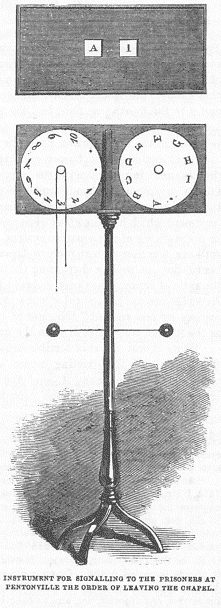 This instrument consists of an oblong board, raised upon a
high shaft, and has two apertures in front, so as to show a small portion of the
edge of two wooden discs that are placed at the back of the board. One disc is
inscribed with letters, and the other with figures round the rim, and arranged
in such a manner, that, by causing one or other to revolve behind the board by
means of a string passed over the centre, as shown in the annexed drawing, a
fresh letter or number is made to appear at either aperture, according as the
right or left hand wheel is worked - the letter and the number appearing to the
prisoners, as represented in the upper diagram, giving the front of the board,
and the wheels being arranged as pictured in the lower or back view of the
apparatus.
This instrument consists of an oblong board, raised upon a
high shaft, and has two apertures in front, so as to show a small portion of the
edge of two wooden discs that are placed at the back of the board. One disc is
inscribed with letters, and the other with figures round the rim, and arranged
in such a manner, that, by causing one or other to revolve behind the board by
means of a string passed over the centre, as shown in the annexed drawing, a
fresh letter or number is made to appear at either aperture, according as the
right or left hand wheel is worked - the letter and the number appearing to the
prisoners, as represented in the upper diagram, giving the front of the board,
and the wheels being arranged as pictured in the lower or back view of the
apparatus.
When the service is over, the instrument is moved to the
space in front of the communion table, and a warder proceeds to work the wheels
from behind, so as to shift either the letters or the numbers, as may be
required.
Each row of seats on either side of the entrance passage in
the middle of the chapel gallery is similarly lettered, and corresponds with the
characters on one of the wheels, whilst the several stalls or pews in those rows
are numbered alike on either side of such entrance-passage, and correspond with
the figures on the other wheel; so that when the warder turns the one wheel
round, and lets the letter A appear at the aperture, the convicts in that row
put on their caps and prepare to move; whilst immediately the figure 1 is
brought to the other aperture, then the first stall on either side of the
central passage pull down their cap-peaks, and throwing back the partition-door,
hasten from the chapel; and when the numbered wheel is turned a little farther
round, so as to bring the figure 2 in the aperture, then the convicts, on either side the passage
occupying the stall next to the one just vacated, likewise turn down their
cap-peaks, and throwing back the division of their stall, pass in a similar
manner out of the chapel. Then number 3 stalls are signalled away in like
manner, each prisoner, as before, making a passage for those who are to come
after him, by pushing [-168-] back the division-door of his stall, and so on
up to number
10; after which the letter-wheel is revolved a little more, so as to present
another character to the prisoners' view. Then another row prepares to leave, as
before ; and thus the chapel is entirely emptied, not only with
considerable rapidity, but without any disturbance or confusion.*
* The arrangement of the chapel into stalls is not generally approved, even by the advocates of the separate system; and surely, if such an arrangement be not indispensably necessary for the carrying out of that system, they should be immediately condemned as bearing a most offensive aspect, and one that hardly consorts with a Christian edifice, where the minister speaks of even the convicts as "brethren."
"As regards the division of the chapel into separate stalls, says Colonel Jebb, in his Report for the year, 1852, "Mr. Reynolds, the chaplain at Wakefield, who is a warm advocate of the separate system, thus expresses his opinion :- 'I am of opinion that the plan of the chapel is very objectionable. I object to it, in the first place, because I think it is calculated to produce disagreeable associations in the minds of the prisoners regarding a place of public worship. I object to it, in the second place, because I believe it to produce a chilling feeling of isolation opposed to the proper social character of public worship. I object to it, in the third place, because, instead of preventing communication between different prisoners, it affords increased facilities for communication; in the fourth, because it affords an opportunity to the ill-disposed to employ their time in chapel in writing on the wood-work of the stalls instead of attending to the service, and opportunities, also, of disturbing the worship of the other prisoners, by making noises, which it is very difficult to trace to any particular prisoner.'" In these opinions Mr. Shepherd, the governor of Wakefield Prison, expresses his concurrence; whilst Colonel Jebb himself adds "Much of the inconvenience pointed out by the governor and chaplain at Wakefield has been experienced at Pentonville. Writing of the most objectionable character appears on the wood-work in many places, and punishments for attempts to communicate have been frequent.
Of the Moral Effects of the Discipline at Pentonville
We have already spoken of the mental effects of the separate
system as carried out at Pentonville Prison, and shown that, whereas the
proportion of lunacy is not quite 0.6 in every thousand of the prison
population throughout England and Wales, the ratio of insanity at Pentonville
was more than ten times that amount, or 6.0 in the first thousand convicts that
entered the Model Prison; whereas it was 10 in the second thousand, 4 in the
third, and 9 in the fourth; so that, had the prisoners throughout England and
Wales been treated according to the same system, there. would leave been,
instead of an overage of 85 lunatics per year in the entire prison population
of the country, upwards of 850 madmen produced.
Great credit is due, however, to the authorities for relaxing
the discipline immediately they became impressed with the conviction of its
danger to the intellects of the prisoners; for, as driving a man mad formed no
part of the original sentence of a convict, it is clear that the prison
authorities had no earthly right to submit a criminal to a course of penal
treatment which had the effect of depriving him of his reason. Since the
alteration, however, in the working of the separate system, and the introduction
of the present method of brisk walking, together with an increased quantity of
out-door exercise, and a more perfect system of ventilation, as well as
shortening the term of imprisonment to one-half its original duration, the ratio
of insanity has been reduced from 6.0 to 1.0 per thousand prisoners (sec page
144). Nevertheless, as the medical officer says, "though much has been
gained, the limits of safety have scarcely yet been reached," the ratio
of lunacy at Pentonville being still almost as high again as the normal rate
deduced from the average of all other prisons.
Were it not for this terrible drawback, it must be admitted
that the separate system is the best of all the existing modes of penal
discipline - better than the "silent system," which has, to recommend it, only
the negative benefit of preventing intercourse among the criminals - and
better than the "mark system," which would have convicts sentenced to do
[-169-] a certain task of work, rather than to suffer a definite term
of imprisonment; but task-work was never yet known to make labour a pleasure to
a man, though this is thee main point claimed by the advocates of that
system as rendering it superior to all others.
The separate system, however, not only prevents the communion
of criminals far more effectually than the silent system can possibly hope to
do, and makes labour so agreeable a relief to the monotony of solitude, that it
positively becomes a punishment to withhold it, and thus, by rendering idleness
absolutely irksome to the prisoner, causes him to find a pleasure in industry -
a
feat that the "mark," or, more properly speaking, "task" system, can
never hope to accomplish; but, by cutting the prisoner off from all society, the
separate system of prison discipline compels him to hold communion with
himself-to turn his thoughts inward- to reflect on the wickedness of his past
career with the view of his forming new resolves for the future, and so gives to
his punishment the true enlightened character of a penance and a chastisement
(or chastening) rather than a mere vindictive infliction of so much pain.
That the separate system has really produced such effects as
the above, the records of Pentonville Prison thoroughly attest. It is urged,
however, by those who object to that mode of prison discipline, that the
reformations it assumes to work are mere temporary depressions of spirits
produced by physical causes, rather than being conversions of nature wrought by
the power of religion.
It should, however, be borne in mind that it is impossible
for any one to repent of his past misdeeds-to be overcome with remorse for an
ill-spent life-and yet be lively and happy over the matter. Grief necessarily
has a tendency to depress the mind and body, and so, too, mental or physical
depression has a tendency to induce grief; consequently, there being here a
state of action and reaction, it is but natural that the dejection or lowness of
spirits resulting from separate confinement should induce sorrow for the past,
and that this same sorrow again should serve to increase such dejection. Whoever
became a better man without lamenting over his former transgressions? If,
therefore, we really wish to excite in the mind that state of contrition which
must infallibly precede all reformation, if not positive conversion of
character, we must place the individual in precisely those circumstances which
will serve to depress his haughty nature and to humble his proud spirit;
and this is just the effect which, according to the medical evidence, the system
of separate confinement is calculated to produce.
But
it is said that these reformations, so far from being real permanent changes of
nature, are mere temporary impressions, caused by the long confinement to which
the assumed converts have been subjected, and that they owe their momentary
results to that derangement of the organs of digestion which arises from the
want not only of proper air and exercise, but the stimulus of agreeable society;
so that men get to mistake a fit of the "megrims" for a religious frame of
mind, or, in the words of Thomas Hood-
"Think they're pious when
they're only bilious."
Others urge, again, that these same professed conversions are
mere hypocritical assumptions on the part of the prisoners for the sake of
cajoling the chaplain out of a "ticket-of-leave" long before the expiration
of their sentence; for as it has been found that many of these same converted
convicts soon relapse, after regaining their liberty, to their former course of
life, people immediately conclude that the religious turn of mind, previous to
their being set free, was merely simulated for the particular purpose. Moreover,
we are well aware that the other convicts generally believe these displays of
religion on the part of their fellow-prisoners to be mere shams, calling those
who indulge in them by the nickname of "Joeys." We have been assured, too,
by the warders, that the prisoners know the very footsteps of the chaplain, and
that many of them fall down on their knees as they hear him coming, so that he
may find them engaged in prayer on visiting their cell; whereas, immediately he
has left, they put their tongue in their cheek, and laugh at his gullibility.
[-170-] Nevertheless, we are inclined to believe that there is a
greater desire for religious consolation among prisoners than is usually
supposed. Indeed, it is our creed that men oftener deceive themselves in this
world, than they do others. Again, it should be borne in mind, that criminals
are essentially creatures of impulse, and though liable to be deeply affected
for the moment, are seldom subject to steady and permanent impressions. This
very unsettledness of purpose or object, is the distinctive point of the
criminal character, so that such people become incapable of all continuity of
action as well as thought. Hence, it is quite in keeping with the nature of
criminals, that when subjected to the depressing influence of separate
confinement, they should exhibit not only deep sorrow for their past career,
but also make earnest resolves to lead a new life for the future, as well as
offer up devout prayers for strength to carry out their intentions-even though
in a few days or months afterwards, they themselves should be found scoffing at
their own weakness, and pursuing, without the least remorse, the very same
course for which a little while ago they had expressed such intense contrition -
contrition that was as fervent and truthful as a child's at the time,
but unfortunately quite as evanescent.
Still, amid all this fickleness of purpose and its consequent
semblance of hypocrisy, and amid, too, a large amount of positive religious
trickery and deceit, there are undoubted cases of lasting changes having been
produced by the discipline of separate confinement. As an illustration of this
fact, the following letter may be cited, for though written by a mere boy
prisoner, previous to his leaving for Australia, we have the best assurances
that the after character of the man fully bore out the mature professions of his
youth, and that he has since returned to this country, not only honest, but a
highly prosperous person, having amassed a considerable fortune in the colonies,
and still continuing to lead the godly, righteous, and sober life that he had so
often prayed to have strength to pursue, in the very chapel where we had but
lately heard the other convicts supplicating - and apparently as devoutly - for the
same power:-
COPY OF A LETTER WRITTEN BY J- D- BEFORE LEAVING
PENTONVILLE PRISON
(The orthography as in the original.)
"I, J- D- , came to this prison on Sepr. 28th 1843 in a most pitiful condition. Destitute of true religion, of any morality, of any sound or useful knowledge, or of any desire to acquire the same, with a hard, wicked, and perverse heart fully bent to, and set on, all manner of mischief, altogether ignorant of my spiritual condition, a child of the Devil, a lover of the World, a slave to Sin, under a most miserable condemnation, having no hope and without God in the World. This is somewhat the condition I was in on coining to this prison, until by degrees the grace of God began to change and new modle me, by showing to me my sins and then leading me to repentance, by giving me desires to love and fear God my Saviour, by enabling me rightly to understand the word and way of Salvation; and savingly, with faith to receive the same. I can say now, what I could not then; that I love those commands which were so grievous to me in my unregenerate state. I delight to read, study, hear and obey the blessed, pure and holy precepts of God's Word, and I hope I may ever continue to do the same to my life's end; they shall be my guide, my teacher, and director through the dark passage of this world. I can say with sincerity I have enjoyed my Sabbaths of affliction and solitude far more than the days spent in sinful pursuits, and I have been always as comfortable here as I could desire to be. I have been taught most Godly, truly, savingly, and soundly, the truths and doctrines of God's Word, in which is contained all my hopes, comfort, and Salvation, by my faithful Pastors; and I have most haply had given me a heart to receive and understand the same to my great comfort. I do truly intend to follow the faith that my ministers have taught me, and to live according to it, God's grace preserving me. I am simply and only trusting on my Saviour for Pardon, Righteousness, Sanctification, and Redemption, or in other words a Joyful Salvation. And

[-171-] I do think it my bounden duty, after receiving these manifold
blessings and priveleges, at all times, and at every period of my life to keep
God's commandments by loving him Supremely with all my heart, and by doing to
all men as I would they should do unto me-the sum of all the Commands. The
breaking of these has been the cause of all my trouble and misfortune, but the
keeping of them will be my future hapiness and prosperity in this short life,
and in the world to come through the merit of my Gracious Saviour, Whom I hope
to know better, to love more and to worship in his fear evermore, Amen. I have
always found my officers very kind to me especially my warder and Extra Warder,
with whom I have had most to do. My schoolmasters have taught me a great deal of
useful knowledge, and have taken every pains to instruct me in what was good. *
* * * * I have learnt Grammar so far as to parse a sentence well. Arithmetic
I have made great progress in. I could not do on coming here Simple Proportion,
but I have gone through my arithmetic, and began to study Algebra so far as
fractions. I have also acquired a little knowledge of Geography and Astronomy,
with other useful subjects. * * * *
"And in this condition I leave this Prison a changed and
altered person to what I was on coming to it. But by the Grace of God I am what
I am. And so I go my way to a distant land, steadfastly purposing to lead an
upright life, and to dwell in love and charity with all men, thanking God for
this affliction which hath confered so many blessings upon me.
J- D- , Aged 21, June 29th, 1845."
In addition to the above we may farther quote some verses that were written by one of the Pentonville convicts, upon the subject of the anecdote of the burial of a young woman and her child by torchlight, which has been already mentioned in our description of the service in the Pentonville chapel; for these verses will go far to illustrate the point we have been insisting upon, namely, the susceptibility of prisoners in separate confinement to religious and other grave impressions for the time being:-
VERSES WRITTEN BY ONE OF THE PRISONERS IN PENTONVILLE UPON A SERMON DELIVERED BY THE ASSISTANT-CHAPLAIN, MARCH, 1856.
And were those joyful tears the old man shed?
Could he unfeigned rejoice? his daughter dead,
When by the lantern's gleam, in darkest night,
The grave received her once lov'd form from sight.
He'd travelled far that day that he might gaze
Upon this scene; this caused delay; her face
He, could not see again: upon her breast,
Her little babe in death's embrace did rest:
His hoary head was bare, with grief his voice
Exclaimed, "My God, I do indeed rejoice,
That thou my child hast taken in her prime,
And saved from farther guilt, and shame, and crime!"
The minister of God, one Sabbath morn,
The fact affirmed, to many prisoners; torn
From evil ways, and friends: and for their good
Confined with best intent to solitude.
But how describe the workings of the mind?
Of all, some felt, and wept, and some were blind,
With hardened hearts, and steeped in guilt, the most
Could glory in their shame, their crimes their boast
[-172-] Some fathers, too, were there, with
daughters left
In the wide world, of fostering care bereft:
Their anguish great, the tears fall down their face,
They almost felt inclined to curse their race.
But better feelings ruled, as one they heard,
The minister explain the written Word;
With studious zeal, his love for souls was great,
He felt commiseration for their state;
His text the miracle that Jesus wrought,
When unto Nain's city He, unsought,
Brought joy for mourning, dried the widow's eyes,
And gracious spoke- "Young man, I say, arise!"
His glorious theme, the Saviour's wondrous love,
Caused many hearts to pity, melt, and move,
And earnest pray that God the Spirit's voice
Might now be heard- "Young man, I say, arise!"
That some poor souls, immersed in guilt and sin,
Might feel the power of love, new life begin
To find; forsake their guilty paths; repent,
The ways of heaven pursue with pure intent,
Might hunger after righteousness divine,
And let their future conversation shine;
Might have a blessed hope beyond the skies,
When the last trump shall sound, "Arise! Arise!"