[... back to menu for this book]
[-129-]
CHAPTER X
THE COAL HORSE
ON the average every Londoner burns a quarter of a pound of
coal an hour. This may not seem to be much, and at first sight one would think
that the various societies for smoke-abatement and so-called fog abolition had
very poor grounds for their existence; but a quarter of a pound of coal an hour
means six pounds of coal a day, and that means a ton of coal a year; so that
Loudon annually burns five million tons. If we add these five millions to the
close upon three millions used by the gas companies, we get the close upon eight
millions which are now entering the London area during the year by land or
water.
There are not many horses used in shifting the gas coal, but
nearly all the five millions used outside the gas manufacture is moved from
wharf and railway station by hiring horse-power. The number of horses employed
in this work is great, though not so great as might perhaps be imagined. The
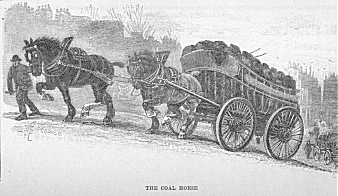
coal horse - that is the first-class coal-merchant's horse, such as works the
vans of Herbert Clarke, for instance - moves about thirty tons a week, or 1,500
tons in the course of the year. If all the horses were like these, and the coal
had to be moved [-130-] but once, as is generally
the case, it would require over 3,000 horses in the London coal trade. As a
matter of fact, there are about five thousand more, but these run down to a very
decided fag end of greengrocers' drudges and cab-yard screws, which we can
conveniently eliminate.
There are 300 horses working out of the Great Northern King's
Cross depot alone; the Midland and North Western have almost as many, and all
the railway coal stations are tended by a numerous herd of distributors, so that
we shall be well within the mark in allotting 1,500 fairly good horses to the
leading London coal merchants. The average of the inner ring of the trade is
about a hundred horses each. This may not seem much, but a hundred horses at 55l.
apiece means 5,500l., a nice little capital to have to invest in
horseflesh alone.
The better-class coal horse is of the heavy dray horse type,
and comes to London when he is five years old, either from the fair or direct
from the farm. lie costs from 50l. to 70l., and he averages from
three to eight years of hard work. When he begins to fail he is sold to what we
may call the second-class merchants for an average of 20l.; or he may be
worked on, and he very often is, until he finds his way to the repository, and
changes hands at 10l., to be put to miscellaneous labour. It is the same
story with these horses as with all the rest. Some will only last a couple of
years, some will go on for ten or twelve, and there is one horse at least in the
London carts who in his time has drawn 18,000 tons of coal, and looks fit to
draw quite half as many more. [-131-]
[-132-] The
coal horse breakfasts at four in the morning and goes out to work at six, taking
with him a nose-bag and a small sack of bait, which is his provender for the
day. He does not return to the stables until his day's work is done, which may
end at seven o'clock or may last out till eleven. He may do two long journeys,
or perhaps as many as four short ones; any way, his average runs out at the
thirty tons, two tons going to each load. Now that the coal merchant, unlike the
grocer, is not allowed to weigh in the bag, the van, the weighing machine, the
weights amid sacks and sundries, amount to rather over a ton, so that a full
load means not less than three tons, which has often to be taken long distances,
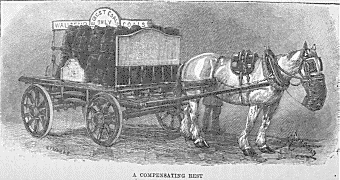
although compensation comes in by the horse having to stand about a good deal
while loading and delivering. This load is taken on the level and up easy
gradients, and a horse will be driven a long way round to avoid a hill; but when
the bill has to be faced the journeys are arranged so that two vans will climb
the hill together, one being left in the valley while the horse is harnessed on,
tandem fashion, to the other van to haul it up, both horses returning for the
other van. In this way most of the London hills are negotiated but there is at
least one hill, Hollybush High, out Highgate wav, where the coal carts go up
behind an improvised team of three.
Six days a week does the coal horse work, averaging, with due
allowance for Saturdays, eighty hours, thirty of them in front of three tons,
thirty in front of one and a half, and twenty standing at ease. On Sunday he has
a whole day's rest, and very glad he is to get it.
He is gradually eased in to his work. At first he [-133-]
[-134-] is out but three days a
week; then he gets four, then five, then six; and after a little experience on
London's varied pavings and gradings he may come to be set one of his most
difficult tasks, that of dragging a load along St. John Street Road, uphill, on
the way from the Meat Market to the Angel. It he can stand that slippery track
he can stand anything. On it the granite squares are so wide as just to have
their corners rounded off by wear, and they lie like petrified puddings on which
no shoe can get a grip. These big granite pitchings are the abhorred of coal
drivers; what they like is the more general three inches by six with which the
railway companies pave their yards, a size that wears as much at the edges as
the corners, and is just wide enough to give a satisfactory foothold.
The really good coal horse is much like the horse that walks
of the railway companies. 'What we want,' said a horse-keeper to us, 'is a stout
bit of timber like this' - and he stroked the near hind cannon approvingly
- 'and a good pair of breeches' - and he smacked the quarter -'and a biggish
tub' - and his hand travelled down the girth - 'not too long, you know! and an
arm like that' - and he touched it with two fingers - 'and a shoulder! ah!' -
and he looked at it admiringly - 'steady, boy, steady!' -and he looked again -
'and a neck - well, there!' That is it exactly. There! We need say no more. The
horse was a black, said to be five years old, standing about sixteen hands, and
weighing about as many hundredweight.
Some of these horses are shires, some of them Clydesdales,
some of them would more than satisfy the Leicestershire people as not being
eligible for entry in [-135-] any stud-book. You
can see theta of all sorts, good, bad, and indifferent, at work in dozens up
that curious thoroughfare - though it looks like a cul-de-sac - which
runs out of Pancras Road under the arches by Battle Bridge, round by the
gasworks and between the Midland and Great Northern Railways. There you will
find coals to the left of you, coals to the right of you, volleying and
thundering. In every arch is a platform; on every platform are two weighing
machines; over each weighing machine is a shoot which delivers into the sacks on
the scales, and from which the coal stream is cut off with a lever much as you
turn off your water at a tap. Overhead are the waggons; down the shoots the coal
roars, and booms, and hisses in a cloud of dust, as sack after sack fills up and
is run out on the hand truck into the vans, in the shafts of which stand the
horses gently bobbing their nosebags and utterly indifferent to the dust and
din. And if you are observant you will notice that the initials on the harness
do not always correspond to the staring name on the carts, thereby showing that
the horses are jobbed, or that the firm has an alias; and some of
these firms have as many names as a princess of the very Highest Mightiness.
Most of the horses are fairly good, for it requires a fairly
good horse to drag the weight. Some of them are occasionally in the first flight
in the Cart-horse Parade, a show which might do more for the quality of London
horses if, in addition to its present prizes, it were to give some for the best
horses that have been five years, or even more, in one employ. The best horse
and the best looked after is the one that lasts longest and works best at middle
age. To encourage [-136-] the 'coalies' to take
care of their horses, a gratuity is generally given at Christmas time to those
who have done best in this way, a reward which is, however, frequently earned
more by luck than judgment.
The coal horse meets with the same accidents as the rest of
the heavy brigade; he is run into and he picks up nails, and has his feet run
over, and so on. And he has the sores from his collar and harness in wet
weather, and all the other ailments we have met with in so many of his brethren.
When he loses form, he is often cleared out, as we have said, to masters in a
smaller way of business, men who have more of one-ton work, or have easy roads
in suburban neighbourhoods, or simply work their horseflesh on the cheap.
The coal trade is managed a good deal on the branch system.
The large merchants have ten or a dozen small studs of horses out in different
parts of London, near the larger local railway stations from which the coal is
obtained for retail distribution. In these stables there are from five to twenty
horses - ten is the average - and in all respects they are worked like the
central depots to which the horses are first attached, and from which they
usually get their feed. Very few of these stables are on two floors, nearly all
being on the ground; as a rule they are particularly roomy and airy, with no
fixed travises, but the common double bale; generally with straw litter, though
occasionally with peat, amid the resulting difficulty as to the disposal of the
waste-capital examples, in fact, of a cart-horse stable in which a few horses
are kept under the best of conditions for health and efficiency. Here and there,
among the second-rate men, the old dark stuffy den is [-137-] the
horse's home; but, as we have already said, the average horse is treated much
better than he used to be; he is better fed, better housed, and more
intelligently looked after, and he lives longer, works more, and is better worth
looking at than in the merry days of the past.