[... back to menu for this book]
[-148-]
[-149-]
CHAPTER XII
THE CAVALRY HORSE
THERE is no more eloquent testimony to the orderliness of London
than the mere sprinkling of cavalry within its limits. It may seem ridiculous to
the foreigner that with 375 mounted police, and two small regiments of Household
troops numbering 275 horses each, five millions of people are content to behave
themselves; but it is a state of affairs of which Englishmen have no cause to be
ashamed. Even adding in the six battalions of Foot Guards and the line battalion
at the Tower, and considering that there is Woolwich, and that there are
Hounslow and Windsor not far off, and that there are facilities of communication
- not, however, greater than exist in other capitals - we shall find that the
police, and military ready to be used as police, in and about London, are a mere
handful compared to what are necessary for peace-keeping and ceremonial purposes
in the cities across the Channel. And the display made of these is
proportionately much less, for, as a matter of fact, the ordinary Londoner is
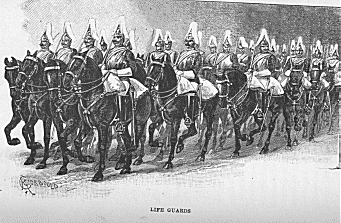
aware of the presence of cavalry by reason only of the two specimens on view
daily in Whitehall.
At one time the black horses of the Household [-150-]
cavalry came almost entirely from Yorkshire and North Lincolnshire, most of them
being expressly bred for the service. But of late we have changed all that. In
those days the cavalry colonels had so much money allowed them for remounts, and
they had to pick up their horses where they could, with the jobmaster at their
elbow - for a consideration - to help them at a pinch; and some of the London
jobmasters had a standing order to be on the look-out for likely horses for
certain regiments. Nowadays the Dublin dealer has taken the place of the London
man, and, instead of the colonel buying horses, the buying is done by the
Remount Department, whose happy hunting ground is Ireland.
When a military horse is 'cast,' and all military horses are
'cast' at fourteen years old, whether they be good, bad, or indifferent, a
requisition for a substitute goes to the Remount Department at Woolwich, and the
substitute arrives a day or two afterwards from the Emerald Isle, generally
shipped direct by Daly or some other Dublin dealer. That the new horse is as
good to look at as the old Yorkshire one, we have not heard any soldier declare,
but he is at least thirty per cent. cheaper, and he seems to be strong enough
for his work.
A British army corps, when discoverable, will be found to
have 12,000 horses, of which 3,134 will be in the cavalry and 2,987 in the
artillery; these 6,121 horses ought to be thoroughly broken and trained, even if
the remainder are not. There are said to be only 70,000 horses in the British
Isles fit for army work, hut this is one of those pleasant fictions of which it
is [-151-]
left to the foreigner to discover the fallacy. Like a good many other statements
regarding our preparedness for self-defence, it is to be taken plus x, x
representing the dominant number.
When Napoleon attempted to invade us - an attempt that was
defeated at Trafalgar, which to the uninitiated may seem to be a long way off
for the defeat of such a scheme, although any future attemp)t will probably have
to be reckoned with still further at sea - the Government took stock of every
horse in the kingdom, with the intention of a general impressment for military
service; and nowadays the Government has power in times of national peril to lay
hands on every horse within these islands, in preparation for which there are
thousands of horses under subsidy with a view to immediate use. And when this
seizure does take place, it will certainly not be to the joy of the jobmaster;
he above all men shudders at the mere mention of foreign invasion, for invasion
to him means the entire loss of his means of livelihood, and this at a
sacrifice, for no Government would pay the price at which the jobmaster's stud
has been collected.
The Life Guardsman's horse used to cost 60l., being
the most expensive horse in the army; we shall not put him offensively cheap in
these times at 20l. less; nor shall we be divulging any secrets of state
in estimating that the cost of mounting the two regiments of cavalry in London -
barring the officers' chargers - does not exceed 22,000l.
And yet the horses are carefully chosen and seem fit for
their work, when either in or out of harness. They, of course, look their best
at Knightsbridge, for [-152-]
at Knightsbridge the stabling is distinctly good, better even than is promised
in the new barracks in Albany Street; but then a soldier's horse in stable
generally looks better than a civilian's, owing to his head being where his tail
should be. The civilian's horse always has his head over the manger; the
soldier's horse is turned round as soon as he has finished his feed, and so gets
more fresh air; the consequence of which admirable arrangement for preventing a
horse 'breathing his own breath,' is that the visitor on entering the stable
sees a double line of intelligent heads, instead of an avenue of hocks and
tails.
Time was when every soldier's horse had a name, the initial
of which was that of the troop to which he belonged. 'A' troop had all A's, 'B'
had all B's, and so on; but in these days the squadron is the unit, not the
troop, and the name has given place to the number. Every horse, then, has
his number placed on a card over his manger, and the horses are separated from
each other by a pole doing duty as a bale, and on each upright is the horse's
kit, including time two spare shoes which every trooper carries, but not
including the arms, which, of course, are kept elsewhere. This kit, and the arms
and the rider, make up a nice little load, which averages out at twenty-three
stone per man ; not quite so heavy as that of our fat old knights, but still
heavy enough for the class of horse which has nothing of the 'dray' type about
it.
It is not easy to get these horses of uniform type and
character. There are many exchanges and rejections, and it often happens that a
horse sent in for cavalry work has to go to the draught, to the Artillery, [-153-]
or even the Transport service; so that though the remainder may not be examples
of the much-talked-of survival of the fittest, they are at least representative
of the not unfit. They are smart, workmanlike horses. It is absolutely necessary
that a regiment should be as sound in its horseflesh as in its men.
Theoretically no remounts are accepted that are not looked over on level ground,
on a road, or in a large yard, for it is easy to pass a bad horse in a field, or
on a hillside, or in deep pasture, or when under cover, or in a drove. It is not
safe to choose an underbred animal, immediately conspiouous by his coarse head,
or thick throat, or short neck, or large, bony joints, or clumsy legs, or short
pasterns, or curly in the hair of his mane or tail. The typical cavalry horse
must have a small lean head, a fiat, broad forehead, fine, full nostrils, a
good, clean throat, thin neck, wel1-shaped legs, long pasterns, and straight
hair, with a deep, wide chest, and short, broad back and loin. No long backs
will do, for long backs do not carry weight, and short necks or croups are
simply impossible for soldiering. Of course the horse has to he of the
regimental colour. In the cavalry generally chestnuts are not in favour, for
chestnuts usually have white, and white, except in the Scots Greys, is not
desirable; neither chestnuts then, nor mealy bays, are fit for cavalry work, but
roans and bays and browns, and for our Guardsmen blacks.
These are bought when rising four years old, and require
about six months' training by the rough riders before they can be passed out of
the riding school as efficient by the colonel. The Knightsbridge riding school
is about forty-five yards long by sixteen wide, [-154-]
and in it perhaps fourteen young horses at a time will be at work, though the
number of course depends on what the horses have to do. Their training is not as
simple as might at first appear. The soldier has only one hand to work his horse
with, and what an ordinary rider would do with the other hand he has to do with
his leg. How skilfully he manages to guide by leg pressure is known to those who
have seen the Musical Ride at the annual Military Tournament, which is little
more than the ordinary practice of the riding school. But it should not be
forgotten that the horse has to be taught to understand this pressure, and that
his training is almost as long a business as that of his rider.
Very early in the morning, so as not to alarm the passers-by,
the young horse is taught to stand fire by having a gun discharged close to him,
and being encouraged to smell the powder and the smoking weapon he thus becomes
familiar with the sound and scent, much as a boy does, though there is nothing
to show that he ever associates the idea of being shot with the report which he
soon treats with indifference. When once he is trained his work becomes lighter,
and he cannot be said to have a hard life in London, an occasional outing at
Wimbledon being his severest trial. Being condemned at fourteen, his full
service is a little over ten years; but it is rare that he reaches the limit,
and his average military life is between six and seven. When it is over he goes
back to the depot, and thence he often comes again by way of the sale yard into
the London crowd.