[... back to menu for this book]
[-165-]
CHAPTER XIV
THE DONKEY MART
THE London donkey exchange is the Islington Cattle Market on
a Friday afternoon. There some 3,000 'mokes' change hands during a year, the
busiest days being the Fridays before and after Bank Holidays, for on these
festive occasions there are not a few donkeys of pleasure which remain in the
same ownership or just seven days, and in that time pay the cost of their
purchase and keep and bring the profit on their re-sale.
The biggest of the batches paying toll at Islington come from
Ireland. Sometimes a herd of a hundred, sometimes even more, will be met with on
the road from Milford or Holyhead, steadily journeying towards the city to which
so many hoofs point, and feeding by the wayside as they come; or, and this is
the more usual method, crowded in truck-loads on the rail. Not that these big
herds are thrown on the market all at once, for the donkey dealer knows his
business, and rarely puts in an appearance at Islington with more than a score;
the trade is a trade of ones, and twos, and threes, which change owners with
much arguing and bargaining, and in which nearly every argument and abatement is
emphasised with a more or less affectionate [-166-]
[-167-]
whack
on the unfortunate animal's back. The stick-play at a donkey sale is
remarkable. 'Sure, sir,' said one of the bystanders, 'the Neddies feel themselves
quite at home!'
The
track, on the high road, of an Irish donkey drove is easily recognisable owing
to the heavy shoes it is
the custom to wear in the Emerald Isle - shoes which are promptly replaced by
the lighter English pattern as

soon
as the purchase goes to his new home. Irish are not, however, the heaviest
shoes; for these we must go to Egypt, where the native farriers simply cover
the feet with a plate. Shoeing a donkey costs sixpence a foot, and the farrier
does not 'hanker after it.' 'You see, sir,' we heard one of them say, 'it's not
nearly so easy as a horse; it is a smaller shoe and finer work, and some of the
brutes have to be 1a~hed up, and some put on their backs with their feet in the
air. However, two [-168-] shillings is the price for a set, and we cannot raise it, and
there's an end of it! Luckily, the shoes last a couple of months!'
We have been assured by a donkey expert that the Irishmen
always bray with a brogue, and that without this they would often be
unrecognisable; but recent experience has taught us to our sorrow that humorists
of the libellous kind are not unknown among donkey drivers. Perhaps our driver
had an unusually cultivated ear for vocal music; any way, after a day's drill we
have not found it difficult to identify an Irish donkey nine times out of ten.
There are over 200,000 donkeys in Ireland employed in
agriculture, and these are of all sizes, some of the larger having a strain of
horse blood in them, as is the case in Italy, where the so-called donkey is a by
no means insignificant animal. Italy has more donkeys than any other European
country, there being over 700,000 of them there; while France, which of late
years has taken to that most difficult of pursuits, mule breeding, has 400,000.
The great mule-breeding country is, however, the United States, where there are
two and a half millions of mules and donkeys taken together, it being found
impossible to separate them owing to the varying proportions of horse ancestry
producing an indefinite series from the genuine mule to the asinine mulatto.
For the male mule is not always sterile, and the female will breed with horse or
ass, or apparently any species of equus.
Next on the list to Ireland, as a source of supply to the
London Donkey Market, is 'gallant little Wales,' whose natives also are credited
with a note of their own, [-169-] shrill, persistent, and distressing, though welcome in the
owner's ear, for a Welsh donkey is generally a good one; in fact, Wales breeds
our best donkeys, and some of them will even fetch as much as 30l.
Donkey breeding has its difficulties, and it does not pay in
England. Now that the commons have been inclosed, or taken over by County
Councils, and the common rights done away with, pasture for nothing is rarely
obtainable, and the margin of profit on a donkey is too small to be worth
troubling about. Prices are 'up' now, it is true, and a donkey that a few years
ago could be had for eighteen shillings will now be cheap at fifty, but the
ordinary work-a-day animal does not range much above that price, which we can
take as a fair average market rate.
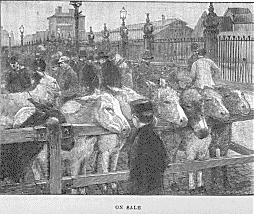
The market has not a thriving look about it. The great area at Islington, with its labyrinth of rails and posts, is all bare except in one corner, and in that about three of the roads are filled, one with donkeys, one with a series of scattered marine stores of harness and horsey sundries, and one with the most miserably weedy ponies and drudges that ever greet the horse-buyer's eye. Here is the tail end of London's horse-world, the last refuge of our cheapest beasts of burden, the last chance of the pony, and the first chance of the donkey, brought together so as to show off the donkey to advantage. Great is the clatter as the weedy nags, all heads and legs, are bustled about over the stones, with a whip here and a whip there to make them swerve and scamper as they are shown off before the 'nibbler.' 'We call 'em nibblers, sir, 'cos they don't always bite!' There is a [-170-]
[-171-] refreshing
candour about the whole affair which effectually disarms criticism. 'He ain't
much to look at, mister, but then I don't ask much. He might suit you at the
price. Four pun ten ain't much for a oss!'
'Try
a donkey, sir?' Well, one would rather. A good donkey is a better servant than a
bad horse. In proportion to his size he will bear a heavier burden and drag a
greater weight. He will eat not a quarter of what a horse does, and he will live
at least twice as long. 'How long will a donkey live?' we asked Mr. Gill of
Hampstead. 'Live? Well, I know one that has lived thirty-seven years and seen
three generations of the family from babhood to babhood!'
And what becomes of the dead donkeys? A good many go in their last days to this Mr.
Gill, who supplies them wholesale to the Veterinary College for dissecting
purposes, the anatomy of the donkey being almost identical with that of the
horse - in fact, a donkey is practically a horse, minus the callosities on the
hind legs, and plus the tufted tail and long ears.
The
dead or moribund horse goes to the knackers, 'the practical zootomists,' as they
are beginning to call themselves, but the knacker will rarely have anything to
do with the donkey, which is hardly worth the cost of carriage. Five shillings
is his outside value for his hoofs, his bones, and skin - chiefly his skin, out of
which we get shagreen leather and memorandum tablets, and perhaps a drumhead or
two, though drumheads are nowadays mostly made of Canadian deerskin. The flesh
is worthless. It is only the Persian who will eat ass's flesh, and even he must
have it wild, after hunting it, as if asses were deer.
[-172-] Most of these Islington donkeys would require little
hunting.
But why this abrupt return to donkeys? Why not asses? The reason is that though
ass is the more scientific - and Semitic - it is the more unpopular, owing
apparently to the old Egyptians, who originated the libel of the animal's
stupidity, and to the Mediaevalists, who made him the symbol of St. Thomas. With
us he is the great ass, for English is the only language in which the old word
does not appear as a diminutive; even in Latin he is as-inus, and in
German he is es-el. Ass sounds so very exclusive amongst us, while there
is something pleasant and companionable about donkey, for a double diminutive
always shows appreciation. No unlovable hoiden was ever called a 'lassiekie'; and
donkey - dun, dunnie, dunniekie - is built on similar lines. 'Oh, you dear little,
wee little donkey!' we overheard on Hampstead Heath; a phrase which an
etymologist would render as, 'Oh, you dear little, little, little, little, little
ass!' And some of these London donkeys are very little, though they are not so
small as those in the ownership of low-caste Hindoos; and they would look mere
dwarfs by the side of the big Spanish donkeys used by the Marquis of Salisbury
in his Hatfield hay-carts, which must stand at least thirteen hands. But then
the donkeys of Spain and Calabria will often run into more, and one of their
stallions will fetch 200l. when bought for export to Kentucky for mule breeding,
and also donkey breeding; the animal known as 'donkey' there being now as big as
any in the world, and ranging from fourteen to fifteen bands. And even by the
banks of the Ohio the donkey betrays his origin by his hereditary aversion to [-173-]
cross running water, and his delight in rolling in the dust,
as his ancestors delighted to roll in their arid desert home.
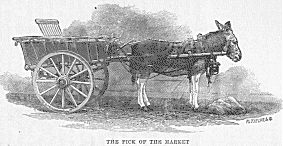
The donkey of our streets is a better animal than he used to
be. He is bigger and healthier, he is fed better, and he does more work. The
work done by these donkeys is remarkable; I have known one in the shafts of a
South London milk-cart which for eight months travelled 140 miles a week in
doing the daily round.
Some of this improvement is certainly due to the shows, the
chief of which is the triennial one, which now sometimes holds its meeting at
the People's Palace. A queer show is this, for not only do the donkeys come,
but they have to bring with them their barrows all duly loaded up with
vegetables, or fish, or firewood, or whatever it may be, out of which the 'commercial traveller,' as the
costermonger now calls himself, earns his hiving.
Of course every donkey has a name, such a name as one would give to a horse -
many
of the names such as are borne by winning race-horses. Some of the donkeys have
been working for their owners seven, ten, or fifteen years; some of them are
even entered as twenty years old; and in most cases, without a rest, they have
worked their six days a week, year in, year out. Every donkey has his price,
often as fictitious as that given at a bird show, but occasionally genuine and
such as would lead to business, even though it may be 15l. or 20l. or
30l.
Even at Islington these high-priced animals are to be met with, but not in the
pens; they are in the light carts and barrows of the donkey dealers, who would [-174-]
think it infra dig. to drive a pony. Some of these
thoroughbreds have pedigrees going back for several generations, and the
starting of a Donkey Stud Book is evidently an event of the near future.
Away from the crowd, in a pen by themselves, harnessed up to
their traps and with cloths over them, we find two of these aristocrats
admirably groomed and in the pink of condition. The cloth is taken off one that
we may inspect her. 'That is White Jenny. She'll do her six miles inside thirty
minutes any day you please!' 'And the other?' 'The Skewbald? He is as good.' 'And
what is Jenny worth?' 'Forty-five pounds, not a penny less!' 'But is that not
rather a long price?' 'Maybe, but she's good. What is a good horse worth compared
to a bad one? How do you know a good horse from a bad one? By opinion. And that
is how we know a good donkey from a bad one. That is not the highest price asked
for a donkey. Why, I know a pair that changed hands for a hundred and twenty
pounds - yes, one hundred and twenty; sixty pounds apiece!'
And yet such scope is there for opinion that the rates at
which the lots are being parted for in the market do not average as many
shillings. This is for 'Jacks' for ordinary driving among costers and organ-men.
But we are here reminded that there is a curious by-way of the donkey world
concerning itself with 'milch asses.' These have been bought for 12l., but
they generally range from 7l. to 8l., being sold again after six months
at from 2l. to 3l. Asses' milk was at one time a favourite with
physicians. Being more sugary and less cheesy than that of the cow, it was well [-175-]
suited for weaklings and invalids of a consumptive turn, and
a fairly large business was done in it. But the patent foods came in with their
voluminous advertisements, and the trade has almost died out. It is most in
evidence in one or two of the West End squares during the season, where a
donkey, with a goat in the cart, may be seen in the morning going round to be
milked. If there are fifty milch asses in London it is as much as there are, the
oldest firm at work being that of Dawkins, of Bolsover Street, which has been
selling asses' milk ever since 1780, and, what is more extraordinary, jobbing
out milch asses to families, sending them far and wide into the country,
accompanied with full printed directions as to how to milk and treat them. As an
ass will yield about a quart a day, the London supply could easily be got into a
single churn, and is manifestly microscopic, but the jobbing is not so
insignificant a business, and is certainly worth a note.
Donkey jobbing in its draught and riding branches exists, but
does not flourish. Here and there one hears of men with studs ranging up to
fifty, but they are not numerous. Ten is the average stud of the donkey master,
and there are about five hundred donkeys thus 'standing at livery.' It is not a
satisfactory business to run, and many people have burnt their lingers at it. A
donkey out on hire for a month is at the mercy of his hirer, who is not always
merciful, and it is frequently returned so over-driven and knocked about that it
takes two months to return to decent condition; and as the charge for hire is
three shillings a week, the twelve shillings spread over three months is not
much [-176-] to get a living out of, although it may mean 75 per cent, per
annum on the capital invested. The poor willingly pay high percentages, owing to
the amounts they deal with being so trifling. The same rule holds good in all
trades; on a large return a living is possible on a small percentage, but where
the return is small the percentage must be large. No wonder, then, that to hire
a donkey many a costermonger has to borrow the money at 20 per cent, per week.
Many of the donkeys at the Islington market appear there two
or three times during the year, and all the 3,000 are not used up in London, for
Brighton and Margate and other seaside pleasure towns are supplied from the
London centre. Against this we must put the private sales, for many of our
donkeys change hands without visiting Islington. Altogether there seem to be
about thirteen thousand donkeys in the county of London. These mostly begin work
at two years old, though they ought not to begin until they are four, and they
are very seldom used for riding purposes until they have turned three.
But the riding donkeys are few in number. On recent
application to the County Council, we were officially informed that only
fifty-seven drivers now hold licences to let out donkeys on the open spaces
under the Council's control, and that each licence only entitles the holder to
let out five animals.
There is at present no special breed for riding, the donkey
being in the same state as the horse, whose shape and make decide whether the
mount or the draught is to be his line in life; and the best begin with 'pleasure,' and take to business in the shafts later on.
[-177-] About twelve years would seem to be the average London life,
most of the veterans being disposed of at last for country work. A donkey seldom
breaks down. He is one of the healthiest of animals, and one of the cheapest to
feed. He is so clean and careful that he rarely troubles the vet. He will not
drink greasy or dirty water; he would rather go without and die of thirst. His
food must be fresh; no leavings will suit him. Once a donkey has breathed over
fodder in a nose-bag no other donkey will touch it, nor will he touch food that
has been breathed over by any other animal. Like the knight, he must have an egg
to himself, although, like the gallant Schweppermann, he will not object to
two. One good meal a day of, perhaps, chaff and oats, and beans and hay, with
some pudding or bread from his master's table, is his usual fare; but he only
has corn when he is at work, and his hay is often that newly mown from a
gentleman's lawn. He takes kindly to potatoes and carrots, but he objects to a
Saturday 'mash.' He is very sound on his feet, and is rarely troubled by
contagious diseases - in short, he is a sanitarian, and almost proof against
epidemics.
He has very strict notions as to what constitutes a day's
work, and once he gets home will never go out again that day if he can help it;
and it requires immense persuasion, and no little force, to get him to work on a
Sunday, for, like his humble master, he has a very strong objection to working
more than six days a week. Some people tell us that the greyer he is the
stupider he is, but it appears on investigation that those who hold the opinion
have generalised on a very few examples, as is the way of the world in most [-178-]

[-179-]
other
matters. He is said always to bear the 'ancestral stripe,'
but this is gradually being bred out of him.
Those
who would see the coster's donkey at his best should go to Billingsgate or the
vegetable markets early in the morning. There they will find him smartened up by
his drive from home, and contentedly waiting for his load; and they will
probably be astonished at his being on the whole so cheery and well. Donkeys on
hire are often ill-treated, but a donkey driven by his owner is generally hooked
after kindly, inasmuch as few men care to damage their own property. Many of
these costers' donkeys come pattering along with a briskness and assurance that
can only come of contentment with their work, and some of the smallest even are
as active and 'packed with power' as one could wish, and with a quiet, fearless
outlook, speaking volumes for their master. Here and there some exceptionally
good-looking examples will be pointed out to a new-comer as 'known in the shows'
or 'on the road,' and hoping to he better known, perhaps next year in the Donkey
Derby which is being organised by Mr. John Atkinson, the well-known medical
superintendent of the Animals' Institute in Wilton Place; the idea of the
competition being that racing will improve the breed by encouraging emulation
among the breeders.
At
the same time the donkey is hardly a racer at present,
although donkey-racing is not unknown, and that
under two very different forms. There is the 'comic'
style, usually indulged in at country fairs and travelling
circuses, in which the rider's object is to reach
the winning-post last, owing to the prize being [-180-] given to the hindmost; and there is the more straightforward,
but certainly less exciting, variety, in which the first past the judge is the
winner. If we could have a race of this kind, in which the skill of the rider
were rewarded in inverse ratio to his use of the stick, such a competition would
not fail of support: but that it will not do to forbid the use of the stick
altogether was shown some years ago at the Agricultural Hall, where, as a
conclusion to the show, a race took place in which no sticks were allowed, and
the result was such a display of tugging at mouths and kicking at ribs on the
part of the riders, and poking and prodding with sticks and umbrellas on the
part of the crowd, that the least said about it the better.
And this Derby reminds us of another, which, however, was a
man who spelt his name with an 'a.' He was a fish-salter who was driving borne
from Billingsgate one morning when his donkey caught his foot in a plug-hole
and broke it between the knee and the fetlock. What was to be done? 'Kill him!'
said the crowd. 'No!' said Darby. 'I'll not kill him; I'll cure him!' and putting
him on the cart, he dragged him home. He put the patient to bed in his own
sitting-room, bandaged him, hooked after him, and had him on the high road to
recovery, when Mrs. Darby, who happened to be a washerwoman at the London
Hospital, let out the secret of the queer patient, and awoke an interest in the
matter which led to a country home being offered to the interesting convalescent
as soon as he was able to travel. And eighteen months after the leg was broken
Darby drove up in triumph to Billingsgate with his pet 'as sound as ever.'
[-181-] This is, of course, an exceptional instance. Costers' donkeys
are not generally tended in sitting-rooms, though their stable accommodation is
peculiarly varied. A shed or a lean-to against the back-yard wall seems to be
the prevailing fashion, with the cart alongside and the harness indoors; for the
harness may be worth as much as the cart or the donkey. A good set will cost 7l,
a bad one may be had for as many pence, there being a lower depth in rag and
rope than that displayed in the marine stores on the Islington stones, where the
line seems to be drawn at the old carriage harness, which makes the poor little
donkey look like a street Arab in a man's coat.
Miserable as many of these turn-outs may look - animal,
harness, and vehicle complete -it will be found that they 'bulk into money.' There
are 7,500l. worth of donkeys alone changing hands at the London mart during the
year, and the carts are worth quite as much as the power that draws them. The
costermonger begins business with a basket; from that he advances to a
hand-truck; and from that, when he has amassed sufficient capital, he rises to
the dignity of the donkey-cart, which made its first appearance amongst us in
the days of Elizabeth, when donkeys first became common in these islands.
Previous to then the few donkeys we had were, it would seem,
used for riding purposes only, as the high-class Syrian breed is used to-day.
Those who would see donkeys at their best, to Syria must go. In that interesting
land they have become differentiated into four distinct breeds: the rough one,
for ordinary draught; the heavy one, used for agriculture; the [-182-]
Arab one, used for ordinary riding; and the light and
graceful one, reserved as a mount for ladies only, which only very distantly
resembles the patient variety on which the London mater-familias of sixteen
stone enjoys a few anxious minutes on high days and holidays.
It may seem a mystery why the donkey market should be held in such an unexpected place. Of course, it went there from Smithfield with the cattle market. But why did it begin at Smithfield? For the same reason as the cattle market did; because the animals could be conveniently watered at the old Horse Pool, which once lay between the moor fields and the smooth field that served the citizens as a playground. And the Friday market on that field was at least as old as the days of Fitzstephen, and even in those days it included the draught animals and peasants' wares' we find represented to-day among the posts and rails of Islington.