
Volume 1
[-30-]
POULTRY.- I.
HOUSES AND RUNS.
THE first and most essential requisite to success in poultry-keeping is a thoroughly good house for the birds.
This does not necessarily imply a large one nor a costly we once knew a young
man who kept fowls most profitably, with only a house of his own
construction not more than three feet square, and a run of the same width,
under twelve feet long. It means simply that the fowl-house must combine two
absolute essentials - be both perfectly weatherproof, and well ventilated. With
regard to the first point, it is not only necessary to keep out the
rain, but also the wind - a matter very seldom attended to, but which has
great influence on the health and laying of the inmates. The cheapest
material is wood, of which an inch thick will answer very well in any ordinary English climate ; but if so built, the boards should either
be tongued together, or all the cracks between them carefully
caulked by driving in string with a blunt chisel. Care should also be taken that the door fits well, admitting
no air except under the bottom; and, in short, every precaution taken to prevent draught. The hole by which the
fowls enter, even when its loose trap-door is closed, should admit enough air to
supply the inmates, and the object is to have but this one source
of supply, and to keep the fowls out of all direct draught from it. For the
roof, tiles alone are not sufficient, and if employed, there should be either
boarding or ceiling under them otherwise all the heat will escape through the
numerous interstices, and in winter it will be impossible to keep the house
warm. Planks alone make a good roofing. They may either be laid horizontally,
one plank overlapping the other, and the whole well tarred two or three times
first of all, and every autumn afterwards; or perpendicularly, fitting close
edge to edge, and tarred, then covered with large sheets of brown paper, which
should receive two coats of tar more. This last makes a very smooth, waterproof
and durable roofing, which throws off the water well. But, on the whole, we
prefer board covered with patent felt, which should be tarred once a year.
In the north of England, a house built of wood, unless artificially warmed,
requires some sort of lining. Matting is often used, and answers perfectly for
warmth, but unfortunately makes a capital harbour for vermin. When used,
it should only be slightly affixed to the walls and at frequent intervals be
removed and well beaten. Felt is the best material, the strong smell of tar
repelling most insects from taking up their residence therein.
If a tight brick shed offers, it will, of course, be secured for the poultry
habitation. But let all dilapidations be well repaired.
Ventilation is scarcely ever provided for as it should be, and the want of it
is a fruitful source of failure and disease. An ill-ventilated fowl-house must
cause sickly inmates; and such will never repay the proprietor. This great
desideratum must, however, as already observed, be secured without exposing the
fowls to any direct draught; and for the ordinary detached fowl-houses, the best
plan is to have an opening at the highest point of the roof, surmounted by a
"lantern" of boards, put together in the well-known fashion of Venetian
blinds. A south or south-east aspect is desirable, where it can be had; and to
have the house at the back either of a fire-place or a stable is a great
advantage in winter; but we have proved by long experience that both can be
successfully dispensed with if only the two essentials are combined, of good
ventilation with perfect shelter.
We do not approve of too large a house. For half a dozen
fowls, a very good size is five feet square, and sloping from six to eight feet
high. The nests may then be placed on the ground at the back, where any eggs can
be readily seen; and one perch will roost all the birds. This perch unless the
breed kept is small, had better not be more than eighteen inches from the
ground, and should be about four inches in diameter. A rough pole with the bark
on answers best : the claws cling to it nicely, and bark is not so hard as planed wood. By far the greater number of perches
are much too
high and small; the one fault causing heavy fowls to lame themselves in flying
down, and the other producing deformed breastbones in the chickens - an occurrence
disgraceful to any poultry-yard. The air at the top of any room or
house is, moreover, much more impure than that nearer the floor. Many prefer a
movable perch fixed on trestles. In large houses they are useful but in a
smaller they are needless. If the perch be placed at the height indicated, and a
little in advance of the front edge of the nests, placed at the back, no hen-
adder will be required; and the floor being left quite clear, will be cleaned
with the greatest ease, while the fowls will feel no draught from the door.
Besides the house for roosting and laying, a shed is necessary, to which the
birds may resort in rainy weather. Though the house, indeed, be very large, and
have a good [-31-] window, this is not absolutely needed; otherwise it must be
provided, and is better separate in any case. If this shed be fenced in with
wire, so that the fowls may be strictly confined during wet weather, so much the
better; for next to bad air, wet is by far the most fruitful source, not only of
barrenness, but of illness and death in the poultry-yard. If the
space available be very limited - say five or six feet by twelve or sixteen -
the
whole should be roofed over; when the house will occupy one end of the space,
and the rest will form a covered run. But in this case the shed should be so
arranged that sun-light may reach the birds during some part of the
day. They not only enjoy it, but without it, although adult fowls may be kept
for a time in tolerable health, they droop sooner or later, and it is almost
impossible to rear healthy chickens.
Should the range be wider, a shed from six to twenty feet
long and four to eight wide may be reared against the wall. Next the fowl-house
will still, for obvious reasons, be the most convenient arrangement, and it is best fenced in, as before recommended. The whole
roof should be in one to look
neat, and should project about a foot beyond the enclosed space, to throw the
water well off To save the roof drippings from splashing in, a gutter-shoot will
of course be provided, and the wire should be boarded up a foot from the ground.
All this being carried out properly, the covered "run" ought all times to he perfectly dry.
The
best flooring for the fowl-house is concrete made with strong, fresh-slaked
hydraulic lime and pounded "clinkers," put down hot, well trodden once a day for a
week, and finally smoothed. The process is troublesome, but the result is a
floor which is not only very clean in itself; but easily kept so. Trodden earth
will also answer very well. The floor of the shed may be the same, but, on the
whole, it is preferable there to leave the natural loose earth, or cover it with
sand, which the fowls delight to scratch in.
Cleanliness must be attended to. In the house it is
easily secured by laying a board under the perch, which can be scraped clean
every morning in a moment, and the air the fowl breathes thus kept perfectly
pure. Or the droppings may be taken up daily with a small hoe and a housemaid's
common dustpan, after which a handful of ashes or sand lightly sprinkled will
make the house all it should be.
There is another most excellent plan for preserving cleanliness
in the roosting-house, for which we are Indebted to "The Canada Farmer," and
which is shown in Fig. 1. A broad shelf, a, is fixed at the back of the the
house, and the perch, b, placed four or five inches above it, a foot from the
wall. The nests, c, are conveniently placed on the ground underneath, and
need no top, whilst they are perfectly protected from defilement and are also
well shaded, to the great delight of the hen. The shelf is scraped clean every
morning with the greatest ease and comfort, on account of its convenient height,
and slightly sanded afterwards; whilst the floor of the house is never polluted
at all by the roosting birds. The broad shelf has yet another recommendation in
the perfect protection it affords from upward draughts of air.
The covered "run" should be raked clean two or three
times a week, and dug over whenever it looks sodden or gives any offensive smell.
Even this is not sufficient. Three or four times a year, two or three inches
deep - in fact, the whole polluted soil - must be removed, and replaced by fresh
earth, ashes, or sand, as the case may be. If the floor be hard, there must be
kept under the shed a heap of dry dust or sifted ashes, for the fowls to roll in
and cleanse themselves in their own peculiar manner, which should be renewed as
often as it becomes damp or foul from use.
If chickens be a part of the intended plan, a separate
compartment should be provided for the sitting hens but this will be further
treated of in a subsequent article.
Many will wish to know what space is necessary. The "run"
for the fowls should certainly be as large as can be afforded; an extensive
range is not only better for their health, but saves both trouble and food, as
they will to a great extent forage for themselves. Very few however, can
command this; and poultry may be kept almost anywhere by bearing in mind the one
important point, that the smaller the space in which they are confined, the
greater and more constant attention must be bestowed upon the cleanliness of
their domain. They decline rapidly in health and produce if kept on foul ground.
If daily attention be given to this matter, a covered shed, ten or twelve feet
long by six feet wider may be made to suffice for half a dozen fowls without any
open run at all. By employing a layer of dry earth as a deodoriser, which is
turned over every day and renewed once a week, the National Poultry Company kept
such a family in each pen of their late large establishment at Bromley. These
pens did not exceed the size mentioned, yet the adult fowls were in the highest
health and condition; and, with birds thus confined, the company took many
prizes at first-class shows.
Poultry-keeping, therefore, is within the reach of all. The
great thing is purity, which must be secured, either by space, or in default of
that, by care: hardy fowls will sometimes thrive in spite of draughts, exposure,
and scanty food; but the strongest birds speedily succumb to bad management in
this particular, which is perhaps the most frequent cause of failure. It should
also be remarked that poultry thus confined will require a different diet to
those kept more at liberty; but this will be more fully explained by-and-bye.
If the run be on the limited scale described, dry earth is
decidedly the best deodoriser. It is, however, seldom at the command of those
who have little space to spare, and sifted ashes an inch deep, spread over the
floor of the whole shed, will answer very well. The ashes should be raked every
other morning, and renewed at least every fortnight, or oftener if possible. Of
course, the number of fowls must be limited; they should not exceed five or six;
and unless a second shed of the same size can be allowed, the rearing of
chickens should not be attempted.
[-32-] To those who can give up a portion of their garden, the plan,
Fig. 2, of a poultry-yard can be confidently recommended. It represents, with
very slight modification, our own present accommodation; and having tested it
by experience, we are prepared to say that it is not only more convenient, more
simple, and more cheaply erected than any plan on a similar scale we have seen,
but, with the addition of a lawn on which the chickens may be cooped, is also
adapted to rearing in the highest perfection any single variety of either ordinary or "fancy"
fowls. The
space required in all is only twenty-five by thirty-five feet. If more can be
afforded, give it, by all means; but we have found this, with very moderate
care, amply sufficient, and we believe it will meet the requirements of a larger
class of readers than any other we are acquainted with.
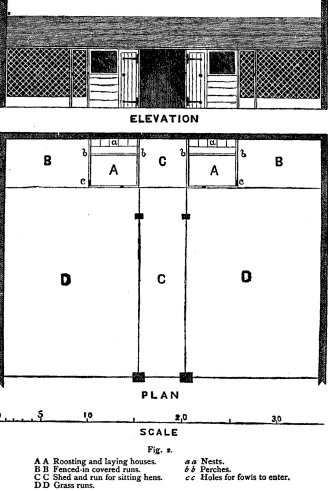
This plan, as will be seen, comprises two distinct houses,
sheds, and runs, with a separate compartment for sitting hens. The nests are
placed on the ground at the back of the houses, and the perches, as before
recommended, a foot in advance of them, and eighteen inches high. The holes by
which the fowls enter open into the sheds, which are netted in, so that in wet
weather they can be altogether confined. In dry weather the shed is opened to
give them liberty. The fencing should be boarded up a foot high, not only to
prevent rain splashing in, but to keep in when necessary young chickens, which
would otherwise run out between the meshes.
A walk in front of the sheds should be gravelled, and the remainder of the open
runs covered with sand, or they may be laid down in grass, which, if well rooted
first, will bear the fowls upon it for several hours each day, but should be
renewed in the spring by sowing when needed. The runs should be enclosed with
wire netting, two inches mesh, which may be conveniently stretched on poles, 1?
inch square, driven two feet into the ground, and placed five feet apart. The
height of the fence depends on the breed chosen. Cochins or Brahmas are easily
retained within bounds by netting a yard high; for moderate-sized fowls six feet
will do ; whilst to confine game, Hamburgs, or bantams, a fence of eight or nine
feet will be found necessary. The netting should be simply stretched from post to post, without a rail at the top,
as the inmates are then far less likely to attempt flying over.
We do not like to see fowls with their wings cut. If their
erratic propensities are troublesome, open one wing and pluck out all the first
or flight feathers, usually ten in number. This will effectually prevent the
birds from flying, and as the primary quills are always tucked under the
others when not in use, there is no external sign of the operation.
The
holes by which the fowls enter the houses should be furnished with trap-doors that they may be
kept out at pleasure whilst either part is being
cleaned. Each house must also have a small window. Having a shed at the side,
ventilating lanterns will not be necessary, as the end will be attained by
boring a few holes in the wall between the house and shed, towards the
highest part of the roof. The compartment for the sitting hen may be walled
in at the front or not; for ourselves, we prefer it open. Her run may also be
covered over or not, at pleasure. To have it in the middle, as here shown, we
consider most convenient.
Such
a yard possesses many advantages. Two separate runs are almost necessary if the
rearing of chickens forms part of the plan of proceeding. It is also in some
respects convenient to keep two different breeds,
as one may supply the deficiencies of the other; and many persons consider it
advisable to separate the cocks and hens, except during the breeding season,
believing that stronger chickens are obtained thereby. The need of the separate compartment
for the sitting hens is further insisted on hereafter, but it has also other
uses; being, when not so employed, often very convenient for the temporary
reception of a pen of strange birds, for which there may be no other
accommodation.
Each run, as here described, will accommodate from six to ten
fowls, according to their size and habits; and we close this paper with one very
simple but important stipulation, which is a sine qua non in rearing
poultry: fowls should not be kept unless proper and regular attention
can be given to them; and we would strongly urge that this needful attention
should be as far as possible personal.
[-46-]
POULTRY.- II.
THE FEEDING AND GENERAL MANAGEMENT OF ADULT FOWLS.
A judicious system of feeding is very essential to the
well-being of poultry, and has, of course, more direct influence upon the
profit or loss than any of the circumstances - though equally important - which
we have before enumerated. We shall, therefore, endeavour to give the subject a
full and practical consideration.
The object is to give the quantity and quality of food [-47-]
which will produce the greatest amount of flesh and eggs; and if it be
attained, the domestic fowl is unquestionably the most profitable of all live
stock. But the problem is rather a nice one, for there is no "mistake on
the right side" here. A fat hen is not only subject to many diseases, but
ceases to lay, or nearly so, and becomes a mere drag on the concern; while a
pampered male bird is lazy and useless at best, and very probably, when the
proprietor most requires his services, may be attacked by apoplexy and drop down
dead.
That fowls cannot be remunerative if starved need scarcely be
proved. Ex nihilo nihil fit; and the almost daily production of an
article so rich in nitrogen as an egg - the very essence of animal nourishment -
must ,demand an ample and regular supply of adequate food. We say no more upon
this point, knowing that the common mistake of nearly all amateur
poultry-keepers is upon the other side-that of over-feeding.
The usual plan, where fowls are regularly fed at all, appears
to be to give the birds at each meal as much barley or oats as they will eat;
and this being done, the owner prides himself upon his liberality, and insists
that his at least are properly fed. Yet both in quantity and quality is he
mistaken. Grain will do for the regular meals of fowls which live on a farm, or
have any other extensive range where they can provide other food for themselves,
have abundant exercise, and their digestive organs are kept in vigorous action.
But poultry kept in confinement on such a diet will not thrive. Their plumage,
after awhile, begins to fall off, their bowels become affected, and they lose
greatly in condition; and though in summer their eggs may possibly repay the
food expended, it will be almost impossible to obtain any in winter, when they
are most valuable.
All fixed dietary scales for fowls are delusive. The one
simple rule is to give them as much as they will eat eagerly, and no
more; directly they begin to feed with apparent indifference, or cease to run
when the food is thrown at a little distance, the supply should be stopped. In a
state of nature, they have to seek far and wide for the scanty morsels which
form their subsistence; and the Creator never intended that they, any more than
human beings, should eat till they can literally eat no more. It follows, from
this rule, that food should never be left on the ground. If such a slovenly
practice be permitted, much of what is eaten will be wasted, and a great deal
will never be eaten at all ; for fowls are dainty in their way, and unless at
starvation point always refuse sour or sodden food.
The number of meals per day best consistent with real economy
will vary from two to three, according to the size of the run. If it be of
moderate extent, so that they can, in any degree, forage for themselves, two are
quite sufficient, at least in summer, and should be given early in the morning,
and the last thing before the birds go to roost. In any case, these will be the
principal meals; but when the fowls are kept in confinement, they will require,
in addition, a scanty-and only a very scanty-feed at midday.
The first feeding should consist of soft food of some kind.
The birds have passed a whole night since they were last fed ; and it is
important, especially in cold weather, that a fresh supply should as soon as
possible be got into the system, and not merely into the crop. If grain be
given, it has to be ground in the poor bird's gizzard before it can be digested;
and on a cold winter's morning the delay is anything but beneficial. But for the
very same reason, at the evening meal grain forms the best food which can be
supplied; it is digested slowly, and during the long cold nights affords support
and warmth to the fowls.
A great deal depends upon this system of feeding, and ~s we
are aware it is opposed to the practice of many, who give grain for the
breakfast, and meal, if at all, at night, let the sceptical reader make one
simple experiment. Give the fowls a feed of meal, say at five o'clock in the
evening; at twelve visit the roosts, and feel the crops of the poor birds. All
will be empty; the gizzard has nothing to act upon, and the food speedily
disappears, leaving with an empty stomach, to cope with the long cold hours
before dawn, the most hungry and incessant feeder of all God's creatures. But if
the last feed has been grain, the crop will still be found partially full, and
the birds will awake in the morning hearty, strengthened, and refreshed.
With respect to the morning meal of pultaceous food, when
only a few fowls are kept, to supply eggs for a moderate family, this may be
provided almost for nothing by boiling daily the potato peelings till soft, and
mashing them up with enough bran, slightly scalded, to make a tolerably stiff
and dry paste. There will be more than sufficient of this if the fowls kept do
not exceed one for each member of the household; and as the peelings cost
nothing, and the bran very little, one half the food is provided at a merely
nominal expense, while no better could be given. A little salt should always be
added, and in cold or wet days in winter a slight seasoning of pepper will tend
to keep the hens in good health and laying. This food may be mixed boiling hot
over night, and covered with a cloth, or be put in the oven; in either case it
will remain warm till morning-the condition in which it should always be given
in cold weather.
If a tolerable stock of poultry be kept, such a source of
supply will be obviously inadequate; and in purchasing the food there is much
variety to choose from. Small or "pig" potatoes may be bought at a low
price and similarly treated; or barley-meal may be mixed with hot water; or an
equal mixture of meal and "sharps," or of Indian meal and bran; either
of these make a capital food. Or, if offered on reasonable terms, a cart-load of
swede or other turnips, or mangel-wurzel, may be purchased; and when boiled and
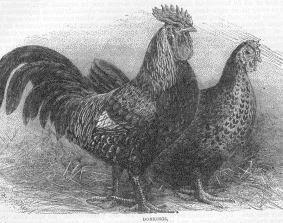
mashed with meal 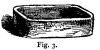 or
"sharps," we believe forms the very best soft food a fowl can have,
especially for Dorkings; but they cannot everywhere be obtained at a cheap rate,
and the buyer must study the local market. A change of food, at times, will be
beneficial, and in making it the poultry-keeper should be guided by the season.
It is, however, necessary to avoid giving too great a proportion of maize,
either as meal or corn, or the effect will be a useless and prejudicial
fattening from the large quantity of oil it contains; it is best mixed with
barley or bean-meal, and is then a most economical and useful food. Potatoes,
also, from the large proportion of starch contained in them, are not good as a
regular diet for poultry; but occasionally mixed with bran or meal will be found
most conducive to condition and laying.
or
"sharps," we believe forms the very best soft food a fowl can have,
especially for Dorkings; but they cannot everywhere be obtained at a cheap rate,
and the buyer must study the local market. A change of food, at times, will be
beneficial, and in making it the poultry-keeper should be guided by the season.
It is, however, necessary to avoid giving too great a proportion of maize,
either as meal or corn, or the effect will be a useless and prejudicial
fattening from the large quantity of oil it contains; it is best mixed with
barley or bean-meal, and is then a most economical and useful food. Potatoes,
also, from the large proportion of starch contained in them, are not good as a
regular diet for poultry; but occasionally mixed with bran or meal will be found
most conducive to condition and laying.
In mixing soft food, there is one general rule always to be
observed: it must be mixed rather dry, so that it will break if thrown
upon the ground. There should never be enough water to cause the food to glisten
in the light, or to make a sticky porridgy mass, which clings round the beaks of
the fowls and gives them infinite annoyance. besides often causing diarrhoea.
If the weather be dry, and the birds are fed in a hard
gravelled yard, the food is just as well, or better, thrown on the ground. If
they are fed in the shed, however, it is best to use an oblong dish of zinc, or,
preferably, earthenware, such as represented in Fig. 3. The trough or dish must,
however, be protected, or the fowls will walk upon it, scratch earth into it,
and waste a large portion; and this is best prevented by having a loose curved
cover made of tin and wire, as shown in Fig. 4, which, when [-48-]
placed on the ground over the dish, will effectually prevent the fowls having
anything to do with the food except to eat it, which they are quite at liberty
to do through the perpendicular wires, two and a half inches apart. Many
experienced poultry-keepers prefer to drive the wires into the ground, leaving
them six inches high; the trough is then put behind them, and a board laid over,
leaning on the top of the wires. The effect of such a plan is precisely similar
as regards the protection of the food, and its only disadvantage is, that the
wires being always in the ground rather hinder the sweeping of the shed.
If the fowls have a field to run in they will require no
further feeding till their evening meal of grain. Taking it altogether, no grain
is more useful or economical than barley, and in summer this may be occasionally
changed with oats; in winter, for the reasons already given, Indian corn may be
given every second or third day with advantage. Buckwheat is, chemically, almost
identical in composition with barley, but it certainly has a stimulating effect
on the production of eggs, and it is a pity it cannot 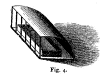 be
more frequently obtained at a cheap rate. We never omit purchasing a sack of
this grain when we can, and have a strong opinion that the enormous production
of eggs and fowls in France is to some extent connected with the almost
universal use of buckwheat by French poultry-keepers. Wheat is generally too
dear to be employed, unless damaged, and if the damage be great it had better
not be meddled with; but if only slightly injured, or if a good sample be
offered of light "tail" wheat, as it is called, it is a most valuable
food, both for chickens and fowls. "Sweepings" sometimes contain
poisonous substances; are invariably dearer, weight for weight, than sound
grain; and should never be seen in a poultry-yard.
be
more frequently obtained at a cheap rate. We never omit purchasing a sack of
this grain when we can, and have a strong opinion that the enormous production
of eggs and fowls in France is to some extent connected with the almost
universal use of buckwheat by French poultry-keepers. Wheat is generally too
dear to be employed, unless damaged, and if the damage be great it had better
not be meddled with; but if only slightly injured, or if a good sample be
offered of light "tail" wheat, as it is called, it is a most valuable
food, both for chickens and fowls. "Sweepings" sometimes contain
poisonous substances; are invariably dearer, weight for weight, than sound
grain; and should never be seen in a poultry-yard.
The mid-day meal of penned-up fowls should be only a scanty
one, and may consist either of soft food or grain. as most convenient meal
preferably in cold weather.
The regular and substantial diet is now provided for, but
will not alone keep the fowls in good health and laying. They are omnivorous in
their natural state, and require some portion of animal food. On a wide range
they will provide this for themselves, and in a small establishment the scraps
of the dinner-table will be quite sufficient; but if the number kept be large,
with only limited accommodation, it will be necessary to buy every week a few
pennyworths of bullocks' liver, which may be boiled, chopped fine, and mixed in
their food, the broth being used instead of water in mixing; these little
tit-bits will be eagerly picked out and enjoyed. A very little is all that is
necessary, and need not be given more than three times a week. If fowls be much
over-fed with this kind of food the quills of the feathers become more or less
charged with blood, which the birds in time perceive, and almost invariably peck
at each other's plumage till they leave the skin quite bare.
There is yet another most important article of diet, without
which it is absolutely impossible to keep fowls in health. We refer to an ample
and daily supply of green or fresh vegetable food. It is not perhaps too much to
say that the omission of this is the proximate cause of nearly half the deaths
where fowls are kept in confinement; whilst with it, our other directions having
been observed, they may be kept in health for a long time in a pen only a few
feet square. It was to provide this that we recommended the open yards, to be
laid down in grass-the very best green food for poultry; and a run of even an
hour daily on such a grass plot, supposing the shed to be dry and clean, will
keep them in vigorous: health, and not be more than the grass will bear. But if
a shed only be available, fresh vegetables must be thrown in daily. Anything
will do. A good plan is to mince up cabbage-leaves or other refuse vegetables,
and mix pretty freely with the soft food; or the whole leaves may be thrown down
for the fowls to devour; or a few turnips may be minced up daily, and scattered
like grain, or simply cut in two and thrown into the run; or if it can be got, a
large sod of fresh-cut turf thrown to the fowls will be better than all. But
something they must have every day, or nearly so, otherwise their bowels sooner
or later become disordered, their feathers look dirty, and their combs lose that
beautiful bright red colour which will always accompany really good health and
condition, and testifies pleasantly to abundance of eggs.
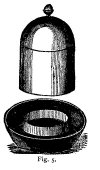
The water vessel must be filled fresh every day at least, and
so arranged that the birds cannot scratch dirt into it, or make it foul. The
ordinary poultry-fountain is too well known to need description, but a rather
better form than is usually made is shown in the annexed figure. The advantages
of such a construction are that the state of the interior can be examined, and
the vessel well sluiced through to remove the green slime which always collects
by degrees, and is very prejudicial to health. Some experienced breeders prefer
shallow pans; but if these be adopted they must be either put behind rails, with
a board over, or protected by a cover, in the same way as the feeding trough
already described.
 Fowls
must never be left without water. During a frost, therefore, the fountain should
be emptied every night, or there will be trouble next morning. Care must always
be taken also that snow is not allowed to fall into the drinking vessel.
The reason has puzzled wiser heads than ours; but it is a fact, that any real
quantity of snow-water seems to reduce fowls and other birds to mere
skeletons.
Fowls
must never be left without water. During a frost, therefore, the fountain should
be emptied every night, or there will be trouble next morning. Care must always
be taken also that snow is not allowed to fall into the drinking vessel.
The reason has puzzled wiser heads than ours; but it is a fact, that any real
quantity of snow-water seems to reduce fowls and other birds to mere
skeletons.
It is well in winter to add to the water a few drops of a
solution of sulphate of iron (green vitriol), ~ just enough to give a slight
mineral taste. This will, in a great measure, guard against roup, and act as a
bracing tonic generally. The rusty appearance the water will assume is
quite immaterial.
Whilst the fowls are moulting, sulphate of iron should always
be used; it will assist them greatly through this, the most critical period of
the whole year. A little hemp-seed should also be given every day at this
season, at least to all fowls of value; and with these aids, and a little pepper
on their food, with perhaps a little extra meat, or even a little ale to
delicate breeds during the few weeks the process lasts, there will rarely be any
lost. With hardy kinds and good shelter such precautions are scarcely necessary,
but they cost little, and have their effect also on the early recommencement of
laying.
In addition to their regular food it will be needful that the
fowls have a supply of lime, in some shape or other, to form the shells of their
eggs. Old mortar pounded is excellent; so are oyster-shells well burnt in the
fire and pulverised; of the latter they are very fond, and it is an excellent
plan to keep a "tree-saucer" full of it in their yard. If this matter
has been neglected, and soft shell-less eggs have resulted, the quickest way of
getting matters right again is to add a little lime to the drinking-water.
[-95-]
POULTRY.-III.
INCUBATION OF POULTRY.
MUCH disappointment in the hatching and rearing of young
broods would be prevented if more care were taken that the eggs selected for
setting were of good quality - not only likely to be fertile, but the produce of
strong and hardy birds. This remark applies to common barn-door poultry quite as
much as to the pure breeds. A friend once complained to us, that out of a dozen
eggs only four or five had hatched ; and on inquiry, we found that the sitting
had been procured from an inn-yard, where, to our knowledge, only one cock was
running with about twenty hens, from which, of course, no better result could be
expected. When the eggs have to be procured from elsewhere, therefore, whatever
be the class of fowls required, it should first of all be ascertained that there
is at least one cock to every six or eight hens, and that he be a strong and
lively bird and next, that the fowls be not only of the kind desired, but that
they are well fed and taken care of. From scraggy, half-starved birds, it is
impossible to rear a large brood, as the greater number even of those hatched
will die in infancy. It only remains to ensure that the eggs be fresh, and a
successful hatching bay he anticipated.
With regard to this latter point, eggs have been known to
hatch when two months old, or even more; but we would never ourselves set, from
choice, any egg which had been laid more than a fortnight; and after a month, or
less, it is useless trouble. Fresh eggs, if all be well, hatch out in good time,
and the chicks are strong and lively; the stale ones always hatch last, being,
perhaps, as much as two days later than new-laid, and the chickens are often too
weak to break the shell. We have also invariably noticed, when compelled to take
a portion of stale eggs to make up a sitting, that even when such eggs have
hatched, the subsequent deaths hive principally occurred in this portion of the
brood; and that if none of the eggs were more than four or five days old, they
not only hatched nearly every one, and within an hour or two of each other, but
the losses in any ordinary season were very few.
When the eggs are from the home stock, their quality should,
of course, be above suspicion. It is scarcely necessary to say, that in order to
ensure this, every egg before storing should have legibly written upon it in
pencil the date on which it was laid. Eggs intended for setting are best kept in
bran, the large end downward, and should never be exposed to concussion. Another
very good plan is to have a large board pierced with a number of round holes in
regular rows to receive the eggs.
Hundreds of years ago it was thought that the sex of eggs
could be distinguished by the shape - the cocks being produced from those of
elongated shape, and hens from the short or round. Others have pretended to
discern the future sex from the position of the air-bubble at the large end. We
need scarcely say, that these and all other fancies have, hundreds of times,
been proved to be erroneous. There is not a breeder of prize poultry in England
who would not gladly give twenty pounds for the coveted knowledge, and
thenceforth breed no more cockerels than he really wanted ; but the secret has
never been discovered yet, and it is even impossible to tell before the egg has
been sat upon a short time whether it will produce a chicken or not.
We have already mentioned that the sitting hens ought to have
a separate shed and run provided for them, in order that the other hens may not
occupy their nests during absence, or they themselves go hack to the wrong ones,
as they will often do if allowed to sit in the fowl-house. Even in a very small
domestic establishment we strongly recommend that the small additional space
requisite be devoted to this purpose, for all our experience has proved that,
whatever success may be obtained otherwise by constant care and watchfulness, it
is never so great as when the sitter can be shut into a separate run; and be
entirely unmolested. An extensive run is neither necessary nor desirable, as it
only entices the birds to wander, whereas, in a limited space, they will go back
to their nests as soon as their wants are satisfied. A shed five feet square,
with a run the same width for ten feet out in front, is quite sufficient for
three hens.
If the hen must be set on the ordinary nest in the
fowl-house, unless she can be watched every day to see that all goes right, it
is best to take her off at a regular time every morning, and after seeing to her
wants and due return, to shut her in so that she cannot be annoyed. She should
be lifted by taking hold under the wings, gently raising them first to see that
no eggs are enclosed. Very fair success may be attained by this method of
management, which is obviously almost imperative in very large establishments,
where numerous hens must be sitting at one time; but where such large numbers do
not allow of a special poultry attendant it is rather troublesome, and on an
average there will be a chicken or two less than if the hens can be put quite
apart, where they need neither be watched nor interfered with. Since we adopted
this plan we have, from good eggs, always hatched at least nine out of twelve,
and generally more ; and have had no trouble or anxiety till the broods were
actually hatched, which is anything but the case on the other system.
With respect to the arrangement of the hatching run, it
should, if possible, be in sight of the other fowls, as it will keep the sitter
from becoming strange to her companions, and prevent an otherwise inevitable
fight on her restoration, to the possible damage of the brood. We prefer
ourselves, as stated in the first chapter, a shed five feet wide and five deep,
open in front to a small gravel or grass run. Under the shed must be, besides
the nests, a good-sized shallow box of sand, dry earth, or fine coal ashes, for
the hen to cleanse herself in, which she specially needs at this time ; and food
and water must be always ready for her. With these precautions the hen may, and
should, in every case, with the exceptions presently mentioned, he left entirely
to herself. There are, however, some birds which, if not removed, would starve
upon their nests sooner than leave them; and, therefore, if the hen has not been
off for two or three days (we would test her for that time first), we should
certainly remove the poor thing for her own preservation. To feed upon the nest
is a cruel practice, which has crippled many a fowl for life, and cannot be too
strongly condemned.
Of all mothers we prefer Cochins or Brahmas. Their abundant
"fluff" and feathering is of inestimable advantage to the young
chicks, and their tame and gentle disposition makes them submit to any amount of
handling or management with great docility. Cochins certainly appear clumsy with
their feet, but we have never found more chickens actually trodden upon by them
than with any other breed. Many complain that they leave their chickens too
soon, but we have not found it so ourselves, if they are kept cooped instead of
being set at liberty, they will generally brood their chickens for two months,
even till they have laid a second batch of eggs, and desire to sit again; and by
that time any but very early broods are able to do without a mother's care. With
regard to Brahmas as mothers, they have a peculiarity we never observed in any
other fowl - they appear actually to look behind them when moving, lest they
should tread upon their little ones. Dorkings, also, are exemplary mothers, and
go with their chickens a long time, which recommends them strongly for very
early broods. And lastly, a Game hen has qualities which often make her most
valuable. She is not only exemplary in her care, and a super-excellent forager
for her young brood, but will defend them to the last gasp, and render a good
account of the most determined cat [-96-]
that ever existed ; indeed, it would be a difficult matter in any case to steal
a chick in daylight from a well-bred Game hen. But whatever be the hen chosen,
she should be well feathered, moderately short-legged, and tolerably tame. A
very high authority* (* Mrs. Fergusson Blair) has affirmed that none but mature
hens should be allowed to sit, and that pullets are not to be trusted; but our
own experience and that of very many large breeders does not confirm this. We
have constantly set pullets, and have I rarely had any more reason to complain
of them than of older birds.
The nests may be arranged under the shed
any way so that no one can see into them, with the one proviso that they be
actually upon the ground. Chicks thus obtained always show more constitution
than those hatched on a wooden bottom at a higher level. This holds good even at
all times of the year. We are aware that eminent authorities who recommend
ground-nests in summer, prefer a warm, wooden box in winter for the sake of the
hen but she will rarely suffer. The heat of her body whilst sitting is so great
that a cool situation seems grateful to her - at least, a hen set on the ground
rarely forsakes her nest, which is otherwise no uncommon case. We knew of a hen
which, during the month of January, made her nest on the top of a rock in one of
the highest and most exposed situations in the Peak of Derbyshire, and brought a
large brood of strong chickens into the yard. It is only necessary that the
birds should be protected from wind and rain, in order to avoid rheumatism and
this is most effectually done by employing for the nest a tight wooden box like
Fig. 6, open at the  bottom,
and also at front, with the exceptions of a strip three inches high to contain
the straw. Let one of these boxes be placed in the back corner of the shed,
touching the side, the front being turned to the back wall, and about nine
inches from it ; and the hen will be in the strictest privacy, will be both
perfectly sheltered and kept cool, and wil1 never mistake her own nest for the
one which may be placed in the other corner. If a third must be made room for,
let her nest be placed the same distance from the wall midway between the
others, and hike them, with the front of the nest to the back of the shed. There
will then be still nearly a foot between each two nests for the birds to pass.
bottom,
and also at front, with the exceptions of a strip three inches high to contain
the straw. Let one of these boxes be placed in the back corner of the shed,
touching the side, the front being turned to the back wall, and about nine
inches from it ; and the hen will be in the strictest privacy, will be both
perfectly sheltered and kept cool, and wil1 never mistake her own nest for the
one which may be placed in the other corner. If a third must be made room for,
let her nest be placed the same distance from the wall midway between the
others, and hike them, with the front of the nest to the back of the shed. There
will then be still nearly a foot between each two nests for the birds to pass.
A damp situation is best for the sitting shed, and will
ensure good hatching in hot weather, when, perhaps, all the neighbours are
complaining that their chicks are dead in the shells. Attempting to keep the
nest and eggs very dry has ruined many a brood. It is not so in nature;
every morning the hen leaves her nest, and has to seek her precarious meal
through the long, wet grass, which drenches her as if she had been ducked in a
pond. With this saturated breast she returns, and the eggs are duly moistened.
But if the nest be dry, the hen be kept dry, and the weather happen to be hot
and dry also, the moisture within the egg itself becomes dried to the
consistency of glue, and the poor little chick, being unable to move round
within the shell, cannot fracture it, and perishes. Such a mishap will not
happen if the ground under the nest be damp and cool. All that is necessary in
such a case is to scrape a slight hollow in the bare, earth, place the nest-box
already described, over it, and put in a moderate quantity of straw cut into
two-inch lengths; or, still better, some fresh-cut damp grass may be put in
first, and the straw over. Shape the straw also into a very slight hollow, and
the nest is made; but care must be taken to well fill up the corners of the box,
or the eggs may be rolled into them and get addled. Some people prefer to put in
first a fresh turf; but if the nest be placed on the bare ground, as we
recommend, this is useless. The rest of our remarks upon this subject must be
postponed to a future number.
[-121-]
POULTRY.-IV.
INCUBATION OF POULTRY (continued from p. 96).
It will always be found a desirable plan to cut the straw
into short lengths for a hatching nest, and the neglect of this precaution is
the most frequent cause of breakage; the hen, during her twenty-four hours'
stay, gets her claws entangled in the long straws, and on leaving for her daily
meal is very likely to drag one or two with her, fracturing one or more eggs, or
even jerking them quite out of the nest.
Should such a mishap occur (and the nest should be examined
every two or three days when the hen is absent, to ascertain this), the eggs
must be removed, clean straw substituted, and every sound egg at all soiled by
the broken one be washed with a sponge and warm water, gently but quickly drying
after with a cloth. The hen, if very dirty, should also have her breast
cleansed, and the whole replaced immediately, that the eggs may not be chilled.
A moderate hatch may still be expected, though the number of chicks is always
more or less reduced by an accident of this kind. If, however, the cleansing be
neglected for more than a couple of days after a breakage, or less at the latter
period of incubation, probably not a single chick will be obtained ; whether
from the pores of the shell being stopped by the viscid matter, or from the
noxious smell of the putrefying egg, it is not very material to inquire.
Every egg should also be marked quite round with ink or
pencil, so that if any be subsequently laid in the nest they may be at once
detected and removed. Hens will sometimes lay several eggs after beginning to
sit.
In ordinary winters the hen should be set as in summer,
giving her, however, rather more straw. Only in severe weather should she be
brought into the house; and in that case, or in summer if the ground be very
dry, it will be necessary during the last half of the hatching period to
sprinkle the eggs slightly with water every day while she is off. This is done
best by dipping a small brush in tepid water; and is always necessary to success
in dry weather, when a hen is set in a box at a distance from the ground, as is
the case in large sitting-houses. But, where it can be had, we prefer the
natural moisture of a damp soil: it never fails, and avoids the need of going
near the hen.
When the number of eggs set yearly is considerable, it is
worth while to withdraw the unfertile ones at an early period. About the eighth
day let the hen be removed by candlelight, and each egg be held between the eye
and the light, in the manner represented, Fig. 8. If the egg be fertile, it will
appear opaque, or dark all over, except perhaps, a small portion towards the top
; but if it be unimpregnated, it will be still translucent, the light passing
through it almost as if new laid. After some experience the eggs can be
distinguished at an earlier period, and a practised hand can tell the unfertile
eggs even at the fourth day. Should the number withdrawn be considerable, four
batches set the same day may be given to three hens, or even two, and the
remainder given fresh eggs ; and if not, the fertile eggs will get more heat,
and the brood come out all the stronger. The sterile eggs are also worth saving,
as they are quite good enough foe cooking purposes.
It is a common mistake to set too many eggs. In summer, a
large hen may have thirteen, or a Cochin fifteen (of her own) ; but in early
spring eleven are quite enough. We have not only to consider how many chickens
the hen can hatch, but how many she can cover when they are partly grown.
If a hen be set in January. she should not have more than seven or eight eggs,
or the poor little things, as soon as they begin to get large, will have no
shelter, and soon die off, It is far better to hatch only six and rear five, or
maybe all, to health and vigour, than to hatch ten and only probably rear three
puny little creatures, good for nothing but to make broth.
[-122-] In April and May broods, such a limitation is not needed; but
even then eleven or twelve chickens are quite as many as a large, well-feathered
hen can properly nourish, and the eggs should only be one or two in excess of
that number.
A good hen will not remain more than half an hour away from
her nest, unless she has been deprived of a dust-bath, and so become infested
with lice, which sometimes causes hens thus neglected to forsake their eggs
altogether. When a hen at the proper time shows no disposition to return, she
should be quietly driven towards her nest; if she be caught, and replaced by
hand, she is often so frightened and excited as to break the eggs. A longer
absence is not, however, necessarily fatal to the brood. We have had hens
repeatedly absent more than an hour, which still hatched seven or eight chicks;
and on one occasion a hen sitting in the fowl-house returned to the wrong nest,
and was absent from her own more than five hours. We of course considered all
chances of hatching at an end; but as the hen had been sitting for a fortnight,
concluded to let her finish her time, and she hatched five chickens. We have
heard of a few hatching even after nine hours' absence, and therefore
would never, on account of such an occurrence, abandon valuable eggs without a
trial.
The chickens break the shell at the end of the twenty-first
day, on an average; but if the eggs are new-laid, it will often lessen the time
by as much as five or six hours, while stale eggs are always more or less
behind.
We never ourselves now attempt to assist a chick from the
shell. If the eggs are fresh, and proper care has been taken to preserve
moisture during incubation, no assistance is ever needed. To fuss about the nest
frets the hen exceedingly; and we have always found that even where the poor
little creature survived at the time, it never lived to maturity. Should the
reader attempt such assistance, in cases where an egg has been long
"chipped," and no further progress made, let the shell be cracked
gently all round, without tearing the inside membrane if that be perforated, the
viscid fluid inside dries, and glues the chick to the shell. Should this happen,
or should both shell and membrane be perforated at first, introduce the point of
a pair of scissors, and cut up the egg towards the large end, where there will
be an empty space, remembering that if blood flow all hope is at an end Then put
the chick back under the hen; she will probably squeeze it to death, it is true,
it being so very weak but it will never live if put by the fire - at least, we
always found it so. Indeed, as we have said, we consider it quite useless to
make the attempt at all.
Cleanliness in the house and run has already been insisted
upon, and is only again alluded to on account of the value of the manure. This,
collected daily, should be put in any convenient receptacle where it can be kept
dry, and either used in the garden, if there is one, or sold. It pays best to
use it, where possible; it should always be mixed with earth, being very strong,
and is especially valuable for all plants of the cabbage kind; it is also
excellent for growing strawberries, or, indeed, almost any thing, if
sufficiently diluted. If there be no possibility of so using it, it is worth about
seven shillings per cwt to sell, and is greatly valued by all nurserymen and
gardeners who know its value; but there is often difficulty in finding those who
do, and getting a fair price. At seven shillings (which we believe to be about a
fair value, compared with that of guano, on account of the moisture contained),
or when it can be used in the garden, we consider the value of the manure equal
to fully one-fifth - perhaps one-fourth would be nearer the mark - of the total
profit from the fowls. It is, therefore, an item too important to be neglected.
Where a considerable number of fowls are killed annually the
feathers also become of value, and should be preserved. They are very easily
dressed at home. Strip the plumage from the quills of the larger feathers, and
mix with the small ones, putting the whole loosely in paper bags, which should
be hung up in the kitchen, or some other warm place, for a few days to dry. Then
let the bags be baked three or four times, for half an hour each time, in a cool
oven, drying for two days between each baking, and the process will be
completed.
Eggs should be collected regularly, if possible twice every
day; and if any chickens are to be reared from the home stock, the owner or
attendant should learn to recognise the egg of each particular hen.
Before concluding this article, it may be expected that
something definite should be said respecting the actual profit of what may be
called domestic poultry-keeping. It is extremely difficult to make any such
statement, so much depends upon the price of food, upon the management,
selection of stock, and value of eggs. But in general we have found the average
cost of fowls, when properly fed, to be about 1d. per week each for ordinary
sorts, and not exceeding 1?d. per week for the larger breeds when the cost is
more we should suspect waste. A good ordinary hen ought to lay 120 eggs in a
year, and if good laying breeds are selected, there ought to be an average of
150, not reckoning the cock. Of course, good management is supposed, and a
regular young stock, as already insisted upon. For domestic purposes eggs
ought to be valued at the price of new-laid, and from these data each can make
his own calculation. The value of the manure, when it can be sold or used, we
consider is about 9d. to 1s. per annum for each fowl.
The whole undertaking - be it large or small - must be
conducted as a real matter of business. If more than three or four hens are
kept, buy the food wholesale, and in the best market; let the grain be purchased
a sack at a time, potatoes by the cart-load or hundred-weight, and so on; and
let a fair and strict account be kept of the whole concern. The scraps of the
house may be thrown in, and the cost of the original stock, and of their
habitations, may be kept separate, and reckoned as capital invested ; but let
everything afterwards for which cash is paid be rigorously set down, and, on the
other side, with equal strictness, let every egg or chicken eaten or sold be
also valued and recorded. This is of great importance. The young beginner may,
perhaps, manage his laying stock well, but succeed badly with his chickens, or vice
versa; and it is no small matter in poultry-keeping, as in any other
mercantile concern, to be able to see from recorded facts where has been the
profit or where the loss. The discovery will lead to reflection; and the waste,
neglect, or other defective management being amended, the hitherto faulty
department will also contribute its quota to the general weal. We shall deal
with the rearing of chickens in our next paper.
[-145-]
POULTRY.-V.
THE REARING AND FATTENING OF CHICKENS.
FOR nearly twenty-four hours after hatching, chickens require no food at all;
and though we do not think it best to leave them quite so long as this without
it, we should let them remain for at least twelve hours undisturbed. We say
undisturbed, because it is a very common practice to take those first hatched
away from the hen, and put them in a basket by the fire till the whole brood is
out. When the eggs have varied much in age, this course must be adopted; for
some chickens will be perhaps a whole day or more behind the others, and the
hen, if she felt the little things moving beneath her, would not stay long
enough to hatch the rest. But we have explained in the last chapter that this
should not be, and that if the eggs are all fresh, the chicks will all appear
within a few hours of each other. In that case they are much better left with
their mother: the heat of her body appears to strengthen and nourish them in a
far better manner than any other warmth, and they are happy and contented,
instead of moving restlessly about as they always do whilst away from her.
Our own plan is to set the eggs in the evening, when the
chicks will break the shell in the evening also, or perhaps the afternoon. Then
at night let the state of the brood be once only examined, all egg-shells
removed from the nest, and the hen, if she be tame enough to receive it, given
food and water. Let her afterwards be so shut in that she cannot leave her nest,
and all may be left safely till the morning. By that time the chicks will be
strong and lively, quite ready for their first meal; and unless some of the eggs
are known to be very stale, any not hatched then are little likely to hatch at
all. If this be so, the chicks may be removed and put in flannel by the fire,
and another day patiently waited, to see if any more will appear. We should not
do so, however, if a fair number had hatched well ; for they never thrive so
well away from the hen, and it is scarcely worth while to injure the healthy
portion of the brood for the sake of one or two which very probably may not live
after all.
The first meal should be given on the nest, and the best
material for it is an equal mixture of hard-boiled yolk of egg and stale
bread-crumbs, the latter slightly moistened with milk. Let the hen be allowed to
partake of this also - she needs it; and then give her besides as much barley as
she will eat, and offer her water, which she will drink greedily. To satisfy the
hen at first saves much restlessness and trouble with her afterwards.
There is a stupid practice adopted by many, of removing the
little horny scale which appears on all chickens' beaks, with the idea of enabling
them to peck better, and then put food of pepper-corns down their throats, and
dip their bills in water to make them drink. It is a mistake to say that if this
does no good it can do no harm: the little beaks are very soft and tender, and
are often injured by such barbarous treatment. Leave them alone. If they
do not eat or drink (and chickens seldom drink the first day), it only shows
they do not wish it ; for to fill an empty stomach is the first and universal
instinct of all living things.
The brood having been fed, the next step will depend upon
circumstances. If, as we recommend, the chickens were hatched the night before,
or be well upon their legs, and the weather be fine and warm, they may be at
once moved out, and the hen cooped where her little ones can get the sun. If it
be winter, or settled wet weather or cold, the hen must, if possible, be kept on
her nest this day also, and when removed be cooped in a dry shed or outhouse.
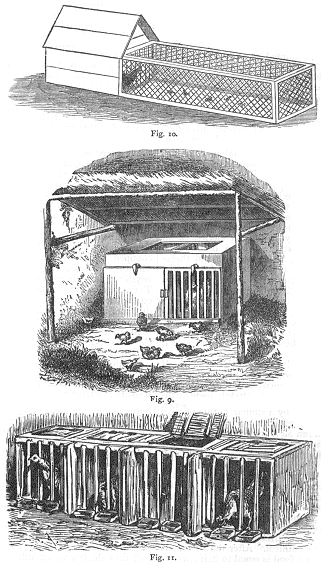
The best arrangement, where there is convenience for it, is
that shown in Fig. 9. A shed, six feet square, is reared against the wall, with
a southern exposure, and the coop placed under it. This coop is best made on a
plan very common in some parts of France, and consists of two compartments,
separated by a partition of bars; one compartment being closed in front, the
other fronted with bars like the partition. Each set of bars should have a
sliding one to serve as a door, and the whole coop should be tight and sound. It
is best to have no bottom, but to put it on loose dry earth or ashes, an inch or
two deep. Each half of the coop must be about two feet six inches square, and
may or may not be lighted from the top by a small pane of glass.
The advantage of such a coop and shed is that except in [-146-]
very severe weather, no further shelter is required even at night. During
the day the hen is kept in the outer compartment, the chickens having liberty,
and the food and water being placed outside; whilst at night she is put in the
inner portion of the coop, and a piece of canvas or sacking hung over the bars
of the outer half. If the top be glazed, a little food and the water vessel may
be placed in the outer compartment at night, and the chicks will be able to run
out and feed early in the morning, being prevented by the canvas from going out
into the cold air. It will be only needful to remove the coop every two days for
a few minutes, to take away the tainted earth and replace it with fresh. There
should, if possible, be a grass plot in front of the shed, the floor of which
should be covered with dry loose dust or earth.
Under such a shed, chickens will thrive well but if such
cannot be obtained, sufficient shelter during ordinary breeding seasons may be
obtained by the use of a well-made board coop, with a gabled roof covered with
felt. This coop should be open in front only, and be two feet six or two feet
three inches square. At night let a thick canvas wrapper be hung over the front.
The ordinary basket coop is only fit to be used in perfectly fine weather, when
it is convenient to place it on a lawn. Some straw, weighted by a stone, or
other covering, should, however, be placed on the top, to give shelter from the
mid-day sun.
Chickens should always, if possible, be cooped near grass. No
single circumstance is so conducive to health, size, and vigour, supposing them
to be decently well cared for, as even a small grass run. Absolute cleanliness
is also essential, even more than for grown fowls; and the reason why difficulty
is often experienced in rearing large numbers is, that the ground becomes so
tainted with their excrement. The coop should therefore either be moved to a
fresh place every day, or the dry earth under be carefully removed. A very good
plan, and one we have found in a limited space to answer remarkably well, is to
have a wooden gable-roofed coop made with a wooden bottom, and to cover this an
inch deep with perfectly dry earth, or fine sifted ashes. The ashes are renewed
every evening in five minutes, and form a nice warm bed for the chicks, clean
and sweet, and much better than straw.
Cats sometimes make sad inroads on the broods. If this
nuisance is feared, it is well to confine the coveted prey while young within a
wire-covered run. And the best way of forming such a run, is to stretch some
inch-mesh wire-netting, two feet wide, upon a light wooden frame, so as to form
two wire hurdles, two feet wide and about six feet long, with another three feet
long. These are easily lashed together with string to form a run six feet by
three, and may be covered by a similar hurdle of two- inch mesh three feet wide,
as represented on the preceding page (Fig. 10). In such a run all animal
depredations may be defied, and in any case we should recommend its use until
the chicks are a fortnight old; it saves a world of trouble and anxiety, and
prevents the brood wandering and getting over-tired. By having an assortment of
such hurdles, portable runs can be constructed in a few minutes of any extent
required, and will be found of great advantage until the broods are strong. The
hen may also be given her liberty within the prescribed bounds.
With regard to feeding, if the question be asked what is the best
food for chickens, irrespective of price, the answer must decidedly be oatmeal.
After the first meal of bread-crumbs and egg, no food is equal to it, if
coarsely ground, and only moistened so much as to remain crumbly. The price of
oatmeal is, however, so high as to forbid its use in general, except for
valuable broods; but we should still advise it for the first week, in order to
lay a good foundation. It may be moistened either with water or milk, but in the
latter case only sufficient must be mixed for each feeding, as it will turn sour
within an hour in the sun, and in that condition is very injurious to the
chickens.
For the first three or four days the yolk of an egg boiled
hard should also be chopped up small, and daily given to each dozen chicks and
when this is discontinued, a little cooked meat, minced fine, should be given
once a day till they are about three weeks old. The cost of this will be
inappreciable, as a piece the size of a good walnut is sufficient for a whole
brood, and the chickens will have more constitution and fledge better than if no
animal food is supplied.
Food must be given very often. For the first week every hour
is not too much, though less will do ; the next three weeks, every two hours;
from one to two months old, every three hours ; and after that, three times a
day will be sufficient. To feed very often, giving just enough fresh food
to be entirely eaten each time, is the one great secret of getting fine birds.
If the meals are fewer, and food is left, it gets sour, the chicks do not like
it, and will not take as much as they ought to have.
After the first week, the oatmeal can be changed for cheaper
food. We can well recommend any of the following, and it is best to change from
one to another, say about every fortnight. An equal mixture of "sharps"
and barley-meal, or of "sharps" and buckwheat meal, or bran and Indian
meal; or of bran, oatmeal, and Indian meal The last our own chickens like best
of all, and as the cheap bran balances the oatmeal, it is not a dear food, and
the chicks will grow upon it rapidly. Potatoes mashed with bran are also most
excellent food for a change.
The above will form the staple food, but after a day or two
some grain should be given in addition. Groats chopped up with a knife are
excellent; so is crushed wheat or bruised oats. Chickens seem to prefer groats
to anything, but it is not equal to meal as a permanent diet. They are also fond
of buckwheat. A little of either the one or the other should, however, be given
once or twice a day, and in particular should form the last meal at night, for
the reasons already given.
Bread sopped in water is the worst possible food for
chickens, causing weakness and general diarrhoea. With milk it is better, but
not equal to meal.
Green food is even more necessary to chickens than to adult
fowls. Whilst very young, it is best to cut some grass into very small morsels
for them with a pair of scissors ; afterwards they will crop it for themselves,
if allowed. Should there be no grass available, cabbage or lettuce-leaves must
be regularly given - minced small.
In winter or very early spring the chickens must, in addition
to the above feeding, have more stimulating diet, Some underdone meat or egg
should be continued regularly, and it is generally necessary to give also, two
or three times a day, some stale bread soaked in ale. They should also be fed
about eight or nine o'clock, by candlelight, and early in the morning. In no
other way can Dorkings or Spanish be successfully reared in an inclement season,
though the hardier breeds will often get along very well with the ordinary
feeding. Ale and meat, with liberal feeding otherwise, will rear chickens at the
coldest seasons; and the extra cost is more than met by the extra prices then
obtained in the market. But shelter they must have; and those who have not at
command large outhouse or shed to keep them in while tender, should not attempt
to raise winter or early spring chickens - if they do, the result will only be
disappointment and loss. The broods should only be let out on the open gravel or
grass in bright, or at least clear dry weather.
At the age of four months the chickens, if of the larger
breeds, should be grown enough for the table; and if they have been well fed,
and come of good stock, they will be. For ourselves, we say, let them be eaten
as they are - they [-147-] will be quite fat
enough; and fattening is a very delicate process, success in which it takes some
experience to acquire. For market, however, a fatted fowl is more valuable; and
the birds should be penned up for a further fortnight or three weeks, which
ought to add at least two pounds to their weight. For a limited number of
chickens it will be sufficient to provide a small number of simply-constructed
pens, such as are represented in Fig. 11. Each compartment should measure about
nine by eighteen inches, by about eighteen inches high; and the bottom should
not consist of board, but be formed of bars two inches wide, placed two inches
apart, the top corners being rounded off. The partitions, top and back, are
board, as the birds should not see each other. These pens ought to be placed
about two inches from the ground, in a darkish but not cold or draughty place,
and a shallow tray be introduced underneath, filled with fresh dry earth every
day, to catch the droppings. This is the best and least troublesome method of
keeping the birds clean and in good health. As fast as each occupant of a pen is
withdrawn for execution, its pen should be whitewashed all over inside, and
allowed to get perfectly dry before another is introduced. This will usually
prevent much trouble from insect vermin ; but if a bird appears restless from
that cause, some powdered sulphur, rubbed well into the roots of the feathers,
will give immediate relief.
[-168-]
THE FATTENING OF CHICKENS (continued from p. 147).
IN front of each compartment, as described in our last paper, there should be
a ledge three inches wide, on which to place the food and water tins. The latter
must be replenished once, the former three times a day; and after each meal the
pens should be darkened for half the time until the next, by hanging a cloth
over the front. This cloth is best tacked along at the top when it can be
conveniently hung over or folded back as required. The two hours' darkness
ensures quiet and thorough digestion; but it is not desirable, though often
done, to keep the birds thus the whole time till the next meal, as the chickens
will have a much better appetite on the plan we recommend.

The best food for fattening is buckwheat-meal when it can be obtained; and it
is to the use of this grain that the French owe, in a great measure, the
splendid fowls they send to market. If it cannot be procured, the best
substitute is an equal mixture of Indian and barley-meal. Each bird should have
as much as it will eat at one time, but no food must be left to become sour a
little barley may, however, be scattered on the ledge. The meal may be mixed
with skim milk, if available. A little minced green food should be given daily,
to keep the bowels in proper order.
In three weeks the process ought to be completed. It must be
borne in mind that fat only is added by thus penning a chicken; the lean or
flesh must be made before, and unless the chicken has attained the proper
standard in this respect, it is useless even to attempt to fatten it. Hence the
importance of high feeding from the very shell. The secret of rearing chickens
profitably is, to get them ready for the table at the earliest possible period,
and not let them live a single day after. Every such day is a dead loss,
for they cannot be kept fat. Once up to the mark, if not killed they get
feverish, and begin to waste away again. To make poultry profitable, even on a
small scale, everything must go upon system; and that system is, to kill the
chickens the very day they are ready for it.
If extra weight and fat is wanted, the birds may be crammed
during the last ten days of the fattening period, but not before. The meal is to
be rolled up the thickness of a finger, and then cut up into pellets an inch and
a half long. Each morsel must be dipped in water before it is put into the
bird's throat, when there will be no difficulty in swallowing. The quantity to
be given can only be learnt by experience.
For home use, however, nothing can equal a chicken never
fattened at all, but just taken out of the yard. If well fed, there will be
plenty of good meat, and the fat of a fowl is to most persons no particular
delicacy. In any case, however, the chicken must be kept without food twelve
hours before it is killed.
There are various modes of killing - all of them very
effectual in practised hands. One is to give the bird a very sharp blow, with a
short but heavy stick, behind the neck, about the second joint from the head,
which will, if properly done, sever the spine and cause death very speedily.
Another is to clasp the bird's head in the hand, and swing the body round by it
- a process which also kills by parting the vertebrae. M. Soyer recommends that
the joints be pulled apart, which can easily be effected by seizing the head in
the right hand, placing the thumb just at the back of the skull, and giving a
smart jerk of the hand, the other, of course, holding the neck of the fowl And
lastly, there is the knife, which we consider the most merciful plan, as it
causes no more pain to the bird than that occasioned by the momentary operation
itself.
Fowls are easiest plucked at once, while still warm. and
should be afterwards scalded by dipping them for just one instant in boiling
water. This process will make any decent fowl look plump and nice, and poor
ones, of course, ought not to be killed at all. They should not be
"drawn" until the day they are wanted, as they will [-169-]
keep much longer without. We now pass on to the other inmates of the
poultry-yard.
DUCKS AND GEESE.
Ducks will do well in a garden or any other tolerably wide range where they
can procure plenty of slugs and worms, with a pond or cistern only a few feet
across. Kept in this manner, they will not only be found profitable, but very
serviceable ; keeping the place almost free of those slugs which are the
gardener's great plague, and doing but little damage, except to strawberries,
for which they have a peculiar partiality, and which must be carefully protected
from their ravages. Other fruit is too high to be in much danger from them. In
such circumstances there can be no doubt whatever that ducks are profitable
poultry; and where many fowls are kept, a few ducks should be added, as they
will keep themselves, very nearly, on what the hens refuse; but where every atom
of the food they consume has to be paid for in cash, our own opinion is that
ducks do not pay to rear except for town markets their appetites are so
everlasting and voracious. This point, however, we must leave to the experience
of the reader. The Aylesbury duck is of the purest snow white all over. The head
should be full, and the bill well set on to the skull, so that the beak should
seem to be almost in a line from the top of the head to the tip. The bill
should be long, and when viewed in front appear much like a woodcock's. Eye,
full, bright, and quite black. The legs should be strong, with the claws
well-webbed, and in colour of a rich dark yellow or orange.
Immense numbers of these ducks are bred around Aylesbury. It
is not at all unusual to see around one small cottage 2,000 ducklings, and it
has been computed that upwards of ?20,000 per annum is returned to the town and
neighbourhood in exchange, whilst the railway not uncommonly carries a ton
weight of the birds up to the London market in a single night. The Aylesbury
duck often begins to lay before Christmas. Rouen ducks are not nearly so
forward, rarely laying till February or March, but they make better layers. They
are very handsome, and will weigh eight or nine pounds each ; and, as a rule,
do much better in most parts of England than the Aylesburys. Their flesh is
excellent. The Jest general description of the Rouens are those which in plumage
are precisely like the wild mallard, but larger. The drake should have a
commanding appearance, with a rich green and purple head, and a fine long bill
of a yellow ground, with a very pale wash of green over it, and the
"bean" at the end of it jet black. His neck should have a sharp,
clearly-marked white ring round it, not quite meeting at the back. Breast, a
deep rich claret brown to well below the water-line, then passing into the under
body-colour, which is a beautiful French grey, shading into white near the tail.
The back ought to be a rich greenish black quite up to the tail-feathers, the
curls in which are a rich dark green. Wings, a greyish brown, with distinct
purple and white ribbon-mark well developed. The flight-feathers must be grey
and brown; any approach to white in them is a fatal disqualification, not to be
compensated by any other beauty or merit. Legs, a rich orange. Nothing can
exceed the beauty of a drake possessing the above colours in perfection. The
bill of the duck should not be so long as in the drake, and orange brown as a
ground colour, shading off at the edges to yellow, and on the top a distinct
splash or mark of a dark colour approaching black, two-thirds down from the top;
it should there be rounded off, and on no account reach the sides. The head of
the duck is dark brown, with two distinct light brown lines running along. each
side of the face, and shading away to the upper part of the neck. Breast, a pale
brown, delicately pencilled with dark blown ; the back is exquisitely pencilled
with black upon a moderately dark brown ground. The shoulder of the wing is also
beautifully pencilled with black and grey; flight-feathers, dark grey, and
ribbon. mark as in the drake. Belly, up to the tail, light brown, with every
feather delicately pencilled to the tip. Legs, orange, often, however, with a
brown tinge. The Muscovy, or Musk duck, appears to be a totally distinct breed,
the cross between it and other ducks being, at least usually, unfertile. The
drake is very large, often weighing ten pounds, and looking far more on account
of the loose feathering; but the female is less than the Aylesbury, not
exceeding about six pounds. The plumage of this species varies greatly from all
white to a deep blue-black, but usually contains both. The face is naked, and
the base of the bill is greatly carunculated. The drake is very quarrelsome, and
we well remember the injuries inflicted by an old tyrant of this breed belonging
to a relative, upon a fine Dorking cock in the same yard. The flesh of the Musk
duck is very good eating; but it is far inferior as a layer to either the Rouen
or the Aylesbury, and cannot be considered a very useful variety. Call ducks are
principally kept as ornamental fowl. The flesh is good; but there is too little
to repay breeding them for the table, and their only proper place is on the
lake. The East Indian, or Buenos Ayres black duck, is a most beautiful bird. The
plumage is black, with a rich green lustre, and any white, grey, or brown
feathers are fatal. They are bred as small as possible, never exceeding four and
five pounds. As they usually pair, equal numbers should be kept of both sexes.
The flesh of this duck is more delicious than that of any other variety, in our
estimation. The Cayuga, or large black duck of America, is a breed well worth
naturalising in this country, being hardy and a good layer. The plumage is
black, approaching brown, with a white collar or neck. Weight, from six to eight
pounds each, being thus inferior to the Aylesbury and Rouen, but with better
flavour, and greater aptitude to fatten. The common duck needs no description.
We believe it to be the Rouen more or less degenerated, or rather, perhaps, not
bred up to the perfection of that breed. It should be remembered in keeping
ducks that the wild birds are monogamous, and not more than two or three
should be given to one drake, if eggs are wanted for sitting. The duck usually
sits well. and always covers her eggs with loose straw when leaving them, a
supply of which should therefore be left near her. The usual number laid is
fifty or sixty in one year; but ducks have laid as many as two hundred and
fifty; and. we believe with care this faculty might be greatly developed, and
their value much increased as producers of eggs. At present they are mostly kept
for table. Ducks should have a separate house, with a brick or stone floor, as
it requires to be frequently washed down. Clean straw should be given them at
least every alternate night. Other attention they need none, beyond the
precaution of keeping them in until they have laid every morning. This is
necessary, as the duck is very careless about laying, and if left at liberty
will often drop her eggs in the water whilst swimming. When intended for fattening,
ducks should only have a trough of water instead of their usual pond, and should
then be fed on barley-meal. Celery will add a delicious flavour. In ordinary
rearing the ducklings should be left with the hen, or mother-duck, and kept from
the water entirely for a week or ten days ; then only allowed to swim for half
an hour at a time, till the feathers begin to grow, else they will be liable to
die of cramp. They will soon be totally independent of their mother, and may
then be left entirely to themselves; only taking precautions against rats, to
which ducklings fall victims far oftener than any other poultry.
Geese.-Of the two principal breeds of geese, the grey
or Toulouse is larger and handsomer than the Embden or white; they are also
better shaped, as a rule, and every [-170-] way the
more profitable variety. The forehead should be flat, and the bill a clear
orange red. The plumage is a rich brown, passing into white on the under parts
and tail. coverts. The Embden goose is pure white in every feather, and the eye
should show a peculiar blue colour in the iris in all well-bred birds. We should
recommend for market to cross the Toulouse goose with the white, by which
greater weight is gained than in either variety purebred; but much will depend
upon circumstances. White or cross-bred geese require a pond, but the Toulouse,
with a. good grass run, will do well with only a trough of water, and will
require no extra feeding, except for fattening or exhibition. With regard to the
general management of geese little need be said. More than four or five should
not be allowed to one gander, and such a family will require a house about eight
feet square ; but to secure fine stock three geese are better to one male. Each
nest must be about two feet six inches square, and, as the goose will always lay
where she has deposited her first egg, there must be a nest for each
bird. If they each lay in a separate nest the eggs may be left ; otherwise they
should be removed daily. Geese should be set in March or early in April, as it
is very difficult to rear the young in hot weather. The time is thirty to
thirty-four days. The goose sits very steadily, but should be induced to come
off daily and take a bath. Besides this she should have in reach a good supply
of food and water, or hunger will compel her, one by one, to eat all her eggs.
The gander is usually kept away; but this is not very needful, as he not only
has no enmity to the eggs or goslings, but takes very great interest in the
hatching, often sitting by his mate for hours. The goslings should be allowed to
hatch out entirely by themselves. When put out they should have a fresh turf
daily for a few days, and be fed on boiled oatmeal and rice, with water from a
pond, in a very shallow dish, as they should not be allowed to swim for a
fortnight, for which time the goose is better kept under a very large crate.
After two weeks they will be able to shift for themselves, only requiring to be
protected from very heavy rain till fledged, and to have one or two feeds of
grain daily, in addition to what they pick up. For fattening they should be
penned up half-a-dozen together in a dark shed and fed on barley-meal, being let
out several hours for a last bath before being killed, in order to clean their
feathers.
[-217-]
TURKEYS AND GUINEA-FOWL
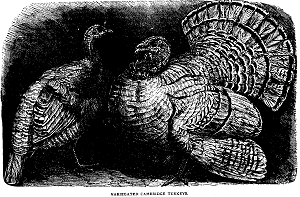
THE most opposite opinions have been expressed by different breeders as to
whether or not the rearing of turkeys in England can be made profitable ; and
the general judgment, we are bound to say, seems to be that they can barely be
made to repay the cost of their food. There are not wanting, however, those who
from their own experience maintain the contrary; and we believe that where the
balance-sheet is unsatisfactory, the cause will generally be found in heavy
losses from want of care. The usual mortality in turkey-chicks is tremendous,
and quite sufficient to eat up any possible amount of profit; but there are
persons who for years have reared every chick; and, under these circumstances,
they will yield a fair return.
The number of hens allowed to a turkey-cock ought to be limited to twelve or
fifteen - quite enough brood stock for even a large establishment. The turkey-cock
may be used for breeding at two years old, and the hen at twelve months, but are
not in their prime till a year older. They will be first-class breeding stock,
as a rule, for at least two years later, and many cocks will breed splendid
chickens for considerably longer; a good bird should not therefore be discarded
till his progeny show symptoms of degeneracy. The size of the hens is of special
importance, much more than that of the cock, in whom good shape, strength, and
spirit are of more value, if combined with a fair good size. The turkey-hen
generally lays about eighteen eggs - sometimes only ten or a dozen, and when each
egg has been taken away when laid, it may be more. We once heard of ninety eggs
being laid by a turkey-hen, but can scarcely credit such a statement. A very
good plan is to give a turkey's first seven eggs to a common hen - quite as many
as she can cover - when there will be just about enough laid subsequently to be
hatched by the turkey herself. The best time to hatch the chicks out is in the
months of May and June, or even July; and all eggs set should be marked, as the
turkey often lays several after commencing incubation. In a state of nature, the turkey-cock is
constantly seeking to destroy both the eggs and the chickens, which the female
as sedulously endeavours to conceal from him. There is generally more or less of
the same disposition when domesticated, and, when it appears, it must be
carefully provided against. The turkey-hen is very prudish, but gives scarcely
any trouble while sitting. She sits so constantly that it is needful to remove
her daily from her nest to feed, or she would absolutely starve. Nevertheless,
when absent she is apt to be forgetful, and therefore, if allowed to range at
liberty, care should be taken that she returns in time-twenty minutes. Besides
her daily feed, a water vessel and some soft food should be always within her
reach. No one must visit the hatching-house but the regular attendant, or the
hens will get startled, and probably break many eggs, which easily happens, from the great weight of the
birds. The chicks break the shell from the twenty-sixth to the twenty-ninth day,
scarcely ever later. The day but one before the hatching is expected, the hen
should be plentifully fed, the nest cleaned of any dung or feathers during her
absence, and an ample supply of food and water placed where she can reach it, as
she must not again be disturbed till the chicks are out. In dry weather, if the
nest be in a dry place, the eggs will have been daily sprinkled as described
under hatching. The egg-shells may be cleared away after hatching has proceeded
some hours, but the chicks should never be taken away from the hen, and never be
forced to eat. The latter practice is very general, as turkey chicks are very
stupid, and do not seem to know how to peck. But a much better plan is to put
two ordinary hen's eggs under the turkey, five or six days after she began to
sit, which will then hatch about the same time as her own? and the little
chickens will teach the young turkeys, quite soon enough, what they should do.
Water or milk may be given, however, by dipping the tips of the finger, or a
camel-hair pencil, in the fluid, and applying it to the end of their beaks. The
best feeding at first - say for a [-218-] week - is
hard-boiled eggs, chopped small, mixed with nothing but minced dandelion. When
dandelions cannot be obtained - and it is well worth while to grow them where
turkeys are reared - boiled nettles chopped fine are perhaps the best substitute.
At the end of a week or ten days some bread-crumbs and barley-meal may gradually
be added to the egg, which may be by degrees lessened, until quite discontinued
at the end of three weeks. About this time, a portion of boiled potato forms an
excellent addition to the food, and by degrees some small grain may be added
also - in fact, assimilating the diet very much to that of other poultry. Curds
also are excellent as a portion of the dietary, but must be squeezed very dry
before they are given. They are easiest prepared by adding a pinch of alum to a
quart of milk slightly warmed. By this feeding, the little chicks will get well
through their first great danger - the tendency to diarrhoea already alluded to;
and the cost of the egg will be repaid by the extra number reared. The second
peril to be guarded against is cold and damp a wetting is absolutely fatal. The
chicks should be kept entirely under a shed, on a board floor kept scrupulously
clean and nicely sanded, except during settled sunny weather, when they may be
allowed a little liberty on the grass, after the dew is quite dry. But in cold
or windy weather, however fine, they must be kept in the shed, and well screened
from the wind. If there be a one-storey building, their best place will be the
top floor, the bottom being devoted to the sitting hens and other adult stock.
Their water also must be so supplied that they cannot wet themselves by any
possibility; and these precautions must be continued till they are nine or ten
weeks old, when they will begin to "put out the red," as it is called, or
to develop the singular red excrescences on the neck so characteristic of the
turkey breed. This process will last some little time, and when completed the
birds will be pretty fully fledged. They are now hardy, but must not be suddenly
exposed to rain or cold winds. Take reasonable care of them for awhile longer,
and very soon they will have become the hardiest birds known in the
poultry-yard, braving with impunity the fiercest storms, and even preferring, if
permitted, to roost on high trees through the depth of winter. In fact, turkeys
will rarely roost in a fowl-house; and a very high open shed should therefore be
provided-the higher the better-the perches being placed as high as possible. The
ordinary domestic turkey is of two kinds - the Norfolk (black all over) and the Cambridge. The latter is of all
colours - the
best, to our fancy, being a dark copper bronze ; but fawn colour and pure white
are often seen, as are also variegated birds, which occasionally present a very
magnificent appearance. The dark Cambridge usually attains the greatest size.
The Guinea-fowl mates in pairs, and an equal number of males and females must
therefore be provided, to prevent disappointment. In commencing, it is needful
to procure some eggs and set them under a common hen ; for if old birds be
purchased they will wander off for miles as soon as they are set at liberty, and
never return ; indeed, no fowl gives such trouble from its wandering habits. If
hatched in the poultry-yard, however, and regularly fed, they will remain; but
must always have one meal regularly at night, or they will scarcely ever roost
at home. Nothing, however, will persuade them to sleep in the fowl-house, and
they usually roost in the lower branches of a tree. The hen lays pretty freely
from May or June to about August. She is a very shy bird, and if eggs are taken
from her nest with her knowledge, will forsake it altogether, and seek another,
which she conceals with the most sedulous care. A few should therefore always be
left, and the nest never be visited when she is in sight. It is best to give the
earliest eggs to a common hen, as the Guinea-fowl herself frequently sits too
late to rear a brood. If "broody" in due season, however, she rarely fails to hatch nearly all.
Incubation is from twenty-six to twenty-nine or thirty days. The chicks require
food almost immediately - within, at most, six hours after hatching-and should be
fed and cared for in the same manner as young turkeys, though they may be
allowed rather more liberty. It should be observed, however, that they require
more constant feeding than any other chickens, a few hours' abstinence being
fatal to them; and they need also rather more animal food to rear them
successfully and keep them in good condition, especially in the winter. The
flesh of the Guinea-fowl is of exquisite flavour, much like that of the
pheasant. The body about equals in size an ordinary Dorking, and is very plump
and well-proportioned.
DISEASES OF POULTRY.
When the stock is provided, let it be not only attended to as described in
our last paper, but carefully observed occasionally for symptoms of disease.
Loss of Feathers is almost always caused either by want of green food, or
having no dust-bath. Let these wants therefore be properly supplied, removing
the fowls, if possible, to a grass run. For local application, we prefer an
unguent composed of sulphur and creosote, but nothing will bring back the
feathers before the next moult.
Roup is always caused by wet, or very cold winds. It begins with a common
cold, and terminates in an offensive discharge from the nostrils and eyes, often
hanging in froth about them. It is highly contagious, the disease being, as we
believe, communicated by the sickly fowl's beak contaminating the drinking
water; therefore, let all fowls affected by it be at once put by themselves, and
have a separate water-vessel. Keep them warm, and feed with meal only, mixed
with hot ale instead of water; give every day internally a capsule of copaiba,
and wash the head and eyes with Labarraque's solution of chlorinated soda,
diluted with two parts of water. Under this treatment the birds affected will
rapidly improve in most cases. Roup runs its course rapidly, and in a week
the bird will either be almost well or so nearly dead that it had better be
killed at once. It is the disease of poultry, and to be dreaded accordingly;
fortunately, the symptoms are specific, and the treatment equally so. Much may
be done to guard against contagion by dis. infecting all drinking vessels with
carbolic acid, or Condy's disinfecting fluid.
Diarrhoea may be caused either by cold, wet weather, with inadequate shelter; neglect in cleansing the house and run; or from the reaction after
constipation caused by too little green food. In this case, feed on warm barley
meal, liberally sprinkled with powdered chalk; and at first administer, four
times a day, three drops of camphorated spirit on a pill of meal. This will
usually effect a cure. If the evacuations become coloured with blood, the
diarrhoea has passed into dysentery, and recovery is almost hopeless. Another
prescription is one grain each of opium and ipecacuanha, with five grains of
chalk ; but the camphorated spirit we consider a better remedy.
Soft Eggs are generally caused by over-feeding the hens, in which case the
remedy is self-evident. It may, however, occur from want of lime, which must
then be supplied, the best form being calcined and pounded oyster-shells.
Sometimes it is occasioned by fright, from being driven about, but in that case
will right itself in a day or two. If perfect eggs are habitually dropped on the
ground, the proprietor should see whether the nests do not need purifying. This
leads us to
Insect Vermin, which can only be troublesome from gross neglect, either of
the fowls or their habitations. The remedy is a dust-bath, mixed with powdered
coke or [-219-] sulphur,
and lime-washing, with a liberal sprinkling about of any good carbolic
disinfecting powder.
It will be seen that by far the greater proportion of poultry diseases arise
either from cold or wet, or neglect in preserving cleanliness-often from both
causes combined.
It should be noted also, that the first general symptom of nearly
all such
diseases is diarrhoea, which we have observed usually manifests itself even in
roup, before any discharge from the nostrils is perceptible. At this stage much
evil may be warded off. Whenever a fowl hangs its wings, and looks drooping, let
it be seen at once whether it appears purged, and if so, give immediately, in a
table-spoonful of warm water, a tea-spoonful of strong brandy saturated with
camphor. Repeat this next morning, and in most cases the disease, whatever it
is, will be checked; care being of course taken to give the invalid warmth and
good shelter, with ale in its food. If the evacuation continues, administer the
stronger prescription given for diarrhoea.
[--grey numbers in brackets indicate page number, |