Victorian London - Crime - Prostitution - London Labour and the
London Poor - Ladies of Intrigue and Houses of Assignation - Cohabitant Prostitutes - Narrative of a Gay Woman at the West End of the Metropolis
London Labour and the London Poor
A
Cyclopædia of the Condition and Earnings of Those That Will Work, Those That
Cannot Work, and Those That Will Not Work.
By Henry Mayhew.
London:
Griffin, Bohn, and Company, Stationers' Hall Court. 1862.
[digitised copy kindly provided by Les
Butler, ed.]
[... back to index]
Ladies Of Intrigue
And Houses Of Assignation
The reader will find more information
about "ladies of intrigue" in the annals of the Divorce Court and
the pages of the Causes Célèbres than it is in my power to furnish him with.
By ladies of intrigue we must understand married women who have connection
with other men than their husbands, and unmarried women who gratify their
passion secretly.
There is a house in Regent Street, I
am told, where ladies, both married and unmarried, go in order to meet with
and be introduced to gentlemen, there to consummate their libidinous desires.
This sort of clandestine prostitution is not nearly so common in England as in
France and other parts of the Continent, where chastity and faithfulness among
married women are remarkable for their absence rather than their presence. As
this vice is by no means common or a national characteristic, but rather the
exception than the rule, it can only expect a cursory notice at our hands.
An anecdote was told me illustrative
of this sort of thing that may not be out of place here.
A lady of intrigue, belonging to the
higher circles of society, married to a man of considerable property, found
herself unhappy in his society, and after some time unwillingly came to the
conclusion that she had formed an alliance that was destined to make her
miserable. Her passions were naturally strong, and she one day resolved to
visit a house that one of her female acquaintances had casually spoken about
before her some little time before. Ordering a cab, she drove to the house in
question, and went in. There was no necessity for her to explain the nature of
her business, or the object with which she called. That was understood. She
was shown into a handsome drawing-room, beautifully fitted up, for the house
was situated in one of the best streets in May Fair, there to await the coming
of her unknown paramour. After waiting some little time the door opened, and a
gentleman entered. The curtains of the room were partially drawn round the
windows, and the blinds were pulled down, which caused a "dim religious
light" to pervade the apartment, preventing the lady from seeing
distinctly the features of her visitor. He approached her, and in a low tone
of voice commenced a conversation with her about some indifferent subject.
She listened to him for a moment, and
then with a cry of astonishment recognized her husband's voice. He, equally
confused, discovered that he had accidentally met in a house of ill-fame the
wife whom he had treated with unkindness and cruelty, and condemned to
languish at home while he did as he chose abroad. This strange rencontre had a
successful termination, for it ended in the reconciliation of husband and
wife, who discovered that they were mutually to blame.
From the Divorce Court emanate strange
revelations, to which the press gives publicity. It reveals a state of
immorality amongst the upper and middle classes that is deplorable; but
although this unveils the delinquencies of ladies of intrigue, they are not
altogether the class we have under discussion. Those who engross our attention
are ladies who, merely to satisfy their animal instincts, intrigue with men
whom they do not truly love. But though we could multiply anecdotes and
stories, it is not necessary to do more than say, they are a class far from
numerous, and scarcely deserve to form a distinctive feature in the category
of prostitution in London.
THE last head in our classification is
"Cohabitant Prostitutes," which phrase must be understood to
include-
1. Those whose paramours cannot afford
to pay the marriage fees. This is a very small and almost infinitesimal
portion of the community, as banns now cost so very little, that it is next to
an absurdity to say "a man and woman" cannot get married because
they have not money enough to pay the fees consequent upon publishing the
banns, therefore this class is scarcely deserving of mention.
2. Those whose paramours do not
believe in the sanctity of the ceremony.
There may be a few who make their
religious convictions an objection to marriage, but you may go a very long
journey before you will be able to discover a man who will conscientiously
refuse to marry a woman on this ground. Consequently we may dismiss these with
a very brief allusion.
3. Those who have married a relative
forbidden by law. We know that people will occasionally marry a deceased
wife's sister, notwithstanding the anathemas of mother church are sure to be
hurled at them. Yet ecclesiastical terrors may have weight with a man who has
conceived an affection for a sister-in-law, for whom he will have to undergo
so many penalties.
Perhaps parliamentary agitation may
soon legitimatize these connections, and abolish this heading from our
category of Cohabitant Prostitution.
4. Those who would forfeit their
income by marrying, - as officers' widows in receipt of pensions, and those
who hold property only while unmarried.
This class is more numerous than any
of those we have yet mentioned, but it offers nothing sufficiently striking or
peculiar to induce us to dwell longer upon it, as it explains itself.
5. Those whose paramours object to
marry them for pecuniary or family reasons.
This is a subject upon which it has
been necessary to dilate; for it includes all the lorettes in London, and the
men by whom they are kept. By lorettes, I mean those I have before touched
upon as prima donnas, who are a class of women who do not call going to
night-houses in Panton Street walking the Haymarket, and feel much insulted if
you so characterize their nocturnal wanderings. The best women go to three or
four houses in Panton Street, where the visitors are more select than in the
other places, where the door porters are less discriminating. Sometimes women
who are violent, and make a disturbance, are kept out of particular houses for
months.
Of course, the visits of kept women
are made by stealth, as the men who keep them would not countenance their
going to such places. Perhaps their men are out of town, and they may then go
with comparative safety.
Women who are well kept, and have
always been accustomed to the society of gentlemen, have an intense horror of
the Haymarket women, properly so called, who promenade the pavement in order
to pick up men.
And in reality there is a greater
distinction between the two classes than would at first appear. Even if a good
sort of woman has been thrown over by her man, and is in want of money, she
will not pick up any one at a night-house who may solicit her; on the
contrary, she will select some fellow she has a liking for: while, on the
other hand, the Haymarket women will pick up any low wretch who she thinks
will pay her. She will not even object to a foreigner, though all the best
women have a great dislike to low foreigners.
Were I to dwell longer upon this
subject it is clear I should merely be recapitulating what I have already said
in a former portion of this work.
The following narrative was given me
by a girl I met in the Haymarket, when in search of information regarding the
prostitution of the West-end of London. Her tale is the usual one of
unsuspecting innocence and virtue, seduced by fraud and violence. The victim
of passion became in time the mistress of lust, and sank from one stage to
another, until she found herself compelled to solicit in the streets to obtain
a livelihood. She was about twenty-one years of age, beneath the ordinary
height, and with a very engaging countenance. She appeared to be a
high-spirited intelligent girl, and gave her sad tale with unaffected candour
and modesty.
Narrative Of A Gay Woman At The
West End Of The Metropolis
I was born in the county of----, in
England, where my father was an extensive farmer, and had a great number of
servants. I have three brothers and one younger sister. I was sent to a
boarding school at B----, where I was receiving a superior education, and was
learning drawing, music, and dancing. During the vacations, and once every
quarter, I went home and lived with my parents, where one of my chief
enjoyments was to ride out on a pony I had, over the fields, and in the
neighbourhood, and occasionally to go to M----, a few miles distant. On these
occasions we often had parties of ladies and gentlemen; when some of the best
people in the district visited us. I had one of the happiest homes a girl
could have.
When I was out riding one day at
M----, in passing through the town, my pony took fright, and threatened to
throw me off, when a young gentleman who was near rode up to my assistance. He
rode by my side till we came to a hotel in town, when we both dismounted.
Leaving the horses with the hostlers, we had some refreshment. I took out my
purse to pay the expenses, but he would not let me and paid for me. We both
mounted and proceeded towards my home. On his coming to the door of the house,
I invited him to come in, which he did. I introduced him to my papa and mamma,
and mentioned the kind service he had done to me. His horse was put up in our
stables, and he remained for some time, and had supper with us, when he
returned to M----. He was very wealthy, resided in London, and only visited
M---- occasionally with his servants.
I was then attending a boarding-school
at B---- , and was about fifteen years of age. A few days after this I left
home and returned to B----. We corresponded by letter for nearly twelve
months.
From the moment he rode up to me at
M---- I was deeply interested in him, and the attachment increased by the
correspondence. He also appeared to be very fond of me. He sometimes came and
visited me at home during my school holidays for the next twelve months. One
day in the month of May - in summer - he came to our house in his carriage,
and we invited him to dinner. He remained with us for the night, and slept
with one of my brothers. We were then engaged to each other, and were to be
married, so soon as I was eighteen years of age.
The next day he asked my parents if I
might go out with him in his carriage. My mamma consented. She asked if any of
our servants would go with us, but he thought there was no occasion for this,
as his coachman and footman went along with us. We proceeded to B---- Railway
Station. He left his carriage with the coachman and footman, and pressed me to
go with him to London. He pretended to my parents he was only going out for a
short drive. I was very fond of him, and reluctantly consented to go with him
to London.
He first brought me to Simpson's hotel
in the Strand, where we had dinner, then took me to the opera. We went to
Scott's supper rooms in the Haymarket. On coming out we walked up and down the
Haymarket. He then took me to several of the cafés, where we had wine and
refreshments. About four o'clock in the morning he called a Hansom, and drove
me to his house; and there seduced me by violence in spite of my resistance. I
screamed out, but none of the servants in the house came to assist me. He told
his servants I was his young wife he had just brought up from the country.
I wanted to go home in the morning,
and began to cry, but he would not let me go. He said I must remain in London
with him. I still insisted on going home, and he promised to marry me. He then
bought me a watch and chain, rings and bracelets, and presented me with
several dresses. After this I lived with him in his house, as though I had
been his wife, and rode out with him in his brougham. I often insisted upon
being married. He promised to do so, but delayed from time to time. He
generally drove out every day over the finest streets, thoroughfares, and
parks of the metropolis; and in the evenings he took me to the Argyle Rooms
and to the Casino at Holborn. I generally went there very well dressed, and
was much noticed on account of my youthful appearance. We also went to the
fashionable theatres in the West-end, and several subscription balls. I often
rode along Rotten Row with him, and along the drives in Hyde Park. We also
went to the seaside, where we lived in the best hotels.
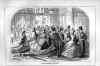
The Haymarket At Midnight
This lasted for two years, when his
conduct changed towards me. One evening I went with him to the Assembly Rooms
at Holborn to a masked ball. I was dressed in the character of a fairy queen.
My hair was in long curls hanging down my back. He left me in the supper-room
for a short time, when a well-dressed man came up to me. When my paramour came
in he saw the young man sitting by my side speaking to me. He told him I was
his wife, and inquired what he meant by it, to which he gave no reply. He then
asked me if I knew him. I replied no. He asked the gentleman to rise, which he
did, apologising for his seating himself beside me, and thereby giving
offence. On the latter showing him his card, which I did not see, they sat
down and had wine together.
We came out of the supper-room, and we
had a quarrel about the matter. We walked up and down the ball-room for some
time, and at last drove home.
When we got home he quarrelled again
with me, struck me, and gave me two black eyes. I was also bruised on other
parts of the body, and wanted to leave him that night, but he would not let
me. In the morning we went out as usual after breakfast for a drive. Next
evening we went to the Casino at Holborn. Many of the gentlemen were staring
at me, and he did not like it. I had on a thick Maltese veil to conceal my
blackened eyes. The gentleman who had accosted me the previous night came up
and spoke to me and my paramour (whom we shall call S.), and had some wine
with us. He asked the reason I did not raise my veil. S. said because I did
not like to do it in this place. The gentleman caught sight of my eyes, and
said they did not look so brilliant as the night before. S. was indignant, and
told him he took great liberty in speaking of his wife in this manner. The
other remarked that no one could help noticing such a girl, adding that I was
too young to be his wife, and that he should not take me to such a place if he
did not wish me to be looked at. He told him he ought to take better care of
me than to bring me there.
When we got home we had another
quarrel, and he struck me severely on the side. We did not sleep in the same
bed that night. On coming down stairs to breakfast next morning I was taken
very ill, and a medical man was sent for. The doctor said I was in a fever,
and must have had a severe blow or a heavy fall. I was ill and confined to my
bed for three months. He went out every night and left me with a nurse and the
servants, and seldom returned till three or four o'clock in the morning. He
used to return home drunk; generally came into my bedroom and asked if I was
better; kissed me and went downstairs to bed.
When I got well he was kind to me, and
said I looked more charming than ever. For three or four months after he took
me out as usual. The same gentleman met me again in the Holborn one night
while S. had gone out for a short time, leaving me alone. He came up and shook
hands with me, said he was happy to see me, and wished me to meet him. I told
him I could not. S. was meanwhile watching our movements. The gentleman asked
me if I was married, when I said that I was. He admired my rings. Pointing to
a diamond ring on his finger, he asked me if I would like it. I said no. He
said your rings are not so pretty. I still refused it; but he took the ring
off his finger and put it on one of mine, and said, 'See how well it looks,'
adding, 'Keep it as a memento; it may make you think of me when I am far
away.' He told me not to mention it to my husband.
Meantime S. was watching me, and came
up when the man had gone away, and asked what he had been saying to me. I told
him the truth, that the same man had spoken to me again. He asked me what had
passed between us, and I told him all, with the exception of the ring. He
noticed the ring on my finger, and asked me where I had got it. I declined at
first to answer. He then said I was not true to him, and if I would not tell
him who gave me the ring he would leave me. I told him the man had insisted on
my having it. He thereupon rushed along the room after him, but did not find
him. On coming back he insisted on my going home without him. He took me
outside to his brougham, handed me in it, and then left me. I went home and
sat in the drawing-room till he returned, which was about three o'clock in the
morning. He quarrelled with me again for not being true to him. I said I was,
and had never left his side for a moment from the time I rose in the morning
till I lay down at night. I then told him I would go home and tell my friends
all about it, and he was afraid. Soon after he said to me he was going out of
town for a week, and wished me to stop at home. I did not like to remain in
the house without a woman, and wished to go with him. He said he could not
allow me, as he was to be engaged in family matters. He was absent for a week.
I remained at home for three nights, and was very dull and wearied, having no
one to speak to. I went to my bedroom, washed and dressed, ordered the
carriage to be got ready, and went to the Holborn. Who should I see there but
this gentleman again. He was astonished to see me there alone; came up and
offered me his arm. I told him I was wearied at home in the absence of S., and
came out for a little relaxation. He then asked to see me home, which I
declined. I remained till the dancing was nearly over. He got into the
brougham with me and drove to Sally's, where we had supper., after which he
saw me home. He bade me 'good-bye,' and said he hoped to see me at the Holborn
again some other night. Meantime S. had been keeping watch over me, it
appears, and heard of this. When he came home he asked me about it. I told
him. He swore the gentleman had connexion with me. I said he had not. He then
hit me in the face and shook me, and threatened to lock me up. After breakfast
he went out to walk, and I refused to go with him.
When he had gone away I packed up all
my things, told the servant to bring a cab, wrote a note and left it on the
table. I asked the cabman if he knew any nice apartments a long way off from
C----, where I was living. He drove me to Pimlico, and took me to apartments
in ---- where I have ever since resided.
When I went there I had my purse full
of gold, and my dresses and jewellery, which were worth about 300l.
One evening soon after I went to the
Holborn and met my old friend again, and told him what had occurred. He was
astonished, and said he would write to my relations, and have S. pulled up for
it. After this he saw me occasionally at my lodgings, and made me presents. He
met S. one day in the City, and threatened to write to my friends to let them
know how I had been treated. I still went to the Holborn occasionally. One
evening I met S., who wished me to go home with him again, but I refused,
after the ill-usage he had given me. I generally spent the day in my
apartments, and in the evening went to the Argyle, until my money was gone. I
now and then got something from the man who had taken my part; but he did not
give me so much as I had been accustomed to, and I used to have strange
friends against my own wish. Before I received them I had spouted most of my
jewellery, and some of my dresses. When I lived with S. he allowed me 10l. a
week, but when I went on the loose I did not get so much.
After I had parted with my jewellery
and most of my clothes I walked in the Haymarket, and went to the Turkish
divans, 'Sally's,' and other cafés and restaurants.
Soon after I became unfortunate, and
had to part with the remainder of my dresses. Since then I have been more
shabby in appearance, and not so much noticed.
