[-back to menu for this book-]
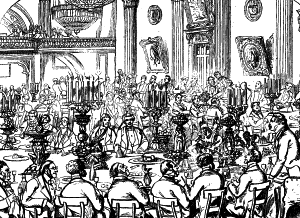
[-218-] SIX P.M.- A CHARITY DINNER, AND THE NEWSPAPER WINDOW AT THE GENERAL POST-OFFICE.
SOME years ago, at the cozy little dining club held in my friend
Madame Busque's back-parlour, in the Rue de la Michodière, and
the city of Paris, I had the advantage of the friendship of one of the
most intelligent and humorous of the American gentlemen. There is
such a personage - the vulgar, drawling, swearing, black-satin-vested,
stove-pipe-hatted, whittling, smoking, expectorating, and dram-drinking Yankee loafers, who infest the Continent, notwithstanding; and a
very excellent sample of the accomplished and unpretending gentleman
was the American in question. He had paid a visit to England, in which country his sojourn had been of about three months' duration;
but he frankly confessed to me that having come purposely unprovided
with those usually tiresome and worthless figments, letters of introduction -
the very Dead-Sea apples of hospitality, goodly on the
exterior, and all dust and ashes within - he had not, with the exception of his banker, who asked him to dinner once as a courteous
acknowledgment of the ponderosity of his letter of credit, possessed
one single acquaintance, male or female, during his stay in the metropolis of the world. I asked him whether he had not felt very lonely
and miserable, and sufficiently inclined, at the end of the first week, to
cast himself over any given bridge into the river Thames. Not in the
slightest degree, he replied. I politely hinted that perhaps, as an
American, he possessed the genial facility, common to his countrymen,
of making himself at home wheresoever he went, and of forming
agreeable travelling acquaintances, occasionally ripening into fast
friends, by the simple process of saying "Fine day, stranger." Not
at all, he replied. He kept himself to himself and indeed he was of
a disposition, save in casual moments of unbending, quite surprising
for its saturnine taciturnity. At all events, I urged, he could not have
amused himself much by prowling about the streets, sleeping at
hotels, dining in coffee-rooms, frequenting theatres and singing-rooms,
and wandering in and out of museums; but I was wrong again, he
said. He had seldom been so jolly in his life. I began to think
either that he was quizzing me- gumming is the proper Transatlantic colloquialism, I
think - or else that he was - the Happy Man [-219-] described in the Eastern apologue. But then, the Happy Man had,
as it turned out, no shirt; and my American was remarkable for displaying a vast amount of fine linen, both at breast and wristbands,
profusely decorated with studs, chains, and sleeve-buttons. How
was it, then, I asked, giving the enigma up in sheer bewilderment.
"Wall," answered my friend with his own peculiar dry chuckle, "I
used to ride about all day on the tops of the omnibuses; and very fine
institutions for seeing life in a philosophical spirit, those omnibuses of
yours are, sir." He said Sir-not "Sirree," as Anglo-Americans are
ordinarily assumed to pronounce that title of courtesy. I understood
him at once; saw through him; had done the same thing myself; and
admired his penetrative and observant aptitude.
Never ride inside an omnibus - I
apostrophise, of course, the men
folks; for till arrangements are made (and why should they not be
made ?) for hoisting ladies in an easy-chair to the breezy roof - they
can manage such things on board a man-of-war - the vehicular ascent
is incommodious, not to say indecorous, for the fair sex. But Ho, ye
men, don't ride inside. A friend of mine had once his tibia fractured
by the diagonal brass rod that crosses the door; the door itself being violently slammed to, as is the usual custom, by the conductor.
Another of my acquaintance was pitched head foremost from the
interior, on the mockingly fallacious cry of "all right" being given
-
was thrown on his head, and killed. Inside an omnibus you are
subjected to innumerable vexatious and annoyances. Sticks or parasols
are poked in your chest and in the back of your neck, as a polite
reminder that somebody wants to get out, and that you must seize the
conductor by the skirt of his coat, or pinch him in the calf of the leg,
as an equally polite request for him to stop; you are half suffocated
by the steam of damp umbrellas; your toes are crushed to atoms as
the passengers alight or ascend; you are very probably the next
neighbour to persons suffering under vexatious ailments, such as
asthma, simple cold in the head, or St. Vitus's dance; it is ten to one
but that you suffer under the plague of babies; and, five days out of
the seven, you will have a pickpocket, male or female, for a fellow-passenger. The rumbling, the jumbling, the jolting, and the
concussions - the lurking ague in the straw when it is wet, and the
peculiar omnibus fleas that lurk in it when it is dry, make the interior
of one of these vehicles a place of terror and discomfort; whereas
outside all is peace. You have room for your legs; you have the
fresh air; you have the lively if not improving conversation of the [-220-] driver and the conductor, and especially of the right-hand box-seat,
who is invariably in some way mysteriously connected with dogs and
horses, and a great authority thereupon. Finally, you have the
inestimable advantage of surveying the world in its workings as you
pass along: of being your own Asmodeus, and unroofing London in a
ride from the White horse Cellar to Hammersmith Gate. The things
I have seen from the top of an omnibus !-more markedly in the
narrow streets through which, from the main thoroughfare being
blocked up by ·the incessant paving, lighting, sewerage, or electric
telegraph communications of underground London, one is compelled
to pass. Now a married couple enjoying an animated wrangle in a
first-floor front; now a servant-maid entertaining a policeman, or a
Life Guardsman, with a heart's devotion and cold shoulder of mutton,
in a far-down area; now a demure maiden lacing her virgin bodice
before a cracked triangle of a looking-glass, at an attic window; now
lords and ladies walking with parasols and lapdogs, and children in
the private gardens of noble mansions, screened from the inquisitive
pedestrians by sullen brick walls; now domestics hanging out the
clothes in back-yards (seen over the roofs of one-storey houses),
malicious birds of prey waiting, doubtless, round the corner for the
fell purpose of pecking off their noses, while the astute King is in his
counting-house on the second floor counting out his money, and the
Queen, with the true gentleness of womanhood, is in the front kitchen,
eating bread and honey in confident security, reeking little of the
four-and-twenty blackbirds baked in a pie, or of the song of sixpence - or rather of five
shillings - which I am this day singing about them
all, in consideration of an adequate pocketful of rye. So shall you
look down and see those things; but chiefly shall you enjoy delectation and gather experience from the sight of the men and women who
are continually passing beneath you in carriages and in cabs; yea,
and in carts and harrows. Varied life, troubled life, busy, restless,
chameleon life. The philosopher may learn much by reading the
tradesmen's names over the shop-fronts, which-he will never read
them as he passes along the pavement - will give him quite a new
insight into nomenclature. But only let him consider the carriages
and the cabs, and he may learn wisdom in the ways of mankind in
every rood of ground he traverses.
Sweethearting in cabs and carriages; passionate appeals for mercy;
men brawling and fighting; lunatics being borne away to captivity;
felons, shackled and manacled to the chin, being taken to jail, and [-221-] perhaps to death, by stern policemen and jailers; frantic women
kneeling on carriage-floors, women with dishevelled hair, streaming
eyes, clasped hands raised to a Heaven which is never deaf but is
sometimes stern, a weeping child clinging to their disordered dress,
and money and jewels cast carelessly on the carriage cushions;
gamblers carding and dicing; knaves drugging fools; debtors in the
charge of sheriff's officers; roysterers gone in drink; the "fatal
accident" on its way to the hospital, lying all bruised and bloody
across the policeman's knee ; the octogenarian in his last paralytic
fit, and the mother suckling her first infant. All these dramas on
four wheels may be seen by him on the top of the omnibus, who
may, if of a caustic turn, rub his hands, and cry, " Aha! little do
you reck that a chiel is above you taking notes, and, faith, that he'll
print them!"
You see, there are some elements of sadness, nay, of deep and
terrible tragedy, in these vehicular panoramas - the unconscious show-vans; but at Six o'Clock in
the Evening the cabs and carriages
on which you look down offer, mostly, a far pleasanter spectacle.
They are full of people going out to dinner. Some in broughams, coupés, double-bodied carriages, and the occupants of these are ladies
and gentlemen, attired in the full panoply of evening costume, and
whom, at the first blush, you might take for members of the highest
aristocracy. But they are not so. They simply belong to the first-class genteel circles,
the very superior middle ranks ; the dwellers in
Lower Belgravia-Brompton, Kensington, and Pimlico; or in Lesser
Tyburnia-Bayswater and Notting hill. They have all the airs and
graces, all the allurements, of the titled and the exclusive; but they
have not the genuine hall-mark of nobility and fashion; they are but Britannia metal,
electro-gilt in a very superior manner. The undeniable Patricians, the satraps of our modern Persian splendour, do
not dine (would not supper be a more appropriate term?) till half-
past seven, or even eight, post meridian. They can have, I should
imagine, but scant appetites for their dinner at that advanced period
of the evening, unless, indeed, they partake of it in the ancient Roman
manner, lolling on the triclinium, crowning themselves with flowers,
and following, between the courses, the swinish examples of Apicius
and Lucullus. Better, I take it, a mutton chop at the Cock, or
the Cheshire Cheese, than these nasty Ancient Roman repasts.
It is true our moderns stay their aristocratic stomachs early in the
afternoon with a copious lunch of hot meats and generous wines; and [-222-] they say that her blessed Majesty herself, like a good, sensible woman,
makes her real dinner at two o'clock, with her little children, in the
nursery, and takes but a mere bite and sup at the grand stall-fed feast
of gold plate in the evening.
But there are plenty of good dinners going on at six o'clock in the
evening, and plenty of good diners-out to attend them. Masters in
Chancery, who are renowned judges of port-wine, dine at six. Six, for
half-past, is the dinner-hour for East India Directors. Let us hope
that their dinners will continue to be as good as of yore, though the
new India Bill leaves them nothing to direct. Members of Parliament,
during the session, dine whenever they can, and sometimes not at all;
but on "no House days", six o'clock-always taken with a reservation for the half-past, for "six o'clock sharp" is entirely gone out of
fashion, save with Muswell Hill stock-brokers, Manchester Square
proctors, Bedford Row solicitors, and people who live in Bloomsburia - is the great time for them to drop into their clubs, sneer over the
evening papers, gnash their teeth because there may happen to be no
leading articles eulogistic or abusive of them therein, and prendre des
informations, as the French say (though why I could not just as well
say it in English, save that the cook at the club is a Frenchman,
puzzles me), about what there may be good for dinner. But I must
not forget that I am on the top of an omnibus, looking down on the
people in the broughams and the cabs. Admire that youthful exquisite, curled, and oiled, and scented into a
sufficient semblance of the
"Nineveh Bull," with whom Mr. Tennyson was so angry in "Maud."
His glossy hair is faultlessly parted down the occiput and down the
cranium behind. White as the fleece of Clarimunda's sheep is his
body linen. Stiff as the necks of the present generation is his collar.
Black as Erebus is his evening suit. Shining like mirrors are the little
varnished tips of his jean-boots. Severe as the late General Picton
is the tie of his cravat. This gracilis puer is going to dine in Thurlow
Square, Brompton. That gold-rimmed lorgnon you see screwed into
his face, to the damaging distortion of his muscles, will not be removed
therefrom - nor during dinner, nor during wine-taking, nor during the
evening party which will follow the dinner, nor during the "little
music," the dancing, the supper, the shawling, the departure, and the
drive home to his chambers. He will eat in his eyeglass, and drink in
his eyeglass, and flirt and polk in his eyeglass. I am almost persuaded
that he will sleep in his eyeglass (I knew a married lady who used to
sleep in her spectacles, which led to a divorce: she alleged the cause to
[-223-] be systematic cruelty, but what will not an enraged woman say?); and
I should not be in the least surprised if he were to die in his eyeglass,
and be buried in his eyeglass, and if the epitaph on his gravestone were
to be " veluti in speculum."
Down and down again, glance from the omnibus summit, and see
in that snug, circular-fronted brougham, a comfortable couple, trotting
out to dinner in the Alpha Road, St. John's Wood. Plenty of lobster
sauce they will have with their salmon, I wager; twice of boiled chicken
and white sauce they will not refuse, and oyster patties will they freely
partake of. A jovial couple, rosy, chubby, middle-aged, childless, I
opine, which makes them a little too partial to table enjoyments. They
should be well to do in the world, fond of giving merry, corpulent
little dinners of their own, with carpet dances afterwards, and living,
I will be bound (our omnibus is ubiquitous, remember) at Maida Hill,
or Pine Apple Gate. There is another couple, stiff, starched, angular,
acrimonious-looking. Husband with a stern, Lincoln's Inn conveyancing face, and pilloried in starch, with white kid gloves much too
large for him. Wife, with all manner of tags, and tags, and odds and
ends of finery fluttering about her: one of those women who, if she
had all the rich toilettes of all King Solomon's wives on her, would
never look well dressed. I shouldn't like to dine where they are
going. I know what the dinner will be like. Prim, pretentious,
dismal, and eminently uncomfortable. There will be a saddle of mutton not sufficiently hung, the fish will be cold, the wines hot, and
the carving-knives will be blunt. After dinner the men will talk
dreary politics, redolent of stupid Retrogression, and the women will
talk about physic amid the hooping-cough. Yet another couple -
husband and wife? A severe swell, with drooping moustaches of immense length, but which are half whiskers. Transparent deceit! A
pretty lady-gauzy bonnet and artificial flowers, muslin jacket, skirts
and flounces oozing out at the sides of the carriage; hair a la Eugenie,
and a Skye terrier with a pink ribbon. I know what this means.
Greenwich, seven o'clock dinner (they are rather late, by the way, but
they pass us on London Bridge, and the coachman will drive rapidly)
water souché, whitebait, brown bread and butter, and iced punch
cigar on balcony, and contemplation of the moon. Ride on, and be
happy. Rejoice in your youth - and never mind the rest. It will
come, O young man, whether you mind it or not.
Hallo there he is. I thought so. With a red face, shaven to the
superlative degree of shininess, with gills white and tremendous, with a [-224-] noble white waistcoat, and from tune to time nervously consulting his
watch, lest he should behalf a minute behind time with time spring soup,
rides by in a swift Hansom, the old gentleman who is going to a Charity
Dinner. Blessings on his benevolent, gastronomic old head, he never
misses one. He is going as quick as double fare will convoy him to
the London Tavern. Quick! oh thou conductor, let me descend, for I
must take a Hansom too, and follow my venerable friend to the London
Tavern; and, by cock and pye, I will go dine there too.
I think my readers must be by this time sufficiently acquainted
with the fact that I am endowed with a very nervous temperament.
Indeed, were I to say that I start at my own shadow, that I do fear
each bush an officer, that I am continually in terror of Sudden Death,
that I would rather not go upstairs in the dark, and that (which is not at all incompatible with a nervous
organisation) in circumstances of
real moment, in imminent life-peril, in a storm, in a balloon, in a
tumult, and in a pestilence, I am perfectly master of myself, and, with
a complete Trust and Reliance, am quite contented and happy in any
mind: when I state this, I don't think I need blush to own that I am
as mortally afraid now of the boys in the street as in the old days when
they pelted me with sharp stones because I preferred going to school
quietly instead of playing fly-the-garter in the gutter. I am afraid of
my last schoolmaster (he is quite bankrupt and broken, and pays me
visits to borrow small silver occasionally), and yet call him reverentially, Sir. I am afraid of
ladies - not of the married ones, in whom
I take great delight, talking Buchan's "Medicine," Aeton's "Cookery,"
and Mrs. Ellis with them, very gravely, till they think me a harmless
fogey, hopelessly celibate, but sensible; not of the innocent young
girls, with their charming niaveté and pretty sauciness; but of the young ladies, who are
"out," and play the piano, and sing Italian songs - of which, Lord bless them! they know no more than I do of
crochet-work - and who fling themselves, their accomplishments, and
their low-necked dresses, at men's heads. I am afraid of policemen,
lest in an evanescent fit of ill temper they should take me up, and
with their facile notions of the obligations of an oath, swear that I was
lurking about with intent to commit a felon; and, transcendentally, I
am afraid of waiters. I watch them - him - the Waiter, with great
awe and trembling. Does he know, I ask myself, as he fills my tumbler with iced champagne, that half-and-half is a liquid to which I am
more accustomed? Does he know that, sumptuously as I dine to-day,
I didn't dine at all yesterday? Is he aware that Mr. Threadpaper is [-225-] dunning me for that dress-coat with the watered-silk facings? Can
he see under the table that the soles of my boots are no better than
they should he? Is it within his cognizance that I have not come to
the Albion, or the London Tavern, or the Freemasons', as a guest, but
simply to report the dinner for the "Morning Meteor?" Does he
consider the shilling I give him as insufficient? Shilling! He has many more shillings than I have, I
trow. He pulls four pounds in
silver from his pocket to change one a crown-piece. To-day he is
Charles or James; but to-morrow he will be the proprietor of a magnificent West-end restaurant, rivalling Messrs.
Simpson and Dawes at
the Divan, or Mr. Sawyer at the London. So I am respectful to the
waiter, and fee him largely but fearfully ; and, were it not that he
might take me for a waiter in disguise, I would also call him "Sir."
I no sooner arrive at the London Tavern, pari passu with the old
gentleman with the gills and the white neckcloth, than I feel myself
delivered over to the thraldom of waiterdom. An urbane creature,
who might pass for a Puseyite curate, were not the waitorial stigmata
unmistakeably imprinted on him, meets me, and tells me in an oleaginous undertone, which is like clear
turtle-soup, that the Anniversary
Festival of the Asylum for Fatuous Monomaniacs as on the second
floor to the right. A second waiter meets me at the foot of the staircase, amid whispers discreetly behind the back of his hand,
"Two
storeys higher, sir." A third waylays me benevolently on the first-floor landing, and mildly ravishes from me my hat and stick, in return
for which he gives me a cheque much larger than my dinner ticket;
which last is taken from me on the second floor by a beaming spirit,
the bows of whose cravat are like wings, and who hands me to a Dread Presence -
a stout, severe man with a gray head, who is in truth
the head waiter at this Anniversary Festival, and who with a solemn
ceremony inducts me into the reception-room.
Here, in a somewhat faded, but intensely respectable-looking
apartment, I find about fifty people I don't know from Adam, and who
are yet all brothers or uncles or cousins-german, at the least, of my
rubicund white-waistcoated friend. And, to tell the truth, I don't
know him personally, though his face, from meeting him at innumerable festivals, is perfectly familiar to me. So are those of the other
fifty strangers. I have heard all their names, and all about them;
but one is not expected to remember these things at public dinners.
You take wine with your next neighbour; sometimes converse with
him about eating and drinking, the merits of the charity, the late [-226-] political tergiversation of the chairman, the heat of the weather, the
fine voice of Mr. Lockey, and the pretty face of Miss Ransford, and
there an end. Your interlocutor may be to-morrow time lawyer who
sues you, the author whose book you will slaughter in a review, the
Commissioner of Insolvency who may send you back for eighteen
months. To have met a man at a public dinner is about as valid a
claim to the possession of his acquaintance, as to have met him in the
Kursaal at Homboumg, or on the steps of the St. Nicholas Hotel at New
York. After some twenty years of public dining together, it is not, I
believe, considered a gross breach of etiquette to make the gentleman
who has been so frequently your fellow convive a very distant bow
should you meet him in the street; but even this is thought to be a
freedom by some rigid sticklers for decorum.
In genteel society, the half hour before dinner is generally accepted
as a time of unlimited boredom and social frigidity, but there you have
the relief, if not relaxation, of staring the guests out of countenance,
making out a mental list of the people you would not like to take wine
with, and turning over the leaves of the melancholy old albums, every
page of which you have conned a hundred times before. But in the
half hour (and it frequently is a whole one) before a public dinner,
you have no albums or scrapbooks to dog's-ear. There is no use in
staring at your neighbours: the types of character are so similar-big
and crimsoned sensuous faces looming over white waistcoats, with a
plentiful sprinkling among them of the clerical element. You can't
smoke, you can't (that is, I daren't) order sherry and bitters. If you
look out of the window, you see nothing but chimney pots, leads, and
skylights, with a stray vagrant cat outrunning the constable over them;
and the best thing you can do is to bring an amusing duodecimo with
you, or betake yourself to one of the settles, and twiddle your thumbs
till dinner-time. But, joy, joy, here are quails in the conversational
famine ; here is a welling spring in the wilderness. The door opens,
and the sonorous voice of the head-waiter announces THE CHAIRMAN.
Very probably he is a lord. A philanthropic peer, always ready
and willing to do a kind turn for anybody, and to the fore with his
chairmanship, his set speeches, and his fifty-pound note for "fatuous
monomaniacs," "intellectual good-for-nothings," or "decayed bailiffs."
He may be a regular dining-out lord, a not very rich nobleman, who
has grown gray in taking the chair at charity dinners, and who is not
expected to give anything to the institution save the powerful weight
of his presence and influence. He may be a young lord, fresh caught, [-227-] generously eager (as are, I am rejoiced to say, the majority of our
young lords now-a-days) to vindicate the power and willingness for
usefulness of his order ; striving to show that there is not so much difference between his coronet and the Phrygian cap, save that one is
made of velvet and the other of red worsted (ah! that irreconcileable
red worsted), very impulsive, very imprudent, sometimes slightly imbecile, but full of good intentions and honest aspirations; or he
may be
a member of Parliament, a veteran of the back benches, burning to
make up for his silence in the house by his eloquence in the forum of
a tavern dinner. He may be a worthy hanker or merchant, who gets
through the speech-making before him in a business-like manner, and
does not allow it in the least to interfere with the consumption of his
proper quantum of wine; or he may be, as is very frequently the case,
a lion-the "great gun" - the last blast of Fame's trumpet for the
hour: a lawyer, a traveller, a philosopher, or an author, whom the
managing committee have secured, just as the manager of a theatre
would secure a dwarf, a giant, a wild beast tamer, a blind piper, or a
sword swallower, to enhance the receipts of the exhibition.
About thirty of the fifty people I don't know from Adam gather
immediately in a circle round the chairman. The few who have the
honour to be on speaking terms with him jostle him sociably, and
shake hands with him with a rueful expression of contentment. Those
who don't know him rub their hands violently, breathe hard, stare
fixedly at him, and whisper to one another that he is very like his
portrait, or that he isn't at all like his portrait, or that he is getting
old, or that he looks remarkably young, or some equally relevant
banalities. The remaining twenty guests gather in the window-bays,
and stare at nothing particular, or else read the printed prospectus of
the Asylum for Fatuous Monomaniacs, and wonder how many of the
fine list of stewards announced may be present on the occasion. As
for the chairman, he takes up a position with his back safely glued (so
it seems) to the mantelpiece, and preserves a dignified equanimity,
working his head from side to side in his white neckcloth hike that
waxen effigy of Mr. Cobbett, late M.P. for Oldham, which terrifies
country cousins by its vitality of appearance (those drab smallclothes
and gaiters were a great stroke of genius) at Madame Tussaud's.
By this time a crowd of more people you don't know from Adam,
and often outnumbering the fifty in the waiting-room, have gathered
on the staircase, the landing, and have even invaded the precincts of
the dining saloon, where they potter about the tables, peeping for the [-228-] napkins which may contain the special cards bearing their name and
denoting their place at the banquet. These are the people who do
know one another; these are the stewards, patrons of the charity, or
gentlemen connected with its administration. They are all in a very
excellent temper, as men need be who are about to partake of a capital
dinner and a skinful of wine, and they crack those special jokes, and
tell those special funny stories, which you hear nowhere save at a
public dinner. Then, at the door, you see a detachment of waiters,
bearing fasces of long, blue staves, tipped with brass, which they distribute to sundry inoffensive gentlemen, whose real attributes are at
once discovered, and who are patent to the dining-out world as
Stewards. They take the stares, looking very much ashamed of them;
and, bearing besides a quaint resemblance to undertakers out for a
holiday, and in a procession, which would be solemn if it wasn't funny,
precede the chairman to his place of honour.
The tables form three sides of an oblong quadrangle:
sometimes the horse-shoe form is adopted. In the midst, in a line with the chairman, and as close to his august presence as is practicable, is a table of
some ten or a dozen couverts, devoted to some modestly-attired gentlemen (some of them not in evening costume at all), whose particular
places are all assigned to them; who for a wonder seem on most intimate terms mutually, and take wine frequently with one another; who
are waited upon with the most sedulous attention, and have the very a
best on the table, both in the way of liquids and solids, at their disposal. They apply themselves to the consumption of these delicacies
with great diligence and cheerfulness but they do not seem quite sufficiently impressed with the commanding merits of the Royal Asylum
for Fatuous Monomaniacs. I wonder what special business brings
these gentlemen hither. At some distance from this table, towards the
door, but still in a line with the chairman, you see a pianoforte, and a
couple of music-stands; partially concealed behind a crimson baize
screen, beneath the gallery at the end, sit some stalwart individuals, of
martial appearance, and superbly attired in scarlet and gold lace, whom
you might easily, at first, mistake for staff officers, but whom their
brass trombones and ophicleides speedily proclaim to be members of the
band of one of the regiments of Guards. And high above all, supported on the sham
scagliola Corinthian columns, with the gilt capitals,
is a trellised balcony, full of ladies in full evening dress. What on
earth those dear creatures want at such gatherings, - what pleasure
they can derive from the spectacle of their husbands and friends over-[-229-]
SIX O'CLOCK P.M. : A CHARITY DINNER
[-230-]eating and sometimes over-drinking themselves, or from the audition
of stupid speeches, passes my comprehension. There they are, however, giggling, fluttering, waving tiny pocket-handkerchiefs, and striving to mitigate the meaty miasma of the place by nasal applications
to their bouquets or their essence bottles ; and there they will be, I
presume, till public dinners go out of fashion altogether.* (* The ladies appear in
the gallery before dinner, quit it after grace has been
said, and are regaled in ante-chambers with ices, coffee, and champagne. They
return when the speech-making, wine-bibbing, and song-singing commence.)
I do not think I am called upon to give the bill of fare of a public
dinner. I have no desire to edit the next republication of Ude, or
Doctor Kitchener, Soyer, or Francatelli; besides, I could only make
your and my mouth water by expatiating on the rich viands and wines
which "mine host" (he is always mine host) of the Albion, the
London Tavern, or the Freemasons', provides for a guinea a-head.
You remember what I told you the friend with the face like an overripe fig said of public
dinners - that they were the sublimation of
superfluities; and, indeed, if such a repast be not one of those in which
a man is called upon to eat Italian trout, Dutch dory, Glo'ster salmon,
quails and madeira, Cherbourg pea-chicks, Russian artichokes, Macedonian
jellies, Charlottes of a thousand fruits, Richelieu puddings,
vanilla creams, Toulouse leverets, iced punch, hock, champagne, claret,
moselle and burgundy, port, sherry, kirschwasser, and pale brandy, I
don't know the meaning of the word superfluity at all.
Some three hours after the company have sate down to dinner
after the "usual loyal and constitutional toasts," with the usual musical
honours; after the toast of the evening - "Prosperity to the Royal
Asylum for Fatuous Monomaniacs" - with its accompanying (more
or less) eloquent speech from the noble or distinguished chairman,
beseeching liberal pecuniary support for so deserving an institution;
after the prompt and generous response, in the way of cheques and
guineas, from the guests; after a tedious programme of glees and
ballads has been got through, and the chairman has discreetly vanished
to his carriage; after the inveterate diners-out, who will tarry long at
the wine, have received one or two gentle hints that coffee awaits their
acceptance in an adjoining apartment; and about the time that the
feast begins to wear a somewhat bleared and faded aspect (the lights
cannot grow pale till they are turned off, for these are of the Gas Company's providing), the waiters slouch about with wooden trays, full of
ruined dessert-plates, cracked nuts, muddy decanters, and half-emptied [-231-] glasses; cherry stalks, strawberry stems, squeezed oranges, the expressed skins of grapes, litter the tables; chairs are standing at all
sorts of eccentric angles; and crumpled and twisted napkins are thrown
pell-mell about. There is an end to the fine feast: the cates are eaten,
the wine drunk. Lazarus the beggar might have taken his rags out of
pawn (had he indeed any such rags to mortgage), and his thin-limbed
little brats might have grown plump and rosy on a tithe of the money
that has been wasted this night in guttling and guzzling. Wasted?
Oh! say not wasted, Cynic; take the mote from thine own eye.
Grumbler, for shame! I have done ill, I think, to caricature the name
even of any public charity. Let the "Fatuous Monomaniacs" be
numbered with the rest of my exploded fantastic conceits. Let this
rather be remembered: that the tavern feast of superfluities is prolific
in generous and glorious results; that from this seemingly gross and
sensual gathering spring charity, love, mercy, and benevolence.
Pardon the rich dinners and rare wines; look over the excess in
animal enjoyments; forgive even the prosy speeches; for the plate has
gone round. To-morrow Lazarus shall rejoice in his rags, and blind
Tobias shall lift up his hands for gratitude ; the voice in Rama shall
be bushed and Rachel shall weep no more; and all because these good
gentlemen with the rosy faces and the white waistcoats have dined so
well. For these dinners are for the benefit of the sick and the infirm,
the lunatic and the imbecile, the widow and the orphan, the decayed
artist and the reduced gentlewoman, the lame, the halt, the blind, the
poor harlot and the penitent thief, and they shall have their part in
these abundant loaves and fishes; and the sublimation of superfluities
must be condoned for the sake of those voluntary contributions which
are the noblest support of the noble charities in England. Remember
the story of the Pot of Ointment. These superfluities yield a better
surplus than though the spikenard was sold for an hundred-pence and
given to the poor.
A very cream of waiters has taken good care of me during the
evening. He now fetches me my walking gear, and as he pockets my
modest "largesse," whispers confidentially that he has had the honour
of seeing me afore; and, blushing, I remember that I have met him
at private parties. It is well for me if I can slip downstairs quietly,
hail a cab, and drive to one of the operas ; for an act of the "Trovatore"
or "Lucrezia Borgia" are, in my opinion, far better than Seltzer
water in restoring the balance of one's mind after an arduous public
dinner. But it oft-times happens that a man in your memorialist's [-232-] position has to pass a
quart d'heure de Rabelais, worse than paying the
bill, after one of these festive meetings. For, in a roomy apartment
downstairs, lighted by waxen tapers, such things as pens, ink, and
paper, coffee, cognac, and cigars, are, by the forethought of the liberal
proprietors of the establishment, laid out for the benefit of those merry
gentlemen you saw upstairs at the small table in a line with the chairman, where they were so well taken care of; and if circumstances
compel me to be in a merry mood tonight, I must hie me into this
roomy chamber, and scribble a column or so of "copy" about the
dinner, which will appear to-morrow morning in the "Meteor."
Rubbing my eyes as I glance over the damp sheet between my own
warm ones in bed, I wonder who ever could have written the report of all those elegant speeches. It seems at least a year since I dined with
the "Fatuous Monomanaics."
This is again six o'clock p.m., but not by any means on the same
evening. The occasion could have no possible connection with going
out to dinner, for it happens to be six o'clock "sharp": and, moreover, it is on Friday, a day on which
it is supposed to be as unlucky
to go out to dinner as to go to sea, to marry, to put on a new coat, to
commence a new novel, to cut your nails, or buy tripe. Now, what
can I be doing in the city on this Friday evening? Certainly not to
perform any of the operations alluded to above. Scarcely on business.
Bank, Exchange, wharfs, Custom-house, money-market, merchants'
counting-houses, are all closed, and the inner city, the narrow winding
lanes, that almost smell of money, are deserted. What am I doing so
close to St. Paul's Cathedral, and why do I turn off by St. Martin's-le-Grand? For the simple reason, that Friday evening is the very
best one in the seven to witness the spectacle I am going to see -
Newspaper Fair at the General Post Office.
In the vast vestibule, or hall, of the establishment so admirably
presided over by Mr. Rowland Hill (for I do not reckon the aristocratic placeman who is, turn and turn about, Whig or Tory, its
nominal chief, for much), and whose fostering care has made it (with
some slight occasional shortcomings) the best-managed and most
efficient national institution in Europe, you may observe, in the lefthand corner from the peristyle, and opposite the secretary's office
(tremendous "counts" are the clerks in the secretary's office, jaunty
bureaucrats, who ride upon park hacks, and are "come for" by
ringlets in broughams at closing time, but who get through their [-233-]

SIX O'CLOCK P.M. : THE NEWSPAPER WINDOW AT THE GENERAL POST-OFFICE
[-234-] work in about half the time it would take the ordinary slaves of the
desk, simply because their shrewdness and knowledge of the world
enables them to "see through a case" before the average man of
tape and quill can make up his mind to docket a letter) a huge longitudinal slit in the panelling above, on which is the inscription "For
newspapers only." And all day long, newspapers only, stringed or
labelled, are thrust into this incision; and the typographed lucubrations of the some five hundred men who, for salaries ranging from
twenty shillings to twenty pounds per week, have to think, and sometimes almost feel, in the Anglo-Saxon tongue, for some sixty millions
of people (I say nothing of the re-actionary influence upon foreign
nations), go forth to the uttermost ends of the earth. But as six
o'clock approaches (and six o'clock sharp is the irrevocable closing
time for the departure of newspapers by the current night's mail),
they open a tall window above, and the newspapers are no more
thrust, but flung in.
It is on this congenial ground that I meet those juvenile friends
to whom I introduced a large circle of acquaintances, even in the
second hour of "Twice Round the Clock" - I mean the newspaper
boys. In another page I said, jestingly, that I was afraid of boys.
I must except from the category the newspaper boys. I have been
sadly harassed and teazed by them in their out-of-door or bagful
state, when they go round to purchase newspapers: for I once happened to be editor of a cheap journal, at whose office there was no
editor's room. I was compelled, occasionally, to read my proofs behind the counter, in the presence of the publisher and his assistant,
and I have endured much mental pain and suffering from the somewhat too demonstrative
facetiae of the young gentlemen engaged in
thee "trade." Verbal satire of the most acutely personal nature was
their ordinary mode of procedure ; but, occasionally, when the publication (as sometimes happened) was late in its appearance, their
playfulness was aggravated to the extent of casting an old shoe at me,
and on one signal occasion a bag of flour. Still the newspaper boy is
the twin-brother of the printer's devil; and, much as I have seen of
those patient, willing little urchins, I should be a brute if I were hard
to them, here.
The newspaper boys are, of course, in immense array at the six
o'clock fair on Friday evening. They are varied, as currants are by
sultanas in a dumpling, by newspaper men, who, where thee boys struggle up to the window and drop in their load, boldly
fling bags [-235-] full, sacks full, of journals into the yawning casement. There is a legend that they once threw a boy into the window, newspapers and
all. But at six o'clock everything is over - the window is closed -
and newspaper fair is adjourned to the next Friday.
|
[nb. grey numbers in brackets indicate page number, (ie. where new page begins), ed.] |