[-back to menu for this book-]
[-251-] EIGHT O'CLOCK P.M.-HER MAJESTY'S THEATRE, AND A PAWNBROKER'S SHOP.
I THINK that I have held out something like a guarantee, in the course
of these papers, that my readers shall be introduced to a fair amount of
fashionable life. How far I have performed my promise it is for them
to judge; but I am not, myself, without misgivings. True it is that,
under my guidance, they have perambulated Regent Street; have dined
off the fat of the land at a Public Dinner; have betted at Tattersall's,
ridden in the Park; heard the band play at St. James's; strolled
through the Pantheon Bazaar; and lounged in a theatrical green-room: but then, have not I, discourteous cicerone, cajoled them into visiting
strange unlovely places, dismal to look upon; persuaded them to hang
up their harps by the willows of the Custom-house quay, and listen to
the slang of oyster-boatmen and bargees, at Billingsgate; forced them
to haunt the purlieus of police-courts, and witness the departure of
prison-vans and their felonious cargoes; to keep bad hours, and associate
with newspaper boys, market-gardeners, paupers, and common people
who travel by parliamentary train ; to become acquainted, in fact, with
scenes and people distressingly low and unfashionable? It is true that
I have not taken them to the lanes of Petticoat and Field; to Duke, [-252-] his Place; or St. Mary, her Axe; or
Bevis, his Marks ; or Rag, its
Fair; or Whitechapel, its Butcher Row; or Ratcliff, its Highway; or
Lock, his Fields; or Somers Town, its Brill; or Rats, their Castle; or
Whetstone, its Park ; or Jacob, his Island; or Southwark, its Mint;
or Lambeth, its New Cut; or St. Giles, its Church Lane and Hampshire Hog Lane. If I have not moved them so to travel with me, it is
not, I fear, through any laches of intention or deficiency of will, but
simply because I have at different seasons travelled over every inch of
the road I have named with other readers, and that I have a decent
horror of repeating myself, and respect for the maxim of non bis in
idem.
Be my demerits granted or disallowed, I have still some time left to
me wherein to make amends. Though it may be my duty, ere we have
finished, to lead you again into dismal and wretched places, you shall
have at least an instalment of fashionable life now; and - follow
honest Sancho's advice as to not looking the gift-horse in the mouth; be satisfied with my assurance that this present one is of the pure
Godolphin Arabian lineage, elegant in form, unquestionable in mettle,
electrical in swiftness. The next may be but a sorry nag, spavined,
blown, wind-galled, and sprung. You must take the bad with the
good, in this world, and in all things.
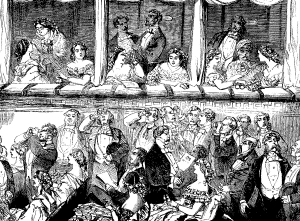
Ladies and gentlemen, we are going to the Opera - to her Majesty's
Theatre in the Haymarket; and by eight o'clock it behoves us all to be
in our seats, if we wish to hear the first bars of the overture. It is true
that if we are so fortunate as to possess, or to hire, or to have opera-boxes given to us, we do not, frequently, make our appearance in the
theatre till past nine o'clock ; and that, if we are lessees or renters of
stalls, the ballet has frequently commenced before we condescend to
occupy our seats; but if the pit or the amphitheatre be our destination,
we had much better present ourselves at the entrance immediately the
doors open, and secure seats with what speed we may. It is a peculiarity of her Majesty's Theatre that whether the
"house" be a good one
or a bad one, there are always, before the termination of the first act of
the opera, some occupants of the pit who are compelled to content themselves with standing-room.
Opinions are divided as to the place in the enceinte of the magnificent theatre where the greatest enjoyment of the performance can be
obtained. To some, a box on the grand tier - vast, roomy, with space
for six to sit abreast - is considered the superlative of operatic felicity.
[-253-] Others hold out stoutly for the artistic fourth tier, where, they declare,
they can hear and see better than their lowly-placed neighbours. There
are many who abide by the stalls, despite of those who declare that in
the front rows thereof the voices of the singers are drowned by the contiguity of the braying band. The pit has its defenders, who allege that
distance not only "lends enchantment to the view," but chastens the
instrumental exuberances of the orchestra ; but perhaps the most energetic advocates of the merits of their own particular seats are the
dwellers in the high-up amphitheatre or gallery, who boldly declare
that it is in that elevated position alone, that you can enjoy, in the full
extent of their beauty, the gems of the opera, and that the sole place fit
for the presence of the genuine amateur is the operatic paradise, ascent
to which is permitted for the sum of three-and-sixpence or half-a-crown.
Be our election, however, the stalls. From those comfortable
fauteuils let us explore the ample field - see what the open, what the
covert yield ; and, as we expatiate over this scene of Man, own that,
though "a mighty maze," it is "not without a plan". For there is a
plan of her Majesty's Theatre in the box-office.
Am I treading on any one's toes, disturbing any one's prejudices,
predilections, or pre-formed opinions, in asseverating that the interior
of Mr. Lumley's establishment offers, with one exception, the most
magnificent coup-d'oeuil of any Opera in Europe that I have seen?
Mark the cunning qualification! I say, that I have seen; for they tell me that there is an Opera at Barcelona (which nutty sea-port I have
never visited), a theatre surpassing in grandeur, and richness of decoration, all the lyric temples of the continent or of these isles; and so far as
mere size is concerned, the palm must, I believe, be yielded to Parma,
in which caseous Italian city there exists - yet unexplored by me - a
huge tumble-down, ruinous, leaky, mildewed salle, which is as the Tower
of Babel of Opera-houses the Great Bonassus of theatres. I speak of
the houses which these weak eyes, in the course of many years' wandering, have surveyed, through
powerful-lensed lorgnettes. Give me her
Majesty's. Above the dreary Scala, with its naked tiers above tiers,
its sediti chuisi, and the three reserved front rows of the pit, where the
authorities were compelled to put the white-blanketed Austrian officers,
lest they should come to blows (they often squabbled in the lobbies even)
with the spiteful Milanese; the ghastly, dingy, ill-lighted Scala - (it is
bigger by far than her Majesty's, though) - with its rabbit-hutch-like
private boxes, whose doors are scrawled over with the penny plain and [-254-] twopence coloured-like coats of arms of the effete and decadent Lombardian nobility. Above the boasted Grand Opera at Paris, tawdry,
inconvenient, and chopped up into unreasonable sections. Above the
Burg Theater, at Vienna; the Theatre de la Monnaie, at Brussels.
Above, even, the superb little Opernhaus, at Berlin, which, though a gem
in its way, is but as a diamond aigrette to the Koh-i-noor. Above the
late Royal Italian Opera House, in Bow Street, Covent Garden, London,
which was simply a big theatre, ill-built, and undecorated. For the
solitary exception I have hinted at you must go north, very far north
into Europe, and in the city of Moscow, in the empire of Holy Russia,
you shall find an Italian Opera house unprecedented, I verily believe,
for size, for splendour, for comfort, for elegance, and for taste. It
was not my fortune to be present in Moscow on the occasion of the
coronation fetes, when the theatre I speak of was opened to the public
preparatory to the regular winter season; but for a description of
its glories I must refer those curious in operatic matters to my friend
Mr. Henry Sutherland Edwards, who was resident many months in the
city of the Kremlin, and whom I sincerely wish I could persuade to do,
in better part, for Moscow the holy that which I have myself endeavoured, according to my lights, to do for St. Petersburg the mundane.
Look around you, in the vast arena of her Majesty's. Wonder and
admire, for such a sight it is not permitted to you often to behold.
Look around, and around again, the enormous horseshoe; look from
base to summit, at this magnificent theatre, glorious with beauties and
with riches. Here are gathered the mighty, and noble, and wealthy,
the venerable and wise, the young and beauteous of the realm. The
prime minister seeks at the opera a few hours' relaxation from the toils
of office; the newly-married peeress there displays the dazzling diamonds
custom now, for the first time, permits her to wear; the blushing
maiden of seventeen, "just out "- that very day, perhaps, presented
at Court - smiles and simpers in a shrine of gauze and artificial flowers.
Mark yonder, that roomy box on the grand tier, which a quiet, plainly-dressed party has just entered. There is a
[-255-] matronly lady in black,
with a few bugle ornaments in her coiffure. She ensconces herself in a
corner, her back towards the audience, screens herself with a curtain,
and then calmly proceeds to take a review of the front rows of the
stalls, and the occupants of the proscenium boxes. It is not considered
etiquette to take more than a cursory glimpse of the matronly lady in
black through your opera-glass. Presently there sits down by the
matronly lady's side, a handsome, portly, middle-aged gentleman, in
plain sober evening dress, and with a very high forehead - so high,
indeed, that I don't think that the assumption that the middle-aged
gentleman's head inclined to baldness would be unreasonable. In the
opposite angle of the box sits a demure young lady - sometimes a
couple of demure ones - who doesn't move much or speak much; and
at the back of the loge are two gentlemen in white waistcoats, who
never sit down, and, from the exquisitely uncomfortable expression of
their countenances, would appear to be standing on one leg. Now,
take the hat of your heart oft; for your head, according to operatic
sumptuary laws, must be already uncovered, and with your spirit
salaam thrice three times, for the matronly lady is Victoria Queen of
England, and the middle-aged gentleman, inclined to corpulence and
baldness, is his Royal Highness the Prince Consort. The demure ones
are maids of honour or ladies in waiting; and as for the white-waist-coated uncomfortables (seemingly) on one leg, one may be the tremendous Gold Stick himself, and the
other - who shall say? - the ineffable
Phipps, pride of chivalry and pearl of privy purses.
On the same tier, but nearer the stage, there is a narrow box, holding only two persons
de face, at whose occupants you may gaze without any glaring dereliction of the proprieties. See, a lady who screens
herself behind the amber satin drapery, even more completely than her
Majesty, and by her side an elderly gentleman, with a large mouth, a
very stiff white neckcloth, and a very severe aspect, and about whose
tendency to baldness there cannot exist any doubt, inasmuch as his
cranium is as bare and polished as a billiard-ball. It would be a
pardonable guess to presume this individual to be a member of the
College of Preceptors, or a proctor, fresh from Doctors' Commons; but
if you eye him narrowly through the many-lensed lorgnette, you will
perceive that he wears a little badge of parti-coloured ribands at his
button-holes, and on some evenings you may even discern a brilliant
star tacked on the left breast of his coat. Who is this distinguished
bald one? I must not be personal with less distinguished people than
royalty, and so I will content myself with calling him his Excellency.
His Excellency dwells in an enormous mansion in Belgravia, where he
gives grand parties. His own little cabinet is, I am told, decorated
with charming-coloured lithographs, representing scenes Oriental and
operatic; and, indeed, his Excellency has been throughout his long
and ornamental life a consistent and liberal patron of Terpsichore. [-256-] He never misses a new ballet night now. Occasionally, his Excellency
has some business to transact with the Baron Fitzharris, Earl of Malmesbury; but the old fogies of the clubs, and the chronic alarmists of the
newspapers, are haunted by the notion that his Excellency is perpetually weaving plots, and entangling British statesmen in the mazes
of his dark diplomacy. For my part, I think that very often, when
his Excellency is supposed to be busily occupied in concocting his Machiavellian plots, the good man is quietly at home snipping away
the outlines of his favourite coloured lithographs, and pasting them in
albums or on screens. You know what the Chancellor Oxenstiern said
to his son anent the small amount of wisdom with which this world is
governed; and I think as much might be said concerning diplomacy.
But his Excellency has a terrible reputation for undermining, plotting,
and counter-plotting, and is supposed to be, intellectually, a compound
of the dark and crooked astuteness of Talleyrand, Metternich, ex-Inspector Field, and the late Joseph
Ady.
I might tire you out, and exhaust a space already growing limited,
by drawing portraits of the denizens of opera-boxes. Our glances at
them must be, perforce, rapid, for I dare not linger. See, there (he
comes late, does not seem to enjoy the music much, and stays but for
an hour) seventy-three years worth of learning, of genius, of wit, of
eloquence, and patriotism - that glorious edifice of humanity, of which
the first stone was laid by a young north-country advocate, who was
a friend of Jeffrey and Sydney Smith, and wrote stinging articles in the
"Edinburgh Review." No man so famous as that whilom chancellor
has her Majesty's Theatre reckoned among its audience, since the days
when, in spotless white waistcoat, and creaseless cravat, with a silver
buckle behind, the great duke was wont to make his bow at the court
of Euterpe, not because, honest man, he cared much for operas, Italian
or English, but because he considered it to be a matter of duty towards
that aristocracy of which, though a premier duke, he was the prince,
to show himself in their places of resort. He went everywhere, the
brave old boy, to balls and concerts, to routs and banquets. In the
house of feasting, when the goblets were wreathed with flowers, and
the cymbals clashed, there was Duke Arthur, long after his gums were
toothless, his eyes dim, his joints stiffened, and the drums of his ears
muffled. And, next morning, at eight o'clock, you would still see him
on duty, at early service, in St. James's Church, reading out the responses to the Psalms as though they were words of command. [-257-]
EIGHT O'CLOCK P.M. : THE OPERA
[-258-] There, in her family box, is the still beautiful marchioness, with
that crop of ringlets unequalled in luxuriance. There, in the stalls, is
Captain Fitzblazer, the Duke of Alma's aide-de-camp, whom we met
"behind the scenes" an hour since. "Jemmy" Fitzblazer - he is
always known as "Jemmy," though there are not half-a-dozen men of
his acquaintance who would presume thus familiarly to address him to
his face - is getting very middle-aged and gray-headed now. He is not
slim enough in the waist. Adonis is growing fat. Narcissus has the
gout. Lesbia's sparrow is moulting. A sad reflection, but so runs the
world.
I should be wilfully deceiving you, and unworthy the name I have
been always striving to gain-that of a faithful chronicler - if I were to
lead you to imagine that the brilliant theatre is full only of rank, fashion,
wealth, and happiness. Are any of the terms I have used synonymous,
I wonder. There are many aching hearts, doubtless, beneath all this
jewellery and embroidery ; many titled folks who are thinking of
pawning their plate on the morrow, many dashing young scions of
aristocracy, who, between the bars of the overture, are racking their
brains as to how on earth they are to meet Mephibosheth's bill, and
whether a passage through the Insolvent Court would not be, after
all, the best way out of their difficulties. And in the great equality
that dress-coats, bare shoulders, white neckcloths, and opera-cloaks
make among men and women, how much dross and alloy might we not
find among the gold and silver! In the very next box to the mother
of the Gracchi, resplendent among her offspring, in her severe beauty,
is poor pretty lost Mrs. Demmymond, late Miss Vanderplank, of the
Theatres Royal. The chaste Volumnia, who only comes to the opera
once in the season, and always goes away before the commencement of
the ballet, is elbowed in the crush-room by Miss Golightly, who has
one of the best boxes that Mr. Sams can let, and who comes with a head
of flaxen hair one night, and with raven black tresses the next. Captain Spavin, of the 3rd Jibbers, shudders when he finds his next-stall
neighbour to be his long-suffering tailor; and Sir Hugh Hempenridge,
baronet, is covered with confusion when he feels the hawk-glance of
little Casay, the sheriff's officer (and none so bravely attired as he)
darted full at him from Fops' Alley.
Fops' Alley! The word reminds me of bygone operatic days, and
I sigh when, looking round the house, I remember how Time, the
destroyer, has left a mark, too, upon these cari luoghi. It is true that
[-259-] many of those reminiscences may not be worth sighing for; but is there
not always something melancholy in the fading away of old associations? Where is the Omnibus Box? The longitudinal den answering
to the Loge Infernale at Paris, and the Fosse aux Lions at Madrid, yet
has its customary locality over the orchestra, on the Queen's side of the
proscenium; but where are its brilliant, witty, worthless occupants?
But one, the gay young prince, who, if report says true, kicked, with
his own royal foot, through the panels of the door of communication
leading from the Omnibus Box to the stage, and for that night-the
night of the famous Tamburini and Coletti disturbance - locked by
special order of M. Laporte, has become a Respectable, holds high
office, does his work well, and occupies himself far more with the subjects of soldiers' kit and barrack accommodation, than with squabbles
between Tweedledum and Tweedledee. But where are the rest? Where
the dashing spirits and impetuous madcaps of twenty years since? One
is in a lunatic asylum, and another is paralytic, and a third is prowling
about the gambling-places on the Rhine, and the last I saw of a fourth,
was once, in 1852, descending the stairs of the Hotel des Bains, at
Dieppe, when a companion, drawing me on one side as a broken, bowed,
decrepit, sunken-eyed, gray-headed, prematurely-aged man passed us
tottering on a stick, whispered to me, "See! there goes D'Orsay;"
who died a fortnight afterwards.
A Liberal, I hope - a Democrat, if you will - on some not unimportant public topics, I cannot help a species of meek wailing Conservatism upon the decadence of some of our social institutions. This
is the age of abolition - of doing away with and putting down. They
have robbed our grenadiers of their worsted epaulettes. The beefeaters
in the Tower have been deprived of those scarlet and embroidered
tunics, that contrasted so quaintly with the pantaloons and highlows of
everyday life, and thrust into buttoned-up coats and brass buttons.
The barristers' wigs will go next, I suppose, and the cocked-hat of the
parish beadle - his red plush shorts and buckled shoon are already departed. I have fears for the opera ; I tremble for the days when there
will be bonnets in the upper tiers and paletots in the pit. When I
mind the opera first, it was a subaltern's, and not a sergeant's, guard
that kept watch and ward under the portico. The officer on duty had
a right of entrance ex officio into the pit, and it was splendid to see
him swinging his bearskin and flashing his epaulettes in Fops' Alley.
The very name of Fops' Alley is becoming obsolete now. The next [-260-] generation will forget its locality. In those days, on drawing-room
nights, the men used to come in their court suits and uniforms, their
stars and badges, the ladies in their ostrich plumes and diamond necklaces, only taking off their trains. There were opera-hats in those
days-half moon cocked-hats; now the men carry Gibuses like pancakes. The link boys are disappearing - the leather-lunged, silver-badged fellows, who shouted so sonorously that Lady
Sardanapalias'
carriage stopped the way. And the glories of the operatic stage ; are
not those inconstant singing birds fled now? Can all the Arditis in
the world compensate for Costa, with his coat thrown back, and those
Immortal, tight-fitting white kid gloves? Hc was the first man who
ever succeeded in parting his hair down the back; and now, he too is
growing bald, and he has cajoled Grisi the mellifluous, and Mario the
heroic, to pipe their nightingale notes among the coach-builders of
Long Acre, and the fried-fish shopmen of Drury Lane. Of the glorious
unequalled, unapproachable Four - Grisi, Rubini, Tamburini, and Lablache- who once electrified the world in the "Puritani," three
are dead: the first is in Covent Garden provoking malevolent criticism.
Where are the other Four, the Terpsichorean quartett, the immortals
who danced the pas de quatre! Ah! Mademoiselle Piccolomini, you
are very arch and pretty; ah! Mademoiselle Marie Taglioni, you are
a spirituelle and graceful dancer; but you are not the giants and
giantesses of the old Dead Days.
"You little people of the skies,
What are you when the sun shall rise!"
But the sun is set, and there is darkness, and I am afraid that I am
prosing in re her Majesty's Theatre, as old playgoers will prose about
Jack Bannister, sir, and Dow ton, and Munden and Fawcett.
There is lately come to town, at least within these latter years, an
Italian gentleman by the name of Verdi, to whose brassy screeds, and
tinkling cymbalics, it is expected that all habitués of the opera must
listen, to the utter exclusion and oblivion of the old musical worthies
who delighted the world with their immortal works before Signor
Verdi was born. I have brought you to her Majesty's Theatre, and
this is unfortunately a Verdi night. You may listen to him, but I
won't. Thersites Theorbo, the editor of the "Spinet" (with which is
incorporated that famous musical journal the "Jew's Harp" ), may
accuse me of being "perfunctory," or of being an ass - no one minds
[-261-] Thersites Theorbo, knowing him to be a good fellow, much bemused in
Cavendish tobacco and counterpoint; but I will shut my eyes, and
muse upon the bygone glories of the opera. The place is a mass of
memories. Things and books, and scenes and men, and stories, come
teeming on my brain as I sit in my stall, heedless of Signor Verdi and
his musical machinations. From that shelf, well, known to me, where
nestle my dog's-eared Rabelais, my Montaigne, my annotated edition of
Captain Grose's Dictionary of the Vulgar Tongue, my Shakspeare, and
my beloved Jeremy Taylor, I take down garrulous old Pepys, and read - "Jan. 12, 1667. With my Lord Brouncker to his house, there
to hear some Italian Musique, and here we met Tom Killigrew, Sir
Robert Murray, and the Italian Signor Baptista, who had prepared a
play for the Opera, which Sir T. Killigrew do intend to have up ; and
here he did sing one of the acts. He is himself the poet as well as
the musician, and did sing the whole from the words without any
musique prick'd, and played all along on a harpiscon most admirably,
and the composition most excellent." And then I mind me of an
advertisement in the "London Gazette," in 1692, setting forth how
"the Italian lady that is lately come over, that is so famous for singing, will sing at the concerts at York Buildings during the season."
The season! There was a "season" in William the Deliverer's time,
then. So I call to mind Dick Steele's serio-comic announcement in
the fourth number of the "Tattler," of how "Letters from the Hay
market inform us that on Saturday night last the opera of Pyrrhus
and Demetrius' was performed with great applause." Then from the
beginning of Italian opera in England, a grand trunk line extending to
our days, I shunt off on to innumerable little branches and loop-lines.
I see the Faustina and the Cuzzoni coming to blows - Sir Robert Walpole backing the first, his lady the second. I am, for the nonce, an
ardent partisan of Mrs. Tofts. Then I have a vision of Mrs. Fox Lane,
in a hoop of preternatural size, bidding General Crewe get out of her
house, because he professed his ignorance as to whom Signora Mingotti was - the Mingotti who told Dr. Burney that she had "been frequently
hissed by the English for having a toothache, a cold, or a fever, to
which the good people of England will readily allow every human
being to be liable except an actress or a singer." And then I bow down
in awe before the radiant shadow of Farinelli, great and good, unmoved
by misfortune, unspoilt by fame - Farinelli, whose dulcet notes cured
a Spanish king of madness, who was thought worthy to receive [-262-] the decorations of the orders of St. Jago and of Calatrava - Farinelli,
of whom honest Will Hogarth could not help falling a little foul in the
Rake's Progress, but who was, nevertheless, as singularly modest
and upright as he was unprecedentedly gifted in his art. Unprecedentedly! recall the word. I bow before a greater shadow, though of
one who wrote, and sang not, save to his pretty wife.* (* Who married again, and extinguished herself. So did Maria Louisa, so did
Mrs. Shelley. They will marry again, those unconscionable feminines.) I see a little
boy, in a grave court suit, and his young locks curling like the tendrils
of the vine, sitting before the harpsichord in the orchestra of the great
theatre of Milan. It is the first night of a new opera, and the opera
is his - this almost suckling. Upstairs, in a box near the chandelier,
is the little man's father, sobbing, and smiling, and vowing candles to
the Virgin, if his dear child's opera succeeds. And it does succeed, and
all Milan is full of that small maestro's, that maestrino's fame, the next
day. I see him again, years afterwards, grown to be a slight, vivacious
little personage, in a scarlet pelisse and a cocked-hat. He is standing
behind the scenes at the wing of the Imperial Theatre at Vienna, and
it is again the first night of the performance of a new opera - his own.
There is a singer in a Spanish costume, and who must be, I take it, a
species of barber. When he sings a song, commencing "Non piu
andrai farfallone amoroso," the little man in the scarlet pelisse and
cocked-hat begins to beat his palms together in applause, and murmurs
"Bravo! Bravo! Benucci !" But when the singer winds up in that
magnificent exercitation to Cherubino, "Alla vittoria! Alla gloria
militar!" the house comes down with applause. The people shout
out; the fat-headed musicians in the orchestra beat their violin bows
violently against their desks, and (quite in defiance of operatic discipline) cry "Bravo! Bravo! Viva! viva! grande maestro!" I see
the same little man lying sick and pining on his bed at Salzburg.
The intrigues of Salieri, the ingratitude of courts, the quick forgetfulness of the public, are nothing to him now. Little does it matter if
he have been indeed poisoned with aqua tofana, or if he be dying of
that common, but denied disease, a broken heart. He has written the Requiem (recreant Sussmayer will strive to rob him even of that fame
after death), and his last hour is approaching. The poor Swan dies;
and then the sluice-gates of my eyes are opened, and I remember that
this was Johann Wolfgang von Mozart.
Upon my word and honour there is Van Poggi, the chorus-singer,
[-263-] on the stage. I am recalled at once from dreamland to actualities.
There is an old operatic saying that her Majesty's Theatre, in the Haymarket, could not be complete without Van Poggi, and now behold
that lyrical Widdicomb. According to the same tradition - not always trustworthy
- Van Poggi was the identical chorus-singer who assisted Velluti to alight from his barge the night the last of those male
soprani made his first appearance (in the opera of the "Crociato in
Egitto") before an audience who had almost forgotten the fame of the
Pacchierottis, the Rubinellis, and the l~Iarchesis. Van Poggi wears
wonderfully well. Nobody knows his exact nationality : whether he
is a Dutchman, a Dane, or an Italian. His residence has never been
precisely ascertained. The management have no occasion to rout him
up, for he is always punctual at rehearsal. During the vacation he
retires to Paris, where he tells his friends that he is to be found
between ten and four every day in the Long Gallery of the Louvre.
During the London season you may contemplate Van Poggi between
the same hours in Mr. Zerubbabel's cigar-shop in the Quadrant, at
whose door he generally stands in a Spanish cloak faced with velvet.
He never sang any better or any worse than he sings now; he was
never promoted to play the smallest separate part, such as is from time
to time assigned to the gentleman who appears in the bills as Signor
N. N., or non nominate. It is believed that Van Poggi would faint
if he had to deliver a line of recitative. Yet there is a very general
opinion in operatic circles that her Majesty's Theatre would come to
hopeless grief if Van Poggi were not among the chorus. At the commencement of the season there are always anxious inquiries at the box-office as to whether Van Poggi is secured; and a reply being given in
the affirmative, the lovers of the lyrical drama breathe freely, and the
subscription progresses. No one knows what became of Van Poggi in
the dark and dismal interregnum during which Mr. Lumley was compelled to close his doors. Mysterious offers of better parts, and better
salaries, had, it is reported, been made to Van Poggi, emanating from a
quarter not a hundred miles from Bow Street, Covent Garden; but the
patriotic chorister scornfully refused them. He was still seen to haunt
Mr. Zerubbabel's cigar-shop at the commencement of the musical
season; then he suddenly disappeared ; and whether he went abroad,
or wrapped himself in the Spanish cloak and so lay torpid for two
years like a dormouse, must for ever remain a matter for speculation.
But it is certain that when the Haymarket Phoenix arose from its [-264-] ashes, and light once more shone on its amber satin curtains, there was
Van Poggi, at the first chorus rehearsal, as fresh as paint, and looking
better than ever. And it is moreover reported, that when his Excellency, whom a combination of political difficulties (which began about
the time some English grenàdiers were sent out to Gallipoli) had forced
to leave this country, and who did not return for upwards of three
years, when his Excellency Baron ... made his first visit to his beloved opera-house, the piece of the evening being
"Lucia di Lammermoor," he swept the ranks of those preposterous sham Highlanders,
who are discovered singing a sham hunting chorus, anxiously with his
lorgnette, and at last cried out with a satisfied accent "Bon, voila
Van Poggi." He had recognised that chorus-singer in his kilt, and
was thenceforth persuaded that the opera season was safe.
There is a new ballet to-night, in which the enchanting little Pocchini, most modest and most graceful of modern danseuses, is to appear ;
and Signor Verdi's opera is very long, and I am aweary of his figments,
and cannot sit them out. Besides, I want your presence, trusty friend
and companion, always in the interest of "Twice Round the Clock."
We have a little business to transact ; and as it is getting towards nine
o'clock, we had better transact it at once. Leave we then the dazzling
temple, let us hie to an obscure retreat, to your servant known, where
we can leave our opera-glasses, divest ourselves of our white cravats, and
throw paletots over our evening dress. There, a few touches, and the
similitude of swells is taken away from us. Now let us plunge into a
labyrinth of narrow streets to attain our unfashionable goal, for, upon
my word, our destination is a pawnbroker's shop.
Where the long lane from St. Giles's to the Strand divides the many-branching slums; where flares the gas over coarse scraps of meat in cheap
butchers' shops ; where brokers pile up motley heaps of second-hand wares - from fishing-rods and bird-cages to flat-irons and blankets; from
cornet-à-pistons and "Family Encyclopaedias" to corkscrews and fowling-pieces ; where linen-drapers are invaded by poorly-clad women and
girls, demanding pennorths of needles, ha'porths of buttons, and farthingworths of thread ; where jean stays flap against the door jambs,
and "men's stout hose" gleam gaunt in the shop-windows; where
grimy dames sit in coal and potato-sheds, and Jew clothesmen wrestle
for the custom of passengers who don't want to buy anything ; where
little dens, reeking with the odours of fried fish, sausages, and baked
potatoes, or steaming with reminders of à-la-mode beef and hot eel soup, [-265-]

EIGHT O'CLOCK P.M. : INTERIOR OF A PAWNBROKER'S SHOP
[-266-] offer suppers, cheap and nasty, to the poor in pocket ; where, in low
coffee-shops, newspapers a fortnight old, with coffee-cup rings on them,
suggest an intellectual pabulum, combined with bodily refreshment;
where gaping public-houses receive or disgorge their crowds of tattered
topers; where "general shops" are packed to overflowing with heterogeneous odds and
ends - soap, candles, Bath brick, tobacco, Dutch
cheese, red herrings, firewood, black lead, streaky bacon, brown sugar,
birch brooms, lucifer matches, tops, marbles, hoops, brandy balls, packets
of cocoa, steel pens, cheap periodicals, Everton toffy, and penny canes;
where on each side, peeping down each narrow thoroughfare, you see a
repetition only of these scenes of poverty and misery; where you have
to elbow and jostle your way through a teeming, ragged, ill-favoured,
shrieking, fighting population-by oyster-stalls and costermongers' harrows - by orange-women and
organ-grinders - by flower-girls and match-sellers - by hulking labourers and brandy-faced viragos, squabbling at
tavern doors - by innumerable children in every phase of weazened,
hungry, semi-nakedness, who pullulate at every corner, and seem cast up
on the pavement like pebbles on the sea-shore. Here, at last, we find
the hostelry of the three golden balls, where the capitalist, whom men
familiarly term "my uncle," lends money on the security of plate,
jewellery, linen, wearing apparel, furniture, bedding, books-upon everything, in fact, that is not in itself of so perishable a nature as to warrant
the probability of its rotting upon my uncle's shelves.
The pawnbroker's shop window - the étalage, as our Parisian neighbours would term
it - presents a medley of merchandise for sale; for I
suppose the host of the three balls buys-in sundry articles at the quarterly sales of unredeemed pledges, of whose aspect you have already had
an inkling in these pages, which he thinks are likely to sell in his particular neighbourhood. Of course, the nature and quality of the articles
exhibited vary according to the locality. In fashionable districts (for
even Fashion cannot dispense with its pawnbrokers) you may see
enamels and miniatures, copies of the Italian masters, porcelain vases,
bronze statuettes, buhl clocks, diamond rings, bracelets, watches, cashmere shawls, elegantly-bound books, and cases of mathematical instruments; but we are now in an emphatically low neighbourhood, and such
articles as I have alluded to are likely to attract but few purchasers.
Rather would there seem a chance of a ready sale for the bundles of
shirts, and women's gear, and cheap printed shawls; for the saws, and
planes, adzes, gimlets, and chisels ; for the cotton umbrellas ; for the [-267-] heavy silver watches that working men wear (though they, even, are not
plentiful) ; for the infinity of small cheap wares, for sale at an alarming
reduction of prices.
Let us enter. Behold the Bezesteen of borrowed money. This, too,
might be compared, with a grim mockery, to the theatre; for bath it
not private boxes and a capacious stage, on which is continually being
performed the drama of the "Rent Day," and the tragi-comedy of
"Lend me Five Shillings?"
See the pawners, so numerous that the boxes can no longer remain
private, and two or three parties, total strangers to one another, are all
crowded into the same aperture. It is Saturday night, and they are
deliriously anxious to redeem their poor little remnants of wearing
apparel for that blessed Sunday that comes to-morrow, to be followed,
however, by a Black Monday, when father's coat, and Polly's merino
frock, nay the extra petticoat, nay the Lilliputian boots of the toddling
child, will have to be pawned again. Certain wise men, political economists and pseudo-philanthropists, point at the plethora of pawnbrokers' shops as melancholy proofs of the poor's improvidence. But
the poor are so poor, they have at the best of times so very little money,
that pawning with them is an absolute necessity; and the pawnbroker's
shop, that equitable mortgage on a small scale, is to them rather a
blessing than a curse. Without that fourpence on the flat-iron, there
would be very frequently no bread in the cupboard.
It is Saturday night, and my uncle, who on other days of the week
shuts at six o'clock in winter and eight in summer time, does not close his doors, and drives a roaring trade till midnight. The half-pence
rattle, shillings are tested, huge bundles rumble down the spout, and
the little black calico bags, containing the tickets having reference to
the goods desired to be redeemed, and which the assistant will look out
in the warehouse, fly rapidly upwards. It is time now for us to redeem
that trifling little matter which we pawned last Tuesday, on purpose to
have an excuse for visiting the pawnbroker's shop to-night; and, casting
glances in which curiosity is not unmixed with compassion, go back to
Signor Verdi and her Majesty's Theatre. Thou, at least, my friend, may
do this - I will leave thee in the vestibule for awhile; for, between the
hours of nine and ten, I have other clock matters to which I must
attend.
|
[nb. grey numbers in brackets indicate page number, (ie. where new page begins), ed.] |