
[... back to menu for this book]
[-100-]
[-101-]
CHAPTER VIII
THE CARRIAGE HORSE
A FOUR-HORSE coach weighs a ton; a single brougham, the lightest close carriage
built, weighs about seven hundredweight the carriage horse has thus not much
of a weight to pull, but he has to pull it at a good pace, and it is the pace
that kills. In quick work nowadays it is as much as an average carriage horse
can do to travel fourteen miles a day for five days only of the week.
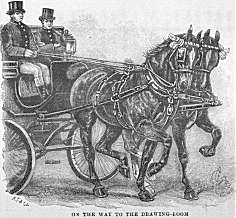
Eighty per cent. of the magnificent animals that draw the family coaches to the
Queen's drawing-rooms are on hire from the jobmaster. If you keep them and shoe
them yourself at your own stables, you can get them for a hundred guineas a
year; if you want them only from April to July, youl will be lucky to get them
for six guineas a week, taking them by the month; or if you want them in the off season, you can, perhaps, have them cheap at sixteen guineas a month. If
the jobmaster keeps them and shoes them at his stables, his charge is nearly
double. This is for what is known as 'state coach horses,' but good carriage
horses cost as
much. Some jobmasters will provide you with brougham
and horse, and everything but the coachman's [-102-] livery, for
200l. a year, but only on the condition that you
never go outside the seven-miles radius from Charing Cross. In fact, the
first-class carriage horse is a somewhat unsatisfactory investment ; it is safer
to hire than to buy him ; and hence the importance of the jobmaster in the
horse-world of London.
There are some of the London jobmasters with 500 pairs out
among the carriage folk, and several with over a hundred pairs. These horses are
nearly all geldings, and they almost all begin their carriage work when they are
four and a half years old; if they are bought before, they have to be kept till
fit, which is another way of saying that there is little monetary advantage in
buying them young, as the cost of their keep increases their price. Out of each
thousand, three hundred are cleared out of the stables in a year to the auction
mart, and about twenty-five die from accident or disease.
How many carriage horses are there in London? By the courtesy
of the Board of Inland Revenue we are enabled to speak precisely with regard to
the number of carriages. During the year ending March 31, 1891, the number of
carriage licences issued within the Administrative County of London was 22,204.
Of these, 7,955 were for carriages with four or more wheels drawn by two or more
horses ; 7,535 for carriages with four or more wheels but fitted to be drawn by
one horse only, and 6,714 for carriages with less than four wheels. Of course,
this is independent altogether of the hackney carriages which are given in the
Metropolitan Police report, and of all vehicles, carts, vans and otherwise, used
in trade. These carriages [-103-]
[-104-] have probably about forty
thousand horses, varying in value
from the twenty-guinea pony up to the four-hundred-guinea state-coach horse; to
average them is almost impossible, although the lot would certainly represent
more than 2,500,000l. at present prices.
There are just double as many private carriages in London as
there are cabs, and they range from the fifteen-guinea pony trap up to the
three-hundred-guinea chariot, and beyond to the gorgeous official coaches,
including the Lord Mayor's carriage, which pays duty like the rest. How to sort
out the proportions we candidly do not know, but if we adopt for the capital
they represent the excellent principle suggested by Mr. Montague Tigg, 'and put
down a one, and as many noughts as we can get in the line,' we shall have a
million's worth, and average our vehicles at 45l. each, which is about
half what they are generally said to amount to.
Doubling the million, then, and adding to it the two millions
and a half for the horses, and another half million for the stabling and
harness, we arrive at five millions as the approximate value of the London
private carriages and their horses, with their stables and coach-houses. In the
last half million we are well enough within the mark to allow for any excess
we may have made in the other items, for a set of pony harness will cost 5l.,
and much of the double chariot harness seen in St. James's Street during a
drawing-room is worth from thirty to forty pounds a set; and for stable
accommodation the stock estimate is 15l. per horse.
[-105-] The stabling in a London mews has not the best of
reputations, and its accommodation compares unfavourably with that obtainable at
a country town; in fact, it is owing in a great measure to the stable difficulty
that so many people job their horses during the London season. The horse of
pleasure is not like the horse of trade; he is worked at all hours, but rarely
with regularity he is kept healthy with exercise instead of work; and
consequently he has to be carefully looked after, and wants the best of housing,
which in London he does not always get.
A large number of these showy carriage horses are Cleveland
bays, bred in North Yorkshire and South Durham, such horses as in recent years have been sold at
from 30l. to 60l as stud-book foals, at front 50l. to 70l. as
yearlings, and at from 60l. to 160l. as two-year-olds. At one time the Cleveland
mare was almost the only mother of our best carriage horses, but of late a good
many of them trace their maternal pedigree through the Clydesdale breed, the
result being a gain in hardiness and in the firmness and fitness of the feet for
the hard paving of the town streets. But there are thousands which are neither
Clevelands nor Clydesdales, and are bred from a Yorkshire coach-horse and a
thoroughbred mare, or from the humble hackney stallion and half-bred mare, such
as may occasionally be found in our omnibus and van stables. And there are
thousands that are not home-bred at all. In every county in England the foreign
'machiner' will be found ousting the native, and in Hyde Park during the season
he will be found in dozens, unmistakable though unlabelled, crawling along as
leisurely as if his owner [-106-] or hirer were like the great Earl of Chesterfield rehearsing
a funeral.
Thousands of horses are imported and exported annually. So
great is the Continental trade, that at Harwich, for instance, the Great
Eastern Railway Company have provided stabling for eighty horses, which is
frequently full. As many as 120 have been sent across the sea in one boat, most
of them being Irish; indeed, the whole Belgian army used to be horsed from
Ireland, the shipments, of course, going direct. We import mostly for the
cheaper kinds of work, and we export for hard work, breeding, and waste, and in
a whisper be it mentioned, for various food preparations, though not largely for
these last. Sometimes the exports exceed the imports; sometimes, and oftener,
the balance is the other way; though it is always on the right side as far as
cash is concerned, for the imported horses average 17l. as their value,
while
the exported horse is worth 54l.
In 1890, 19,400 horses came into this country and 12,900 went
out; in 1889, 13,800 came in and 14,200 went out; and in three years the exports
realised 2,532,000l., while the imports were declared at only 804,000l. In 1876,
when our horse-world was in a bad way, as ninny as 40,700 came in, but the
imports have ever since shown a tendency downwards. Of these foreigners London
has always taken the largest share. They are of all classes. On one occasion
Tattersall's sold a batch of carriage horses from the States-good upstanding
animals of sixteen hands or more, with good teeth and the uncut tail so much
valued by jobmasters for their fashionable hirers, and [-107-] these fetched in some cases 80 and 120 guineas. But the bulk
of our imports are not of this quality, and come from nearer home. The draught
horses come in from Denmark, Holland, Belgium, and France; the ponies from
Norway and Sweden, and East Russia and Poland and Finland; the riding and
driving horses from Hanover and Hungary. Some, as we have seen, come from the
United States, some from Canada - the Canadian horse having many admirers - and even
the South American mustang and the South Russian tarpan have figured in the
carriages with less than four wheels licensed by the Board of Inland Revenue.
It is the general opinion that our carriage horses are not as
good as they used to be, and we are told of the wonderful work that was
accomplished by them before the railway monopolised the long-distance passenger
traffic. A carriage horse that travels a hundred miles a week is now thought to
be a treasure, but many horses in the past did fifty miles a day. The travelling
carriage with its two horses would then do about ten miles at the rate of six or
seven miles an hour, and halt for a quarter of an hour, during which the horses
would wash out their mouths and eat a wisp of hay; the next stage would be about
six miles, when there would be a halt for half an hour, during which the horses
would be unharnessed and rubbed well down and fed with half a peck of corn; at
the end of another ten miles there would be a halt of a quarter of an hour and a
bait as before; at the end of six miles further there would be a halt of two
hours, during which the horses would have both hay and corn; then would come
another ten-mile stage, ending with a quarter of [-108-] an hour's bait; and then would come the remaining eight
miles, at the end of which the horses would have a mash before their night meal.
This was the way people travelled when George the Fourth was King, or perhaps it
would be more correct to say, 'the way some people travelled,' for it is clear
enough that this sort of horse was the exception and not the rule. Of course, a
large number went by post-horses; and then there was the coach traffic, so
curiously limited in its capacity.
There are coaches now; even during the winter there are
half-a-dozen working on the roads to and from London; but these coaches can
hardly be taken seriously as representing the coach of those 'glorious old days,'
the recollection of which has lasted so much longer than their existence.
The mails have been carried by train for a longer period than
they were carried by coach. The first mail coach appeared in August 1784, it
having been then introduced by Major Palmer, the Duke of Richmond's son-in-law.
What may be called the dominant idea of his invention was the cutting up of the
road into short stages so as to change horses every ten miles, and use just as
many horses as there were miles to be travelled. About 1835, when coaching was
in its prime, there were seven hundred coaches at work, and these averaged ten
miles an hour. Each horse ran for only one hour in the twenty-four, and stayed
at home on the fourth day. He lasted about four years, and he cost 25l. to buy;
but the horses used within the ten-mile radius of the large towns were very
different from the roughish cattle that took their places along the country
stretches. Nowadays our coaches are horsed [-109-] with teams of level excellence all the way down. To horse the
Brighton coach of 1891 forty-five horses were used, and these at Aldridge's
realised under the hammer 3,811 guineas, or an average of 85 guineas each. In 1877 the Brighton stud fetched
80l. each; in 1878 they
fetched 75l.; in 1885 the Guildford horses fetched 74l. 10s. each, and next year
the Windsor horses fetched over 60l. The truth is that our modern coach- horses
are really hunters, while the business coach-horse of the past was more of an
omnibus horse. Of course the only coach-horses that come into our London 'world'
are those used on the home stage, and their number is insignificant in a herd of
hundreds of thousands such as that with which we are dealing.
As with the horses so with the coach. The present coach is
merely a drag for passengers only, and differs greatly from the old mail, which
went swinging along, with a lurch every now and then, no matter how cleverly it
might be ballasted. Its fore boot was full of parcels, so was its hind boot; its
roof was piled up with baggage, with a tarpaulin lashed over the pile; game and
baskets were hung on to its lamp irons; and underneath it was a 'cradle' of more
luggage, all carefully packed, it is true, but giving a very different look to
the whole affair than we get to-day in the handsome drags that leave the Métropole.
The coaches, as now, were mostly supplied by contract. Vidler of Millbank was
the great man, and he used to sell them right out at 140 guineas, or lend them
out at so much a mile. And the horses were also hired out. Chaplin was the
largest contractor; he had 1,700 horses at one time at work on the roads out of
London. Horne was another [-110-] contractor in an expansive way; he, like Chaplin, had been a
driver, and the time came when he became his partner, and dropping coaching took
to cartage, for which, as Chaplin and Horne, they became better known.
As London now has its Cart-horse Parade, it had then its
parade of mail coaches, which took place at Millbank, where the coaches were
mostly built and the harness made. It was held on May Day, and brought together
all the large London coach proprietors, the Sherbomns, the Hearnes, the Faggs,
and others, men who prided themselves on the fact that nowhere in the world were
to be found such horses, such coaches, such drivers, or such guards. 'The coaches
and harness were either new or newly painted and furnished,' says Mr. J. K.
Fowler in his interesting Echoes of Old Country Life, 'the horses in the
pink of condition and beauty, the coachmen and guards in new liveries of scarlet
and gold, each proprietor vieing with his opponent in an endeavour to produce
the most perfect turn-out. Critics abounded, and the judges gave the awards
unbiassed by any predilections for the teams which passed through their
respective districts. The procession started, and dense crowds of spectators
thronged the route from Westminster, through the Strand, Fleet Street, and
Ludgate Hill, by the Old Bailey, to the General Post Office.'
The London proprietors did well at this coaching; the country ones did not.
'The London firms,' says Mr. Fowler, 'had many great advantages over us. Every coach that left any booking-office was charged
1l.
per month for booking passengers, and as many [-111-] hundred coaches ran into London at
12l. per annum each, it
became a very large sum for the Londoners to pocket, amounting to some thousands
a year. Each coach was charged 12s. 6d. a week for washing
and greasing the wheels; for every parcel or passenger two-pence had to be paid
for booking; the coachmen paid their takings into the London end, and thus the
London proprietors had always thousands at their bankers. The accounts were made
up monthly, and divided at so much per mile for their earnings, and each man who
horsed the coach had his mileage sent him, whilst if any loss of parcels or
otherwise had happened on his section of the road, he was the person made
responsible. At every stage the coachman took what was called his waybill into
the office, and entered the number of passengers taken up and carried; their
fares were placed in the proper column, and the money was given up at the
journey's end. The proprietors were thus entirely at the mercy of the coachmen
and guards, as there was no check upon the number of miles the passengers were
recorded as having travelled. It was always considered that the Government, in
duty and taxes, owned one wheel of the coach, and the coachman and guard
purloined another wheel; the turnpikes, furriers, harness- makers and
coach-painters had another, which left one wheel only to the proprietors as
their share of the profit.'
In the coaching heyday Hounslow was to London what Clapham
Junction is now. 'A coach,' we are told, 'went through Hounslow every twelve
minutes during the twenty-four hours!' Prodigious! One hundred and twenty
coaches, carrying perhaps a dozen [-112-] people
each! What would the good folk of Hounslow have thought of the six hundred
trains that now go through Clapham in the same time? What would our streets be
like if we were to turn on to them all the people that now go by rail? We should
have the Hounslow road all the year round like Balham Hill on the Derby Day.