< previous chapter < | THE MYSTERIES OF LONDON | > next chapter >
[-78-]
CHAPTER XXX.
THE 26TH OF NOVEMBER
As soon as the first gleam of morning
penetrated through the curtains of the boudoir in the Villa near Upper Clapton,
Walter leapt from her couch.
Conflicting feelings of joy and sorrow filled her bosom. The
day - the happy day had at length arrived, when, according to the promise of the
man on whom she looked as her benefactor, and grand event was to be
accomplished, which would release her from the detestable disguise which she had
now maintained for a period of nearly five years. The era had come when she was
again to appear in the garb that suited alike her charms and her inclinations.
This circumstance inspired her with the most heartfelt happiness.
But, on the other hand, she loved - tenderly loved one who
had meditated against her an outrage of a most infamous description. Instead of
hailing her approaching return to her female attire as the signal for the
consummation of the fond hopes in which she had a few weeks before indulged, -
hopes which pictured her imagination delicious scenes of matrimonial bliss in
the society of George Montague,- she was compelled to separate the dream of
felicity from the feet of her emancipation from a thraldom repulsive to her
delicacy and her tastes.
It was, therefore, with mingled feelings of happiness and
melancholy, that she commenced her usual toilette - that masculine toilette
which she was that day to wear for the last time.
"You ought to be in good spirits this morning, my
dearest mistress," said Louisa, as she entered the room: "the period
so anxiously looked forward to by yon has at length arrived."
"And to-morrow - to-morrow," exclaimed Walter, her
hazel eyes lighting up with a brilliant expression of joy, "you, my
excellent Louisa, will assist me to adorn myself with that garb which I have
neglected so of late!"
"1 shall be happy both for your sake and mine,"
returned Louisa, who was indeed deeply attached to her mistress "and when I
see you recovering all your usual spirits, in a foreign land —"
"In Switzerland," hastily interrupted Walter;
"in Switzerland - whither you will accompany me, my good and faithful Louisa; and to
which delightful country we will proceed without delay. There indeed I shall be
happy - and, I hope, contented !"
"Mr. Stephen is to be here at ten, is he not ?"
said Louisa, after a short pause.
"At ten precisely; and we then repair forthwith to the
West End of the town, where certain preliminaries are requisite, previously
to receiving an immense sum of money which will be paid over to us at the Bank
of England. This much Mr. Stephens told me yesterday. He had never communicated
so much before."
"And this very afternoon it is your determination to
leave London ?" said Louisa.
"I am now resolved upon that step," replied the lady. "You
alone shall accompany me: Mr. Stephens has premised to provide for the groom and
the old cook. Therefore, while I am absent this morning about
the momentous business the real nature of which, by-the-bye, has yet to be
explained to me you will make all the preparations that may be necessary for our
journey."
This conversation took place while Louisa hastily lighted the
fire in the boudoir. In a few minutes the grate sent up a cheering and grateful
heat; and the flames roared up the chimney. The lady, with an elegant
dressing-gown folded loosely around her, and her delicate white feet thrust into
red morocco slippers, threw herself into her luxurious easy-chair. while Louisa
hastened to serve up breakfast upon a little rose-wood table, covered with a
napkin as white as snow. But the meal passed away almost untouched: the lady's
heart was to full of hope and tender melancholy to allow her to experience the
least appetite.
The mysterious toilette was completed: and Walter descended
to the parlour, attired in masculine garments for the last time!
At ten o'clock precisely Mr. Stephens arrived. He was
dressed with peculiar neatness and care; but his countenance was very pale, and
his eyes vibrated in a restless manner in their sockets. He, however assumed a
bold composure; and thus the profound anxiety to which he was at that moment a
prey, was unnoticed by Walter Sydney.
They seated themselves upon the sofa, and looked at each
other for an instant without speaking. Those glances on either side expressed,
in the ardent language of the eye, the words -" This is the day!"
"Walter," said Mr. Stephens, at length breaking the
silence which had prevailed, "your conduct to-day must crown my designs
with glorious success, or involve me in irretrievable ruin."
"You may rely with confidence upon my discretion and
prudence," answered Walter. "Command me in all respects - consistently with
honour."
"Honour!" exclaimed Stephens impatiently: "why do you for ever mention that unmeaning word?
Honour is
a conventional term, and is often used in a manner inconsistently with common
sense and sound judgment. Honour is all very well when it is brought in contact
with honour only; but when it has to oppose fraud and deceit, it must succumb
if it trust solely to its own force. The most honest lawyer sets
chichanery and quibble to work, to counteract the chichanery and quibble of his
pettifogging opponent: the politician calls the machinery of intrigue into
play, in order to fight his foeman with that foeman's own weapon :- if the French
employ the aid of riflemen concealed in the thicket while the fair fight takes
place upon the plain, the English must do the same."
"I certainly comprehend the necessity of frequently
fighting a man with his own weapons," said Walter; "but I do not see to
what point in our affairs your reasoning tends."
"Suppose, Walter," resumed Stephens, speaking very
earnestly, and emphatically accentuating every syllable, "Suppose that you
had a friend who was entitled to certain rights which were witheld from him by
means of some detestable quibble and low chicanery; suppose that by stating
that your friend's name was George instead of William, or instance, you could
put him in possession of what is justly and legitimately his due, but which,
remember, is shamefully and most dishonestly kept away from him ;- in this case,
should you hesitate to declare that his name was George, and not William?"
[-79-] "I think that I should be inclined to make the statement, to serve the
cause of justice and to render a friend a signal service," answered Sydney, after
a moment's hesitation.
"I could not have expected a different reply," exclaimed Stephens, a
gleam of joy animating his pale countenance: "and you would do so with less
remorse when you found that you were transferring property from one individual
who could well spare what he was never justly entitled to, to a person who
would starve without the restoration of his legitimate rights."
"Oh! certainly," said Walter; and this time the reply was given without
an instant's meditation.
"Then," continued Stephens, more and more satisfied with the influence of
his sophistry, "you would in such a case eschew those maudlin and mawkish
ideas of honour, which arbitrarily exact that a falsehood must never be told for
a good purpose, and that illegitimate means must never - never be adopted to work
out virtuous and profitable ends ?"
"My conduct in assuming this disguise," returned Sydney, with a smile and
a blush, "has proved to you, I should imagine, that I should not hesitate
to make use of a deceit comparatively innocent, with a view to oppose fraud and
ensure permanent benefit to my friend and myself."
"Oh! Walter, you should have been a man in person as well as in mind!"
cried Stephens, enthusiastically. "Now I have no fears of the result of
my plans; and before sun-set you shall be worth ten thousand pounds!"
"Ten thousand pounds!" repeated Walter
mechanica1ly. "How much can
be done with such a sum as that!"
"You expressed a wish to leave this country, and visit the south of Europe,"
said Stephens: "you will have ample means to gratify all your tastes, and
administer to all your inclinations. Only conceive a beautiful little cottage on
the shore of the lake of Brienz - that pearl of the Oberland; the fair boat-women
- the daughters of Switzerland - passing in their little shallops beneath your
windows, and singing their national songs, full of charming tenderness, while the soft music mingles with the
murmuring waves and the sounds of the
oars!"
" Oh! what an enchanting picture!" cried Walter. " And have you
ever seen such as this ?"
"I have; and I feel convinced that the existence I recommend is the one which
will best suit you. To-day," continued Stephens, watching his compatriot's
countenance with a little anxiety, "shall you recover your rights ;- to-day
shall you oppose the innocent deceit to the enormous fraud ;- to-day shall you do
for yoursef what you ere now stated you would do for a friend!"
"If you have drawn my own case in putting those queries to
me, - if
immense advantages will be derived from my behaviour in this affair, - if I am
merely wresting from the hands of base cupidity that which is justly mine own, -
and if the enemy whom we oppose can well afford to restore to me the means
of subsistence, and thus render me independent for the remainder of my
days,-oh! how can I hesitate for a moment? how can I refuse to entrust myself
wholely and solely - blindly and confidently - in your hands, - you who have done so much for me, and who have taught me to
respect, honour, and obey you?"
The lady uttered these words with a species of electric enthusiasm, while her
eyes brightened, and her cheeks were suffused with the purple glow of animation. The specious arguments and the
glowing description of Swiss life,
brought forward by Stephens with admirable dexterity, awakened all the
ardour of an impassioned soul; and the bosom of that beauteous creature
palpitated with hope, with joy, and with excitement, as she gazed upon the
future through the mirror presented by Stephens to her view.
She was now exactly in a frame of mind suited to his purpose. Without
allowing her ardour time to abate, and while she was animated by the delicious
aspirations which be had conjured up, as it were by an enchanter's spell, in
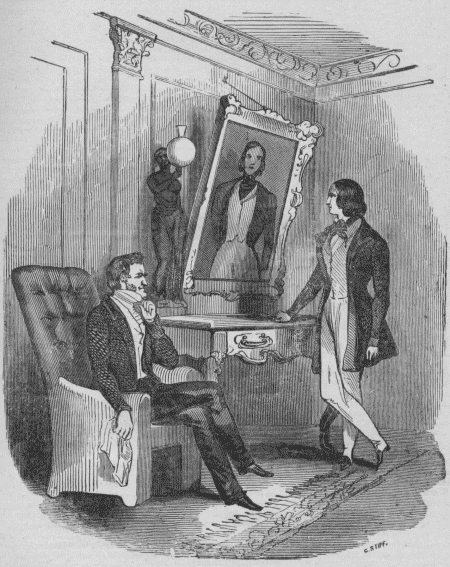
her breast, he took her by the hand, and led her up to the mantelpiece; then,
pointing to the portrait of her brother, he said in a row, hurried, and yet
solemn tone,- "The fortune which must be wrested from the grasp of cupidity this
day, would have belonged to your brother; and no power on earth could have
deprived him of it; for, had he lived, he would yesterday have attained his
twenty-first year! His death is unknown to him who holds this money: but, by a
miserable legal technicality, you - you, his sister, and in justice his
heiress - you would be deprived of that fortune by the man who now grasps it, and
who would chuckle at any plan which made it his own. Now do you comprehend
me? You have but to say that you, name is Walter, instead of Eliza,
- and you
will recover your just rights, defeat the wretched chicanery of the law, and
enter into possession of those resources which belong to you in the eyes of God,
by which, if you shrink, will be for ever alienated from you and yours!'
"In one word," said the lady, "I am to personate my
brother?"
"Precisely! Do you hesitate?" demanded Stephens: "will you allow the property of
your family to pass into the
hands of a stranger, who possesses not the remotest right to its enjoyment? or will you by one bold
effort - an effort that cannot fail - direct that fortune
into its just, its proper, and its legitimate channel?"
"The temptation is great," said the lady, earnestly contemplating the
portrait of her brother - "but the danger - the danger?" she added
hastily "what would be the result if we were detected?"
"Nothing - nothing, save the total loss of the entire fortune," answered
Stephens: "and, therefore, you perceive, that want of nerve - hesitation -
awkwardness - blushes - confusion on your part, would ruin all. Be firm - be
collected - be
calm and resolute - and our plans must be crowned with unequivocal success!"
"Oh! if I proceed farther, I will pass through the ordeal with ease and
safety," exclaimed the lady: "I can nerve my mind to encounter any danger. when it is well defined,
and I know its extent;- it is only when it is vague, uncertain, and
indistinct, that I shrink from meeting it. Yes," she continued, after a few
moments' reflection, "I will follow your counsel in all respects: you do
know - you must know how much we risk, and how far we compromise ourselves
;- and
when I see you ready to urge on this matter to the end, how can I fear to accompany you? Yes," she added, after another pause, much longer than the
preceding one,- "I will be Walter Sydney throughout this day at least!"
"My dear friend," ejaculated Stephens, in a transport of joy, "you act
in a manner worthy of your noble-hearted brother, I see - he smiles upon you even
in his picture-frame."
"I will retrieve from the hands of strangers that [-80-]
which is thine, dear brother," said the lady, addressing herself to the
portrait as if it could hear the words which she pronounced with a melancholy
solemnity: then, turning towards Stephens, she exclaimed, "But you must
acquaint me with the ceremonies we have to fulfil, and the duties which I shall
have to perform, in order to accomplish the desired aim."
"I need not instruct you now," returned Stephens: "the forms are
nothing, and explain themselves, as it were;- a few papers to sign at a certain person's house in Grosvenor Square - then a
ride to the Bank - and all is
over. But we must now take our departure: the hackney-coach that brought us
hither is waiting to convey us to the West End."
Stephens and Sydney issued from the house together. The former gave certain
directions to the coachman; and they then commenced their memorable journey.
Mr. Stephens did not allow his companion a single moment for calm and
dispassionate reflection. He continued to expatiate upon the happiness which
was within her reach amidst the rural scenery of Switzerland he conjured up
before her mental vision the most ravishing and delightful pictures of domestic
tranquillity, so congenial to her tastes :- he fed her imagination
with all those fairy visions which were calculated to attract and dazzle a mind tinged with a romantic shade
;- and then he skilfully introduced those specious
arguments which blinded her as to the real nature of the deceit in which she was
so prominent an agent. He thus sustained an artificial state of excitement,
bordering upon enthusiasm, in the bosom of that confiding and generous-hearted
woman; and not for one moment during that long ride, did she repent of the step
she had taken. In fact, such an influence did the reasoning of Stephens
exercise upon her mind, that she ceased to think of the possibility of either
incurring danger or doing wrong ;- she knew not how serious might be the
consequences of detection ;- she believed that she was combating the chicanery of
the law with a similar weapon, the use of which was justified and rendered
legitimate by the peculiar circumstances of the case.
The hackney-coach proceeded by way of the New Road, and stopped to take up
Mr. Mac Chizzle at his residence near Saint Pancras New Church. The vehicIe
then proceeded to Grosvenor Square where it stopped opposite one of those
princely dwellings whose dingy exteriors afford to the eye of the foreigner accustomed to the gorgeous edifices of continental
cities, but little promise of
the wealth, grandeur, and magnificence which exist within.
The door was opened by a footman in splendid livery.
This domestic immediately recognised Mr. Stephens, and said, "His
lordship expects you, sir."
The three visitors alighted from the coach: and as Stephens walked with the
disguised lady into the hall of the mansion, he said in a hurried whisper,
"Courage, my dear Walter: you are now about to appear in the presence of
the Earl of Warrington!"
The servant led the way up a wide staircase, and conducted the visitors into
a library fitted up in the most luxurious and costly manner. Cases filled with magnificently bound volumes, statues of
exquisite sculpture, and pictures of
eminent artists, denoted the taste of the aristocratic possessor of that lordly
mansion.
Two individuals were seated at a table covered with papers and legal documents. One was a fine
tall, middle-aged man, with
a noble and handsome countenance, polished manners, and most kind and affable address
:- the other was an old gentleman with a bald head, sharp features, and constant smile upon his lips when he
addressed the personage just described.
The first was the Earl of Warrington; the other was his solicitor, Mr.
Pakenham.
The Earl rose and greeted Mr. Stephens cordially; then, turning towards
Walter, he shook her kindly by the hand, and said, "I need not ask if you
are the young gentleman to whom I am to be introduced as Mr. Walter Sydney."
"This is my ward, your lordship," said Mr. Stephens, smiling. " I
think it is scarcely necessary to call your lordship's attention to the striking
resemblance which he bears to his lamented father."
"Yes - it would be impossible to mistake him," said his lordship hastily,
while a cloud passed over his brow. "But sit down - pray sit down and we will
proceed to business. I presume that gentleman is your professional adviser?"
" Mr. Mac Chizzle," observed Stephens, introducing the lawyer.
"Mr. Pakenham, I have had the pleasure of seeing you before," he added,
addressing the nobleman's attorney with a placid smile.
Mr. Pakenham acknowledged the salutation with a bow; and his eye, wandered
for a moment, with some surprise, towards Mac Chizzle, - as much as to may, "
I am astonished to see a person like you employed in so important an affair."
When every one was seated, the Earl of Warrington referred to some papers
placed before him, and said, "The object of this meeting is known to everyone present. The duty that devolves upon me is to transfer to Walter Sydney, the
only son and heir of the late Stanford Sydney, upon being satisfied with
respect to the identity of the claimant, the sum of forty-one thousand
pounds now invested in certain stocks in the Bank of England."
"It is needless, I presume," said Mr. Pakenham to enter into the
particulars of this inheritance. We on our side admit our liability to pay the
amount specified by his lordship, to the proper claimant."
"Quite satisfactory," observed Mac Chizzle to whom these observations
were addressed.
"The proofs of identity are, then, all that your lordship now requires
?" said Mr. Stephens.
"And I only require them as a mere matter of necessary form and
ceremony, Mr. Stephens," returned the Earl of Warrington. "I am well
aware of your acquaintance with the late Mrs. Sydney. and of the fact that the deceased
lady left her children to your care."
"My lord, here are the various certificates," said Stephens, placing a
small packet of papers before the Earl. "In the first instance you have
the marriage certificate of Stanford Sydney and Letitia Hardinge, the
natural daughter of the late Earl of Warrington, your lordship's uncle."
"Well - well," exclaimed the nobleman, somewhat impatiently, as if he
were anxious to get rid as soon as possible of a business by no means pleasant
to him. "That certificate is beyond all dispute."
"Here," continued Stephens, "is the
certificate of the birth of
Eliza Sydney, born October 12th 1810; and, here is the certificate of her death,
which took place on the 14th of February, 1831."
"This certificate is not necessary," observed Mr.
[-81-]
Pakenham;
"as in no case, under the provisions of these deeds," he added, pointing to a
pile of documents before him, "could that young lady have instituted even
a shadow of a claim to this money."
"We had better possess one deed too many, than one too few," said Mr.
Stephens, with another bland smile.
"Oh! certainly," exclaimed the Earl. "And this precaution shows the exact
condition of the late Mr Stanford Sydney's family. The daughter is no more : the son lives, and is present."
"Here, then, my lord," continued Stephens., "is
the certificate of
the birth of Walter Sydney, on the 25th day of November, 1814."
The nobleman examined this document with far more attention than he had
devoted to either of the former. He then handed it to Mr. Pakenham, who also
scrutinized it narrowly.
"It is quite correct, my Lord," said this gentleman. "We now
require two witnesses as to identity."
" I presume his Lordship will receive me as one," observed Mr. Stephens,
"considering my intimate acquaintance with all —"
"Oh certainly - certainly," interrupted the Earl hastily.
"And Mr. Mac Chizzle will tender his evidence in the
other instance," said Stephens.
[-82-] "I
have known this young gentleman for the last six years," exclaimed Mac Chizzle,
pointing towards Walter, "and I knew his mother also."
"Is your Lordship satisfied?" enquired Mr. Pakenham,
after a short pause.
"Perfectly," answered the nobleman, without
hesitation. "I am, however, in your hands."
"Oh!
as for me," returned Mr. Pakenham, "I have no objection to offer. Your Lordship is acquainted with
Mr. Stephens."
"Yes - yes," again interrupted the Earl ; "I
have
known Mr. Stephens for some years - and I know him to be a man of honour."
"Then there is nothing more to be said,"observed
Pakenham.
"No-nothing," added Mac Chizzle; "but to complete
the business."
"I will now read the release," said Mr. Pakenham.
The solicitor settled himself in a comfortable manner in
his chair, and taking up a deed consisting of several folios, proceeded to make
his hearers as much acquainted with its contents as the multifarious
redundancies of law terms would allow.
The disguised lady had now time for reflection. She had been
more or less prepared for the assertion of Mr. Stephens that Eliza Sydney was
dead, and that Walter was living :- but the bare-faced falsehood uttered by Mac
Chizzle (who, so far from having been acquainted with her for years, had never
seen her until that morning), shocked and astounded her. She had also just
learnt for the first time, that her late mother was the natural daughter of an
Earl; and she perceived that she herself could claim a distant kinship with the
nobleman in whose presence she then was. This circumstance inspired her with
feelings in his favour, which were enhanced by the urbanity of his manners, and
the readiness with which he admitted all the proofs submitted to him by Mr.
Stephens. She had expected, from the arguments used by this gentleman to
convince her that she should not hesitate to fight the law with its own weapons,
&c., that every obstacle would he thrown in the way of her claims by him
on whom they were to be made; - and she was astonished when she compared all the specious
representations of Stephens with the readiness, good-will, and alacrity manifested by the Earl in
yielding up an enormous sum of money. Now also, for the first time, it struck her as remarkable
that Stephens had promised her ten thousand pounds only - a fourth part of that
amount to which, according to his own showing, she alone was justly entitled.
All these reflections passed rapidly through her mind while the lawyer was
reading the deed of release, not one word of which was attended to by her. She
suddenly felt as if her eyes were opened to a fearful conspiracy, in which she
was playing a conspicuous part :- she trembled, as if she were standing upon
the edge of a precipice ;- and yet she knew not how to act. She was bewildered:
but the uppermost idea in her mind was that she had gone too far to retreat.
This was the impression that ruled her thoughts at the
precise moment when Mr. Pakenham brought the reading of the long wearisome
document to a termination. The buzzing, droning noise which had filled her ears
for upwards of twenty minutes, suddenly ceased ;- and she heard a voice say in a
kind tone "Will you now please to sign this?"
$he started - but immediately recovered her presence of mind,
and, taking the pen from the lawyer's hand, applied the signature of Walter
Sydney to the document. It was next witnessed by Pakenham, Stephens, and Mac Chizzle,
who
handed to the Earl.
The nobleman then took several papers - famfliar to all those
who have ever possessed Bank Stock - from an iron safe in one corner of the
library, and handing them to the disguised lady, said, "Mr. Walter Sydney,
I have much pleasure in putting you in possession of this fortune; and I can
assure you that my best - my very best wishes for your health and prosperity,
accompany the transfer."
Walter
received the documents mechanically as it were and murmured a few words of thanks and
gratitude.
"Perhaps, Mr. Stephens," said the Earl, when the
ceremony
was thus completed, "you and your friends will do me the honour to accept
of a slight refreshment in an adjoining room. You will excuse my absence; but
I have a few matters of pressing importance to transact with my solicitor, and
which cannot possibly be postponed. You must accept this as my apology ; and
believe in my regret that I cannot keep you company."
The Earl shook hands with both Stephens and Sydney, and
bowed to Mac Chizzle. These three individuals then withdrew.
An elegant collation was prepared for them in another
apartment ; but Mac Chizzle was the only one who seemed inclined to pay his
respects to it. Walter, however, gladly swallowed a glass of wine ; for she felt
exhausted with the excitement she had passed through. Stephens was too highly
elated either to eat or drink, and too anxious to complete the business in the
City, to allow Mac Chizzle to waste much time over the delicacies of which the
collation consisted.
They were, therefore, all three soon on their way to the Bank
of England.
"Well, I think-we managed the job very correctly," said
Mac Chizzle.
"Everything passed off precisely as I had anticipated,"
observed Mr. Stephens. " But you, Walter - you are serious."
" I do not look upon the transaction in the same light
as I did a couple of hours since," answered she coldly.
"Ah! my dear friend," cried Stephens, " you are
deceived by the apparent urbanity of that nobleman, and the mildness of his
solicitor. They assumed that appearance because there was no help for them ;-
they had no good to gain by throwing obstacles in our way."
" But the certificate of my death was a forgery," said
Walter, bitterly.
"A necessary alteration of names - without which the accomplishment of our plan would have been impossible,"
answered Stephens. "
But let me ease your mind in one respect, my dear Walter. That nobleman is a
relation of yours - and yet until this day his name has never been mentioned to
you. And why? Because he visits upon you the hatred which he entertained for
your deceased mother! Did you not observe that he interrupted me when I spoke
of her? did you not notice that he touched with extreme aversion upon the
topics connected with your revered parents?"
" I did! - I did!" exclaimed Walter.
" He hates you! - he detests you !" continued
Stephens, emphatically ; " and he will not countenance any claim which you
might advance towards kinship with him. His duties as a nobleman and a
gentleman dictated the outward civility with which he treated you; but his heart
gave no [-missing word, ed-] [-83-] to the words of
congratulation which issued from his lips."
"I believe you - I know that you are speaking the truth," cried Walter.
"Pardon me, if for a moment I ceased to look upon you as a friend."
Stephens pressed the hand of the too-confiding being, over whom his dangerous
eloquence and subtle reasoning possessed an influence so omnipotent for
purposes of evil ; and he then again launched out into glowing descriptions of
the sources and means of happiness within her reach. This reasoning, aided by
the hope that in a few hours she should be enabled to quit London for ever,
restored the lady's disposition to that same easy and pliant state, to which
Stephens had devoted nearly five years to model it.
At length the hackney-coach stopped at the Bank of England. Stephens hurried to the
rotunda to obtain the assistance of a stock-broker, for the purpose of transferring and selling out the
immense sum which now appeared within his reach, and to obtain which he had devoted his
time,
his money, and his tranquillity!
Walter and the lawyer awaited his return beneath the porch of the entrance.
After the lapse of a few moments he appeared, accompanied by a broker of his
acquaintance. They then all four proceeded together to the office where the
business was to be transacted.
The broker explained the affair to a clerk, and the clerk, after consulting a
huge volume, received the documents which Lord Warrington had handed over to
Sydney. Having compared those papers with the entries in the book, the clerk
made a sign to three men who were lounging at the upper end of the office, near
the stove, and who had the appearance of messengers, or porters.
These men moved hastily forward, and advanced up to Stephens, Mac Chizzle,
and Walter Sydney.
A deadly pallor spread over the countenance of Stephens; Mac
Chizzle
appeared alarmed; but Walter remained still unsuspicious of danger.
"Those are the persons," said the clerk,
significantly, as he pointed to the
three conspirators, to whom he observed, almost in the same breath, "Your
plans are detected - these men are officers!"
"Officers!" ejaculated Sydney ; "what does this mean?"
"We are here to apprehend you," answered the foremost of these functionaries.
" Resistance will be vain : there are others outside in readiness."
"Merciful heavens!" cried Walter, joining her bands in agony "Oh!
Stephens, to what have you brought me!"
That unhappy man hung down his head and made no reply. He felt
crushed by
this unexpected blow, which came upon him at the very instant when the object of
his dearest hopes seemed within his reach.
As for Mac Chizzle, he resigned himself with dogged submission to his fate.
The officers and their prisoners now proceeded to the Mansion House,
accompanied by the clerk and the stock-broker.
Sydney - a
prey to the most dreasful apprehensions and painful remorse - was compelled to
lean for support upon the arm of the officer who had charge of her.
Sir
Peter Laurie sat for the Lord Mayor.
The worthy knight is the terror of all
swindlers, mock companies, and bubble firms existing in the City of London
wherever there is fraud, within the jurisdiction of the civic authorities, he
is certain to root it out. He has conferred more benefit upon the commercial world, and has devoted
himself more energetically to
protect the interests at the trading community, than any other alderman. Unlike
the generality of the city magistrates who are coarse, vulgar, ignorant, and
narrow minded men, Sir Peter Laurie is possessed of a high range of intellect,
and is an enlightened, an agreeable and a polished gentleman.
It was about three o'clock in the afternoon when Stephens, Mac
Chizzle, and
Sydney were placed in the dock of the Mansion House Police-office.
The solicitor of the Bank of England attended for the prosecution.
"With what do you charge these prisoners?" demanded the magistrate.
"With conspiring to obtain the sum of forty-one thousand pounds from the
hands of the Earl of Warrington, and the Governor and Company of the Bank of
England."
"Is his lordship present ?"
"Your worship, he is, at this moment, unaware of the diabolical
fraud that
has been contemplated and in part perpetrated upon him. He has given up to the
prisoners certain documents, which constituted their authority for transferring
and selling out the sum I have mentioned. By certain means the intentions of the
prisoners were discovered some time ago; and secret information was given to the
Bank directors upon the subject. The directors were not, however, permitted to
communicate with the Earl of Warrington, under penalty of receiving no farther
information from the quarter whence the original warning emanated. Under all
circumstances, I shall content myself with stating sufficient to support the
charge to-day, so that your worship may remand the prisoners until a period
when the attendance of the Earl of Warrington can be procured.
"State your case."
"I charge this prisoner," said the solicitor, pointing towards Sydney, "
with endeavouring to obtain the sum of forty-one thousand pounds from the
Governor and Company of the Bank of England, under pretence of being one Walter Sydney,
a man - whereas the prisoner's name is Eliza Sydney, and she is a woman!"
An immense sensation prevailed in the justice-room at this announcement.
The disguised lady moaned audibly, and leant against the bar of the dock for
support.
"And I charge the other prisoners, Robert Stephens and Hugh Mac Chizzle, with
aiding and abetting in the crime," added the solicitor, after a pause.
The unhappy lady, yielding to emotions and feelings which she was now no
longer able to contain, threw herself upon her knees, clasped her hands
together in an agony of grief, and exclaimed,
"It is true! I am not what I seem! I have been guilty of a fearful
deception - a horrible cheat: but it
was he -he," she cried, pointing to Stephens, "who made me do it !"
There was an universal sentiment of deep sympathy with the female prisoner,
throughout the court; and the worthy alderman himself was affected.
"You
must remember," he said, in a kind tone "that
anything which you admit here, may be used against you elsewhere."
"I am
anxious to confess all that I have done and all that I know," cried the lady;
"and in so doing, I shall in some measure atone for the enormity of my
guilt, which I now view in its true light!"
[-84-] "Under these
circumstances," said the alderman, " let the case
stand over until to-morrow."
The prisoners were then removed.
In another hour they were inmates of the Giltspur-street
Compter.
And how terminated the 26th of November for Walter Sydney? Instead of being
in possession of an ample fortune, and about to visit a clime where she hoped to
enjoy all the blessings of domestic tranquillity, and the charms of rural bliss,
she found herself a prisoner, charged with a crime - of deep dye!
Oh! what a sudden reverse was this!
Still, upon that eventful day, there was one hope of hers fulfilled. She
threw aside her masculine attire, and assumed the garb adapted to her sex. A
messenger was despatched to the villa, to communicate the sad tidings of the
arrest to Louisa, and procure suitable clothing for her wretched mistress.
But, alas! that garb in which she had so ardently desired to appear
again, was now doomed to be worn, for the first time, in a prison :- the new
epoch of her life, which was to be marked by a return to feminine habits, was
commenced in a dungeon!
Still that new period had begun; and from henceforth we shall know her only
by her real name of Eliza Sydney.
< previous chapter < | THE MYSTERIES OF LONDON | > next chapter >